REVIEW 2 major objections 9 minor 28 references
Control of spatially rotating structures in diffractive Kerr cavities
T0 review · 2 major / 9 minor · reviewed 2026-08-14 · deepseek-v4-flash
Pith's one-line read Turing patterns in a Kerr cavity rotate at a rate set by orbital angular momentum and ring radius, and vector beams make that rate continuously tunable.
desk verdict A clean exact rotation law (omega = 2m/R^2) for OAM-pumped Kerr cavities, honestly situated against prior work, with a genuinely new vector-beam control mechanism; the ring-width assumption is a real but nonfatal gap. read the letter →
The pith
A machine-rendered reading of the paper's core claim, the machinery that carries it, and where it could break.
The reading
What carries the argument
The load-bearing mechanism is the traveling-wave reduction of the ring-reduced Lugiato-Lefever equation: writing the field as $E(\varphi,t) = F(\varphi - \omega t)e^{im\varphi}$ turns the OAM phase into a Doppler-like shift, and the cancellation condition fixes $\omega = 2m/R^2$. This maps rotating patterns onto stationary patterns with detuning $\theta + m^2/R^2$, so the standard Turing linear-stability analysis (critical wavevector $k_c = \sqrt{2\beta I_s - \theta - m^2/R^2}$) applies unchanged. For control, the coupled LLE for two circular polarizations provides the platform: the relative amplitude $\gamma$ of orthogonal OAM eigenmodes is the bias knob for $\omega$, and the sum $m_L + m_R$ sets the net rotation when the modes overlap.
What would settle it
Take a top-hat pump with known radius $R$ and OAM $m$ in a 2D Kerr-cavity simulation or experiment, measure the angular velocity of the ring pattern after the transients settle, and compare with $2m/R^2$; any deviation beyond the uncertainty in $R$, or any dependence of $\omega$ on pump steepness or intensity at fixed measured $R$, would falsify the law. A sharper check is to vary ring curvature by reducing $R$ until radial gradients are unavoidable and see where the measured $\omega$ departs from the formula.
Extended reading notes
Core claim
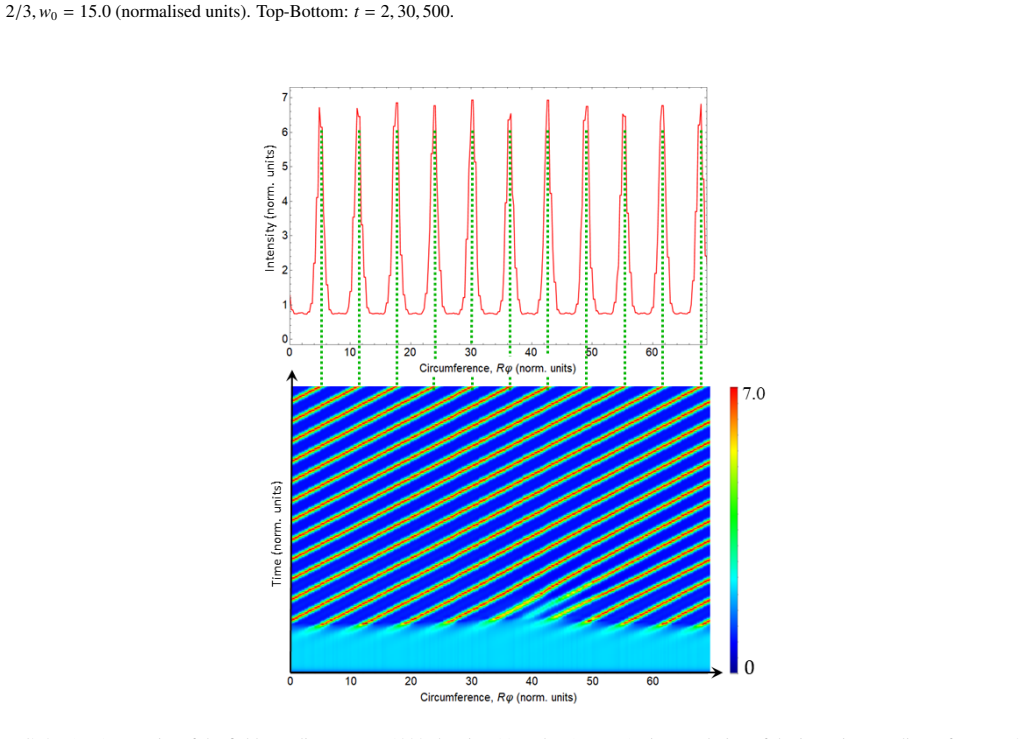
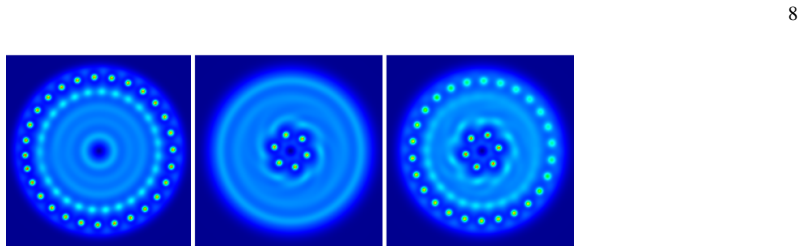
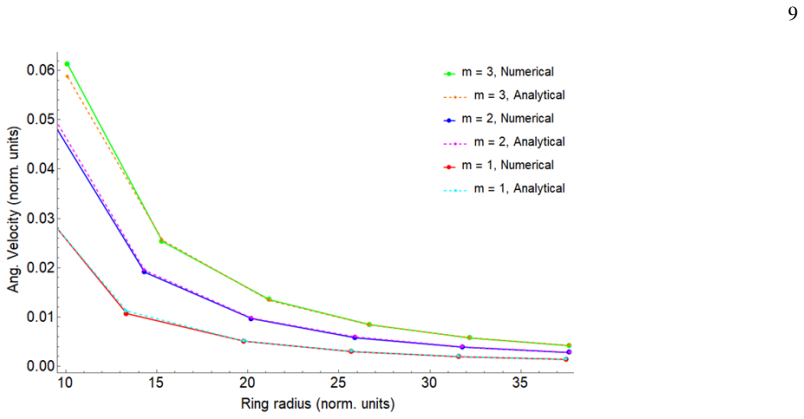
In the paper's own terms, the discovery is that the azimuthal motion of a Turing pattern is slaved to the pump's orbital angular momentum: factoring $E = F e^{im\varphi}$ in the ring-reduced Lugiato-Lefever equation produces a first-order derivative term $\frac{2m}{R^2} \partial_\varphi F$, and requiring the envelope to travel as $F(\varphi - \omega t)$ fixes $\omega = 2m/R^2$ exactly. The same reduction leaves a stationary equation with detuning shifted by $m^2/R^2$, so every known result for $m=0$ Turing patterns, including the critical wavevector and peak-number formula, carries over with the renormalized detuning. Simulations confirm the law for LG and top-hat pumps, including multi-ring cases where each ring rotates at $2m/R^2$ with its own measured radius. Vector pumps then give continuous control: equal-and-opposite OAM modes with relative amplitude $\gamma$ interpolate $\omega$ across $[-2m/R^2, 2m/R^2]$, and Poincaré modes with overlapping eigenmodes rotate at $(m_L + m_R)/R^2$, while non-overlapping modes yield counter-rotating concentric rings ('optical peppermill').
Load-bearing premise
The central derivation assumes a fixed ring radius (dropping radial derivatives) and, in its analytic part, proximity to the pattern-formation threshold; the 2D radius is measured after the fact rather than predicted, so if radial coupling or threshold-distance effects are significant the formula could fail.
Editorial extensions
If this is right
- Rotation speed is no longer a free parameter: for any measured ring radius $R$ and pump OAM $m$, the pattern must rotate at $2m/R^2$, giving a quantitative check in any Kerr-cavity experiment.
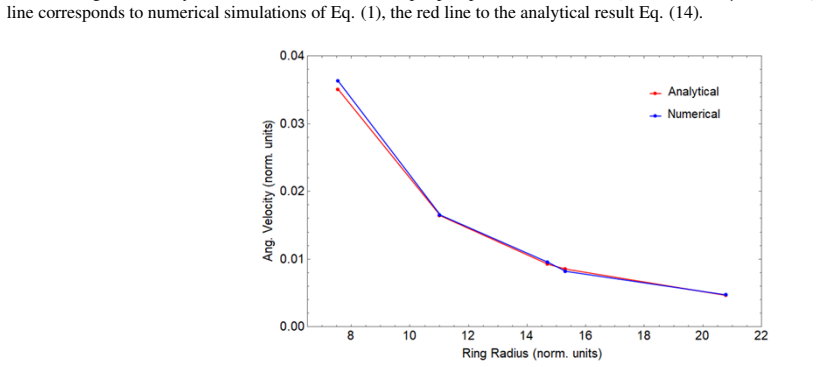
- For a Laguerre-Gaussian pump of fixed waist $w_0$, the speed is $\pm 4/w_0^2$ independent of $m$, explaining and unifying earlier observations of slowly varying rotation across OAM values.
- Cylindrical vector beam bias provides a knob that smoothly tunes rotation from full clockwise to full counter-clockwise, passing through a stationary pattern at zero net OAM.
- Poincaré-beam pumps rotate at $(m_L+m_R)/R^2$ when modes overlap; when they do not, concentric rings rotate independently and oppositely, forming an 'optical peppermill' with individual ring-speed control.
- These rotors can act as optically driven conveyors: dipole trapping of atoms, molecules, and particles, cell stretching by differential rotation, and circular transport of cold atoms or BEC wavepackets.
Reading between the lines
- The same traveling-wave argument should apply to any translationally invariant pump carrying a linear phase gradient in a nonlinear cavity, so equivalent speed laws are expected for tilted-plane-wave pumps; that extension is not explored in the paper.
- Because each concentric ring is dynamically independent, multi-ring pumps with independent OAM assignments per ring suggest reconfigurable multi-speed rotors, which could be used to create differential flows for sorting or mixing microscale objects.
- The relation $\omega = 2m/R^2$ makes the accumulated rotation angle a deterministic function of time, so a rotating Turing ring is a candidate for an all-optical clock or phase reference whose frequency is set geometrically by $R$ and $m$, testable by interferometric phase measurement.
Signed reviews
Editorial analysis
A structured set of objections, weighed in public.
Referee Report
Summary. The manuscript studies Turing pattern formation in the transverse plane of a Kerr cavity described by the Lugiato–Lefever equation (LLE) when the pump beam carries orbital angular momentum (OAM). By reducing the two-dimensional Laplacian to its angular part on a ring of fixed radius R (Eq. (3)), the authors derive that a pump phase e^{imφ} produces patterns rotating with angular velocity ω = 2m/R² (Eq. (14)), and that the OAM renormalizes the detuning by m²/R² (Eqs. (7), (16)–(18)). The prediction is checked in 2D simulations for Laguerre–Gaussian pumps with m = 1–5 and several waists, including the parameter-free consequence that LG modes with the same waist rotate at ±4/w0², and for top-hat pumps that generate concentric rings, each rotating at 2m/R² with R the measured radius of the ring. For vector pumps the authors demonstrate numerically that cylindrical vector beams tune the angular velocity continuously in −2m/R² ≤ ω ≤ 2m/R² (Eq. (24)), that Poincaré beams give ω = (mL + mR)/R² (Eq. (26)), and that weakly overlapping modes give counter-rotating 'optical peppermill' rings. Appendices provide a retarded-time formulation (Appendix A) and a stationarity condition for rotating Turing patterns away from threshold (Appendix B).
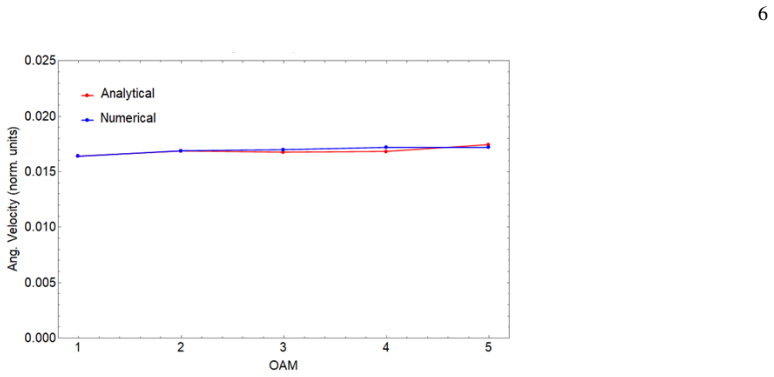
Significance. If it holds, the central result is a clean, parameter-free prediction: the rotation speed of a dissipative pattern is fixed by the pump OAM and the ring radius, with no fitted constants, and the simulations confirm it within the reported error bars (for example, ω = 0.0164 ± 0.0003 versus 2/11² ≈ 0.0165 in Fig. 2). The strengths of the paper are the exact 1D derivation of Eq. (14); the parameter-free prediction ω = ±4/w0² for LG pumps, verified for several waists including a two-ring case; the per-ring verification of Eq. (14) for multi-ring top-hat pumps in Fig. 9; and the demonstration of continuous, sign-tunable rotation control through vector beams, which is new for this system and relevant to particle manipulation, optical trapping, and cold-atom transport. The manuscript also credits earlier related results on OPO domain walls [3] and necklace-ring beams [15] appropriately. Its main limitations are that the 2D validity of Eq. (14) rests on a narrow-ring assumption that is neither stated nor tested, and that the vector-beam laws (24) and (26) are supported only numerically, with the radius R underspecified when the eigenmodes have different |m|.
major comments (2)
- [§2 (paragraph after Eq. (2)) and Figs. 2–4, 9] The derivation of the central law ω = 2m/R² (Eq. (14)) is exact only for the 1D ring model (Eq. (3)), in which the transverse Laplacian is replaced by (1/R²)∂²/∂ϕ², with R treated as a constant and the radial terms (∂²/∂r² + (1/r)∂/∂r) dropped. The abstract, however, states the law as an unqualified property of 2D Turing patterns, and the conclusion asserts that the 2D case is confirmed numerically. The missing piece is a stated regime of validity: the manuscript neither quantifies the radial width ΔR of the patterned rings nor establishes that ΔR/R is small. For the example in Fig. 2 (R = 11.0 ± 0.5 with w0 = 15), the local advection rate 2m/r² changes by several tens of percent over a radial spread of a few units, so a pattern of finite width cannot, in general, rotate rigidly with a single ω unless nonlinear radial locking keeps the pattern at the intensity maximum. The reported agreement suggests that such a mechanism operates, but it is not characterized. I request that the authors (i) report the radial intensity widths of the rings in the LG and top-hat simulations, (ii) state the condition under which Eq. (14) is expected to hold in 2D (e.g., ΔR/R ≪ 1, or radial localization of the pattern), and (iii) test the radial dependence directly, for example by varying w0 or the top-hat steepness S, to verify that the measured ω equals the local value 2m/r² at the intensity maximum rather than some radial average. This also bears on the multi-ring case of Fig. 9 and the 'peppermill' structures, where the rings are described as independent without a quantitative check of radial decoupling.
- [§4, Eqs. (24) and (26), Figs. 11–12] The vector-beam control laws are presented as results but are supported only by numerical simulation of the coupled LLE (22); no analytical derivation is given, and for the Poincaré beams the relation ω = (mL + mR)/R² is not a closed prediction because the radius R is left undefined. When |mL| ≠ |mR|, the two LG eigenmodes have different radii of maximum intensity, rmax = w0√(|m|/2), so the 'good overlap' assumption invoked in the abstract is violated by construction, and it is unclear whether R in Fig. 12 is the radius of the output ring common to both modes, the radius of the dominant mode, or a fitted quantity. Please specify the operational definition of R used for the data in Fig. 12 and state the overlap condition quantitatively, including the expected breakdown when the eigenmode radii differ substantially. A parallel clarification is needed for Eq. (24), where R should also be defined for the CV beams of Fig. 11.
minor comments (9)
- [Introduction] In the final sentence of the Introduction, 'Applications of these rotating structures to particle manipulation, optical beam shaping and photonic devices will is discussed' should read 'will be discussed.'
- [§3 (Numerical simulations)] The first sentence of the Numerical Simulations section contains the typo 'Althought' for 'Although.'
- [Conclusion] In the Conclusion, 'the numer of independent concentric rings' should read 'the number.'
- [Eq. (21)] In Eq. (21), the right-circular component appears to be written with the same LG index mL as the left-circular component; it should presumably carry mR, consistent with Eq. (25) and the surrounding discussion.
- [§4 (Optical peppermill)] In the peppermill paragraph, the phrase 'rotating counter-clockwise and the inner clockwise with the same angular velocity ω = 0.0375 ± 0.0015' is ambiguous; the two rings have the same angular speed but opposite angular velocities, so the wording should be rephrased.
- [Fig. 3 caption] The caption of Fig. 3 states only that the red line is the analytical result (14), whereas the text explains that the analytical curve uses the measured ring radius for each m; the caption should state this, since otherwise the flat blue line could be misread as contradicting the OAM dependence.
- [Fig. 12] For Fig. 12, please report the measurement uncertainty or the number of rotation periods over which ω was averaged; without error bars the claimed 'very good agreement' with the line mL + mR cannot be quantified.
- [§4 (CV beams)] The phrase 'left ellptical' should read 'left elliptical,' and a similar check of spelling is suggested throughout the vector-beam section.
- [§3 (top-hat pumps)] The sentence 'the dynamics leading to the asymptotic ring rotation for m ≠ 0 is much faster that that of m = 0' contains a grammatical error: 'faster that' should be 'faster than.'
Circularity Check
No load-bearing circularity: the scalar rotation law is derived from the ring-reduced LLE without fitted parameters, and the 2D and vector-beam checks are parameter-free comparisons using independently measured radii.
full rationale
The derivation chain is self-contained. Equation (3) reduces the transverse Laplacian to (1/R^2) d^2/dphi^2 on a fixed ring; this is an explicit modeling assumption, not a hidden input equivalent to the target result. With the ansatz E = F exp(i m phi), the advective term (2m/R^2) dF/dphi appears. The traveling-wave ansatz q = phi - omega t cancels this term exactly when omega = 2m/R^2 (Eqs. 11-14), and the remaining equation (15) is the m = 0 stationary problem with a renormalized detuning, so existence of the rotating solutions is inherited from the known Turing instability. No parameter is fitted to omega. In the 2D simulations the ring radius R is measured from the intensity profile (e.g., R = 11.0 +/- 0.5 for w0 = 15) and then compared with Eq. (14) across m = 1-5 and several beam waists; for top-hat pumps, each ring's measured radius is compared with Eq. (14). This is a relation check with an independently observable geometric input, not a self-fulfilling fit. The cylindrical-vector and Poincare-beam results are likewise parameter-free comparisons: Fig. 12 plots measured omega R^2 against mL + mR without any fitted slope or intercept. Self-citations in the paper are contextual or historical (e.g., [3], [12], [24], [26]) and are not used to justify the central rotation law. The constant-R ring approximation is a stated validity assumption rather than a circular step; if the ring width invalidated it, the numerical agreement would fail rather than be enforced by construction. No step reduces to its own inputs.
Assumptions & free parameters
assumptions (6)
- domain assumption The Lugiato-Lefever equation (Eq. 1) models the Kerr cavity field.
- domain assumption The 2D transverse Laplacian can be reduced to (1/R^2) ∂^2/∂ϕ^2 with R treated as constant on a ring.
- standard math Rotating solutions can be sought as traveling waves F(q) with q = ϕ - ωt.
- domain assumption The coupled LLE (Eq. 22) describes vector-beam pumping with cross-phase modulation.
- domain assumption Concentric diffraction rings in top-hat pumps are decoupled, behaving as independent 1D azimuthal structures.
- domain assumption Good spatial overlap between the two polarization eigenmodes is assumed for the Poincaré beam law ω = (m_L + m_R)/R^2.
Cite this review
Pith. "Pith review of Control of spatially rotating structures in diffractive Kerr cavities." pith.science (2026). https://pith.science/paper/DX4FCMZ4
@misc{pith2026190801680,
  author       = {Pith},
  title        = {Pith review of: Control of spatially rotating structures in diffractive Kerr cavities},
  year         = {2026},
  howpublished = {\url{https://pith.science/paper/DX4FCMZ4}},
  note         = {Machine review of arXiv:1908.01680}
}
abstract
Turing patterns in self-focussing nonlinear optical cavities pumped by beams carrying orbital angular momentum (OAM) $m$ are shown to rotate with an angular velocity $\omega = 2m/R^2$ on rings of radii $R$. We verify this prediction in 1D models on a ring and for 2D Laguerre-Gaussian and top-hat pumps with OAM. Full control over the angular velocity of the pattern in the range $- 2m/R^2 \le \omega \le 2m/R^2$ is obtained by using cylindrical vector beam pumps that consist of orthogonally polarized eigenmodes with equal and opposite OAM. Using Poincar\'e beams that consist of orthogonally polarized eigenmodes with different magnitudes of OAM, the resultant angular velocity is $\omega = (m_L + m_R)/R^2$, where $m_L, m_R$ are the OAMs of the eigenmodes, assuming good overlap between the eigenmodes. If there is no, or very little, overlap between the modes then concentric Turing pattern rings, each with angular velocity $\omega = 2m_{L,R}/R^2$ will result. This can lead to, for example, concentric, counter-rotating Turing patterns creating an 'optical peppermill'-type structure. Full control over the speeds of multiple rings has potential applications in particle manipulation and stretching, atom trapping, and circular transport of cold atoms and BEC wavepackets.
Figures

Figures from the paper (10 more)





Reference graph
Works this paper leans on
-
[3]
A. M. Turing, The Chemical Basis of Morphogenesis, Phil. Trans. R. Soc. B237, 37–72 (1952)
work page 1952
-
[15]
A. J. Scroggie, W. J. Firth, G. S. McDonald, M. Tlidi, R. Lefever, and L. A. Lugiato, Pattern Formation in a Passive Kerr Cavity,Chaos, Solitons and Fractals 4, 1323–1353 (1994); D. Gomila and P. Colet, Transition from hexagons to optical turbulence, Phys. Rev. A 68, 011801–4 (2003)
work page 1994
-
[1]
We therefore expect the angular velocityof LG modes to be independent ofm but inversely proportional to the beam waist, w0. To confirm this we numerically integrated Eq. (1) using LG pumps with m = 1 and beam waists of 10.0, 15.0, 20.0, which formed rings of bright spots at radii 19.23, 28.11, 37.5, and with a beam waist of 25.0, which formed two rings of ...
-
[2]
This means that we can control the angular velocity of the patterns by the choice of: • OAM, m • beam waist of LG pump, w0 • radius of top-hat pump, R. Note that the numer of independent concentric rings that can form inside the top-hat depends on its diameter and the Turing pattern wavelength. Our analysis confirms earlier results on rotating domain walls...
work page 2017
-
[4]
L. A. Lugiato and R. Lefever, Spatial Dissipative Structures in Passive Optical Systems, Phys. Rev. Lett. 58, 2209–2211 (1987)
work page 1987
-
[5]
G.-L. Oppo, A. J. Scroggie and W. J. Firth, Characterization, dynamics and stabilization of diffractive domain walls and dark ring cavity solitons in parametric oscillators, Phys. Rev. E 63, 066209–066216 (2001)
work page 2001
-
[6]
R. Kheradmand, L. A. Lugiato, G. Tissoni, M. Brambilla and H. Tajalli, Rotating and Fugitive Cavity Solitons in semiconductor mi- croresonators, Optics Express 11, 3612–3621 (2003)
work page 2003
-
[7]
V . Caullet, N. Marsal, D. Wolfersberger, and M. Sciamanna,Vortex Induced Rotation Dynamics of Optical Patterns,Phys. Rev. Lett.108, 263903–4 (2012)
work page 2012
Show all 28 references
-
[8]
Zhan, Cylindrical vector beams: from mathematical concepts to applications, Adv
Q. Zhan, Cylindrical vector beams: from mathematical concepts to applications, Adv. Opt. Photon. 1, 1–57 (2009)
2009
-
[9]
A. M. Beckley, T. G. Brown, and M. A. Alonso, Full Poincar´ e beams,Optics Express 18, 10777–10785 (2010)
2010
-
[10]
E. J. Galvez, S. Khadka, W. H. Schubert, and S. Nomoto, Poincar´ e-beam patterns produced by nonseparable superpositions of Laguer- reGauss and polarization modes of light, Appl. Opt. 51, 2925–2934 (2012)
2012
-
[11]
A. V . Nesterov and V . G. Niziev,Laser beams with axially symmetric polarization, J. Phys. D 33, 1817–1822 (2000). 14
2000
-
[12]
Novotny, M
L. Novotny, M. R. Beversluis, K. S. Youngworth, and T. G. Brown, Longitudinal Field Modes Probed by Single Molecules, Phys. Rev. Lett. 86, 5251–5254 (2001)
2001
-
[13]
R. Dorn, S. Quabis, and G. Leuchs, Sharper Focus for a Radially Polarized Light Beam,Phys. Rev. Lett. 91, 233901–4 (2003)
2003
-
[14]
Bouchard, H
F. Bouchard, H. Larocque, A. M. Yao, C. Travis, I. De Leon, A. Rubano, E. Karimi, G.-L. Oppo, and R. W. Boyd, Polarization Shaping for Control of Nonlinear Propagation, Phys. Rev. Lett. 117, 233903–5 (2016)
2016
-
[16]
W. J. Firth and A. J. Scroggie, Optical Bullet Holes: Robust Controllable Localized States of a Nonlinear Cavity, Phys. Rev. Lett. 76, 1623–1626 (1996)
1996
-
[17]
Solja ˘ci´c and M
M. Solja ˘ci´c and M. Segev,Integer and Fractional Angular Momentum Borne on Self-Trapped Necklace-Ring Beams,Phys. Rev. Lett. 86, 420–423 (2001)
2001
-
[18]
S. M. Barnett and R. Zambrini Orbital Angular Momentum of Light in Quantum Imaging, pg. 284, K. I. Kolobov, ed., (Springer, Singa- pore, 2007)
2007
-
[19]
H. Li,T. L. Lucas, J. G. McInerney, and R. A. Morgan, Transverse modes and patterns of electrically pumped vertical-cavity surface- emitting semiconductor lasers, Chaos, Solitons and Fractals 4, 1619–1636 (1994)
1994
-
[20]
Y . G. Zhao and J. McInerney, Transverse-mode control of vertical-cavity surface-emitting lasers, IEEE J. Quant. Elect. 32, 1950–1958 (1996)
1996
-
[21]
S. F. Pereira, M. B. Willemsen, M. P. van Exter, and J. P. Woerdman,Pinning of daisy modes in optically pumped vertical-cavity surface- emitting lasers, App. Phys. Lett. 73, 2239-2241 (1998) (with m , 0)
1998
-
[22]
Degen, I
C. Degen, I. Fischer, and W. Elßer, Transverse modes in oxide confined VCSELs: Influence of pump profile, spatial hole burning, and thermal effects, Optics Express 5, 38–47 (1999)
1999
-
[23]
Lemke, C
F. Lemke, C. Kropla, A. Mischok, R. Br ´’uckner, H. Fr´’ob, and K. Leo, Nonlinearity-induced Laguerre-Gauss modes in organic vertical cavity lasers, App. Phys. Lett. 111, 063303 (2017)
2017
-
[24]
A. M. Yao and M. J. Padgett, Orbital angular momentum: origins, behavior and applications, Advances in Optics and Photonics 3, 161–204 (2011)
2011
-
[25]
J. B. Geddes, J. V . Moloney, E. M. Wright, W. J. Firth,Polarisation patterns in a nonlinear cavityOptics Communications 111, 623–631 (1994)
1994
-
[26]
C. J. Gibson, P. Bevington, G.-L. Oppo, and A. M. Yao, Control of polarization rotation in nonlinear propagation of fully structured light, Phys. Rev. A 97, 033832–8 (2018)
2018
-
[27]
J. Guck, R. Ananthakrishnan, H. Mahmood, T. J. Moon, C. C. Cunningham, and J. Kas The Optical Stretcher: A Novel Laser Tool to Micromanipulate Cells, Biophysical Journal 81, 767–784 (2001)
2001
-
[28]
G. Baio, G. R. M. Robb, A. M. Yao, and G.-L. Oppo,Optomechanical transport of cold atoms induced by structured light,to be submitted (2019)
2019
Reviewed August 14, 2026 · model on record in the stance chip above.
Discussion (0). Continue with ORCID to comment.