REVIEW 2 major objections 2 minor 33 references
Statistical Inference for Gaussian Kernel Robust Regression with the gkrreg Package
T0 review · 2 major / 2 minor · reviewed 2026-07-01 · grok-4.3
Pith's one-line read Gaussian kernel robust regression is a redescending M-estimator that supports closed-form sandwich variance estimation and a pairs bootstrap.
desk verdict Paper supplies missing inference for GKRReg via M-estimator sandwich and bootstrap plus a usable R package, but the regularity conditions when gamma^2 is estimated from data are not shown to hold. read the letter →
The pith
A machine-rendered reading of the paper's core claim, the machinery that carries it, and where it could break.
The reading
What carries the argument
Membership of the converged GKRReg estimator in the redescending M-estimators family, which licenses direct use of generalised M-estimators theory to obtain the sandwich variance formula.
What would settle it
Monte Carlo simulations in which the empirical coverage of confidence intervals constructed from the sandwich estimator falls substantially below the nominal level when the data-generating process is known.
Extended reading notes
Core claim
GKRReg is formally established as a redescending M-estimator. This membership justifies derivation of a closed-form sandwich variance estimator corresponding to the HC0 class of heteroskedasticity-robust matrices. A pairs bootstrap is proposed that re-estimates the kernel width gamma squared on each replicate to capture variability ignored by the sandwich formula.
Load-bearing premise
The converged GKRReg estimator satisfies the regularity conditions of generalised M-estimators so that the sandwich variance formula applies directly.
Editorial extensions
If this is right
- The sandwich estimator supplies a computationally cheap alternative to full bootstrap inference for the regression coefficients.
- A finite-sample correction analogous to HC3 would require the weighted hat matrix produced by the converged IRWLS algorithm.
- The pairs bootstrap accounts for uncertainty in the data-driven selection of the kernel width gamma squared.
Reading between the lines
- The same M-estimator classification could be used to obtain analytic variance estimators for other iteratively reweighted robust regression procedures.
- The gkrreg package's automatic procedures for choosing gamma squared could be compared against fixed-width versions to isolate how much extra variability the bootstrap captures.
Editorial analysis
A structured set of objections, weighed in public.
Referee Report
Summary. The paper claims to address the lack of inferential procedures for Gaussian Kernel Robust Regression (GKRReg) by (i) formally establishing GKRReg as a redescending M-estimator, (ii) deriving a closed-form HC0 sandwich variance estimator from generalised M-estimator theory, and (iii) proposing a pairs bootstrap that re-estimates the kernel width gamma^2 on every replicate; all methods are implemented in the gkrreg R package together with four gamma estimators, diagnostic plots, and six real datasets.
Significance. If the regularity conditions hold, the work supplies both analytic and resampling-based inference for a robust estimator whose IRWLS convergence is already guaranteed, filling a practical gap. The package's data-driven gamma selection, diagnostics, and real-data examples add usability value beyond the theoretical contribution.
major comments (2)
- [Section establishing GKRReg as redescending M-estimator (referenced in abstract)] The central justification for the sandwich variance (HC0) is the claim that GKRReg satisfies the regularity conditions of generalised M-estimators (bounded continuous derivative of the score, uniform integrability, positive definite information matrix, consistency). The manuscript must explicitly verify these conditions in the section establishing the M-estimator property, particularly when gamma^2 is itself estimated from the data rather than fixed; the abstract asserts the establishment but does not indicate where or how the verification is performed.
- [Section on pairs bootstrap] The pairs bootstrap is motivated by variability omitted by the sandwich when gamma^2 is estimated; however, the manuscript should quantify or bound the additional variability captured by re-estimating gamma^2 on replicates versus fixing it, to substantiate that the bootstrap is necessary rather than merely precautionary.
minor comments (2)
- Clarify notation for the weighted hat matrix used in any finite-sample discussion so that its dependence on the converged IRWLS weights (which incorporate the estimated gamma^2) is unambiguous.
- Add a short table comparing the analytic sandwich standard errors with bootstrap standard errors on the six real datasets to illustrate the practical difference.
Simulated Author's Rebuttal
We thank the referee for the constructive feedback on our manuscript. We respond to each major comment below.
read point-by-point responses
-
Referee: [Section establishing GKRReg as redescending M-estimator (referenced in abstract)] The central justification for the sandwich variance (HC0) is the claim that GKRReg satisfies the regularity conditions of generalised M-estimators (bounded continuous derivative of the score, uniform integrability, positive definite information matrix, consistency). The manuscript must explicitly verify these conditions in the section establishing the M-estimator property, particularly when gamma^2 is itself estimated from the data rather than fixed; the abstract asserts the establishment but does not indicate where or how the verification is performed.
Authors: We agree that greater explicitness would strengthen the presentation. Section 2 establishes GKRReg as a redescending M-estimator by verifying that its score function meets the requirements of generalised M-estimator theory, including boundedness and continuity of the derivative. In the revision we will insert a dedicated subsection that enumerates each regularity condition (bounded continuous derivative, uniform integrability, positive-definiteness of the information matrix, and consistency) and provides a brief verification for each, with a separate paragraph addressing the data-driven case for gamma^2. The location of this verification will be cross-referenced from the abstract and the sandwich-variance derivation. revision: yes
-
Referee: [Section on pairs bootstrap] The pairs bootstrap is motivated by variability omitted by the sandwich when gamma^2 is estimated; however, the manuscript should quantify or bound the additional variability captured by re-estimating gamma^2 on replicates versus fixing it, to substantiate that the bootstrap is necessary rather than merely precautionary.
Authors: A general analytical bound on the extra variability induced by re-estimating gamma^2 is not available under the mild conditions used throughout the paper; any such bound would require distributional assumptions that we deliberately avoid. The pairs bootstrap is offered as a practical, distribution-free procedure that automatically incorporates this source of variability. We will expand the motivation paragraph to clarify that the sandwich estimator is derived under the assumption of fixed tuning parameters (standard in generalised M-estimator theory), while the bootstrap relaxes that assumption. revision: no
- Quantifying or bounding the additional variability from re-estimating gamma^2 on bootstrap replicates versus fixing it, without imposing strong distributional assumptions.
Circularity Check
No circularity: inference derives from external M-estimator theory
full rationale
The paper's central step is formally establishing GKRReg membership in redescending M-estimators to invoke generalized M-estimator theory for the sandwich variance (HC0). This applies an external body of results rather than reducing any quantity to a fitted parameter or self-citation chain by construction. The pairs bootstrap explicitly re-estimates gamma^2 on each replicate, and no equations or steps in the abstract reduce the variance estimator or convergence claims to the inputs themselves. The derivation chain remains self-contained against the cited external theory.
Assumptions & free parameters
free parameters (1)
- gamma^2
assumptions (2)
- domain assumption GKRReg is a redescending M-estimator
- domain assumption The theory of generalised M-estimators applies directly to the converged IRWLS weights
Cite this review
Pith. "Pith review of Statistical Inference for Gaussian Kernel Robust Regression with the gkrreg Package." pith.science (2026). https://pith.science/paper/DXNCAYON
@misc{pith2026260631652,
  author       = {Pith},
  title        = {Pith review of: Statistical Inference for Gaussian Kernel Robust Regression with the gkrreg Package},
  year         = {2026},
  howpublished = {\url{https://pith.science/paper/DXNCAYON}},
  note         = {Machine review of arXiv:2606.31652}
}
read the original abstract
The Gaussian Kernel Robust Regression method (GKRReg) is a robust regression estimator that iteratively re-weights observations via a Gaussian kernel so that outliers and leverage points receive near-zero weight, with convergence of the estimation algorithm theoretically guaranteed. Despite a thorough study of estimation, the original work leaves open the problem of statistical inference for the regression coefficients. We fill this gap with three contributions. First, we formally establish that GKRReg belongs to the family of redescending M-estimators, providing the theoretical foundation for the inferential procedures that follow. Second, we derive a closed-form analytic sandwich variance estimator based on the theory of generalised M-estimators, corresponding to the HC0 class of heteroskedasticity-robust covariance matrices; we show that a finite-sample correction analogous to HC3 requires the weighted hat matrix of the converged IRWLS step, and identify this as a direction for future work. Third, we propose a pairs bootstrap that re-estimates the kernel width hyper-parameter gamma^2 on every replicate, capturing variability that the sandwich ignores. All procedures are implemented in the R package gkrreg, which also provides four estimators for gamma^2 and an automatic data-driven selection procedure, comprehensive diagnostic plots, and six real datasets from the robust regression literature. Applications to real data sets and comparison with traditional robust regression models highlight the potential of the GKRReg and the usability of the R package.
Figures
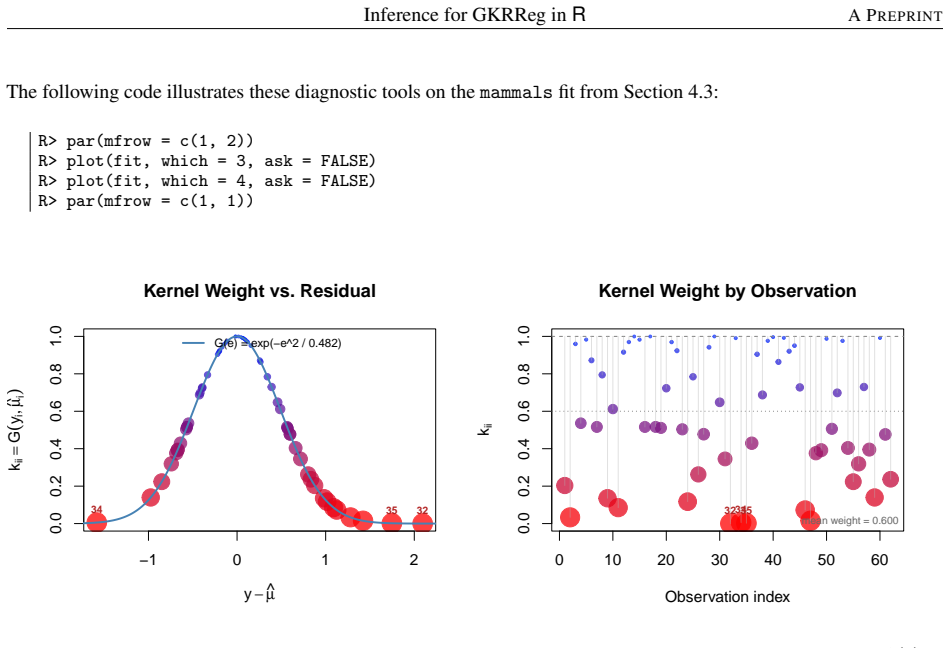


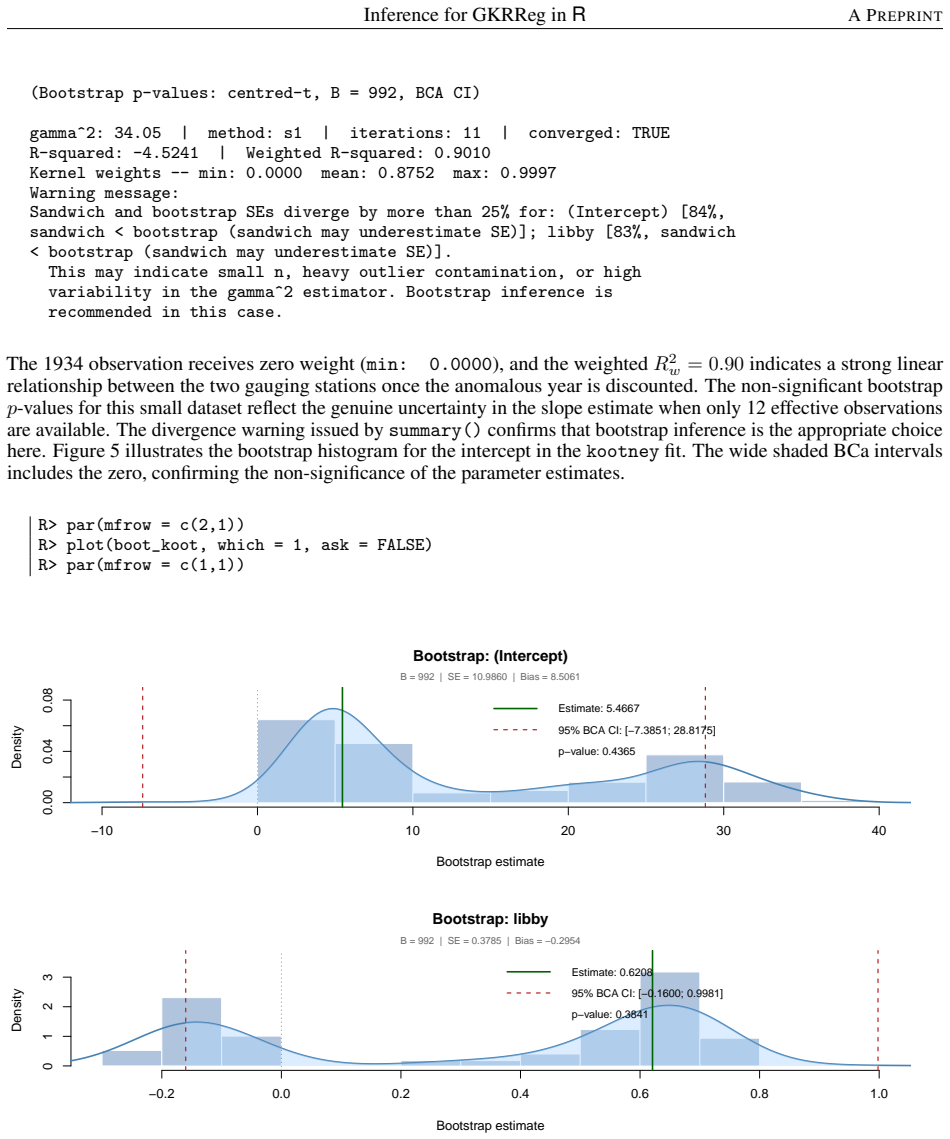
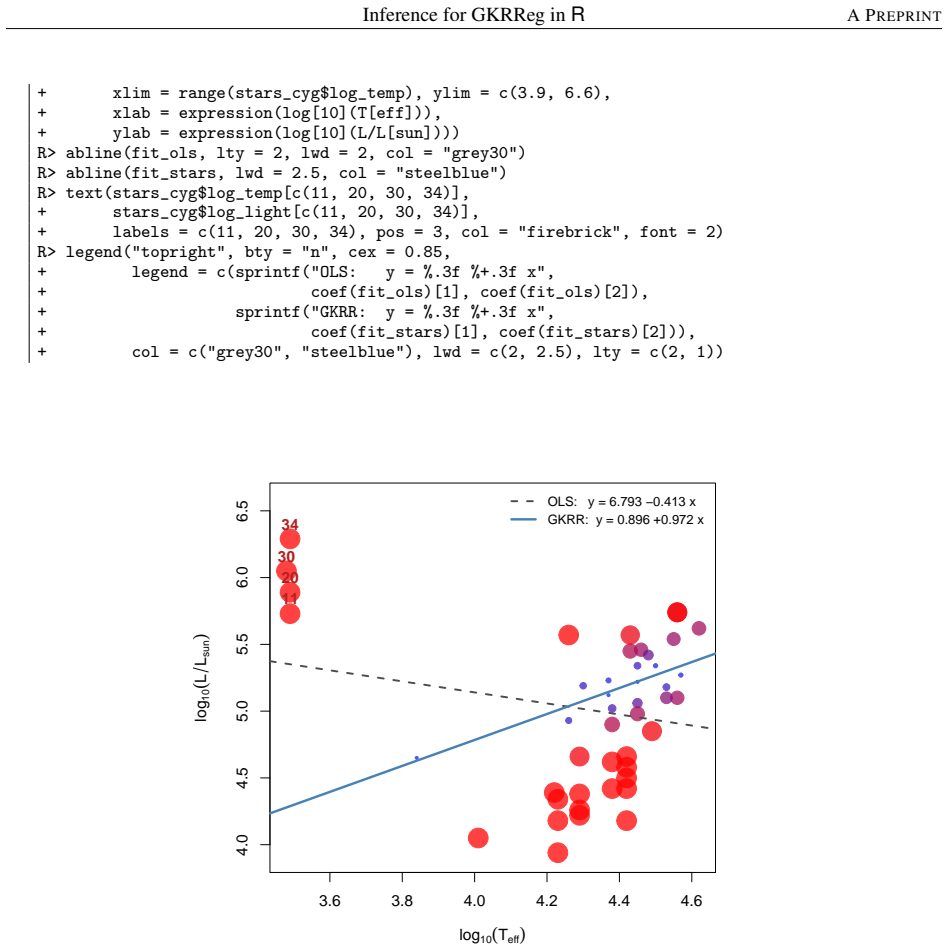
Figures from the paper (6 more)




Reference graph
Works this paper leans on
-
[1]
Fast and Robust Bootstrap for Multivariate Inference: The
Stefan. Fast and Robust Bootstrap for Multivariate Inference: The. Journal of Statistical Software , year =
-
[2]
A Robust Regression Method Based on Exponential-Type Kernel Functions , journal =. 2017 , volume =
work page 2017
- [3]
-
[4]
Ricardo A. Maronna and R. Douglas Martin and Victor J. Yohai , title =. 2006 , doi =
work page 2006
- [5]
-
[6]
Peter J. Huber , title =. Proceedings of the Fifth Berkeley Symposium on Mathematical Statistics and Probability , year =
- [7]
-
[8]
Peter J. Rousseeuw and Victor J. Yohai , title =. Robust and Nonlinear Time Series Analysis , editor =. 1984 , pages =
work page 1984
Show all 33 references
-
[9]
Yohai , title =
Victor J. Yohai , title =. Annals of Statistics , year =
-
[10]
Conceicao and Maria Anna di Palma , title =
Martin Maechler and Peter Rousseeuw and Christophe Croux and Valentin Todorov and Andreas Ruckstuhl and Matias Salibian-Barrera and Tobias Verbeke and Manuel Koller and Eduardo L.T. Conceicao and Maria Anna di Palma , title =. 2023 , note =
2023
-
[11]
Venables and Brian D
William N. Venables and Brian D. Ripley , title =. 2002 , pages =
2002
-
[12]
Econometrica , year =
Halbert White , title =. Econometrica , year =
-
[13]
MacKinnon and Halbert White , title =
James G. MacKinnon and Halbert White , title =. Journal of Econometrics , year =
-
[14]
MacKinnon , title =
Russell Davidson and James G. MacKinnon , title =
-
[15]
Computational Statistics & Data Analysis , year =
Francisco Cribari-Neto , title =. Computational Statistics & Data Analysis , year =
-
[16]
Zeger , title =
Kung-Yee Liang and Scott L. Zeger , title =. Biometrika , year =
-
[17]
Newey and Daniel McFadden , title =
Whitney K. Newey and Daniel McFadden , title =. Handbook of Econometrics , editor =. 1994 , volume =
1994
-
[18]
Stefanski and Dennis D
Leonard A. Stefanski and Dennis D. Boos , title =. The American Statistician , year =
-
[19]
Bowman and Adelchi Azzalini , title =
Adrian W. Bowman and Adelchi Azzalini , title =
-
[20]
Annals of Statistics , year =
Bradley Efron , title =. Annals of Statistics , year =
-
[21]
1982 , volume =
Bradley Efron , title =. 1982 , volume =
1982
-
[22]
Journal of the American Statistical Association , year =
Bradley Efron , title =. Journal of the American Statistical Association , year =
-
[23]
Tibshirani , title =
Bradley Efron and Robert J. Tibshirani , title =. 1993 , doi =
1993
-
[24]
DiCiccio and Bradley Efron , title =
Thomas J. DiCiccio and Bradley Efron , title =. Statistical Science , year =
-
[25]
Davison and David V
Anthony C. Davison and David V. Hinkley , title =. 1997 , doi =
1997
-
[26]
1992 , doi =
Peter Hall , title =. 1992 , doi =
1992
-
[27]
Rousseeuw and Annick M
Peter J. Rousseeuw and Annick M. Leroy , title =. 1987 , doi =
1987
-
[28]
Montgomery and Elizabeth A
Douglas C. Montgomery and Elizabeth A. Peck , title =
-
[29]
Kutner and Christopher J
John Neter and Michael H. Kutner and Christopher J. Nachtsheim and William Wasserman , title =
-
[30]
Draper and Harry Smith , title =
Norman R. Draper and Harry Smith , title =. 1998 , doi =
1998
-
[31]
Cicchetti , title =
Truett Allison and Domenic V. Cicchetti , title =. Science , year =
-
[32]
Humphreys , title =
Roberta M. Humphreys , title =. Astrophysical Journal Supplement Series , year =
-
[33]
Appearance-Based Object Recognition Using
B. Appearance-Based Object Recognition Using. Proceedings of the NIPS Workshop on Statistical Methods for Computational Experiments in Visual Processing and Computer Vision , year =
Reviewed July 1, 2026 · model on record in the stance chip above.
Discussion (0). Continue with ORCID to comment.