Online Charge Scheduling for Electric Vehicles in Autonomous Mobility on Demand Fleets
Pith reviewed 2026-05-25 11:26 UTC · model grok-4.3
The pith
An online primal-dual heuristic schedules charging and rebalancing for autonomous electric vehicle fleets and admits a competitive ratio to the offline optimum.
A machine-rendered reading of the paper's core claim, the machinery that carries it, and where it could break.
Core claim
The central claim is that a primal-dual online algorithm can allocate limited charging resources and rebalance autonomous electric vehicles as each vehicle enters its between-ride state, avoiding congestion at facilities while achieving a competitive ratio against the clairvoyant offline solution.
What carries the argument
The primal-dual online welfare-maximization heuristic that incrementally updates dual prices and primal allocations as vehicle availability information arrives.
If this is right
- The online method can be deployed without advance knowledge of daily ride demand.
- Charging and rebalancing decisions remain feasible at every step and respect station capacities.
- Performance is guaranteed to lie within a fixed factor of the best possible offline schedule.
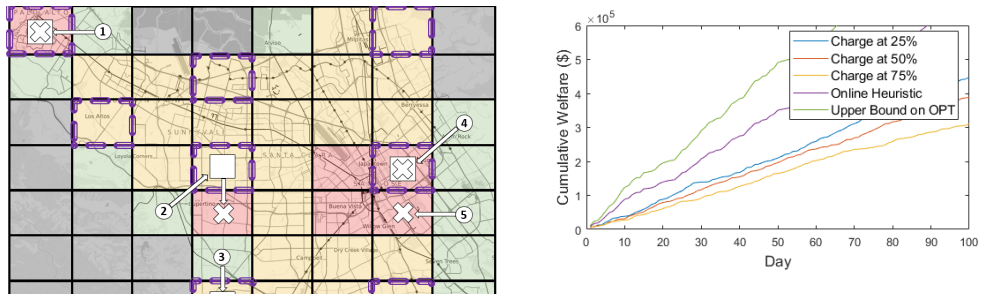
- Numerical tests confirm that the heuristic produces high welfare on realistic instances.
Where Pith is reading between the lines
- The same online framework could be adapted to other sequentially revealed resources such as parking spots or energy storage in ride-sharing systems.
- If the competitive ratio is shown to be tight on worst-case sequences, designers would know the method is already near-optimal in the adversarial setting.
- Coupling the heuristic with short-term demand forecasts could tighten practical performance while preserving the worst-case guarantee.
Load-bearing premise
Vehicle availability information arrives in an online sequence that permits the primal-dual updates to produce feasible allocations without future knowledge and still satisfy the competitive-ratio analysis.
What would settle it
Compare the total welfare obtained by the online heuristic against the welfare of the optimal offline schedule on the identical sequence of ride requests; if the ratio falls below the claimed bound on any instance, the guarantee does not hold.
Figures
read the original abstract
In this paper, we study an online charge scheduling strategy for fleets of autonomous-mobility-on-demand electric vechicles (AMoD EVs). We consider the case where vehicles complete trips and then enter a between-ride state throughout the day, with their information becoming available to the fleet operator in an online fashion. In the between-ride state, the vehicles must be scheduled for charging and then routed to their next passenger pick-up locations. Additionally, due to the unknown daily sequences of ride requests, the problem cannot be solved by any offline approach. As such, we study an online welfare maximization heuristic based on primal-dual methods that allocates limited fleet charging resources and rebalances the vehicles while avoiding congestion at charging facilities and pick-up locations. We discuss a competitive ratio result comparing the performance of our online solution to the clairvoyant offline solution and provide numerical results highlighting the performance of our heuristic.
Editorial analysis
A structured set of objections, weighed in public.
Referee Report
Summary. The manuscript proposes an online welfare-maximization heuristic, based on primal-dual methods, for charge scheduling and rebalancing of autonomous mobility-on-demand electric vehicle (AMoD EV) fleets. Vehicles arrive online in a between-ride state; the algorithm allocates scarce charging resources and routes vehicles to pick-up locations while avoiding congestion at both charging facilities and pick-up points. The central theoretical claim is a competitive-ratio guarantee relative to a clairvoyant offline optimum; numerical experiments are also presented to illustrate practical performance.
Significance. If the competitive-ratio result is rigorously established and the numerical study is reproducible, the work would supply a theoretically grounded online algorithm for a practically relevant resource-allocation problem at the intersection of transportation and energy systems. The primal-dual framework is a standard tool for online welfare maximization, and its application to congestion-aware EV rebalancing is a natural extension that could inform fleet operators.
minor comments (2)
- [Abstract] Abstract: 'vechicles' is a typographical error and should read 'vehicles'.
- [Abstract] The abstract states that a competitive ratio is 'discussed' but does not state the ratio itself or the assumptions under which it holds. A reader cannot assess the strength of the guarantee without the explicit statement.
Simulated Author's Rebuttal
We thank the referee for reviewing our manuscript on online charge scheduling for AMoD EV fleets. The report provides a concise summary of the contribution but does not enumerate any specific major comments. We therefore have no individual points to address in the responses section below. We remain available to supply further details on the competitive-ratio proof or the numerical experiments if the editor or referee requests them.
Circularity Check
No significant circularity identified
full rationale
The paper describes an online primal-dual welfare maximization heuristic for EV charge scheduling and rebalancing, with a competitive ratio result framed as a comparison to the clairvoyant offline optimum. This is a standard external benchmark in online algorithm analysis and does not reduce to any self-definitional, fitted-input, or self-citation load-bearing step within the given claims. No equations or derivations are provided that equate a prediction to its own inputs by construction, and the setup relies on independent problem assumptions about online arrivals rather than circular justification.
Axiom & Free-Parameter Ledger
Reference graph
Works this paper leans on
-
[1]
Autonomous mobility-on-demand systems for future ur- ban mobility,
M. Pavone, “Autonomous mobility-on-demand systems for future ur- ban mobility,” pp. 399–416, 2015, Publisher: Springer Berlin Heidel- berg, doi=10.1007/978-3-662-45854-9 19
-
[2]
Models, algorithms, and evaluation for autonomous mobility-on-demand systems,
R. Zhang, K. Spieser, E. Frazzoli, and M. Pavone, “Models, algorithms, and evaluation for autonomous mobility-on-demand systems,” in 2015 American Control Conference (ACC) , July 2015, pp. 2573–2587
work page 2015
-
[3]
Automated vehicles, on-demand mobility, and environmental impacts,
J. B. Greenblatt and S. Shaheen, “Automated vehicles, on-demand mobility, and environmental impacts,” Current Sustainable/Renewable Energy Reports, vol. 2, no. 3, pp. 74–81, Sep 2015
work page 2015
-
[4]
Optimization for dynamic ride-sharing: A review,
N. Agatz, A. Erera, M. Savelsbergh, and X. Wang, “Optimization for dynamic ride-sharing: A review,” European Journal of Operational Research, vol. 223, no. 2, pp. 295 – 303, 2012
work page 2012
-
[5]
A matching algorithm for dynamic ridesharing,
M. Schreieck et al., “A matching algorithm for dynamic ridesharing,” Transportation Research Procedia, vol. 19, pp. 272 – 285, 2016
work page 2016
-
[6]
A mechanism for dynamic ride sharing based on parallel auctions,
A. Kleiner, B. Nebel, and V . A. Ziparo, “A mechanism for dynamic ride sharing based on parallel auctions,” in Proceedings of the 22 International Joint Conference on Artificial Intelligence, ser. IJCAI’11, 2011, pp. 266–272
work page 2011
-
[7]
On-demand high-capacity ride-sharing via dy- namic trip-vehicle assignment,
Alonso-Mora et al. , “On-demand high-capacity ride-sharing via dy- namic trip-vehicle assignment,” Proceedings of the National Academy of Sciences, vol. 114, no. 3, pp. 462–467, 2017
work page 2017
-
[8]
A decomposition algorithm to solve the multi-hop peer-to-peer ride-matching problem,
N. Masoud and R. Jayakrishnan, “A decomposition algorithm to solve the multi-hop peer-to-peer ride-matching problem,” Transportation Research Part B: Methodological , vol. 99, pp. 1 – 29, 2017
work page 2017
-
[9]
Autonomous mobility and energy service management in future smart cities: An overview,
X. Tan and A. Leon-Garcia, “Autonomous mobility and energy service management in future smart cities: An overview,” 2018 International Conference on Universal Village , Oct 2018
work page 2018
-
[10]
Model predictive control of autonomous mobility-on-demand systems,
R. Zhang, F. Rossi, and M. Pavone, “Model predictive control of autonomous mobility-on-demand systems,” in 2016 IEEE International Conference on Robotics and Automation (ICRA) , May 2016
work page 2016
-
[11]
T. D. Chen, K. M. Kockelman, and J. P. Hanna, “Operations of a shared, autonomous, electric vehicle fleet: Implications of vehicle and charging infrastructure decisions,” Transportation Research Part A: Policy and Practice, vol. 94, pp. 243 – 254, 2016
work page 2016
-
[12]
Management of a shared au- tonomous electric vehicle fleet: Implications of pricing schemes,
T. D. Chen and K. M. Kockelman, “Management of a shared au- tonomous electric vehicle fleet: Implications of pricing schemes,” Transportation Research Record, vol. 2572, no. 1, pp. 37–46, 2016
work page 2016
-
[13]
A congestion-aware routing scheme for autonomous mobility-on-demand systems,
M. Salazar, M. Tsao, I. Aguiar, M. Schiffer, and M. Pavone, “A congestion-aware routing scheme for autonomous mobility-on-demand systems,” in European Control Conference, 2019
work page 2019
-
[14]
Model predictive control of ride-sharing autonomous mobility-on-demand systems
M. Tsao, D. Milojevic, C. Ruch, M. Salazar Villalon, E. Frazzoli, and M. Pavone, “Model predictive control of ride-sharing autonomous mobility-on-demand systems.” IEEE, 2019-05, 2019 IEEE Interna- tional Conference on Robotics and Automation (ICRA); Conference Location: Montreal, Canada; Conference Date: May 20-24, 2019
work page 2019
-
[15]
F. Rossi, R. Iglesias, M. Alizadeh, and M. Pavone, “On the interac- tion between autonomous mobility-on-demand systems and the power network: models and coordination algorithms,” Robotics: Science and Systems XIV, Jun 2018
work page 2018
-
[16]
On the interaction between autonomous mobility-on-demand and public transportation systems,
M. Salazar, F. Rossi, M. Schiffer, C. H. Onder, and M. Pavone, “On the interaction between autonomous mobility-on-demand and public transportation systems,” in 2018 21st International Conference on Intelligent Transportation Systems (ITSC) , Nov 2018, pp. 2262–2269
work page 2018
-
[17]
Distribution grid impacts of smart electric vehicle charging from different perspectives,
E. Veldman and R. A. Verzijlbergh, “Distribution grid impacts of smart electric vehicle charging from different perspectives,” IEEE Transactions on Smart Grid , vol. 6, no. 1, pp. 333–342, Jan 2015
work page 2015
-
[18]
A survey on the electrifica- tion of transportation in a smart grid environment,
W. Su, H. Eichi, W. Zeng, and M. Chow, “A survey on the electrifica- tion of transportation in a smart grid environment,” IEEE Transactions on Industrial Informatics , vol. 8, no. 1, pp. 1–10, Feb 2012
work page 2012
-
[19]
A review of charge scheduling of electric vehicles in smart grid,
J. C. Mukherjee and A. Gupta, “A review of charge scheduling of electric vehicles in smart grid,” IEEE Systems Journal , vol. 9, no. 4, pp. 1541–1553, Dec 2015
work page 2015
-
[20]
B. Ferguson, V . Nagaraj, E.C. Kara, and M. Alizadeh, “Optimal planning of workplace electric vehicle charging insfrastructure with smart charging opportunities,” ITSC Hawaii 2018
work page 2018
-
[21]
V . Robu, E. H. Gerding, S. Stein, D. C. Parkes, A. Rogers, and N. R. Jennings, “An online mechanism for multi-unit demand and its application to plug-in hybrid electric vehicle charging,” J. Artif. Int. Res., vol. 48, no. 1, pp. 175–230, Oct. 2013
work page 2013
-
[22]
Auc2charge: An online auction framework for electric vehicle park- and-charge,
Q. Xiang, F. Kong, X. Liu, X. Chen, L. Kong, and L. Rao, “Auc2charge: An online auction framework for electric vehicle park- and-charge,” in Proceedings of the 2015 ACM Sixth International Conference on Future Energy Systems , ser. e-Energy ’15
work page 2015
-
[23]
Deadline differentiated pricing of deferrable electric power service,
E. Bitar and S. Low, “Deadline differentiated pricing of deferrable electric power service,” in IEEE 51st CDC , 2012, pp. 4991–4997
work page 2012
-
[24]
Control of charging of electric vehicles through menu-based pricing,
A. Ghosh and V . Aggarwal, “Control of charging of electric vehicles through menu-based pricing,” IEEE Transactions on Smart Grid, vol. 9, no. 6, pp. 5918–5929, Nov 2018
work page 2018
-
[25]
Optimal planning of pev charging station with single output multiple cables charging spots,
H. Zhang, Z. Hu, Z. Xu, and Y . Song, “Optimal planning of pev charging station with single output multiple cables charging spots,” IEEE Transactions on Smart Grid , vol. 8, Sept 2017
work page 2017
-
[26]
Online pricing mechanisms for electric vehicle management at workplace charging facilities,
N. Tucker and M. Alizadeh, “Online pricing mechanisms for electric vehicle management at workplace charging facilities,” Allerton Con- ference on Communication, Control, and Computing , 2018
work page 2018
-
[27]
An online pricing mecha- nism for electric vehicle parking assignment and charge scheduling,
N. Tucker, B. Ferguson, and M. Alizadeh, “An online pricing mecha- nism for electric vehicle parking assignment and charge scheduling,” American Control Conference, 2019, To Appear
work page 2019
-
[28]
An online admission control mechanism for electric vehicles at public parking infrastructures,
N. Tucker and M. Alizadeh, “An online admission control mechanism for electric vehicles at public parking infrastructures,” IEEE Transac- tions on Smart Grid , pp. 1–1, 2019
work page 2019
-
[29]
Primal dual gives almost optimal energy efficient online algorithms,
N. R. Devanur and Z. Huang, “Primal dual gives almost optimal energy efficient online algorithms,” in Proceedings of the 25th ACM-SIAM SODA, ser. SODA ’14, Philadelphia, PA, USA, 2014
work page 2014
-
[30]
Online auctions in iaas clouds: Welfare and profit maximization with server costs,
X. Zhang, Z. Huang, C. Wu, Z. Li, and F. C. M. Lau, “Online auctions in iaas clouds: Welfare and profit maximization with server costs,” IEEE/ACM Transactions on Networking , vol. 25, no. 2, April 2017
work page 2017
-
[31]
California ISO OASIS Locational Marginal Prices (LMP), [Online],
“California ISO OASIS Locational Marginal Prices (LMP), [Online],” http://oasis.caiso.com/mrioasis/logon.do
-
[32]
California ISO Supply and Renewables, [Online],
“California ISO Supply and Renewables, [Online],” http://www.caiso. com/TodaysOutlook/Pages/supply.aspx
-
[33]
San Jose Heatmap, SherpaShare Rideshare Analysis, [Online],
“San Jose Heatmap, SherpaShare Rideshare Analysis, [Online],” https: //www.sherpashare.com/heatmap. APPENDIX Definition 1. (From [30]) The Differential Allocation- Payment Relationship for a given parameter α≥ 1 is: ( p(t)−f′(y(t)) ) dy(t)≥ 1 α(t)f∗′ (p(t))dp(t) (26) for all t∈ [0,T ] and for all shared resources where f′(y(t)) is the derivative of an oper...
discussion (0)
Sign in with ORCID, Apple, or X to comment. Anyone can read and Pith papers without signing in.