REVIEW 2 major objections 4 minor 13 references
Periodic particle arrangements using standing acoustic waves
T0 review · 2 major / 4 minor · reviewed 2026-08-14 · deepseek-v4-flash
Pith's one-line read A small matrix predicts where acoustic waves trap particles
desk verdict Solid level-set mathematics; the Bravais classification section classifies the wave lattice, not the particle lattice, and the abstract overstates the result. read the letter →
The pith
A machine-rendered reading of the paper's core claim, the machinery that carries it, and where it could break.
The reading
What carries the argument
The central object is the $2d\times 2d$ Hermitian matrix $Q(x)=M(x)^*\operatorname{diag}(a,-bI_d)M(x)$ that expresses the acoustic radiation potential as a quadratic form $\psi(x;u)=u^*Q(x)u$ in the transducer amplitudes. The key structural fact is that a translation by $\varepsilon$ is realized by a unitary similarity, so the eigenvalues of $Q(x)$ are position-independent; the whole spatial dependence is carried by the phase factors $\exp(i[K,-K]^T x)$ acting on $u$. At $x=0$, the matrix decomposes as $Q(0)=a11^T-b[K;-K][K;-K]^T$, and its eigenspaces are built from the constant vector and the singular vectors of $K$. The level-set criteria in Theorem 2.1 then reduce to checking whether the eigenvector $u$ stays in the $\lambda$-eigenspace after sign flips of its entries; the sets $T_{\lambda,u}$, $T^{\pm}_{\lambda,u}$, and $R^{\pm}_{\lambda,u}$ record exactly which sign flips are allowed, and each allowed flip contributes a shifted lattice, a line, or a plane.
What would settle it
Take a two-dimensional wave set with two equal-length wavevectors at 60 degrees to each other, pick a unit vector $u$ in a simple smallest-eigenvalue eigenspace of $Q(0)$, and compute the full set of global minima of the radiation potential. Lemma 2.4 predicts minima on the two lattices $A n$ and $A(n+1/2)$; determine the Bravais class of the resulting pattern. If that class is not tetragonal, hexagonal, or orthorhombic centred, the paper's claim that only three Bravais classes are achievable is false.
Extended reading notes
Core claim
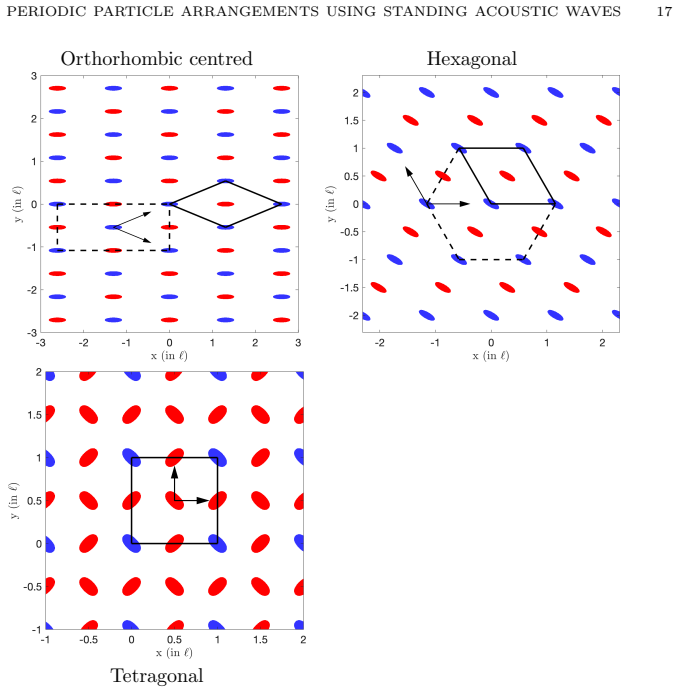
Writing the acoustic radiation potential at position $x$ as $\psi(x;u)=u^*Q(x)u$, where $u$ are the complex amplitudes of the $d$ plane waves, the paper shows that a spatial shift is a unitary similarity of $Q$, so all eigenvalue information is contained in $Q(0)=a11^T-b[K;-K][K;-K]^T$. For a unit-power parameter vector $u$ in the eigenspace of the smallest eigenvalue of $Q(0)$, the origin is a global minimum of $\psi(\cdot;u)$. Theorem 2.1 then characterizes the level sets $L_{\lambda,u}$ for any eigenpair: if $u$ has a zero entry the minima contain lines or planes; if $u$ has no zero entries and the $\lambda$-eigenspace lies within one of the symmetric subspaces $H_+$ or $H_-$, the level set is a union of up to $2d$ lattices $\{A(n+s/2): n\in\mathbb{Z}^d\}$ with $s\in\{0,1\}^d$; and if the eigenspace straddles $H_+$ and $H_-$, lines or planes may appear. Applying the equal-length constraint $|k_1|=\cdots=|k_d|$ to the enumeration of Bravais classes, the paper concludes that only three classes are achievable in two dimensions (tetragonal, hexagonal, orthorhombic centred) and six in three dimensions (triclinic primitive, orthorhombic face-centred, trigonal primitive, cubic primitive, cubic face-centred, cubic body-centred), with explicit reciprocal vectors for each.
Load-bearing premise
The enumeration of achievable Bravais classes assumes the particle pattern's periodicity is the wave lattice $A$, even though Theorem 2.1 shows minima can also form finer shifted lattices $A(n+s/2)$ that may belong to classes outside the enumeration.
Editorial extensions
If this is right
- Choosing transducer parameters from the smallest-eigenvalue eigenspace of $Q(0)$ makes the origin a global minimum of the radiation potential at fixed power, and by periodicity this minimum repeats on the lattice $A$.
- Real particle patterns need not be the lattice $A$ alone: the minima can be a union of up to $2d$ shifted lattices $A(n+s/2)$, so a single wave set can produce a finer two-point or $2d$-point basis within each primitive cell.
- The equal-length constraint on wavevectors rules out most Bravais classes; in two dimensions only tetragonal, hexagonal, and orthorhombic-centred lattices are achievable, and in three dimensions only six of the fourteen classes.
- Turning off one or more transducers (zero entries in $u$) turns the minima from isolated points into continuous lines or planes, which could be used to make fibrous or lamellar particle arrangements.
- The level-set description holds for every eigenvalue of $Q(0)$, not just the minimum, so the same machinery can describe other preferential surfaces inside the potential, although the paper leaves the study of non-global local minima open.
Reading between the lines
- The paper's recipe can be read backwards as a design algorithm: choose a desired Bravais class from the tables, set the wavevectors accordingly, compute $Q(0)$, and select $u$ from the minimal eigenspace; whether the desired within-cell particle motif is actually produced then hinges on the sign-flip sets $T_{\lambda,u}$, which the paper gives but does not fully explore as a design tool.
- Because the radiation potential itself rests on the small-sphere, inviscid-fluid approximation, real experiments with finite-size or non-spherical particles may see the trap positions shift or additional minima appear; quantifying that shift is a natural experimental follow-up the paper does not attempt.
- The same quadratic-form-plus-unitary-shift structure appears in other wave-based manipulation settings, such as optical tweezers or structured light, so the Bravais-class limitations may be a general property of wave-directed assembly rather than an acoustic-specific feature.
- One could test the enumeration by fabricating a two-dimensional hexagonal wavefield with a simple smallest eigenvalue and checking whether the predicted two-point-per-cell pattern indeed belongs to one of the three listed classes; the paper does not report such an explicit check.
Signed reviews
Editorial analysis
A structured set of objections, weighed in public.
Referee Report
Summary. This paper studies periodic acoustic radiation potentials generated by superpositions of d plane waves with equal wavenumbers in a non-viscous fluid, and uses them to predict where small spherical particles are trapped. The potential is written as a quadratic form u*Q(x)u, and a unitary similarity argument reduces the position dependence to the matrix Q(0). Lemma 2.1 gives the explicit eigendecomposition of Q(0) in terms of the eigenvectors of KK^T, and the paper shows that level sets corresponding to eigenvalues are unions of lattices of the form A(n+s/2) when the eigenspace lies in one of the H± subspaces, or contain lines or planes when the eigenspace straddles the two subspaces. Section 3 then enumerates, in two and three dimensions, which Bravais lattice classes are compatible with the constraint that all reciprocal vectors have equal length, concluding that only 3 of 5 two-dimensional and 6 of 14 three-dimensional classes are achievable.
Significance. The Section 2 analysis is elegant, self-contained, and largely correct. It gives a parameter-free recipe: for physical constants a and b and a chosen matrix K, the optimal transducer amplitudes are eigenvectors of Q(0), and the geometry of the resulting minima is read off from the corresponding eigenspace without further numerical optimization. The lemmas are stated with proofs, and Examples 2.1-2.4 verify the level-set predictions numerically. If the Section 3 classification were corrected to describe the translation lattice of the particle positions rather than the wave lattice, the paper would provide a useful design rule for ultrasound-directed self-assembly. As it stands, however, the central application claim, namely that the achievable particle arrangements are limited to the enumerated Bravais classes, is not established.
major comments (2)
- [Section 3, Definition 3.1, Tables 1-2] The classification in Section 3 is for the wave lattice A = 2πK^{-T}, not for the lattice of particle positions. Lemma 2.4 shows that for a simple eigenvalue the set of global minima is L = A Z^d ∪ A(1/2+Z^d), which is the index-2 superlattice generated by A and A(1/2,...,1/2), not A itself. This lattice can belong to a different Bravais class from A. For example, in 2D take A hexagonal; then L has basis (a1+a2)/2 and (a1-a2)/2, which are orthogonal with unequal lengths, i.e. a primitive rectangular (orthorhombic) lattice, a class that Table 1 declares unachievable. Consequently, the abstract's statement that the arrangement's periodicity is limited to the enumerated Bravais classes is unsupported. The remark after Definition 3.1, which says the definition is irrespective of the particular particle arrangement inside a primitive cell, does not address this point, because the issue is not the configuration inside the cell but the translation lattice of the set of minima itself. The tables need to be recomputed for the minimizer lattice L (and for the other cases in Lemma 2.4), or the claims need to be explicitly restricted to the wave lattice.
- [Section 2.4, Lemma 2.4 and Section 3] The discussion of the 'two points per primitive cell' case in Lemma 2.4 conceals the distinction between the primitive cell of A and the period of the set of minima. For a simple eigenvalue, the two points 0 and 1/2 in atomic coordinates generate the superlattice L described above, and the period of the arrangement is L, not A. For an eigenvalue of multiplicity d, T = {0,1}^d and the minima form the refinement A/2 Z^d, which has the same Bravais class as A; for intermediate multiplicities the union of cosets may or may not be a lattice. The paper does not analyze these cases before stating the enumerations in Tables 1 and 2. A complete treatment must either classify the Bravais class of L for each possible T_{λ,u} or explicitly state that only the wave lattice is being classified.
minor comments (4)
- [Table 2, Hexagonal primitive row] The word 'Tegragonal' in the 'Implied symmetry' column should be 'Tetragonal'.
- [Section 3, after Definition 3.1] The sentence beginning 'We remark that definition 3.1 is irrespective of the particular particle arrangement inside a primitive cell' is ambiguous and should be replaced by an explicit statement of whether the classification refers to the wave lattice A or to the period lattice of the minima.
- [Figures 7 and 8] The captions describe the Bravais class of the wave lattice, but the plotted minima may lie on a different lattice; it would be helpful to state which eigenvalue multiplicity and which set T_{λ,u} is used in each panel, since the same wave lattice can lead to different minimizer sets.
- [Proof of Lemma 2.4] In the definition of T_{λ,u}, the sign '±' is not quantified within the set-builder notation; from context it means the sign chosen in u = [v;±v], but this should be stated explicitly.
Circularity Check
No circularity: the derivation is self-contained, parameter-free, and not reliant on self-citations for its load-bearing steps.
full rationale
The paper's central claim is that global minima of a spatially periodic acoustic radiation potential are determined by the smallest-eigenvalue eigenspace of the explicitly constructed matrix Q(0). This is derived from the physical Gor'kov potential with constants a and b; no parameter is fitted to data and no target result is used as an input. Lemma 2.1 gives an explicit eigendecomposition of Q(0) in terms of the wavevector matrix K, and Lemmas 2.3-2.6 and Theorem 2.1 characterize the level sets using only the eigenspace structure and elementary harmonic analysis. The citations to [6,11] are acknowledgements that the eigen-decomposition idea was used earlier, but the present derivation does not import an unverified theorem from those papers; the needed algebra is carried out here. Section 3's Bravais-lattice classification is obtained by imposing the equal-length reciprocal-vector constraint on standard crystallographic reference tables, an external check rather than a self-citation. The possible mismatch between the wave lattice A and the finer particle lattice identified in Lemma 2.4 is a correctness concern about the interpretation of the classification, not a circularity: the classification is not defined in terms of the particle arrangement it is used to claim. Overall, no step reduces by construction to its own inputs.
Assumptions & free parameters
assumptions (5)
- domain assumption The Gor'kov acoustic radiation potential (equation 2) correctly describes trapping locations for small spherical particles in an inviscid fluid.
- domain assumption The pressure field is exactly a superposition of d plane waves with wavevectors k_1,...,k_d forming a basis (equation 4).
- domain assumption All wavevectors have the same magnitude |k_j| = k.
- domain assumption Particles do not interact with each other and do not perturb the acoustic field.
- standard math The reference Bravais lattice tables from [2,9] are correct.
Cite this review
Pith. "Pith review of Periodic particle arrangements using standing acoustic waves." pith.science (2026). https://pith.science/paper/DXSUZURH
@misc{pith2026190808664,
  author       = {Pith},
  title        = {Pith review of: Periodic particle arrangements using standing acoustic waves},
  year         = {2026},
  howpublished = {\url{https://pith.science/paper/DXSUZURH}},
  note         = {Machine review of arXiv:1908.08664}
}
read the original abstract
We determine crystal-like materials that can be fabricated by using a standing acoustic wave to arrange small particles in a non-viscous liquid resin, which is cured afterwards to keep the particles in the desired locations. For identical spherical particles with the same physical properties and small compared to the wavelength, the locations where the particles are trapped correspond to the minima of an acoustic radiation potential which describes the net forces that a particle is subject to. We show that the global minima of spatially periodic acoustic radiation potentials can be predicted by the eigenspace of a small real symmetric matrix corresponding to its smallest eigenvalue. We relate symmetries of this eigenspace to particle arrangements composed of points, lines or planes. Since waves are used to generate the particle arrangements, the arrangement's periodicity is limited to certain Bravais lattice classes that we enumerate in two and three dimensions.
Figures


Figures from the paper (5 more)



Reference graph
Works this paper leans on
-
[1]
J. P. K. Armstrong, J. L. Puetzer, A. Serio, A. G. Guex, M. Kapnisi, A. Breant, Y. Zong, V. Assal, S. C. Skaalure, O. King, T. Murty, C. Meinert, A. C. Franklin, P. G. Bassin- dale, M. K. Nichols, C. M. Terracciano, D. W. Hutmacher, B. W. Drinkwater, T. J. Klein, A. W. Perriman, and M. M. Stevens. Engineering anisotropic muscle tissue using acoustic cell ...
work page 2018
-
[2]
C. J. Bradley and A. P. Cracknell. The mathematical theory of symmetry in solids . Oxford Classic Texts in the Physical Sciences. The Clarendon Press, Oxford University Press, New York, 2010. Representation theory for point groups and space groups, Corrected paperback edition of the 1972 original
work page 2010
-
[3]
M. Caleap and B. W. Drinkwater. Acoustically trapped colloidal crystals that are reconfig- urable in real time. Proceedings of the National Academy of Sciences , 111(17):6226–6230, 2014
work page 2014
-
[4]
D. Colton and R. Kress. Inverse acoustic and electromagnetic scattering theory , volume 93 of Applied Mathematical Sciences. Springer-Verlag, Berlin, second edition, 1998
work page 1998
-
[5]
L. P. Gor’kov. On the forces acting on a small particle in an acoustical field in an ideal fluid. Soviet Physics Doklady , 6:773, March 1962
work page 1962
-
[6]
J. Greenhall, F. Guevara Vasquez, and B. Raeymaekers. Ultrasound directed self-assembly of user-specified patterns of nanoparticles dispersed in a fluid medium. Applied Physics Letters, 108(10):103103, 2016
work page 2016
-
[7]
J. Greenhall and B. Raeymaekers. 3D printing macroscale engineered materials using ul- trasound directed self-assembly and stereolithography. Advanced Materials Technologies , 2(9):1700122–n/a, 2017. 1700122
work page 2017
-
[8]
L. V. King. On the acoustic radiation pressure on spheres. Proceedings of the Royal Society of London A: Mathematical, Physical and Engineering Sciences , 147(861):212–240, 1934
work page 1934
Show all 13 references
-
[9]
C. Kittel. Introduction to Solid State Physics . John Wiley & Sons, Inc., 8th edition, 2005. 16 FERNANDO GUEV ARA V ASQUEZ 1 AND CHINA MAUCK 1 Bravais lattice class Reciprocal lattice vectors Implied symmetry Triclinic primitive |g1| =|g2| =|g3| g1 = (− cosγ,− sinγ, 0) Cubic p...
2005
-
[10]
Marzo and B
A. Marzo and B. W. Drinkwater. Holographic acoustic tweezers. Proceedings of the National Academy of Sciences, 116(1):84–89, 2019
2019
-
[11]
Prisbrey, J
M. Prisbrey, J. Greenhall, F. Guevara Vasquez, and B. Raeymaekers. Ultrasound directed self- assembly of three-dimensional user-specified patterns of particles in a fluid medium. Journal of Applied Physics , 121:014302, 2017
2017
-
[12]
Settnes and H
M. Settnes and H. Bruus. Forces acting on a small particle in an acoustical field in a viscous fluid. Phys. Rev. E , 85:016327, Jan 2012. 18 FERNANDO GUEV ARA V ASQUEZ 1 AND CHINA MAUCK 1 Triclinic primitive Orthorhombic face-centred Trigonal primitive Cubic primitive Cubic face...
2012
-
[13]
G. T. Silva, J. H. Lopes, J. P. Le˜ ao Neto, M. K. Nichols, and B. W. Drinkwater. Particle pat- terning by ultrasonic standing waves in a rectangular cavity. Phys. Rev. Applied, 11:054044, May 2019. 1Mathematics Department, University of Utah, Salt Lake City UT 84112, USA
2019
Reviewed August 14, 2026 · model on record in the stance chip above.
Discussion (0). Continue with ORCID to comment.