REVIEW 3 major objections 5 minor 13 references
Beamforming Cancellation Design for Millimeter-Wave Full-Duplex
T0 review · 3 major / 5 minor · reviewed 2026-08-14 · deepseek-v4-flash
Pith's one-line read Projecting the transmit beam into the null space of the effective self-interference channel cancels a mmWave full-duplex node's own interference, bringing its sum spectral efficiency close to ideal.
desk verdict The null-space projection idea is sound for NRF=2Ns, but the more practical Case B cannot support Ns transmit streams for NRF<2Ns, so its headline claim fails on a dimension count. read the letter →
The pith
A machine-rendered reading of the paper's core claim, the machinery that carries it, and where it could break.
The reading
What carries the argument
The load-bearing object is the effective self-interference channel, $\mathbf{W}_{BB}^{(i)H}\mathbf{W}_{RF}^{(i)H}\mathbf{H}_{ii}\mathbf{F}_{RF}^{(i)}$ in Case B (reduced to $\mathbf{W}^{(i)H}\mathbf{H}_{ii}$ in Case A), which is the portion of the SI channel that survives the receive combiner. The mechanism is the orthogonal projection matrix $P = B(B^H B)^{-1}B^H$, where $B$ is a basis of that channel's null space; applying $P$ to the transmit precoder forces the SI term in the received signal to zero while keeping the beam as close as possible to the eigen-precoder for the desired link. This works because although the raw SI channel is full rank and has no null space, the effective channel seen after combining has a large null space when the number of streams is well below the number of antennas.
What would settle it
Run either proposed design in simulation or over the air using an SI channel estimate corrupted by a known error (for example, Gaussian noise added to $\mathbf{H}_{ii}$); if the residual self-interference power after projection exceeds the noise floor for error levels typical of mmWave channel estimation, the claim of complete SI elimination is falsified under imperfect CSI, which is the practical condition.
Extended reading notes
Core claim
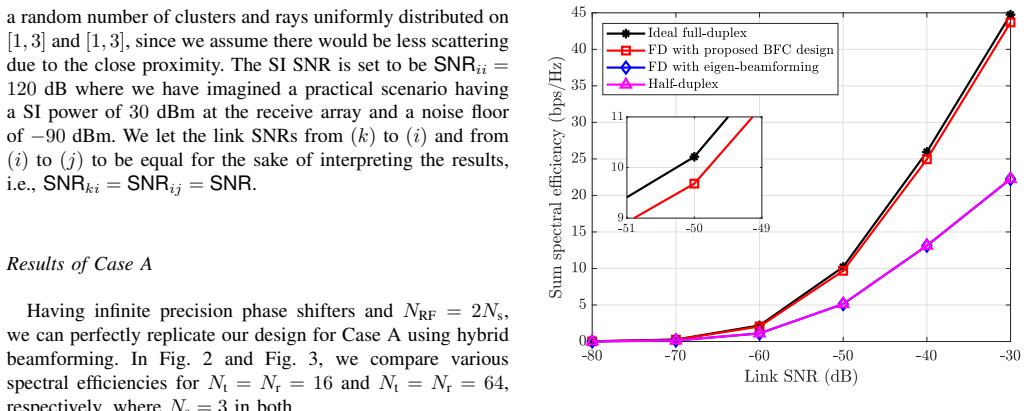
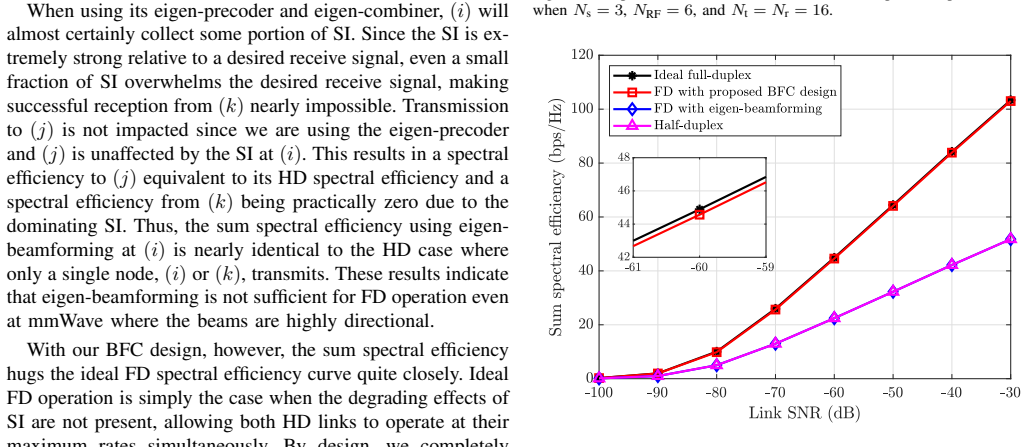
The paper's central claim is that the received self-interference at a full-duplex node can be completely eliminated by design, not by estimation and subtraction. Fixing the receive combiner to the eigen-combiner for the link from $k$, the authors define the effective self-interference channel as the SI channel seen through that combiner, and require the transmit precoder to lie in its null space so that $\mathbf{W}^{(i)H}\mathbf{H}_{ii}\mathbf{F}^{(i)} = \mathbf{0}$. In Case A, with $N_{\mathrm{RF}} = 2N_s$ and infinite-resolution phase shifters, the fully-digital eigen-precoder is projected onto the null space and then decomposed perfectly into hybrid form. In Case B, with $2N_s > N_{\mathrm{RF}} \geq N_s$ and finite resolution, the projection is applied to the digital precoder after an OMP-based hybrid decomposition, so the constraint is enforced inside the hybrid architecture. The consequence is that the link from $k$ to $i$ achieves its half-duplex spectral efficiency while $i$ simultaneously serves $j$, and the sum spectral efficiency hugs the ideal full-duplex curve; the only cost is a slight deviation of the transmit beam from the unconstrained eigen-precoder. The paper also shows that eigen-beamforming alone fails completely, because even a tiny fraction of the 120 dB self-interference dominates the desired signal.
Load-bearing premise
The designs assume the full-duplex node knows its own self-interference channel exactly; if the channel estimate is even slightly wrong, the projected beam will not lie in the true null space, and the 120 dB self-interference will overwhelm the desired receive signal.
Editorial extensions
If this is right
- A single mmWave node can serve a downlink user and receive from an uplink user in the same band at the same time, with a sum spectral efficiency close to the theoretical self-interference-free full-duplex bound.
- Eigen-beamforming alone cannot support mmWave full-duplex: the 120 dB self-interference overwhelms the desired receive signal, so a deliberate null-space projection is essential.
- Increasing the number of RF chains in the practical Case B design mainly adds dimensions for null-space projection, which improves the transmit link more than it improves hybrid approximation accuracy.
- Larger antenna arrays enlarge the null space of the effective SI channel, so the transmit beam can stay closer to the unconstrained eigen-precoder while still cancelling self-interference exactly.
- The designs are non-iterative and do not require joint optimization across the transmitter and receiver, unlike earlier mmWave full-duplex beamforming-cancellation approaches.
Reading between the lines
- A direct extension would test robustness to imperfect SI channel knowledge: because the projection is exact only with perfect CSI, practical deployment would need either estimation-error-aware projection or a residual analog/digital cancellation stage.
- The same null-space idea should carry over to a full-duplex node serving multiple users or streams, with each stream projected into the effective SI null space; the cost in desired-link rate will grow as the number of streams approaches the number of antennas.
- Fixing the receive combiner to the eigen-combiner, as the paper does, is a choice; jointly optimizing the combiner and the projected precoder could yield a higher sum rate than this design, since the combiner determines the effective SI channel and hence the available null space.
- Because the cancellation is purely spatial, it is complementary to existing self-interference cancellation techniques; a practical mmWave full-duplex system would likely combine the two to relax the perfect-CSI assumption.
Signed reviews
Editorial analysis
A structured set of objections, weighed in public.
Referee Report
Summary. This paper proposes beamforming cancellation (BFC) designs for in-band full-duplex millimeter-wave communication with hybrid beamforming at the full-duplex node (i). The node uses separate transmit and receive arrays and seeks to null self-interference by projecting its transmit precoder onto the null space of the effective SI channel observed through its receive combiner. Case A assumes NRF=2Ns RF chains with infinite-resolution phase shifters, enabling perfect hybrid decomposition of the projected fully-digital precoder. Case B treats the more practical regime 2Ns > NRF >= Ns with finite-resolution phase shifters, using orthogonal matching pursuit to obtain the analog precoder and then projecting only the digital precoder into the null space of the resulting effective SI channel. The paper claims that in both cases the sum spectral efficiency approaches that of an SI-free full-duplex system, and it presents simulations for Ns=3 with different array sizes and RF chain counts.
Significance. The conceptual approach of nulling the effective SI channel rather than the full SI channel is useful, and the Case A design is mathematically sound: with NRF=2Ns, the null space of the Ns x Nt effective channel has dimension at least Ns for Nt>Ns, so the projected precoder can preserve Ns streams. The paper also clearly demonstrates that eigen-beamforming alone is insufficient for mmWave FD, and it offers a non-iterative design that does not require joint optimization across nodes. These are strengths. However, the central claim about Case B fails under the stated parameter range because the null space of the effective SI channel is too small to carry Ns streams; this is a dimensional impossibility, not a matter of optimization quality, and it undermines the paper's main practical contribution.
major comments (3)
- [Section III, Case B, Eqs. (18)-(20)] The dimension of the null space of the effective SI channel is insufficient to support Ns streams when NRF < 2Ns. Since C_eff in (18) is Ns x NRF and generically has rank Ns, its null space has dimension NRF - Ns < Ns under the stated condition 2Ns > NRF. The projected digital precoder F_BB = Q XBB in (20) therefore has rank at most NRF - Ns, so the link from (i) to (j) can carry at most NRF - Ns streams rather than Ns. For the example Ns=3, NRF=4 used in the simulations, this limits the transmit link to one stream, so the sum spectral efficiency cannot approach that of an SI-free FD system at high SNR; the claim in the abstract and in Section IV that both designs approach ideal FD performance is not supported.
- [Section IV, Results of Case B] The discussion of 'offering more dimensions to the digital precoder F_BB' as NRF increases overlooks that for every NRF < 2Ns, the nullity remains less than Ns, so the transmit link is rank-deficient regardless of the hybrid approximation quality. The simulations in Figs. 4-5 should report the number of spatial streams actually delivered after the projection; otherwise the spectral efficiency results are difficult to interpret and the comparison with the NRF=6 eigen-precoder baseline is misleading.
- [Section V, Conclusion] The conclusion states that the designs 'achieve significant spectral efficiency gains approaching that of ideal FD operation.' This is accurate for Case A (NRF=2Ns) and for Case B only at the boundary NRF=2Ns, which is excluded from the stated Case B range. As written, the conclusion overstates the practical Case B, which suffers an unavoidable stream deficit for NRF<2Ns.
minor comments (5)
- [Section III, after Eq. (14)] The motivation for considering the effective SI channel could be complemented by an explicit statement that the null space dimension of the effective channel must be at least Ns for the projection in (16) or (20) to preserve the number of streams; this would have highlighted the Case B limitation.
- [Section III, Assumptions] The paper assumes perfect CSI of the SI channel; a sentence acknowledging the sensitivity to CSI error and possible extensions would strengthen the practical claims.
- [Figs. 4 and 5] The captions of Figs. 4 and 5 should specify the exact NRF values and the corresponding supported stream counts after projection, since the text leaves this ambiguous.
- [Notation] The notation F(i) is used both for the fully-digital precoder in (16) and for the effective hybrid precoder in (21); consider distinguishing these two quantities.
- [Section II, array response] The expression for the phase shift, phi(theta) = 2*pi/lambda_c * lambda_c/2 * cos(theta), simplifies to pi*cos(theta); the simplification would be clearer.
Circularity Check
No significant circularity found: SI suppression is imposed by projection design; simulation evaluates achievable rates without fitted parameters.
full rationale
The paper's design intentionally projects the transmit precoder into the null space of the effective self-interference channel, so the statement 'By design, we completely eliminate the received SI' (Section IV, Results of Case A) is a mathematical consequence of Eqs. (14)-(16) and Eqs. (18)-(20), not a prediction fitted to data. The actual claim being tested in simulation is the spectral efficiency of the projected precoder on the desired link relative to ideal FD; that quantity depends on the random mmWave channels and the OMP hybrid decomposition and is evaluated honestly rather than assumed. No parameters are fitted to produce the reported curves, and the load-bearing external results—the NRF=2Ns hybrid decomposition theorem [11], the SI channel model [7]/[12], and OMP decomposition [13]—are independent prior works, not self-citations by the present authors. The possible dimensional infeasibility of Case B when NRF<2Ns is a correctness concern about the design's feasibility, not a circularity of the derivation. Hence no circular step is present.
Assumptions & free parameters
assumptions (6)
- domain assumption Perfect CSI at node (i) for Hii, Hij, Hki
- domain assumption SI channel follows Rician decomposition with near-field LOS and far-field NLOS, per (6)-(7) from [7] and [12]
- domain assumption Desired links are far-field and follow extended Saleh-Valenzuela model (5)
- domain assumption No adjacent user interference between (j) and (k)
- standard math NRF=2Ns and infinite-resolution phase shifters permit exact hybrid decomposition of any fully-digital beamformer, per [11]
- domain assumption OMP-based hybrid decomposition with a DFT codebook gives a suitable approximation of the desired analog beamformers
Cite this review
Pith. "Pith review of Beamforming Cancellation Design for Millimeter-Wave Full-Duplex." pith.science (2026). https://pith.science/paper/DYHKGPQY
@misc{pith2026190806505,
  author       = {Pith},
  title        = {Pith review of: Beamforming Cancellation Design for Millimeter-Wave Full-Duplex},
  year         = {2026},
  howpublished = {\url{https://pith.science/paper/DYHKGPQY}},
  note         = {Machine review of arXiv:1908.06505}
}
read the original abstract
In recent years, there has been extensive research on millimeter-wave (mmWave) communication and on in-band full-duplex (FD) communication, but work on the combination of the two is relatively lacking. FD mmWave systems could offer increased spectral efficiency and decreased latency while also suggesting the redesign of existing mmWave applications. While FD technology has been well-explored for sub-6 GHz systems, the developed methods do not translate well to mmWave. This turns us to a method called beamforming cancellation (BFC), where the highly directional mmWave beams are steered to mitigate self-interference (SI) and enable simultaneous transmission and reception in-band. In this paper, we present BFC designs for two fully-connected hybrid beamforming scenarios, both of which sufficiently suppress the SI such that the sum spectral efficiency approaches that of a SI-free FD system. A simulation and its results are then used to verify our designs.
Figures

Figures from the paper (2 more)


Reference graph
Works this paper leans on
-
[1]
J. G. Andrews, S. Buzzi, W. Choi, S. V . Hanly, A. Lozano, A. C. K. Soong, and J. C. Zhang, “What will 5G be?” IEEE Journal on Selected Areas in Communications , vol. 32, no. 6, pp. 1065–1082, Jun 2014
work page 2014
-
[2]
An overview of signal processing techniques for millimeter wave MIMO systems,
R. W. Heath, N. Gonzalez-Prelcic, S. Rangan, W. Roh, and A. M. Sayeed, “An overview of signal processing techniques for millimeter wave MIMO systems,” IEEE Journal of Selected Topics in Signal Processing, vol. 10, no. 3, pp. 436–453, Apr. 2016
work page 2016
-
[3]
R. W. Heath Jr. and A. Lozano, Foundations of MIMO Communication. Cambridge University Press, 2018
2018
-
[4]
Hybrid MIMO architectures for millimeter wave communica- tions: Phase shifters or switches?
R. Mendez-Rial, C. Rusu, N. Gonzalez-Prelcic, A. Alkhateeb, and R. W. Heath, “Hybrid MIMO architectures for millimeter wave communica- tions: Phase shifters or switches?” IEEE Access , vol. 4, pp. 247–267, 2016
2016
-
[5]
MIMO for millimeter-wave wireless communications: beamforming, spatial multi- plexing, or both?
S. Sun, T. Rappaport, R. Heath, A. Nix, and S. Rangan, “MIMO for millimeter-wave wireless communications: beamforming, spatial multi- plexing, or both?” IEEE Communications Magazine, vol. 52, no. 12, pp. 110–121, Dec. 2014
work page 2014
-
[6]
Achieving single channel, full duplex wireless communication,
J. I. Choi, M. Jain, K. Srinivasan, P. Levis, and S. Katti, “Achieving single channel, full duplex wireless communication,” in Proceedings of the 16th annual international conference on mobile computing and networking. ACM, 2010, pp. 1–12
work page 2010
-
[7]
Hybrid beamforming design for full-duplex millimeter wave communication,
K. Satyanarayana, et al. , “Hybrid beamforming design for full-duplex millimeter wave communication,”IEEE Transactions on Vehicular Tech- nology, vol. 68, no. 2, pp. 1394–1404, Feb. 2019
work page 2019
-
[8]
Full-duplex millimeter-wave communica- tion,
Z. Xiao, P. Xia, and X. Xia, “Full-duplex millimeter-wave communica- tion,” IEEE Wireless Communications, vol. 24, no. 6, pp. 136–143, Dec. 2017
work page 2017
Show all 13 references
-
[9]
Full duplex relay in millimeter wave backhaul links,
H. Abbas and K. Hamdi, “Full duplex relay in millimeter wave backhaul links,” in IEEE Wireless Communications and Networking Conference , Apr 2016, pp. 1–6
2016
-
[10]
In-band full-duplex relay-assisted millimeter-wave system design,
D. Jagyasi and P. Ubaidulla, “In-band full-duplex relay-assisted millimeter-wave system design,” IEEE Access , vol. 7, pp. 2291–2304, 2019
2019
-
[11]
Hybrid digital and analog beamforming design for large-scale antenna arrays,
F. Sohrabi and W. Yu, “Hybrid digital and analog beamforming design for large-scale antenna arrays,” IEEE Journal of Selected Topics in Signal Processing, vol. 10, no. 3, pp. 501–513, Apr. 2016
2016
-
[12]
Spherical-wave model for short-range MIMO,
J. S. Jiang and M. A. Ingram, “Spherical-wave model for short-range MIMO,” IEEE Transactions on Communications , vol. 53, no. 9, pp. 1534–1541, Sep. 2005
2005
-
[13]
Spatially sparse precoding in millimeter wave MIMO systems,
O. E. Ayach, S. Rajagopal, S. Abu-Surra, Z. Pi, and R. W. Heath, “Spatially sparse precoding in millimeter wave MIMO systems,” IEEE Transactions on Wireless Communications , vol. 13, no. 3, pp. 1499– 1513, Mar. 2014
2014
Reviewed August 14, 2026 · model on record in the stance chip above.
Discussion (0). Continue with ORCID to comment.