Deep learning model emulators for marine biogeochemistry forecasting from days to decades
Pith reviewed 2026-06-26 01:26 UTC · model grok-4.3
The pith
Deep learning emulators match or beat a marine biogeochemistry model in both 10-day forecasts and multi-decadal projections while remaining stable.
A machine-rendered reading of the paper's core claim, the machinery that carries it, and where it could break.
Core claim
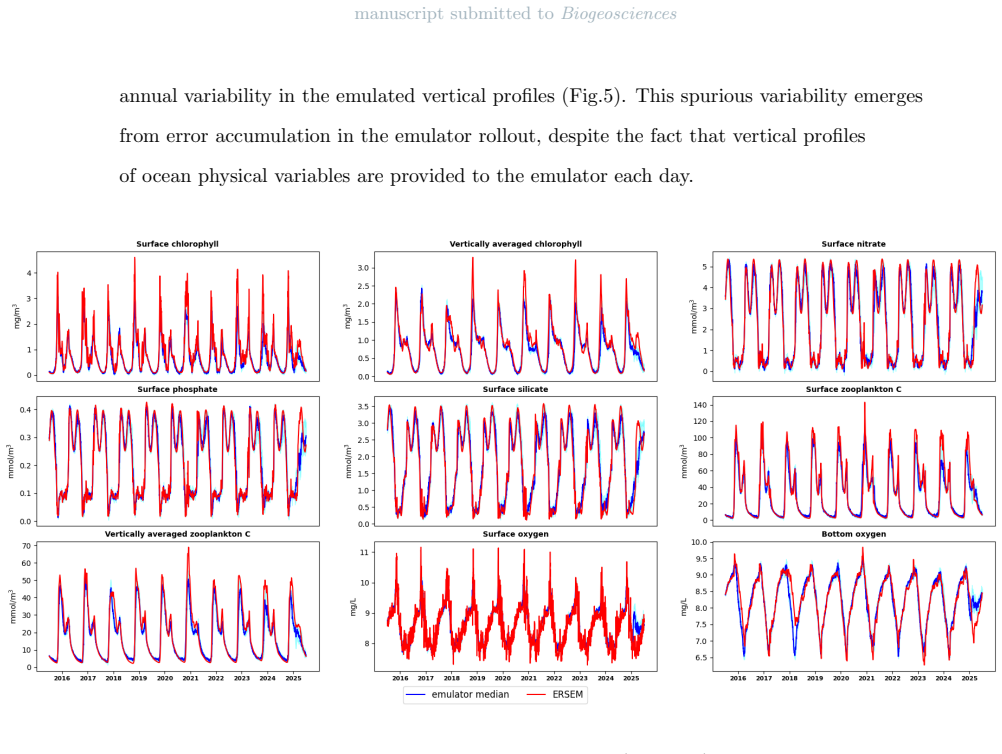
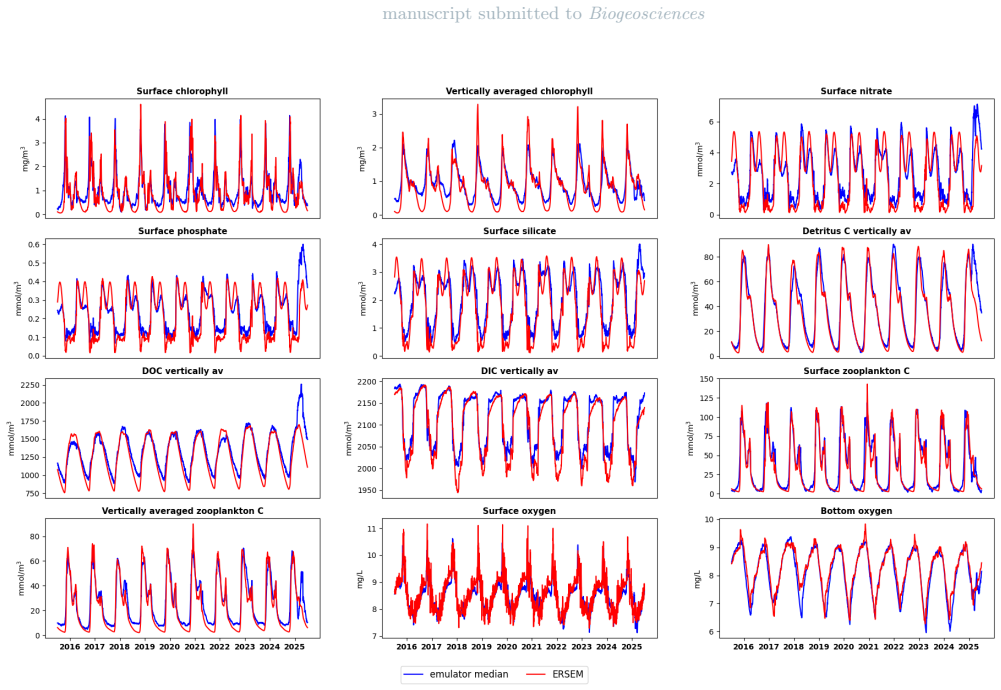
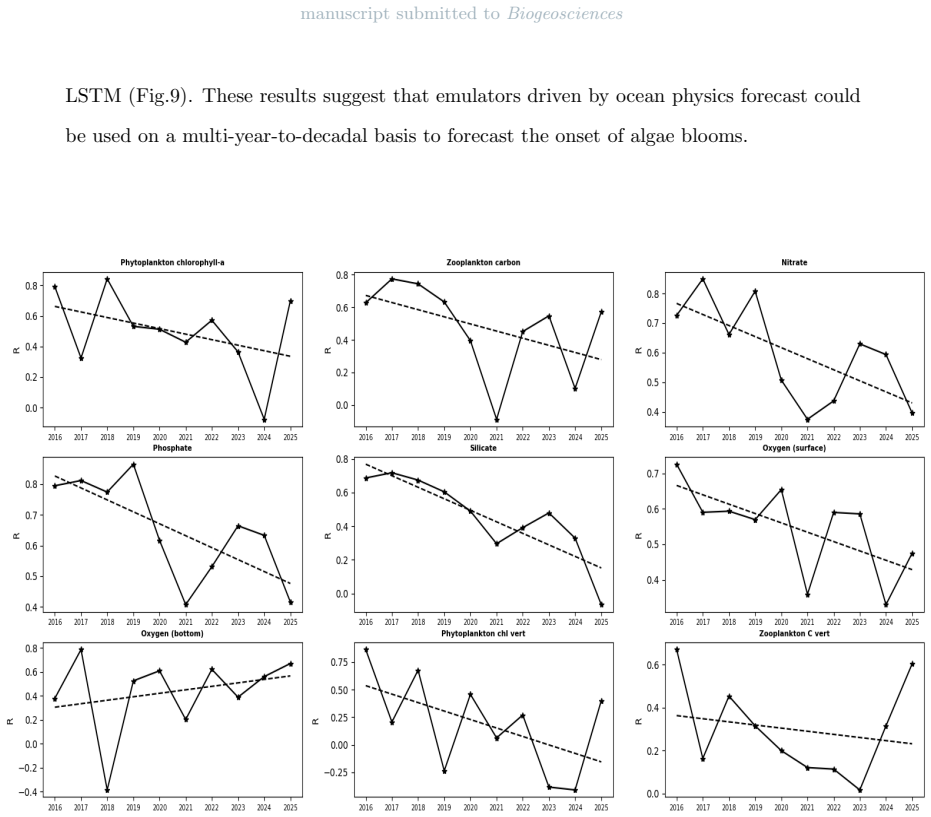
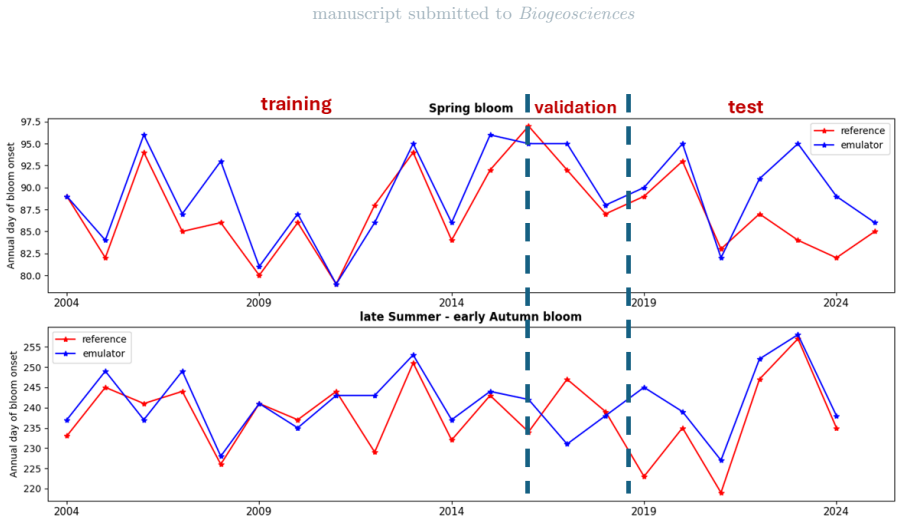
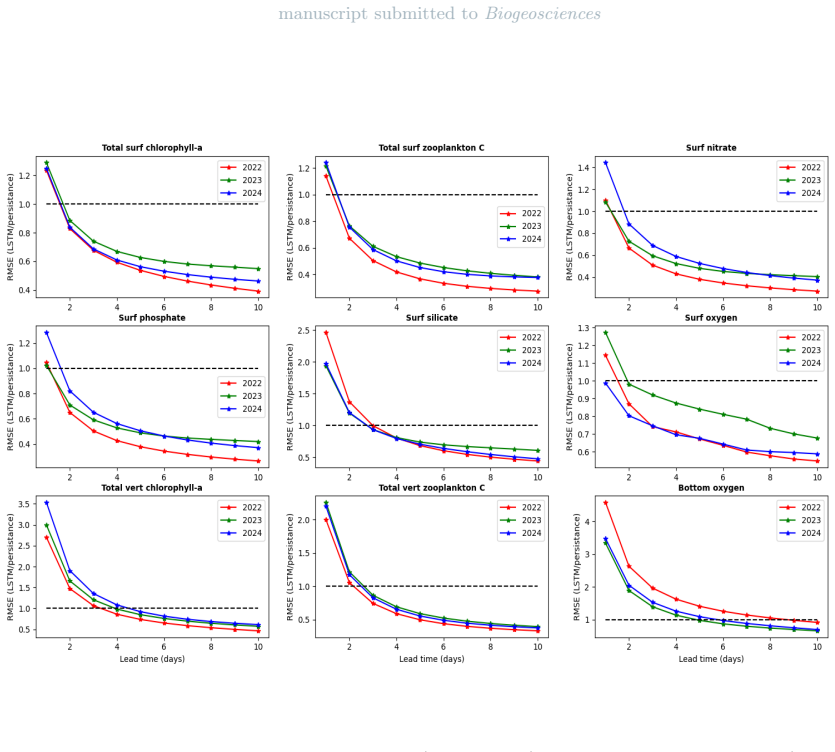
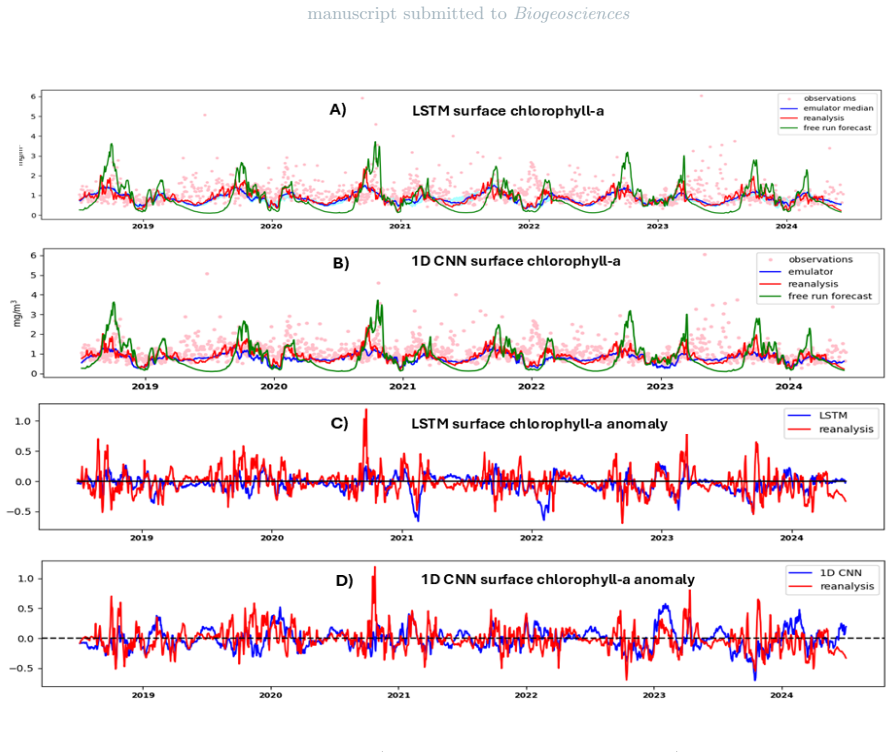
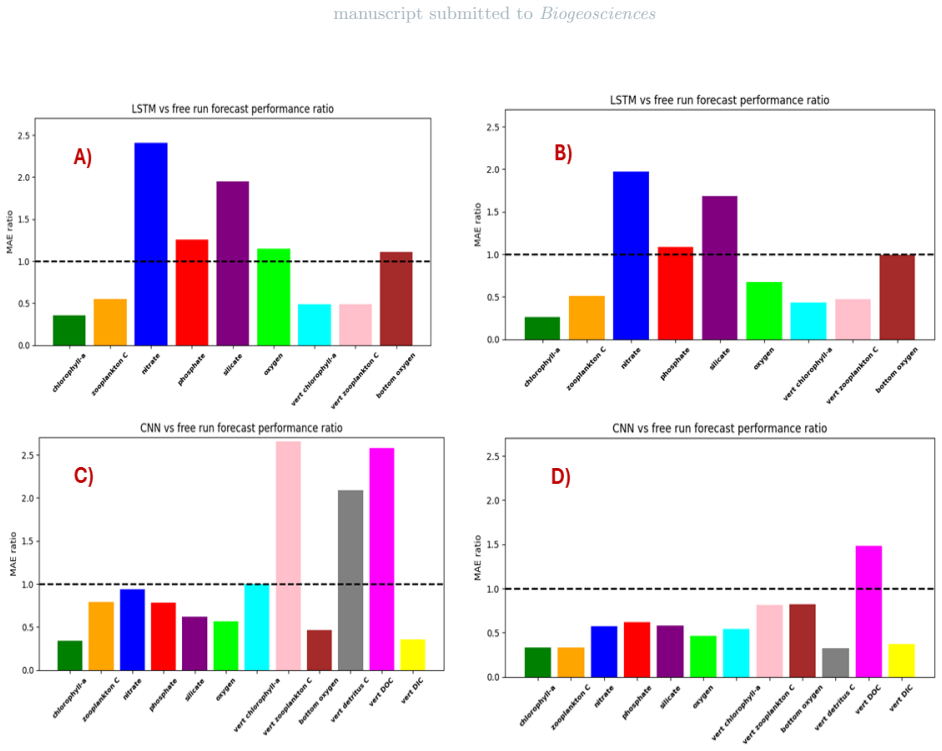
Both the LSTM and 1D-CNN emulators remain largely stable over multi-decadal timescales and accurately reproduce the parent model in decadal climate projections and short-range (10-day) forecasting applications, including the ability to predict the timing of phytoplankton Spring blooms several years in advance; when trained on reanalysis data the emulators substantially outperform the parent model's forecast skill score for several key ecosystem variables.
What carries the argument
LSTM networks and physics-informed 1D CNNs that take ocean physics simulator inputs and output daily-resolution biogeochemical states.
If this is right
- Operational marine forecasting could run at higher resolution or with larger ensembles at the same computational budget.
- Climate-scale simulations of marine ecosystems become feasible at lower cost while preserving daily variability and extreme-event statistics.
- Explainability methods applied to the emulators can reveal key physical drivers of emergent ecosystem behaviour.
- Marine autonomous observing systems could use the emulators for on-board short-range prediction.
Where Pith is reading between the lines
- If the 1D-to-3D translation holds, the same architectures could be coupled to existing ocean physics models to produce hybrid Earth-system forecasts.
- Training directly on reanalysis rather than model output may allow the emulators to correct systematic biases present in the parent biogeochemistry model.
- Daily-resolution emulation opens the possibility of ingesting real-time satellite or in-situ data streams for continuous correction of the forecast state.
Load-bearing premise
That success inside a one-dimensional water-column model will carry over once horizontal advection, mesoscale features and three-dimensional boundary conditions are added.
What would settle it
A side-by-side run of the emulators inside a full three-dimensional regional model that shows whether forecast skill scores on phytoplankton and zooplankton remain higher than those of the parent model.
Figures
read the original abstract
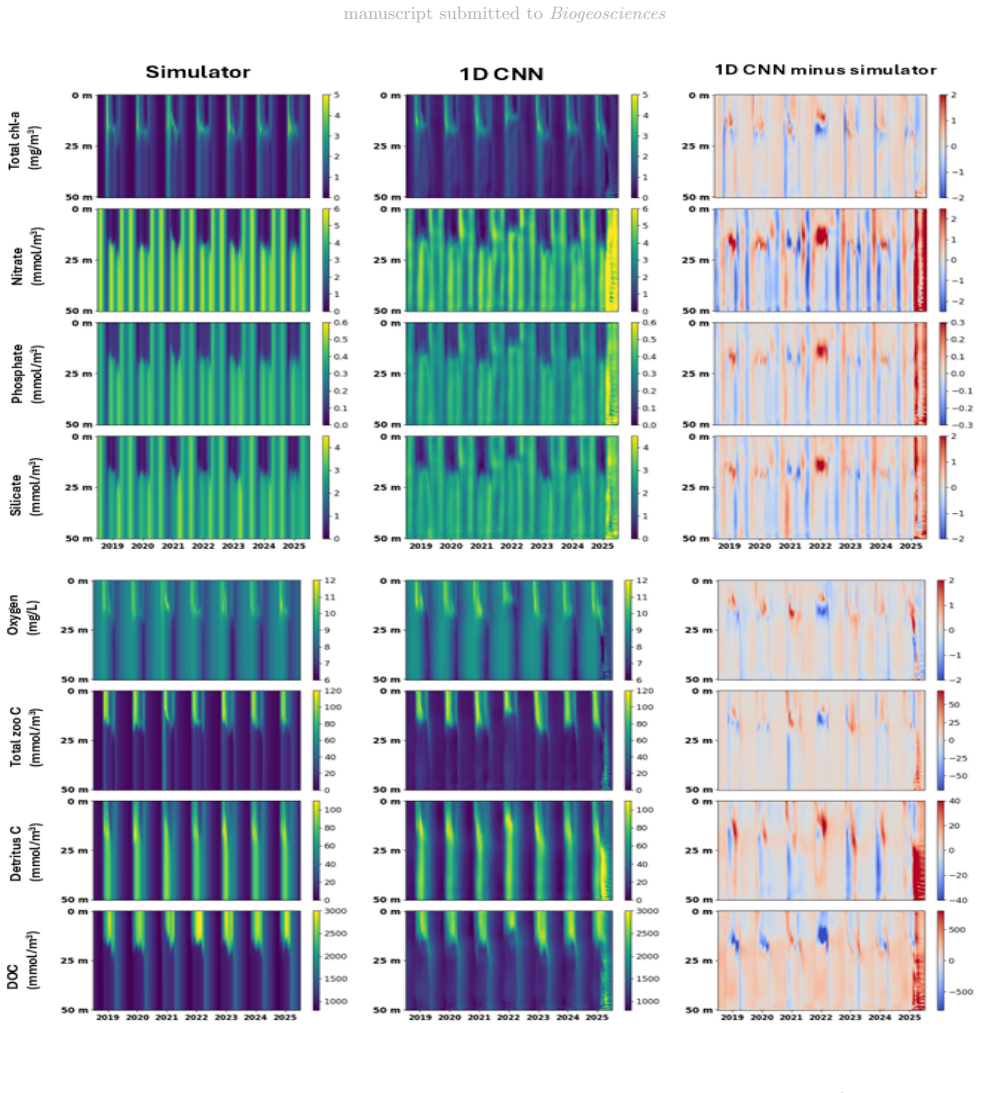
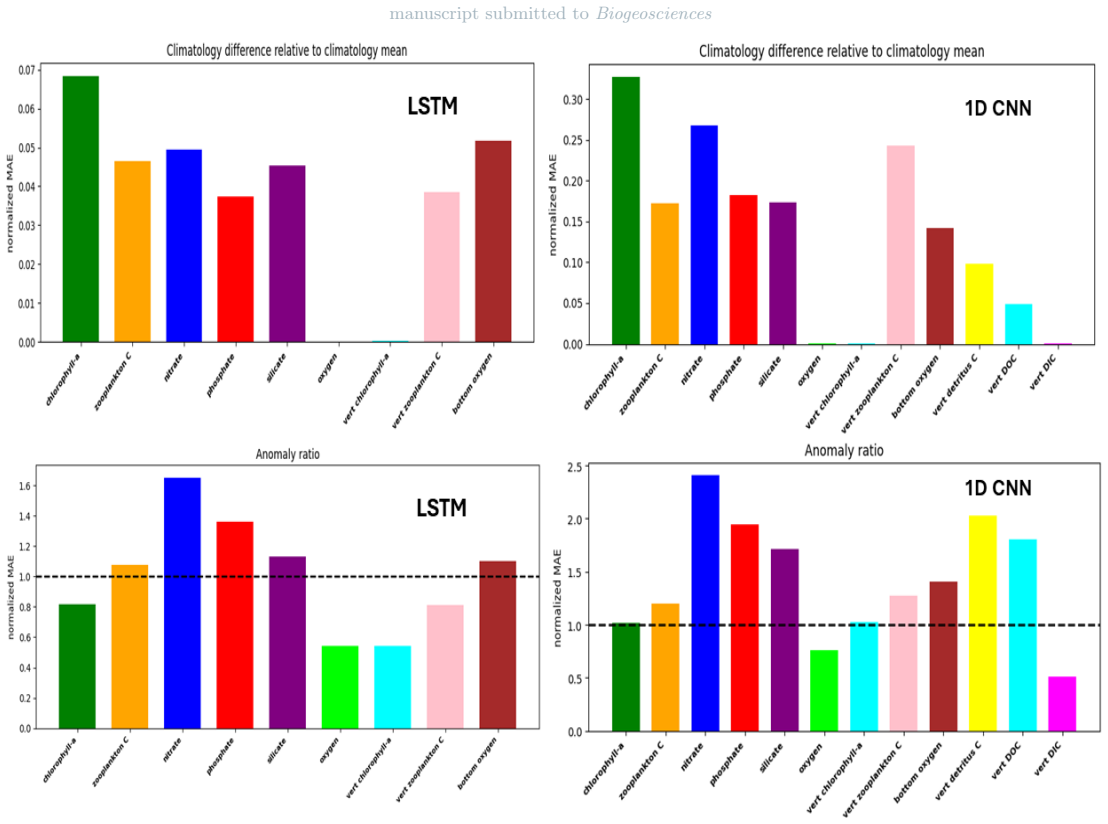
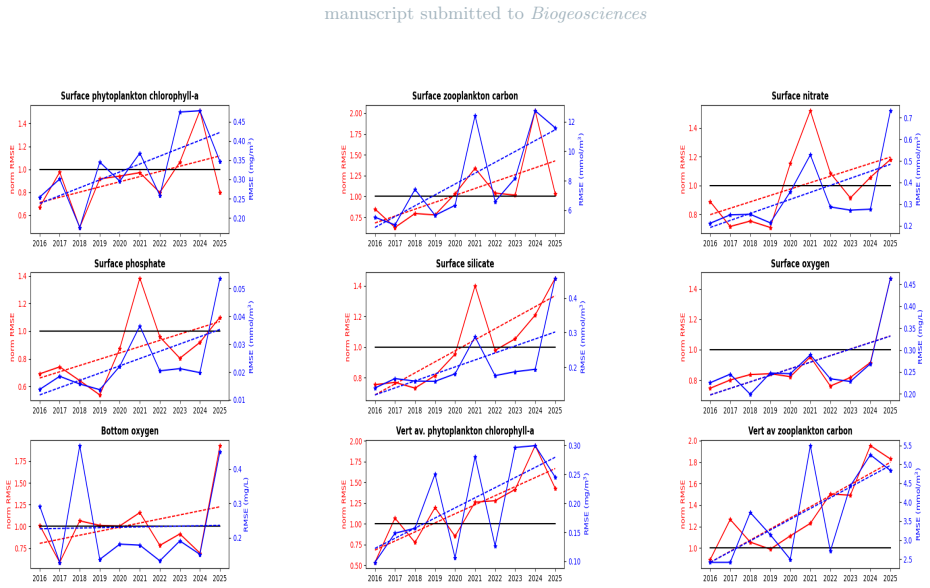
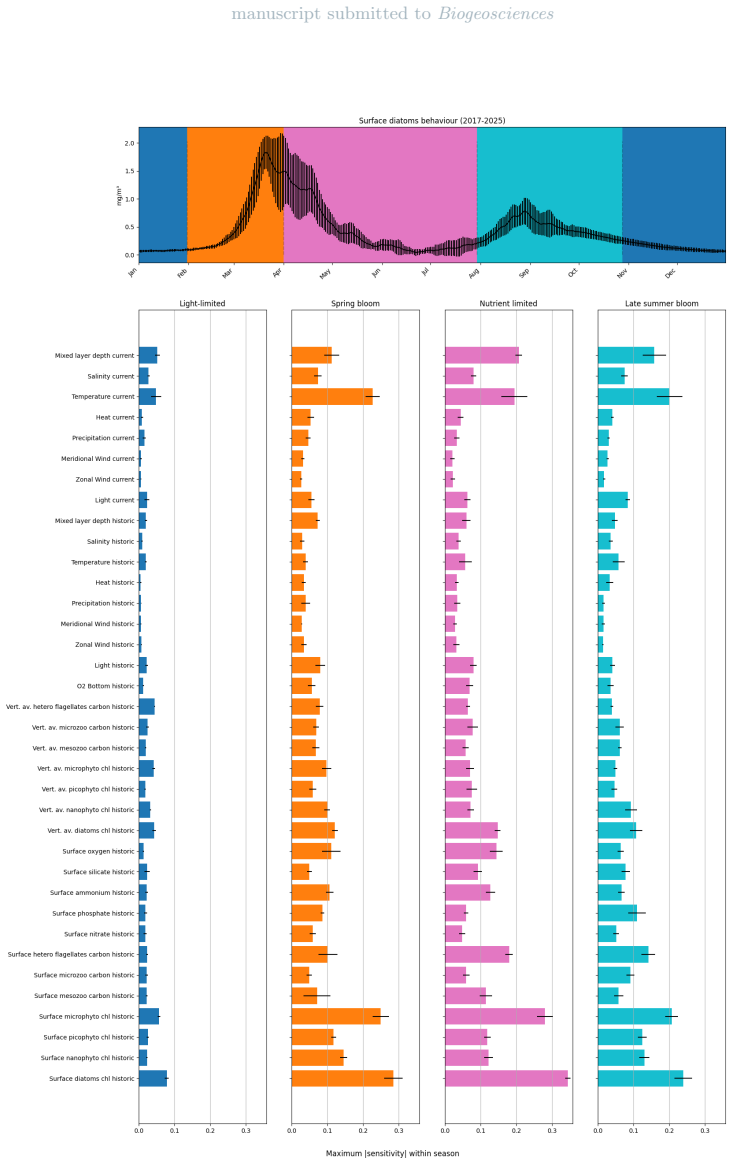
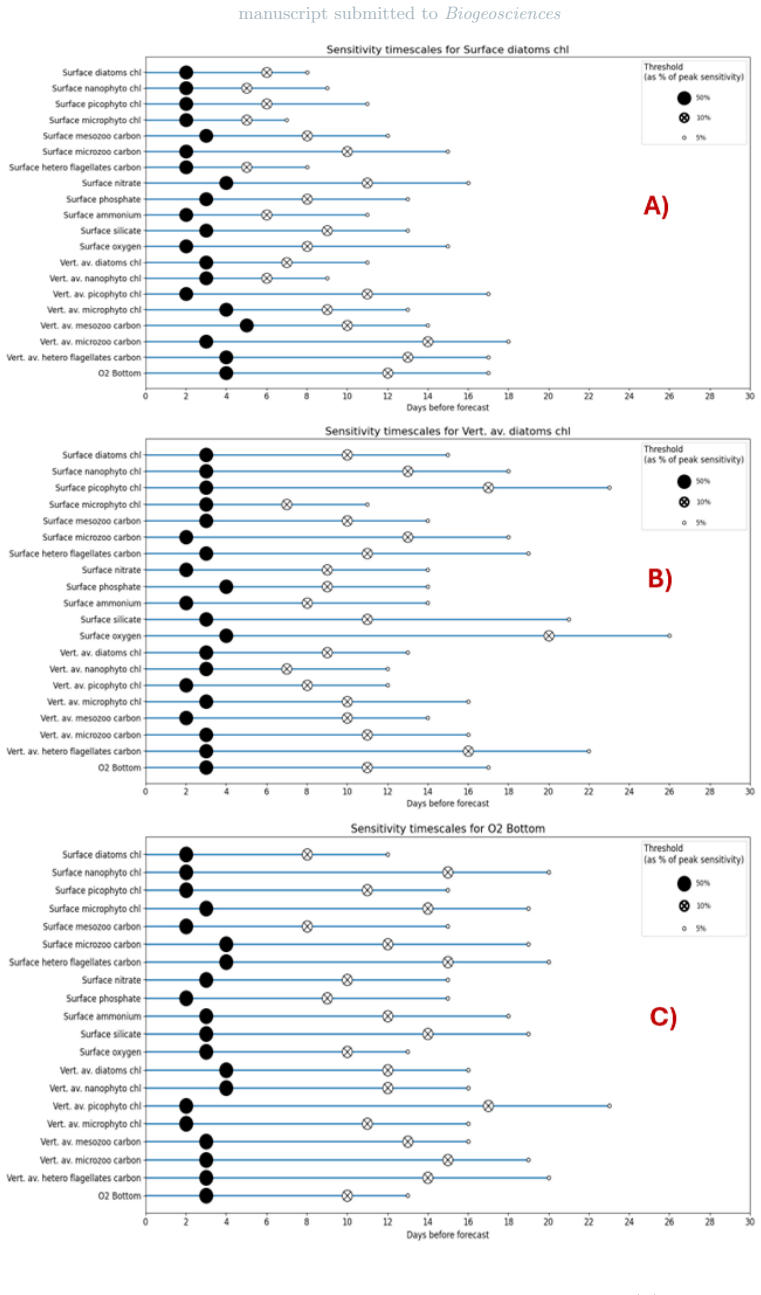
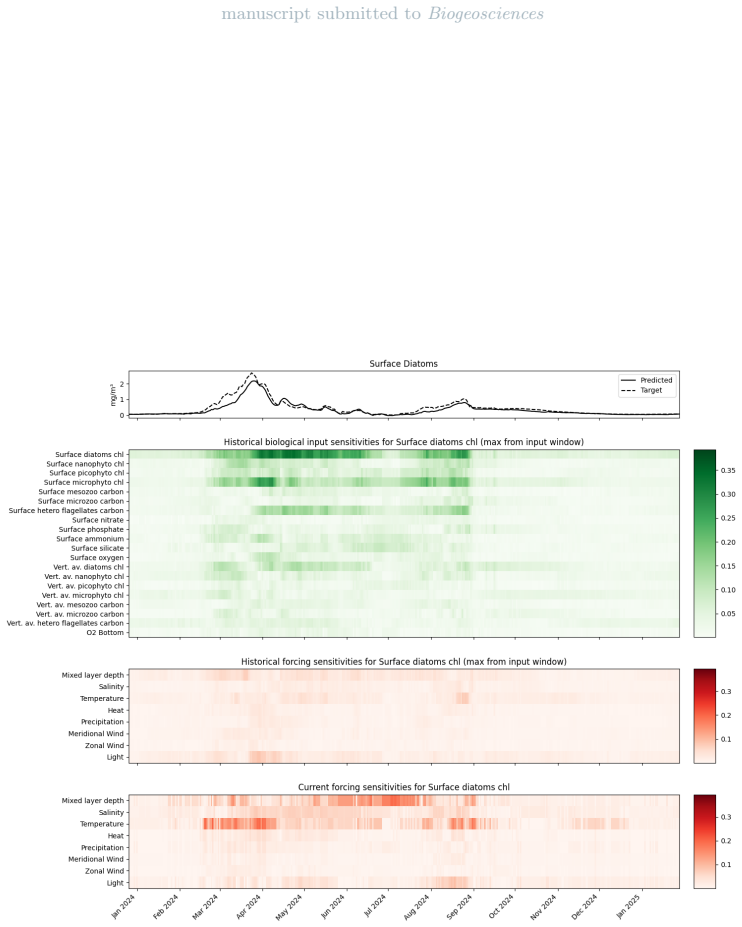
Deep-learning emulators have emerged as a promising approach for reducing the computational cost of Earth System Models while potentially improving forecasting skill. Here, we demonstrate the successful emulation of a high-complexity marine biogeochemistry model within a simplified one-dimensional water-column framework. We explore two emulator architectures: Long Short-Term Memory (LSTM) neural networks that emulate a selected subset of variables at daily resolution, and physics-informed one-dimensional Convolutional Neural Networks (1D CNNs) that emulate the full pelagic system throughout the water column also at daily resolution. Using ocean physics simulator inputs, both emulators remain largely stable over multi-decadal timescales and accurately reproduce the parent model in both decadal climate projections and short-range (10-day) forecasting applications. The former includes the ability to predict the timing of phytoplankton Spring blooms several years in advance. When trained on reanalysis data, the emulators substantially outperform the parent model's forecast skill score for several key ecosystem variables, including phytoplankton and zooplankton. If similar performance can be achieved in three-dimensional regional applications, these emulators could provide substantially higher-quality predictions at a fraction of the computational cost. We further apply novel explainability techniques to identify key drivers of emulator behaviour and gain insights into emergent ecosystem dynamics. Performance is evaluated using a range of metrics, including the reproduction of daily variability and extreme events. These approaches have considerable potential for future applications in operational forecasting, climate-scale simulations, and marine autonomous systems.
Editorial analysis
A structured set of objections, weighed in public.
Referee Report
Summary. The manuscript develops and tests two deep-learning emulators (LSTM networks for selected variables at daily resolution and physics-informed 1D CNNs for the full pelagic system) of a high-complexity marine biogeochemistry model inside a strictly one-dimensional water-column framework. It reports that both emulators remain stable over multi-decadal timescales, reproduce the parent model in decadal climate projections and 10-day forecasts (including multi-year advance prediction of phytoplankton spring-bloom timing), and, when trained on reanalysis data, substantially outperform the parent model on several key variables. Novel explainability methods are applied to identify drivers, and the work is positioned as a step toward lower-cost operational and climate-scale forecasting if the 1D results generalize to three-dimensional settings.
Significance. If the reported 1D stability, bloom-timing skill, and reanalysis outperformance hold under rigorous validation, the work would demonstrate a viable route to computationally inexpensive marine biogeochemistry emulators with potential value for operational forecasting and long-term simulations. The application of explainability techniques to emergent ecosystem dynamics is a positive addition. However, the absence of quantitative error bars, explicit training/validation splits, drift diagnostics, and any 2D/3D sensitivity tests limits the immediate impact.
major comments (2)
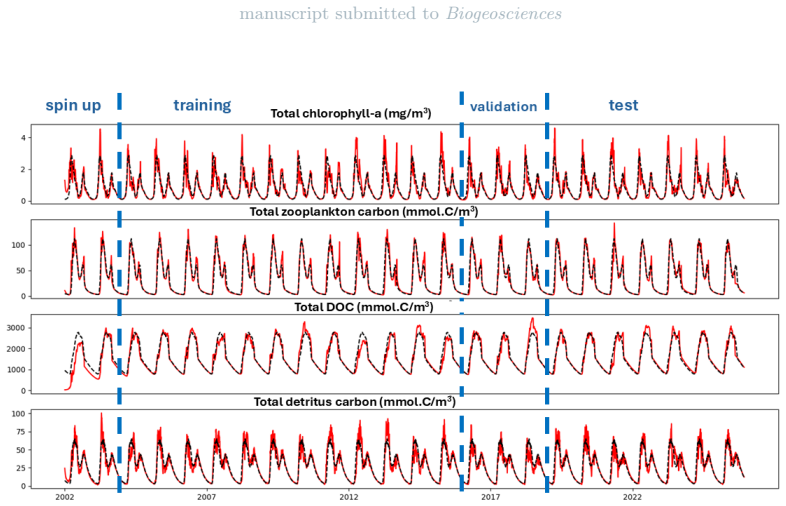
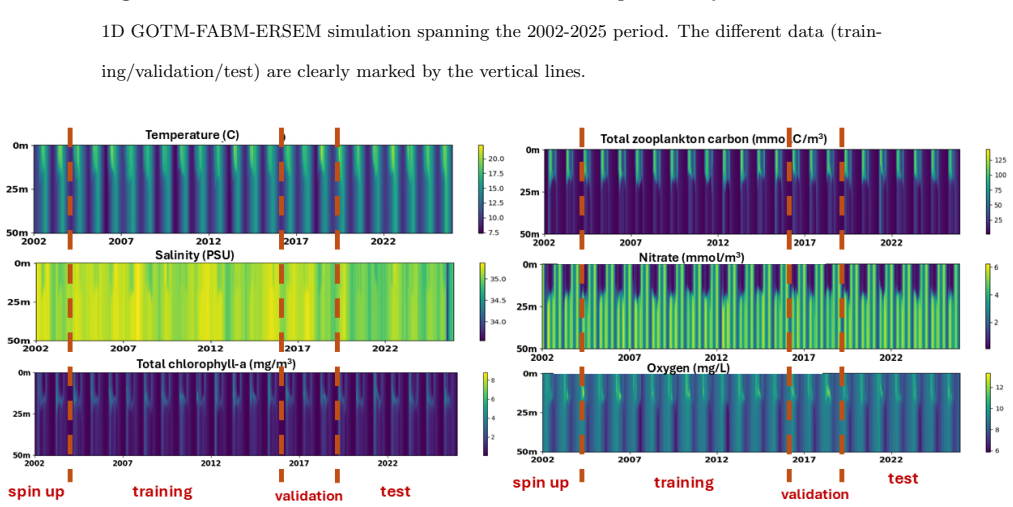
- [Abstract/Methods] Abstract and Methods: the claims of 'successful reproduction,' 'largely stable' multi-decadal behavior, and 'substantially outperform' on reanalysis data are presented without reported quantitative error bars, explicit training/validation/test splits, or drift diagnostics over decades; these omissions make it impossible to assess whether the central performance assertions are robust.
- [Abstract/Discussion] Abstract and Discussion: all quantitative results (multi-decadal stability, spring-bloom prediction years ahead, reanalysis outperformance) are obtained inside a 1-D column where horizontal advection, mesoscale features, and lateral boundary conditions are absent by construction. No ablation study, 2-D schematic experiment, or sensitivity test is described that would indicate whether the LSTM or 1D-CNN architectures retain skill or stability once these processes must be emulated or supplied as inputs; this directly bears on the manuscript's claims for operational forecasting and climate-scale use.
minor comments (1)
- [Abstract] The abstract states that performance is evaluated with 'a range of metrics, including the reproduction of daily variability and extreme events,' but does not list the specific metrics or show example time series; adding these would improve clarity.
Simulated Author's Rebuttal
We thank the referee for their constructive and detailed review. The comments highlight important aspects of robustness and scope that we address point-by-point below. Where the suggestions strengthen the manuscript without altering its core 1D focus, we have incorporated revisions.
read point-by-point responses
-
Referee: [Abstract/Methods] Abstract and Methods: the claims of 'successful reproduction,' 'largely stable' multi-decadal behavior, and 'substantially outperform' on reanalysis data are presented without reported quantitative error bars, explicit training/validation/test splits, or drift diagnostics over decades; these omissions make it impossible to assess whether the central performance assertions are robust.
Authors: We agree that explicit quantitative support improves clarity. The revised manuscript now includes (i) error bars on all reported skill scores and stability metrics, (ii) a clear statement of the training/validation/test split (70/15/15 with temporal blocking to avoid leakage), and (iii) drift diagnostics (mean and maximum absolute drift per variable over 20-year integrations). These additions appear in the updated Methods and Results sections and in new supplementary figures. revision: yes
-
Referee: [Abstract/Discussion] Abstract and Discussion: all quantitative results (multi-decadal stability, spring-bloom prediction years ahead, reanalysis outperformance) are obtained inside a 1-D column where horizontal advection, mesoscale features, and lateral boundary conditions are absent by construction. No ablation study, 2-D schematic experiment, or sensitivity test is described that would indicate whether the LSTM or 1D-CNN architectures retain skill or stability once these processes must be emulated or supplied as inputs; this directly bears on the manuscript's claims for operational forecasting and climate-scale use.
Authors: The study is deliberately restricted to a 1D water-column setting, as stated in the title, abstract, and introduction; the text already qualifies all forecasting and climate claims with the conditional 'if similar performance can be achieved in three-dimensional regional applications.' We have expanded the Discussion to reiterate this scope limitation and to outline the additional inputs (horizontal velocities, lateral boundaries) that would be required for 3D extension. Performing 2D/3D ablation or sensitivity experiments lies outside the present scope, which is to establish baseline emulator viability in 1D before such extensions. revision: partial
Circularity Check
No circularity: performance claims rest on held-out test data and reanalysis, not self-referential definitions
full rationale
The paper trains LSTM and 1D-CNN emulators on parent-model output and reanalysis data, then evaluates reproduction of variables, multi-decadal stability, bloom timing, and forecast skill on held-out periods. These are standard supervised-learning metrics on independent splits; no equation or claim reduces by construction to a fitted parameter or self-citation. The 1D-to-3D extrapolation is explicitly flagged as untested future work rather than assumed. The derivation chain is therefore self-contained against external benchmarks.
Axiom & Free-Parameter Ledger
axioms (1)
- domain assumption The 1D water-column framework captures the dominant vertical processes that determine the target biogeochemical variables.
Reference graph
Works this paper leans on
-
[1]
AIFS--ECMWF's data-driven forecasting system , author=. arXiv preprint arXiv:2406.01465 , year=
-
[2]
Science Advances , volume=
Generative emulation of weather forecast ensembles with diffusion models , author=. Science Advances , volume=. 2024 , publisher=
2024
-
[3]
Proceedings of the IEEE conference on computer vision and pattern recognition , pages=
Deep residual learning for image recognition , author=. Proceedings of the IEEE conference on computer vision and pattern recognition , pages=
-
[4]
Science , volume=
Learning skillful medium-range global weather forecasting , author=. Science , volume=. 2023 , publisher=
2023
-
[5]
Nature , volume=
Accurate medium-range global weather forecasting with 3D neural networks , author=. Nature , volume=. 2023 , publisher=
2023
-
[6]
Fourcastnet: A global data-driven high-resolution weather model using adaptive fourier neural operators , author=. arXiv preprint arXiv:2202.11214 , year=
work page internal anchor Pith review Pith/arXiv arXiv
-
[7]
Journal of Advances in Modeling Earth Systems , volume=
A reliable generative adversarial network approach for climate downscaling and weather generation , author=. Journal of Advances in Modeling Earth Systems , volume=. 2025 , publisher=
2025
-
[8]
Earth's Future , volume=
AI-driven weather forecasts to accelerate climate change attribution of heatwaves , author=. Earth's Future , volume=. 2025 , publisher=
2025
-
[9]
Nature Communications , volume=
Artificial intelligence for modeling and understanding extreme weather and climate events , author=. Nature Communications , volume=. 2025 , publisher=
2025
-
[10]
Geophysical Research Letters , volume=
Samudra: An AI global ocean emulator for climate , author=. Geophysical Research Letters , volume=. 2025 , publisher=
2025
-
[11]
Ocean Science , volume=
Long-term prediction of the Gulf Stream meander using OceanNet: a principled neural-operator-based digital twin , author=. Ocean Science , volume=. 2025 , publisher=
2025
-
[12]
arXiv preprint arXiv:2509.12490 , year=
SamudrACE: Fast and accurate coupled climate modeling with 3D ocean and atmosphere emulators , author=. arXiv preprint arXiv:2509.12490 , year=
-
[13]
arXiv preprint arXiv:2402.04342 , year=
Building ocean climate emulators , author=. arXiv preprint arXiv:2402.04342 , year=
-
[14]
Geophysical Research Letters , volume=
On some limitations of current machine learning weather prediction models , author=. Geophysical Research Letters , volume=. 2024 , publisher=
2024
-
[15]
arXiv preprint arXiv:2405.15412 , volume=
ORCA: A global ocean emulator for multi-year to decadal predictions , author=. arXiv preprint arXiv:2405.15412 , volume=
-
[16]
arXiv preprint arXiv:2410.11807 , year=
Regional ocean forecasting with hierarchical graph neural networks , author=. arXiv preprint arXiv:2410.11807 , year=
-
[17]
arXiv preprint arXiv:2308.03152 , year=
Ai-goms: Large ai-driven global ocean modeling system , author=. arXiv preprint arXiv:2308.03152 , year=
-
[18]
Journal of Marine Systems , volume=
Estimating time-dependent parameters for a biological ocean model using an emulator approach , author=. Journal of Marine Systems , volume=. 2012 , publisher=
2012
-
[19]
Biogeosciences Discussions , volume=
Reviews and syntheses: parameter identification in marine planktonic ecosystem modelling , author=. Biogeosciences Discussions , volume=. 2016 , publisher=
2016
-
[20]
Frontiers in Marine Science , volume=
Identifying drivers and dynamics of phytoplankton in the Black Sea: application of a neural emulator , author=. Frontiers in Marine Science , volume=. 2026 , publisher=
2026
-
[21]
Environmental Modelling & Software , pages=
Physically-informed Deep Neural Network for the joint prediction of chlorophyll-a and hydrographic 3D structure of the Mediterranean Sea , author=. Environmental Modelling & Software , pages=. 2025 , publisher=
2025
-
[22]
Science of the Total Environment , volume=
Sub-monthly time scale forecasting of harmful algal blooms intensity in Lake Erie using remote sensing and machine learning , author=. Science of the Total Environment , volume=. 2023 , publisher=
2023
-
[23]
Salva Rühling Cachay, Miika Aittala, Hailey James, and Rose Yu
Fourcastnet 3: A geometric approach to probabilistic machine-learning weather forecasting at scale , author=. arXiv preprint arXiv:2507.12144 , year=
-
[24]
Biogeosciences , volume=
iMarNet: an ocean biogeochemistry model intercomparison project within a common physical ocean modelling framework , author=. Biogeosciences , volume=. 2014 , publisher=
2014
-
[25]
EGUsphere , volume=
Equation discovery for climate impact: emulating impact models for unexplored climate scenario with interpretable symbolic regression , author=. EGUsphere , volume=. 2026 , publisher=
2026
-
[26]
ICES Journal of Marine Science , volume=
On conditions for the vernal blooming of phytoplankton , author=. ICES Journal of Marine Science , volume=. 1953 , publisher=
1953
-
[27]
Limnology and oceanography , volume=
Critical depth and critical turbulence: two different mechanisms for the development of phytoplankton blooms , author=. Limnology and oceanography , volume=. 1999 , publisher=
1999
-
[28]
Ecology , volume=
Abandoning Sverdrup's critical depth hypothesis on phytoplankton blooms , author=. Ecology , volume=. 2010 , publisher=
2010
-
[29]
Journal of Geophysical Research: Machine Learning and Computation , year=
Estimating carbon pools in the European Shelf sea environment: replacing reanalysis by model-informed machine learning? , author=. Journal of Geophysical Research: Machine Learning and Computation , year=
-
[30]
Nature Reviews Methods Primers , volume=
Ocean biogeochemical modelling , author=. Nature Reviews Methods Primers , volume=. 2022 , publisher=
2022
-
[31]
Frontiers in Marine Science , volume=
Advancing marine biogeochemical and ecosystem reanalyses and forecasts as tools for monitoring and managing ecosystem health , author=. Frontiers in Marine Science , volume=. 2019 , publisher=
2019
-
[32]
Quarterly Journal of the Royal Meteorological Society , volume=
Validating and improving the uncertainty assumptions for the assimilation of ocean-colour-derived chlorophyll a into a marine biogeochemistry model of the northwest European shelf seas , author=. Quarterly Journal of the Royal Meteorological Society , volume=. 2023 , publisher=
2023
-
[33]
Quarterly Journal of the Royal Meteorological Society , pages=
Assimilation of machine-learning-predicted nitrate to improve the quality of phytoplankton forecasting in the shelf-sea environment , author=. Quarterly Journal of the Royal Meteorological Society , pages=. 2026 , publisher=
2026
-
[34]
Biogeosciences , volume=
Hybrid machine learning data assimilation for marine biogeochemistry , author=. Biogeosciences , volume=. 2026 , publisher=
2026
-
[35]
Journal of Geophysical Research: Oceans , volume=
Sensitivity of shelf sea marine ecosystems to temporal resolution of meteorological forcing , author=. Journal of Geophysical Research: Oceans , volume=. 2020 , publisher=
2020
-
[36]
Journal of Geophysical Research: Oceans , volume=
Assessment of skill and portability in regional marine biogeochemical models: Role of multiple planktonic groups , author=. Journal of Geophysical Research: Oceans , volume=. 2007 , publisher=
2007
-
[37]
Journal of Marine Systems , volume=
Gaussian anamorphosis extension of the DEnKF for combined state parameter estimation: Application to a 1D ocean ecosystem model , author=. Journal of Marine Systems , volume=. 2012 , publisher=
2012
-
[38]
Method and parameter estimates , author=
Simultaneous data-based optimisation of a 1D-ecosystem model at three locations in the North Atlantic Ocean: Part 1. Method and parameter estimates , author=. Journal of Marine Research , volume=. 2003 , publisher=
2003
-
[39]
Ocean Modelling (submitted) , year=
Improving the prediction of ecosystem indicators by assimilating biogeochemical data from multiplatform observing systems , author=. Ocean Modelling (submitted) , year=
-
[40]
Progress in Oceanography , volume=
Control of simulated ocean ecosystem indicators by biogeochemical observations , author=. Progress in Oceanography , volume=. 2025 , publisher=
2025
-
[41]
Handbook of Brain Theory and Neural Networks , editor =
LeCun, Yann and Bengio, Yoshua , title =. Handbook of Brain Theory and Neural Networks , editor =
-
[42]
Neural Computation , volume=
Long Short-Term Memory , author=. Neural Computation , volume=
-
[43]
Journal of Marine systems , volume=
Description of a flexible and extendable physical--biogeochemical model system for the water column , author=. Journal of Marine systems , volume=. 2006 , publisher=
2006
-
[44]
Environmental modelling & software , volume=
A general framework for aquatic biogeochemical models , author=. Environmental modelling & software , volume=. 2014 , publisher=
2014
-
[45]
Data assimilation methodology , author=
Physical and biological modeling in the Gulf Stream region:: I. Data assimilation methodology , author=. Deep Sea Research Part I: Oceanographic Research Papers , volume=. 2000 , publisher=
2000
-
[46]
Journal of Marine Systems , volume=
The carbonate system in the North Sea: Sensitivity and model validation , author=. Journal of Marine Systems , volume=. 2012 , publisher=
2012
-
[47]
Biogeosciences , volume=
Relationships between the surface concentration of particulate organic carbon and optical properties in the eastern South Pacific and eastern Atlantic Oceans , author=. Biogeosciences , volume=. 2008 , publisher=
2008
-
[48]
Science of the Total Environment , volume=
Modelling terrigenous DOC across the north west European Shelf: Fate of riverine input and impact on air-sea CO2 fluxes , author=. Science of the Total Environment , volume=. 2024 , publisher=
2024
-
[49]
Zenodo , year=
NECCTON: Technical specification of the pelagic lower trophic level products , author=. Zenodo , year=
-
[50]
Journal of Marine Systems , volume=
Modelling the combined impacts of climate change and direct anthropogenic drivers on the ecosystem of the northwest European continental shelf , author=. Journal of Marine Systems , volume=. 2015 , publisher=
2015
-
[51]
Combining machine learning with data assimilation to improve the quality of phytoplankton forecasting in a shelf sea environment , author=. submitted to QJRMS, arXiv:2508.02400, https://arxiv.org/abs/2508.02400 , year=
work page internal anchor Pith review Pith/arXiv arXiv
-
[52]
Journal of Geophysical Research: Oceans , volume=
Algorithm development and validation for satellite-derived distributions of DOC and CDOM in the US Middle Atlantic Bight , author=. Journal of Geophysical Research: Oceans , volume=. 2008 , publisher=
2008
-
[53]
Frontiers in Marine Science , pages=
Uncertainty in ocean-color estimates of chlorophyll for phytoplankton groups , author=. Frontiers in Marine Science , pages=
-
[54]
Frontiers in Applied Mathematics and Statistics , volume=
Joint interpolation and representation learning for irregularly sampled satellite-derived geophysical fields , author=. Frontiers in Applied Mathematics and Statistics , volume=
-
[55]
Journal of Geophysical Research: Oceans , volume=
Modeling the carbon fluxes of the northwest European continental shelf: Validation and budgets , author=. Journal of Geophysical Research: Oceans , volume=. 2012 , publisher=
2012
-
[56]
Biogeosciences , volume=
Investigating ecosystem connections in the shelf sea environment using complex networks , author=. Biogeosciences , volume=. 2024 , publisher=
2024
-
[57]
NEMO-FABM-ERSEM free run 2016-2020 simulations , year =
Sk. NEMO-FABM-ERSEM free run 2016-2020 simulations , year =
2016
-
[58]
NEMO-FABM-ERSEM reanalysis 2016-2020 simulations , year =
Sk. NEMO-FABM-ERSEM reanalysis 2016-2020 simulations , year =
2016
-
[59]
NN code and weights , year =
Sk. NN code and weights , year =
-
[60]
Earth System Science Data Discussions , volume=
Global carbon budget 2024 , author=. Earth System Science Data Discussions , volume=. 2024 , publisher=
2024
-
[61]
Estuarine, coastal and shelf science , volume=
Carbon dioxide in European coastal waters , author=. Estuarine, coastal and shelf science , volume=. 2006 , publisher=
2006
-
[62]
Carbon and nutrient fluxes in continental margins: A global synthesis , pages=
Global synthesis1 , author=. Carbon and nutrient fluxes in continental margins: A global synthesis , pages=. 2010 , publisher=
2010
-
[63]
2008 , publisher=
Chemical oceanography and the marine carbon cycle , author=. 2008 , publisher=
2008
-
[64]
The carbon cycle and atmospheric CO2: Natural variations Archean to present , volume=
Ocean carbon pumps: Analysis of relative strengths and efficiencies in ocean-driven atmospheric CO2 changes , author=. The carbon cycle and atmospheric CO2: Natural variations Archean to present , volume=. 1985 , publisher=
1985
-
[65]
Frontiers in Marine Science , volume=
Satellite ocean colour: current status and future perspective , author=. Frontiers in Marine Science , volume=. 2019 , publisher=
2019
-
[66]
Earth-Science Reviews , volume=
Sensing the ocean biological carbon pump from space: A review of capabilities, concepts, research gaps and future developments , author=. Earth-Science Reviews , volume=. 2021 , publisher=
2021
-
[67]
Frontiers in Marine Science , volume=
Validation and intercomparison of ocean color algorithms for estimating particulate organic carbon in the oceans , author=. Frontiers in Marine Science , volume=. 2017 , publisher=
2017
-
[68]
Journal of Geophysical Research: Oceans , volume=
A color-index-based empirical algorithm for determining particulate organic carbon concentration in the ocean from satellite observations , author=. Journal of Geophysical Research: Oceans , volume=. 2018 , publisher=
2018
-
[69]
Remote Sensing of Environment , volume=
Size-partitioned phytoplankton carbon and carbon-to-chlorophyll ratio from ocean colour by an absorption-based bio-optical algorithm , author=. Remote Sensing of Environment , volume=. 2017 , publisher=
2017
-
[70]
Applied Optics , volume=
Reconciling models of primary production and photoacclimation , author=. Applied Optics , volume=. 2020 , publisher=
2020
-
[71]
Advances in neural information processing systems , volume=
A unified approach to interpreting model predictions , author=. Advances in neural information processing systems , volume=
-
[72]
Proceedings of the National Institute of Sciences of India , volume=
On the generalised distance in statistics , author=. Proceedings of the National Institute of Sciences of India , volume=
-
[73]
Facta Universitatis, Series: Mathematics and Informatics , pages=
Mahalanobis distance and its application for detecting multivariate outliers , author=. Facta Universitatis, Series: Mathematics and Informatics , pages=
-
[74]
Neural computation , volume=
A review of recurrent neural networks: LSTM cells and network architectures , author=. Neural computation , volume=
-
[75]
IEEE transactions on neural networks and learning systems , volume=
A survey of convolutional neural networks: analysis, applications, and prospects , author=. IEEE transactions on neural networks and learning systems , volume=. 2021 , publisher=
2021
-
[76]
Remote sensing of Environment , volume=
Pan-Arctic optical characteristics of colored dissolved organic matter: Tracing dissolved organic carbon in changing Arctic waters using satellite ocean color data , author=. Remote sensing of Environment , volume=. 2017 , publisher=
2017
-
[77]
Frontiers in Marine Science , volume=
A machine learning model-based satellite data record of dissolved organic carbon concentration in surface waters of the global open ocean , author=. Frontiers in Marine Science , volume=. 2024 , publisher=
2024
-
[78]
Quarterly Journal of the Royal Meteorological Society , volume=
Global seasonal forecast system version 5 (GloSea5): A high‐resolution seasonal forecast system , author=. Quarterly Journal of the Royal Meteorological Society , volume=
-
[79]
Geoscientific Model Development , volume=
The CO5 configuration of the 7 km Atlantic Margin Model: large-scale biases and sensitivity to forcing, physics options and vertical resolution , author=. Geoscientific Model Development , volume=
-
[80]
IEEE transactions on neural networks , volume=
The graph neural network model , author=. IEEE transactions on neural networks , volume=
discussion (0)
Sign in with ORCID, Apple, or X to comment. Anyone can read and Pith papers without signing in.