REVIEW 2 major objections 2 minor 97 references
cBHBd: A fast code for the evolution of tidally limited star clusters and their binary black hole mergers
T0 review · 2 major / 2 minor · reviewed 2026-06-29 · grok-4.3
Pith's one-line read Updated cBHBd code reproduces cluster mass, radius, black hole populations and merger rates to within 10-20 percent after fitting seven parameters.
desk verdict Incremental cBHBd update adds GW capture prescriptions but the 10-20% accuracy numbers rest on a seven-parameter fit to the CMC runs being matched. read the letter →
The pith
A machine-rendered reading of the paper's core claim, the machinery that carries it, and where it could break.
The reading
What carries the argument
The cBHBd code with its seven fitted parameters and new prescriptions for gravitational wave captures during BBH-BBH interactions and resonant eccentricity pumping.
What would settle it
A direct N-body or Monte Carlo simulation of a cluster with initial mass, density, or metallicity outside the fitted range that yields binary black hole merger rates differing by more than 20 percent from the cBHBd prediction.
Extended reading notes
Core claim
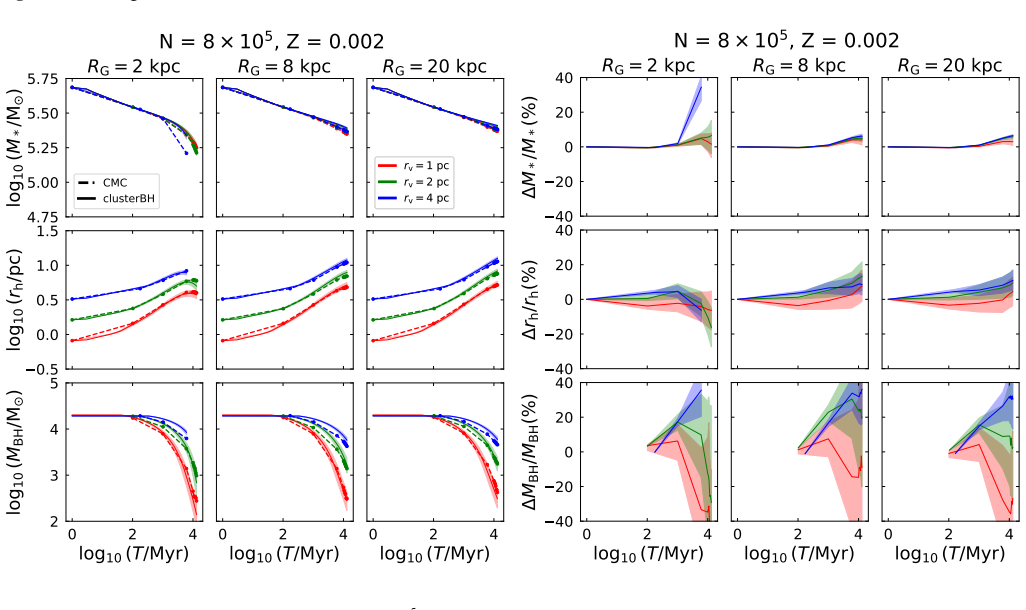
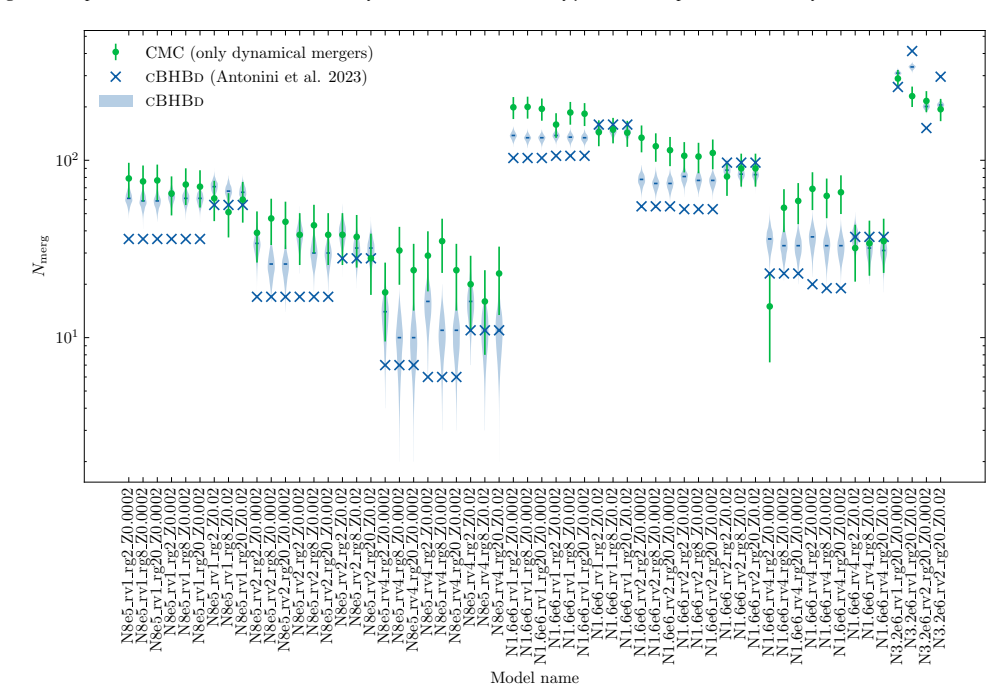
The central claim is that the updated cBHBd code, after fitting seven model parameters to Cluster Monte Carlo results and adding new gravitational wave capture prescriptions for binary-binary interactions and resonant distant encounters, reproduces the evolution of cluster mass, half-mass radius, and black hole population over 13 Gyr to within ~10 percent while matching binary black hole merger rates from both CMC models of clusters above 10^5 solar masses and direct N-body models of lower-mass clusters to within ~20 percent.
Load-bearing premise
The seven fitted parameters together with the new gravitational wave capture rules will produce accurate merger rates and cluster evolution for initial conditions outside the specific Cluster Monte Carlo models used in the fit.
Editorial extensions
If this is right
- The one-second runtime per cluster enables systematic searches over wide ranges of globular cluster initial conditions.
- The code can be used for modeling the contribution of clusters to observed stellar streams.
- It supports population synthesis calculations of gravitational wave sources from tidally limited clusters.
- Validation against both massive and lower-mass clusters indicates the same framework applies across a factor of ten in cluster mass.
Reading between the lines
- The code could be extended to predict how merger rates change when clusters form in galaxies with different tidal fields or metallicities.
- Comparisons with future observations of black hole populations in surviving clusters would test whether the fitted evaporation treatment holds at late times.
- Because the gravitational wave capture rules are now explicit, the same prescriptions could be inserted into other fast cluster codes for cross-checks.
Editorial analysis
A structured set of objections, weighed in public.
Referee Report
Summary. The manuscript presents an updated version of the cBHBd code for fast evolution of tidally limited star clusters containing stars and stellar-mass black holes. Improvements include refined evaporation in the Galactic tidal field, inclusion of metallicity and stellar mass function effects, and new prescriptions for GW captures in BBH-BBH interactions and resonant encounters. Seven model parameters are fitted via nested sampling to Cluster Monte Carlo (CMC) results; with best-fit values the code reproduces cluster mass, half-mass radius, and BH population evolution over 13 Gyr to ~10% and BBH merger rates from CMC (massive clusters) and N-body (lower-mass clusters) models to ~20%. The code runs in ~1 s per cluster.
Significance. A validated fast code of this type would enable efficient exploration of large initial-condition spaces for globular cluster populations and their contribution to gravitational-wave sources. The new GW-capture terms address a physically relevant channel, and the reported runtime is a clear practical strength if the accuracy claims hold independently of the fitting procedure.
major comments (2)
- [Abstract and validation section] The central accuracy claims (~10% for cluster properties and ~20% for merger rates) are obtained after fitting seven model parameters directly to the CMC output being reproduced (see abstract and validation discussion). This procedure makes the reported agreement dependent on the fit by construction rather than an independent test of the underlying prescriptions.
- [N-body comparison paragraph] The ~20% agreement claim with direct N-body models for clusters ≲10^5 M_⊙ is stated without listing the specific runs, their initial masses/radii/metallicities, sample size, or the exact merger-rate metric used. Because the seven parameters were optimized exclusively on CMC, any mismatch in the N-body regime would falsify the generalization assumption without being detectable from the CMC residuals alone.
minor comments (2)
- [Methods] Define the seven fitted parameters explicitly, state their physical motivation, and report the priors and convergence diagnostics for the nested sampling.
- [Validation] Clarify whether the N-body comparison runs are drawn from the literature or newly performed, and provide a table or appendix with their initial conditions and quantitative comparison metrics.
Simulated Author's Rebuttal
We thank the referee for the constructive comments. We address each major point below and will revise the manuscript to improve clarity and add requested details.
read point-by-point responses
-
Referee: [Abstract and validation section] The central accuracy claims (~10% for cluster properties and ~20% for merger rates) are obtained after fitting seven model parameters directly to the CMC output being reproduced (see abstract and validation discussion). This procedure makes the reported agreement dependent on the fit by construction rather than an independent test of the underlying prescriptions.
Authors: We agree that the ~10% agreement for cluster mass, half-mass radius, and BH population evolution is achieved after fitting the seven parameters to CMC simulations and is therefore by construction for those quantities. The ~20% agreement for BBH merger rates includes comparisons to independent N-body simulations that were not part of the fitting procedure. We will revise the abstract and validation section to explicitly distinguish the fitted CMC results from the independent N-body validation and to clarify the role of the fitting as a calibration step for the fast code. revision: yes
-
Referee: [N-body comparison paragraph] The ~20% agreement claim with direct N-body models for clusters ≲10^5 M_⊙ is stated without listing the specific runs, their initial masses/radii/metallicities, sample size, or the exact merger-rate metric used. Because the seven parameters were optimized exclusively on CMC, any mismatch in the N-body regime would falsify the generalization assumption without being detectable from the CMC residuals alone.
Authors: We acknowledge that the manuscript lacks sufficient detail on the N-body comparison. In the revision we will add a table or explicit list of the specific N-body runs used, including their initial masses, radii, metallicities, the number of simulations, and the precise merger-rate metric (e.g., total mergers per cluster or rate per unit time). This will allow independent assessment of generalization beyond the CMC fit. revision: yes
Circularity Check
7-parameter fit to CMC results presented as reproduction of CMC evolution and merger rates to 10-20%
-
fitted input called prediction
[Abstract]
"Seven model parameters are fitted to the CMC results with nested sampling. With the best-fit values, the evolution of the cluster mass, half-mass radius, and BH population over 13 Gyr is reproduced to within ∼10%. The new GW capture prescriptions allow cBHBd to reproduce BBH merger rates from CMC models of massive clusters (≳10^5 M_⊙) and direct N-body models of lower-mass clusters (≲10^5 M_⊙) to within ∼20%."
The seven parameters are optimized to match CMC outputs; the reported agreement with CMC evolution and merger rates is therefore the result of the fit rather than an independent prediction or validation.
full rationale
The paper explicitly fits seven parameters to CMC outputs via nested sampling, then reports that the best-fit values reproduce the same CMC cluster evolution (mass, radius, BH population) to ~10% and BBH merger rates from CMC models to ~20%. This directly matches the fitted_input_called_prediction pattern: the quoted agreement is the output of the fit rather than an independent test. N-body comparisons are cited as additional support but are not shown to be part of the fitting; the CMC reproduction claim remains circular by construction. No other load-bearing steps (self-citation chains, ansatzes, or uniqueness theorems) are evident from the provided text.
Assumptions & free parameters
free parameters (1)
- seven model parameters
assumptions (1)
- domain assumption Cluster evolution is driven by stellar mass loss, two-body relaxation, and evaporation in the Galactic tidal field
Cite this review
Pith. "Pith review of cBHBd: A fast code for the evolution of tidally limited star clusters and their binary black hole mergers." pith.science (2026). https://pith.science/paper/DYYFXUMK
@misc{pith2026260528088,
  author       = {Pith},
  title        = {Pith review of: cBHBd: A fast code for the evolution of tidally limited star clusters and their binary black hole mergers},
  year         = {2026},
  howpublished = {\url{https://pith.science/paper/DYYFXUMK}},
  note         = {Machine review of arXiv:2605.28088}
}
abstract
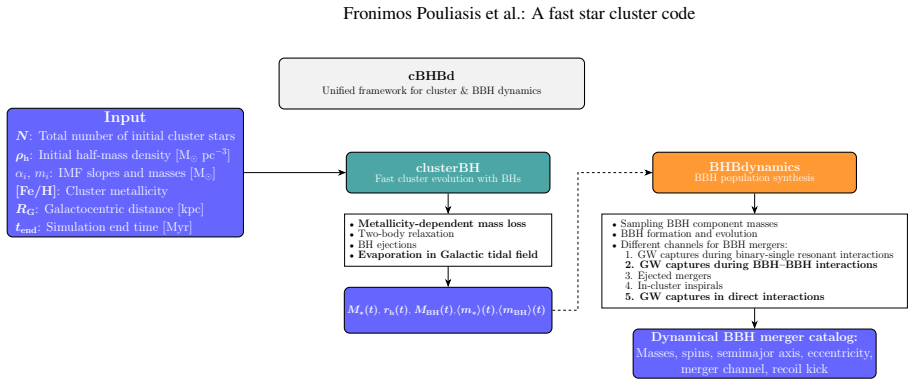
The evolution of star clusters is driven by stellar mass loss, two-body relaxation, and evaporation in the Galactic tidal field. Fast modeling tools are crucial for exploring diverse initial conditions and predicting cluster populations and their contribution to gravitational wave (GW) sources over cosmic timescales. We present an improved version of the clusterBHBdynamics (cBHBd) code, designed to evolve star clusters containing stars and stellar-mass black holes (BHs). We improve the treatment of evaporation in the Galactic tidal field and include the effects of metallicity and stellar mass functions. We also introduce new prescriptions for GW captures during BBH-BBH interactions and between resonant interactions due to distant encounters that increase BBH eccentricities. The updated cBHBd is validated against Cluster Monte Carlo (CMC) models and $N$-body simulations spanning a range of cluster properties. Seven model parameters are fitted to the CMC results with nested sampling. With the best-fit values, the evolution of the cluster mass, half-mass radius, and BH population over 13 Gyr is reproduced to within $\sim10\%$. The new GW capture prescriptions allow cBHBd to reproduce BBH merger rates from CMC models of massive clusters ($\gtrsim10^5,M_\odot$) and direct $N$-body models of lower-mass clusters ($\lesssim10^5,M_\odot$) to within $\sim20\%$. The improved cBHBd provides a fast and flexible tool for large-scale star cluster studies. With a runtime of about one second per cluster, it enables applications such as searches for globular cluster initial conditions, stellar stream modeling, and GW population synthesis.
Figures


Figures from the paper (11 more)




Reference graph
Works this paper leans on
-
[1]
Aarseth, S. J. 1999, PASP, 111, 1333
1999
-
[2]
Aarseth, S. J. 2012, MNRAS, 422, 841
2012
-
[3]
D., Vanzella, E., et al
Adamo, A., Bradley, L. D., Vanzella, E., et al. 2024, Nature, 632, 513
2024
-
[4]
Alexander, P. E. R. & Gieles, M. 2012, MNRAS, 422, 3415
2012
-
[5]
Alexander, P. E. R., Gieles, M., Lamers, H. J. G. L. M., & Baumgardt, H. 2014, MNRAS, 442, 1265
2014
-
[6]
Ambartsumian, V . A. 1938, TsAGI Uchenye Zapiski, 22, 19
1938
-
[7]
Antonelli, A., Kritos, K., Ng, K. K. Y ., Cotesta, R., & Berti, E. 2023, Phys. Rev. D, 108, 084044
2023
-
[8]
2023, MNRAS, 522, 466
Antonini, F., Gieles, M., Dosopoulou, F., & Chattopadhyay, D. 2023, MNRAS, 522, 466
2023
Show all 97 references
-
[9]
2023, Monthly Notices of the Royal Astronomical Society, 522, 466
Antonini, F., Gieles, M., Dosopoulou, F., & Chattopadhyay, D. 2023, Monthly Notices of the Royal Astronomical Society, 522, 466
2023
-
[10]
2019, MNRAS, 486, 5008
Antonini, F., Gieles, M., & Gualandris, A. 2019, MNRAS, 486, 5008
2019
-
[11]
2025, arXiv:2509.04637, arXiv:2509.04637 Arca Sedda, M., Mapelli, M., Benacquista, M., & Spera, M
Antonini, F., Romero-Shaw, I., Callister, T., et al. 2025, arXiv:2509.04637, arXiv:2509.04637 Arca Sedda, M., Mapelli, M., Benacquista, M., & Spera, M. 2023, MNRAS, 520, 5259
2025 arXiv
-
[12]
& Gieles, M
Balbinot, E. & Gieles, M. 2018, MNRAS, 474, 2479
2018
-
[13]
2021, Monthly Notices of the Royal Astronomical Society, 503, 3371
Banerjee, S. 2021, Monthly Notices of the Royal Astronomical Society, 503, 3371
2021
-
[14]
L., et al
Banerjee, S., Belczynski, K., Fryer, C. L., et al. 2020, A&A, 639, A41
2020
-
[15]
& Antonini, F
Barber, J. & Antonini, F. 2025, MNRAS, 538, 639
2025
-
[16]
2001, MNRAS, 325, 1323 Article number, page 17 of 24 A&A proofs:manuscript no
Baumgardt, H. 2001, MNRAS, 325, 1323 Article number, page 17 of 24 A&A proofs:manuscript no. andaa
2001
-
[17]
2016, Astronomy and Astro- physics, 594, A97
Belczynski, K., Heger, A., Gladysz, W., et al. 2016, Astronomy and Astro- physics, 594, A97
2016
-
[18]
Breen, P. G. & Heggie, D. C. 2013, MNRAS, 432, 2779
2013
-
[19]
2020, ApJ, 898, 71
Breivik, K., Coughlin, S., Zevin, M., et al. 2020, ApJ, 898, 71
2020
-
[20]
J., Katz, H., Rey, M
Cameron, A. J., Katz, H., Rey, M. P., & Saxena, A. 2023, MNRAS, 523, 3516
2023
-
[21]
C., Ibata, R., Irwin, M., et al
Chapman, S. C., Ibata, R., Irwin, M., et al. 2008, MNRAS, 390, 1437
2008
-
[22]
2023, A&A, 673, L7
Charbonnel, C., Schaerer, D., Prantzos, N., et al. 2023, A&A, 673, L7
2023
-
[23]
M., Umbreit, S., & Rasio, F
Chatterjee, S., Fregeau, J. M., Umbreit, S., & Rasio, F. A. 2010, ApJ, 719, 915
2010
-
[24]
2022, MNRAS, 513, 4527
Chattopadhyay, D., Hurley, J., Stevenson, S., & Raidani, A. 2022, MNRAS, 513, 4527
2022
-
[25]
2016, ApJ, 823, 102
Choi, J., Dotter, A., Conroy, C., et al. 2016, ApJ, 823, 102
2016
-
[26]
Dickson, N., Hénault-Brunet, V ., Baumgardt, H., Gieles, M., & Smith, P. J. 2023, MNRAS, 522, 5320
2023
-
[27]
J., Hénault-Brunet, V ., Gieles, M., & Baumgardt, H
Dickson, N., Smith, P. J., Hénault-Brunet, V ., Gieles, M., & Baumgardt, H. 2024, MNRAS, 529, 331
2024
-
[28]
& King, I
Djorgovski, S. & King, I. R. 1986, ApJ, 305, L61
1986
-
[29]
2007, AJ, 134, 376
Dotter, A., Chaboyer, B., Jevremovi´c, D., et al. 2007, AJ, 134, 376
2007
-
[30]
2008, ApJS, 178, 89
Dotter, A., Chaboyer, B., Jevremovi´c, D., et al. 2008, ApJS, 178, 89
2008
-
[31]
Fall, S. M. & Rees, M. J. 1977, MNRAS, 181, 37P
1977
-
[32]
& Benz, W
Freitag, M. & Benz, W. 2001, A&A, 375, 711
2001
-
[33]
& Benz, W
Freitag, M. & Benz, W. 2002, A&A, 394, 345
2002
-
[34]
L., Belczynski, K., Wiktorowicz, G., et al
Fryer, C. L., Belczynski, K., Wiktorowicz, G., et al. 2012, ApJ, 749, 91
2012
-
[35]
& Heggie, D
Fukushige, T. & Heggie, D. C. 2000, MNRAS, 318, 753
2000
-
[36]
& Mould, M
Gerosa, D. & Mould, M. 2023, in 57th Rencontres de Moriond on Gravitation
2023
-
[37]
Gieles, M., Alexander, P. E. R., Lamers, H. J. G. L. M., & Baumgardt, H. 2014, MNRAS, 437, 916
2014
-
[38]
& Baumgardt, H
Gieles, M. & Baumgardt, H. 2008, MNRAS, 389, L28
2008
-
[39]
2021, Nature Astronomy, 5, 957
Gieles, M., Erkal, D., Antonini, F., Balbinot, E., & Peñarrubia, J. 2021, Nature Astronomy, 5, 957
2021
-
[40]
& Gnedin, O
Gieles, M. & Gnedin, O. Y . 2023, MNRAS, 522, 5340
2023
-
[41]
C., & Zhao, H
Gieles, M., Heggie, D. C., & Zhao, H. 2011, MNRAS, 413, 2509
2011
-
[42]
& Heggie, D
Giersz, M. & Heggie, D. C. 1996, MNRAS, 279, 1037
1996
-
[43]
2018, MNRAS, 475, L15
Giesers, B., Dreizler, S., Husser, T.-O., et al. 2018, MNRAS, 475, L15
2018
-
[44]
Ginat, Y . B. & Perets, H. B. 2021, Physical Review X, 11, 031020
2021
-
[45]
Gnedin, O. Y . & Ostriker, J. P. 1997, ApJ, 474, 223
1997
-
[46]
1984, ApJ, 280, 298 Grudi´c, M
Goodman, J. 1984, ApJ, 280, 298 Grudi´c, M. Y ., Hafen, Z., Rodriguez, C. L., et al. 2023, MNRAS, 519, 1366
1984
-
[47]
Hansen, R. O. 1972, Phys. Rev. D, 5, 1021
1972
-
[48]
Heggie, D. C. 1975, MNRAS, 173, 729
1975
-
[49]
Heggie, D. C. & Aarseth, S. J. 1992, MNRAS, 257, 513
1992
-
[50]
Heggie, D. C. & Rasio, F. A. 1996, Monthly Notices of the Royal Astronomical Society, 282, 1064–1084 Hénon, M. 1961, Ann. Astrophys., 24, 369; English trans.: arXiv:1103.3499 Hénon, M. 1965, Annales d’Astrophysique, 28, 62; English translation: arXiv:1103.3498 Hénon, M. H. 197...
1996 arXiv
-
[51]
L., & Rasio, F
Kremer, K., Chatterjee, S., Rodriguez, C. L., & Rasio, F. A. 2018, ApJ, 852, 29
2018
-
[52]
S., Rui, N
Kremer, K., Ye, C. S., Rui, N. Z., et al. 2020, ApJS, 247, 48
2020
-
[53]
2023, Phys
Kritos, K., Berti, E., & Silk, J. 2023, Phys. Rev. D, 108, 083012
2023
-
[54]
2024, Phys
Kritos, K., Strokov, V ., Baibhav, V ., & Berti, E. 2024, Phys. Rev. D, 110, 043023
2024
-
[55]
2001, MNRAS, 322, 231
Kroupa, P. 2001, MNRAS, 322, 231
2001
-
[56]
R., McKee, C
Krumholz, M. R., McKee, C. F., & Bland-Hawthorn, J. 2019, ARA&A, 57, 227 Lahén, N., Naab, T., & Szécsi, D. 2024, MNRAS, 530, 645
2019
-
[57]
Lamers, H. J. G. L. M., Gieles, M., & Portegies Zwart, S. F. 2005, A&A, 429, 173
2005
-
[58]
Lee, H. M. & Goodman, J. 1995, ApJ, 443, 109
1995
-
[59]
& Aarseth, S
Makino, J. & Aarseth, S. J. 1992, PASJ, 44, 141
1992
-
[60]
Maltsev, K., Schneider, F. R. N., Mandel, I., et al. 2025, A&A, 700, A20
2025
-
[61]
& Broekgaarden, F
Mandel, I. & Broekgaarden, F. S. 2022, Living Reviews in Relativity, 25, 1
2022
-
[62]
Mapelli, M., Bouffanais, Y ., Santoliquido, F., Arca Sedda, M., & Artale, M. C. 2022, MNRAS, 511, 5797
2022
-
[63]
2021, MNRAS, 505, 339 Marín Pina, D
Mapelli, M., Dall’Amico, M., Bouffanais, Y ., et al. 2021, MNRAS, 505, 339 Marín Pina, D. & Gieles, M. 2024, MNRAS, 527, 8369 Marín Pina, D., Gieles, M., Andrade, T., & Trani, A. A. 2025, A&A, 698, A229
2021
-
[64]
McMillan, S. L. W. & Hut, P. 1996, ApJ, 467, 348
1996
-
[65]
Ng, K. K. Y ., Kritos, K., Antonelli, A., Cotesta, R., & Berti, E. 2023, Phys. Rev. D, 108, 083015
2023
-
[66]
& Aarseth, S
Nitadori, K. & Aarseth, S. J. 2012, MNRAS, 424, 545
2012
-
[67]
Pearson, S., Bonaca, A., Chen, Y ., & Gnedin, O. Y . 2024, ApJ, 976, 54
2024
-
[68]
Peters, P. C. 1964, Phys. Rev., 136, B1224
1964
-
[69]
Plummer, H. C. 1911, MNRAS, 71, 460 Portegies Zwart, S. F. & McMillan, S. L. W. 2000, ApJ, 528, L17 Portegies Zwart, S. F. & McMillan, S. L. W. 2002, ApJ, 576, 899 Portegies Zwart, S. F., McMillan, S. L. W., & Gieles, M. 2010, ARA&A, 48, 431 Rando Forastier, B., Marín Pina, D....
1911
-
[70]
Renaud, F., Gieles, M., & Boily, C. M. 2011, MNRAS, 418, 759
2011
-
[71]
K., Tremblay, P.-E., O’Brien, M
Roberts, E. K., Tremblay, P.-E., O’Brien, M. W., et al. 2025, MN- RAS[arXiv:2502.09579]
2025
-
[72]
L., Amaro-Seoane, P., Chatterjee, S., et al
Rodriguez, C. L., Amaro-Seoane, P., Chatterjee, S., et al. 2018, Phys. Rev. D, 98, 123005
2018
-
[73]
L., Chatterjee, S., & Rasio, F
Rodriguez, C. L., Chatterjee, S., & Rasio, F. A. 2016, Phys. Rev. D, 93, 084029
2016
-
[74]
L., Morscher, M., Pattabiraman, B., et al
Rodriguez, C. L., Morscher, M., Pattabiraman, B., et al. 2015, Physical Review Letters, 115, 051101
2015
-
[75]
L., Weatherford, N
Rodriguez, C. L., Weatherford, N. C., Coughlin, S. C., et al. 2022, ApJS, 258, 22
2022
-
[76]
2018, ApJ, 855, 124
Samsing, J., Askar, A., & Giersz, M. 2018, ApJ, 855, 124
2018
-
[77]
& D’Orazio, D
Samsing, J. & D’Orazio, D. J. 2018, MNRAS, 481, 5445
2018
-
[78]
2014, ApJ, 784, 71
Samsing, J., MacLeod, M., & Ramirez-Ruiz, E. 2014, ApJ, 784, 71
2014
-
[79]
& Moore, B
Schneider, A. & Moore, B. 2011, MNRAS, 415, 1569
2011
-
[80]
2018, ApJ, 862, 114
Shipp, N., Drlica-Wagner, A., Balbinot, E., et al. 2018, ApJ, 862, 114
2018
-
[81]
Speagle, J. S. 2020, MNRAS, 493, 3132
2020
-
[82]
1987, Dynamical Evolution of Globular Clusters (Princeton Univ
Spitzer, L. 1987, Dynamical Evolution of Globular Clusters (Princeton Univ
1987
-
[83]
Spitzer, L. J. 1969, ApJ, 158, L139
1969
-
[84]
Spitzer, L. J. & Hart, M. H. 1971, ApJ, 164, 399
1971
-
[85]
J., et al
Strader, J., Chomiuk, L., Maccarone, T. J., et al. 2012, ApJ, 750, L27
2012
-
[86]
2012, New A, 17, 272 The LIGO Scientific Collaboration, the Virgo Collaboration, the KAGRA Col- laboration, et al
Tanikawa, A., Hut, P., & Makino, J. 2012, New A, 17, 272 The LIGO Scientific Collaboration, the Virgo Collaboration, the KAGRA Col- laboration, et al. 2025, arXiv e-prints, arXiv:2508.18082
2012 arXiv
-
[87]
2022, MNRAS, 517, 2953
Torniamenti, S., Rastello, S., Mapelli, M., et al. 2022, MNRAS, 517, 2953
2022
-
[88]
A., Leigh, N
Trani, A. A., Leigh, N. W. C., Boekholt, T. C. N., & Portegies Zwart, S. 2024, A&A, 689, A24
2024
-
[89]
E., et al
Valluri, M., Fagrelius, P., Koposov, S. E., et al. 2025, ApJ, 980, 71
2025
-
[90]
2022, ApJ, 940, L53
Vanzella, E., Castellano, M., Bergamini, P., et al. 2022, ApJ, 940, L53
2022
-
[91]
2019, MNRAS, 482, 1525
Vasiliev, E. 2019, MNRAS, 482, 1525
2019
-
[92]
2020, MNRAS, 491, 2413
Wang, L. 2020, MNRAS, 491, 2413
2020
-
[93]
2020, MNRAS, 497, 536
Wang, L., Iwasawa, M., Nitadori, K., & Makino, J. 2020, MNRAS, 497, 536
2020
-
[94]
2016, MNRAS, 458, 1450
Wang, L., Spurzem, R., Aarseth, S., et al. 2016, MNRAS, 458, 1450
2016
-
[95]
2015, MNRAS, 450, 4070
Wang, L., Spurzem, R., Aarseth, S., et al. 2015, MNRAS, 450, 4070
2015
-
[96]
Willcox, R., Schneider, F. R. N., Laplace, E., et al. 2025 [arXiv:2508.20787]
2025
-
[97]
Zevin, M., Samsing, J., Rodriguez, C., Haster, C.-J., & Ramirez-Ruiz, E. 2019, ApJ, 871, 91 Article number, page 18 of 24 Fronimos Pouliasis et al.: A fast star cluster code Appendix A: Differences betweenclusterBHand emacss It is worth briefly discussing the capabilities ofcl...
2019
Reviewed June 29, 2026 · model on record in the stance chip above.
Discussion (0). Sign in to comment.