Early Emergence of Environmental Effects: Accelerated Galaxy Assembly in a z=2.96 Protocluster in the COSMOS Field
Pith reviewed 2026-05-20 17:18 UTC · model grok-4.3
The pith
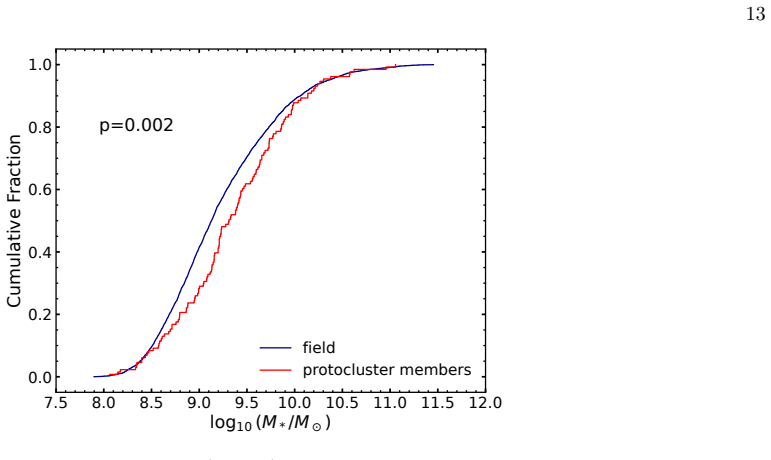
Protocluster members at z=2.96 show a +0.2 dex shift toward higher stellar masses than field galaxies.
A machine-rendered reading of the paper's core claim, the machinery that carries it, and where it could break.
Core claim
The authors identify a highly significant protocluster at z=2.96 containing 131 galaxies, including 21 with spectroscopic confirmation. Analysis shows its member galaxies possess a stellar mass distribution shifted +0.2 dex higher than a comparable mass-complete sample drawn from the coeval field. The protocluster population largely follows the star-forming main sequence, with low-to-intermediate mass members displaying 0.11 to 0.15 dex higher star formation rates, while the quiescent fraction stays indistinguishable from the field. A preliminary size-mass relation also suggests greater compactness at fixed stellar mass. These observations together indicate accelerated mass assembly in the 3
What carries the argument
Comparative analysis of the stellar mass distribution between the 110 high-fidelity photometric plus 21 spectroscopic protocluster members and a mass-complete coeval field sample, which isolates the +0.2 dex offset as the signature of accelerated assembly.
If this is right
- Dense environments accelerate stellar mass assembly as early as z~3.
- Low-to-intermediate mass galaxies experience a measurable star formation rate boost of 0.11-0.15 dex.
- The quiescent fraction remains as low as in the field, showing quenching has not yet become dominant.
- Morphological compactness may already be elevated at fixed stellar mass inside the protocluster.
Where Pith is reading between the lines
- Early mass assembly in protoclusters may contribute to the eventual buildup of massive cluster galaxies observed locally.
- The absence of quenching at this stage suggests environmental suppression of star formation appears later than the acceleration of growth.
- If confirmed, the compactness hint would imply that dense regions begin to influence galaxy structure before they quench star formation.
Load-bearing premise
The assumption that the 110 photometric members are correctly assigned to the protocluster with negligible contamination or projection effects.
What would settle it
A large spectroscopic follow-up campaign that measures redshifts for most photometric candidates and finds the stellar mass distribution difference vanishes or falls below statistical significance.
Figures


read the original abstract
The redshift range z=2-4 marks a critical transition in large scale structure formation, where the dynamically unrelaxed progenitors of local massive clusters undergo rapid stellar mass assembly. We report the discovery and physical characterization of a highly significant protocluster, PC J1001+0214, at z=2.96 within the COSMOS field. Leveraging the multi-wavelength COSMOS2025 catalog with exceptional photometric precision in conjunction with JWST/NIRCam wide-field slitless spectroscopy (WFSS) from the COSMOS-3D program, we robustly identify a cosmic overdensity with $\delta=2.66$. The structure comprises 131 member galaxies, including 21 spectroscopically confirmed members (identified primarily via He I $\lambda10830$ emission) and 110 high-fidelity photometric members. A comparative analysis against a mass-complete coeval field sample reveals a statistically significant +0.2 dex shift in the stellar mass distribution of protocluster members, signaling accelerated mass assembly in the dense environment by $z\sim3$. While the protocluster population broadly follows the star-forming main sequence, low-to-intermediate mass galaxies ($\log_{10}(M_{*}/M_{\odot})\le9.7$) exhibit a measurable star formation rate (SFR) enhancement of +0.11 to +0.15 dex. Crucially, the quiescent fraction remains extremely low and indistinguishable from the field sample, implying that environmental quenching mechanisms have not yet become dominant. Furthermore, a preliminary size-mass analysis hints at elevated morphological compactness among protocluster members at fixed stellar mass. These results suggest that PC J1001+0214 represents a growth-dominated protocluster phase in which environmental effects are already detectable, primarily through accelerated stellar mass assembly and ongoing growth rather than through strong quenching.
Editorial analysis
A structured set of objections, weighed in public.
Referee Report
Summary. The paper reports the discovery of protocluster PC J1001+0214 at z=2.96 in the COSMOS field using the COSMOS2025 multi-wavelength catalog and JWST/NIRCam WFSS data from COSMOS-3D. The structure is identified as a significant overdensity (δ=2.66) containing 131 members (21 spectroscopic via He I λ10830 and 110 high-fidelity photometric). A mass-complete coeval field comparison shows a statistically significant +0.2 dex shift in the stellar mass distribution of protocluster members, interpreted as accelerated assembly by z∼3. Additional findings include SFR enhancement of +0.11 to +0.15 dex for low-to-intermediate mass galaxies (log M* ≤ 9.7), a quiescent fraction indistinguishable from the field, and a preliminary hint of increased morphological compactness at fixed mass.
Significance. If the membership assignments and field comparison hold, the work provides timely evidence that environmental effects on galaxy growth can emerge by z∼3 through accelerated stellar mass assembly, prior to the onset of strong quenching. The combination of high-precision photometry and JWST spectroscopy for membership is a strength, as is the focus on a growth-dominated phase rather than quenching.
major comments (3)
- [Membership Selection] Membership Selection section: The central +0.2 dex stellar-mass offset depends critically on the 110 photometric members having negligible mass-dependent line-of-sight contamination. The manuscript must show the mass distribution and offset when restricted to the 21 spectroscopic members alone, and must quantify the expected contamination fraction versus stellar mass given the photo-z precision of COSMOS2025 + JWST WFSS at z=2.96.
- [Field Sample Construction] Field Sample Construction section: The mass-complete coeval field sample must be defined with explicit completeness limits, redshift matching criteria, and any post-selection cuts; without these, it is impossible to rule out that the reported offset arises from differences in sample construction rather than environment.
- [Statistical Results] Statistical Results section: The statistical significance of the +0.2 dex shift (including the exact test used and p-value) and the error propagation on the cumulative mass distributions should be reported explicitly; the abstract states the shift but does not detail how uncertainties from photometric redshifts or stellar-mass estimates are incorporated.
minor comments (2)
- [Abstract and Identification] The overdensity value δ=2.66 is stated without reference to the precise formula, aperture, or background subtraction method used to compute it.
- [Throughout] Notation for stellar mass (log10(M*/M⊙)) should be used consistently in text, tables, and figure labels.
Simulated Author's Rebuttal
We thank the referee for their careful and constructive review of our manuscript. We agree that additional details on membership robustness, field sample definition, and statistical methodology will strengthen the paper and improve clarity. We will revise the manuscript to incorporate these points as outlined below.
read point-by-point responses
-
Referee: [Membership Selection] Membership Selection section: The central +0.2 dex stellar-mass offset depends critically on the 110 photometric members having negligible mass-dependent line-of-sight contamination. The manuscript must show the mass distribution and offset when restricted to the 21 spectroscopic members alone, and must quantify the expected contamination fraction versus stellar mass given the photo-z precision of COSMOS2025 + JWST WFSS at z=2.96.
Authors: We agree that verifying the mass offset with only spectroscopic members is important for robustness. In the revised manuscript, we will add the stellar mass distribution and measured offset restricted to the 21 spectroscopic members. We will also quantify the expected contamination fraction versus stellar mass, using the photo-z precision of COSMOS2025 combined with JWST WFSS constraints at z=2.96 and our photometric selection criteria. revision: yes
-
Referee: [Field Sample Construction] Field Sample Construction section: The mass-complete coeval field sample must be defined with explicit completeness limits, redshift matching criteria, and any post-selection cuts; without these, it is impossible to rule out that the reported offset arises from differences in sample construction rather than environment.
Authors: We will expand the Field Sample Construction section in the revision to explicitly state the stellar mass completeness limits, the redshift matching criteria used to ensure the field sample is coeval with the protocluster, and any post-selection cuts applied. revision: yes
-
Referee: [Statistical Results] Statistical Results section: The statistical significance of the +0.2 dex shift (including the exact test used and p-value) and the error propagation on the cumulative mass distributions should be reported explicitly; the abstract states the shift but does not detail how uncertainties from photometric redshifts or stellar-mass estimates are incorporated.
Authors: We will revise the Statistical Results section to report the exact statistical test used, the associated p-value for the +0.2 dex shift, and details of error propagation on the cumulative distributions, including contributions from photometric redshift and stellar mass uncertainties. We will also update the abstract to briefly reference these aspects. revision: yes
Circularity Check
No significant circularity; claims rest on direct observational comparisons
full rationale
The paper identifies the protocluster via photometric and spectroscopic membership in the COSMOS field, computes an overdensity δ=2.66, and reports a +0.2 dex stellar-mass offset plus SFR trends by direct comparison to an independent mass-complete field sample at the same redshift. No equations, parameter fits, or self-citations are shown that reduce the reported mass shift or environmental signals to quantities defined by the same inputs. Membership selection and field comparison remain independent steps without self-definitional loops or fitted-input predictions. This is a standard observational analysis whose central results are not forced by construction.
Axiom & Free-Parameter Ledger
free parameters (2)
- overdensity threshold
- mass completeness limit
axioms (1)
- domain assumption Photometric redshifts from the COSMOS2025 catalog are sufficiently accurate to assign 110 galaxies as protocluster members with low contamination.
Lean theorems connected to this paper
-
IndisputableMonolith/Foundation/RealityFromDistinction.leanreality_from_one_distinction unclear?
unclearRelation between the paper passage and the cited Recognition theorem.
A comparative analysis against a mass-complete coeval field sample reveals a statistically significant +0.2 dex shift in the stellar mass distribution of protocluster members, signaling accelerated mass assembly in the dense environment by z∼3.
What do these tags mean?
- matches
- The paper's claim is directly supported by a theorem in the formal canon.
- supports
- The theorem supports part of the paper's argument, but the paper may add assumptions or extra steps.
- extends
- The paper goes beyond the formal theorem; the theorem is a base layer rather than the whole result.
- uses
- The paper appears to rely on the theorem as machinery.
- contradicts
- The paper's claim conflicts with a theorem or certificate in the canon.
- unclear
- Pith found a possible connection, but the passage is too broad, indirect, or ambiguous to say the theorem truly supports the claim.
Reference graph
Works this paper leans on
-
[1]
Alberts, S., & Noble, A. 2022, Universe, 8, 554, doi: 10.3390/universe8110554
-
[2]
Arnouts, S., Le Floc’h, E., Chevallard, J., et al. 2013, A&A, 558, A67, doi: 10.1051/0004-6361/201321768 13 7.5 8.0 8.5 9.0 9.5 10.0 10.5 11.0 11.5 12.0 log10 (M * /M ⊙ ) 0.0 0.2 0.4 0.6 0.8 1.0Cumulative Fraction p=0.002 field protocluster members Figure 10.Empirical cumulative distribution functions (ECDFs) of stellar mass for the protocluster members a...
-
[3]
2019, A&A, 622, A103, doi: 10.1051/0004-6361/201834156
Boquien, M., Burgarella, D., Roehlly, Y., et al. 2019, A&A, 622, A103, doi: 10.1051/0004-6361/201834156
work page internal anchor Pith review doi:10.1051/0004-6361/201834156 2019
-
[4]
Brown, L. D., Cai, T. T., & DasGupta, A. 2001, Statistical Science, 16, 101 , doi: 10.1214/ss/1009213286
-
[5]
Bruzual, G., & Charlot, S. 2003, MNRAS, 344, 1000, doi: 10.1046/j.1365-8711.2003.06897.x
-
[6]
Calzetti, D., Armus, L., Bohlin, R. C., et al. 2000, ApJ, 533, 682, doi: 10.1086/308692
work page internal anchor Pith review doi:10.1086/308692 2000
-
[7]
Casey, C. M., Kartaltepe, J. S., Drakos, N. E., et al. 2023, ApJ, 954, 31, doi: 10.3847/1538-4357/acc2bc
-
[8]
Galactic Stellar and Substellar Initial Mass Function
Chabrier, G. 2003, PASP, 115, 763, doi: 10.1086/376392
work page internal anchor Pith review doi:10.1086/376392 2003
-
[9]
2013, ApJ, 779, 127, doi: 10.1088/0004-637X/779/2/127
Chiang, Y.-K., Overzier, R., & Gebhardt, K. 2013, ApJ, 779, 127, doi: 10.1088/0004-637X/779/2/127
-
[10]
2018, PASJ, 70, S7, doi: 10.1093/pasj/psx047
Coupon, J., Czakon, N., Bosch, J., et al. 2018, PASJ, 70, S7, doi: 10.1093/pasj/psx047
-
[11]
Cucciati, O., Lemaux, B. C., Zamorani, G., et al. 2018, A&A, 619, A49, doi: 10.1051/0004-6361/201833655
-
[12]
2015, ApJ, 805, 121, doi: 10.1088/0004-637X/805/2/121
Aragon-Calvo, M. 2015, ApJ, 805, 121, doi: 10.1088/0004-637X/805/2/121
-
[13]
Dressler, A. 1980, ApJ, 236, 351, doi: 10.1086/157753
-
[14]
Edward, A. H., Balogh, M. L., Bah´ e, Y. M., et al. 2024, MNRAS, 527, 8598, doi: 10.1093/mnras/stad3751
-
[15]
Forrest, B., Lemaux, B. C., Shah, E., et al. 2023, MNRAS, 526, L56, doi: 10.1093/mnrasl/slad114
-
[16]
Forrest, B., Lemaux, B. C., Shah, E. A., et al. 2024, ApJ, 971, 169, doi: 10.3847/1538-4357/ad5e78 G´ omez, P. L., Nichol, R. C., Miller, C. J., et al. 2003, ApJ, 584, 210, doi: 10.1086/345593
-
[17]
2020, A&A, 640, A107, doi: 10.1051/0004-6361/201935855
Guaita, L., Pompei, E., Castellano, M., et al. 2020, A&A, 640, A107, doi: 10.1051/0004-6361/201935855
-
[18]
2016, ApJL, 826, L28, doi: 10.3847/2041-8205/826/2/L28
Hayashi, M., Kodama, T., Tanaka, I., et al. 2016, ApJL, 826, L28, doi: 10.3847/2041-8205/826/2/L28
-
[19]
M., Sun, F., Woodrum, C., et al
Helton, J. M., Sun, F., Woodrum, C., et al. 2024, ApJ, 974, 41, doi: 10.3847/1538-4357/ad6867
-
[20]
1986, PASP, 98, 609, doi: 10.1086/131801
Horne, K. 1986, PASP, 98, 609, doi: 10.1086/131801
-
[21]
Accurate photometric redshifts for the CFHT Legacy Survey calibrated using the VIMOS VLT Deep Survey
Ilbert, O., Arnouts, S., McCracken, H. J., et al. 2006, A&A, 457, 841, doi: 10.1051/0004-6361:20065138
work page internal anchor Pith review doi:10.1051/0004-6361:20065138 2006
-
[22]
Ilbert, O., McCracken, H. J., Le F` evre, O., et al. 2013, A&A, 556, A55, doi: 10.1051/0004-6361/201321100
-
[23]
2023, ApJL, 945, L9, doi: 10.3847/2041-8213/acb49b
Ito, K., Tanaka, M., Valentino, F., et al. 2023, ApJL, 945, L9, doi: 10.3847/2041-8213/acb49b
-
[24]
Kauffmann, G., White, S. D. M., Heckman, T. M., et al. 2004, MNRAS, 353, 713, doi: 10.1111/j.1365-2966.2004.08117.x
-
[25]
Kewley, L. J., & Dopita, M. A. 2002, ApJS, 142, 35, doi: 10.1086/341326
-
[26]
Khostovan, A. A., Kartaltepe, J. S., Salvato, M., et al. 2026, ApJS, 282, 6, doi: 10.3847/1538-4365/ae1cb9
-
[27]
2013, MNRAS, 428, 1551, doi: 10.1093/mnras/sts133
Koyama, Y., Kodama, T., Tadaki, K.-i., et al. 2013, MNRAS, 428, 1551, doi: 10.1093/mnras/sts133
-
[28]
2026, ApJ, 997, 207, doi: 10.3847/1538-4357/ae225e
Lin, X., Egami, E., Sun, F., et al. 2026, ApJ, 997, 207, doi: 10.3847/1538-4357/ae225e
-
[29]
Lovell, C. C., Thomas, P. A., & Wilkins, S. M. 2018, MNRAS, 474, 4612, doi: 10.1093/mnras/stx3090
-
[30]
2019, A&A Rv, 27, 3, doi: 10.1007/s00159-018-0112-2
Maiolino, R., & Mannucci, F. 2019, A&A Rv, 27, 3, doi: 10.1007/s00159-018-0112-2
-
[31]
Monson, E. B., Lehmer, B. D., Doore, K., et al. 2021, ApJ, 919, 51, doi: 10.3847/1538-4357/ac0f84
-
[32]
Newman, A. B., Qezlou, M., Rudie, G. C., et al. 2025, ApJ, 988, 47, doi: 10.3847/1538-4357/ade0b2
-
[33]
Oke, J. B. 1974, ApJS, 27, 21, doi: 10.1086/190287 14
-
[34]
Overzier, R. A. 2016, A&A Rv, 24, 14, doi: 10.1007/s00159-016-0100-3
-
[35]
Pan, R., Suess, K. A., Marchesini, D., et al. 2025, ApJL, 990, L24, doi: 10.3847/2041-8213/adf7ab
-
[36]
Pei, Y. C. 1992, ApJ, 395, 130, doi: 10.1086/171637
-
[37]
2010, A&A, 523, A13, doi: 10.1051/0004-6361/200913020
Pozzetti, L., Bolzonella, M., Zucca, E., et al. 2010, A&A, 523, A13, doi: 10.1051/0004-6361/200913020
-
[38]
Salim, S., Boquien, M., & Lee, J. C. 2018, ApJ, 859, 11, doi: 10.3847/1538-4357/aabf3c
-
[39]
Sattari, Z., Mobasher, B., Chartab, N., et al. 2021, ApJ, 910, 57, doi: 10.3847/1538-4357/abe5a3
-
[40]
Shi, K., Toshikawa, J., Lee, K.-S., et al. 2021, ApJ, 911, 46, doi: 10.3847/1538-4357/abe62e
-
[41]
2015, MNRAS, 448, 666, doi: 10.1093/mnras/stv051
Shimakawa, R., Kodama, T., Tadaki, K.-i., et al. 2015, MNRAS, 448, 666, doi: 10.1093/mnras/stv051
-
[42]
2018a, MNRAS, 473, 1977, doi: 10.1093/mnras/stx2494
Shimakawa, R., Kodama, T., Hayashi, M., et al. 2018a, MNRAS, 473, 1977, doi: 10.1093/mnras/stx2494
-
[43]
Shimakawa, R., Koyama, Y., R¨ ottgering, H. J. A., et al. 2018b, MNRAS, 481, 5630, doi: 10.1093/mnras/sty2618
-
[44]
Shuntov, M., Akins, H. B., Paquereau, L., et al. 2025a, A&A, 704, A339, doi: 10.1051/0004-6361/202555799
-
[45]
Shuntov, M., Ilbert, O., Toft, S., et al. 2025b, A&A, 695, A20, doi: 10.1051/0004-6361/202452570
-
[46]
Sillassen, N. B., Jin, S., Magdis, G. E., et al. 2026, A&A, 706, A344, doi: 10.1051/0004-6361/202557857
-
[47]
2023, ApJ, 953, 53, doi: 10.3847/1538-4357/acd53c
Sun, F., Egami, E., Pirzkal, N., et al. 2023, ApJ, 953, 53, doi: 10.3847/1538-4357/acd53c
-
[48]
Sun, F., Fudamoto, Y., Lin, X., et al. 2025 https://arxiv.org/abs/2503.15587
-
[49]
2024, ApJL, 967, L34, doi: 10.3847/2041-8213/ad4986
Sun, H., Wang, T., Xu, K., et al. 2024, ApJL, 967, L34, doi: 10.3847/2041-8213/ad4986
-
[50]
2024, ApJ, 970, 59, doi: 10.3847/1538-4357/ad5316
Tanaka, M., Onodera, M., Shimakawa, R., et al. 2024, ApJ, 970, 59, doi: 10.3847/1538-4357/ad5316
-
[51]
2018, PASJ, 70, S12, doi: 10.1093/pasj/psx102
Toshikawa, J., Uchiyama, H., Kashikawa, N., et al. 2018, PASJ, 70, S12, doi: 10.1093/pasj/psx102
-
[53]
2025b, MNRAS, 537, 3561, doi: 10.1093/mnras/staf197
Toshikawa, J., Wuyts, S., Kashikawa, N., et al. 2025b, MNRAS, 537, 3561, doi: 10.1093/mnras/staf197
-
[54]
Wang, et al., Discovery of a Galaxy Cluster with a Violently Starbursting Core at z = 2.506
Wang, T., Elbaz, D., Daddi, E., et al. 2016, ApJ, 828, 56, doi: 10.3847/0004-637X/828/1/56
-
[55]
2022, ApJ, 926, 70, doi: 10.3847/1538-4357/ac3974
Wang, X., Li, Z., Cai, Z., et al. 2022, ApJ, 926, 70, doi: 10.3847/1538-4357/ac3974
-
[56]
Weaver, J. R., Kauffmann, O. B., Ilbert, O., et al. 2022, ApJS, 258, 11, doi: 10.3847/1538-4365/ac3078
-
[57]
R., Davidzon, I., Toft, S., et al
Weaver, J. R., Davidzon, I., Toft, S., et al. 2023, A&A, 677, A184, doi: 10.1051/0004-6361/202245581
discussion (0)
Sign in with ORCID, Apple, or X to comment. Anyone can read and Pith papers without signing in.