REVIEW 4 major objections 5 minor 34 references
Spectral properties of Neumann-Poincare operator and anomalous localized resonance in elasticity beyond quasi-static limit
T0 review · 4 major / 5 minor · reviewed 2026-08-14 · deepseek-v4-flash
Pith's one-line read Theorem proves elastic invisibility cloak at finite frequencies.
desk verdict Finite-frequency elastic N-P spectral system is a real contribution, but the CALR proof as written is conditional on unprovided determinant estimates and a dropped constant in Theorem 4.1. read the letter →
The pith
A machine-rendered reading of the paper's core claim, the machinery that carries it, and where it could break.
The reading
What carries the argument
The central object is the complete spectral system of the finite-frequency Neumann-Poincaré operator, the boundary integral operator whose eigenvalues govern polariton resonances, derived on a sphere in Theorem 3.2. It yields three infinite families of eigenfunctions: the tangential vector spherical harmonics $T_n^m$ with eigenvalue $\lambda_{1,n}$, and two mixed families $U_n^m$ and $V_n^m$ built from the normal-type harmonics $I_{n-1}^m$ and $N_{n+1}^m$, with eigenvalues $\lambda_{2,n}$ and $\lambda_{3,n}$ expressed through combinations of spherical Bessel and Hankel functions. This spectral decomposition reduces the core-shell transmission problem to a $4\times 4$ algebraic system per spherical mode, and the resonance mechanism is the near-vanishing of the determinant $d_{n,m}$ for a selected large mode $n_0$ once the shell shear modulus is tuned appropriately. The critical radius $r_*$ emerges from comparing the decay rate of the source's multipole coefficients with the growth of the Bessel functions inside the shell, so that inside $r_*$ the energy lower bound grows faster than any prescribed $M$.
What would settle it
Place a point force inside the critical radius $r_*$ so that its multipole expansion necessarily contains low-order vector spherical harmonics, and set the shell parameters as in (5.14)-(5.15). Compute the dissipation energy $E(u)$ numerically as the imaginary part of $\hat\mu$ is sent to zero: if $E(u)$ does not exceed every prescribed $M$ while the exterior field stays bounded, then the claim in Remark 5.2 that the restriction (5.7) is only technical would be false.
Extended reading notes
Core claim
The central discovery is that polariton resonance and cloaking due to anomalous localized resonance in elasticity do not require the quasi-static approximation. There exist core-shell-matrix configurations, with the shell shear modulus tuned to a slightly imaginary negative value of the form $\hat\mu = -\mu + i\rho^{n_0} + p_{2,n_0}$ satisfying the smallness condition (5.15), such that any source whose Newtonian potential consists of high-order vector spherical harmonic modes and lies inside the critical radius $r_* = \sqrt{r_e^3/r_i}$ produces unbounded energy dissipation while the exterior displacement field remains bounded. Outside $r_*$ the energy stays bounded, so no resonance occurs. The proof uses the complete finite-frequency spectral system of the Neumann-Poincaré operator: for each spherical mode the eigenvalues are explicit combinations of Bessel and Hankel functions, and resonance is driven by a single large mode $n_0$ whose algebraic denominator $d_{n_0,m}$ behaves like $\rho^{2n_0}$ and can be made small by the parameter choice.
Load-bearing premise
The CALR proof assumes the source's Newtonian potential consists only of high-order $T_n^m$ vector spherical harmonic modes with $n \geq N$; the paper calls this restriction technical in Remark 5.2, but gives no argument covering sources with low-order or $I_n^m$/$N_n^m$ components, so the advertised general-source behavior is not established.
Editorial extensions
If this is right
- Elastic cloaking via anomalous localized resonance works at frequencies comparable to the structure size, not just in the static or small-wavelength regimes.
- The metamaterial design only requires tuning a single Lamé parameter, the shear modulus, leaving the other parameter free and relaxing the conditions for constructing the shell.
- The critical radius gives a precise spatial threshold: sources inside it are cloaked, sources outside it generate no resonance and remain observable.
- The complete finite-frequency spectral system provides a tool for analyzing other resonance-based elastic phenomena, such as field enhancement or superlensing-like effects.
- Prior static and quasi-static polariton resonance constructions are recovered as limits of this spectral framework, so the present analysis unifies them.
Reading between the lines
- The proof restricts the source to high-order $T_n^m$ vector spherical harmonic modes and states in Remark 5.2 that this is a technical issue, but no argument covers low-order modes or the $I_n^m$/$N_n^m$ components; numerical tests with generic point sources inside $r_*$ would reveal whether the advertised general-source cloaking actually holds.
- The critical radius formula $r_* = \sqrt{r_e^3/r_i}$ is derived from Bessel asymptotics in the large-mode limit, so at moderate frequencies or for low-order sources the effective cloaking boundary may shift or develop frequency corrections.
- Because only the shear modulus needs to be negative, shells made of anisotropic or fluid-like materials that violate one convexity condition might realize the same cloak, widening the class of physical realizations.
- The mode-by-mode determinantal condition suggests a tunable resonance: by choosing which $n_0$ is amplified through the imaginary part of $\hat\mu$, one could in principle select which source frequencies are cloaked.
Signed reviews
Editorial analysis
A structured set of objections, weighed in public.
Referee Report
Summary. The paper studies polariton resonances and cloaking due to anomalous localized resonance (CALR) for the time-harmonic elastic system at finite frequency, dropping the quasi-static assumption ω diam(Ω) ≪ 1. For spherical geometries it derives (Theorem 3.2) a claimed complete spectral system for the elastic Neumann–Poincaré operator (K^ω_SR)^* acting on vector spherical harmonics, with eigenvalues λ_{1,n}, λ_{2,n}, λ_{3,n} expressed through Bessel/Hankel coefficients. It then uses these spectra to construct material configurations: Theorem 4.1 claims polariton resonance for a homogeneous inclusion with no core when the shell Lamé parameter μ̂ is chosen with suitably large imaginary part, and Theorem 5.1 claims CALR for a core-shell-matrix structure with ˘μ = μ and μ̂ = −μ + iρ^{n0} + p_{2,n0} when the source's Newtonian potential has the restricted form (5.7) and is supported inside the critical radius r* = sqrt(r_e^3/r_i), with no resonance for sources outside r*.
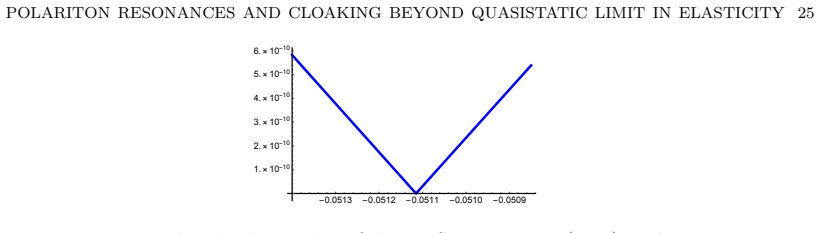
Significance. The novelty is in moving the elastic ALR/CALR construction beyond the quasi-static limit using spectral information of the finite-frequency N-P operator; the claimed construction only requires violation of one of the two strong-convexity conditions, and taking the static limit is said to recover earlier results. The spectral system of Theorem 3.2, if correct, is a substantial independent contribution. The paper includes numerical illustrations (Figures 1–3) supporting the parameter conditions. However, the paper does not supply machine-checked derivations, and the two central theorems depend on asymptotic estimates that are quoted as 'direct calculations' rather than proved, which currently prevents verification of the headline claims.
major comments (4)
- [§5, (5.17)–(5.20)] The proof of Theorem 5.1 is built on four asymptotic estimates for the numerators and the determinant d_{n,m} of the 4×4 transmission system (5.9) that are stated without derivation immediately before (5.17). In particular, (5.19)–(5.20) assert the two-sided bounds |d_{n0,m}| ≈ ρ^{2n0} and |d_{n,m}| ≥ ρ^{2n0}+ρ^{2n} for all n ≥ N under the parameter choice (5.14)–(5.15). These bounds are load-bearing: the energy lower bound (5.22) and the boundedness estimate (5.25) both invoke the size of d_{n,m}. Since d_{n,m} is a multilinear combination of Bessel and Hankel functions and derivatives, an undetected polynomial-in-n factor or an extra ρ^n factor would invalidate the construction. The authors should either supply complete error-controlled derivations or state the determinant estimates as explicit lemmas with proofs.
- [§4, (4.18)–(4.21)] Equation (4.18) writes ~ψ_{1,n0,m} = C(μ̂ + μ + q_{1,n0}) with q_{1,n0} = O(1/n0), but the constant C is dropped in the subsequent estimate (4.21). The claimed choice μ̂ = −μ + i/M + p_{1,n0} satisfying (4.10) only makes the parenthesis of order O(1/M); it does not imply ℑ(μ̂)/|~ψ_{1,n0,m}|² ≥ M unless C is bounded away from zero and absorbed into the O-term. This gap affects the proof that condition (4.8) is achievable and should be repaired.
- [Theorem 5.1 and Remark 5.2] The theorem is proved only for Newtonian potentials consisting of T_n^m components with n ≥ N, as in (5.7). The statement of Theorem 5.1 and the surrounding discussion advertise CALR for general sources, but no argument is supplied for low-order T_n^m modes or for the I_n^m and N_n^m components that appear in the full expansion (4.7). Remark 5.2 asserts that this is 'just a technical issue', but the proof of the boundedness condition (1.11) for a general source is not given. The claimed general-source CALR and the critical-radius dichotomy are therefore not established by the present proof.
- [§5, (5.22)–(5.23)] The energy lower bound (5.22) is asserted without derivation from the representation (5.21), and the displayed limsup in (5.23) does not transparently follow from (5.7): for a source at distance r_s the coefficient growth in (5.7) should be governed by k r_s, whereas (5.23) involves the reciprocal of k r* and contains a square root. The subsequent combination of (5.22) and (5.23) to prove E(u) > M is therefore not justified as written; this step needs a detailed derivation.
minor comments (5)
- [Throughout] The manuscript contains numerous typographical errors, including 'ovelrine' for 'overline', 'indentities' for 'identities', 'formual' for 'formula', 'hod' for 'hold', and repeated 'the the'; a careful proofreading is needed.
- [§4, (4.15)] The notation P_{λ̂/μ̂,1}(u,u) is used without being defined; please specify the Lamé parameters and the meaning of the subscript 1.
- [§5, (5.2)] The shorthand jn0i, jn1i, etc. is easy to misread because the subscripts mix the mode number n with the radius labels i and e; a table or clearer notation (e.g., j_n(k_s r_i)) would improve readability.
- [Theorem 4.1] In the 'furthermore' part of Theorem 4.1, it should be stated explicitly that n0 is assumed large enough for the asymptotic (2.8) and that the choice (4.9) depends on both n0 and M; the current phrasing 'p_{1,n0} should satisfy' is imprecise.
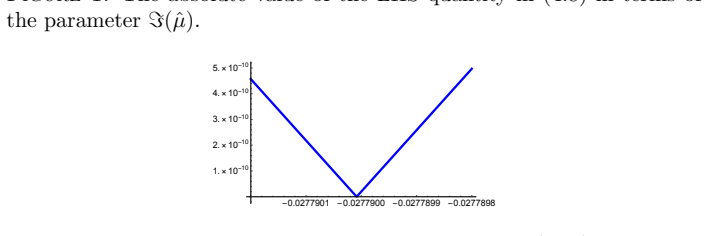
- [Figure 2] The caption 'The absolute value of the LHS quantity in (4.10)' refers to a condition, not a quantity; it should specify what is plotted, presumably p_{1,n0} + q_{1,n0} as a function of p_{1,n0}.
Circularity Check
No material circularity: the spectral system is derived, and the resonance/cloaking results are conditional constructions rather than fitted predictions.
full rationale
The paper's derivation chain is self-contained in the sense required by the circularity test. The finite-frequency spectral system in Theorem 3.2 is obtained from explicit single-layer-potential actions (Theorem 3.1 and Propositions 3.3–3.6) and an algebraic 2x2 eigenproblem; the eigenvalues are not assumed from the resonance conclusions. The polariton-resonance and CALR results are conditional existence statements: they prescribe admissible Lamé parameters, e.g. (5.14)–(5.15), and then prove energy divergence or boundedness under those stated conditions. The parameters are constructed before the energy estimates and are not fitted from the energy functional E(u), so there is no fitted-input-called-prediction pattern. Lemma 3.1 is imported from the authors' prior work [23], but it is a standard spherical Bessel identity for the scalar single-layer potential and is not a uniqueness theorem or an unverified ansatz; moreover, the elastic spectral system is derived rather than reduced to that lemma. The source restriction in (5.7) is an acknowledged technical limitation, not a circular step. The determinant estimates (5.17)–(5.20) are asserted by 'direct calculations' rather than fully demonstrated; this is a rigor gap that belongs to correctness risk, not circularity, because those estimates do not by definition equal the theorem's conclusion. Overall, the central claims retain independent mathematical content and are not forced by self-citation or by definitional equivalence.
Assumptions & free parameters
free parameters (5)
- hat(mu) in Theorem 4.1 =
-mu + i/M + p1,n0
- p1,n0 correction =
O(1/n0), satisfying p1+q1=O(1/M)
- hat(mu) in Theorem 5.1 =
-mu + i*rho^(n0) + p2,n0
- p2,n0 correction =
satisfies p2^2+q2=O(rho^(2n0)); numerically about -0.0511 in Figure 3
- n0 mode order =
large integer satisfying condition (5.16)
assumptions (5)
- standard math Vector spherical harmonics (I_n^m, T_n^m, N_n^m) form an orthogonal basis of (L^2(S))^3
- domain assumption The single layer potential for the scalar Helmholtz kernel satisfies S^k_{S_R}[Y_n^m]=-ikR^2 j_n(kR)h_n(kR)Y_n^m (Lemma 3.1)
- standard math Spherical Bessel and Hankel functions satisfy the large-order asymptotics (2.8) and small-argument asymptotics (2.9)
- ad hoc to paper In Theorem 5.1 the Newtonian potential F of the source has expansion (5.7) with only T_n^m components and orders n>=N
- domain assumption The radiation condition (1.6) selects the unique outgoing solution and the shell parameters can be complex with positive imaginary part while only one convexity condition is violated
Cite this review
Pith. "Pith review of Spectral properties of Neumann-Poincare operator and anomalous localized resonance in elasticity beyond quasi-static limit." pith.science (2026). https://pith.science/paper/DZA554WV
@misc{pith2026190805064,
  author       = {Pith},
  title        = {Pith review of: Spectral properties of Neumann-Poincare operator and anomalous localized resonance in elasticity beyond quasi-static limit},
  year         = {2026},
  howpublished = {\url{https://pith.science/paper/DZA554WV}},
  note         = {Machine review of arXiv:1908.05064}
}
read the original abstract
This paper is concerned with the polariton resonances and their application for cloaking due to anomalous localized resonance (CALR) for the elastic system within the finite frequency regime beyond the quasi-static approximation. We first derive the complete spectral system of the Neumann-Poincar\'e operator associated with the elastic system within the finite frequency regime. Based on the obtained spectral results, we construct a broad class of elastic configurations that can induce polariton resonances beyond the quasi-static limit. As an application, the invisibility cloaking effect is achieved through constructing a class of core-shell-matrix metamaterial structures provided the source is located inside a critical radius. Moreover, if the source is located outside the critical radius, it is proved that there is no resonance.
Figures

Reference graph
Works this paper leans on
-
[16]
Y. Deng, H. Li and H. Liu, On spectral properties of Neumann-Poincare operator and plasmonic cloaking in 3D elastostatics , J. Spectral Theory , DOI:10.4171/JST/262
-
[24]
H. Li, J. Li and H. Liu, On novel elastic structures inducing polariton resonances with finite fre- quencies and cloaking due to anomalous localized resonance, Journal de Math´ ematiques Pures et Appliqu´ ees,120(2018), pp 195–219
work page 2018
- [23]
- [1]
- [2]
- [3]
- [4]
-
[5]
H. Ammari, P. Millien, M. Ruiz and H. Zhang, Mathematical analysis of plasmonic nanoparticles: the scalar case, Arch. Ration. Mech. Anal., DOI: 10.1007/s00205-017-1084-5
Show all 34 references
-
[6]
Ammari, M
H. Ammari, M. Ruiz, S. Yu and H. Zhang, Mathematical analysis of plasmonic resonances for nanoparticles: the full Maxwell equations , J. Differential Equations, 261 (2016), 3615–3669
2016
-
[7]
Ando and H
K. Ando and H. Kang, Analysis of plasmon resonance on smooth domains using spectral properties of the Neumann-Poincar´ e operator, J. Math. Anal. Appl., 435 (2016), 162–178
2016
-
[8]
K. Ando, Y. Ji, H. Kang, K. Kim and S. Yu, Spectral properties of the Neumann-Poincar´ e operator and cloaking by anomalous localized resonance for the elasto-static system , arXiv:1510.00989
-
[9]
K. Ando, H. Kang, K. Kim and S. Yu, Cloaking by anomalous localized resonance for linear elasticity on a coated structure, arXiv:1612.08384
-
[10]
K. Ando, H. Kang and H. Liu, Plasmon resonance with finite frequencies: a validation of the quasi- static approximation for diametrically small inclusions , SIAM J. Appl. Math., 76 (2016), 731–749
2016
-
[11]
Bruno and S
O. Bruno and S. Lintner, Superlens-cloaking of small dielectric bodies in the quasistatic regime, Journal of Applied Physics 102 (2007), no. 12
2007
-
[12]
Bl˚ asten, H
E. Bl˚ asten, H. Li, H. Liu and Y. Wang, Localization and geometrization in plasmon resonances and geometric structures of Neumann-Poincar´ e eigenfunctions, arXiv:1809.08533
-
[13]
Bouchitt´ e and B
G. Bouchitt´ e and B. Schweizer,Cloaking of small objects by anomalous localized resonance , Quart. J. Mech. Appl. Math., 63 (2010), 438–463
2010
-
[14]
Bruno and S
O.P. Bruno and S. Lintner, Superlens-cloaking of small dielectric bodies in the quasistatic regime , J. Appl. Phys., 102 (2007), 124502
2007
-
[15]
Colton and R
D. Colton and R. Kress, Inverse Acoustic and Electromagnetic Scattering Theory , 2nd Edition, Springer-Verlag, Berlin, 1998. 26 YOUJUN DENG, HONGJIE LI, AND HONGYU LIU
1998
-
[17]
Y. Deng, H. Li and H. Liu, Analysis of surface polariton resonance for nanoparticles in elastic system, arXiv:1804.05480
-
[18]
Kettunen, M
H. Kettunen, M. Lassas and P. Ola, On absence and existence of the anomalous localized resonace without the quasi-static approximation , preprint, arXiv: 1406.6224
-
[19]
Kohn, J.Lu, B
R.V. Kohn, J.Lu, B. Schweizer and M.I. Weinstein, A variational perspective on cloaking by anoma- lous localized resonance, Comm. Math. Phys., 328 (2014), 1–27
2014
-
[20]
V. D. Kupradze, Three-dimensional Problems of the Mathematical Theory of Elasticity and Ther- moelasticity, Amsterdam, North-Holland, 1979
1979
-
[21]
Li and H
H. Li and H. Liu, On anomalous localized resonance for the elastostatic system , SIAM J. Math. Anal., 48 (2016), 3322–3344
2016
-
[22]
Li and H
H. Li and H. Liu, On three-dimensional plasmon resonance in elastostatics , Annali di Matematica Pura ed Applicata, doi:10.1007/s10231-016-0609-0
-
[25]
H. Li, J. Li and H. Liu, On quasi-static cloaking due to anomalous localized resonance in R3, SIAM J. Appl. Math., 75 (2015), no. 3, 1245–1260
2015
-
[26]
H. Li, S. Li, H. Liu and X. Wang, Analysis of electromagnetic scattering from plasmonic inclusions at optical frequencies and applications, ESAIM: Math. Model. Numer. Anal. , arXiv:1804.09517
-
[27]
McPhedran, N.-A.P
R.C. McPhedran, N.-A.P. Nicorovici, L.C. Botten and G.W. Milton,Cloaking by plasmonic resonance among systems of particles: cooperation or combat? C.R. Phys., 10 (2009), 391–399
2009
-
[28]
Milton and N.-A.P
G.W. Milton and N.-A.P. Nicorovici, On the cloaking effects associated with anomalous localized resonance, Proc. R. Soc. A, 462 (2006), 3027–3059
2006
-
[29]
Milton, N.-A.P
G.W. Milton, N.-A.P. Nicorovici, R.C. McPhedran, K. Cherednichenko and Z. Jacob, Solutions in folded geometries, and associated cloaking due to anomalous resonance , New. J. Phys., 10 (2008), 115021
2008
-
[30]
Milton, N.-A.P
G.W. Milton, N.-A.P. Nicorovici, R.C. McPhedran, and V.A. Podolskiy, Proof of superlensing in the quasistatic regime, and limitations of superlenses in this regime due to anomalous localized resonance, Proc. R. Soc. A, 461 (2005), 3999–4034
2005
-
[31]
J. C. N´ ed´ elec,Acoustic and Electromagnetic Equations: Integral Representations for Harmonic Prob- lems, Springer-Verlag, New York, 2001
2001
-
[32]
Nicorovici, R.C
N.-A.P. Nicorovici, R.C. McPhedran, S. Enoch and G. Tayeb, Finite wavelength cloaking by plas- monic resonance, New. J. Phys., 10 (2008), 115020
2008
-
[33]
Nicorovici, R.C
N.-A.P. Nicorovici, R.C. McPhedran and G.W. Milton, Optical and dielectric properties of partially resonant composites, Phys. Rev. B, 49 (1994), 8479–8482
1994
-
[34]
Nicorovici, G.W
N.-A.P. Nicorovici, G.W. Milton, R.C. McPhedran and L.C. Botten, Quasistatic cloaking of two- dimensional polarizable discrete systems by anomalous resonance , Optics Express, 15 (2007), 6314– 6323. School of Mathematics and Statistics, Central South University, Changsha, Huna...
2007
Reviewed August 14, 2026 · model on record in the stance chip above.
Discussion (0). Continue with ORCID to comment.