REVIEW 2 major objections 5 minor 178 references
Emergence of high-mass stars in complex fiber networks (EMERGE) VI. Turbulence dissipation and the formation of dense fibers
T0 review · 2 major / 5 minor · reviewed 2026-07-11 · grok-4.5
Pith's one-line read In Orion, turbulence is dissipated at the fiber scale before cores form, with small high-shear patches near dense fibers doing most of the work.
desk verdict Solid multi-region ALMA HNC maps that put the transition-to-coherence at fiber scales and quantify high-shear dissipation layers next to N2H+ fibers. read the letter →
The pith
A machine-rendered reading of the paper's core claim, the machinery that carries it, and where it could break.
The reading
What carries the argument
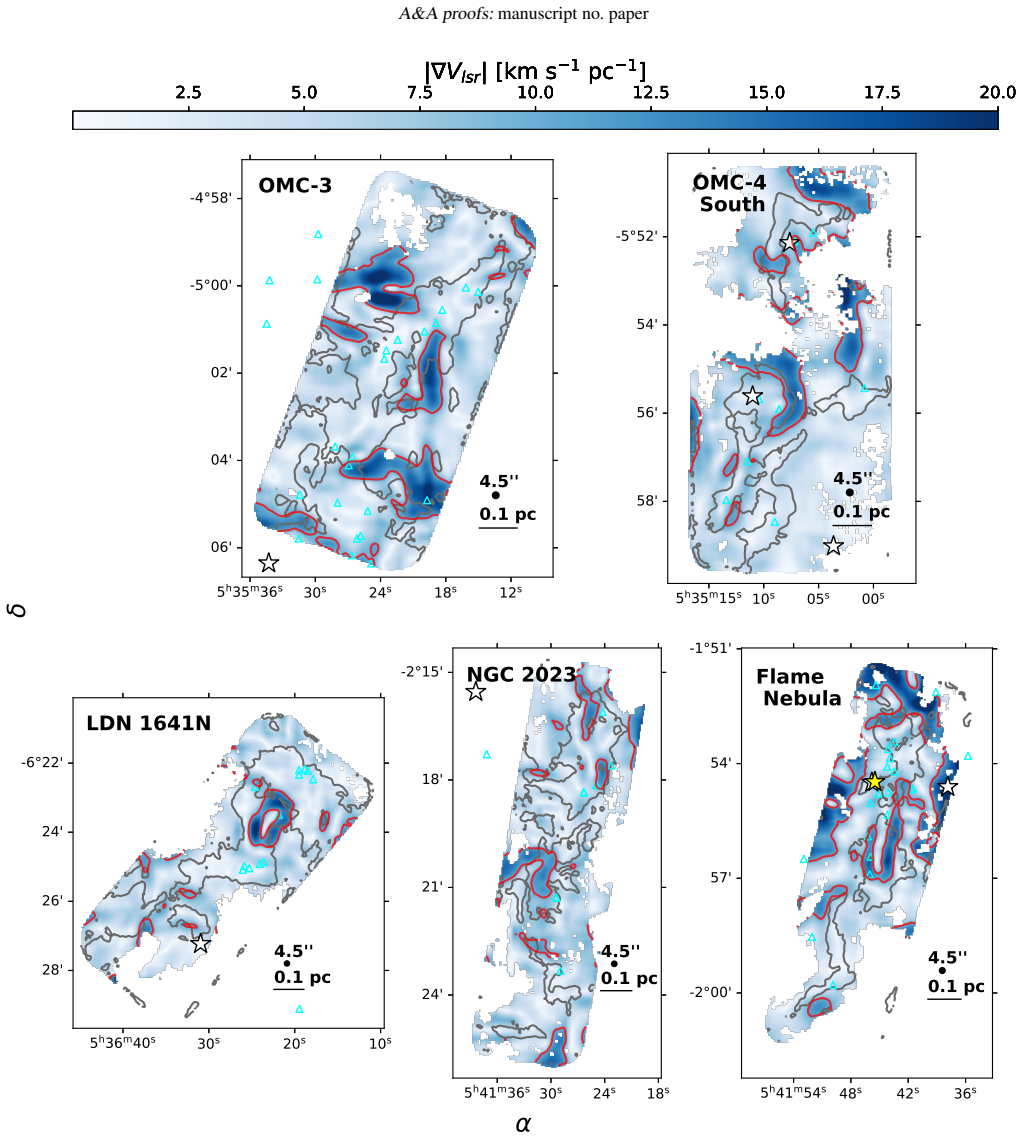
Centroid-velocity-gradient (and increment) PDFs evaluated at 0.04 pc lag: non-Gaussian wings above |∇V_lsr| ≥ 10 km s^{-1} pc^{-1} flag intermittent high-shear patches whose integrated contribution f_ε exceeds 30–60 % of the total dissipation.
What would settle it
A map of an identical region in an optically thin isotopologue or a higher-resolution tracer that shows the high-gradient patches either disappearing or relocating away from the dense fibers would falsify the identification of those patches as the main dissipation sites.
Extended reading notes
Core claim
In Orion the transition from turbulent, diffuse gas to coherent, subsonic gas occurs at the fiber level: high-shear regions of 0.1–0.3 pc size located next to dense fibers dissipate the bulk of the turbulent energy before cores form.
Load-bearing premise
That the non-Gaussian wings of the velocity-gradient PDFs cleanly mark dissipative intermittency rather than residual multi-component blending, outflows, or large-scale feedback shear.
Editorial extensions
If this is right
- Core properties (mass, velocity dispersion) are largely inherited from the parental fiber rather than set by local dissipation at the core scale.
- Fiber formation models must include intermittent, localized dissipation rather than uniform cascading.
- High-shear patches should appear as elevated vorticity or enhanced dissipation signatures in future multi-tracer or MHD simulations of the same regions.
- Surveys that resolve only cores will systematically miss the scale at which coherence first appears.
Reading between the lines
- If the same high-shear morphology appears in lower-mass clouds outside Orion, the fiber-scale transition may be universal rather than environment-dependent.
- The filling-factor versus dissipation-fraction numbers supply a quantitative target for sub-grid turbulence models that currently assume space-filling dissipation.
- A direct comparison of these HNC gradients with simultaneous NH3 or continuum maps could test whether the shear patches coincide with the sharpest density jumps.
Signed reviews
Editorial analysis
A structured set of objections, weighed in public.
Referee Report
Summary. This EMERGE Paper VI uses high-resolution (4.5 arcsec) ALMA+IRAM-30m HNC(1-0) mosaics of five Orion star-forming regions to characterize the kinematics of lukewarm, diffuse gas (N(H2)~5e21 cm^-2) surrounding dense fibers previously identified in N2H+. The diffuse gas is systematically more turbulent (median Ms~2.9) than the subsonic dense gas inside fibers (Ms~0.74). Through centroid-velocity increments and newly applied velocity-gradient statistics at lag L=0.04 pc, the authors identify high-shear regions (|∇V_lsr|≥10 km s^-1 pc^-1) as non-Gaussian wings of the PDFs; these form elongated 0.1–0.3 pc features near dense-gas contours, occupy fs≲20% of the maps, yet contribute f_ε>30–60% of the integrated ∇V^2 budget (Table 3). The central claim is that in Orion the transition to coherence occurs at the fiber scale, with turbulence dissipated during fiber formation rather than at core scales.
Significance. If the result holds, it reframes the classical transition-to-coherence picture (Goodman et al. 1998; Pineda et al. 2010) by placing the dissipative step at fiber rather than core scales, with direct implications for how cores inherit subsonic conditions from parental filaments. Strengths include a homogeneous multi-region sample spanning low- to high-mass regimes, quantitative filling-factor and dissipation-fraction estimates (Table 3), and multi-method cross-checks (single- vs multi-component fits, moments, box gradients vs annuli vs classical increments in Appendices B–C) that make the high-shear identification re-examinable by the reader. The work is a natural and well-executed extension of the EMERGE series and of prior intermittency studies (Pety & Falgarone 2003; Hily-Blant et al.).
major comments (2)
- [Sect. 5.2.2 / Figs. 7, 10] Sect. 5.2.2 and Figs. 7/10: The claim that high-shear features are systematically associated with dense fibers (and therefore that dissipation occurs during fiber formation) rests on visual proximity to N2H+ 3σ contours. No quantitative distance metric, nearest-neighbor statistic, or null test against random placement is provided. A simple contour-distance or fiber-spine offset distribution (even for the subset of fibers already catalogued in Paper III) would make the spatial association load-bearing rather than qualitative.
- [Sect. 5.3, Eq. (4), Table 3] Sect. 5.3, Eq. (4) and Table 3: f_ε is defined as the fraction of ∑(∇V_lsr)^2 residing in high-shear pixels. This is a standard proxy following Pety & Falgarone (2003), but the manuscript should state explicitly the assumptions under which ∇V^2 traces local dissipation (projection/LOS averaging, that high-shear is not dominated by unresolved multi-component jumps or large-scale shear). Without that caveat, the numerical claim f_ε>30–60% can be over-read as a direct energy-dissipation fraction.
minor comments (5)
- [Sect. 4.1] Sect. 4.1 / Fig. 5: Kinetic temperatures are taken from 30-arcsec IRAM maps and assumed constant inside each IRAM pixel when computing Ms at 4.5-arcsec resolution. The paper notes Ms ∝ 1/√TK, but a short quantitative estimate of the possible Ms bias from unresolved T gradients (especially near feedback edges) would help the reader.
- [Abstract / Conclusions] Abstract and Conclusions: Column density for HNC is given as ~5e21 cm^-2 in the abstract but as N(H2)≳10^22 in Conclusion point 1; align the wording.
- [Sect. 4.2] Fig. 6 and Sect. 4.2: The WISE 12 µm cut used to isolate feedback in the Flame Nebula is effective; a brief note on why analogous cuts failed in the other targets (background levels) is already present but could be moved earlier so Table 2 upper-limit caveats are clearer.
- [Sect. 5.2.2 / App. C] Appendix C is thorough and valuable; consider adding a one-sentence pointer in the main text of Sect. 5.2.2 that the three estimators recover the same ±10 km s^-1 pc^-1 threshold and the same spatial features.
- [Keywords / Tables] Typographical: 'Massive star-formation —- ISM' (double dash) in keywords; occasional missing spaces before units in tables.
Circularity Check
No significant circularity: HNC kinematics, gradient statistics and dissipation fractions are independent measurements; prior EMERGE fiber catalogue is used only as a spatial reference.
-
self citation load bearing
[Sect. 5.1, Table 2, Fig. 4]
"Paper III identified a total of 76 fibers within our maps (152 including OMC-1 and OMC-2), where the majority of these structures shows non-thermal motions within the sonic regime (Ms(N2H+)∼0.74, see Table 2 and Fig. 4). This statistical behaviour would agree with fibers being the first structures formed out of the turbulent cascade in the regions sampled by our survey."
The subsonic character of the dense fibers is taken from Socci et al. (2024a,b) (same team). The citation is load-bearing for the comparative claim ‘fibers are the first coherent structures’, yet the new HNC analysis (linewidths, Ms maps, gradient PDFs, fϵ) is independent of that catalogue; the fibers are used only as a spatial reference. This is ordinary self-citation, not a definitional reduction.
full rationale
The paper’s central claim (transition to coherence at fiber scales; high-shear HNC features as major dissipators) rests on new ALMA+IRAM-30m HNC (1-0) maps, single-component Gaussian fits, and three independent estimators of velocity increments/gradients (box, annulus, classical lag). The N2H+ fiber catalogue and subsonic Ms values are imported from earlier EMERGE papers by the same team, but they serve only as a spatial mask and a comparison distribution; none of the HNC-derived quantities (Ms(HNC)=2.9, |∇Vlsr| threshold, fs, fϵ) is algebraically forced by those prior results. The dissipation fraction fϵ is a direct sum of observed ∇V^{2} over the high-shear mask versus the whole map; it is not a fitted parameter renamed as a prediction. Multi-component blending, outflows and feedback are stress-tested inside the paper (App. B–C) rather than assumed away. The single minor self-citation load is therefore non-circular and scores 1.
Assumptions & free parameters
free parameters (3)
- lag L for increments/gradients =
0.04 pc
- high-shear threshold =
10 km s⁻¹ pc⁻¹
- minimum pixel count for gradient fit =
100 (gradients) / 20 (increments)
assumptions (4)
- domain assumption HNC (1-0) is an optically thin-to-moderate tracer of lukewarm diffuse gas at N(H2) ∼ 5×10²¹ cm⁻² and n ∼ few ×10³ cm⁻³
- domain assumption Non-Gaussian wings of centroid-velocity-increment/gradient PDFs at small lags are the observational signature of intermittent turbulence dissipation
- ad hoc to paper Single-component Gaussian fits provide usable upper limits on linewidth and unbiased centroids for gradient analysis
- ad hoc to paper Kinetic temperature can be taken as constant inside each 30-arcsec IRAM pixel when computing Mach numbers at 4.5-arcsec resolution
Cite this review
Pith. "Pith review of Emergence of high-mass stars in complex fiber networks (EMERGE) VI. Turbulence dissipation and the formation of dense fibers." pith.science (2026). https://pith.science/paper/DZXIETQW
@misc{pith2026260705156,
  author       = {Pith},
  title        = {Pith review of: Emergence of high-mass stars in complex fiber networks (EMERGE) VI. Turbulence dissipation and the formation of dense fibers},
  year         = {2026},
  howpublished = {\url{https://pith.science/paper/DZXIETQW}},
  note         = {Machine review of arXiv:2607.05156}
}
abstract
(Abridged) The turbulent cascade naturally generates a hierarchy of filaments within molecular clouds, with fibers suggested to be the first (tran-)sonic components formed out of it. We aim to investigate the diffuse gas kinematics and its interaction with the dense gas composing fibers using HNC as molecular tracer. We use high-resolution (4.5" or 2000au) large-scale ALMA+IRAM-30m mosaics to survey five star-forming regions in Orion, as part of the EMERGE Early ALMA Survey covering a wide range of stellar activity, cloud morphology, and evolutionary stages. We observe our targets in HNC(1-0) as probe of diffuse gas in the regions and compare it to the N2H+(1-0) emission tracing the dense gas. Our high resolution observations reveal that HNC traces lukewarm, diffuse ($\sim5\times10^{21}$ cm$^{-2}$) material around dense fibers. The properties of the diffuse gas appear to be similar across our sample, despite the wide range of different environments. Compared to the quiescent and subsonic gas inside fibers, the diffuse gas is, however, more turbulent ($M_\text{s}=2.9$). Understanding the dissipation process is crucial to mark the transition between the dense subsonic gas and diffuse turbulent material occurs. We investigated the turbulence dissipation through the statistical analysis of the HNC velocity gradients. We identified high-shear regions showing higher gradients with $\nabla V_{lsr}\ge10~\mathrm{km~s^{-1}~pc^{-1}}$ concentrated in small features of 0.1-0.3 pc in size located near the dense gas. These high-shear structures appear to be major contributors of the turbulence dissipation in our targets. Our results suggest that in Orion the transition to coherence occurs at the fiber level, as suggested by the turbulence being effectively dissipated before the formation of cores and during the formation of these first dense structures.
Figures


Figures from the paper (11 more)




Reference graph
Works this paper leans on
-
[1]
ALminer: ALMA archive mining and visualization toolkit
-
[2]
, year = 2001, month = jan, volume =
Internal structure of a cold dark molecular cloud inferred from the extinction of background starlight. , year = 2001, month = jan, volume =
2001
-
[3]
The mass function of dense molecular cores and the origin of the IMF
The mass function of dense molecular cores and the origin of the IMF. , keywords =. doi:10.1051/0004-6361:20066389 , archivePrefix =. astro-ph/0612126 , primaryClass =
-
[4]
Orion revisited. I. The massive cluster in front of the Orion nebula cluster. , keywords =. doi:10.1051/0004-6361/201220119 , archivePrefix =. 1209.3787 , primaryClass =
-
[5]
From filamentary clouds to prestellar cores to the stellar IMF: Initial highlights from the Herschel Gould Belt Survey. , keywords =. doi:10.1051/0004-6361/201014666 , archivePrefix =. 1005.2618 , primaryClass =
-
[6]
Protostars and Planets VI , year = 2014, editor =
From Filamentary Networks to Dense Cores in Molecular Clouds: Toward a New Paradigm for Star Formation. Protostars and Planets VI , year = 2014, editor =. doi:10.2458/azu_uapress_9780816531240-ch002 , archivePrefix =. 1312.6232 , primaryClass =
-
[7]
Journal of Fluid Mechanics , keywords =
High-order velocity structure functions in turbulent shear flows. Journal of Fluid Mechanics , keywords =. doi:10.1017/S0022112084000513 , adsurl =
-
[8]
, year = 2001, month = oct, volume =
Turbulent flows and intermittency in laboratory experiments. , year = 2001, month = oct, volume =. doi:10.1016/S0032-0633(01)00059-9 , adsurl =
Show all 178 references
- [9]
- [10]
- [11]
-
[12]
, year = 1907, month = apr, volume =
On a nebulous groundwork in the constellation Taurus. , year = 1907, month = apr, volume =. doi:10.1086/141434 , adsurl =
1907 doi
-
[13]
Coherent Dense Cores. I. NH _ 3 Observations. , keywords =. doi:10.1086/306044 , adsurl =
-
[14]
The Theory of Homogeneous Turbulence
- [15]
-
[16]
, keywords =
A Survey for Dense Cores in Dark Clouds. , keywords =. doi:10.1086/191365 , adsurl =
-
[17]
, keywords =
Cold Dark Clouds: The Initial Conditions for Star Formation. , keywords =. doi:10.1146/annurev.astro.45.071206.100404 , archivePrefix =. 0705.3765 , primaryClass =
- [18]
- [19]
- [20]
-
[21]
An introduction to radio astronomy, 4th edition
- [22]
- [23]
- [24]
- [25]
- [26]
- [27]
- [28]
- [29]
- [30]
- [31]
-
[32]
10.3, ver
ALMA Technical Handbook, ALMA Doc. 10.3, ver. 1.0
- [33]
- [34]
- [35]
- [36]
- [37]
- [38]
-
[39]
Astronomical Data Analysis Software and Systems XXIX , year = 2020, editor =
The CASA Software for Radio Astronomy: Status Update from ADASS 2019. Astronomical Data Analysis Software and Systems XXIX , year = 2020, editor =. doi:10.48550/arXiv.1912.09437 , archivePrefix =. 1912.09437 , primaryClass =
- [40]
-
[41]
, keywords =
A Signature of the Intermittency of Interstellar Turbulence: The Wings of Molecular Line Profiles. , keywords =. doi:10.1086/169068 , adsurl =
-
[42]
, keywords =
The small-scale density and velocity structure of quiescent molecular clouds. , keywords =
- [43]
- [44]
- [45]
- [46]
- [47]
-
[48]
GILDAS: Grenoble Image and Line Data Analysis Software
- [49]
-
[50]
Dense Cores in Dark Clouds. VIII. Velocity Gradients. , keywords =. doi:10.1086/172465 , adsurl =
-
[51]
Coherence in Dense Cores. II. The Transition to Coherence. , keywords =. doi:10.1086/306045 , adsurl =
- [52]
- [53]
- [54]
- [55]
- [56]
- [57]
- [58]
- [59]
- [60]
- [61]
- [62]
- [63]
- [64]
- [65]
-
[66]
SINS - Small Ionized and Neutral Structures in the Diffuse Interstellar Medium , year = 2007, editor =
Small-Scale Dissipative Structures of Diffuse ISM Turbulence: I -- CO Diagnostics. SINS - Small Ionized and Neutral Structures in the Diffuse Interstellar Medium , year = 2007, editor =. doi:10.48550/arXiv.astro-ph/0701326 , archivePrefix =. astro-ph/0701326 , primaryClass =
-
[67]
Dissipative structures of diffuse molecular gas. II. The translucent environment of a dense core. , keywords =. doi:10.1051/0004-6361:20054565 , adsurl =
- [68]
- [69]
-
[70]
, year = 1974, month = jun, volume =
Aperture Synthesis with a Non-Regular Distribution of Interferometer Baselines. , year = 1974, month = jun, volume =
1974
-
[71]
, year = 1958, month = jan, volume =
A phase sensitive interferometer technique for the measurement of the Fourier transforms of spatial brightness distributions of small angular extent. , year = 1958, month = jan, volume =. doi:10.1093/mnras/118.3.276 , adsurl =
1958 doi
- [72]
- [73]
- [74]
- [75]
- [76]
- [77]
- [78]
-
[79]
Akademiia Nauk SSSR Doklady , year = 1941, month = apr, volume =
Dissipation of Energy in Locally Isotropic Turbulence. Akademiia Nauk SSSR Doklady , year = 1941, month = apr, volume =
1941
-
[80]
Journal of Fluid Mechanics , year = 1962, month = jan, volume =
A refinement of previous hypotheses concerning the local structure of turbulence in a viscous incompressible fluid at high Reynolds number. Journal of Fluid Mechanics , year = 1962, month = jan, volume =. doi:10.1017/S0022112062000518 , adsurl =
1962 doi
-
[81]
, keywords =
The Core Mass Function in the Infrared Dark Cloud G28.37+0.07. , keywords =. doi:10.3847/1538-4357/aaffd5 , adsurl =
- [82]
- [83]
-
[84]
, keywords =
On the variation of the initial mass function. , keywords =. doi:10.1046/j.1365-8711.2001.04022.x , archivePrefix =. astro-ph/0009005 , primaryClass =
2001 doi
-
[85]
, keywords =
A Study of Combining Technique of Single-Dish and Interferometer Data: Imaging Simulations and Analysis. , keywords =. doi:10.1093/pasj/61.4.873 , adsurl =
-
[86]
, keywords =
Turbulence and star formation in molecular clouds. , keywords =. doi:10.1093/mnras/194.4.809 , adsurl =
-
[87]
, keywords =
Cloud fragmentation and stellar masses. , keywords =. doi:10.1093/mnras/214.3.379 , adsurl =
- [88]
- [89]
- [90]
- [91]
-
[92]
, keywords =
Statistical Properties of Line Centroid Velocities and Centroid Velocity Increments in Compressible Turbulence. , keywords =. doi:10.1086/177276 , adsurl =
-
[93]
, keywords =
Statistical Properties of Line Centroid Velocity Increments in the Ophiuchi Cloud. , keywords =. doi:10.1086/306096 , adsurl =
- [94]
-
[95]
Boletin de la Asociacion Argentina de Astronomia La Plata Argentina , keywords =
An analysis of the isomers HCN and HNC in the evolution of high-mass star-forming regions. Boletin de la Asociacion Argentina de Astronomia La Plata Argentina , keywords =. doi:10.48550/arXiv.2305.05073 , archivePrefix =. 2305.05073 , primaryClass =
-
[96]
Relative Integration Times for the ALMA Cycle 1 12-m, 7-m, and Total Power Arrays
- [97]
-
[98]
Astronomical Data Analysis Software and Systems XVI , year = 2007, editor =
CASA Architecture and Applications. Astronomical Data Analysis Software and Systems XVI , year = 2007, editor =
2007
- [99]
- [100]
- [101]
- [102]
- [103]
- [104]
- [105]
-
[106]
, keywords =
The initial conditions of star formation in the rho Ophiuchi main cloud: wide-field millimeter continuum mapping. , keywords =
- [107]
- [108]
- [109]
-
[110]
I ---Solutions of Linear and Second-Order Perturbation Equations---
Fragmentation of Isothermal Sheet-Like Clouds. I ---Solutions of Linear and Second-Order Perturbation Equations---. Progress of Theoretical Physics , year = 1987, month = nov, volume =. doi:10.1143/PTP.78.1051 , adsurl =
1987 doi
-
[111]
II ---Full Nonlinear Numerical Simulations---
Fragmentation of Isothermal Sheet-Like Clouds. II ---Full Nonlinear Numerical Simulations---. Progress of Theoretical Physics , year = 1987, month = dec, volume =. doi:10.1143/PTP.78.1273 , adsurl =
1987 doi
-
[112]
Dense Cores in Dark Clouds. VI. Shapes. , keywords =. doi:10.1086/170305 , adsurl =
-
[113]
, keywords =
An Origin of Filamentary Structure in Molecular Clouds. , keywords =. doi:10.1086/306249 , adsurl =
- [114]
- [115]
-
[116]
, keywords =
Turbulent velocity structure in molecular clouds. , keywords =. doi:10.1051/0004-6361:20020629 , adsurl =
- [117]
-
[118]
, year = 1964, month = oct, volume =
The Equilibrium of Polytropic and Isothermal Cylinders. , year = 1964, month = oct, volume =. doi:10.1086/148005 , adsurl =
1964 doi
- [119]
- [120]
- [121]
- [122]
- [123]
- [124]
- [125]
- [126]
- [127]
- [128]
-
[129]
SF2A-2005: Semaine de l'Astrophysique Francaise , year = 2005, editor =
Successes of and Challenges to GILDAS, a State-of-the-Art Radioastronomy Toolkit. SF2A-2005: Semaine de l'Astrophysique Francaise , year = 2005, editor =
2005
- [130]
- [131]
- [132]
-
[133]
Protostars and Planets VII , year = 2023, editor =
From Bubbles and Filaments to Cores and Disks: Gas Gathering and Growth of Structure Leading to the Formation of Stellar Systems. Protostars and Planets VII , year = 2023, editor =. doi:10.48550/arXiv.2205.03935 , archivePrefix =. 2205.03935 , primaryClass =
- [134]
-
[135]
Physics of Fluids , year = 1994, month = jun, volume =
Kolmogorov-like spectra in decaying three-dimensional supersonic flows. Physics of Fluids , year = 1994, month = jun, volume =. doi:10.1063/1.868217 , adsurl =
1994 doi
- [136]
- [137]
-
[138]
Philosophical Transactions of the Royal Society of London Series A , keywords =
Shock interactions, turbulence and the origin of the stellar mass spectrum. Philosophical Transactions of the Royal Society of London Series A , keywords =. doi:10.1098/rsta.2012.0248 , archivePrefix =. 1201.2650 , primaryClass =
2012 doi
- [139]
-
[140]
, year = 1955, month = jan, volume =
The Luminosity Function and Stellar Evolution. , year = 1955, month = jan, volume =. doi:10.1086/145971 , adsurl =
1955 doi
-
[141]
Revisiting its role as a tracer of the dense gas reservoir for star formation
HCN emission from translucent gas and UV-illuminated cloud edges revealed by wide-field IRAM 30 m maps of the Orion B GMC. Revisiting its role as a tracer of the dense gas reservoir for star formation. , keywords =. doi:10.1051/0004-6361/202346598 , archivePrefix =. 2309.03186...
- [142]
-
[143]
, keywords =
Interstellar Turbulence II: Implications and Effects. , keywords =. doi:10.1146/annurev.astro.42.120403.143327 , archivePrefix =. astro-ph/0404452 , primaryClass =
- [144]
- [145]
- [146]
- [147]
-
[148]
, keywords =
Universal scaling laws in fully developed turbulence. , keywords =. doi:10.1103/PhysRevLett.72.336 , adsurl =
-
[149]
and Haberland, Matt and Reddy, Tyler and Cournapeau, David and Burovski, Evgeni and Peterson, Pearu and Weckesser, Warren and Bright, Jonathan and
Virtanen, Pauli and Gommers, Ralf and Oliphant, Travis E. and Haberland, Matt and Reddy, Tyler and Cournapeau, David and Burovski, Evgeni and Peterson, Pearu and Weckesser, Warren and Bright, Jonathan and. Nature Methods , year =
- [150]
- [151]
- [152]
- [153]
- [154]
- [155]
-
[156]
Single-Dish Radio Astronomy: Techniques and Applications , year = 2002, editor =
Short-Spacings Correction from the Single-Dish Perspective. Single-Dish Radio Astronomy: Techniques and Applications , year = 2002, editor =. doi:10.48550/arXiv.astro-ph/0205329 , archivePrefix =. astro-ph/0205329 , primaryClass =
- [157]
- [158]
- [159]
- [160]
- [161]
- [162]
- [163]
- [164]
- [165]
- [166]
-
[167]
, keywords =
Gravitational instability of isothermal gas layers - Effect of curvature and magnetic field. , keywords =
-
[168]
With diagnostic plots to interpret observed line intensity ratios
A computer program for fast non-LTE analysis of interstellar line spectra. With diagnostic plots to interpret observed line intensity ratios. , keywords =. doi:10.1051/0004-6361:20066820 , archivePrefix =. 0704.0155 , primaryClass =
- [169]
- [170]
-
[171]
Journal of Fluid Mechanics , keywords =
The spatial structure and statistical properties of homogeneous turbulence. Journal of Fluid Mechanics , keywords =. doi:10.1017/S0022112091001957 , adsurl =
- [172]
-
[173]
, keywords =
The S140 Core: Aperture Synthesis HCO + and SO Observations. , keywords =. doi:10.1086/174195 , adsurl =
-
[174]
Large-Scale Structure, Kinematics, and Heating of the Orion Ridge. I. VLA NH _ 3 (1, 1) and (2, 2) Multifield Mosaics. , keywords =. doi:10.1086/305930 , adsurl =
-
[175]
, keywords =
The 30 Doradus Molecular Cloud at 0.4 pc Resolution with the Atacama Large Millimeter/submillimeter Array: Physical Properties and the Boundedness of CO-emitting Structures. , keywords =. doi:10.3847/1538-4357/ac723a , archivePrefix =. 2206.06528 , primaryClass =
- [176]
- [177]
-
[178]
A study of HCN, HNC and their isotopometers in OMC-1. I. Abundances and chemistry. , keywords =
Reviewed July 11, 2026 · model on record in the stance chip above.
Discussion (0). Continue with ORCID to comment.