REVIEW 2 major objections 6 minor 2 references
Ten years of research on ResearchGate, a scoping review using Google Scholar 2008_2017
T0 review · 2 major / 6 minor · reviewed 2026-08-14 · deepseek-v4-flash
Pith's one-line read This scoping review counts 159 documents about ResearchGate in 2008-2017 and finds that publications and citations grew sharply after 2015.
desk verdict Useful descriptive inventory of ResearchGate literature, but the headline percentages do not match the paper's own table. read the letter →
The pith
A machine-rendered reading of the paper's core claim, the machinery that carries it, and where it could break.
The reading
What carries the argument
The machinery is the exact-phrase title query allintitle:researchgate in Google Scholar, restricted to 2008-2017, followed by manual removal of non-documents; this produces the 159-item corpus and all subsequent counts. Its work is to define the population of 'research on ResearchGate' as title-bearing, scholar-indexed documents, which makes the growth and citation trends measurable.
What would settle it
Run the same title-only query in Google Scholar for 2008-2017, and alongside it run a broader topic search covering titles, abstracts, and keywords in Google Scholar plus a second database such as Scopus; if the broader search turns up many documents the title search misses, especially before 2015, the conclusion that interest grew only after 2015 would be overturned.
Extended reading notes
Core claim
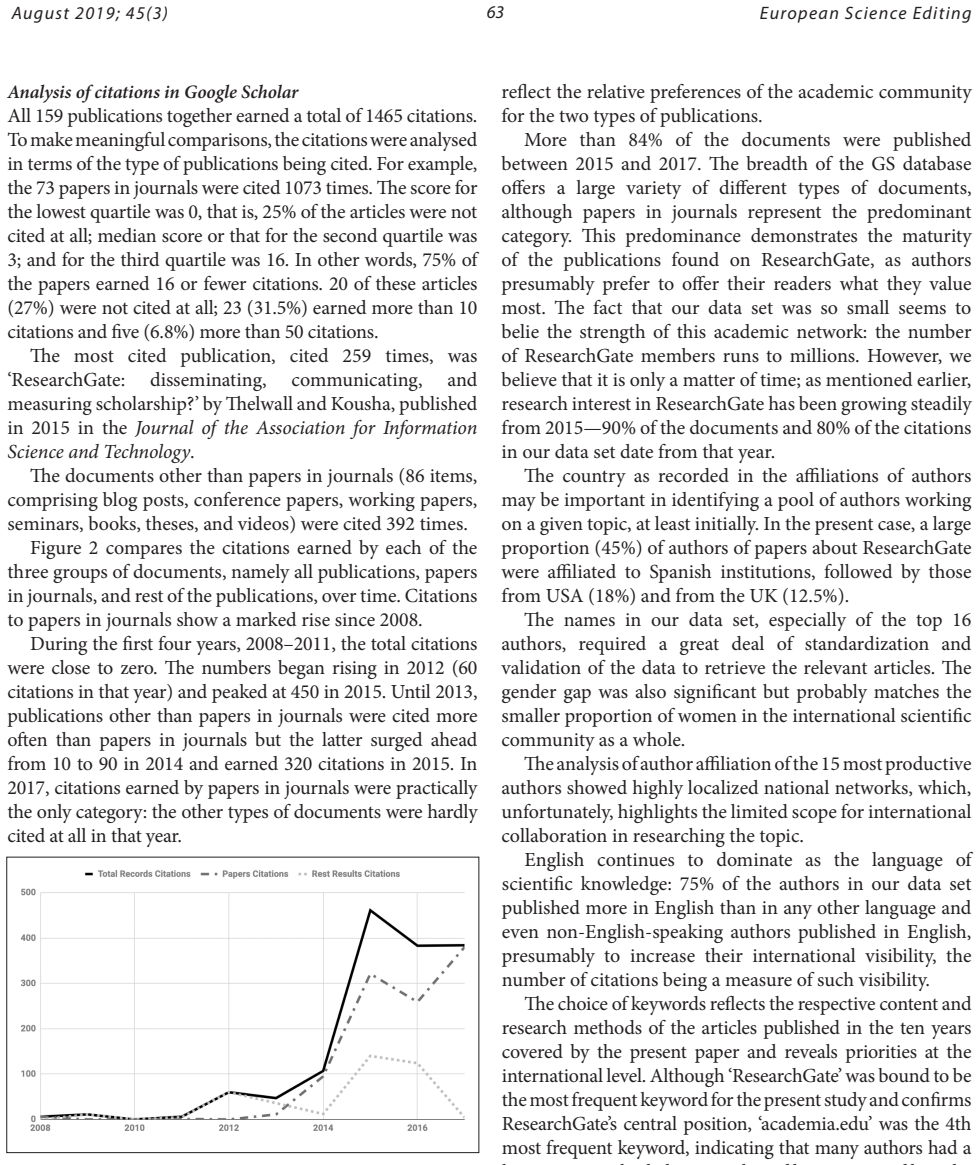
The central claim is that research on ResearchGate, measured by documents with the word 'ResearchGate' in their titles and retrieved through Google Scholar, was limited but genuine and is now growing. Specifically, the paper reports 159 documents after filtering 386 records; journal papers dominate at 46 percent, followed by conference papers at 19.5 percent; the most productive authors are two Spanish scholars who co-authored all eight of their contributions; the most frequent keywords are 'ResearchGate' and 'Altmetrics'; and more than 90 percent of all citations arrived from 2014 onward. The paper concludes that interest in ResearchGate has grown since 2015, as shown by both publication counts and citation counts.
Load-bearing premise
The load-bearing assumption is that searching for the exact word 'ResearchGate' in document titles via Google Scholar, then manually removing non-documents, captures the population of research about ResearchGate; if relevant studies omit the word from their titles or sit outside Google Scholar, the counts and growth trend would not represent the field.
Editorial extensions
If this is right
- Any 2008-2017 literature review on ResearchGate can be near-exhaustive with a small corpus; the 159-document count bounds the field.
- The sharp post-2015 rise means studies of ResearchGate's scholarly impact should weight the 2015-2017 window far more heavily than the early years.
- Because most authors are library and information science professionals publishing in English with co-authors from their own institutions, the field is best described as a locally clustered, English-language specialty.
- Journal papers increasingly attract citations compared with blogs, conference papers, and other outputs, so formal peer-reviewed venues are becoming the main channel through which ResearchGate scholarship is consumed.
Reading between the lines
- A testable extension would search for 'ResearchGate' in titles plus abstracts and keywords across several bibliographic databases; that would show whether the 159-document count is a floor or an artifact of title-only retrieval.
- Because the paper measures 'interest' by publications and citations, an altmetrics-based check using ResearchGate views, RG Score, or social-media mentions could reveal a different or earlier growth curve.
- The heavy concentration of Spanish-affiliated authors suggests a possible national research agenda around academic social networks; a collaboration-network map of the 267 authors would test whether this is one community or several isolated groups.
- If the same method were applied to rival networks such as Academia.edu, the comparison would show whether the post-2015 surge is specific to ResearchGate or common to academic social networking as a subject.
Signed reviews
Editorial analysis
A structured set of objections, weighed in public.
Referee Report
Summary. The paper presents a scoping bibliometric review of documents about the academic social network ResearchGate published between 2008 and 2017. The authors searched Google Scholar using the query `allintitle:researchgate`, manually filtered the 386 retrieved records down to 159 documents (excluding 227 bibliographic citations), and analyzed the documents by publication type, author productivity and gender, keywords, language, country affiliation, and citation counts. The main results are that journal articles are the most frequent document type (46%), the two most productive authors (each with 8 papers) are Spanish scholars Delgado López-Cózar and Orduña-Malea, and that research interest in ResearchGate has grown since 2015 as reflected in the number of publications and citations. The paper concludes that 'interest in ResearchGate has grown since 2015'.
Significance. If the reported figures were accurate, the paper would provide a useful descriptive baseline for the literature on ResearchGate, a topic that is relevant to bibliometrics, scholarly communication, and altmetrics. The paper's strengths include its attempt to cover a decade of publications, its breakdown by document type, and its attention to authorship patterns and keywords. However, the study's validity is compromised by the non-reproducible nature of the Google Scholar search and by internal inconsistencies between the stated percentages in the abstract and conclusions and the data shown in Table 1. Because the main conclusion (growth since 2015) relies on these counts, the paper needs correction and verification before its quantitative claims can be accepted.
major comments (2)
- [Abstract and Conclusions] The abstract reports that 'more than 90% of the total cites fell in that period' (i.e., since 2014), and the Conclusions state that '90% of the documents – all papers in journals – and 80% of the citations in our data set date from that year' (i.e., 2015). These claims are contradicted by Table 1. From Table 1, the number of documents published in 2015–2017 is 129/159 = 81.1% (not 90%), and the number of bibliographic citation records for the same period is 142/227 = 62.6% (not 80%). The abstract's more-than-90%-since-2014 figure for the 227 citation records is also incorrect (175/227 = 77.1%). If the abstract instead refers to the 1,465 citations received by the documents (as described in the Results), the paper does not provide any data in the text to verify that 90% of these fell after 2014. These errors affect the headline growth claim and must be corrected.
- [Methods/Procedure and Results] The search strategy is not reproducible and does not guarantee a valid or representative sample of the literature on ResearchGate. The query `allintitle:researchgate` in Google Scholar is non-deterministic, and the manual filtering of 386 records to 159 is described only qualitatively ('eliminated duplicates and corrected some errors', 'data were cleaned'). The paper itself notes that the initial GS results were 'misleading', and the filtering criterion is not specified in a way that allows replication. Moreover, restricting the search to titles containing 'ResearchGate' excludes any relevant document whose title does not contain that exact phrase, and the use of a single database (Google Scholar) means that coverage depends on the database's transient index. The paper should provide a full audit trail (date-stamped search, inclusion/exclusion criteria, a flow diagram, and ideally a list of the 159 included documents) and cross-validate the counts with an additional database such as Scopus or Web of Science.
minor comments (6)
- [Full text, first sentence] The first sentence of the full text contains a typo: 'ReseachGate' should be 'ResearchGate'.
- [Table 1] The column headers in Table 1 are garbled (e.g., 'Y ear Publication type N (%)' reads as two headings). Please separate and label the columns clearly, especially the 'Total records' and 'Citations' columns.
- [Methods/Procedure] The sentence 'The filtering criterion was "articles, excluding patents" to obtain the total number of items, sorted by the national or institutional web domain' is unclear; please explain how sorting by domain contributed to the filtering and what 'articles, excluding patents' means in the Google Scholar interface.
- [Results – keywords] In the sentence 'The most used keywords were "ResearchGate" (33) and " Altmetrics" (14)', there is an extra space before 'Altmetrics'. Also, Figure 1 would benefit from a descriptive caption.
- [Conclusions] The phrase '90% of the documents – all papers in journals –' is grammatically confusing; if it is meant to say that the growth is driven by journal papers, rephrase clearly.
- [Methods] Please specify whether the custom date range for each year was applied as January 1 to December 31, and describe how the 'adding up the total' was done to avoid double-counting year boundaries.
Circularity Check
No load-bearing circularity; the central growth claim is a direct corpus summary, with one acknowledged self-definitional keyword artifact and one minor non-load-bearing self-citation.
-
self definitional
[Discussion, keyword-analysis paragraph (after Figure 1)]
"Although 'ResearchGate' was bound to be the most frequent keyword for the present study and confirms ResearchGate's central position, 'academia.edu' was the 4th most frequent keyword, indicating that many authors had a keen interest in both the networks and have examined how the two compare."
The corpus was constructed by requiring the exact phrase 'ResearchGate' in document titles (Procedure: allintitle:researchgate). Counting keywords over that same corpus makes 'ResearchGate' the most frequent keyword by construction, not as an independent discovery. The paper explicitly acknowledges this ('bound to be'), so the step is transparent and does not support the paper's central conclusion about growth since 2015; it is a definitional artifact of the search filter rather than a circular derivation.
full rationale
This paper is a descriptive bibliometric scoping review. It contains no model, no fitted parameters, and no first-principles derivation. The central conclusion ('Interest in ResearchGate has grown since 2015') is a direct temporal summary of the year-by-year counts of the 159 retrieved documents and their 1465 citations. That conclusion is an empirical property of the corpus, not a quantity equivalent to the search definition by construction. The only real reduction-by-construction is the observation that 'ResearchGate' is the most frequent keyword, which follows from the title-search inclusion rule; the paper openly acknowledges this and does not lean on it for the main claim. One minor self-citation appears in the introduction (reference 4, Prieto-Gutierrez 2011, cited for general claims about social media monitoring), but it is not load-bearing and does not support the bibliometric method or the conclusions. Reproducibility and completeness concerns about the Google Scholar allintitle search and the manual filtering of 227 records are validity and measurement issues, not circularity. The internal inconsistency between the stated 90% and the table-implied 81% for post-2015 documents is a reporting error, also not circularity. Overall, the paper's derivation chain is self-contained and non-circular, with only a minor self-definitional artifact and a trivial self-citation.
Assumptions & free parameters
assumptions (4)
- domain assumption Google Scholar is an adequate bibliographic source for retrieving documents about ResearchGate.
- domain assumption Searching for 'ResearchGate' only in titles captures the population of documents about ResearchGate.
- domain assumption Manual filtering of 386 Google Scholar records into 159 documents is consistent and correct.
- domain assumption Google Scholar citation counts and name-based gender assignment are reliable enough for the conclusions.
Cite this review
Pith. "Pith review of Ten years of research on ResearchGate, a scoping review using Google Scholar 2008_2017." pith.science (2026). https://pith.science/paper/E2BNH4CR
@misc{pith2026190808752,
  author       = {Pith},
  title        = {Pith review of: Ten years of research on ResearchGate, a scoping review using Google Scholar 2008_2017},
  year         = {2026},
  howpublished = {\url{https://pith.science/paper/E2BNH4CR}},
  note         = {Machine review of arXiv:1908.08752}
}
read the original abstract
Objective. To analyse quantitatively the articles published during 2008_2017 about the academic social networking site ResearchGate. Methods. A scoping bibliometric review of documents retrieved using Google Scholar was conducted, limited to publications that contained the word "ResearchGate" in their title and were published from 2008 to 2017. Results. The search yielded 159 documents, once a preliminary list of 386 documents retrieved from Google Scholar was filtered, which eliminated about 60% of the results that were bibliographic citations and not documents. Papers in journals were the most numerous type of documents (n73; 46%), followed by conference papers (n_31; 19.5 %). Contributing eight publications, two Spanish scholars (Delgado Lopez-Cozar and Orduna Malea, who were coauthors in each case) were the most prolific authors writing on this topic during the ten-year period. The keywords most used in the documents were "ResearchGate" and "Altmetrics". The publications were cited frequently since 2014 (more than 90% of the total cites fell in that period), and those with more than one author were the most cited ones. The authors of the documents were mainly librarians and information science professionals, who wrote primarily as co-authors with colleagues from their own institutions, mostly published in English. Conclusions. Interest in ResearchGate has grown since 2015, as evident from the number of articles published and the citations they received. Keywords. Academic social networks, bibliometrics, scholarly communication
Figures

Reference graph
Works this paper leans on
-
[1]
Scholarly use of social media and altmetrics: a review of the literature
1 Sugimoto CR, Work S, Larivière V et al. Scholarly use of social media and altmetrics: a review of the literature. Journal of the Association for Information Science and Technology 2017;68(9):2037–2062. 2 Haustein S, Sugimoto C, Larivière, V . Guest editorial: social media in scholarly communication. Aslib Journal of Information Management 2015;67(3):372...
work page 2017
-
[2015]
Altmetrics in the wild: Using social media to explore scholarly impact
Available at: http://oro.open.ac.uk/43538/1/ASCW15_jordan_response_kraker- lex.pdf. 10 Yu MC, Wu YCJ, Alhalabi W et al. ResearchGate: an effective altmetric indicator for active researchers? Computers in Human Behavior 2016;55:1001–1006. 11 Ward J, Bejarano W , Dudás A. Scholarly social media profiles and libraries: a review. Liber Quarterly 2015;24(4):17...
work page Pith review arXiv 2016
Reviewed August 14, 2026 · model on record in the stance chip above.
Discussion (0). Continue with ORCID to comment.