Constraining the near-source relativistic wind medium using Fast Radio Burst circular polarization data
Pith reviewed 2026-07-03 19:29 UTC · model grok-4.3
The pith
Faraday conversion in magnetar winds accounts for the circular polarization observed in Fast Radio Bursts.
A machine-rendered reading of the paper's core claim, the machinery that carries it, and where it could break.
Core claim
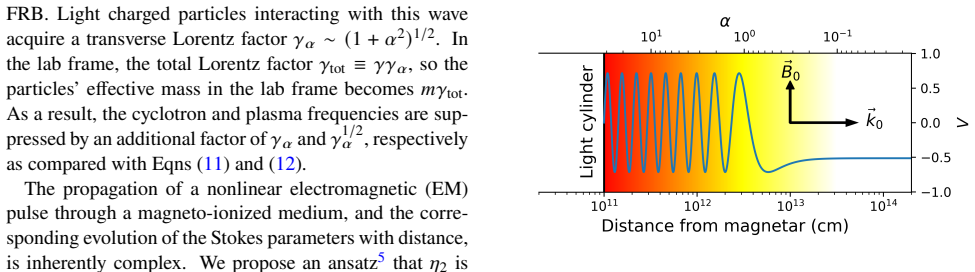
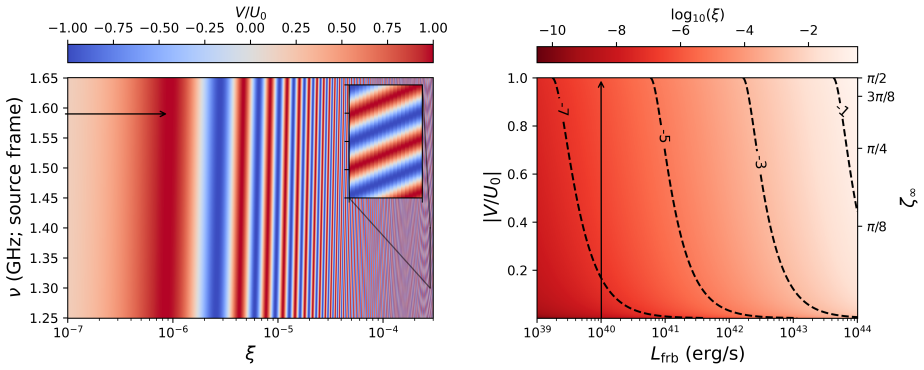
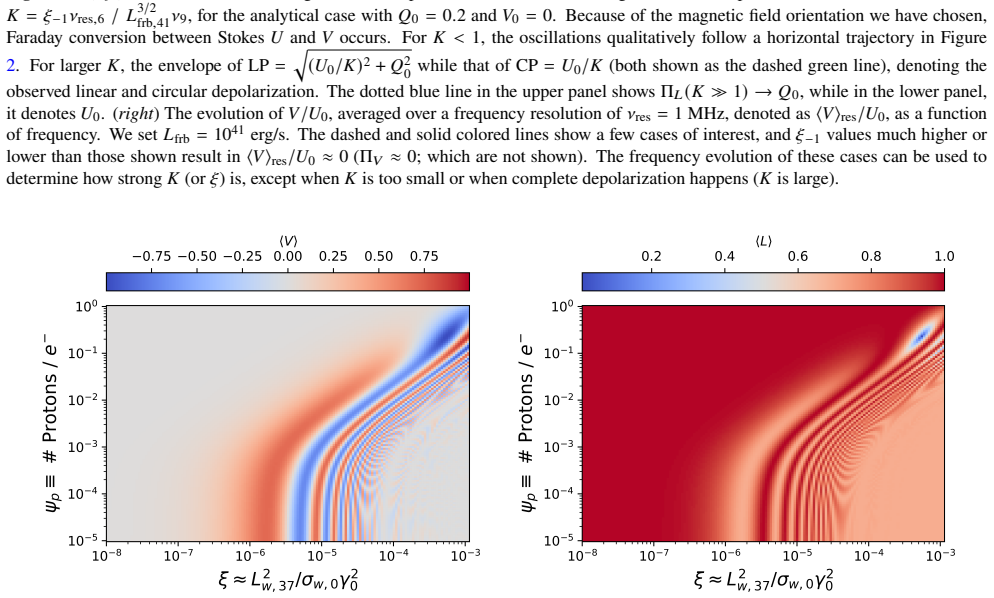
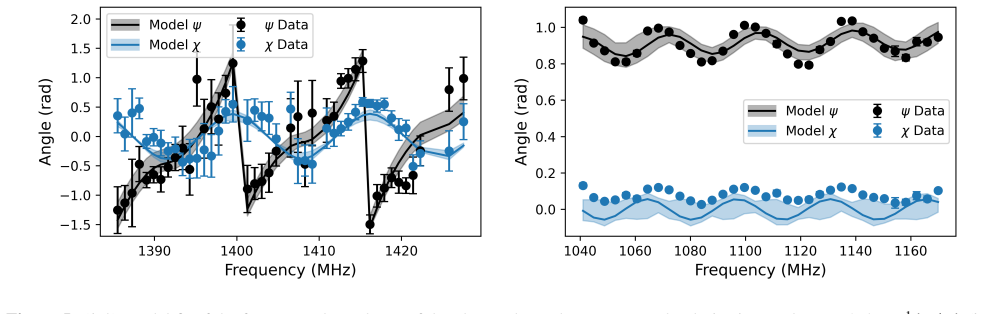
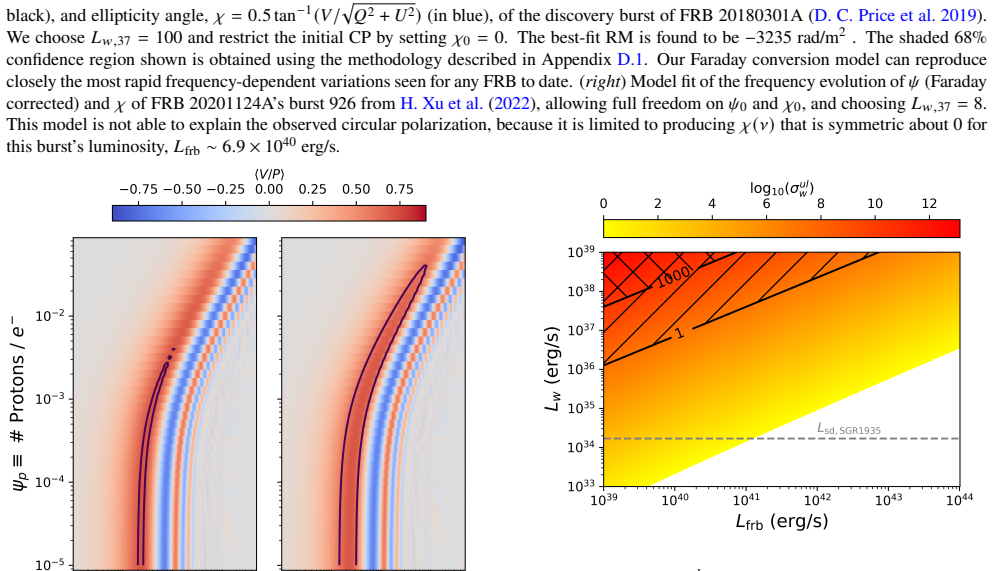
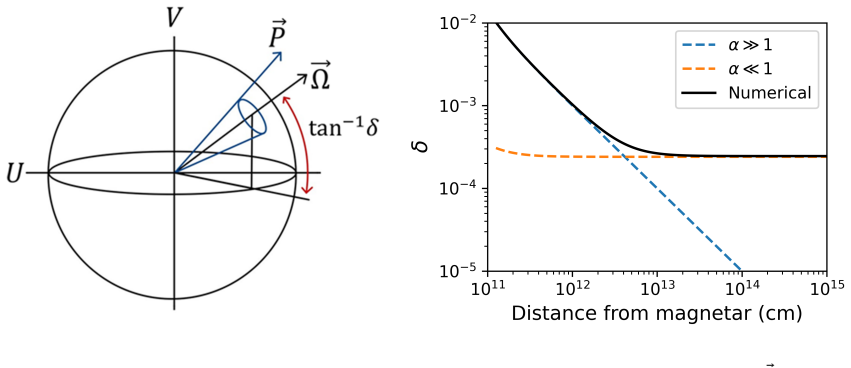
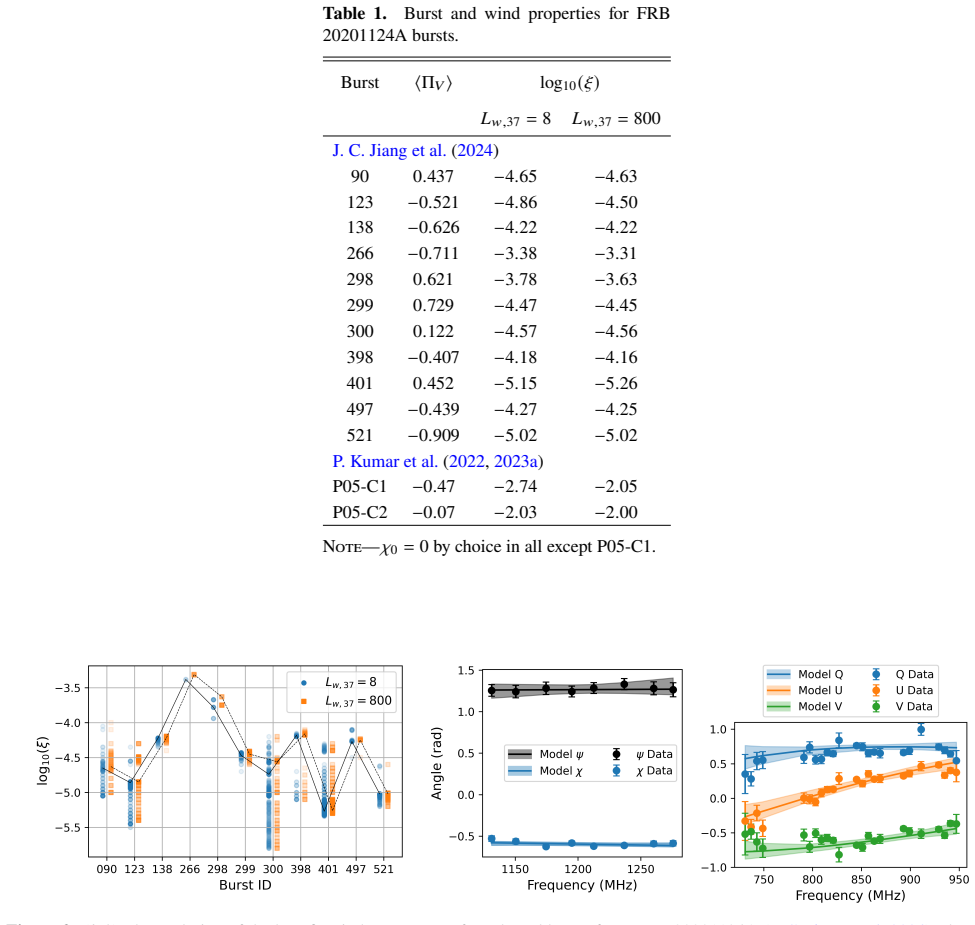
Faraday conversion in the magnetar wind, after incorporating the increase in effective mass of e± caused by the FRB wave itself, reproduces the observed range of circular polarization fractions. This includes explaining why many bursts show no detectable V. The same mechanism turns observational upper limits on V into quantitative constraints on wind luminosity, magnetization, Lorentz factor, and ion-related effective mass. Frequency-resolved Stokes spectra yield direct estimates of the wind environment, while rapid frequency oscillations of the Stokes parameters in the high-wind regime produce depolarization. Separate zones are required for significant circular polarization and rotation mea
What carries the argument
Faraday conversion in the near-source relativistic magnetar wind, including the wave-induced effective-mass increase of electron-positron pairs.
If this is right
- Upper limits on Stokes V constrain wind luminosity, magnetization, bulk Lorentz factor, and effective particle mass when ions are present.
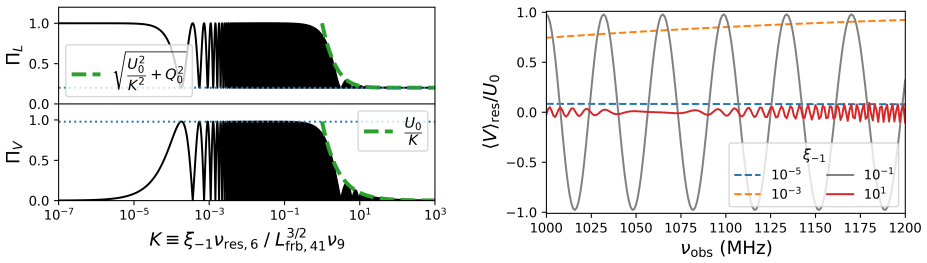
- Frequency-resolved Stokes spectra provide direct estimates of the wind environment for specific sources.
- Stokes parameters undergo rapid oscillations with frequency in the high-wind or low-FRB-luminosity regime, producing depolarization.
- Bursts with luminosities significantly below typical FRB values can still develop measurable circular polarization.
- Significant circular polarization and rotation measure must arise in separate zones.
Where Pith is reading between the lines
- Polarization measurements from additional FRB sources could map source-to-source differences in wind parameters.
- Multi-frequency campaigns could search for the predicted rapid oscillations in Stokes parameters as a direct test.
- The separate-zone requirement implies that rotation-measure and circular-polarization signals sample distinct radial regions of the wind.
- Lower-luminosity bursts should exhibit higher circular-polarization fractions on average.
Load-bearing premise
The observed circular polarization is produced by propagation through the near-source wind rather than being generated intrinsically at the emission site.
What would settle it
A burst whose circular polarization fraction shows frequency dependence that cannot be fit by Faraday conversion through a wind with the predicted effective-mass correction, or direct evidence that the polarization is generated at the source with no propagation contribution.
Figures
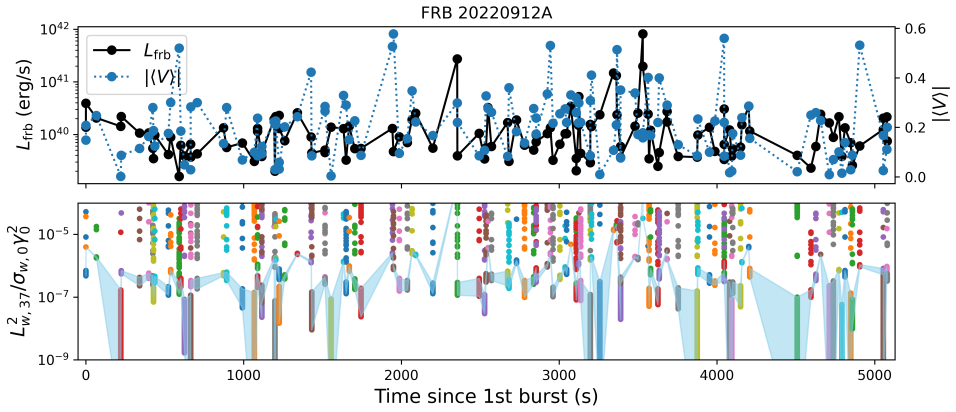
read the original abstract
Fast Radio Bursts (FRBs) exhibit diverse spectro-temporal characteristics, which can probe vital propagation and source physics via Stokes polarimetry. We investigate whether the circular polarization (Stokes $V$) observed in some bursts is produced by Faraday conversion in the near-source wind of magnetars rather than being intrinsic to the source. Our calculation includes the increase in the effective mass of $e^\pm$ in the presence of the FRB wave. We find that Faraday conversion in the magnetar wind can explain the broad range of observed circular polarization in FRBs, including its frequent non-detection. Observationally derived upper limits on $V$ provide stringent constraints on the wind luminosity, magnetization, bulk Lorentz factor, and effective particle mass when ions are present. When available, frequency resolved Stokes spectra offer direct estimates of the wind environment. The Stokes parameters can undergo rapid oscillations with frequency in the high-wind/low-FRB-luminosity regime, resulting in Stokes-V depolarization. Bursts with significantly lower luminosities than typical FRBs can also develop measurable circular polarization, within the model framework. Additionally, separate zones are favored for significant circular polarization and rotation measure, when the model is applicable. The model constrains instantaneous wind parameters for several sources, including FRB 20201124A, FRB 20180301A, and SGR 1935+2154. This work represents the first instance in which properties of winds from compact objects associated with FRBs are inferred from polarization data.
Editorial analysis
A structured set of objections, weighed in public.
Referee Report
Summary. The manuscript claims that Faraday conversion in the near-source relativistic wind of magnetars, incorporating the effective mass increase of e± pairs in the FRB wave, can explain the observed range of circular polarization (Stokes V) in FRBs including frequent non-detections. Upper limits on V are used to derive constraints on wind luminosity, magnetization, bulk Lorentz factor, and effective particle mass (when ions are present); frequency-resolved spectra can estimate wind properties, rapid frequency oscillations can cause depolarization, lower-luminosity bursts can show measurable V, and separate zones are favored for significant V versus rotation measure. The work is presented as the first inference of compact-object wind properties from FRB polarization data, with specific constraints derived for sources including FRB 20201124A, FRB 20180301A, and SGR 1935+2154.
Significance. If the propagation origin of V holds and the effective-mass incorporation is correctly implemented, the result would provide a new, observationally grounded method to constrain instantaneous parameters of relativistic magnetar winds associated with FRBs, addressing a key gap in near-source environment studies. The use of existing upper limits on V to produce quantitative bounds is a strength, as is the discussion of depolarization regimes and the potential for frequency-resolved Stokes spectra. However, the overall significance remains conditional on the foundational assumption that observed V is not generated intrinsically at the emission site.
major comments (3)
- [Abstract and Introduction] Abstract and Introduction: the central claim that upper limits on V yield stringent constraints on wind luminosity, magnetization, γ, and effective mass rests entirely on the premise that Stokes V is produced by Faraday conversion in the wind rather than intrinsically; no dedicated section or quantitative test is provided to distinguish these origins or to show how the constraints would be invalidated if the intrinsic-emission hypothesis holds.
- [§3] §3 (calculation of conversion coefficient): the incorporation of the effective-mass increase for e± is stated to be included, but the manuscript does not display the explicit derivation steps, the resulting expression for the conversion coefficient, or the propagated uncertainties; without these, it is impossible to verify whether the reported constraints on effective particle mass (when ions are present) are robust or sensitive to post-hoc parameter choices.
- [§4] §4 (model applicability and zones): the requirement of distinct zones for significant circular polarization versus rotation measure is asserted, yet no quantitative condition or observational discriminant is derived to establish when this separation must hold; this is load-bearing because the model is stated to be applicable only under that condition.
minor comments (2)
- [Notation] Notation for the effective mass and the conversion coefficient should be defined once at first use and used consistently thereafter to avoid ambiguity in the frequency-dependence discussion.
- [Figures] Figure captions for any Stokes-V spectra or constraint plots should explicitly state the assumed ion fraction and the range of Lorentz factors explored.
Simulated Author's Rebuttal
We thank the referee for their detailed and constructive comments. We address each major point below and will incorporate revisions to improve the manuscript's clarity and rigor.
read point-by-point responses
-
Referee: [Abstract and Introduction] Abstract and Introduction: the central claim that upper limits on V yield stringent constraints on wind luminosity, magnetization, γ, and effective mass rests entirely on the premise that Stokes V is produced by Faraday conversion in the wind rather than being intrinsic; no dedicated section or quantitative test is provided to distinguish these origins or to show how the constraints would be invalidated if the intrinsic-emission hypothesis holds.
Authors: We agree that the constraints are conditional on the propagation origin. The manuscript presents Faraday conversion as one possible explanation and derives bounds under that assumption. In revision we will add a dedicated paragraph to the Introduction and a short subsection to the Discussion that explicitly states the conditional nature of the results, outlines how the derived bounds would be invalidated under an intrinsic-emission scenario, and proposes simple observational discriminants (frequency dependence of V, correlation with burst luminosity, and comparison with RM). revision: yes
-
Referee: [§3] §3 (calculation of conversion coefficient): the incorporation of the effective-mass increase for e± is stated to be included, but the manuscript does not display the explicit derivation steps, the resulting expression for the conversion coefficient, or the propagated uncertainties; without these, it is impossible to verify whether the reported constraints on effective particle mass (when ions are present) are robust or sensitive to post-hoc parameter choices.
Authors: We acknowledge the omission of the explicit derivation. The revised manuscript will include an appendix containing the step-by-step derivation of the conversion coefficient with the effective-mass term, the final analytic expression, and a brief sensitivity analysis showing how the constraints on effective particle mass respond to variations in the adopted parameters. revision: yes
-
Referee: [§4] §4 (model applicability and zones): the requirement of distinct zones for significant circular polarization versus rotation measure is asserted, yet no quantitative condition or observational discriminant is derived to establish when this separation must hold; this is load-bearing because the model is stated to be applicable only under that condition.
Authors: We agree that a quantitative criterion is needed. In the revised §4 we will derive and present a simple condition based on the relative optical depths (or path lengths) required for appreciable conversion versus Faraday rotation, together with an observational discriminant such as the expected statistical independence between measured |V| and RM when the zones are spatially separated. revision: yes
Circularity Check
No significant circularity; derivation uses external observations to constrain model parameters
full rationale
The paper models Faraday conversion in the magnetar wind (including effective mass effects) and applies it to observed upper limits on Stokes V from FRB data to derive constraints on wind parameters. No steps reduce predictions to fitted inputs by construction, no self-citations are load-bearing for the central result, and the derivation remains independent of the target constraints. The assumption that V originates from propagation is stated explicitly as a premise rather than derived internally.
Axiom & Free-Parameter Ledger
axioms (1)
- domain assumption Faraday conversion occurs in relativistic magnetar winds and can be modified by wave-induced effective mass of e±
Reference graph
Works this paper leans on
-
[1]
2023, Science, 380, 599, doi: 10.1126/science.abo6526
Anna-Thomas, R., Connor, L., Dai, S., et al. 2023, Science, 380, 599, doi: 10.1126/science.abo6526
-
[2]
Beloborodov, A. M. 2020, ApJ, 896, 142, doi: 10.3847/1538-4357/ab83eb
-
[3]
2025, ApJ, 982, 45, doi: 10.3847/1538-4357/adb8e6
Beniamini, P., & Kumar, P. 2025, ApJ, 982, 45, doi: 10.3847/1538-4357/adb8e6
-
[4]
Beniamini, P., Kumar, P., & Narayan, R. 2022, MNRAS, 510, 4654, doi: 10.1093/mnras/stab3730 Bochenek,C.D.,Ravi,V.,Belov,K.V.,etal.2020,Nature,587, 59, doi: 10.1038/s41586-020-2872-x
-
[5]
2024, Nature, 632, 1014, doi: 10.1038/s41586-024-07782-6
Bruni, G., Piro, L., Yang, Y.-P., et al. 2024, Nature, 632, 1014, doi: 10.1038/s41586-024-07782-6
-
[6]
Cattani, F., Kim, A., Anderson, D., & Lisak, M. 2000, PhRvE, 62, 1234, doi: 10.1103/PhysRevE.62.1234 CHIME Collaboration, Amiri, M., Bandura, K., et al. 2022, ApJS, 261, 29, doi: 10.3847/1538-4365/ac6fd9 CHIME/FRB Collaboration, Andersen, B. C., Bandura, K. M., et al. 2020, Nature, 587, 54, doi: 10.1038/s41586-020-2863-y
-
[7]
Cocke, W. J., & Holm, D. A. 1972, Nature Physical Science, 240, 161, doi: 10.1038/physci240161b0
-
[8]
2002, ApJ, 566, 336, doi: 10.1086/324778
Contopoulos, I., & Kazanas, D. 2002, ApJ, 566, 336, doi: 10.1086/324778
-
[9]
2023, in American Astronomical Society Meeting
Croft, S. 2023, in American Astronomical Society Meeting
2023
-
[10]
Decker, C. D., Mori, W. B., Tzeng, K.-C., & Katsouleas, T. 1996, Physics of Plasmas, 3, 2047, doi: 10.1063/1.872001 Feng,Y.,Zhang,Y.-K.,Li,D.,etal.2022a,ScienceBulletin,67, 2398, doi: 10.1016/j.scib.2022.11.014
-
[11]
2022b, Science, 375, 1266, doi: 10.1126/science.abl7759
Feng, Y., Li, D., Yang, Y.-P., et al. 2022b, Science, 375, 1266, doi: 10.1126/science.abl7759
-
[12]
2024, ApJ, 974, 296, doi: 10.3847/1538-4357/ad7a64
Feng, Y., Li, D., Zhang, Y.-K., et al. 2024, ApJ, 974, 296, doi: 10.3847/1538-4357/ad7a64
-
[13]
Gajjar, V., Siemion, A. P. V., Price, D. C., et al. 2018, ApJ, 863, 2, doi: 10.3847/1538-4357/aad005
-
[14]
2019, ApJ, 876, 74, doi: 10.3847/1538-4357/ab0fa3
Gruzinov, A., & Levin, Y. 2019, ApJ, 876, 74, doi: 10.3847/1538-4357/ab0fa3
-
[15]
M., Bhandari, S., Marcote, B., et al
Hewitt, D. M., Bhandari, S., Marcote, B., et al. 2024, MNRAS, 529, 1814, doi: 10.1093/mnras/stae632
-
[16]
Hilmarsson, G. H., Spitler, L. G., Main, R. A., & Li, D. Z. 2021, MNRAS, 508, 5354, doi: 10.1093/mnras/stab2936
-
[17]
Hobbs, G., Manchester, R. N., Dunning, A., et al. 2020, PASA, 37, e012, doi: 10.1017/pasa.2020.2
-
[18]
Huang, L., & Shcherbakov, R. V. 2011, MNRAS, 416, 2574, doi: 10.1111/j.1365-2966.2011.19207.x
-
[19]
L., Esposito, P., Rea, N., et al
Israel, G. L., Esposito, P., Rea, N., et al. 2016, MNRAS, 457, 3448, doi: 10.1093/mnras/stw008
-
[20]
2022, Research in Astronomy and Astrophysics, 22, 124003, doi: 10.1088/1674-4527/ac98f6
Jiang, J.-C., Wang, W.-Y., Xu, H., et al. 2022, Research in Astronomy and Astrophysics, 22, 124003, doi: 10.1088/1674-4527/ac98f6
-
[21]
Jiang, J. C., Xu, J. W., Niu, J. R., et al. 2024, National Science Review, 12, nwae293, doi: 10.1093/nsr/nwae293
-
[22]
2020, Research in Astronomy and Astrophysics, 20, 064, doi: 10.1088/1674-4527/20/5/64
Jiang, P., Tang, N.-Y., Hou, L.-G., et al. 2020, Research in Astronomy and Astrophysics, 20, 064, doi: 10.1088/1674-4527/20/5/64
-
[23]
Kirk, J. G., Lyubarsky, Y., & Petri, J. 2009, in Astrophysics and Space Science Library, Vol. 357, Astrophysics and Space Science Library, ed. W. Becker, 421, doi: 10.1007/978-3-540-76965-1_16
-
[24]
Kirsten, F., Snelders, M. P., Jenkins, M., et al. 2021, Nature Astronomy, 5, 414, doi: 10.1038/s41550-020-01246-3
-
[25]
Kumar, P., Shannon, R. M., Lower, M. E., et al. 2022, MNRAS, 512, 3400, doi: 10.1093/mnras/stac683
-
[26]
Prochaska, J. X. 2023a, PhRvD, 108, 043009, doi: 10.1103/PhysRevD.108.043009
-
[27]
Kumar, P., Luo, R., Price, D. C., et al. 2023b, MNRAS, 526, 3652, doi: 10.1093/mnras/stad2969
-
[28]
Lower, M. E. 2021, arXiv e-prints, arXiv:2108.09429, doi: 10.48550/arXiv.2108.09429
-
[29]
Luo, R., Wang, B. J., Men, Y. P., et al. 2020, Nature, 586, 693, doi: 10.1038/s41586-020-2827-2
-
[30]
2022, ApJL, 933, L6, doi: 10.3847/2041-8213/ac786f
Lyutikov, M. 2022, ApJL, 933, L6, doi: 10.3847/2041-8213/ac786f
-
[31]
2024, MNRAS, 529, 2180, doi: 10.1093/mnras/stae591
Lyutikov, M. 2024, MNRAS, 529, 2180, doi: 10.1093/mnras/stae591
-
[32]
2025, Nature, 637, 43, doi: 10.1038/s41586-024-08184-4
Mckinven, R., Bhardwaj, M., Eftekhari, T., et al. 2025, Nature, 637, 43, doi: 10.1038/s41586-024-08184-4
-
[33]
Michel, F. C. 1969, ApJ, 158, 727, doi: 10.1086/150233
-
[34]
Michel, F. C. 1991, Theory of neutron star magnetospheres
1991
-
[35]
1978, MNRAS, 185, 69, doi: 10.1093/mnras/185.1.69
Okamoto, I. 1978, MNRAS, 185, 69, doi: 10.1093/mnras/185.1.69
-
[36]
2025, A&A, 693, A279, doi: 10.1051/0004-6361/202450953
Pastor-Marazuela, I., van Leeuwen, J., Bilous, A., et al. 2025, A&A, 693, A279, doi: 10.1051/0004-6361/202450953
-
[37]
C., Foster, G., Geyer, M., et al
Price, D. C., Foster, G., Geyer, M., et al. 2019, MNRAS, 486, 3636, doi: 10.1093/mnras/stz958
-
[38]
2002, Applied Physics B: Lasers and Optics, 74, 355, doi: 10.1007/s003400200795
Pukhov, A., & Meyer-ter-Vehn, J. 2002, Applied Physics B: Lasers and Optics, 74, 355, doi: 10.1007/s003400200795
-
[39]
R., Van Eck, C
Purcell, C. R., Van Eck, C. L., West, J., Sun, X. H., & Gaensler, B. M. 2020,, Astrophysics Source Code Library, record ascl:2005.003 http://ascl.net/2005.003 Radhakrishnan,V.,&Cooke,D.J.1969,Astrophys.Lett.,3,225
2020
-
[40]
Rahaman, S. M., Acharya, S. K., Beniamini, P., & Granot, J. 2025, ApJ, 988, 276, doi: 10.3847/1538-4357/ade70c
-
[41]
2023, ApJL, 949, L3, doi: 10.3847/2041-8213/acc4b6
Ravi, V., Catha, M., Chen, G., et al. 2023, ApJL, 949, L3, doi: 10.3847/2041-8213/acc4b6
-
[42]
B., & Lightman, A
Rybicki, G. B., & Lightman, A. P. 1986, Radiative Processes in Astrophysics
1986
-
[43]
2016, High Energy Density Physics, 19, 48, doi: 10.1016/j.hedp.2016.03.003
Saedjalil, N., & Jafari, S. 2016, High Energy Density Physics, 19, 48, doi: 10.1016/j.hedp.2016.03.003
-
[44]
2017, PhRvE, 96, 043209, doi: 10.1103/PhysRevE.96.043209
Sano, T., Tanaka, Y., Iwata, N., et al. 2017, PhRvE, 96, 043209, doi: 10.1103/PhysRevE.96.043209
-
[45]
2006, Physics of Plasmas, 13, 033102, doi: 10.1063/1.2178187
Sazegari, V., Mirzaie, M., & Shokri, B. 2006, Physics of Plasmas, 13, 033102, doi: 10.1063/1.2178187
-
[46]
Scott, D. R., Dial, T., Bera, A., et al. 2025, PASA, 42, e133, doi: 10.1017/pasa.2025.10103
-
[47]
Sharma, A., & Tripathi, V. K. 2012, Laser and Particle Beams, 30, 659, doi: 10.1017/S0263034612000481
-
[48]
B., Connor, L., Ravi, V., et al
Sherman, M. B., Connor, L., Ravi, V., et al. 2024, ApJ, 964, 131, doi: 10.3847/1538-4357/ad275e
-
[49]
Interaction of Strong Electromagnetic Waves with Unmagnetized Pair Plasmas
Sridhar, N., Sobacchi, E., Sironi, L., et al. 2026, arXiv e-prints, arXiv:2604.11698, doi: 10.48550/arXiv.2604.11698
work page internal anchor Pith review Pith/arXiv arXiv doi:10.48550/arxiv.2604.11698 2026
-
[50]
M., Pastor-Marazuela, I., et al
Tian, J., Rajwade, K. M., Pastor-Marazuela, I., et al. 2024, MNRAS, 533, 3174, doi: 10.1093/mnras/stae2013
-
[51]
Pulsar data analysis with PSRCHIVE
Uttarkar, P. A., Shannon, R. M., Lower, M. E., et al. 2024, MNRAS, 534, 2485, doi: 10.1093/mnras/stae2159 Van Eck, C. L., R. Purcell, C., Baidoo, L., et al. 2026, ApJS, 283, 28, doi: 10.3847/1538-4365/ae3dea van Straten, W., Demorest, P., & Oslowski, S. 2012, Astronomical Research and Technology, 9, 237, doi: 10.48550/arXiv.1205.6276
work page internal anchor Pith review Pith/arXiv arXiv doi:10.1093/mnras/stae2159 2024
-
[52]
Vedantham, H. K., & Ravi, V. 2019, MNRAS, 485, L78, doi: 10.1093/mnrasl/slz038
-
[53]
2025, ApJ, 988, 164, doi: 10.3847/1538-4357/ade1d2
Wang, W.-Y., Liu, X., Li, D., et al. 2025, ApJ, 988, 164, doi: 10.3847/1538-4357/ade1d2
-
[54]
2023, ApJS, 268, 5, doi: 10.3847/1538-4365/ace77c
Xiao, S., Yang, J.-J., Luo, X.-H., et al. 2023, ApJS, 268, 5, doi: 10.3847/1538-4365/ace77c
-
[55]
Xu, H., Niu, J. R., Chen, P., et al. 2022, Nature, 609, 685, doi: 10.1038/s41586-022-05071-8
-
[56]
2020, ApJ, 895, 7, doi: 10.3847/1538-4357/ab88ab
Yang, Y.-P., Li, Q.-C., & Zhang, B. 2020, ApJ, 895, 7, doi: 10.3847/1538-4357/ab88ab
-
[57]
2022, ApJL, 928, L16, doi: 10.3847/2041-8213/ac5f46
Yang, Y.-P., Lu, W., Feng, Y., Zhang, B., & Li, D. 2022, ApJL, 928, L16, doi: 10.3847/2041-8213/ac5f46
-
[58]
2023, ApJ, 955, 142, doi: 10.3847/1538-4357/aced0b
Zhang, Y.-K., Li, D., Zhang, B., et al. 2023, ApJ, 955, 142, doi: 10.3847/1538-4357/aced0b
discussion (0)
Sign in with ORCID, Apple, or X to comment. Anyone can read and Pith papers without signing in.