REVIEW 4 major objections 5 minor 116 references
Close-in Exoplanets as Candidates of Strange Quark Matter Objects
T0 review · 4 major / 5 minor · reviewed 2026-08-14 · deepseek-v4-flash
Pith's one-line read Close-in exoplanets with orbital periods under 6,100 seconds are most plausibly strange quark matter planets, and four pulsar companions already meet this criterion.
desk verdict A useful candidate list, but the orbital-period screen is a necessary condition, not a test that distinguishes SQM planets from brown dwarfs or degenerate cores. read the letter →
The pith
A machine-rendered reading of the paper's core claim, the machinery that carries it, and where it could break.
The reading
What carries the argument
The load-bearing object is the tidal-disruption radius, $r_{\rm td}\approx (6M/\pi\rho)^{1/3}$, combined with Kepler's law to convert radius into a period threshold. An SQM planet with density $\sim4\times10^{14}$ g cm$^{-3}$ is disrupted only at $\sim2.37\times10^6$ cm, essentially at the stellar surface, whereas a normal planet capped at 30 g cm$^{-3}$ is disrupted at $5.6\times10^{10}$ cm. The period-density relation $\rho_{\min}\approx 3\pi/(0.4623\,G P_{\rm orb}^2)$ then gives a minimum density for each observed companion, and the criterion $P_{\rm orb}<6100$ s becomes a simple observational filter for exotic matter.
What would settle it
A radius measurement showing any of the four pulsar companions has a mean density below roughly 30 g cm$^{-3}$, for example through an X-ray eclipse or optical detection revealing a large low-density body, would break the tidal-disruption criterion and remove the need for strange quark matter. Alternatively, a gravitational-wave burst from a merger whose matter signature is incompatible with quark matter would settle the question.
Extended reading notes
Core claim
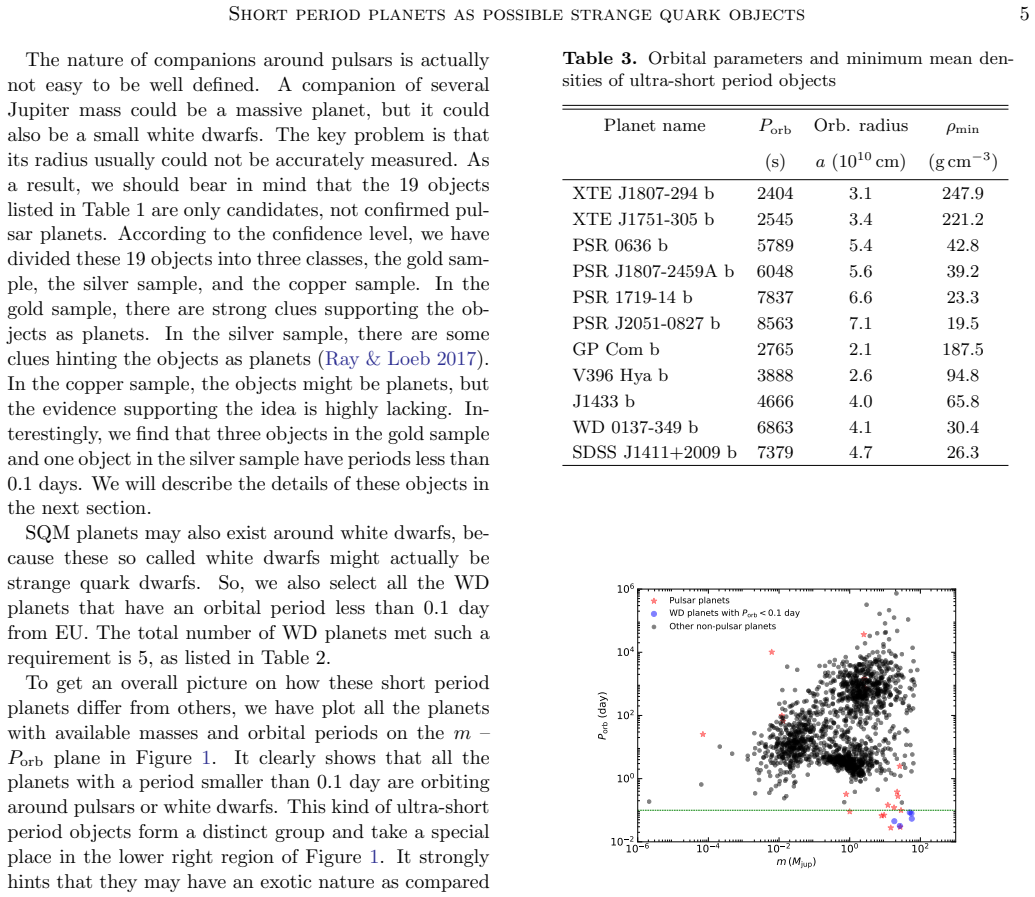
The central claim is that extreme closeness alone can identify exotic compact planets: a planet observed with $P_{\rm orb}<6100$ s (orbital radius $a<5.6\times10^{10}$ cm) must have a mean density exceeding the normal-matter ceiling of roughly 30 g cm$^{-3}$, so it is most likely a strange quark matter object. Among known pulsar planets, XTE J1807-294 b (2404 s), XTE J1751-305 b (2545 s), PSR 0636 b (5789 s), and PSR J1807-2459A b (6048 s) fully meet the criterion, while PSR 1719-14 b (7837 s) and PSR J2051-0827 b (8563 s) are close enough to be potential candidates. Among white-dwarf companions, GP Com b, V396 Hya b, and J1433 b have orbital periods of 2765, 3888, and 4666 s and minimum densities of 187.5, 94.8, and 65.8 g cm$^{-3}$, respectively, which the paper argues makes them very good SQM planet candidates. The paper thereby converts the SQM hypothesis into a concrete list of observable targets.
Load-bearing premise
The argument assumes that an orbital period under 6100 s forces a mean density higher than ordinary matter can provide, so the companion must be exotic; if a crystallized C/O dwarf or a brown dwarf can be that dense and that close, the SQM conclusion does not follow.
Editorial extensions
If this is right
- Any future planet found in a circular orbit with $P_{\rm orb}<6100$ s around a pulsar or white dwarf would, by this criterion, be classified as an SQM candidate rather than an ordinary planet.
- The four listed pulsar companions are concrete follow-up targets: measuring their radii or detecting their surfaces would directly test whether they are ordinary matter.
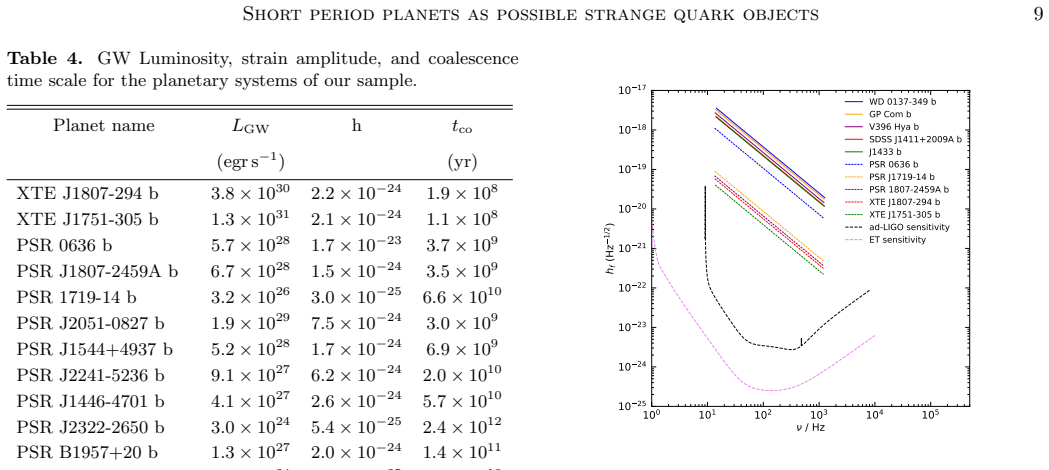
- Persistent gravitational waves from GP Com b, V396 Hya b, and J1433 b should lie above LISA's one-year sensitivity curve, so LISA data can be searched for these predicted signals.
- Merger bursts from close-in SQM planets are predicted to exceed the sensitivity of advanced LIGO and the Einstein Telescope, offering a gravitational-wave channel to test the SQM hypothesis.
- Confirmation of even one candidate would support the conjecture that millisecond pulsars in low-mass X-ray binaries are strange stars, linking accretion-induced deconfinement to the presence of exotic companions.
Reading between the lines
- The same period-density logic could be applied to future ultra-short-period planets around white dwarfs found by wide-field surveys: any object with $P_{\rm orb}<6100$ s and a minimum density above 30 g cm$^{-3}$ would automatically be flagged as an SQM candidate even without a pulsar host.
- The 30 g cm$^{-3}$ ceiling and the assumed circular orbit are the tunable parameters; allowing eccentric orbits or higher-density ordinary cores, such as crystallized C/O dwarfs, would shift the period cutoff and could change which near-threshold candidates count.
- A targeted LISA search for the three above-threshold white-dwarf systems could serve as a clean test: detecting monochromatic emission at $f=2/P_{\rm orb}$ would confirm a very compact companion without needing an electromagnetic radius measurement.
- If follow-up rules out all eleven candidates, the absence of ultra-short-period normal planets around pulsars would itself constrain the abundance of SQM planets and the strange-star fraction of millisecond pulsars.
Signed reviews
Editorial analysis
A structured set of objections, weighed in public.
Referee Report
Summary. The paper argues that normal-matter planets with densities below about 30 g/cm^3 would be tidally disrupted if their orbital radius is below about 5.6e10 cm or their orbital period is below about 6100 s, whereas strange quark matter planets could survive at such close separations. Using this criterion, the authors compile a sample of 19 pulsar-planet candidates from public exoplanet catalogs, identify four pulsar companions (XTE J1807-294 b, XTE J1751-305 b, PSR 0636 b, PSR J1807-2459A b) as completely meeting the criterion and five white-dwarf companions with P_orb < 0.1 day as additional candidates, and compute minimum densities as well as persistent and merger gravitational-wave signals for these systems, concluding that several are detectable by LISA, advanced LIGO, and the Einstein Telescope.
Significance. If the strange quark matter hypothesis is correct and the listed candidates are genuine SQM planets, the paper would provide a useful target list and a potentially falsifiable gravitational-wave search strategy. The strengths of the manuscript are its systematic use of public catalogs, its transparent gold/silver/copper classification of pulsar companions, and its quantitative use of standard Peters-Mathews formulas for gravitational-wave emission. However, the central screening criterion is only a necessary condition based on mean density; ordinary degenerate cores and dense brown dwarfs can also satisfy it. The paper would therefore be better framed as a candidate-screening study than as an identification of SQM objects, and it needs additional quantitative treatment of the competing interpretations before its central claim can be fully supported.
major comments (4)
- [Sec. 4.1, Table 3] The four pulsar companions that are said to 'completely meet' the SQM criteria are not robustly identified as SQM planets, because the period-density relation gives only a necessary lower bound on mean density. The text itself notes in Sec. 4.1.3 that XTE J1807-294 b and XTE J1751-305 b may be crystallized C/O dwarf cores (Deloye & Bildsten 2003), and the counter-argument based on masses below roughly 100 M_jup does not exclude such cores, which can have masses well below that value in stripped configurations (the PSR J1719-14 b case cited by the authors is a precedent). Similarly, PSR 0636 b and PSR J1807-2459A b, discussed in Sec. 4.1.1, are compact enough to be degenerate cores rather than SQM planets. The paper should either provide additional diagnostics that distinguish SQM planets from C/O degenerate cores, or explicitly weaken the claim from 'good candidates' to 'objects that pass a necessary-condition screen'.
- [Sec. 4, density formula] The printed formula rho_min approximately 3 pi / (0.4623 G P^2) is missing the cube on 0.4623; the values in Table 3 are consistent with 3 pi / (0.4623^3 G P^2), since the Roche-lobe radius enters as 0.4623 a (m/M)^(1/3) and therefore contributes a volume factor of 0.4623^3. With the formula as printed, PSR 0636 b and PSR J1807-2459A b would have rho_min values around 9 and 8 g/cm^3, below the 30 g/cm^3 threshold used to justify their SQM candidacy. Please correct the equation and state explicitly which normalization was used to produce Table 3.
- [Sec. 4.2, Table 2] The brown-dwarf alternative is not quantitatively excluded for the five white-dwarf companions. The masses of GP Com b, V396 Hya b, J1433 b, WD 0137-349 b, and SDSS J1411+2009 b are in the range 18 to 57 M_jup, which substantially overlaps the brown-dwarf mass range, and the text acknowledges that several of these objects have been suggested to be irradiated brown dwarfs. The assertion in Sec. 4.2 that the densities of the three shortest-period objects are 'so high that they can hardly be normal brown dwarfs' is not backed by a mass-radius calculation for old, irradiated brown dwarfs, which can contract to mean densities well above 30 g/cm^3. A quantitative comparison of expected brown-dwarf and C/O-core mean densities at these masses is needed before these systems can be promoted to SQM candidates.
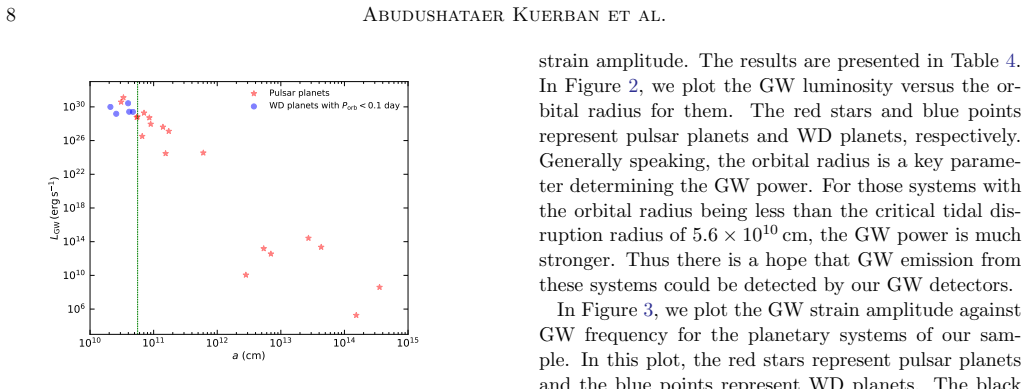
- [Sec. 5.1] The claim that gravitational-wave observation 'would be a unique tool to search for SQM candidates' is not justified. The persistent gravitational-wave strain in Eqs. (3) and (4) depends only on the chirp mass, orbital period, and distance; it is the same for an SQM planet, a C/O degenerate core, and a brown dwarf at identical orbital parameters. The statement that a close-in planet-like object discovered via gravitational waves 'must be an SQM planetary system' is therefore too strong, since gravitational waves alone do not measure the companion density or radius. The persistent signal can be part of a multi-messenger identification only when combined with an independent compactness measurement.
minor comments (5)
- [Table 1, Sec. 4.1] Object naming is inconsistent: the text uses 'PSR J0636 b' and 'PSR J1719-14 b', while Table 1 lists 'PSR 0636 b' and 'PSR 1719-14 b'. Please unify names to the standard J2000 pulsar designations.
- [Sec. 6] The phrase 'cooper sample' should be 'copper sample'.
- [Eq. (5), Sec. 2.2] The symbol M is used for the host mass in Eqs. (1) and (2) but then defined as the total mass M + m in the text following Eq. (5); this notational clash should be fixed.
- [Sec. 3, Figure 4] Figure 4 labels 'PSR 1719-14 b' and 'PSR 1807-2459A b' differ from the names used in Table 1; please align the figure labels with the table.
- [Sec. 3] For reproducibility, please state the date on which the exoplanet databases were queried and the version of each catalog used, since the number of listed candidates depends on catalog updates.
Circularity Check
No significant circularity: candidate selection and GW predictions use external catalogs and standard physics; self-citations are minor and not load-bearing.
full rationale
The paper's candidate list is not a fitted output. The selection rule P_orb < 6100 s is derived in Sec. 2.1 from the standard tidal-disruption radius (Hills 1975) with an assumed normal-density ceiling of 30 g/cm^3; this is a stated physical assumption, not a parameter calibrated to the candidate objects. The minimum densities in Table 3 use the period-density relation with catalog orbital periods, and the GW estimates in Sec. 5 use the standard Peters & Mathews (1963) formulas with external masses, periods, and distances. No predicted quantity is equal by construction to an input fitted value. The self-citations (Huang & Yu 2017 for the 6100 s threshold; Geng et al. 2015 for GW burst templates) are present but not load-bearing, because the same formulas are independently stated and attributed to standard references. The paper's own caveats that copper-sample objects may be crystallized C/O dwarf cores and that WD companions may be brown dwarfs, plus the apparent typo in the printed period-density relation relative to Table 3, affect the soundness of the inference to SQM, but they are correctness concerns, not circularity. No step in the derivation reduces to its own input by definition.
Assumptions & free parameters
assumptions (6)
- domain assumption Strange quark matter is the true ground state of hadronic matter and strange stars exist.
- standard math The tidal disruption radius of a planet is given by r_td = (6 M / (pi rho))^(1/3).
- domain assumption Normal matter planets have density no higher than 30 g/cm^3.
- domain assumption The period-density relation provides a lower limit on the companion mean density.
- domain assumption Companions with masses below about 60 Mjup can be classified as planets.
- standard math Kepler's laws and the Peters-Mathews gravitational wave formulas hold.
Cite this review
Pith. "Pith review of Close-in Exoplanets as Candidates of Strange Quark Matter Objects." pith.science (2026). https://pith.science/paper/E4PNL6IN
@misc{pith2026190811191,
  author       = {Pith},
  title        = {Pith review of: Close-in Exoplanets as Candidates of Strange Quark Matter Objects},
  year         = {2026},
  howpublished = {\url{https://pith.science/paper/E4PNL6IN}},
  note         = {Machine review of arXiv:1908.11191}
}
abstract
Since the true ground state of the hadrons may be strange quark matter (SQM), pulsars may actually be strange stars rather than neutron stars. According to this SQM hypothesis, strange planets can also stably exist. The density of normal matter planets can hardly be higher than 30 g cm$^{-3}$. As a result, they will be tidally disrupted when its orbital radius is less than $\sim 5.6\times10^{10} \rm \, cm $, or when the orbital period ($P_{\rm orb}$) is less than $ \sim \rm 6100\, s $. On the contrary, a strange planet can safely survive even when it is very close to the host, due to its high density. The feature can help us identify SQM objects. In this study, we have tried to search for SQM objects among close-in exoplanets orbiting around pulsars. Encouragingly, it is found that four pulsar planets (XTE J1807-294 b, XTE J1751-305 b, PSR 0636 b, PSR J1807-2459A b) completely meet the criteria of $P_{\rm orb} < \rm 6100\, s $, and are thus good candidates for SQM planets. The orbital periods of two other planets (PSR J1719+14 b and PSR J2051-0827 b) are only slightly higher than the criteria. They could be regarded as potential candidates. Additionally, we find that the periods of five white dwarf planets (GP Com b, V396 Hya b, J1433 b, WD 0137-349 b, and SDSS J1411+2009 b) are less than 0.1 days. We argue that they might also be SQM planets. It is further found that the persistent gravitational wave emissions from at least three of these close-in planetary systems are detectable to LISA. More encouragingly, the advanced LIGO and Einstein Telescope are able to detect the gravitational wave bursts produced by the merger events of such SQM planetary systems, which will provide a unique test for the SQM hypothesis.
Figures

Figures from the paper (2 more)

Reference graph
Works this paper leans on
-
[1]
P., Abbott, R., Abbott, T
Abbott, B. P., Abbott, R., Abbott, T. D., & Abernathy, M. R. 2016, PhRvL, 116, 061102
2016
-
[2]
Abernathy, M. R. 2017, PhRvL, 119, 161101
2017
-
[3]
1986, ApJ, 310, 261
Alcock, C. 1986, ApJ, 310, 261
1986
-
[4]
I., & Ho, W
Andersson, N., Jones, D. I., & Ho, W. C. G. 2014, MNRAS, 442, 1786
2014
-
[5]
I., & Kokkotas, K
Andersson, N., Jones, D. I., & Kokkotas, K. D. 2002, MNRAS, 337, 1224
2002
-
[6]
Antoniadis, J., Freire, P. C. C., Wex, N., et al. 2013, Science, 340, 448 Short period planets as possible strange quark objects 11
2013
-
[7]
G., & Garmire, G
Arumugasamy, P., Pavlov, G. G., & Garmire, G. P. 2015, ApJ, 814, 90
2015
-
[8]
D., Bhalerao, V., et al
Bailes, M., Bates, S. D., Bhalerao, V., et al. 2011, Science, 333, 1717
2011
Show all 116 references
-
[9]
2018, Geosciences, 8(9), 325
Bashi, D., Helled, R., & Zucker, S. 2018, Geosciences, 8(9), 325
2018
-
[10]
2010, PhRvD, 81, 024012
Bauswein, A., Oechslin, R., & Janka, H.-T. 2010, PhRvD, 81, 024012
2010
-
[11]
V., et al
Beuermann, K., Dreizler, S., Hessman, F. V., et al. 2013, A&A, 558, A96
2013
-
[12]
S., et al
Bhattacharyya, B., Roy, J., Ray, P. S., et al. 2013, ApJL, 733, L12
2013
-
[13]
Bhattacharyya, S., Bombaci, I., Logoteta, D., & Thampan, A. V. 2016, MNRAS, 457, 3101
2016
-
[14]
Bodmer, A. R. 1971, PhRvD, 4, 1601
1971
-
[15]
2019, arXiv:1903.04667v1
Burgasser, A., Baraffe, I., Browning, M., et al. 2019, arXiv:1903.04667v1
2019 arXiv
-
[16]
R., Hogan, E., Dobbie, P
Burleigh, M. R., Hogan, E., Dobbie, P. D., Napiwotzki, R., & Maxted, P. F. L. 2006, MNRAS, 373, L55
2006
-
[17]
2003, ApJ, 594, L39
Belloni, T. 2003, ApJ, 594, L39
2003
-
[18]
L., Lawrie, K
Casewell, S. L., Lawrie, K. A., Maxted, P. F. L., et al. 2015, MNRAS, 447, 3218
2015
-
[19]
Chakrabarty, D., & Morgan, E. H. 1998, Nature, 394, 346
1998
-
[20]
Chen, W. C. 2016, MNRAS, 464, 4673
2016
-
[21]
T., Fonseca, E., Ransom, S
Cromartie, H. T., Fonseca, E., Ransom, S. M., et al. 2019, arXiv:1904.06759v1 [astro-ph.HE]
2019 arXiv
-
[22]
V., Silva, F
Cunha, J. V., Silva, F. E., & Lima, J. A. S. 2018, MNRAS, 480, L28
2018
-
[23]
G., & Lu, T
Dai, Z. G., & Lu, T. 1995a, AAS, 36, 165 —. 1995b, ChA&A, 19, 513 D’Amico, N., Lyne, A. G., Manchester, R. N., Possenti, A., & Camilo, F. 2001, ApJL, 548, L171 de Avellar, M. G. B., & Horvath, J. E. 2010, International Journal of Modern Physics D, 19, 1937
2001
-
[24]
J., & Bildsten, L
Deloye, C. J., & Bildsten, L. 2003, ApJ, 598, 1217
2003
-
[25]
1979, Nature, 282, 383
Demianski, M., & Proszynski, M. 1979, Nature, 282, 383
1979
-
[26]
B., Pennucci, T., Ransom, S
Demorest, P. B., Pennucci, T., Ransom, S. M., Roberts, M. S. E., & Hessels, J. W. T. 2010, Nature, 467, 1081
2010
-
[27]
O., & Seager, S
Demory, B. O., & Seager, S. 2011, ApJS, 197, 12
2011
-
[28]
2014, PhRvD, 88, 043014
Drago, A., Lavagno, A., & Pagliara, G. 2014, PhRvD, 88, 043014
2014
-
[29]
J., Beshore, E., Catelan, M., et al
Drake, A. J., Beshore, E., Catelan, M., et al. 2010, arXiv:1009.3048 [astro-ph.EP]
2010 arXiv
-
[30]
K., Rice, E
Faherty, J. K., Rice, E. L., Cruz, K. L., Mamajek, E. E., & unez, A. N. 2013, ApJ, 145, 2
2013
-
[31]
M., Poutanen, J., et al
Falanga, M., Bonnet-Bidaud, J. M., Poutanen, J., et al. 2005, A&A, 436, 647
2005
-
[32]
Farhi, E., & Jaffe, R. L. 1984, PhRvD, 30, 2379
1984
-
[33]
S., & Chernoff, D
Finn, L. S., & Chernoff, D. F. 1993, PhRvD, 47, 2198
1993
-
[34]
R., & Raine, D
Frank, J., King, A. R., & Raine, D. J. 1985 (Cambridge: Cambridge Univ. Press)
1985
-
[35]
L., Ipser, J
Friedman, J. L., Ipser, J. R., & Parker, L. 1989, PhRvD, 62, 3015
1989
-
[36]
A., & Olinto, A
Frieman, J. A., & Olinto, A. V. 1989, Nature, 341, 633
1989
-
[37]
D., Ray, S., Dey, M., & Dey, J
Gangopadhyay, T., Li, X. D., Ray, S., Dey, M., & Dey, J. 2012, NewA, 17, 43
2012
-
[38]
D., & Dey, J
Gangopadhyay, T., Ray, S., Li, X. D., & Dey, J. 2013, MNRAS, 431, 3216
2013
-
[39]
J., Huang, Y
Geng, J. J., Huang, Y. F., & Lu, T. 2015, ApJ, 804, 21 Gierli´ nski, M., & Poutanen, J. 2005, MNRAS, 359, 1261
2015
-
[40]
Glendenning, N. K. 1989, PhRvL, 63, 2629
1989
-
[41]
Grether, D., & Lineweaver, C. H. 2006, ApJ, 640, 1051
2006
-
[42]
P., & Rauer, H
Hatzes, A. P., & Rauer, H. 2015, ApJL, 810, L25
2015
-
[43]
Hills, J. G. 1975, Nature, 254, 295
1975
-
[44]
Horvath, J. E. 2012, RAA, 12, 813
2012
-
[45]
F., & Geng, J
Huang, Y. F., & Geng, J. J. 2014, ApJL, 782, L20
2014
-
[46]
F., & Yu, Y
Huang, Y. F., & Yu, Y. B. 2017, ApJ, 848, 115
2017
-
[47]
Jaranowski, P., Krlak, A., & Schutz, B. F. 1998, PhRvD, 58, 063001
1998
-
[48]
C., & Li, X
Jiang, L., Chen, W. C., & Li, X. D. 2018, MNRAS, 476, 109
2018
-
[49]
I., & Andersson, N
Jones, D. I., & Andersson, N. 2002, MNRAS, 331, 201
2002
-
[50]
L., Stovall, K., Kerkwijk, M
Kaplan, D. L., Stovall, K., Kerkwijk, M. H., Fremling, C., & Istrate, A. G. 2018, ApJ, 864, 15
2018
-
[51]
J., Johnston, S., Ray, P
Keith, M. J., Johnston, S., Ray, P. S., et al. 2011, MNRAS, 414, 1292
2011
-
[52]
J., Johnston, S., Bailes, M., et al
Keith, M. J., Johnston, S., Bailes, M., et al. 2012, MNRAS, 419, 1752
2012
-
[53]
Kirsch, M. G. F., Mukerjee, K., Breitfellner, M. G., et al. 2004, A&A, 423, L9
2004
-
[54]
R., Middledrtch, J., et al
Kristian, J., Pennypacker, C. R., Middledrtch, J., et al. 1989, PhRvD, 338, 234
1989
-
[55]
Krivoruchenko, M. I. 1991, ApJ, 378, 628
1991
-
[56]
J., et al
Kupfer, T., Steeghs, D., Groot, P. J., et al. 2016, MNRAS, 457, 1828
2016
-
[57]
Y., & Xu, R
Lai, X. Y., & Xu, R. X. 2009, MNRAS, 398, L31
2009
-
[58]
Laughlin, G., Crismani, M., & Adams, F. C. 2011, ApJL, 729, L7
2011
-
[59]
M., Sackett, P
Lewis, K. M., Sackett, P. D., & Mardling, R. A. 2008, ApJ, 685, L153
2008
-
[60]
2010, MNRAS, 402, 2715
Li, A., Xu, R.-X., & Lu, J.-F. 2010, MNRAS, 402, 2715
2010
-
[61]
D., Bombaci, I., Dey, M., Dey, J., & van den Heuvel, E
Li, X. D., Bombaci, I., Dey, M., Dey, J., & van den Heuvel, E. P. J. 1999, PhRvL, 83, 3776 12 Abudushataer Kuerban et al
1999
-
[62]
D., Dai, Z
Li, X. D., Dai, Z. G., & Lu, T. 1995, A&A, 303, L1
1995
-
[63]
2000, PhRvD, 61, 104003
Lindblom, L., & Mendell, G. 2000, PhRvD, 61, 104003
2000
-
[64]
P., Dhillon, V
Littlefair, S. P., Dhillon, V. S., Marsh, T. R., et al. 2006, Science, 314, 1578
2006
-
[65]
P., Casewell, S
Littlefair, S. P., Casewell, S. L., Parsons, S. G., et al. 2014, MNRAS, 445, 2106 Longstaff, E. S., Casewell, S. L., Wynn, G. A., Maxted, P. F. L., & Helling, C. 2017, arXiv:1707.05793 [astro-ph.SR]
2014 arXiv
-
[66]
Lorimer, D. R. 2008, LRR, 11, 8
2008
-
[67]
S., Freire, P
Lynch, R. S., Freire, P. C. C., Ransom, S. M., & Jacoby, B. A. 2012, ApJ, 745, 109
2012
-
[68]
2014, MNRAS, 439, 2781
Ma, B., & Ge, J. 2014, MNRAS, 439, 2781
2014
-
[69]
X., Dai, Z
Ma, Z. X., Dai, Z. G., Huang, Y. F., & Lu, T. 2002, Ap&SS, 282, 537
2002
-
[70]
1998, PhRvL, 81, 3311
Madsen, J. 1998, PhRvL, 81, 3311
1998
-
[71]
2013, PhRvC, 87, 025804
Mallick, R. 2013, PhRvC, 87, 025804
2013
-
[72]
2015, ApJ, 815, L11
Tonelli, F. 2015, ApJ, 815, L11
2015
-
[73]
B., Swank, J
Markwardt, C. B., Swank, J. H., Strohmayer, & Marshall, F. E. 2002, ApJ, 575, L21
2002
-
[74]
G., Livio, M., & Palaniswamy, D
Martin, R. G., Livio, M., & Palaniswamy, D. 2016, ApJ, 832, 122
2016
-
[75]
Burleigh, M. R. 2006, Nature, 442, 543
2006
-
[76]
Moraes, P. H. R. S., & Miranda, O. D. 2014, MNRAS, 445, L11
2014
-
[77]
2011, A&A, 532, A21
Mottez, F., & Heyvaerts, J. 2011, A&A, 532, A21
2011
-
[78]
E., Robinson, E
Nather, R. E., Robinson, E. L., & Stover, R. J. 1981, ApJ, 244, 269
1981
-
[79]
D., et al
Ng, C., Bailes, M., Bate, S. D., et al. 2014, MNRAS, 439, 1865
2014
-
[80]
Sievers, J. L. 2010, ApJ, 725, 496
2010
-
[81]
Page, D., & Applegate, J. H. 1992, PhLB, 394, L17
1992
-
[82]
2017, A&A, 608, A147
Patruno, A., , & Kama, M. 2017, A&A, 608, A147
2017
-
[83]
M., Wijnands, R., Chakrabarty, D., & van der Klis, M
Patruno, A., Hartman, J. M., Wijnands, R., Chakrabarty, D., & van der Klis, M. 2010, ApJ, 717, 1253
2010
-
[84]
Peters, P. C. 1964, PhRv, 136, B1224
1964
-
[85]
C., & Mathews, J
Peters, P. C., & Mathews, J. 1963, PhRv, 131, 435
1963
-
[86]
Pizzochero, P. M. 1991, PhRvL, 66, 2425
1991
-
[87]
A., & Yungelson, L
Postnov, K. A., & Yungelson, L. R. 2014, LRR, 17, 3
2014
-
[88]
2003, MNRAS, 343, 1301
Poutanen, J., & Gierlinski, M. 2003, MNRAS, 343, 1301
2003
-
[89]
M., Greenhill, L
Ransom, S. M., Greenhill, L. J., Herrnstein, J. R., et al. 2001, ApJ, 546, L25
2001
-
[90]
2017, ApJ, 836, 135
Ray, A., & Loeb, A. 2017, ApJ, 836, 135
2017
-
[91]
T., Callanan, P
Reynolds, M. T., Callanan, P. J., Fruchter, A. S., et al. 2007, MNRAS, 379, 1117
2007
-
[92]
D., Burderi, L., et al
Riggio, A., Salvo, T. D., Burderi, L., et al. 2007, MNRAS, 382, 1751
2007
-
[93]
T., Rojo, P
Ruiz, M. T., Rojo, P. M., Garay, G., & Maza, J. 2001, ApJ, 552, 679
2001
-
[94]
Santisteban, J. V. H., Knigge, C., Littlefair, S. P., et al. 2016, Nature, 533, 366
2016
-
[95]
Sawyer, R. F. 1989, PhLB, 233, 412
1989
-
[96]
2011, A&A, 532, A79
Zolotukhin, I. 2011, A&A, 532, A79
2011
-
[97]
Shabanova, T. T. 1995, ApJ, 453, 779
1995
-
[98]
2019, arXiv e-prints, arXiv:1905.03656
Shibata, M., Zhou, E., Kiuchi, K., & Fujibayashi, S. 2019, arXiv e-prints, arXiv:1905.03656
2019 arXiv
-
[99]
L., Archibald, A., et al
Spiewak, R., Kaplan, D. L., Archibald, A., et al. 2016, ApJ, 822, 37
2016
-
[100]
D., et al
Spiewak, R., Bailes, M., Barr, E. D., et al. 2018, MNRAS, 475, 469
2018
-
[101]
W., Bailes, M., Lyne, A
Stappers, B. W., Bailes, M., Lyne, A. G., et al. 1996, ApJ, 465, L119
1996
- [102]
-
[103]
S., Ransom, S
Stovall, K., Lynch, R. S., Ransom, S. M., et al. 2014, ApJ, 791, 61
2014
-
[104]
A., & Rodin, A
Suleymanova, S. A., & Rodin, A. E. 2014, Astronomy Report, 58, 796
2014
-
[105]
L., Phinney, E
Tang, S., Kaplan, D. L., Phinney, E. S., et al. 2014, ApJL, 791, L5
2014
-
[106]
E., Arzoumanaian, Z., & Taylor, J
Thorsett, S. E., Arzoumanaian, Z., & Taylor, J. H. 1993, ApJ, 412, L33
1993
- [107]
-
[108]
Bielich, J. S. 2011, ApJL, 740, L14
2011
-
[109]
1984, PhRvD, 30, 271
Witten, E. 1984, PhRvD, 30, 271
1984
-
[110]
1994, Ap&SS, 212, 67 —
Wolszczan, A. 1994, Ap&SS, 212, 67 —. 2012, NewAR, 56, 2 —. 2018, PSR B1257+12 and the First Confirmed Planets Beyond the Solar System, ed. H. J. Deeg & J. A. Belmonte (New York City: Springer International Publishing AG), 21–34
1994
-
[111]
Wolszczan, A., & Frail, D. A. 1992, Nature, 355, 145
1992
-
[112]
Wong, K. W. K., Berti, E., Gabella, W. E., & Bockelmann, K. H. 2018, arXiv:1808.07055v2 [astro-ph.EP]
2018 arXiv
-
[113]
X., & Qiao, G
Xu, R. X., & Qiao, G. J. 1998, ChPhL, 15, 934
1998
-
[114]
X., & Wu, F
Xu, R. X., & Wu, F. 2003, ChPhL, 20, 806
2003
-
[115]
P., Zhou, X., & Li, A
Zhou, E. P., Zhou, X., & Li, A. 2018, PhRvD, 97, 083015 Short period planets as possible strange quark objects 13
2018
-
[116]
H., L, G
Zhu, C. H., L, G. L., Wang, Z. J., & Liu, J. Z. 2013, PASP, 125, 25
2013
Reviewed August 14, 2026 · model on record in the stance chip above.
Discussion (0). Continue with ORCID to comment.