REVIEW 1 major objections 7 minor 35 references
Money Burning Improves Mediated Communication
T0 review · 1 major / 7 minor · reviewed 2026-08-12 · deepseek-v4-flash
Pith's one-line read Money burning can strictly improve mediated communication.
desk verdict The main idea and value formula are genuinely new and likely right, but the proof of Theorem 1 has a real gap in the boundary-continuity lemma that needs repair before the result is fully convincing. read the letter →
The pith
A machine-rendered reading of the paper's core claim, the machinery that carries it, and where it could break.
The reading
What carries the argument
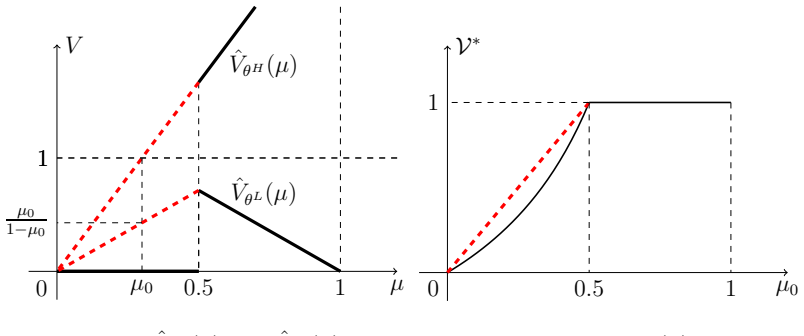
The central object is a canonical mediated-communication-with-money-burning mechanism: the sender reports his type to a mediator, who publicly outputs a posterior belief from a pre-committed signaling scheme and burns a deterministic amount of money that depends only on that posterior. Because burning carries no information beyond the posterior, the receiver's obedience constraint and the sender's incentive constraints separate. The load-bearing identity is Proposition 3, $V^*(\mu_0)=\max_{\pi}\min_{\theta}V_\pi(\theta)=\min_{\lambda}\operatorname{cav}(\hat V_\lambda)(\mu_0)$, obtained by viewing the mechanism-design problem as a zero-sum game between the sender and a fictitious chooser of the subjective prior $\lambda$. The incentive-compatibility equation (5), $\int_{\mu}\left(\frac{\mu(\theta)}{\mu_0(\theta)}-\frac{\mu(\theta')}{\mu_0(\theta')}\right)(V(\mu)-x(\mu))\,dp(\mu)=0$, forces all types' net interim payoffs to be equal, and money burning $x(\mu)$ is the transfer that makes this equalization possible. Proposition 11's construction, which burns money only on messages that reveal the type with small unconditional probability, attains this max-min value in the limit.
What would settle it
A computational search over finite receiver payoff matrices that satisfy the generic condition could look for a positive-measure set of priors where commitment is valuable, $V^*_{CT}(\mu_0)<\max V$, yet $V^*_{MD}(\mu_0)=V^*(\mu_0)$; Theorem 1 asserts no such set exists. The paper's Example 3 shows the equality can occur outside the generic class, so the search must enforce Definition 3. A sharp experiment would compare sender payoffs under mediation with and without burning in a lab: under transparent motives the burning treatment should strictly dominate for almost all priors, and the gap should disappear when sender payoffs depend on his type.
Extended reading notes
Core claim
On its own terms, the paper establishes Theorem 1: under a generic condition on the receiver's payoff functions (any action that is optimal at a belief is uniquely optimal at another belief with the same support), for almost all priors either cheap talk already reaches the sender's maximal feasible payoff, so commitment has no value, or money burning strictly raises the value of mediated communication. The companion characterization is $V^*(\mu_0)=\max_{\pi}\min_{\theta}V_\pi(\theta)=\min_{\lambda\in\Delta(\Theta)}\operatorname{cav}(\hat V_\lambda)(\mu_0)$, where $V_\pi(\theta)$ is type $\theta$'s interim payoff under the signaling scheme $\pi$ and $\hat V_\lambda(\mu)=\sum_{\theta}\lambda(\theta)\frac{\mu(\theta)}{\mu_0(\theta)}V(\mu)$. This ties the money-burning value to cautious Bayesian persuasion and to Bayesian persuasion under the sender's worst subjective prior. The proof builds a revelation principle that separates a mechanism into a signaling scheme and a report-contingent burning schedule, then shows that whenever burning fails to beat ordinary mediation, cheap talk already attains the same value.
Load-bearing premise
The result assumes the sender's payoff depends only on the receiver's action, not on his private type; if payoffs are state-dependent, money burning can fail to improve mediated communication, as the paper's buyer-seller example shows.
Editorial extensions
If this is right
- At almost every prior where cheap talk cannot already deliver the sender's maximum feasible payoff, the optimal money-burning mechanism strictly outperforms ordinary mediation (Theorem 1).
- Mediated communication with money burning has the same value as cautious Bayesian persuasion and as Bayesian persuasion under the sender's worst subjective prior, so robust-persuasion solution methods transfer directly (Corollaries 2 and 3).
- With a finite burning budget, the value is $\min_{\lambda}\operatorname{cav}(\hat V_{\lambda,C})(\mu_0)$, and optimal mechanisms split messages into a costless persuasion group and a burning-for-credibility group (Proposition 10).
- In smart-contract settings, commitment is valuable exactly when it is valuable in conventional communication, but the refined value of commitment is generically smaller (Corollary 4 and Theorem 1).
- Money burning does not make cheap talk more credible; the credibility gain is specific to mediated communication (Section 6.2).
Reading between the lines
- The equivalence with cautious Bayesian persuasion suggests money burning is a way to implement maxmin behavior without asking the sender to commit to ignoring his type: the burning schedule itself enforces equal interim payoffs.
- Because the value is a minimum over subjective priors, algorithms that solve worst-prior persuasion could be repurposed to design optimal burning mechanisms, a computational shortcut the paper does not spell out.
- A lab test could compare sender payoffs across cheap talk, mediation, and mediation with burning; under transparent motives the burning treatment should sit strictly between ordinary mediation and Bayesian persuasion for most priors, and the gap should disappear when sender payoffs are type-dependent.
- The binary-type result (Proposition 6) suggests the worst subjective prior is always an extreme point in two-type environments; if that shortcut extends to small finite type spaces, optimal burning mechanisms become easy to compute.
Signed reviews
Editorial analysis
A structured set of objections, weighed in public.
Referee Report
Summary. The paper introduces "mediated communication with money-burning mechanisms" (MDMB), in which a Sender with state-independent preferences commits to a mediator who sends messages and burns money contingent on the Sender's report. It develops a revelation principle for this protocol, characterizes the Sender's value as V*(µ0) = max_π min_θ V_π(θ) = min_λ cav(V̂_λ)(µ0) (Proposition 3), and compares this value with the values of cheap talk, mediated communication without burning, and Bayesian persuasion. The main result, Theorem 1, claims that under a generic condition on Receiver payoffs, for almost all priors either cheap talk already attains the maximum possible Sender payoff or money burning strictly improves mediated communication. The paper also analyzes bounded burning budgets, relates MDMB to robust/cautious Bayesian persuasion, and discusses applications to Web 3.0 smart contracts.
Significance. If the main characterization and Theorem 1 are correct, the paper makes a substantive theoretical contribution: it identifies a limited-commitment communication protocol whose value has a clean geometric formula, and it shows a generic strict-improvement result relative to ordinary mediation. The proof strategy is largely constructive, and the connection to cautious Bayesian persuasion and heterogeneous-prior persuasion is insightful. The paper is also commendably explicit about the scope of its conclusions: Section 7 states the transparent-motives assumption, and Appendix A.4 gives a counterexample without it. The formal apparatus, including the new revelation principle and the minimax argument, is a serious derivation rather than a list of assertions. The paper does not provide machine-checked proofs or computational verification, but the written proofs are extensive.
major comments (1)
- [Appendix B.3, Lemma 5] The first equality V*(µ0) = max_π min_{θ∈Θ} V_π(θ), together with the definition of V̂_λ in Eq. (10), is not well-posed for priors with zero-probability types. The ratio µ(θ)/µ0(θ) is undefined when µ0(θ) = 0, and for such types π(·|θ) is unconstrained by the model yet still enters the minimum over Θ. The statement should either restrict attention to supp(µ0), restrict λ to be supported on supp(µ0), or explicitly assume a full-support prior. Lemma 2, which derives the upper bound, has the same issue: incentive compatibility is only required for types with positive prior probability.
minor comments (7)
- [Section 4.1] In the paragraph after Proposition 3, "min-mas" should read "min-max".
- [Section 6.3] The word "Lagragian" appears twice and should be "Lagrangian".
- [Appendix A.4] The sentence beginning "Because we can merge the posteriors that induce the same action..." is repeated verbatim in consecutive paragraphs; please delete the duplicate.
- [Appendix B.4] The proof of Proposition 9 refers to "Cauchy inequality" without qualification; this should be "Cauchy-Schwarz inequality".
- [Appendix B] Several proofs cite "Proposition 9 of the working paper version of Kamenica and Gentzkow [2011]" with no formal reference in the bibliography; please provide a citable published version or state the result explicitly.
- [Section 5] The sentence "Technically, we provide an example in Appendix A. Example 3 shows..." is awkwardly punctuated and could be read as referring to two different examples; please rephrase for clarity.
- [Figures 2-5] The figure captions are minimal; please label all curves and indicate which lines correspond to which protocol or value function, as this would substantially improve readability.
Circularity Check
No significant circularity: the value formula and strict-improvement theorem are derived from model primitives, with external benchmarks used as comparisons and only a non-load-bearing self-citation.
full rationale
Proposition 3 is derived from the primitives rather than assumed: Propositions 1 and 2 provide a canonical revelation principle that converts the MDMB equilibrium problem into incentive-compatibility, obedience, and Bayes-plausibility constraints; Lemma 2 gives the upper bound V*(μ0) ≤ maxπ minθ Vπ(θ) from nonnegative burning; Proposition 11 constructs a burning scheme attaining minθ Vπ(θ) in the limit; and Sion's minimax theorem yields V*(μ0) = minλ cav(V̂λ)(μ0). None of these steps presupposes the strict-improvement conclusion. Theorem 1 is a comparative statement built on external benchmarks from Salamanca (2021), Corrao and Dai (2023), and Lipnowski and Ravid (2020), and on the generic condition of Definition 3 taken from Lipnowski et al. (2024); no parameter is fitted to data and no benchmark is the paper's own conclusion. The only self-citation, Liu and Wu (2024), is described as related work on implementation with outcome-contingent transfers and is not an input to Proposition 3, Proposition 7, or Theorem 1, so it does not make the derivation circular. One non-circular completeness concern should be noted: in Appendix B.3, Lemma 5's first case invokes Lemma 4 for boundary beliefs with supp(μ1) ⊆ supp(μ), while Lemma 4 is proved only for full-support beliefs; this is a proof gap requiring an additional support-size argument rather than a circular reduction of the theorem to its own assumptions.
Assumptions & free parameters
assumptions (5)
- standard math Sion's minimax theorem and its extension by Arandjelović apply to the relevant payoff functions and domains.
- domain assumption Sender has state-independent preferences, so v(a) does not depend on theta.
- domain assumption Generic condition on the Receiver's payoff function in Definition 3: for any belief and any optimal action, there is a same-support belief at which that action is uniquely optimal.
- standard math Known properties of quasi-concave envelopes and concavifications from Lipnowski and Ravid [2020] and Kamenica and Gentzkow [2011], including piecewise constant qcav for finite actions and collinearity of concavifying supports.
- domain assumption Perfect Bayesian equilibrium and Bayes-plausible updating are the solution concept, with finite message, action, and burning sets.
Cite this review
Pith. "Pith review of Money Burning Improves Mediated Communication." pith.science (2026). https://pith.science/paper/E5Y2RJBJ
@misc{pith2026241119431,
  author       = {Pith},
  title        = {Pith review of: Money Burning Improves Mediated Communication},
  year         = {2026},
  howpublished = {\url{https://pith.science/paper/E5Y2RJBJ}},
  note         = {Machine review of arXiv:2411.19431}
}
read the original abstract
Can wasteful money burning improve strategic communication? We show that it can, but only with intermediate commitment. In mediated communication with report-contingent burning, the mediator can use costly messages to discipline deviations and make persuasive messages credible. Under transparent motives, increasing the burning budget strictly raises the Sender's payoff once the budget is large enough, unless mediated communication with money burning collapses to cheap talk. With an unbounded budget, the value equals a robust Bayesian persuasion payoff, or equivalently the payoff of a cautious Sender. The framework clarifies commitment through smart contracts and Web 3.0 mediation.
Figures


Figures from the paper (2 more)


Reference graph
Works this paper leans on
-
[1]
Bayesian persuasion with heterogeneous priors
Ricardo Alonso and Odilon C \^a mara. Bayesian persuasion with heterogeneous priors. Journal of Economic Theory, 165: 0 672--706, 2016
work page 2016
-
[2]
An extension of the sion's minimax theorem
Ivan Arandjelovi \'c . An extension of the sion's minimax theorem. Zbornik radova Filozofskog fakulteta u Ni s u. Serija Matematik , pages 1--3, 1992
work page 1992
-
[3]
David Austen-Smith and Jeffrey S Banks. Cheap talk and burned money. Journal of Economic Theory, 91 0 (1): 0 1--16, 2000
work page 2000
-
[4]
Information design: A unified perspective
Dirk Bergemann and Stephen Morris. Information design: A unified perspective. Journal of Economic Literature, 57 0 (1): 0 44--95, 2019
2019
-
[5]
The design and price of information
Dirk Bergemann, Alessandro Bonatti, and Alex Smolin. The design and price of information. American Economic Review, 108 0 (1): 0 1--48, 2018
work page 2018
-
[6]
Contracting with imperfect commitment and the revelation principle: the single agent case
Helmut Bester and Roland Strausz. Contracting with imperfect commitment and the revelation principle: the single agent case. Econometrica, 69 0 (4): 0 1077--1098, 2001
work page 2001
-
[7]
Archishman Chakraborty and Rick Harbaugh. Persuasion by cheap talk. American Economic Review, 100 0 (5): 0 2361--2382, 2010
work page 2010
-
[8]
Mediation markets: The case of soft information
Roberto Corrao. Mediation markets: The case of soft information. Working Paper, 2023
work page 2023
Show all 35 references
-
[9]
The bounds of mediated communication
Roberto Corrao and Yifan Dai. The bounds of mediated communication. Working Paper, 2023
2023
-
[10]
Strategic information transmission
Vincent P Crawford and Joel Sobel. Strategic information transmission. Econometrica: Journal of the Econometric Society, pages 1431--1451, 1982
1982
-
[11]
Mechanism design with limited commitment
Laura Doval and Vasiliki Skreta. Mechanism design with limited commitment. Econometrica, 90 0 (4): 0 1463--1500, 2022
2022
-
[12]
Information payoffs: An interim perspective
Laura Doval and Alex Smolin. Information payoffs: An interim perspective. arXiv preprint arXiv:2109.03061, 2021
2021 arXiv
-
[13]
Persuasion and welfare
Laura Doval and Alex Smolin. Persuasion and welfare. Journal of Political Economy, 132 0 (7): 0 2451--2487, 2024
2024
-
[14]
Blockchain mediated persuasion
Kimon Drakopoulos, Irene Lo, and Justin Mulvany. Blockchain mediated persuasion. In Proceedings of the 24th ACM Conference on Economics and Computation, 2023
2023
-
[15]
Persuasion and incentives through the lens of duality
Shaddin Dughmi, Rad Niazadeh, Alexandros Psomas, and S Matthew Weinberg. Persuasion and incentives through the lens of duality. In Web and Internet Economics: 15th International Conference, WINE 2019, New York, NY, USA, December 10--12, 2019, Proceedings 15, pages 142--155. Sp...
2019
-
[16]
An approach to communication equilibria
Francoise Forges. An approach to communication equilibria. Econometrica: Journal of the Econometric Society, pages 1375--1385, 1986
1986
-
[17]
Rules and commitment in communication: An experimental analysis
Guillaume R Fr \'e chette, Alessandro Lizzeri, and Jacopo Perego. Rules and commitment in communication: An experimental analysis. Econometrica, 90 0 (5): 0 2283--2318, 2022
2022
-
[18]
Mediation, arbitration and negotiation
Maria Goltsman, Johannes H \"o rner, Gregory Pavlov, and Francesco Squintani. Mediation, arbitration and negotiation. Journal of Economic Theory, 144 0 (4): 0 1397--1420, 2009
2009
-
[19]
Beneficial mediated communication in cheap talk
Maxim Ivanov. Beneficial mediated communication in cheap talk. Journal of Mathematical Economics, 55: 0 129--135, 2014
2014
-
[20]
Bayesian persuasion
Emir Kamenica and Matthew Gentzkow. Bayesian persuasion. American Economic Review, 101 0 (6): 0 2590--2615, 2011
2011
-
[21]
Optimal signaling with cheap talk and money burning
Vladimir Karamychev and Bauke Visser. Optimal signaling with cheap talk and money burning. International Journal of Game Theory, 46 0 (3): 0 813--850, 2017
2017
-
[22]
A note on cheap talk and burned money
Navin Kartik. A note on cheap talk and burned money. Journal of Economic Theory, 136 0 (1): 0 749--758, 2007
2007
-
[23]
Relational communication
Anton Kolotilin and Hongyi Li. Relational communication. Theoretical Economics, 16 0 (4): 0 1391--1430, 2021
2021
-
[24]
Discriminatory information disclosure
Hao Li and Xianwen Shi. Discriminatory information disclosure. American Economic Review, 107 0 (11): 0 3363--3385, 2017
2017
-
[25]
Credible persuasion
Xiao Lin and Ce Liu. Credible persuasion. Journal of Political Economy, 132 0 (7): 0 2228--2273, 2024
2024
-
[26]
Cheap talk with transparent motives
Elliot Lipnowski and Doron Ravid. Cheap talk with transparent motives. Econometrica, 88 0 (4): 0 1631--1660, 2020
2020
-
[27]
Persuasion via weak institutions
Elliot Lipnowski, Doron Ravid, and Denis Shishkin. Persuasion via weak institutions. Journal of Political Economy, 130 0 (10): 0 2705--2730, 2022
2022
-
[28]
Perfect bayesian persuasion
Elliot Lipnowski, Doron Ravid, and Denis Shishkin. Perfect bayesian persuasion. arXiv preprint arXiv:2402.06765, 2024
2024 arXiv
-
[29]
Implementing randomized allocation rules with outcome-contingent transfers
Yi Liu and Fan Wu. Implementing randomized allocation rules with outcome-contingent transfers. Journal of Economic Theory, 220: 0 105878, 2024
2024
-
[30]
Bayesian persuasion under partial commitment
Daehong Min. Bayesian persuasion under partial commitment. Economic Theory, 72 0 (3): 0 743--764, 2021
2021
-
[31]
Optimal coordination mechanisms in generalized principal--agent problems
Roger B Myerson. Optimal coordination mechanisms in generalized principal--agent problems. Journal of Mathematical Economics, 10 0 (1): 0 67--81, 1982
1982
-
[32]
Test design under falsification
Eduardo Perez-Richet and Vasiliki Skreta. Test design under falsification. Econometrica, 90 0 (3): 0 1109--1142, 2022
2022
-
[33]
Multistage information transmission with voluntary monetary transfers
Hitoshi Sadakane. Multistage information transmission with voluntary monetary transfers. Theoretical Economics, 18 0 (1): 0 267--301, 2023
2023
-
[34]
The value of mediated communication
Andr \'e s Salamanca. The value of mediated communication. Journal of Economic Theory, 192: 0 105191, 2021
2021
-
[35]
Online rating system development using blockchain-based distributed ledger technology
Monir Shaker, Fereidoon Shams Aliee, and Reza Fotohi. Online rating system development using blockchain-based distributed ledger technology. Wireless Networks, 27 0 (3): 0 1715--1737, 2021
2021
Reviewed August 12, 2026 · model on record in the stance chip above.
Discussion (0). Continue with ORCID to comment.