REVIEW 3 major objections 5 minor 48 references
Pronounced 2/3 magnetization plateau in a frustrated $S$ = 1 isolated spin-triangle compound: Interplay between Heisenberg and biquadratic exchange interactions
T0 review · 3 major / 5 minor · reviewed 2026-08-14 · deepseek-v4-flash
Pith's one-line read A new nickel-triangle magnet reaches a flat two-thirds magnetization plateau because biquadratic spin exchange, not just Heisenberg coupling, is active in it.
desk verdict The robust 2/3 plateau in isolated spin-1 triangles is a solid experimental finding worth publishing, but the biquadratic-exchange mechanism is a plausible hypothesis rather than an established result, as the paper's own Appendix I demonstrates. read the letter →
The pith
A machine-rendered reading of the paper's core claim, the machinery that carries it, and where it could break.
The reading
What carries the argument
The load-bearing object is the spin-1 triangle Hamiltonian of Eq. (1), solved by exact diagonalization: $H = \sum_{\langle i,j\rangle} J_{ij}\,\mathbf{S}_i\cdot\mathbf{S}_j + \sum_{\langle i,j\rangle} K_{ij}(\mathbf{S}_i\cdot\mathbf{S}_j)^2 + \sum_{\langle i,j\rangle} D_{ij}\,\hat{d}_{ij}\cdot(\mathbf{S}_i\times\mathbf{S}_j) + 2\mu_B H \sum_i S_i^z$. The biquadratic term, an interaction proportional to the square of the dot product of two neighboring spin operators, is what turns a would-be 1/3 plateau into a pronounced 2/3 plateau: for $S=1$ it favors the $|1,1,0\rangle$ manifold over the $|1,1,-1\rangle$ and $|1,0,0\rangle$ states that would give one-third saturation. The paper also uses DFT+U to fix the Ni $d^8$ ($S=1$) configuration and asymmetric exchange couplings, and ESR to fix $g=2.23$. The same parameter set reproduces the magnetization curve, the plateau boundaries (about 7 and 20 T, with saturation near 35 T), and the gapped specific heat.
What would settle it
A decisive test would be to measure the single-triangle excitation spectrum, for example by inelastic neutron scattering or high-field ESR, and check whether the Hamiltonian with $K\approx 0.3J$ reproduces the plateau width, the 2 K spin gap, and the field dependence of the gap. If a model without biquadratic exchange but with appreciable intertriangle coupling, or with a phonon-mediated effective interaction, fits the same data equally well, the paper's claim that biquadratic exchange is essential would be falsified.
Extended reading notes
Core claim
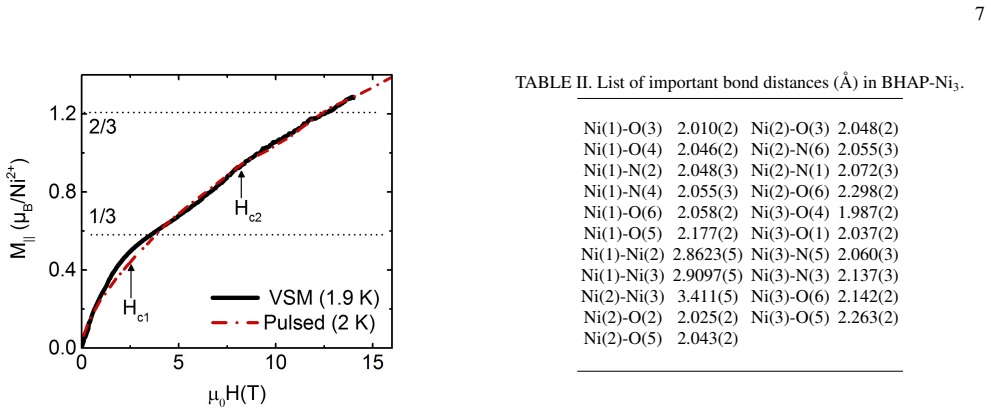
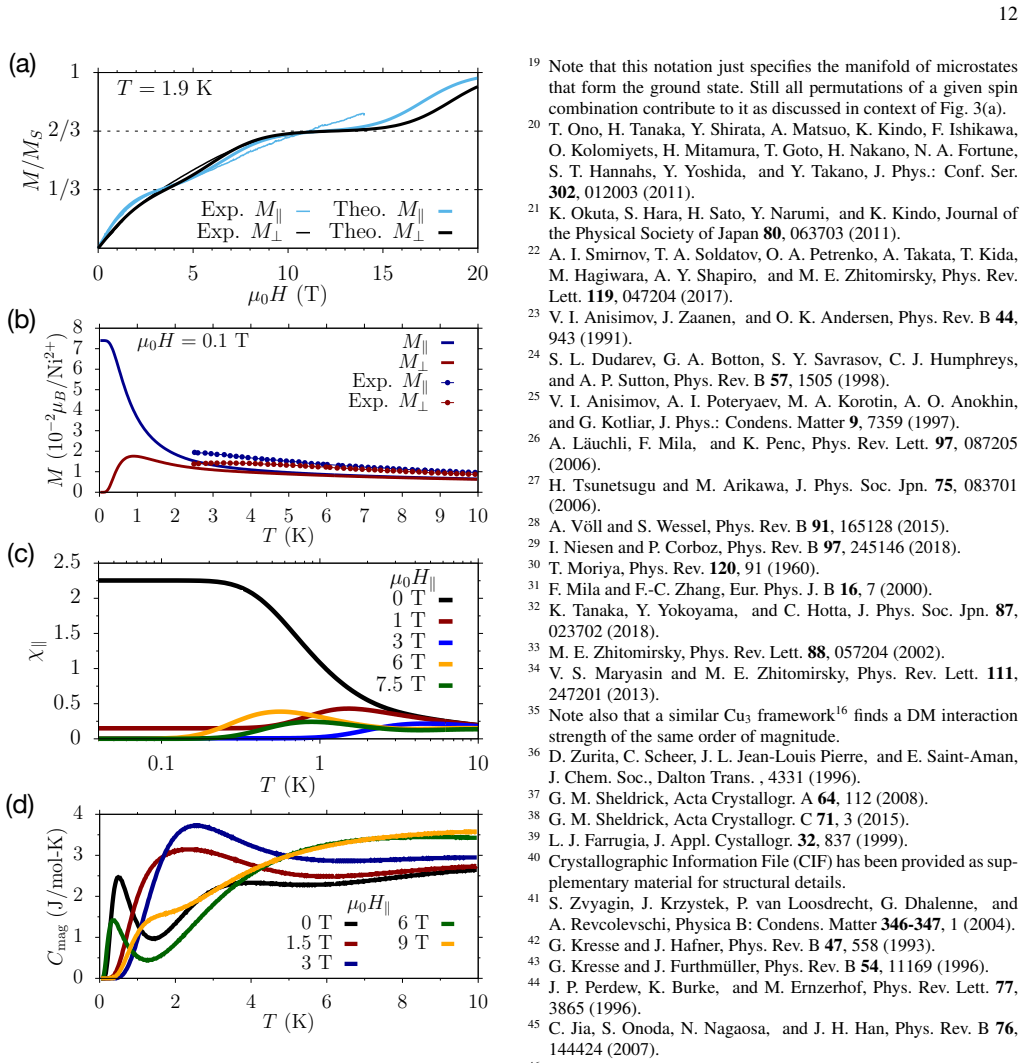
The central discovery is that the 2/3 magnetization plateau of BHAP-Ni3 arises from the interplay of antiferromagnetic Heisenberg and biquadratic exchange within a single $S=1$ triangle, rather than from lattice effects or anisotropy. The spin Hamiltonian (Eq. 1) contains anisotropic Heisenberg exchanges $J_{ij}$, biquadratic exchanges $K_{ij}(\mathbf{S}_i\cdot\mathbf{S}_j)^2$, Dzyaloshinskii-Moriya terms, and the Zeeman term. Best agreement with the measured magnetization and specific heat is obtained for $J_{31}=J_{12}\approx 3.5$ K, $J_{23}\approx 17.5$ K, $K_{ij}\approx 0.3\,J_{ij}$, and DM strength $\approx 0.2\,J_{ij}$. In this model the biquadratic term shrinks the 1/3 plateau to a near-invisible anomaly and stabilizes a 2/3 plateau whose ground state is approximately the three permutations of $|1,1,0\rangle$. The calculated spin gap of about 2.1 K matches the experimental gap of about 2.0 K extracted from specific heat.
Load-bearing premise
The load-bearing premise is that the biquadratic term $K_{ij}(\mathbf{S}_i\cdot\mathbf{S}_j)^2$ with fitted strength about $0.3\,J_{ij}$ is a real microscopic interaction inside BHAP-Ni3, not just a fitting parameter that absorbs other neglected physics.
Editorial extensions
If this is right
- BHAP-Ni3 would be a rare clean example where biquadratic exchange, usually negligible for $S=1$, sets the high-field phase diagram; its 7 to 20 T plateau directly encodes $K/J$.
- The 2/3 plateau state, approximately $|1,1,0\rangle$, is a field-induced state that could be probed by magnetostriction or neutron diffraction to confirm the local spin configuration.
- Chemical substitution or pressure that changes the Ni-O-Ni angles should shift the plateau boundaries in a predictable way if $K$ scales with $J$, offering a direct test of the mechanism.
- The 1/3 plateau, suppressed here, should reappear in related triangles with smaller $K/J$, providing a tunable family of $S=1$ molecular magnets.
Reading between the lines
- If biquadratic exchange of this size is common in edge-sharing Ni(II) triangles with near-90-degree superexchange, the two-thirds plateau could serve as a quick experimental proxy for $K/J$ in other molecular magnets, not just BHAP-Ni3.
- The microscopic origin the paper leaves open, twisted ring exchange through the two shared oxygens, could be tested by DFT extraction of $K$ or by comparing with an isostructural molecule where the bridging geometry is changed; a successful derivation would turn the fitted $K$ into a structure-based prediction.
- The $|1,1,0\rangle$ plateau state is reminiscent of quadrupolar or spin-nematic correlations; a natural next step is to look for the associated quadrupolar excitations in the gapped spectrum, which would connect this molecular result to bulk nematic spin liquids.
Signed reviews
Editorial analysis
A structured set of objections, weighed in public.
Referee Report
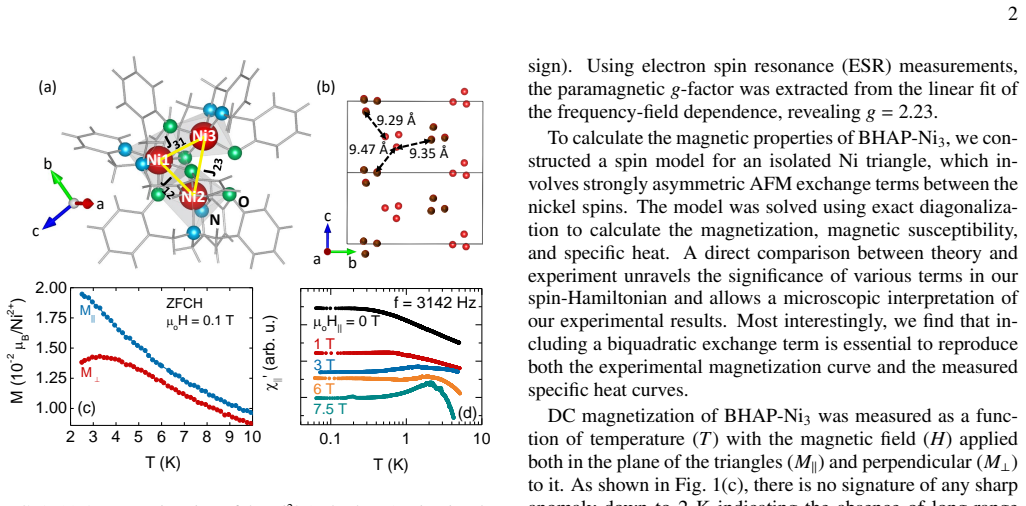
Summary. This paper reports the synthesis, crystal structure, and magnetic characterization of BHAP-Ni3, an S=1 spin-triangle compound with nearly isolated Ni3 units. High-field magnetization measurements reveal a pronounced 2/3 magnetization plateau between 7 and 20 T, alongside a very weak anomaly near 1/3 saturation. The authors model the isolated triangle with an anisotropic Heisenberg Hamiltonian augmented by biquadratic exchange and Dzyaloshinskii-Moriya terms, solved by exact diagonalization. They find that a biquadratic exchange strength Kij ≈ 0.3 Jij is needed to reproduce the measured M(H) curve and the low-temperature specific heat, including a calculated gap of 2.1 K versus the measured 2.0 K. The paper explicitly concedes that a microscopic derivation of the biquadratic term is left for future work and that the model does not capture several low-field magnetic properties. An alternative bilinear-only model is also presented in Appendix I; it reproduces the 2/3 plateau but is rejected based on its specific-heat shape.
Significance. The experimental discovery of a robust 2/3 magnetization plateau in a nearly isolated spin-1 triangle is novel and valuable. The plateau is documented by two complementary magnetometry techniques, and the ac-susceptibility measurements provide a careful check against magnetic ordering or glassy behavior. The exact-diagonalization model is a clean theoretical treatment, and the match between the predicted and measured specific-heat gap (2.1 K vs 2.0 K) is a nontrivial success. However, the central claim that biquadratic exchange is essential to the plateau is not uniquely established: the Appendix I model without any biquadratic term also produces a robust 2/3 plateau. The paper is honest about its limitations, but the abstract and conclusion currently overstate the evidence for the biquadratic mechanism. If confirmed, this would be an important example of biquadratic exchange in a molecular magnet; at present, the evidence is suggestive rather than conclusive.
major comments (3)
- [Section III and Appendix I] The central claim that biquadratic exchange is essential to explain the 2/3 plateau is undercut by the alternative model in Appendix I, which uses only bilinear Heisenberg exchange and single-ion anisotropy and yet "shows a feeble 1/3 and robust 2/3 magnetization plateau" (Appendix I, Fig. 13). Because a model without the biquadratic term already yields the plateau, the observation of the plateau does not uniquely support the biquadratic mechanism. The paper should either weaken this claim or provide a quantitative criterion (e.g., plateau width, transition sharpness, or a different observable) that clearly excludes the alternative model.
- [Appendix I, Fig. 13(d)] The rejection of the alternative model rests almost entirely on its specific-heat shape, specifically the sharp peak near 0.5 K that is absent in the measured C(T). However, the parameter space of the alternative model (varying Jij, D, or adding a small biquadratic correction) is not systematically explored. It is plausible that a nearby parameter set reproduces both the magnetization plateau and the exponential low-temperature specific heat, especially since the main model itself fails to capture the low-field magnetization and susceptibility (Appendix H). The authors should report a scan over this parameter space or explicitly state why the chosen parameters are representative of all models that reproduce the plateau.
- [Appendix H, Figs. 11-12] The main model fails to capture the low-field magnetization and susceptibility, as the authors acknowledge: at 0.1 T the calculated in-plane and out-of-plane magnetizations are reversed relative to experiment, and the zero-field susceptibility shows a hump around 2–3 K not seen in the data. This admitted discrepancy means the model is not a complete description of BHAP-Ni3. The abstract's phrasing that the 2/3 plateau "emerges due to the interplay between Heisenberg and biquadratic exchange interactions" overstates the present evidence; the claim should be scoped to high-field magnetization and the specific-heat gap, with the low-field failures clearly presented as unresolved.
minor comments (5)
- [Eq. (1)] The Zeeman term is written as 2μB H Σ S^z_i without an explicit g-factor, but the text later introduces g = 2.23 from ESR. Please clarify whether the g-factor is included in the Zeeman term or is absorbed elsewhere.
- [Appendix I and Section III] The main model parameters are given in kelvin (J31 = J12 ≈ 3.5 K, J23 ≈ 17.5 K) while the alternative model parameters are given in meV (J12 = 1.55 meV, etc.). Using consistent energy units throughout would help readers compare the two models directly.
- [Figure 3] The figure as assembled appears to contain duplicated or garbled panels; the caption describes subfigures (a), (b), and (c), but the rendering mixes multiple copies. Please check the final figure production.
- [Section III] The sentence "For good agreement with experiment, we have used a moderate biquadratic exchange of Kij ≈ 0.3 Jij" would benefit from a sensitivity analysis, for example a plot of the plateau width or the critical fields as a function of K/J with the actual J values, rather than the simplified isotropic model shown in Fig. 3.
- [Appendix F] The phrase "we derive and motivate the different terms of the model" is misleading because the biquadratic term is not derived from a microscopic Hamiltonian; the authors explicitly leave that derivation for future work. Please rephrase to "motivate and estimate".
Circularity Check
No significant circularity: the biquadratic-mechanism conclusion is a transparent fit to magnetization with an independent specific-heat check; the Appendix I alternative shows underdetermination but does not make the derivation circular.
full rationale
The claimed derivation chain is not circular. Eq. (1) is a physically motivated Hamiltonian with Heisenberg, DM, Zeeman, and biquadratic exchange terms, and the biquadratic parameter Kij ~ 0.3 Jij is explicitly fitted 'for good agreement with experiment' (Section III). The 2/3 plateau is therefore an input to the fit, not a prediction of the term, but the paper never labels the reproduced M(H) as a prediction and does not rest the mechanism claim solely on that agreement. The same parameter set produces a calculated magnetic specific-heat gap of 2.1 K versus an experimental 2.0 K (Fig. 4), which is a distinct observable and a genuine cross-check. Appendix I's bilinear-only FM/AFM model also produces a 2/3 plateau, and the paper admits 'A model that could explain all salient features ... remains to be found'; this underdetermination weakens the uniqueness of the biquadratic explanation but is not circularity. The cited triangular-lattice BBH studies (Refs. 26-29) are external and not self-citations. No load-bearing self-citation, imported uniqueness theorem, or definitional identification of input and output was found.
Assumptions & free parameters
free parameters (5)
- J12 = J31 (Heisenberg exchange) =
3.5 K
- J23 (Heisenberg exchange) =
17.5 K
- K/J (biquadratic exchange ratio) =
0.3
- D/J (DM interaction ratio) =
0.2
- g-factor =
2.23
assumptions (5)
- domain assumption Nickel ions are in d8 configuration with S = 1
- domain assumption Inter-triangle couplings are negligible
- ad hoc to paper Biquadratic exchange is a valid effective interaction for BHAP-Ni3
- domain assumption Phonon contribution to specific heat is negligible below 2 K
- standard math Exact diagonalization correctly solves the finite spin model
Cite this review
Pith. "Pith review of Pronounced 2/3 magnetization plateau in a frustrated $S$ = 1 isolated spin-triangle compound: Interplay between Heisenberg and biquadratic exchange interactions." pith.science (2026). https://pith.science/paper/E6577G3A
@misc{pith2026190810807,
  author       = {Pith},
  title        = {Pith review of: Pronounced 2/3 magnetization plateau in a frustrated $S$ = 1 isolated spin-triangle compound: Interplay between Heisenberg and biquadratic exchange interactions},
  year         = {2026},
  howpublished = {\url{https://pith.science/paper/E6577G3A}},
  note         = {Machine review of arXiv:1908.10807}
}
abstract
We report the synthesis and characterization of a new quantum magnet [2-[Bis(2-hydroxybenzyl)aminomethyl]pyridine]Ni(II)-trimer (BHAP-Ni3) in single-crystalline form. Our combined experimental and theoretical investigations reveal an exotic spin state that stabilizes a robust 2/3 magnetization plateau between 7 and 20 T in an external magnetic field. AC-susceptibility measurements show the absence of any magnetic order/glassy state down to 60 mK. The magnetic ground state is disordered and specific-heat measurements reveal the gapped nature of the spin excitations. Most interestingly, our theoretical modeling suggests that the 2/3 magnetization plateau emerges due to the interplay between antiferromagnetic Heisenberg and biquadratic exchange interactions within nearly isolated spin $S$ = 1 triangles.
Figures


Figures from the paper (7 more)



Reference graph
Works this paper leans on
-
[1]
author author R. Moessner \ and\ author A. P. \ Ramirez ,\ 10.1063/1.2186278 journal journal Physics Today \ volume 59 ,\ pages 24 ( year 2006 ) NoStop
-
[2]
editor C. Lacroix , editor P. Mendels , \ and\ editor F. Mila ,\ eds.,\ https://doi.org/10.1007/978-3-642-10589-0 title Introduction to Frustrated Magnetism: Materials, Experiments, Theory ,\ Springer Series in Solid-State Sciences\ ( publisher Springer, Berlin, Heidelberg ,\ year 2011 ) NoStop
-
[3]
author author H. T. \ Diep ,\ 10.1142/8676 title Frustrated Spin Systems ,\ edition 2nd \ ed.\ ( publisher World Scientific ,\ year 2013 ) NoStop
doi:10.1142/8676 2013
-
[4]
author author A. V. \ Chubokov \ and\ author D. I. \ Golosov ,\ http://stacks.iop.org/0953-8984/3/i=1/a=005 journal journal J. Phys.: Condens. Matter \ volume 3 ,\ pages 69 ( year 1991 ) NoStop
work page 1991
-
[5]
author author M. E. \ Zhitomirsky , author A. Honecker , \ and\ author O. A. \ Petrenko ,\ 10.1103/PhysRevLett.85.3269 journal journal Phys. Rev. Lett. \ volume 85 ,\ pages 3269 ( year 2000 ) NoStop
-
[6]
author author C. L. \ Henley ,\ 10.1103/PhysRevLett.62.2056 journal journal Phys. Rev. Lett. \ volume 62 ,\ pages 2056 ( year 1989 ) NoStop
-
[7]
author author Y. Kamiya , author L. Ge , author T. Hong , author Y. Qiu , author D. L. \ Quintero-Castro , author Z. Lu , author H. B. \ Cao , author M. Matsuda , author E. S. \ Choi , author C. D. \ Batista , author M. Mourigal , author H. D. \ Zhou , \ and\ author J. Ma ,\ https://doi.org/10.1038/s41467-018-04914-1 journal journal Nat. Commun. \ volume ...
-
[8]
author author H. Suematsu , author K. Ohmatsu , author K. Sugiyama , author T. Sakakibara , author M. Motokawa , \ and\ author M. Date ,\ https://doi.org/10.1016/0038-1098(81)90749-3 journal journal Solid State Commun. \ volume 40 ,\ pages 241 ( year 1981 ) NoStop
Show all 48 references
-
[9]
Ono , author H
author author T. Ono , author H. Tanaka , author H. Aruga Katori , author F. Ishikawa , author H. Mitamura , \ and\ author T. Goto ,\ 10.1103/PhysRevB.67.104431 journal journal Phys. Rev. B \ volume 67 ,\ pages 104431 ( year 2003 ) NoStop
-
[10]
Inami , author Y
author author T. Inami , author Y. Ajiro , \ and\ author T. Goto ,\ 10.1143/JPSJ.65.2374 journal journal J. Phys. Soc. Jpn. \ volume 65 ,\ pages 2374 ( year 1996 ) NoStop
1996 doi
-
[11]
Ishii , author S
author author R. Ishii , author S. Tanaka , author K. Onuma , author Y. Nambu , author M. Tokunaga , author T. Sakakibara , author N. Kawashima , author Y. Maeno , author C. Broholm , author D. P. \ Gautreaux , author J. Y. \ Chan , \ and\ author S. Nakatsuji ,\ http://stacks....
2011
-
[12]
Kitazawa , author H
author author H. Kitazawa , author H. Suzuki , author H. Abe , author J. Tang , \ and\ author G. Kido ,\ https://doi.org/10.1016/S0921-4526(98)01101-6 journal journal Physica B: Condens. Matter \ volume 259-261 ,\ pages 890 ( year 1999 ) NoStop
-
[13]
Shirata , author H
author author Y. Shirata , author H. Tanaka , author A. Matsuo , \ and\ author K. Kindo ,\ 10.1103/PhysRevLett.108.057205 journal journal Phys. Rev. Lett. \ volume 108 ,\ pages 057205 ( year 2012 ) NoStop
2012 doi
-
[14]
Shirata , author H
author author Y. Shirata , author H. Tanaka , author T. Ono , author A. Matsuo , author K. Kindo , \ and\ author H. Nakano ,\ 10.1143/JPSJ.80.093702 journal journal J. Phys. Soc. Jpn. \ volume 80 ,\ pages 093702 ( year 2011 ) NoStop
2011 doi
-
[15]
author author L. E. \ Svistov , author A. I. \ Smirnov , author L. A. \ Prozorova , author O. A. \ Petrenko , author L. N. \ Demianets , \ and\ author A. Y. \ Shapiro ,\ 10.1103/PhysRevB.67.094434 journal journal Phys. Rev. B \ volume 67 ,\ pages 094434 ( year 2003 ) NoStop
-
[16]
\ Choi , author Y
author author K.-Y. \ Choi , author Y. H. \ Matsuda , author H. Nojiri , author U. Kortz , author F. Hussain , author A. C. \ Stowe , author C. Ramsey , \ and\ author N. S. \ Dalal ,\ 10.1103/PhysRevLett.96.107202 journal journal Phys. Rev. Lett. \ volume 96 ,\ pages 107202 ( ...
-
[17]
Schmitz , author J
author author S. Schmitz , author J. van Leusen , author N. V. \ Izarova , author S. D. \ Bourone , author A. Ellern , author P. K \"o gerler , \ and\ author K. Y. \ Monakhov ,\ https://doi.org/10.1016/j.poly.2018.01.014 journal journal Polyhedron \ volume 144 ,\ pages 144 ( y...
2018 doi
-
[18]
\ Zhang , author M.-F
author author S.-H. \ Zhang , author M.-F. \ Tang , \ and\ author C.-M. \ Ge ,\ 10.1002/zaac.200801402 journal journal Z. Anorg. Allg. Chem. \ volume 635 ,\ pages 1442 ( year 2009 ) NoStop
2009 doi
-
[19]
Still all permutations of a given spin combination contribute to it as discussed in context of Fig
note Note that this notation just specifies the manifold of microstates that form the ground state. Still all permutations of a given spin combination contribute to it as discussed in context of Fig. FigN1 (a). Stop
-
[20]
Ono , author H
author author T. Ono , author H. Tanaka , author Y. Shirata , author A. Matsuo , author K. Kindo , author F. Ishikawa , author O. Kolomiyets , author H. Mitamura , author T. Goto , author H. Nakano , author N. A. \ Fortune , author S. T. \ Hannahs , author Y. Yoshida , \ and\ ...
2011
-
[21]
Okuta , author S
author author K. Okuta , author S. Hara , author H. Sato , author Y. Narumi , \ and\ author K. Kindo ,\ 10.1143/JPSJ.80.063703 journal journal Journal of the Physical Society of Japan \ volume 80 ,\ pages 063703 ( year 2011 ) NoStop
2011 doi
-
[22]
author author A. I. \ Smirnov , author T. A. \ Soldatov , author O. A. \ Petrenko , author A. Takata , author T. Kida , author M. Hagiwara , author A. Y. \ Shapiro , \ and\ author M. E. \ Zhitomirsky ,\ 10.1103/PhysRevLett.119.047204 journal journal Phys. Rev. Lett. \ volume 1...
-
[23]
author author V. I. \ Anisimov , author J. Zaanen , \ and\ author O. K. \ Andersen ,\ 10.1103/PhysRevB.44.943 journal journal Phys. Rev. B \ volume 44 ,\ pages 943 ( year 1991 ) NoStop
1991 doi
-
[24]
author author S. L. \ Dudarev , author G. A. \ Botton , author S. Y. \ Savrasov , author C. J. \ Humphreys , \ and\ author A. P. \ Sutton ,\ 10.1103/PhysRevB.57.1505 journal journal Phys. Rev. B \ volume 57 ,\ pages 1505 ( year 1998 ) NoStop
-
[25]
author author V. I. \ Anisimov , author A. I. \ Poteryaev , author M. A. \ Korotin , author A. O. \ Anokhin , \ and\ author G. Kotliar ,\ 10.1088/0953-8984/9/35/010 journal journal J. Phys.: Condens. Matter \ volume 9 ,\ pages 7359 ( year 1997 ) NoStop
-
[26]
L\"auchli , author F
author author A. L\"auchli , author F. Mila , \ and\ author K. Penc ,\ 10.1103/PhysRevLett.97.087205 journal journal Phys. Rev. Lett. \ volume 97 ,\ pages 087205 ( year 2006 ) NoStop
2006 doi
-
[27]
Tsunetsugu \ and\ author M
author author H. Tsunetsugu \ and\ author M. Arikawa ,\ 10.1143/jpsj.75.083701 journal journal J. Phys. Soc. Jpn. \ volume 75 ,\ pages 083701 ( year 2006 ) NoStop
2006 doi
-
[28]
V\"oll \ and\ author S
author author A. V\"oll \ and\ author S. Wessel ,\ 10.1103/PhysRevB.91.165128 journal journal Phys. Rev. B \ volume 91 ,\ pages 165128 ( year 2015 ) NoStop
2015 doi
-
[29]
Niesen \ and\ author P
author author I. Niesen \ and\ author P. Corboz ,\ 10.1103/PhysRevB.97.245146 journal journal Phys. Rev. B \ volume 97 ,\ pages 245146 ( year 2018 ) NoStop
2018 doi
-
[30]
Moriya ,\ 10.1103/PhysRev.120.91 journal journal Phys
author author T. Moriya ,\ 10.1103/PhysRev.120.91 journal journal Phys. Rev. \ volume 120 ,\ pages 91 ( year 1960 ) NoStop
1960 doi
-
[31]
Mila \ and\ author F.-C
author author F. Mila \ and\ author F.-C. \ Zhang ,\ 10.1007/s100510070242 journal journal Eur. Phys. J. B \ volume 16 ,\ pages 7 ( year 2000 ) NoStop
-
[32]
Tanaka , author Y
author author K. Tanaka , author Y. Yokoyama , \ and\ author C. Hotta ,\ 10.7566/JPSJ.87.023702 journal journal J. Phys. Soc. Jpn. \ volume 87 ,\ pages 023702 ( year 2018 ) NoStop
2018 doi
-
[33]
author author M. E. \ Zhitomirsky ,\ 10.1103/PhysRevLett.88.057204 journal journal Phys. Rev. Lett. \ volume 88 ,\ pages 057204 ( year 2002 ) NoStop
2002 doi
-
[34]
author author V. S. \ Maryasin \ and\ author M. E. \ Zhitomirsky ,\ 10.1103/PhysRevLett.111.247201 journal journal Phys. Rev. Lett. \ volume 111 ,\ pages 247201 ( year 2013 ) NoStop
2013 doi
-
[35]
note Note also that a similar Cu _3 framework cho06 finds a DM interaction strength of the same order of magnitude. Stop
-
[36]
Zurita , author C
author author D. Zurita , author C. Scheer , author J. L. \ Jean-Louis Pierre , \ and\ author E. Saint-Aman ,\ 10.1039/DT9960004331 journal journal J. Chem. Soc. , Dalton Trans. \ ,\ pages 4331 ( year 1996 ) NoStop
1996 doi
-
[37]
author author G. M. \ Sheldrick ,\ 10.1107/S0108767307043930 journal journal Acta Crystallogr. A \ volume 64 ,\ pages 112 ( year 2008 ) NoStop
2008 doi
-
[38]
author author G. M. \ Sheldrick ,\ 10.1107/S2053229614024218 journal journal Acta Crystallogr. C \ volume 71 ,\ pages 3 ( year 2015 ) NoStop
2015 doi
-
[39]
author author L. J. \ Farrugia ,\ 10.1107/S0021889899006020 journal journal J. Appl. Cystallogr. \ volume 32 ,\ pages 837 ( year 1999 ) NoStop
1999 doi
-
[40]
note Crystallographic Information File (CIF) has been provided as supplementary material for structural details NoStop
-
[41]
Zvyagin , author J
author author S. Zvyagin , author J. Krzystek , author P. van Loosdrecht , author G. Dhalenne , \ and\ author A. Revcolevschi ,\ https://doi.org/10.1016/j.physb.2004.01.009 journal journal Physica B: Condens. Matter \ volume 346-347 ,\ pages 1 ( year 2004 ) NoStop
2004 doi
-
[42]
Kresse \ and\ author J
author author G. Kresse \ and\ author J. Hafner ,\ 10.1103/PhysRevB.47.558 journal journal Phys. Rev. B \ volume 47 ,\ pages 558 ( year 1993 ) NoStop
1993 doi
-
[43]
Kresse \ and\ author J
author author G. Kresse \ and\ author J. Furthm\"uller ,\ 10.1103/PhysRevB.54.11169 journal journal Phys. Rev. B \ volume 54 ,\ pages 11169 ( year 1996 ) NoStop
1996 doi
-
[44]
author author J. P. \ Perdew , author K. Burke , \ and\ author M. Ernzerhof ,\ 10.1103/PhysRevLett.77.3865 journal journal Phys. Rev. Lett. \ volume 77 ,\ pages 3865 ( year 1996 ) NoStop
1996 doi
-
[45]
Jia , author S
author author C. Jia , author S. Onoda , author N. Nagaosa , \ and\ author J. H. \ Han ,\ 10.1103/PhysRevB.76.144424 journal journal Phys. Rev. B \ volume 76 ,\ pages 144424 ( year 2007 ) NoStop
2007 doi
-
[46]
Sarkar , author S
author author S. Sarkar , author S. Kanungo , \ and\ author T. Saha-Dasgupta ,\ 10.1103/PhysRevB.82.235122 journal journal Phys. Rev. B \ volume 82 ,\ pages 235122 ( year 2010 ) NoStop
2010 doi
-
[47]
author author G. M. \ Cole Jr \ and\ author B. B. \ Garrett ,\ @noop journal journal Inorg. Chem. \ volume 9 ,\ pages 1898 ( year 1970 ) NoStop
1970
-
[48]
Vijayakumar \ and\ author M
author author M. Vijayakumar \ and\ author M. Gopinathan ,\ https://doi.org/10.1016/0166-1280(95)04297-0 journal journal J. Mol. Struct. \ volume 361 ,\ pages 15 ( year 1996 ) NoStop
1996 doi
Reviewed August 14, 2026 · model on record in the stance chip above.
Discussion (0). Continue with ORCID to comment.