Static structure factor and the dispersion of the Girvin-MacDonald-Platzman density mode for fractional quantum Hall fluids on the Haldane sphere
Pith reviewed 2026-05-23 19:48 UTC · model grok-4.3
The pith
On the Haldane sphere the Girvin-MacDonald-Platzman density mode accurately describes the long-wavelength dynamics of primary Jain states.
A machine-rendered reading of the paper's core claim, the machinery that carries it, and where it could break.
Core claim
Using the static structure factor computed directly on the Haldane sphere, the GMP density-mode dispersion is obtained for many bosonic and fermionic fractional quantum Hall states. The algebra of lowest-Landau-level projected density operators is derived on the sphere, and the long-wavelength limit of the resulting dispersion accurately matches the dynamics of the primary Jain states.
What carries the argument
The Girvin-MacDonald-Platzman density operator acting on the uniform ground state, whose dispersion is fixed by the static structure factor through the derived spherical GMP algebra.
If this is right
- The GMP mode supplies a reliable description of long-wavelength neutral excitations for primary Jain states when the sphere geometry is used.
- Sphere-based calculations remove the discrepancies previously reported for the same states in the plane.
- Both bosonic and fermionic fractional quantum Hall states are treated uniformly by the same static-structure-factor method.
- The spherical GMP algebra enables systematic extraction of density-mode dispersions without plane-specific adjustments.
Where Pith is reading between the lines
- The improved long-wavelength agreement may indicate that spherical curvature better approximates real finite-size samples than flat-plane calculations.
- The method could be applied to test whether GMP modes remain accurate for non-Jain fractional quantum Hall states at other fillings.
- Microwave or inelastic light-scattering experiments that probe long-wavelength neutral modes could use the sphere-derived dispersion as a quantitative benchmark.
Load-bearing premise
The ground-state static structure factor computed on the sphere is sufficiently accurate to determine the long-wavelength GMP dispersion without higher-Landau-level or finite-size corrections.
What would settle it
Exact diagonalization of the neutral excitation spectrum for a primary Jain state on the sphere at system sizes large enough to reach the long-wavelength regime, compared directly against the GMP dispersion curve.
Figures


read the original abstract
We study the neutral excitations in the bulk of the fractional quantum Hall (FQH) fluids generated by acting with the Girvin-MacDonald-Platzman (GMP) density operator on the uniform ground state. Creating these density modulations atop the ground state costs energy, since any density fluctuation in the FQH system has a gap stemming from underlying interparticle interactions. We calculate the GMP density-mode dispersion for many bosonic and fermionic FQH states on the Haldane sphere using the ground state static structure factor computed on the same geometry. Previously, this computation was carried out on the plane. Analogous to the GMP algebra of the lowest Landau level (LLL) projected density operators in the plane, we derive the algebra for the LLL-projected density operators on the sphere, which facilitates the computation of the density-mode dispersion. Contrary to previous results on the plane, we find that, in the long-wavelength limit, the GMP mode accurately describes the dynamics of the primary Jain states.
Editorial analysis
A structured set of objections, weighed in public.
Referee Report
Summary. The paper derives the algebra satisfied by LLL-projected density operators on the Haldane sphere and employs the ground-state static structure factor computed on the same geometry to obtain the GMP density-mode dispersion for multiple bosonic and fermionic FQH states. It reports that, in contrast to prior planar calculations, the long-wavelength limit of this dispersion accurately captures the dynamics of the primary Jain states.
Significance. If the central claim holds after finite-size checks, the work would establish a geometry-dependent validity of the GMP single-mode approximation for Jain states and supply a reusable spherical GMP algebra. The explicit derivation of the spherical commutators is a clear technical asset that enables the computation.
major comments (1)
- [Results section on Jain-state dispersions (long-wavelength limit)] The long-wavelength claim for primary Jain states is load-bearing and rests on S(q) evaluated at the smallest accessible wave-vectors (q ~ 1/R) for finite N. Because these minimal q values scale with system size, any unaccounted 1/N or curvature corrections to S(q) enter directly into the dispersion through the algebra derived in the paper; the manuscript must demonstrate convergence under explicit finite-size extrapolation or by presenting data for several N to substantiate that the reported agreement is not an artifact of the spherical geometry.
minor comments (1)
- Figure captions and text should explicitly state the range of system sizes used for each state and whether any extrapolation procedure was applied to the small-q data.
Simulated Author's Rebuttal
We thank the referee for their careful reading of the manuscript and for highlighting the importance of finite-size convergence in supporting the central claim. We address the major comment below.
read point-by-point responses
-
Referee: The long-wavelength claim for primary Jain states is load-bearing and rests on S(q) evaluated at the smallest accessible wave-vectors (q ~ 1/R) for finite N. Because these minimal q values scale with system size, any unaccounted 1/N or curvature corrections to S(q) enter directly into the dispersion through the algebra derived in the paper; the manuscript must demonstrate convergence under explicit finite-size extrapolation or by presenting data for several N to substantiate that the reported agreement is not an artifact of the spherical geometry.
Authors: We agree that the long-wavelength agreement for primary Jain states requires explicit demonstration of robustness under finite-size scaling. In the revised manuscript we will add GMP dispersion curves computed for multiple system sizes N (at least three values per state) together with a finite-size extrapolation of the long-wavelength slope to the thermodynamic limit. This will confirm that the reported agreement is not an artifact of the smallest accessible q on the sphere. revision: yes
Circularity Check
No circularity: dispersion obtained from independently computed S(q) via newly derived sphere algebra
full rationale
The paper computes the ground-state static structure factor S(q) on the Haldane sphere (presumably via exact diagonalization or similar) and inserts it into an algebra for LLL-projected density operators that is derived in the present work. The long-wavelength GMP dispersion is then obtained directly from this combination. No equation reduces the target dispersion to a fit, a self-definition, or a prior self-citation chain; the sphere result is contrasted with plane results precisely because the geometry-specific algebra and S(q) are new inputs. Finite-size caveats exist but are orthogonal to circularity.
Axiom & Free-Parameter Ledger
axioms (1)
- domain assumption Lowest-Landau-level projection of density operators remains valid on the Haldane sphere.
Forward citations
Cited by 2 Pith papers
-
Non-Perturbative SDiff Covariance of Fractional Quantum Hall Excitations
The effective Maxwell-Chern-Simons theory for FQH excitations admits a non-perturbative unitary SDiff-equivariant construction that is nevertheless non-differentiable.
-
Theory of magnetoroton bands in moir\'e materials
The authors derive an effective Hamiltonian for magnetoroton modes in moiré FQH and FCI systems via single-mode approximation and Monte Carlo three-point density correlations, predicting THz absorption trends and a so...
Reference graph
Works this paper leans on
-
[1]
Evaluation of Oσ L,M Ψν The expectation value of Oσ L,M [see Eq. (A8)] in the LLL projected FQH ground state |Ψν⟩ is de- termined from the expectation value of the constituent LL operators h χσ l1,m1 i† χσ l2,m2, which is given by h χσ l1,m1 i† χσ l2,m2 Ψν =¯νδl1,Q δl2,Q δm1,m2. This follows from the fact that the state |Ψν⟩ resides entirely in the LLL, a...
-
[2]
Evaluation of ¯Oσ L,M Ψν To evaluate ¯Oσ L,M Ψν [see Eq. (A9)], we use D χσ m2 † χσ m3 E Ψν =¯νδm2,m3 [see Appendix A 1] to obtain ¯Oσ L,M Ψν = N 2Q + 1 X m1,m2 Bm1,m2 L,M C m1,m2 L,M . (A19) The integrals in Bm1,m2 L,M [see Eq. (A10)] and C m1,m2 L,M [see Eq. (A11)] are evaluated using Eq. (6) from the main text by noting that h Y Q Q,m(Ω) i∗ =(−1)Q+m Y ...
-
[3]
Fermionic Laughlin, Jain, and Moore-Read states This section will present results on the Coulomb ground state energies and average pair amplitudes ⟨Vm⟩ of the fermionic FQH states. The thermodynamic extrapolation of the per-particle density-corrected and background sub- tracted Coulomb energy is presented in Fig. 6( a), for various FQH states, including, ...
-
[4]
Bosonic Laughlin and Moore-Read states Here we present the average bare energies (without background subtraction) of the Vm-only interaction, where m is even, for bosonic FQH states. In Fig. 6( d), we show the thermodynamic extrapolation of the energy of Vm=δm,0 (referred to as the V0) interaction for the νb=1 Moore-Read state [green solid hexagons]. The ...
-
[5]
D. C. Tsui, H. L. Stormer, and A. C. Gossard, Two- dimensional magnetotransport in the extreme quantum limit, Phys. Rev. Lett. 48, 1559 (1982)
work page 1982
-
[6]
X.-G. Wen, Topological orders and edge excitations in fractional quantum Hall states, Advances in Physics 44, 405 (1995), http://www.tandfonline.com/doi/pdf/10.1080/00018739500101566
-
[7]
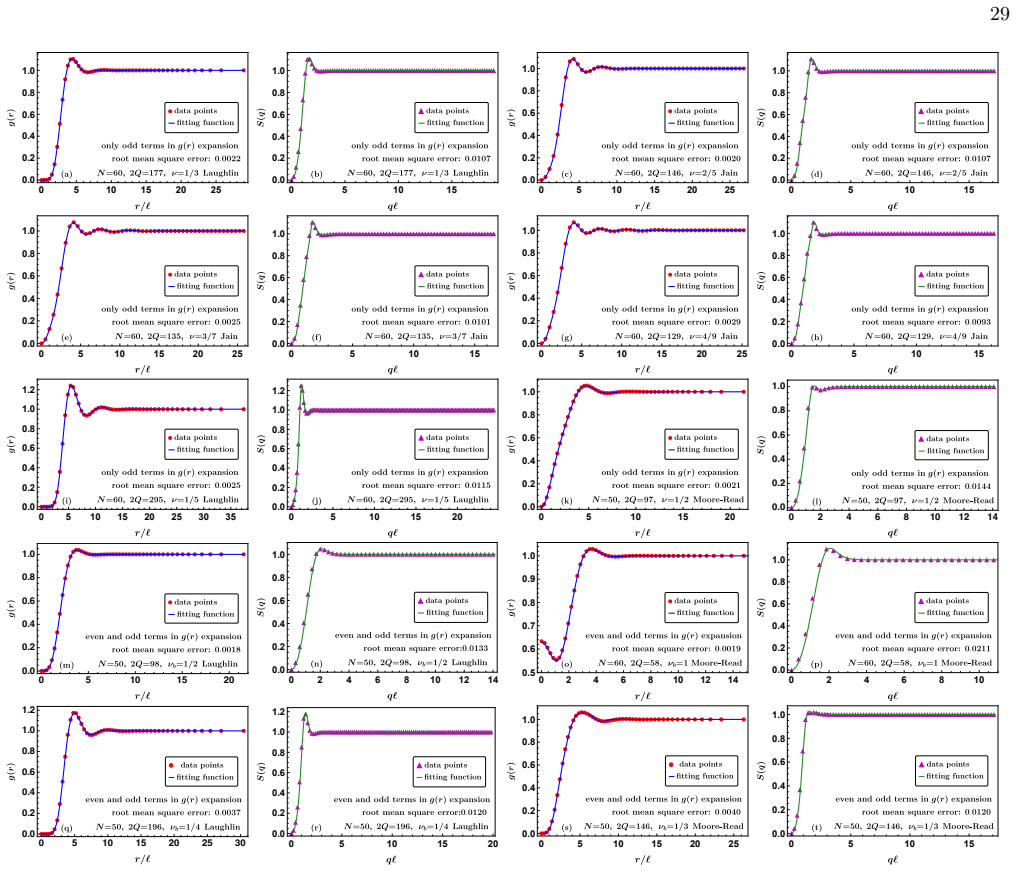
R. B. Laughlin, Anomalous quantum Hall effect: An 29 0 5 10 15 20 25 0.0 0.2 0.4 0.6 0.8 1.0 0 5 10 15 0.0 0.2 0.4 0.6 0.8 1.0 0 5 10 15 20 25 0.0 0.2 0.4 0.6 0.8 1.0 0 5 10 15 0.0 0.2 0.4 0.6 0.8 1.0 0 5 10 15 20 25 0.0 0.2 0.4 0.6 0.8 1.0 0 5 10 15 0.0 0.2 0.4 0.6 0.8 1.0 0 5 10 15 20 25 0.0 0.2 0.4 0.6 0.8 1.0 0 5 10 15 0.0 0.2 0.4 0.6 0.8 1.0 0 5 10 1...
work page 1983
-
[8]
B. I. Halperin, Statistics of quasiparticles and the hi- erarchy of fractional quantized Hall states, Phys. Rev. Lett. 52, 1583 (1984)
work page 1984
- [9]
-
[10]
J. Nakamura, S. Liang, G. C. Gardner, and M. J. Man- fra, Direct observation of anyonic braiding statistics, Nature Physics 16, 931 (2020)
work page 2020
-
[11]
H. Bartolomei, M. Kumar, R. Bisognin, A. Marguerite, J.-M. Berroir, E. Bocquillon, B. Pla¸ cais, A. Cavanna, Q. Dong, U. Gennser, Y. Jin, and G. F` eve, Fractional statistics in anyon collisions, Science 368, 173 (2020), https://science.sciencemag.org/content/368/6487/173.full.pdf
work page 2020
-
[12]
F. D. M. Haldane, Geometrical description of the frac- tional quantum Hall effect, Phys. Rev. Lett.107, 116801 (2011)
work page 2011
-
[13]
S. M. Girvin, A. H. MacDonald, and P. M. Platzman, Collective-excitation gap in the fractional quantum Hall effect, Phys. Rev. Lett. 54, 581 (1985)
work page 1985
-
[14]
S. M. Girvin, A. H. MacDonald, and P. M. Platzman, Magneto-roton theory of collective excitations in the fractional quantum Hall effect, Phys. Rev. B 33, 2481 (1986)
work page 1986
-
[15]
Bijl, The lowest wave function of the symmetrical many particles system, Physica 7, 869 (1940)
A. Bijl, The lowest wave function of the symmetrical many particles system, Physica 7, 869 (1940)
work page 1940
-
[16]
R. P. Feynman, Atomic theory of liquid helium near absolute zero, Phys. Rev. 91, 1301 (1953)
work page 1953
-
[17]
R. P. Feynman, Atomic theory of the two-fluid model of liquid helium, Phys. Rev. 94, 262 (1954)
work page 1954
-
[18]
R. P. Feynman and M. Cohen, Energy spectrum of the excitations in liquid helium, Phys. Rev. 102, 1189 (1956)
work page 1956
-
[19]
F. D. M. Haldane, Self-duality and long-wavelength 30 behavior of the Landau-level guiding-center structure function, and the shear modulus of fractional quantum Hall fluids (2011), arXiv:1112.0990 [cond-mat.str-el]
work page internal anchor Pith review Pith/arXiv arXiv 2011
-
[20]
Z. Liu, A. Gromov, and Z. Papi´ c, Geometric quench and nonequilibrium dynamics of fractional quantum Hall states, Phys. Rev. B 98, 155140 (2018)
work page 2018
-
[21]
Z. Liu, A. C. Balram, Z. Papi´ c, and A. Gromov, Quench dynamics of collective modes in fractional quantum Hall bilayers, Phys. Rev. Lett. 126, 076604 (2021)
work page 2021
-
[22]
S.-F. Liou, F. D. M. Haldane, K. Yang, and E. H. Rezayi, Chiral gravitons in fractional quantum Hall liq- uids, Phys. Rev. Lett. 123, 146801 (2019)
work page 2019
-
[23]
Gupta, Neereja Sundaresan, Thomas Alexander, Christopher J
J. Liang, Z. Liu, Z. Yang, Y. Huang, U. Wurstbauer, C. R. Dean, K. W. West, L. N. Pfeiffer, L. Du, and A. Pinczuk, Evidence for chiral graviton modes in frac- tional quantum Hall liquids, Nature 10.1038/s41586- 024-07201-w (2024)
-
[24]
J. K. Jain, Composite-fermion approach for the frac- tional quantum Hall effect, Phys. Rev. Lett. 63, 199 (1989)
work page 1989
-
[25]
G. Moore and N. Read, Nonabelions in the fractional quantum Hall effect, Nucl. Phys. B 360, 362 (1991)
work page 1991
-
[26]
N. Read and E. Rezayi, Beyond paired quantum Hall states: Parafermions and incompressible states in the first excited Landau level, Phys. Rev. B59, 8084 (1999)
work page 1999
-
[27]
J. K. Jain, Incompressible quantum Hall states, Phys. Rev. B 40, 8079 (1989)
work page 1989
-
[28]
P. M. Platzman and S. He, Resonant Raman scattering from mobile electrons in the fractional quantum Hall regime, Phys. Rev. B 49, 13674 (1994)
work page 1994
-
[29]
S. He, S. H. Simon, and B. I. Halperin, Response func- tion of the fractional quantized Hall state on a sphere. ii. exact diagonalization, Phys. Rev. B 50, 1823 (1994)
work page 1994
-
[30]
A. C. Balram, G. J. Sreejith, and J. K. Jain, Splitting of the Girvin-MacDonald-Platzman density wave and the nature of chiral gravitons in the fractional quantum Hall effect, Phys. Rev. Lett. 133, 246605 (2024)
work page 2024
-
[31]
D. Mujumder, S. Mandal, and J. Jain, Collective exci- tations of composite fermions across multiple λ levels, Nature Physics 5, 403 (2009)
work page 2009
-
[32]
I. D. Rodriguez, A. Sterdyniak, M. Hermanns, J. K. Slingerland, and N. Regnault, Quasiparticles and exci- tons for the Pfaffian quantum Hall state, Phys. Rev. B 85, 035128 (2012)
work page 2012
-
[33]
B. Yang, Z.-X. Hu, Z. Papi´ c, and F. D. M. Haldane, Model wave functions for the collective modes and the magnetoroton theory of the fractional quantum Hall ef- fect, Phys. Rev. Lett. 108, 256807 (2012)
work page 2012
-
[34]
Yang, Analytic wave functions for neutral bulk exci- tations in fractional quantum Hall fluids, Phys
B. Yang, Analytic wave functions for neutral bulk exci- tations in fractional quantum Hall fluids, Phys. Rev. B 87, 245132 (2013)
work page 2013
-
[35]
J. K. Jain and R. K. Kamilla, Composite fermions in the Hilbert space of the lowest electronic Landau level, Int. J. Mod. Phys. B 11, 2621 (1997)
work page 1997
-
[36]
J. K. Jain and R. K. Kamilla, Quantitative study of large composite-fermion systems, Phys. Rev. B 55, R4895 (1997)
work page 1997
-
[37]
A. Pinczuk, B. S. Dennis, L. N. Pfeiffer, and K. West, Observation of collective excitations in the fractional quantum Hall effect, Phys. Rev. Lett. 70, 3983 (1993)
work page 1993
-
[38]
C. J. Mellor, R. H. Eyles, J. E. Digby, A. J. Kent, K. A. Benedict, L. J. Challis, M. Henini, C. T. Foxon, and J. J. Harris, Phonon absorption at the magnetoroton minimum in the fractional quantum Hall effect, Phys. Rev. Lett. 74, 2339 (1995)
work page 1995
-
[39]
A. Pinczuk, B. Dennis, L. Pfeiffer, and K. West, Light scattering by low-energy collective excitations of quan- tum hall states, in High Magnetic Fields in the Physics of Semiconductors, edited by G. Landwehr and W. Os- sau (World Scientific Connect, 1996) pp. 83–90
work page 1996
-
[40]
H. D. M. Davies, J. C. Harris, J. F. Ryan, and A. J. Turberfield, Spin and charge density excitations and the collapse of the fractional quantum Hall state atν = 1/3, Phys. Rev. Lett. 78, 4095 (1997)
work page 1997
-
[41]
U. Zeitler, A. M. Devitt, J. E. Digby, C. J. Mellor, A. J. Kent, K. A. Benedict, and T. Cheng, Ballistic heating of a two-dimensional electron system by phonon excitation of the magnetoroton minimum at ν = 1/3, Phys. Rev. Lett. 82, 5333 (1999)
work page 1999
-
[42]
M. Kang, A. Pinczuk, B. S. Dennis, M. A. Eriksson, L. N. Pfeiffer, and K. W. West, Inelastic light scattering by gap excitations of fractional quantum Hall states at 1/3 ≥ ν ≤ 2/3, Phys. Rev. Lett. 84, 546 (2000)
work page 2000
-
[43]
B. A. Bernevig and F. D. M. Haldane, Model fractional quantum Hall states and jack polynomials, Phys. Rev. Lett. 100, 246802 (2008)
work page 2008
-
[44]
R. K. Kamilla, X. G. Wu, and J. K. Jain, Excitons of composite fermions, Phys. Rev. B 54, 4873 (1996)
work page 1996
-
[45]
R. K. Kamilla, X. G. Wu, and J. K. Jain, Compos- ite fermion theory of collective excitations in fractional quantum Hall effect, Phys. Rev. Lett. 76, 1332 (1996)
work page 1996
-
[46]
S. Pu, A. C. Balram, J. Taylor, E. Fradkin, and Z. Papi´ c, Microscopic model for fractional quantum Hall nemat- ics, Phys. Rev. Lett. 132, 236503 (2024)
work page 2024
-
[47]
V. W. Scarola, K. Park, and J. K. Jain, Rotons of com- posite fermions: Comparison between theory and exper- iment, Phys. Rev. B 61, 13064 (2000)
work page 2000
-
[48]
A. C. Balram, Z. Liu, A. Gromov, and Z. Papi´ c, Very- high-energy collective states of partons in fractional quantum Hall liquids, Phys. Rev. X 12, 021008 (2022)
work page 2022
-
[49]
D. X. Nguyen, F. D. M. Haldane, E. H. Rezayi, D. T. Son, and K. Yang, Multiple magnetorotons and spec- tral sum rules in fractional quantum Hall systems, Phys. Rev. Lett. 128, 246402 (2022)
work page 2022
-
[50]
W. Yuzhu and Y. Bo, Geometric fluctuation of confor- mal Hilbert spaces and multiple graviton modes in frac- tional quantum Hall effect, Nature Communications14, 2317 (2023)
work page 2023
-
[51]
F. D. M. Haldane, Fractional quantization of the Hall effect: A hierarchy of incompressible quantum fluid states, Phys. Rev. Lett. 51, 605 (1983)
work page 1983
-
[52]
X. G. Wen and A. Zee, Shift and spin vector: New topo- logical quantum numbers for the Hall fluids, Phys. Rev. Lett. 69, 953 (1992)
work page 1992
-
[53]
S. H. Simon and B. I. Halperin, Response function of the fractional quantized Hall state on a sphere. i. fermion Chern-Simons theory, Phys. Rev. B 50, 1807 (1994)
work page 1994
-
[54]
R. K. Kamilla, J. K. Jain, and S. M. Girvin, Fermi-sea- like correlations in a partially filled Landau level, Phys. Rev. B 56, 12411 (1997)
work page 1997
-
[55]
A. C. Balram and J. K. Jain, Fermi wave vector for the partially spin-polarized composite-fermion Fermi sea, Phys. Rev. B 96, 235102 (2017)
work page 2017
-
[56]
S. A. Trugman and S. Kivelson, Exact results for the fractional quantum Hall effect with general interactions, Phys. Rev. B 31, 5280 (1985)
work page 1985
-
[57]
S. H. Simon, E. H. Rezayi, and N. R. Cooper, Pseu- dopotentials for multiparticle interactions in the quan- 31 tum Hall regime, Phys. Rev. B 75, 195306 (2007)
work page 2007
-
[58]
Configuration interaction matrix elements for the quantum Hall effect
R. Wooten and J. Macek, Configuration interaction matrix elements for the quantum Hall effect (2014), arXiv:1408.5379 [cond-mat.str-el]
work page internal anchor Pith review Pith/arXiv arXiv 2014
-
[59]
G. Fano, F. Ortolani, and E. Colombo, Configuration- interaction calculations on the fractional quantum Hall effect, Phys. Rev. B 34, 2670 (1986)
work page 1986
- [60]
-
[61]
A. Cappelli, C. A. Trugenberger, and G. R. Zemba, Infinite symmetry in the quantum Hall effect, Nuclear Physics B 396, 465 (1993)
work page 1993
-
[62]
A. Cappelli and L. Maffi, W-infinity symmetry in the quantum Hall effect beyond the edge, Journal of High Energy Physics 2021, 120 (2021)
work page 2021
-
[63]
L. Spodyneiko, Girvin-Macdonald-Platzman algebra, dipole symmetry, and Hohenberg-Mermin-Wagner the- orem in the lowest Landau level, Phys. Rev. B 108, 125102 (2023)
work page 2023
- [64]
-
[65]
K. Park and J. Jain, Girvin–MacDonald–Platzman col- lective mode at general filling factors: magneto-roton minimum at half-filled Landau level, Solid State Com- munications 115, 353 (2000)
work page 2000
-
[66]
A. C. Balram and S. Pu, Positions of the magnetoro- ton minima in the fractional quantum Hall effect, The European Physical Journal B 90, 124 (2017)
work page 2017
-
[67]
N. d’Ambrumenil and A. M. Reynolds, Fractional quan- tum Hall states in higher Landau levels, Journal of Physics C: Solid State Physics 21, 119 (1988)
work page 1988
- [68]
-
[69]
X. G. Wu, G. Dev, and J. K. Jain, Mixed-spin incom- pressible states in the fractional quantum Hall effect, Phys. Rev. Lett. 71, 153 (1993)
work page 1993
-
[70]
J. K. Jain, Composite Fermions (Cambridge University Press, New York, US, 2007)
work page 2007
-
[71]
A. C. Balram, A. W´ ojs, and J. K. Jain, State counting for excited bands of the fractional quantum Hall effect: Exclusion rules for bound excitons, Phys. Rev. B 88, 205312 (2013)
work page 2013
-
[72]
B. Ku´ smierz and A. W´ ojs, Emergence of Jack ground states from two-body pseudopotentials in fractional quantum Hall systems, Phys. Rev. B 97, 245125 (2018)
work page 2018
-
[73]
B. Yang and A. C. Balram, Elementary excitations in fractional quantum Hall effect from classical constraints, New Journal of Physics 23, 013001 (2021)
work page 2021
-
[74]
A. C. Balram, A non-abelian parton state for the ν = 2 + 3/8 fractional quantum Hall effect, SciPost Phys. 10, 83 (2021)
work page 2021
-
[75]
A. C. Balram and A. W´ ojs, Fractional quantum Hall effect at ν = 2 + 4 /9, Phys. Rev. Research 2, 032035 (2020)
work page 2020
-
[76]
A. C. Balram, Transitions from Abelian composite fermion to non-Abelian parton fractional quantum Hall states in the zeroth Landau level of bilayer graphene, Phys. Rev. B 105, L121406 (2022)
work page 2022
-
[77]
M. Yutushui and D. F. Mross, Phase diagram of com- pressible and paired states in the quarter-filled Landau level, Phys. Rev. B 111, 035106 (2025)
work page 2025
-
[78]
R. Morf, N. d’Ambrumenil, and B. I. Halperin, Micro- scopic wave functions for the fractional quantized Hall states at ν = 2 5and 2 7, Phys. Rev. B 34, 3037 (1986)
work page 1986
-
[79]
S. M. Girvin, Anomalous quantum Hall effect and two-dimensional classical plasmas: Analytic approxima- tions for correlation functions and ground-state ener- gies, Phys. Rev. B 30, 558 (1984)
work page 1984
-
[80]
T. Can, M. Laskin, and P. Wiegmann, Fractional quantum Hall effect in a curved space: Gravitational anomaly and electromagnetic response, Phys. Rev. Lett. 113, 046803 (2014)
work page 2014
discussion (0)
Sign in with ORCID, Apple, or X to comment. Anyone can read and Pith papers without signing in.