REVIEW 3 major objections 4 minor 18 references
Multichannel signal detection in interference and noise when signal mismatch happens
T0 review · 3 major / 4 minor · reviewed 2026-08-14 · deepseek-v4-flash
Pith's one-line read A tunable detector smoothly trades robustness against selectivity for mismatched signals in subspace interference.
desk verdict The tunable detector idea is genuinely useful, but the printed analytical PFA and PD formulas are not correct, so the paper needs major revision before the performance analysis can be trusted. read the letter →
The pith
A machine-rendered reading of the paper's core claim, the machinery that carries it, and where it could break.
The reading
What carries the argument
The load-bearing object is the loss factor $\beta$ of Eq. (13), a scalar in $(0,1)$ equal to the reciprocal of the remaining energy after projecting the quasi-whitened data away from the interference and signal-plus-interference subspaces. Together with the GLRT-I statistic it satisfies $t_{\mathrm{ABORT\text{-}I}} = t_{\mathrm{GLRT\text{-}I}}+\beta$, $t_{\mathrm{W\text{-}ABORT\text{-}I}} = (1+t_{\mathrm{GLRT\text{-}I}})\beta$, and $t_{\mathrm{T\text{-}W\text{-}ABORT\text{-}I}} = \beta^{\kappa-1}(1+t_{\mathrm{GLRT\text{-}I}})$. These identities let the paper substitute the known conditional distribution of $t_{\mathrm{GLRT\text{-}I}}$ and the density of $\beta$ into the integrals in Eqs. (22)-(27), producing the closed-form PD and PFA expressions. Interference is removed by projecting the whitened test data onto the orthogonal complement of the interference subspace, so the interference power itself never appears in the probabilities.
What would settle it
Run the same Monte Carlo setup but draw the actual signal vector randomly around the nominal one on every trial, keeping the SNR fixed; the empirical detection probability will depart from Eqs. (22)-(27), because those integrals average only over a fixed mismatch realization rather than over a distribution of mismatch.
Extended reading notes
Core claim
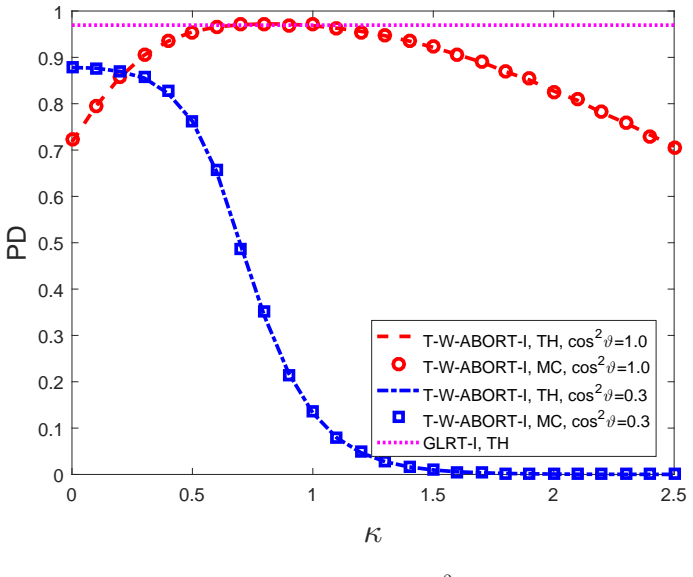
On the paper's own terms, the central discovery is that the tunable statistic defined in Eq. (9), $t_{\mathrm{T\text{-}W\text{-}ABORT\text{-}I}} = (1+\tilde{x}^H P_{\tilde J}^\perp \tilde{x})/(1+\tilde{x}^H P_{\tilde J}^\perp \tilde{x} - \tilde{x}^H P_{P_{\tilde J}^\perp \tilde H}\tilde{x})^{\kappa}$, interpolates between the adaptive energy detector at $\kappa=0$, the GLRT-I at $\kappa=1$, and the W-ABORT-I at $\kappa=2$. For $\kappa<1$ it is more robust to mismatched signals than the existing GLRT-I and 2S-GLRT-I, while for $\kappa>2$ it rejects mismatched signals more strongly than the two selective detectors. With the loss factor $\beta = (1+\tilde{x}^H P_{\tilde J}^\perp \tilde{x} - \tilde{x}^H P_{P_{\tilde J}^\perp \tilde H}\tilde{x})^{-1}$, each proposed detector becomes a simple function of $\beta$ and the GLRT-I statistic, so the detection and false-alarm probabilities reduce to one-dimensional integrals over $\beta$ using known distributions of $t_{\mathrm{GLRT\text{-}I}}$ and $\beta$ under mismatch. The resulting analytical PD and PFA formulas, Eqs. (22)-(27), are confirmed by Monte Carlo simulations for the parameters shown.
Load-bearing premise
The claimed formulas assume the mismatch is a fixed signal vector completely captured by the two scalars $\rho_{\mathrm{eff}}$ and $\delta^2$, and that the test data and training data share exactly the same Gaussian covariance matrix; if either assumption fails, the derived distributions and probabilities do not apply.
Editorial extensions
If this is right
- With a small $\kappa$, the T-W-ABORT-I preserves detection of targets whose steering vector is uncertain, going beyond the robustness of 2S-GLRT-I.
- With a large $\kappa$, for example 2.5, it is more selective than ABORT-I and W-ABORT-I, so it can reject sidelobe targets and jamming-like signals even at high SNR.
- Because closed-form false-alarm probabilities are available, thresholds can be set analytically to meet a false-alarm constraint without Monte Carlo threshold searches.
- For matched signals, ABORT-I and T-W-ABORT-I with $0.6 \le \kappa \le 1.0$ nearly match the GLRT-I detection probability, so the added robustness costs little in the matched case.
- These detectors are the first in this setting specifically designed for signal mismatch, extending the ABORT/W-ABORT selectivity mechanism to subspace interference.
Reading between the lines
- Because the trade-off is governed by a single power $\kappa$, the same construction could be applied to other ratio-type detectors to generate a full family of selective-to-robust detectors.
- If actual mismatch is random, as with a distribution of pointing errors, the fixed-mismatch distributions of $\beta$ and $t_{\mathrm{GLRT\text{-}I}}$ would need to be averaged over that distribution; the paper's formulas cover each fixed realization, not the random-mismatch average.
- A natural extension is to estimate the mismatch metric $\cos^2\vartheta$ online and choose $\kappa$ adaptively, though the paper proposes no such feedback rule.
- The verification is limited to exponentially correlated Gaussian noise with the displayed parameters; whether the integrals track simulations for non-Gaussian or heterogeneous training data remains untested.
Signed reviews
Editorial analysis
A structured set of objections, weighed in public.
Referee Report
Summary. The paper considers adaptive detection of a multichannel signal in subspace interference and Gaussian noise with unknown covariance, when the actual signal may be mismatched with respect to the nominal signal subspace. It proposes two selective detectors, ABORT-I and W-ABORT-I, and a tunable detector T-W-ABORT-I whose tunable parameter kappa is intended to interpolate continuously between robustness and selectivity. The statistical analysis expresses the detectors as functions of the GLRT-I statistic and a loss factor beta, and Section 4 derives analytical PD and PFA expressions from the conditional distributions of these quantities. The paper claims that these expressions are verified by Monte Carlo simulations and that the tunable detector can smoothly trade off rejection of mismatched signals against detection of matched signals.
Significance. The detector construction is a natural and potentially useful extension of ABORT/W-ABORT to the subspace-interference setting, and the idea of a single tunable parameter that continuously trades selectivity for robustness is attractive for practical operators. The conditional-distribution route is standard, and the Monte Carlo results in the tested regime are broadly consistent with the underlying distributional model. However, two load-bearing defects in the printed analytical expressions mean that the paper's central claim of verified PD/PFA formulas is not currently established: the printed H0 CDF is not the rho_eff=0 limit of the stated noncentral CDF, and several PD/PFA integrals discard regions where the conditional probability is exactly one. These errors are correctable but require re-derivation and re-verification.
major comments (3)
- [Section 4, Eq. (37)] The stated P0(eta) is not the rho_eff=0 limit of Eq. (34). Since IG_{k+1}(0)=1 for every k, setting rho_eff=0 in Eq. (34) gives P0(eta)= sum_{k=0}^{L-N+q} C_{k+p}^{L-N+p+q} eta^{k+p}/(1+eta)^{L-N+p+q}; the printed expression keeps only the k=0 term. The printed P0 tends to 0 as eta tends to infinity rather than to 1, so it cannot be a valid CDF. Because the PFA formulas are obtained by substituting P0 into Eqs. (22)-(27), all printed PFA expressions are incorrect, and thresholds computed from Eq. (37) would not achieve the designed false-alarm probability.
- [Section 4, Eqs. (22), (23), (25), (26)] The integrals restrict beta to the region where the CDF argument is non-negative and omit the complementary region, but on that complementary region the conditional detection probability is exactly 1. For example, for ABORT-I the correct expression is PD_ABORT-I = integral_0^{min(1,eta_a)} [1-P1(eta_a-beta)] f1(beta) dbeta + integral_{min(1,eta_a)}^1 f1(beta) dbeta, because t_GLRT-I is non-negative. The same omission affects W-ABORT-I and T-W-ABORT-I cases ii and iii; in particular, Eq. (26) should be 1 - integral_0^{eta_t^{1/(kappa-1)}} P1(eta_t beta^{1-kappa}-1) f1(beta) dbeta, not the two-part expression that drops the region where beta>eta_t^{1/(kappa-1)}. The PFA integrals formed by replacing P1 with P0 have the same defect. Unless the thresholds in the plotted examples always fall in cases where the omitted mass is negligible, the displayed theoretical curves do not correspond to the printed formulas.
- [Section 5, numerical verification] The numerical section verifies the PD curves against Monte Carlo detection probabilities, but it does not verify the analytical PFA expressions; the thresholds themselves are generated by 10^5 Monte Carlo trials. Given the error in Eq. (37), the claim that the analytical PFA expressions are verified is unsupported. The authors should either display simulated-versus-theoretical PFA curves for the proposed detectors or explicitly state that the analytical PFA is not used and is not verified by the figures shown.
minor comments (4)
- [Section 3, text before Eq. (11)] The sentence containing 'Equation (10) as be recast as' should read 'Equation (10) can be recast as'.
- [Eq. (21) and surrounding text] The condition written as 'beta^{1-kappa} > eta_t^{-1}' is hard to parse; it would be clearer to state the equivalent inequalities for each case, such as beta < eta_t^{1/(kappa-1)} for kappa>1 and eta_t<=1.
- [Section 5, Fig. 3 discussion] The phrase 'a special case of the T-W-ABORT-I with <= kappa = 1.0' contains a stray '<=' symbol and should be corrected.
- [Figures and thresholds] The paper does not report the actual threshold values used for the PD curves in Figs. 1-4; reporting these values would allow readers to identify which case of Eqs. (24)-(27) is active and to check whether the omitted-region issue affects the displayed results.
Circularity Check
No significant circularity: the analytical derivations use prior distributional results (including the authors' [12]) as tools, and the closed-form PD/PFA expressions are checked against independent Monte Carlo simulations, not fitted.
full rationale
The derivation chain is self-contained in the relevant sense. Detector statistics in Eqs. (14)-(16) are exact algebraic rewritings of the proposed test statistics in terms of t_GLRT-I and the loss factor beta; no target quantity is inserted into the definitions. The conditional probabilities in Eqs. (17)-(19) are direct CDF evaluations. The distributions of t_GLRT-I and beta in Eqs. (28)-(32) are imported from [12], a prior paper with overlapping authorship, and the CDF/PDF formulas (34)-(36) are imported from Kelly-Forsythe [17]. This is legitimate tool use rather than circularity: those cited results concern a previously studied detector (GLRT-I) and the loss factor, do not assume the new ABORT-I/W-ABORT-I/T-W-ABORT-I detectors, and do not include the paper's target conclusion. Moreover, the final PD/PFA formulas are parameter-free closed forms and are verified a posteriori by Monte Carlo simulations in Figs. 1-4, so no fitted input is renamed as a prediction. The tunable-detector claim is a reading of the derived curves, not a tautology. The skeptic's concerns about Eq. (37) (dropping all but the k=0 term when rho_eff=0) and about beta-integration domains are mathematical-correctness issues, not circularity; if valid they would make some printed formulas wrong, but the derivation would still not be circular.
Assumptions & free parameters
free parameters (1)
- Tunable parameter kappa =
user-chosen; examples 0.8 and 2.5
assumptions (4)
- domain assumption Test and training data are independent, share the same Gaussian covariance R, and are IID under each hypothesis.
- domain assumption Signal and interference lie in known, linearly independent subspaces with unknown coordinates, with p + q <= N.
- domain assumption The mismatched signal is a fixed deterministic vector whose effect is fully captured by rho_eff and delta^2.
- standard math The distributions of t_GLRT-I and beta under mismatch, and the CDF formula, are those given in [12] and [17].
Cite this review
Pith. "Pith review of Multichannel signal detection in interference and noise when signal mismatch happens." pith.science (2026). https://pith.science/paper/E6Y6LR5Z
@misc{pith2026190809431,
  author       = {Pith},
  title        = {Pith review of: Multichannel signal detection in interference and noise when signal mismatch happens},
  year         = {2026},
  howpublished = {\url{https://pith.science/paper/E6Y6LR5Z}},
  note         = {Machine review of arXiv:1908.09431}
}
read the original abstract
In this paper, we consider the problem of detecting a multichannel signal in interference and noise when signal mismatch happens. We first propose two selective detectors, since their strong selectivity is preferred in some situations. However, these two detectors would not be suitable candidates if a robust detector is needed. To overcome this shortcoming, we then devise a tunable detector, which is parametrized by a non-negative scaling factor, referred to as the tunable parameter. By adjusting the tunable parameter, the proposed detector can smoothly change its capability in rejecting or robustly detecting a mismatch signal. Moreover, one selective detector and the tunable detector with an appropriate tunable parameter can provide nearly the same detection performance as existing detectors in the absence of signal mismatch. We obtain analytical expressions for the probabilities of detection (PDs) and probabilities of false alarm (PFAs) of the three proposed detectors, which are verified by Monte Carlo simulations.
Figures


Figures from the paper (1 more)

Reference graph
Works this paper leans on
-
[1]
An adaptive detection algorithm,
E. J. Kelly, “An adaptive detection algorithm,” IEEE Transactions on Aerospace and Electronic Systems, vol. 22, no. 1, pp. 115–127, 1986
work page 1986
-
[2]
A CFAR adaptive matched filter detector,
F. C. Robey, D. R. Fuhrmann, E. J. Kelly, and R. Nitzberg, “A CFAR adaptive matched filter detector,” IEEE Transactions on Aerospace and Electronic Systems, vol. 28, no. 1, pp. 208–216, 1992
work page 1992
-
[3]
The CFAR adaptive subspace det ector is a scale- invariant GLRT,
S. Kraut and L. L. Scharf, “The CFAR adaptive subspace det ector is a scale- invariant GLRT,” IEEE Transactions on Signal Processing , vol. 47, no. 9, pp. 2538–2541, 1999
work page 1999
-
[4]
Perfor mance of the GLRT for adaptive vector subspace detection,
R. S. Raghavan, N. Pulsone, and D. J. McLaughlin, “Perfor mance of the GLRT for adaptive vector subspace detection,” IEEE Transactions on Aerospace and Electronic Systems, vol. 32, no. 4, pp. 1473–1487, 1996
work page 1996
-
[5]
D. Pastina, P . Lombardo, and T. Bucciarelli, “Adaptive p olarimetric tar- get detection with coherent radar part I: Detection against Gaussian back- ground,” IEEE Transactions on Aerospace and Electronic Systems , vol. 37, no. 4, pp. 1194–1206, 2001
work page 2001
-
[6]
S. Kraut and L. L. Scharf, “Adaptive subspace detectors, ” IEEE Transactions on Signal Processing, vol. 49, no. 1, pp. 1–16, 2001
work page 2001
-
[7]
W. Liu, W. Xie, J. Liu, and Y . Wang, “Adaptive double subsp ace signal de- tection in Gaussian background–part I: Homogeneous enviro nments,” IEEE Transactions on Signal Processing, vol. 62, no. 9, pp. 2345–2357, 2014
work page 2014
-
[8]
F. Bandiera, A. De Maio, A. S. Greco, and G. Ricci, “Adapti ve radar de- tection of distributed targets in homogeneous and partiall y homogeneous 19 noise plus subspace interference,” IEEE Transactions on Signal Processing , vol. 55, no. 4, pp. 1223–1237, 2007
work page 2007
Show all 18 references
-
[9]
Multichannel sig nal detec- tion based on Wald test in subspace interference and Gaussia n noise,
W. Liu, J. Liu, H. Li, Q. Du, and Y . Wang, “Multichannel sig nal detec- tion based on Wald test in subspace interference and Gaussia n noise,” IEEE Transactions on Aerospace and Electronic Systems, vol. 55, no. 3, pp. 1370– 1381, 2019
2019
-
[10]
A Rao test with enhanced select ivity properties in homogeneous scenarios,
D. Orlando and G. Ricci, “A Rao test with enhanced select ivity properties in homogeneous scenarios,” IEEE Transactions on Signal Processing , vol. 58, no. 10, pp. 5385–5390, 2010
2010
-
[11]
Performance analysis of a two -stage Rao detec- tor,
C. Hao, B. Liu, and L. Cai, “Performance analysis of a two -stage Rao detec- tor,” Signal Processing, vol. 91, no. 8, pp. 2141–2146, 2011
2011
-
[12]
Performan ce analysis of adaptive detectors for point targets in subspace interfere nce and Gaussian noise,
W. Liu, J. Liu, H. Lei, C. Hao, and Y .-L. Wang, “Performan ce analysis of adaptive detectors for point targets in subspace interfere nce and Gaussian noise,” IEEE Transactions on Aerospace and Electronic Systems , vol. 54, no. 1, pp. 429–441, 2018
2018
-
[13]
Adaptive beamformer orth ogonal rejection test,
N. B. Pulsone and C. M. Rader, “Adaptive beamformer orth ogonal rejection test,” IEEE Transactions on Signal Processing , vol. 49, no. 3, pp. 521–529, 2001
2001
-
[14]
Optimal waveform desi gn for general- ized likelihood ratio and adaptive matched filter detectors using a diversely polarized antenna,
J. Liu, Z.-J. Zhang, and Y . Y ang, “Optimal waveform desi gn for general- ized likelihood ratio and adaptive matched filter detectors using a diversely polarized antenna,” Signal Processing, vol. 92, no. 4, pp. 1126–1131, 2012
2012
-
[15]
An ABORT-like det ector with im- proved mismatched signals rejection capabilities,
F. Bandiera, O. Besson, and G. Ricci, “An ABORT-like det ector with im- proved mismatched signals rejection capabilities,” IEEE Transactions on Signal Processing, vol. 56, no. 1, pp. 14–25, 2007. 20
2007
-
[16]
CFAR det ection in clutter with unknown correlation properties,
R. S. Raghavan, H. F. Qiu, and D. J. Mclaughlin, “CFAR det ection in clutter with unknown correlation properties,” IEEE Transactions on Aerospace and Electronic Systems, vol. 31, no. 2, pp. 647–657, 1995
1995
-
[17]
Adaptive detection and p arameter estima- tion for multidimensional signal models,
E. J. Kelly and K. M. Forsythe, “Adaptive detection and p arameter estima- tion for multidimensional signal models,” Lincoln Laborat ory, Lexington, Technical Report, 1989
1989
-
[18]
Performance predict ion of subspace- based adaptive detectors with signal mismatch,
W. Liu, J. Liu, C. Zhang, and H. Li, “Performance predict ion of subspace- based adaptive detectors with signal mismatch,” Signal Processing, vol. 123, pp. 122–126, 2016. 21 5 10 15 20 SNR (dB) 0 0.1 0.2 0.3 0.4 0.5 0.6 0.7 0.8 0.9 1 PD ABORT-I, TH W-ABORT-I, TH T-W-ABORT-I, T...
2016
Reviewed August 14, 2026 · model on record in the stance chip above.
Discussion (0). Continue with ORCID to comment.