REVIEW 3 major objections 6 minor 1 cited by
How feedback shapes galaxies: an analytic model
T0 review · 3 major / 6 minor · reviewed 2026-08-14 · deepseek-v4-flash
Pith's one-line read This paper argues that a single time-independent star-formation efficiency curve, peaking at Milky-Way-scale haloes and falling off on both sides, reproduces the observed evolution of galaxies from the present day to redshift four, and…
desk verdict A handy analytic wrapper around abundance matching with genuine out-of-sample checks, but the high-redshift claim in the abstract needs reining in and the double-Schechter explanation is largely built into the fitting function. read the letter →
The pith
A machine-rendered reading of the paper's core claim, the machinery that carries it, and where it could break.
The reading
What carries the argument
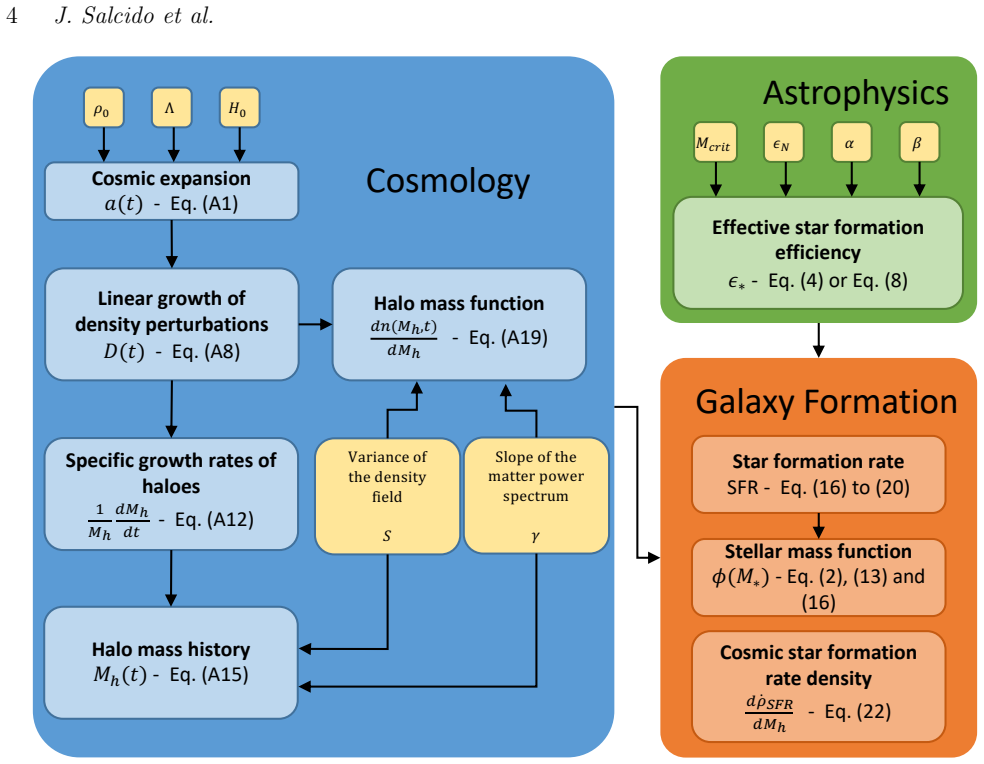
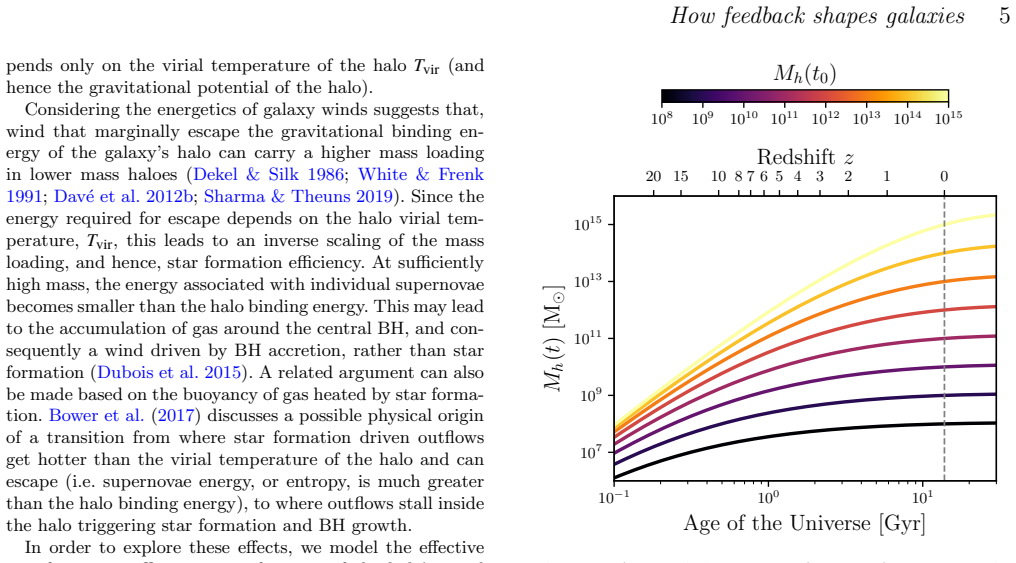
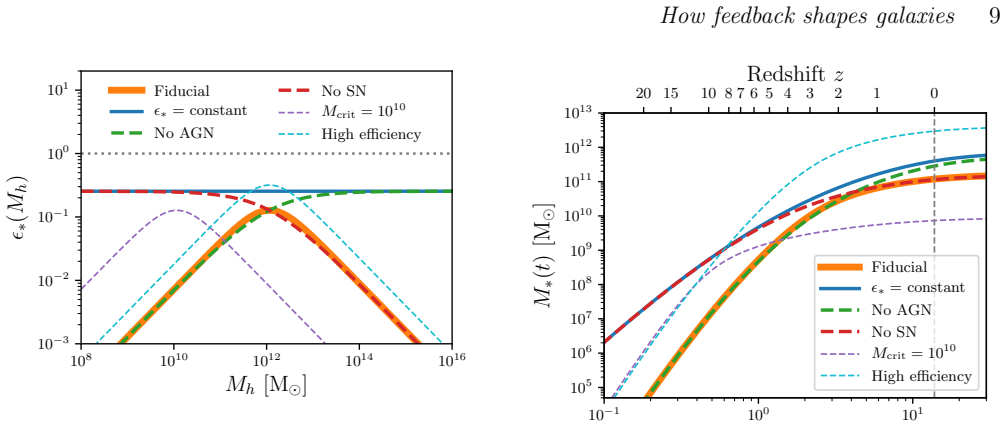
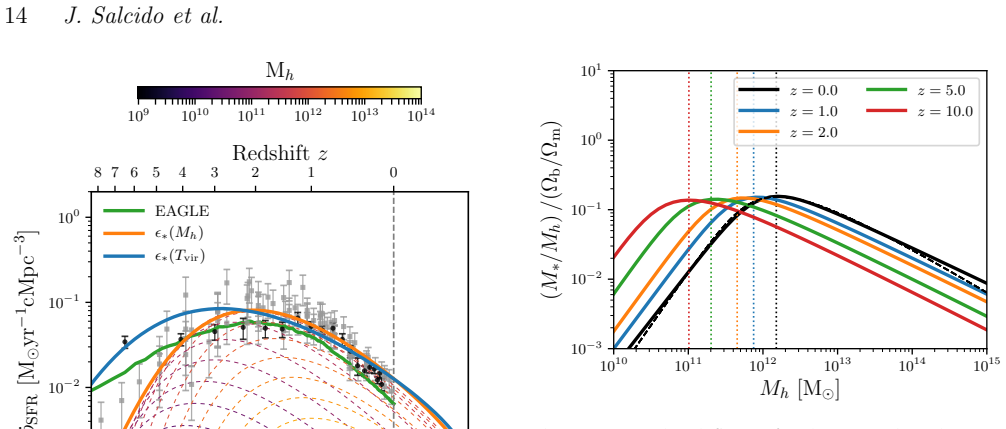
The central object is the effective star formation efficiency $\epsilon_*(M_h)$, modelled as a double power law (Eq. 4) with four free parameters: normalisation $\epsilon_N$, peak halo mass $M_{\rm crit}$, low-mass slope $\alpha$, and high-mass slope $\beta$. This efficiency is combined with an analytic Press--Schechter description of halo growth and abundance, including a Taylor-expansion solution of the Friedmann equations and a power-law approximation to the density-field variance $S\propto M_h^{-\gamma}$. The stellar mass function is then obtained through the Jacobian relation $\varphi(M_*)=\epsilon^{-1}\varphi_h(M_h)$, where $\epsilon$ is the logarithmic slope of the stellar-to-halo mass relation; the discontinuity in this slope between $1+\alpha$ and $1-\beta$ creates the inflection point that becomes the double Schechter bump. A separate factor $f_{\rm SFR}$ splits stellar growth into in-situ star formation and accreted stars, allowing the star formation rate and cosmic star formation rate density to be computed.
What would settle it
Measure the galaxy stellar mass function or the stellar-to-halo mass relation at $z=4{-}8$ with small uncertainties: if the abundance of high-redshift galaxies lies systematically above the time-independent efficiency model while the virial-temperature model also overshoots at intermediate redshifts, the central claim fails. More directly, abundance matching that shows the peak efficiency mass $M_{\rm crit}$ shifting with redshift by more than the model's fixed value would violate Eq. (4).
Extended reading notes
Core claim
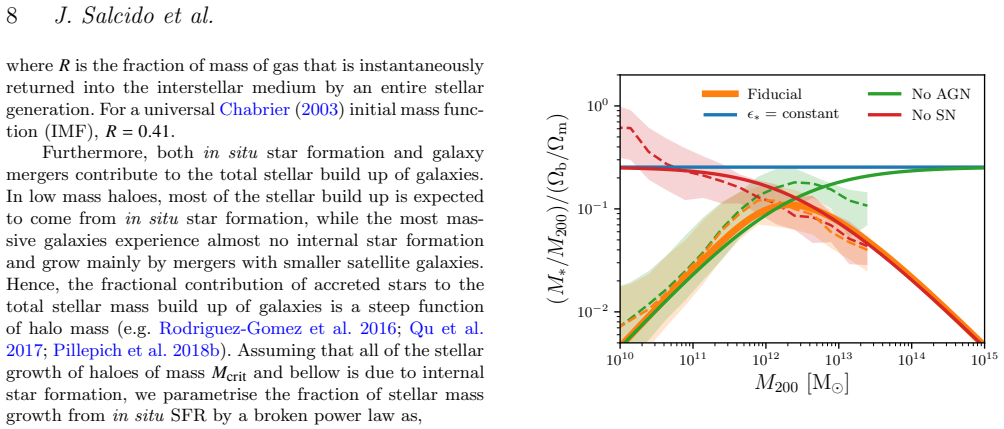
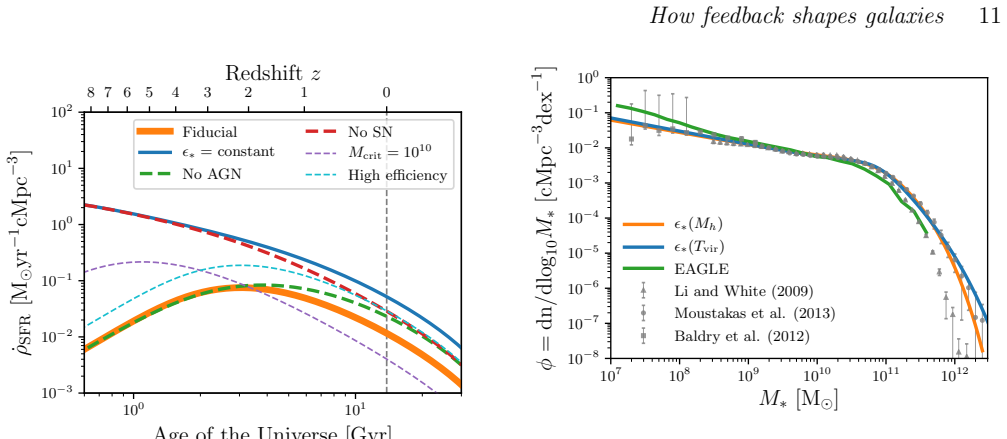
Galaxy formation can be reduced to a product of cosmology and a single astrophysical object: the effective star formation efficiency $\epsilon_*(M_h)$, defined as the fraction of infalling baryons converted into stars. Taking this efficiency to be a fixed, time-independent double power law of halo mass, with four parameters calibrated to the present-day stellar mass function, the model reproduces the cosmic star formation rate density, the specific star formation rate of galaxies, and the galaxy stellar mass function at both low and high redshift. The paper's key explanatory result is that the double Schechter function emerges from the mapping between halo mass and stellar mass: the logarithmic slope of the stellar-to-halo mass relation changes sharply at the efficiency peak, producing an inflection point, or 'bump', at the knee of the stellar mass function. Physically, this bump is the pile-up of galaxies around the halo mass where star formation efficiency peaks, between a stellar-feedback-regulated regime at low masses and a black-hole-regulated regime at high masses.
Load-bearing premise
The load-bearing premise is that a halo's effective star formation efficiency is a fixed function of halo mass alone, calibrated to the $z\sim 0$ stellar mass function and held constant with cosmic time; if that efficiency evolves, the high-redshift predictions break down, and Figure 11 shows the fixed model under-predicting galaxy abundances at $z>4$.
Editorial extensions
If this is right
- If the fixed, mass-dependent efficiency is correct, then the redshift evolution of the galaxy stellar mass function from $z=0$ to $z\approx 4$ is driven almost entirely by the growth and abundance of dark matter haloes, not by evolving baryonic physics.
- The double Schechter function of low-redshift galaxy surveys would have a mechanistic explanation in terms of two feedback stages, making it a prediction rather than an empirical fitting function.
- Supernova feedback, through the low-mass slope $\alpha$, sets the rise and peak of the cosmic star formation history; removing it turns the cosmic star formation rate density into a power law with no peak.
- Black-hole feedback, through the high-mass slope $\beta$, is primarily responsible for the sharp knee of the stellar mass function; removing it leaves the mass function shallow and featureless at the high-mass end.
- The virial-temperature version of the model identifies a physical critical temperature $T_{\rm crit}$ at which stellar outflows stall and black-hole feedback switches on, offering a concrete threshold that can be sought in hydrodynamic simulations.
Reading between the lines
- The model's failure at $z>4$ under the fixed-efficiency assumption, noted in the paper, is itself a measurement: it brackets the redshift where the effective star formation efficiency must begin to evolve with cosmic time.
- Because all ingredients are analytic and differentiable, one could invert the model directly against the observed stellar mass function to recover the efficiency function without running hydrodynamical simulations, which would make the method a practical tool for survey data.
- A natural extension is to let $M_{\rm crit}$ or the slopes $\alpha,\beta$ vary smoothly with time while keeping the double power-law form; the paper's two limiting cases bracket the allowed behaviour of such an extension.
- The virial-temperature model's overly rapid evolution at intermediate redshifts could be cured by a mild redshift dependence of $T_{\rm crit}$ itself, for instance through metallicity or dust effects on cooling, a modification the paper leaves unexplored.
Editorial analysis
A structured set of objections, weighed in public.
Referee Report
Summary. This paper develops a fully analytic model of galaxy formation in which the growth of stellar mass is tied to the growth of dark matter haloes through an effective star formation efficiency. The efficiency is either a time-independent function of halo mass (Model I, Eq. 4) or a function of virial temperature (Model II, Eq. 8), with four parameters calibrated to the z~0 galaxy stellar mass function (GSMF) in Table 2. From analytic halo growth histories and a Press-Schechter mass function, the authors derive stellar mass growth, the GSMF, the cosmic star formation rate density, and the specific star formation rate, and compare these with observations and with EAGLE simulation variants. The paper claims that the model reproduces the shape and evolution of the cosmic SFR density, the sSFR, and the GSMF both at the present time and at high redshift, and that the double Schechter function arises naturally from two efficiency regimes in the stellar-to-halo mass relation.
Significance. The analytic machinery is elegant and potentially useful: the derivations in Appendix A are transparent, the model is invertible and fast, and the out-of-sample agreement with the cosmic SFR density and the sSFR is a genuine success. The comparison with EAGLE variants in Figs. 5, B1, and B2 also gives a welcome sanity check. However, the paper's headline claim about reproducing the high-redshift GSMF is not supported by either model as presented, and the double-Schechter 'explanation' is largely a restatement of the assumed double power-law parametrization. If those claims are properly qualified, the framework is a valuable contribution to analytic galaxy formation modelling.
major comments (3)
- [Abstract; Section 4.1; Fig. 11] The abstract's claim that the model reproduces the GSMF 'both at the present time and at high redshifts' is contradicted by the paper's own results. Section 4.1 states that Model I 'reproduces very well the evolution of the GSMF up to redshift z≈4, but significantly under predicts the abundance of distant galaxies,' while Model II 'provides a good fit both at low and high redshift, but the evolution is too rapid at intermediate redshift (z=1 to z=4).' No single efficiency prescription in the paper works across the full claimed range. The abstract and the similar concluding sentence in Section 5 should be revised to present the two models as complementary (Model I to z≈4; Model II at high z but with an intermediate-redshift tension), or the claim of reproducing the high-redshift GSMF should be removed.
- [Section 2.1, Eqs. (4), (7), (15); Section 4] The 'explanation' of the double Schechter function as two efficiency regimes is largely circular. The double power-law form of epsilon_* in Eq. (4), and the resulting slope transition in Eq. (7), are fitted to the z~0 GSMF (Table 2), so the appearance of a bump at the knee of the GSMF is built into the parametrization rather than independently predicted. The paper should state explicitly that the double-Schechter-like shape is a consequence of the assumed functional form, and should frame the genuine prediction as the redshift evolution of that shape, which is tested in Fig. 11 up to z≈4. As written, the 'origin' claim overstates what the model independently establishes.
- [Section 4.1; Fig. 11] The high-redshift comparison in Fig. 11 is only qualitative: no chi-squared or other quantitative statistic is given for the z>0 panels. Given that the abstract claims a reproduction of the high-redshift GSMF, the authors should either quantify the agreement per redshift bin, or explicitly identify the panels where the model deviates by more than the observational uncertainties. This would also clarify whether the phrase 'reproduces very well' is supported across the full mass range or only at certain masses.
minor comments (6)
- [Section 4.1.1] The text repeatedly writes 'viral temperature' where 'virial temperature' is meant; please correct these typographical errors.
- [Figure 5 caption] The caption contains the garbled string '10th^a˘A¸S90th'; this should be '10th to 90th percentiles'.
- [Eq. (1) and Eq. (3)] The symbol epsilon is used for the logarithmic slope of the stellar-to-halo mass relation in Eq. (1) and for the star formation efficiency in Eq. (3). These are distinct quantities, and using the same base symbol is confusing; consider denoting the slope by, for example, s(M_h,t).
- [Eq. (4)] The variable z is defined as (M_h/M_crit)^(alpha+beta), which conflicts with the standard use of z for redshift throughout the paper. The authors note the clash, but a different symbol, such as y, would be clearer.
- [Table 2] The reduced chi-squared values are quoted to one decimal place; giving the raw chi-squared and the number of data points would allow readers to assess the fit quality more precisely.
- [Section 4.1] The text contains the typo 'In. this section'; it should read 'In this section'.
Circularity Check
The double-Schechter 'explanation' is built into the fitted double-power-law efficiency; the SFR density and sSFR remain genuine out-of-sample predictions.
-
fitted input called prediction
[Section 2.3 (Eqs. 4, 7); Section 4 and Table 2; Abstract and Section 5]
"The models were calibrated to reproduce only the observed GSMF at redshift z∼0. ... When the halo mass function is multiplied by the inverse of the logarithmic slope of the SHMR, the low-mass end is multiplied by a factor 1/(1 +α), while the high-mass end is multiplied by a factor of 1/(1−β). As both α and β are positive, this creates an a kink in the gradient ... creating a 'bump' at the knee of the GSMF."
Eq. (4) postulates epsilon*(Mh) as a double power law with slopes alpha, -beta and a transition at Mcrit; Eq. (7) converts that into a slope transition of the SHMR. The GSMF is then obtained by the Jacobian identity Eq. (2), phi = phi_h/epsilon, so the 'bump' at the knee is a mathematical consequence of the assumed parametrization. The four parameters in Eq. (4) were chi^2-fitted to the z~0 GSMF (Table 2), i.e. to a dataset that already exhibits the double-Schechter knee. Presenting the resulting shape as 'naturally explained' by two efficiency regimes is therefore an interpretation of the fitted slopes, not an independent prediction. The cosmic SFR density and sSFR are not fitted and remain genuine predictions, which limits the overall circularity.
full rationale
The circularity burden is moderate and localized. The cosmological ingredients (Press-Schechter halo mass function, halo growth histories) are standard or cited to prior work and are not equivalent to the galaxy-formation outputs. The cosmic SFR density and sSFR are computed from the fitted efficiency without being fitted themselves and agree with independent data, so those are genuine predictions. The present-day GSMF, however, is explicitly calibrated: Section 4 states that the models were calibrated to reproduce only the observed GSMF at z~0, with best-fit parameters in Table 2. Consequently, the claimed 'origin of the double Schechter function' is not an independent derivation: Eq. (4) postulates a double-power-law efficiency with a slope transition at Mcrit, Eq. (7) turns that into a slope transition in the SHMR, and the Jacobian relation Eq. (2) then forces a bump/knee in the GSMF. The two 'efficiency regimes' are the two slopes of the fitted parametrization. The abstract's claim that the GSMF is reproduced 'both at the present time and at high redshifts' is also stronger than the paper's own Section 4.1, which says Model I underpredicts z>4 and Model II evolves too fast at intermediate z; that is an overclaim or correctness issue rather than circularity. No load-bearing self-citation chain was found: the Salcido et al. (2018) cosmology approximation and the Bower et al. (2017) critical-mass comparison do not smuggle in the target result.
Assumptions & free parameters
free parameters (6)
- epsilon_N (normalisation of efficiency) =
0.178 (mass model); 0.140 (Tvir model)
- M_crit (critical halo mass) =
10^11.68 Msun (mass model); 10^12 Msun at z=0 (Tvir model)
- alpha (low-mass slope) =
1.537 (mass model); 2.377 (Tvir model)
- beta (high-mass slope) =
0.656 (mass model); 0.834 (Tvir model)
- eta (in-situ fraction slope) =
-0.3
- R (instantaneous recycling fraction) =
0.41
assumptions (7)
- domain assumption Press-Schechter formalism with power-law variance S = S0 (Mh/10^12 M_sun)^-gamma, gamma=0.3, S0=3.98, q=3.16, delta_c=1.68
- domain assumption Taylor-expansion analytic solution of the Friedmann equations (Eqs. A1, A8-A9) from Salcido et al. 2018
- domain assumption Instantaneous recycling approximation with return fraction R = 0.41 (Eq. 17)
- ad hoc to paper The star formation efficiency epsilon* is a time-independent function of halo mass (Model I, Eq. 4) or virial temperature (Model II, Eq. 8)
- domain assumption Stellar mass growth tracks the cosmological baryon accretion rate: dM*/dt = epsilon* f_b dMh/dt (Eq. 3)
- domain assumption Reionisation suppresses star formation in haloes with T_vir < 10^4 K (Model II and No-SN comparisons)
- domain assumption In-situ star formation fraction fSFR is a broken power law (Eq. 18) with slope eta = -0.3 fixed by Pillepich et al. 2018b
Cite this review
Pith. "Pith review of How feedback shapes galaxies: an analytic model." pith.science (2026). https://pith.science/paper/EABBZDQ4
@misc{pith2026190800552,
  author       = {Pith},
  title        = {Pith review of: How feedback shapes galaxies: an analytic model},
  year         = {2026},
  howpublished = {\url{https://pith.science/paper/EABBZDQ4}},
  note         = {Machine review of arXiv:1908.00552}
}
read the original abstract
We introduce a simple analytic model of galaxy formation that links the growth of dark matter haloes in a cosmological background to the build-up of stellar mass within them. The model aims to identify the physical processes that drive the galaxy-halo co-evolution through cosmic time. The model restricts the role of baryonic astrophysics to setting the relation between galaxies and their haloes. Using this approach, galaxy properties can be directly predicted from the growth of their host dark matter haloes. We explore models in which the effective star formation efficiency within haloes is a function of mass (or virial temperature) and independent of time. Despite its simplicity, the model reproduces self-consistently the shape and evolution of the cosmic star formation rate density, the specific star formation rate of galaxies, and the galaxy stellar mass function, both at the present time and at high redshifts. By systematically varying the effective star formation efficiency in the model, we explore the emergence of the characteristic shape of the galaxy stellar mass function. The origin of the observed double Schechter function at low redshifts is naturally explained by two efficiency regimes in the stellar to halo mass relation, namely, a stellar feedback regulated stage, and a supermassive black hole regulated stage. By providing a set of analytic differential equations, the model can be easily extended and inverted, allowing the roles and impact of astrophysics and cosmology to be explored and understood.
Figures

Figures from the paper (9 more)





Forward citations
Cited by 1 Pith paper
-
Properties of reionization-era galaxies from JWST luminosity functions and 21-cm interferometry
JWST luminosity functions alone improve constraints on high-redshift galaxy properties by only a factor of 2 to 3, but combining them with SKA 21-cm observations recovers all eight model parameters and tightens the re...
Reference graph
Works this paper leans on
-
[3]
K., et al., 2012, @doi [ ] 10.1111/j.1365-2966.2012.20340.x , 421, 621
Baldry I. K., et al., 2012, @doi [ ] 10.1111/j.1365-2966.2012.20340.x , 421, 621
arXiv 2012
-
[4]
Behroozi P. S., Wechsler R. H., Conroy C., 2013, @doi [ ] 10.1088/0004-637X/770/1/57 , 770, 57
-
[5]
Behroozi P., Wechsler R. H., Hearin A. P., Conroy C., 2019, @doi [ ] 10.1093/mnras/stz1182 , https://ui.adsabs.harvard.edu/abs/2019MNRAS.tmp.1134B p. 1134
-
[6]
J., 2012, @doi [ ] 10.1016/j.newast.2011.07.004 , 17, 175
Benson A. J., 2012, @doi [ ] 10.1016/j.newast.2011.07.004 , 17, 175
-
[7]
Benson A. J., Bower R. G., Frenk C. S., Lacey C. G., Baugh C. M., Cole S., 2003, @doi [ ] 10.1086/379160 , 599, 38
doi:10.1086/379160 2003
-
[8]
Berlind A. A., Weinberg D. H., 2002, @doi [ ] 10.1086/341469 , 575, 587
doi:10.1086/341469 2002
-
[9]
Bose S., Deason A. J., Frenk C. S., 2018, @doi [ ] 10.3847/1538-4357/aacbc4 , https://ui.adsabs.harvard.edu/abs/2018ApJ...863..123B 863, 123
-
[10]
Bouch \'e N., et al., 2010, @doi [ ] 10.1088/0004-637X/718/2/1001 , 718, 1001
Show all 92 references
-
[12]
G., Schaye J., Frenk C
Bower R. G., Schaye J., Frenk C. S., Theuns T., Schaller M., Crain R. A., McAlpine S., 2017, @doi [ ] 10.1093/mnras/stw2735 , 465, 32
2017 doi
- [13]
-
[14]
Bruzual G., Charlot S., 2003, @doi [ ] 10.1046/j.1365-8711.2003.06897.x , 344, 1000
2003
-
[15]
C., Kinney A
Calzetti D., Armus L., Bohlin R. C., Kinney A. L., Koornneef J., Storchi-Bergmann T., 2000, @doi [ ] 10.1086/308692 , 533, 682
2000 doi
-
[16]
Chabrier G., 2003, @doi [ ] 10.1086/376392 , 115, 763
2003 doi
-
[17]
G., 2018, @doi [ ] 10.1093/mnras/sty1229 , 478, 3994
Clauwens B., Schaye J., Franx M., Bower R. G., 2018, @doi [ ] 10.1093/mnras/sty1229 , 478, 3994
2018 doi
-
[18]
S., Navarro J
Cole S., Aragon-Salamanca A., Frenk C. S., Navarro J. F., Zepf S. E., 1994, @doi [ ] 10.1093/mnras/271.4.781 , 271, 781
1994 doi
-
[19]
Cooray A., Sheth R., 2002, @doi [ ] 10.1016/S0370-1573(02)00276-4 , 372, 1
2002 doi
-
[20]
A., Wyithe J
Correa C. A., Wyithe J. S. B., Schaye J., Duffy A. R., 2015, @doi [ ] 10.1093/mnras/stv689 , 450, 1514
2015 doi
-
[21]
Couchman H. M. P., Rees M. J., 1986, @doi [ ] 10.1093/mnras/221.1.53 , 221, 53
1986 doi
-
[22]
I., et al., 2018, @doi [ ] 10.3847/1538-4357/aaa41d , 853, 69
Cowley W. I., et al., 2018, @doi [ ] 10.3847/1538-4357/aaa41d , 853, 69
2018 doi
-
[23]
A., et al., 2015, @doi [ ] 10.1093/mnras/stv725 , 450, 1937
Crain R. A., et al., 2015, @doi [ ] 10.1093/mnras/stv725 , 450, 1937
2015 doi
-
[25]
D., 2012b, @doi [ ] 10.1111/j.1365-2966.2011.20148.x , https://ui.adsabs.harvard.edu/abs/2012MNRAS.421...98D 421, 98
Dav \'e R., Finlator K., Oppenheimer B. D., 2012b, @doi [ ] 10.1111/j.1365-2966.2011.20148.x , https://ui.adsabs.harvard.edu/abs/2012MNRAS.421...98D 421, 98
2011
-
[26]
F., 2016, @doi [ ] 10.1093/mnras/stw1862 , 462, 3265
Dav \'e R., Thompson R., Hopkins P. F., 2016, @doi [ ] 10.1093/mnras/stw1862 , 462, 3265
2016 doi
-
[27]
Dekel A., Silk J., 1986, @doi [ ] 10.1086/164050 , https://ui.adsabs.harvard.edu/abs/1986ApJ...303...39D 303, 39
1986 doi
-
[28]
V., 2013, @doi [ ] 10.1088/0004-637X/766/1/25 , 766, 25
Diemer B., More S., Kravtsov A. V., 2013, @doi [ ] 10.1088/0004-637X/766/1/25 , 766, 25
2013 doi
-
[29]
G., Zel'dovich Y
Doroshkevich A. G., Zel'dovich Y. B., Novikov I. D., 1967, Soviet Astronomy, 11, 233
1967
-
[30]
P., et al., 2018, @doi [ ] 10.1093/mnras/stx2728 , 475, 2891
Driver S. P., et al., 2018, @doi [ ] 10.1093/mnras/stx2728 , 475, 2891
2018 doi
-
[31]
Dubois Y., Volonteri M., Silk J., Devriendt J., Slyz A., Teyssier R., 2015, @doi [ ] 10.1093/mnras/stv1416 , https://ui.adsabs.harvard.edu/abs/2015MNRAS.452.1502D 452, 1502
2015 doi
-
[32]
Dubois Y., Peirani S., Pichon C., Devriendt J., Gavazzi R., Welker C., Volonteri M., 2016, @doi [ ] 10.1093/mnras/stw2265 , 463, 3948
2016 doi
-
[33]
Efstathiou G., 1992, @doi [ ] 10.1093/mnras/256.1.43P , 256, 43P
1992 doi
-
[35]
Fitts A., et al., 2017, @doi [ ] 10.1093/mnras/stx1757 , 471, 3547
2017 doi
-
[36]
J., 2015, @doi [ ] 10.1093/mnras/stv138 , 448, 2987
Fosalba P., Crocce M., Gazta \ n aga E., Castander F. J., 2015, @doi [ ] 10.1093/mnras/stv138 , 448, 2987
2015 doi
-
[37]
G., Baldry I
Gilbank D. G., Baldry I. K., Balogh M. L., Glazebrook K., Bower R. G., 2010, @doi [ ] 10.1111/j.1365-2966.2010.16640.x , 405, 2594
2010
-
[38]
J., Shankar F., Zanisi L., Bernardi M., 2019, @doi [ ] 10.1093/mnras/sty3281 , https://ui.adsabs.harvard.edu/abs/2019MNRAS.483.2506G 483, 2506
Grylls P. J., Shankar F., Zanisi L., Bernardi M., 2019, @doi [ ] 10.1093/mnras/sty3281 , https://ui.adsabs.harvard.edu/abs/2019MNRAS.483.2506G 483, 2506
2019 doi
-
[39]
R., Schaye J., Booth C
Haas M. R., Schaye J., Booth C. M., Dalla Vecchia C., Springel V., Theuns T., Wiersma R. P. C., 2013, @doi [ ] 10.1093/mnras/stt1487 , 435, 2931
2013 doi
-
[40]
Henriques B. M. B., White S. D. M., Thomas P. A., Angulo R., Guo Q., Lemson G., Springel V., Overzier R., 2015, @doi [ ] 10.1093/mnras/stv705 , 451, 2663
2015 doi
-
[41]
Hoekstra H., Yee H. K. C., Gladders M. D., 2004, @doi [ ] 10.1086/382726 , 606, 67
2004 doi
-
[42]
J., et al., 2015, @doi [ ] 10.1093/mnras/stu2367 , 447, 298
Hudson M. J., et al., 2015, @doi [ ] 10.1093/mnras/stu2367 , 447, 298
2015 doi
-
[43]
Ilbert O., et al., 2013, @doi [ ] 10.1051/0004-6361/201321100 , 556, A55
2013 doi
-
[44]
Karim A., et al., 2011, @doi [ ] 10.1088/0004-637X/730/2/61 , 730, 61
2011 doi
-
[45]
A., Trujillo-Gomez S., Primack J., 2011, @doi [ ] 10.1088/0004-637X/740/2/102 , 740, 102
Klypin A. A., Trujillo-Gomez S., Primack J., 2011, @doi [ ] 10.1088/0004-637X/740/2/102 , 740, 102
2011 doi
-
[46]
G., et al., 2016, @doi [ ] 10.1093/mnras/stw1888 , 462, 3854
Lacey C. G., et al., 2016, @doi [ ] 10.1093/mnras/stw1888 , 462, 3854
2016 doi
-
[47]
Lan T.-W., M \'e nard B., Mo H., 2016, @doi [Monthly Notices of the Royal Astronomical Society] 10.1093/mnras/stw898 , 459, 3998
2016 doi
-
[49]
Loeb A., Barkana R., 2001, @doi [Annual Review of Astronomy and Astrophysics] 10.1146/annurev.astro.39.1.19 , 39, 19
2001 doi
-
[50]
Madau P., Dickinson M., 2014, @doi [ ] 10.1146/annurev-astro-081811-125615 , 52, 415
2014 doi
-
[51]
McAlpine S., et al., 2016, @doi [Astronomy and Computing] 10.1016/j.ascom.2016.02.004 , 15, 72
2016 doi
-
[52]
G., Rosario D
McAlpine S., Bower R. G., Rosario D. J., Crain R. A., Schaye J., Theuns T., 2018, @doi [ ] 10.1093/mnras/sty2489 , https://ui.adsabs.harvard.edu/abs/2018MNRAS.481.3118M 481, 3118
2018 doi
-
[53]
D., Lacey C
Mitchell P. D., Lacey C. G., Baugh C. M., Cole S., 2016, @doi [ ] 10.1093/mnras/stv2741 , 456, 1459
2016 doi
-
[54]
P., Somerville R
Moster B. P., Somerville R. S., Maulbetsch C., Bosch F. C. v. d., Macci \`o A. V., Naab T., Oser L., 2010, @doi [ ] 10.1088/0004-637X/710/2/903 , 710, 903
2010 doi
-
[55]
P., Naab T., White S
Moster B. P., Naab T., White S. D. M., 2013, @doi [ ] 10.1093/mnras/sts261 , 428, 3121
2013 doi
-
[56]
P., Naab T., White S
Moster B. P., Naab T., White S. D. M., 2018, @doi [ ] 10.1093/mnras/sty655 , 477, 1822
2018 doi
-
[57]
Moustakas J., et al., 2013, @doi [ ] 10.1088/0004-637X/767/1/50 , 767, 50
2013 doi
-
[58]
Muzzin A., et al., 2013, @doi [ ] 10.1088/0004-637X/777/1/18 , 777, 18
2013 doi
-
[59]
P., 2017, @doi [ ] 10.1146/annurev-astro-081913-040019 , 55, 59
Naab T., Ostriker J. P., 2017, @doi [ ] 10.1146/annurev-astro-081913-040019 , 55, 59
2017 doi
-
[60]
C., Dekel A., 2006, @doi [ ] 10.1111/j.1365-2966.2006.10918.x , 372, 933
Neistein E., van den Bosch F. C., Dekel A., 2006, @doi [ ] 10.1111/j.1365-2966.2006.10918.x , 372, 933
2006
-
[61]
L., 1952, @doi [ ] 10.1086/145599 , 116, 144
Neyman J., Scott E. L., 1952, @doi [ ] 10.1086/145599 , 116, 144
1952 doi
-
[62]
S., Cole S., 2008, @doi [ ] 10.1111/j.1365-2966.2007.12583.x , 383, 646
Norberg P., Frenk C. S., Cole S., 2008, @doi [ ] 10.1111/j.1365-2966.2007.12583.x , 383, 646
2008
-
[63]
Pillepich A., et al., 2018a, @doi [ ] 10.1093/mnras/stx2656 , 473, 4077
-
[64]
Pillepich A., et al., 2018b, @doi [ ] 10.1093/mnras/stx3112 , http://adsabs.harvard.edu/abs/2018MNRAS.475..648P 475, 648
-
[65]
Planck Collaboration et al., 2014, @doi [ ] 10.1051/0004-6361/201321591 , 571, A16
2014 doi
-
[66]
Planck Collaboration et al., 2016, @doi [ ] 10.1051/0004-6361/201525830 , 594, A13
2016 doi
-
[67]
H., Schechter P., 1974, @doi [ ] 10.1086/152650 , 187, 425
Press W. H., Schechter P., 1974, @doi [ ] 10.1086/152650 , 187, 425
1974 doi
-
[68]
Qu Y., et al., 2017, @doi [ ] 10.1093/mnras/stw2437 , 464, 1659
2017 doi
-
[69]
J., 1986, @doi [ ] 10.1093/mnras/218.1.25P , 218, 25P
Rees M. J., 1986, @doi [ ] 10.1093/mnras/218.1.25P , 218, 25P
1986 doi
-
[70]
Rodriguez-Gomez V., et al., 2016, @doi [ ] 10.1093/mnras/stw456 , http://adsabs.harvard.edu/abs/2016MNRAS.458.2371R 458, 2371
2016 doi
-
[71]
R., Behroozi P., Faber S
Rodr \'i guez-Puebla A., Primack J. R., Behroozi P., Faber S. M., 2016, @doi [ ] 10.1093/mnras/stv2513 , 455, 2592
2016 doi
-
[72]
Salcido J., et al., 2018, @doi [ ] 10.1093/mnras/sty879 , 477, 3744
2018 doi
-
[73]
S., Crain R
Sawala T., Frenk C. S., Crain R. A., Jenkins A., Schaye J., Theuns T., Zavala J., 2013, @doi [ ] 10.1093/mnras/stt259 , 431, 1366
2013 doi
-
[74]
Sawala T., et al., 2016, @doi [ ] 10.1093/mnras/stv2597 , 456, 85
2016 doi
-
[75]
Schaye J., et al., 2010, @doi [ ] 10.1111/j.1365-2966.2009.16029.x , 402, 1536
2010
-
[76]
Schaye J., et al., 2015, @doi [ ] 10.1093/mnras/stu2058 , 446, 521
2015 doi
-
[77]
Schechter P., 1976, @doi [The Astrophysical Journal] 10.1086/154079 , 203, 297
1976 doi
-
[78]
Schmidt M., 1963, @doi [ ] 10.1086/147553 , http://adsabs.harvard.edu/abs/1963ApJ...137..758S 137, 758
1963 doi
- [79]
-
[80]
S., Dav \'e R., 2015, @doi [ ] 10.1146/annurev-astro-082812-140951 , 53, 51
Somerville R. S., Dav \'e R., 2015, @doi [ ] 10.1146/annurev-astro-082812-140951 , 53, 51
2015 doi
-
[81]
S., Hopkins P
Somerville R. S., Hopkins P. F., Cox T. J., Robertson B. E., Hernquist L., 2008, @doi [ ] 10.1111/j.1365-2966.2008.13805.x , 391, 481
2008
-
[82]
Song M., et al., 2016, @doi [ ] 10.3847/0004-637X/825/1/5 , 825, 5
2016 doi
-
[83]
Springel V., et al., 2005, @doi [ ] 10.1038/nature03597 , 435, 629
2005 doi
-
[84]
J., Johnson B
Tacchella S., Bose S., Conroy C., Eisenstein D. J., Johnson B. D., 2018, preprint
2018
-
[85]
R., et al., 2014, @doi [ ] 10.1088/0004-637X/783/2/85 , 783, 85
Tomczak A. R., et al., 2014, @doi [ ] 10.1088/0004-637X/783/2/85 , 783, 85
2014 doi
-
[86]
R., et al., 2016, @doi [ ] 10.3847/0004-637X/817/2/118 , 817, 118
Tomczak A. R., et al., 2016, @doi [ ] 10.3847/0004-637X/817/2/118 , 817, 118
2016 doi
-
[87]
J., 2011, @doi [ ] 10.1088/0004-637X/742/1/16 , 742, 16
Trujillo-Gomez S., Klypin A., Primack J., Romanowsky A. J., 2011, @doi [ ] 10.1088/0004-637X/742/1/16 , 742, 16
2011 doi
-
[88]
Vogelsberger M., et al., 2014, @doi [ ] 10.1093/mnras/stu1536 , 444, 1518
2014 doi
-
[89]
H., Tinker J
Wechsler R. H., Tinker J. L., 2018, preprint
2018
-
[90]
R., Nagai D., 2015, @doi [ ] 10.1088/0004-637X/808/1/40 , 808, 40
Wetzel A. R., Nagai D., 2015, @doi [ ] 10.1088/0004-637X/808/1/40 , 808, 40
2015 doi
-
[91]
White S. D. M., Frenk C. S., 1991, @doi [ ] 10.1086/170483 , 379, 52
1991 doi
-
[92]
White S. D. M., Rees M. J., 1978, @doi [ ] 10.1093/mnras/183.3.341 , https://ui.adsabs.harvard.edu/abs/1978MNRAS.183..341W 183, 341
1978 doi
-
[93]
J., van den Bosch F
Yang X., Mo H. J., van den Bosch F. C., 2009, @doi [The Astrophysical Journal] 10.1088/0004-637X/695/2/900 , 695, 900
2009 doi
-
[94]
J., van den Bosch F
Yang X., Mo H. J., van den Bosch F. C., Zhang Y., Han J., 2012, @doi [ ] 10.1088/0004-637X/752/1/41 , 752, 41
2012 doi
-
[95]
Zaritsky D., Smith R., Frenk C., White S. D. M., 1993, @doi [ ] 10.1086/172379 , 405, 464
1993 doi
-
[96]
C., Norberg P., Mo H
van den Bosch F. C., Norberg P., Mo H. J., Yang X., 2004, @doi [ ] 10.1111/j.1365-2966.2004.08021.x , 352, 1302
2004
-
[97]
C., Ogiya G., Hahn O., Burkert A., 2018, @doi [ ] 10.1093/mnras/stx2956 , 474, 3043
van den Bosch F. C., Ogiya G., Hahn O., Burkert A., 2018, @doi [ ] 10.1093/mnras/stx2956 , 474, 3043
2018 doi
-
[98]
write newline
" write newline "" before.all 'output.state := FUNCTION fin.entry write newline FUNCTION new.block output.state before.all = 'skip after.block 'output.state := if FUNCTION new.sentence output.state after.block = 'skip output.state before.all = 'skip after.sentence 'output.stat...
Reviewed August 14, 2026 · model on record in the stance chip above.
Discussion (0). Continue with ORCID to comment.