REVIEW 3 major objections 4 minor 42 references
On the homothety conjecture for the body of flotation and the body of buoyancy on a plane
T0 review · 3 major / 4 minor · reviewed 2026-08-06 · deepseek-v4-flash
Pith's one-line read If a plane convex body's flotation and buoyancy bodies are homothetic, then its chords of flotation have constant affine distance and constant cut-off affine arc length; adding the one-third affine-arc condition makes the body an ellipse.
desk verdict A genuinely new variant of the homothety conjecture with real substance, but the main theorem hinges on an unverified μ′(s)=0 computation. read the letter →
The pith
A machine-rendered reading of the paper's core claim, the machinery that carries it, and where it could break.
The reading
What carries the argument
The central objects are the body of flotation Fδ(K), whose boundary is the envelope of water-level lines cutting off area δ, and the body of buoyancy Bδ(K), whose boundary is the locus of centroids of the underwater caps. The argument runs through a chord-of-flotation parametrization: for each boundary point x, the chord [x,y] cutting off area δ has a midpoint on the flotation boundary and a centroid on the buoyancy boundary, with both tangent directions parallel to the chord by the classical flotation theorems. The load-bearing identities are κ1 = ∥c∥^3/|c|^3 and κ2 = 12δ/|c|^3, which yield the homothety characterization ∥c∥^3 ≡ 12δλ; the third-order invariant comparison yields condition (4.7), equivalently constant affine arc length; and a polarity with respect to K converts flotation-to-buoyancy homothety into a duality between the flotation boundary and an illumination body. Finally, the classical affine-hypersphere theorem — a proper affine hypersphere must be an ellipsoid — plus section-centroid characterizations of ellipsoids close the global conclusions.
What would settle it
Compute condition (4.7) directly for a non-circular ellipse: if some chord fails it, the uniqueness argument behind the ellipse conclusion cannot start. Alternatively, numerically search for a $C^{2}$ convex non-ellipse with a δ at which Fδ(K) is homothetic to Bδ(K) and every flotation chord cuts off exactly one third of the total affine arc length; finding one would disprove Theorem 3.
Extended reading notes
Core claim
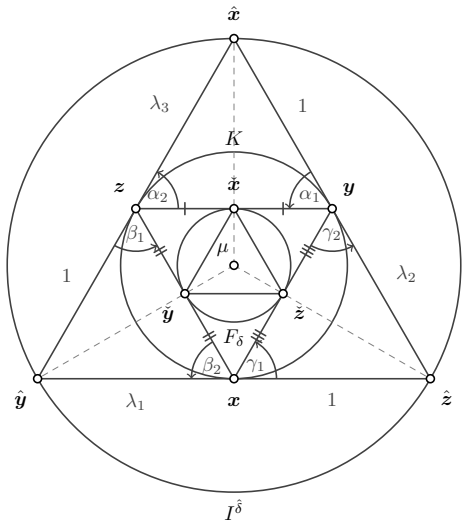
The paper's central discovery, in its own terms, is Theorem 3: let K be a $C^{2}$ convex body in the plane and let δ be a volume in (0, area(K)). If the body of flotation Fδ(K) is homothetic to the body of buoyancy Bδ(K), and if every chord of flotation cuts off from the boundary exactly one third of its total affine arc length, then K is an ellipse. Theorems 1 and 2 are the structural precursors: the same homothety assumption already forces the affine distance ∥c∥^3 between the endpoints of each chord of flotation to be constant, and forces the affine arc length of the boundary arc cut off by each chord to be constant. The proof identifies the homothety ratio with ∥c∥^3/(12δ), translates the comparison of second- and third-order differential invariants into the condition $sin^{3}$ α/κ(s) = $sin^{3}$ β/κ(t), and uses the one-third affine-arc-length condition to force the centroids of consecutive flotation triangles to coincide, giving a fixed homothety center. From there, a weak homothety theorem plus a classical affine-hypersphere characterization of ellipsoids yields the ellipse.
Load-bearing premise
The final ellipse conclusion rests on an unproved assertion that every quadric satisfies the key condition (4.7), which seeds the ODE uniqueness argument, and on several long computations including the fixed-centroid step μ′(s) = 0 that are presented without derivation; if any of these fails, the theorem is not established as written.
Editorial extensions
If this is right
- If a planar C^2 convex body has Fδ(K) homothetic to Bδ(K), then the affine distance between the endpoints of every chord of flotation is constant (Theorem 1).
- Under the same hypothesis, the affine arc length of the boundary arc cut off by every chord of flotation is constant (Theorem 2).
- If, in addition, every chord of flotation cuts off exactly one third of the total affine arc length, then K is an ellipse (Theorem 3).
- A flotation boundary is homothetic to the corresponding centroid curve exactly when ∥c∥^3 is constant, giving an affine counterpart of the classical constant chord-length results.
- Unless K is an ellipse, the values of δ for which the flotation and buoyancy boundaries are homothetic form a nowhere-dense subset of (0, area(K)) (Corollary 4.14).
Reading between the lines
- Beyond the paper: the same third-order invariant comparison could be iterated algorithmically, turning the remaining gap around condition (4.7) into a finite computer-algebra elimination problem.
- Beyond the paper: the one-third affine perimetral density suggests a family of carousel-type rigidity questions at densities 1/q; the paper notes that the geometry becomes less rigid, so a computational search for non-ellipse solutions at q = 4 is a natural test.
- Beyond the paper: Theorems 1 and 2 give a practical differential signature — constant ∥c∥^3 and constant affine arc length — that can be checked numerically on a sampled convex body before attempting any global rigidity argument.
- Beyond the paper: the polarity equivalence of Corollary 4.4 may connect the two-body homothety question to illumination- and intersection-body duality in higher dimensions, although the paper only develops it on the plane.
Signed reviews
Editorial analysis
A structured set of objections, weighed in public.
Referee Report
Summary. The paper studies, in the plane, the bodies of flotation, buoyancy, and illumination associated to a convex body K, using affine differential geometry. It derives systematic formulas for the boundaries and centroid curves of these bodies and records them in Tables 3.11 and 3.20. The main stated results are that if the body of flotation Fδ(K) is homothetic to the body of buoyancy Bδ(K), then the affine distance between endpoints of every chord of flotation is constant (Theorem 1) and the affine arc length cut off by every chord of flotation is constant (Theorem 2); moreover, if in addition every chord of flotation cuts off exactly one third of the total affine arc length of the boundary, then K is an ellipse (Theorem 3). The proof of the latter is implemented through Theorem 4.20, which uses a triangle argument in the spirit of Bracho, Montejano, and Oliveros to show that the centroid of a moving inscribed triangle is fixed, and then invokes Theorem 4.16 to conclude that K is an ellipse. The paper also gives affine counterparts of Zindler carousels and additional characterizations of ellipses, including Theorem 4.12 and Theorem 4.17.
Significance. If the computational claims are fully verified, the paper would provide a new affine-geometric result on the homothety conjecture for floating bodies, a problem that has been open in the plane and has recently received counterexamples for the original formulation. The systematic derivation of formulas for bodies of illumination appears to be new and is presented in a usable tabular form. The paper explicitly makes no use of fitted parameters or external numerical data, and the argument is self-contained up to classical results of Dupin, Blaschke, and Petty. The affine analogue of the Zindler carousel theorem is a natural and potentially influential contribution. However, several load-bearing algebraic and analytic steps are asserted rather than demonstrated, so the main theorems are not yet fully supported as written.
major comments (3)
- [§4.4, proof of Theorem 4.20] The proof's central step is the assertion that substituting (4.22) and (4.23) into the formula for μ′ = (x+y+z)′/3 yields 0. This is not a displayed computation or a separately stated lemma; it is the only place where the moving centroid μ becomes fixed. The fixed centroid is then used to conclude that Π̂δ(K) is homothetic to Πδ(K) with center μ and ratio 4, which is exactly the hypothesis needed to apply Theorem 4.16 and obtain that K is an ellipse. Since μ′ involves γ′(s), γ′(t)t′, and γ′(u)u′ with t and u coupled by the chord-of-flotation equations (3.4), the simplification is not a routine one-line identity. Please provide the complete computation or a dedicated lemma proving μ′(s)=0 under the stated hypotheses.
- [§3.4, Proposition 3.25] The proof of Proposition 3.25 is summarized as “a tedious but straightforward computation,” but this proposition is load-bearing for Theorem 4.16 and Theorem 4.17. Those theorems use the fact that the affine normal to the centroid curve is parallel to the affine bisector of the chord, and the displayed identity r2′′ = 8δ̄^{1/3}∥c∥³(r1−z) is the quantitative form of that fact. The line r1r3 is subsequently identified with the affine normal to Πδ(K), and this identification is essential for concluding that Πδ(K) is a proper affine hypersphere. The full computation, including the handling of the parametrization and of the case where the directions ẋ and ẏ are parallel, should be written out or replaced by a precise reference.
- [§4.2, proof of Theorem 4.12] The proof asserts without justification that “any quadric is known to satisfy the assumptions of Theorem 4.6” and that there is a unique quadric having second-order contact with γ at y and first-order contact with γ at x. The first assertion is a nontrivial global property of conics with respect to condition (4.7), and the second requires an explicit count of the degrees of freedom of a conic against the contact conditions. As written, the ODE uniqueness argument only proves that a solution equals some conic if such a conic is already known to exist. This theorem is advertised as a characterization of ellipses and is used for Corollary 4.14, so the missing justification should be supplied.
minor comments (4)
- [§4.4, Figure 4.21] The points x̂, ŷ, ẑ, ˇx, ˇy, ˇz, x, y, z are used before they are fully defined in the text; please introduce each of these points precisely before the proof of Theorem 4.20.
- [§4.2, proof of Theorem 4.6] The formulas for κ1′ and κ2′ in Table 3.11 are used to compare third-order invariants, but their derivation is not given in the body of the paper; a sentence indicating whether they follow from the same substitution used for κ1 and κ2 would help the reader verify (4.7).
- [§4.2, Theorem 4.12] The term “quadric” should be specified as a nondegenerate conic with positive definite quadratic part (an ellipse), since the convexity of K and the ODE argument require this interpretation.
- [§4.4, first paragraph] Please distinguish clearly between the Euclidean perimetral density used by Auerbach and by Bracho–Montejano–Oliveros and the affine perimetral density used in Theorem 4.20, since the two notions are not the same.
Circularity Check
No significant circularity: the derivation is self-contained and rests on external classical results, not on the conclusions being proved.
full rationale
The paper's central argument is a self-contained differential-geometric derivation. Theorems 4.2 and 4.6 derive the homothety and affine-arc-length conditions from previously established tangent and curvature formulas (3.5), (3.8), and Table 3.11, with no fitted parameter renamed as a prediction and no target conclusion built into the hypotheses. Theorem 4.20 obtains the key normalization lambda_1 = lambda_2 = lambda_3 = 1 by explicit sine-law, area, and condition (4.7) computations, then invokes classical external results such as Blaschke-Deicke (Theorem 2.5), Petty's classification, and Kurusa-Odor's characterization of balls by sections and caps; these are standard mathematical dependencies, and none of the cited works is by the present author, so no self-citation chain is load-bearing. The proof does contain acknowledged or unacknowledged computational gaps: in Theorem 4.20, the assertion that substituting (4.22) and (4.23) into the formula for mu' yields 0 is presented without derivation, and in Theorem 4.12 the claim that every quadric satisfies the hypotheses of Theorem 4.6 is not proved. These are missing justifications in the written argument and therefore correctness risks, not circular reductions of a conclusion to its own inputs. No circular step could be identified from the text.
Assumptions & free parameters
assumptions (6)
- domain assumption The boundary of K is of class C^2, and C^3 for the body of illumination.
- domain assumption The relevant envelopes, tangent intersections, and polar duals are non-degenerate, so denominators in equations (3.4), (3.15), and related formulas do not vanish.
- domain assumption Every quadric satisfies the hypotheses of Theorem 4.6.
- standard math Blaschke-Deicke theorem: a compact non-degenerate affine hypersphere is an ellipsoid.
- standard math Kurusa-Ódor theorem: an ellipsoidal floating body forces the original body to be an ellipsoid.
- standard math Petty's framework for the class F2, which characterizes ellipses via curvature functions.
Cite this review
Pith. "Pith review of On the homothety conjecture for the body of flotation and the body of buoyancy on a plane." pith.science (2026). https://pith.science/paper/EAF4BGYX
@misc{pith2026250711850,
  author       = {Pith},
  title        = {Pith review of: On the homothety conjecture for the body of flotation and the body of buoyancy on a plane},
  year         = {2026},
  howpublished = {\url{https://pith.science/paper/EAF4BGYX}},
  note         = {Machine review of arXiv:2507.11850}
}
abstract
We investigate several closely related "homothety conjectures" for convex bodies on a plane. Using the modern language of differential geometry, we systematically derive the fundamental properties of bodies of flotation, bodies of buoyancy, and bodies of illumination. As a direct consequence of our results, we show that if the body of flotation is homothetic to the body of buoyancy, and if every chord of flotation cuts off from the boundary exactly $\frac{1}{3}$ of its total affine arc length, then $K$ is an ellipse. We also provide natural affine counterparts of the classical theorems on the floating body problem from the Scottish Book due to H. Auerbach. In particular, we obtain an affine counterpart of Zindler carousels introduced by J. Bracho, L. Montejano, and D. Oliveros.
Figures


Figures from the paper (5 more)


Reference graph
Works this paper leans on
-
[1]
M. Angeles Alfonseca, F. Nazarov, D. Ryabogin, A. Stancu, and V. Yaskin, Two results on the homothety conjecture for convex bodies of flotation on the plane , Revista de la Uni´ on Matem´ atica Argentina (2025), accepted
work page 2025
-
[2]
Angeles Alfonseca, F
M. Angeles Alfonseca, F. Nazarov, D. Ryabogin, and V. Yaskin, Analysis and geometry near the unit ball: proofs, counterexamples, and open questions, Harmonic Analysis and Convexity (A. Koldobsky and A. Volberg, eds.), De Gruyter, Berlin, Boston, 2023, pp. 445–468
2023
-
[3]
M. Angeles Alfonseca, D. Ryabogin, A. Stancu, and V. Yaskin, On flotation, stability and related questions: a survey , submitted, 2024
work page 2024
-
[4]
Auerbach, Sur un probl´ eme de M
H. Auerbach, Sur un probl´ eme de M. Ulam concernant l’´ equilibre des corps flottants, Studia Mathematica 7 (1938), no. 1, 121–142 (French)
work page 1938
-
[5]
V. Balestro, H. Martini, and E. Shonoda, Concepts of curvatures in normed planes, Expositiones Mathematicae 37 (2019), no. 4, 347–381
work page 2019
-
[6]
I. B´ ar´ any and D.G. Larman,Convex bodies, economic cap coverings, random polytopes , Mathematika 35 (1988), no. 2, 274–291
work page 1988
-
[7]
C. Ben ´ ıtez and D. Y´ a˜ nez,Middle points and inner products , Bulletin of the London Mathematical Society 39 (2007), no. 5, 811–817
work page 2007
-
[8]
Blaschke, Kreis und Kugel , Veit & Comp., Leipzig, 1916 (German)
W. Blaschke, Kreis und Kugel , Veit & Comp., Leipzig, 1916 (German)
work page 1916
Show all 42 references
-
[9]
Bracho, L
J. Bracho, L. Montejano, and D. Oliveros, Carousels, Zindler curves and the floating body problem , Periodica Mathematica Hungarica 49 (2004), no. 2, 9–23
2004
-
[10]
Busemann and C.M
H. Busemann and C.M. Petty, Problems on convex bodies , Mathematica Scandinavica 4 (1956), 88–94
1956
-
[11]
do Carmo, Differential geometry of curves and surfaces , Dover Books on Mathematics, Dover Publications, 2016
M.P. do Carmo, Differential geometry of curves and surfaces , Dover Books on Mathematics, Dover Publications, 2016
2016
-
[12]
Dupin, Applications de g´ eom´ etrie de m´ ecanique, ´ a la marine, aux ponts et chauss´ ees, Bachelier, Successeur de Mme
C. Dupin, Applications de g´ eom´ etrie de m´ ecanique, ´ a la marine, aux ponts et chauss´ ees, Bachelier, Successeur de Mme. Ve. Courcier, Paris, 1822 (French)
-
[13]
Gardner, Geometric tomography, 2 ed., Encyclopedia of Mathematics and its Applications, Cambridge University Press, 2006
R.J. Gardner, Geometric tomography, 2 ed., Encyclopedia of Mathematics and its Applications, Cambridge University Press, 2006
2006
-
[14]
Huang, B.A
H. Huang, B.A. Slomka, and E.M. Werner, Ulam floating bodies, Journal of the London Mathematical Society 100 (2019), no. 2, 425–446
2019
-
[15]
Kurusa and T
A. Kurusa and T. ´Odor, Characterizations of balls by sections and caps , Beitr¨ age zur Algebra und Geometrie56 (2015), no. 2, 459–471
2015
-
[16]
de La Vall´ ee Poussin,Le¸ cons de m´ ecanique analytique, vol
C.-J. de La Vall´ ee Poussin,Le¸ cons de m´ ecanique analytique, vol. 2, Gauthier-Villars, Paris, 1925 (French)
1925
-
[17]
Meyer and S
M. Meyer and S. Reisner, Characterizations of ellipsoids by section-centroid location , Geometriae Dedicata 31 (1989), no. 3, 345–355
1989
- [18]
-
[19]
Mordhorst and E.M
O. Mordhorst and E.M. Werner, Duality of floating and illumination bodies , Indiana University Mathematics Journal 69 (2020), no. 5, 1507–1541
2020
-
[20]
Myroshnychenko, D
S. Myroshnychenko, D. Ryabogin, and C. Saroglou, Star bodies with completely symmetric sections , International Mathe- matics Research Notices 2019 (2017), no. 10, 3015–3031
2017
-
[21]
S. Nagy, C. Sch¨ utt, and E.M. Werner,Halfspace depth and floating body , Statistics Surveys 13 (2019), 52–118
2019
-
[22]
Nomizu, N
K. Nomizu, N. Katsumi, and T. Sasaki, Affine differential geometry: Geometry of affine immersions , Cambridge Tracts in Mathematics, Cambridge University Press, 1994
1994
-
[23]
S.P. Olovyanishnikov, Ob odnoy kharakteristike ellipsoida [On a certain characterization of an ellipsoid ], Uchenyye Za- piski Leningradskogo Gosudarstvennogo Universiteta [Proceedings of the Leningrad State University] 83 (1941), 114–128 (Russian)
1941
-
[24]
Olver, Classical invariant theory , London Mathematical Society Student Texts, Cambridge University Press, 1999
P.J. Olver, Classical invariant theory , London Mathematical Society Student Texts, Cambridge University Press, 1999
1999
-
[25]
Petty, Centroid surfaces, Pacific Journal of Mathematics 11 (1961), no
C.M. Petty, Centroid surfaces, Pacific Journal of Mathematics 11 (1961), no. 4, 1535–1547
1961
-
[26]
1, 113–127
, Affine isoperimetric problems , Annals of the New York Academy of Sciences 440 (1985), no. 1, 113–127
1985
-
[27]
Prochno, C
J. Prochno, C. Sch¨ utt, and E.M. Werner, Best and random approximation of a convex body by a polytope , Journal of Complexity 71 (2022), 101652
2022
-
[28]
Radon, ¨Uber eine besondere Art ebener Kurven , Berichte ¨ uber die Verhandlungen der S¨ achsischen Gesellschaft der Wissenschaften zu Leipzig
J. Radon, ¨Uber eine besondere Art ebener Kurven , Berichte ¨ uber die Verhandlungen der S¨ achsischen Gesellschaft der Wissenschaften zu Leipzig. Mathematisch-Physische Klasse 68 (1916), 131–134 (German)
1916
-
[29]
Ryabogin, A negative answer to Ulam’s Problem 19 from the Scottish Book , Annals of Mathematics 195 (2022), no
D. Ryabogin, A negative answer to Ulam’s Problem 19 from the Scottish Book , Annals of Mathematics 195 (2022), no. 3, 1111–1150
2022
-
[30]
, On bodies floating in equilibrium in every orientation , Geometriae Dedicata 217 (2023), no. 4, 70
2023
-
[31]
Schneider, Convex bodies: The Brunn-Minkowski theory , 2 ed., Encyclopedia of Mathematics and its Applications, Cambridge University Press, 2013
R. Schneider, Convex bodies: The Brunn-Minkowski theory , 2 ed., Encyclopedia of Mathematics and its Applications, Cambridge University Press, 2013
2013
-
[32]
Sch¨ utt and E.M
C. Sch¨ utt and E.M. Werner,The convex floating body , Mathematica Scandinavica 66 (1990), no. 2, 275–290
1990
-
[33]
3, 335–348
, Homothetic floating bodies, Geometriae Dedicata 49 (1994), no. 3, 335–348
1994
-
[34]
Stancu, The floating body problem , The Bulletin of the London Mathematical Society 38 (2006), no
A. Stancu, The floating body problem , The Bulletin of the London Mathematical Society 38 (2006), no. 5, 839–846
2006
-
[35]
3, 464– 472
, Two volume product inequalities and their applications , Canadian Mathematical Bulletin 52 (2009), no. 3, 464– 472
2009
-
[36]
Su, Affine differential geometry , Science Press, Beijing, 1983
B. Su, Affine differential geometry , Science Press, Beijing, 1983
1983
-
[37]
Ulam, The Scottish Book , U.S
S.M. Ulam, The Scottish Book , U.S. Government Printing Office, Los Alamos, 1977
1977
-
[38]
Weatherburn, Differential geometry of three dimensions , vol
C.E. Weatherburn, Differential geometry of three dimensions , vol. 1, Cambridge University Press, 1955
1955
-
[39]
Werner, Floating bodies and illumination bodies , Integral Geometry And Convexity: Proceedings of the International Conference (Wuhan, China), World Scientific, 2006, pp
E. Werner, Floating bodies and illumination bodies , Integral Geometry And Convexity: Proceedings of the International Conference (Wuhan, China), World Scientific, 2006, pp. 129–140
2006
-
[40]
Werner, Illumination bodies and affine surface area , Studia Mathematica 110 (1994), no
E.M. Werner, Illumination bodies and affine surface area , Studia Mathematica 110 (1994), no. 3, 257–269
1994
-
[41]
Werner and D
E.M. Werner and D. Ye, On the homothety conjecture , Indiana University Mathematics Journal 60 (2011), no. 1, 1–20
2011
-
[42]
Zhukovskiy, P.A
N.Ye. Zhukovskiy, P.A. Nekrasov, and P.M. Pokrovskiy,Zhizn ’ i trudy A.Yu. Davidova [Life and works of A.Yu. Davidov ], Matematicheskiy Sbornik [Mathematical Collection] 15 (1890), no. 1, 1–57 (Russian). (B. Zawalski) Kent State University, Kent, OH, USA Email address : bzawal...
Reviewed August 6, 2026 · model on record in the stance chip above.
Discussion (0). Continue with ORCID to comment.