REVIEW 2 major objections 4 minor 47 references
Partitioning and Observability in Linear Systems via Submodular Optimization
T0 review · 2 major / 4 minor · reviewed 2026-08-07 · deepseek-v4-flash
Pith's one-line read Observability-driven partitioning of linear systems is a submodular maximization problem, solvable with a $(1-1/e)$ guarantee.
desk verdict The new submodular partitioning formulation is worth engaging, but Theorem 2's logdet bound is false as stated and the paper needs major revision before it is citable. read the letter →
The pith
A machine-rendered reading of the paper's core claim, the machinery that carries it, and where it could break.
The reading
What carries the argument
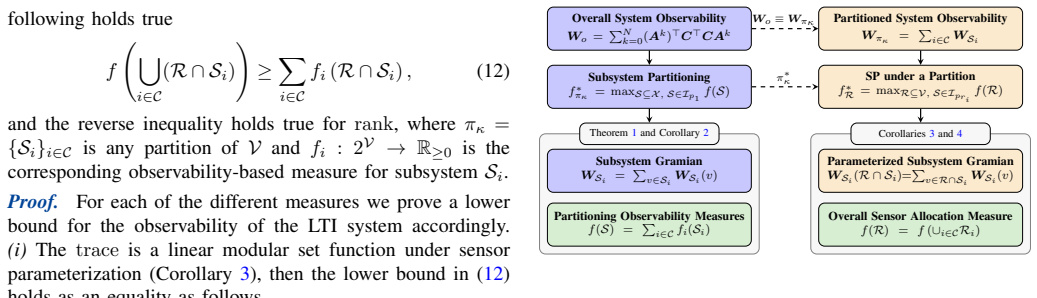
The machinery is the reduction of partitioning to submodular maximization under a partition matroid, carried by two objects. First, the subsystem observability Gramian $W_{S_i}$ is a sum of per-state Gramian contributions, making it a modular set function; sums of submodular functions remain submodular, so the logdet and rank metrics over $\kappa$ subsystems inherit submodularity and monotonicity. Second, the multilinear extension of the objective allows the continuous greedy algorithm to operate on fractional assignments, with pipage rounding (or independent randomized rounding for the simple partition matroid) recovering a discrete partition while preserving the $(1-1/e)$ approximation guarantee. The bound that connects local and global observability is the statement that $\log\det(\sum_i W_{S_i}(R_i)) \ge \sum_i \log\det(W_{S_i}(R_i))$, which the paper derives from the Minkowski determinant inequality together with Jensen's inequality.
What would settle it
Evaluate the claimed bound directly on two positive definite matrices, say $W_1=W_2=\mathrm{diag}(10,10)$. Then $\log\det(W_1+W_2)=\log(20\cdot20)\approx 5.99$ while $\log\det(W_1)+\log\det(W_2)=2\log(10\cdot10)\approx 9.21$, so the inequality stated in Theorem 2 fails for this pair; a defender of the theorem would need to show that subsystem Gramians cannot realize such a configuration.
Extended reading notes
Core claim
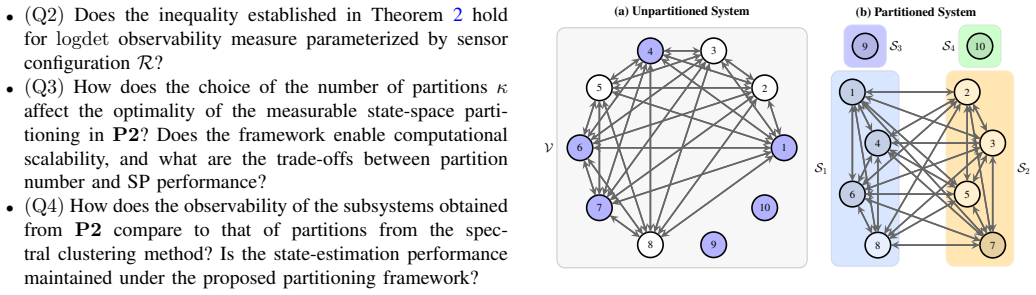
On the paper's own terms, the central discovery is that the partition problem and the sensor-placement problem over partitions are both submodular maximization problems. The measurable-state set $V$ is copied once per subsystem to form the ground set $X=\mathcal{C}\times V$, and the constraint $|S\cap(\mathcal{C}\times\{v\})|\le 1$ for each state $v$ says each state is claimed by at most one subsystem. The objective $f(S)=\sum_{i\in\mathcal{C}} f_i(\{v\in V:(i,v)\in S\})$ sums the observability measures of the subsystems, each built from the Gramian $W_{S_i}=\sum_{v\in S_i}\sum_{k=0}^{N-1}(A^k)^\top c_v^\top c_v A^k$. Because this Gramian is modular as a set function, the trace metric is modular while the rank and logdet metrics are monotone submodular, so continuous greedy with the multilinear extension gives a $(1-1/e)$ guarantee for the partition. For sensor placement, the paper's Theorem 2 states that for the trace and logdet metrics, the global observability of the partitioned network is at least the sum of the subsystem observabilities under the same sensor set, and the numerical experiments find that the optimal sensor configuration for the partitioned network coincides with the unpartitioned optimum while taking less computation time.
Load-bearing premise
The load-bearing premise is the determinantal inequality used in Theorem 2, namely that $\log\det(\sum_i W_i)\ge\sum_i\log\det(W_i)$ for the positive semidefinite subsystem Gramians; the proof derives this from Minkowski's determinant inequality and Jensen's inequality, and the bound collapses if that derivation is not valid.
Editorial extensions
If this is right
- The partition problem P1 becomes solvable in polynomial time: continuous greedy under the partition matroid achieves the $(1-1/e)$ guarantee, and pipage rounding returns a feasible partition.
- Sensor placement over the partitioned network inherits the same submodularity, so greedy sensor selection with per-subsystem quotas carries a provable approximation factor.
- For the trace and logdet metrics, the global observability measure evaluated at any sensor configuration is at least the sum of the subsystem observability measures at that same configuration; for the rank metric the inequality reverses.
- On the tested combustion networks, the optimal sensor configuration obtained after partitioning matches the unpartitioned optimum, so partitioning need not sacrifice observability while cutting sensor-placement computation time.
- The results provide a principled way to choose the number of partitions $\kappa$: the optimal $\kappa$ balances subsystem observability against inter-subsystem connections, with $\kappa=5$ best on the GRI30 network.
Reading between the lines
- By duality, the same submodular machinery should reformulate actuator placement under controllability Gramians; the paper notes this in passing but does not develop it, so a natural extension is to run the identical pipeline on the dual system.
- A subtlety left implicit is that the partition matroid in P2 only prevents a state from being claimed twice and does not by itself force every state to be claimed, so degenerate cases with zero marginal gains could return a partial partition unless full coverage is separately enforced.
- The bound in Theorem 2, if valid, implies that the gap between global and local sensor objectives grows with the disparity in subsystem Gramian scales; this is testable by running P3 on networks with deliberately heterogeneous subsystem sizes.
- The continuous greedy algorithm for the simple partition matroid can use independent randomized rounding instead of pipage rounding, so the method is amenable to parallelization across subsystems for very large networks.
Editorial analysis
A structured set of objections, weighed in public.
Referee Report
Summary. The paper studies the problem of partitioning a linear time-invariant system into κ disjoint subsystems while maximizing observability-based metrics (trace, rank, logdet) of the subsystem dynamics, and then solving sensor placement over the partitioned system. The authors formulate the partitioning problem as a submodular maximization under a partition matroid (P2), claim equivalence with the original partition problem (P1), prove submodularity of the observability measures, and derive a comparison bound between the global observability of the partitioned system and the sum of subsystem observabilities. Numerical experiments on two combustion reaction networks are used to validate the approach and the theoretical bounds.
Significance. The problem is practically relevant, and the use of submodular optimization with matroid constraints is a suitable framework; the numerical studies are clearly described and show computational savings for sensor placement on partitioned networks. However, the validity of the paper's central theoretical claims is not established. In particular, Theorem 2, which is presented as a key contribution and is cited as being validated by the experiments, is false, and Lemma 1's asserted equivalence between P1 and P2 is not correctly proven. These are load-bearing issues because the abstract, the concluding remarks, and the experimental discussion all rely on these results. The submodular reformulation may still be salvageable, but the current manuscript's headline claims are unsupported.
major comments (2)
- [Section V-B, Eq. (12)] The lower bound in Theorem 2 for the logdet metric is false as stated. In the proof, after defining α_i = r_i/r, Jensen's inequality is applied with coefficients 1/α_i whose sum is κ, not 1, so that step is invalid. More decisively, the claimed inequality logdet(Σ_i W_i) ≥ Σ_i logdet(W_i) fails for PSD matrices: for W_1 = W_2 = 10 I_2, the left-hand side equals 2 ln 20 ≈ 5.99 while the right-hand side equals 4 ln 10 ≈ 9.21. This false theorem is invoked in the abstract, in Section VII (Table III), and in the concluding remarks, so the central claim that the partitioned system's observability is bounded below by the sum of subsystem observabilities is unsupported.
- [Section III, Lemma 1] The claimed equivalence between P1 and P2 is not correct as proven. The partition matroid constraint (4b) only enforces |S ∩ (C × {v})| ≤ 1, i.e., each state is assigned to at most one subsystem; it does not require every state to be assigned to some subsystem. In the proof, the sentence 'since v ∈ V is allocated to at least one partition then ∪_i S_i = V' is asserted without justification. Consequently, P2 is a relaxation of P1, and the feasible solution spaces are not bijective. While monotonicity of the objective may imply that an optimal P2 solution covers all of V, the lemma as stated is false and must be reformulated or proved with an explicit coverage argument.
minor comments (4)
- [Section V-B] The notation f(∪_{i∈C} W_{S_i}(R_i)) uses a union symbol for matrices; the intended operation is the sum, as used in the proof and in Table I.
- [Section V-B, Corollary 4] The submodularity proof for logdet is deferred with 'For brevity, we do not show the matrix derivative'; since Corollary 4 underlies the greedy guarantees for P3, the omitted derivative should be supplied or a complete reference given.
- [Section VII-B] The phrase 'Section IV .B' is malformed; it should read 'Section IV-B' or 'Section IV.B'.
- [Section VI] The complexity statements O(|X|^7) and O(|X|^2) are quoted without specifying the exact algorithm variant or the oracle cost model; please clarify.
Circularity Check
No significant circularity: the derivation chain uses external submodular-optimization results and standard linear algebra, with no self-citation or fit-renamed-as-prediction; the main theoretical weaknesses are mathematical errors, not circular reasoning.
full rationale
The paper's central claims are not circular. The submodular formulation P2, the continuous-greedy (1-1/e) guarantee, and the submodularity lemmas are supported by in-paper arguments combined with external, independently established results ([28], [29], [32], [33]), not by the authors' own prior uniqueness theorems or fitted parameters. The partitioned-versus-unpartitioned sensor-placement comparisons in Section VII are computed independently (including a brute-force check of the unpartitioned optimum) and are not obtained by renaming an input as a prediction. The Gramian decomposition in Proposition 1 and Corollary 1 is a valid algebraic identity following from disjoint coverage of the state set, not a self-definitional reduction. What the reader's take identifies are genuine mathematical flaws: Lemma 1's equivalence claim is weakened because the P2 matroid constraint only enforces 'at most one' assignment and does not itself force full coverage of V, and Theorem 2's logdet lower bound rests on an invalid Jensen step with non-unit weights and is false for equal PSD matrices. These are correctness risks, not circularity patterns: no quantity is fitted then predicted, no result is imported solely from a self-citation, and no conclusion is identical to its premises by construction. Accordingly, the circularity score is 0.
Assumptions & free parameters
free parameters (4)
- Number of partitions κ =
3-6 in GRI30 case study
- Number of sensors r =
10, 16, 23 in case study
- Observation horizon N =
1000
- Discretization step Δt =
1e-12
assumptions (6)
- standard math Finite-horizon observability Gramian decomposes as a sum of per-state terms W_v = Σ_k (A^k)^T c_v^T c_v A^k.
- standard math A nonnegative weighted sum of submodular functions is submodular.
- standard math rank and logdet of observability Gramians are monotone submodular set functions under addition of measurement rows.
- domain assumption Every state in V can be sensed by a to-be-placed sensor, and C rows correspond one-to-one with measurable states.
- domain assumption Every state in V is allocated to exactly one subsystem in the P2 reformulation.
- ad hoc to paper Minkowski determinant inequality and Jensen's inequality combine to give logdet(Σ_i W_i) ≥ Σ_i logdet(W_i).
Cite this review
Pith. "Pith review of Partitioning and Observability in Linear Systems via Submodular Optimization." pith.science (2026). https://pith.science/paper/ECNMMOU6
@misc{pith2026250516169,
  author       = {Pith},
  title        = {Pith review of: Partitioning and Observability in Linear Systems via Submodular Optimization},
  year         = {2026},
  howpublished = {\url{https://pith.science/paper/ECNMMOU6}},
  note         = {Machine review of arXiv:2505.16169}
}
read the original abstract
Network partitioning has gained recent attention as a pathway to enable decentralized operation and control in large-scale systems. This paper addresses the interplay between partitioning, observability, and sensor placement (SP) in dynamic networks. The problem, being computationally intractable at scale, is a largely unexplored, open problem in the literature. To that end, the paper's objective is designing scalable partitioning of linear systems while maximizing observability metrics of the subsystems. We show that the partitioning problem can be posed as a submodular maximization problem -- and the SP problem can subsequently be solved over the partitioned network. Consequently, theoretical bounds are derived to compare observability metrics of the original network with those of the resulting partitions, highlighting the impact of partitioning on system observability. Case studies on networks of varying sizes corroborate the derived theoretical bounds.
Figures


Figures from the paper (7 more)




Reference graph
Works this paper leans on
-
[1]
Detection of Covert Cyber-Attacks in Interconnected Systems: A Distributed Model-Based Approach,
A. Barboni, H. Rezaee, F. Boem, and T. Parisini, “Detection of Covert Cyber-Attacks in Interconnected Systems: A Distributed Model-Based Approach,”IEEE Transactions on Automatic Control, vol. 65, no. 9, pp. 3728–3741, 2020
work page 2020
-
[2]
Complex networks: Structure and dynamics,
S. Boccaletti, V . Latora, Y . Moreno, M. Chavez, and D. U. Hwang, “Complex networks: Structure and dynamics,”Physics Reports, vol. 424, no. 4-5, pp. 175–308, 2006
work page 2006
-
[3]
Sensor selection via convex optimization,
S. Joshi and S. Boyd, “Sensor selection via convex optimization,”IEEE Transactions on Signal Processing, vol. 57, no. 2, pp. 451–462, 2009
work page 2009
-
[4]
On Submodularity and Controllability in Complex Dynamical Networks,
T. H. Summers, F. L. Cortesi, and J. Lygeros, “On Submodularity and Controllability in Complex Dynamical Networks,”IEEE Transactions on Control of Network Systems, vol. 3, no. 1, pp. 91–101, mar 2016
work page 2016
-
[5]
Near-optimal sensor scheduling for batch state estimation: Complexity, algorithms, and limits,
V . Tzoumas, A. Jadbabaie, and G. J. Pappas, “Near-optimal sensor scheduling for batch state estimation: Complexity, algorithms, and limits,”2016 IEEE 55th Conference on Decision and Control, CDC 2016, no. Cdc, pp. 2695–2702, 2016
work page 2016
-
[6]
Performance guarantees for greedy maximization of non-submodular controllability metrics,
T. Summers and M. Kamgarpour, “Performance guarantees for greedy maximization of non-submodular controllability metrics,”2019 18th European Control Conference, ECC 2019, pp. 2796–2801, 2019
work page 2019
-
[7]
Sensor Assignment Algorithms to Improve Observability while Tracking Targets,
L. Zhou and P. Tokekar, “Sensor Assignment Algorithms to Improve Observability while Tracking Targets,”IEEE Transactions on Robotics, vol. 35, no. 5, pp. 1206–1219, 2019
work page 2019
-
[8]
Sensor Selection for Dynamics-Driven User-Interface Design,
A. P. Vinod, A. J. Thorpe, P. A. Olaniyi, T. H. Summers, and M. M. K. Oishi, “Sensor Selection for Dynamics-Driven User-Interface Design,” IEEE Transactions on Control Systems Technology, vol. 30, no. 1, pp. 71–84, 2022
work page 2022
Show all 47 references
-
[9]
Actuator Placement under Structural Controllability Using Forward and Reverse Greedy Algorithms,
B. Guo, O. Karaca, T. Summers, and M. Kamgarpour, “Actuator Placement under Structural Controllability Using Forward and Reverse Greedy Algorithms,”IEEE Transactions on Automatic Control, vol. 66, no. 12, pp. 5845–5860, 2021
2021
-
[10]
Data-Driven Partitioning of Power Networks Via Koopman Mode Analysis,
F. Raak, Y . Susuki, and T. Hikihara, “Data-Driven Partitioning of Power Networks Via Koopman Mode Analysis,”IEEE Transactions on Power Systems, vol. 31, no. 4, pp. 2799–2808, 2016
2016
-
[11]
Characterizing controllable subspace and herdability of signed weighted networks via graph partition,
B. She and Z. Kan, “Characterizing controllable subspace and herdability of signed weighted networks via graph partition,”Automatica, vol. 115, p. 108900, 2020
2020
-
[12]
Model reduction and clusterization of large-scale bidirectional networks,
T. Ishizaki, K. Kashima, J. I. Imura, and K. Aihara, “Model reduction and clusterization of large-scale bidirectional networks,”IEEE Transac- tions on Automatic Control, vol. 59, no. 1, pp. 48–63, 2014
2014
-
[13]
Event-triggered partitioning for non-centralized predictive-control-based economic dispatch of intercon- nected microgrids,
W. Ananduta and C. Ocampo-Martinez, “Event-triggered partitioning for non-centralized predictive-control-based economic dispatch of intercon- nected microgrids,”Automatica, vol. 132, p. 109829, 2021
2021
-
[14]
Cluster partitioning of heterogeneous multi-agent systems,
M. Mattioni and S. Monaco, “Cluster partitioning of heterogeneous multi-agent systems,”Automatica, vol. 138, p. 110136, 2022
2022
-
[15]
A survey on clustering methods for distributed and networked control systems,
P. Chanfreut, J. M. Maestre, and E. F. Camacho, “A survey on clustering methods for distributed and networked control systems,”Annual Reviews in Control, vol. 52, pp. 75–90, 2021
2021
-
[16]
A Submodular Approach to Controlled Is- landing for Multi-Agent Network Stability,
S. Cheng and A. Clark, “A Submodular Approach to Controlled Is- landing for Multi-Agent Network Stability,”2024 American Control Conference (ACC), pp. 2405–2411, 2024
2024
-
[17]
On the herdability of linear time- invariant systems with special topological structures,
G. De Pasquale and M. E. Valcher, “On the herdability of linear time- invariant systems with special topological structures,”Automatica, vol. 149, p. 110804, 2023
2023
-
[18]
Subspace Identification of Individual Systems Operating in a Network (SI2ON),
C. Yu and M. Verhaegen, “Subspace Identification of Individual Systems Operating in a Network (SI2ON),”IEEE Transactions on Automatic Control, vol. 63, no. 4, pp. 1120–1125, 2018
2018
-
[19]
Subspace identification of individual systems in a large-scale heterogeneous network,
C. Yu, J. Chen, and M. Verhaegen, “Subspace identification of individual systems in a large-scale heterogeneous network,”Automatica, vol. 109, p. 108517, 2019
2019
-
[20]
Optimization-based network partitioning for distributed and decentralized control,
A. Arastou, Y . Wang, and E. Weyer, “Optimization-based network partitioning for distributed and decentralized control,”Journal of Process Control, vol. 146, no. December 2024, p. 103357, 2025
2024
-
[21]
Partitioning techniques for non-centralized predictive control: A systematic review and novel theoretical insights,
A. Riccardi, L. Laurenti, and B. De Schutter, “Partitioning techniques for non-centralized predictive control: A systematic review and novel theoretical insights,” 2025. [Online]. Available: http://arxiv.org/abs/ 2509.11470
2025
-
[22]
Decomposition of control and optimization problems by network structure: Concepts, methods, and inspirations from biology,
P. Daoutidis, W. Tang, and A. Allman, “Decomposition of control and optimization problems by network structure: Concepts, methods, and inspirations from biology,”AIChE Journal, vol. 65, no. 10, 2019
2019
-
[23]
Clustering-based average state observer design for large-scale network systems,
M. U. B. Niazi, X. Cheng, C. Canudas-de Wit, and J. M. Scherpen, “Clustering-based average state observer design for large-scale network systems,”Automatica, vol. 151, p. 110914, 2023
2023
-
[24]
Distributed Submodular Maximization on Partition Matroids for Planning on Large Sensor Networks,
M. Corah and N. Michael, “Distributed Submodular Maximization on Partition Matroids for Planning on Large Sensor Networks,”Proceedings of the IEEE Conference on Decision and Control, vol. 2018-Decem, no. Cdc, pp. 6792–6799, 2018
2018
-
[25]
Partitioning of relative sensing networks: A stability margin perspective,
V . Hamdipoor and Y . Kim, “Partitioning of relative sensing networks: A stability margin perspective,”Automatica, vol. 106, pp. 294–300, 2019
2019
-
[26]
Distributed Strategy Selection: A Sub- modular Set Function Maximization Approach,
N. Rezazadeh and S. S. Kia, “Distributed Strategy Selection: A Sub- modular Set Function Maximization Approach,”Automatica, vol. 153, p. 111000, 2021
2021
-
[27]
Detecting Directional Coupling in Network Dynamical Systems via Kalman’s Observability,
R. Succar and M. Porfiri, “Detecting Directional Coupling in Network Dynamical Systems via Kalman’s Observability,”Physical Review Let- ters, vol. 134, no. 7, p. 77401, 2025. 16
2025
-
[28]
Convex Analysis and Optimization with Submodular Functions: a Tutorial,
F. Bach, “Convex Analysis and Optimization with Submodular Functions: a Tutorial,” 2010. [Online]. Available: http://arxiv.org/abs/ 1010.4207
2010 arXiv
-
[29]
Submodularity In Machine Learning and Artificial Intelligence,
J. Bilmes, “Submodularity In Machine Learning and Artificial Intelligence,” 2022. [Online]. Available: http://arxiv.org/abs/2202.00132
2022 arXiv
-
[30]
Fujishige,Submodular Functions and Optimization Second Edition, second edition ed., 2005, vol
S. Fujishige,Submodular Functions and Optimization Second Edition, second edition ed., 2005, vol. 58
2005
-
[31]
Constrained Robust Submodular Partitioning,
S. Wang, T. Zhou, C. Lavania, and J. A. Bilmes, “Constrained Robust Submodular Partitioning,”Advances in Neural Information Processing Systems, vol. 4, no. NeurIPS, pp. 2721–2732, 2021
2021
-
[32]
Maximizing a Monotone Submodular Function Subject to a Matroid Constraint,
G. Calinescu, C. Chekuri, M. P ´al, and J. V ondr ´ak, “Maximizing a Monotone Submodular Function Subject to a Matroid Constraint,”SIAM Journal on Computing, vol. 40, no. 6, pp. 1740–1766, jan 2011
2011
-
[33]
Optimal approximation for the Submodular Welfare Prob- lem in the value oracle model,
J. V ondr ´ak, “Optimal approximation for the Submodular Welfare Prob- lem in the value oracle model,”Proceedings of the Annual ACM Symposium on Theory of Computing, pp. 67–74, 2008
2008
-
[34]
Controllability Scores for Selecting Control Nodes of Large-Scale Network Systems,
K. Sato and S. Terasaki, “Controllability Scores for Selecting Control Nodes of Large-Scale Network Systems,”IEEE Transactions on Auto- matic Control, vol. 69, no. 7, pp. 4673–4680, jul 2024
2024
-
[35]
Controllability metrics, limitations and algorithms for complex networks,
F. Pasqualetti, S. Zampieri, and F. Bullo, “Controllability metrics, limitations and algorithms for complex networks,”IEEE Transactions on Control of Network Systems, vol. 1, no. 1, pp. 40–52, 2014
2014
-
[36]
R. A. Horn and C. R. Johnson,Matrix Analysis. Cambridge University Press, dec 1985
1985
-
[37]
C. P. Niculescu and L.-E. Persson,Convex Functions and Their Applications, ser. CMS Books in Mathematics. New York, NY: Springer New York, 2006. [Online]. Available: http://link.springer.com/ 10.1007/0-387-31077-0
2006 doi
-
[38]
Submodular maximization via gradient ascent: The case of deep submodular functions,
W. Bai, W. S. Noble, and J. A. Bilmes, “Submodular maximization via gradient ascent: The case of deep submodular functions,”Advances in Neural Information Processing Systems, vol. 2018-Decem, no. NeurIPS, pp. 7978–7988, 2018
2018
-
[39]
Pipage rounding: A new method of constructing algorithms with proven performance guarantee,
A. A. Ageev and M. I. Sviridenko, “Pipage rounding: A new method of constructing algorithms with proven performance guarantee,”Journal of Combinatorial Optimization, vol. 8, no. 3, pp. 307–328, 2004
2004
-
[40]
Monotone closure of relaxed con- straints in submodular optimization: Connections between minimization and maximization,
R. Iyer, S. Jegelka, and J. Bilmes, “Monotone closure of relaxed con- straints in submodular optimization: Connections between minimization and maximization,”Uncertainty in Artificial Intelligence - Proceedings of the 30th Conference, UAI 2014, pp. 360–369, 2014
2014
-
[41]
Submodular maximization via taylor series approximation,
G. ¨Ozcan, A. Moharrer, and S. Ioannidis, “Submodular maximization via taylor series approximation,”SIAM International Conference on Data Mining, SDM 2021, pp. 423–431, 2021
2021
-
[42]
Modeling and simulation of hydrogen combustion in engines,
N. N. Smirnov and V . F. Nikitin, “Modeling and simulation of hydrogen combustion in engines,”International Journal of Hydrogen Energy, vol. 39, no. 2, pp. 1122–1136, 2014
2014
-
[43]
Cantera: An object- oriented software toolkit for chemical kinetics, thermodynamics, and transport processes,
D. G. Goodwin, H. K. Moffat, and R. L. Speth, “Cantera: An object- oriented software toolkit for chemical kinetics, thermodynamics, and transport processes,” http://www.cantera.org
-
[44]
Generalized Submod- ular Information Measures: Theoretical Properties, Examples, Optimiza- tion Algorithms, and Applications,
R. Iyer, N. Khargonkar, J. Bilmes, and H. Asnani, “Generalized Submod- ular Information Measures: Theoretical Properties, Examples, Optimiza- tion Algorithms, and Applications,”IEEE Transactions on Information Theory, vol. 68, no. 2, pp. 752–781, 2022
2022
-
[45]
Finding and evaluating community structure in networks,
M. E. Newman and M. Girvan, “Finding and evaluating community structure in networks,”Physical Review E - Statistical, Nonlinear, and Soft Matter Physics, vol. 69, no. 2 2, pp. 1–15, 2004
2004
-
[46]
On spectral clustering: Analysis and an algorithm,
A. Ng, M. Jordan, and Y . Weiss, “On spectral clustering: Analysis and an algorithm,” inAdvances in Neural Information Processing Systems, T. Dietterich, S. Becker, and Z. Ghahramani, Eds., vol. 14. MIT Press, 2001
2001
-
[47]
A new approach to linear filtering and prediction problems,
R. E. Kalman, “A new approach to linear filtering and prediction problems,”Journal of Fluids Engineering, Transactions of the ASME, vol. 82, no. 1, pp. 35–45, 1960. 17
1960
Reviewed August 7, 2026 · model on record in the stance chip above.
Discussion (0). Continue with ORCID to comment.