REVIEW 2 major objections 4 minor 28 references
Cobordism of nested manifolds
T0 review · 2 major / 4 minor · reviewed 2026-08-03 · deepseek-v4-flash
Pith's one-line read This paper proves that when the highest-dimensional submanifold of a nested manifold has a normal bundle with a framed direction, nested cobordism classes are in bijection with cobordism classes of links, so link invariants apply to nested
desk verdict Nice new bridge between nested cobordism and link cobordism, but the proof of the main theorem skips a load-bearing coherence check that needs to be written out. read the letter →
The pith
A machine-rendered reading of the paper's core claim, the machinery that carries it, and where it could break.
The reading
What carries the argument
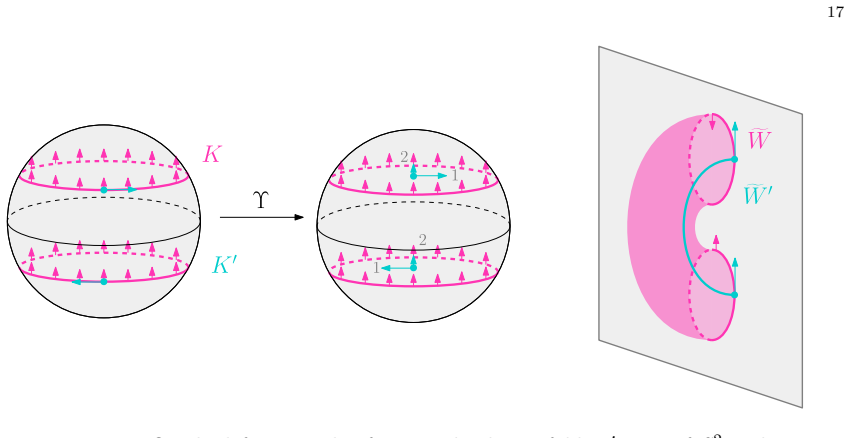
The unnesting map Υ sends a nested submanifold K′ ⊆ K to the disjoint union K ⊔ K′, displacing K′ off K using the framed normal direction of K. Its bijectivity is proven via the homotopy equivalence (5) between the nested Thom space Th(θ′∗γ^{d′})₊ ∧ Th(θ∗γ^d) and the link Thom space Th((θ′×θ)∗γ^{d+d′}) ∨ Th(θ∗γ^d); the equivalence is built from Lemma 3.10, which identifies Σ(X₊) with ΣX ∨ S¹, together with distributivity of smash products over wedges. The key step is showing that the projection to Th(θ∗γ^d) in the nested space corresponds to the collapse map in the link space, making the Pontryagin–Thom correspondence commute.
What would settle it
Compute the two possible unnested links for the nested S⁰ ⊆ S¹ ⊆ S² with unoriented normal structures described in Example 3.16: if the two unnestings are actually link-cobordant, the unnesting map might still be well-defined in general; if they are not, then no such bijection exists without a framed direction. For the framed case, explicitly track a representative class through both sides of the homotopy equivalence (5) and check whether the projection and collapse maps agree on a low-dimensional example such as the Figure 4 nested pair; a homotopy commuting diagram would confirm the key step
Extended reading notes
Core claim
Theorem 3.9: for a θ-structure that factors over BO(d−1), i.e. when the normal bundle of the highest-dimensional submanifold has a framed direction, the unnesting map Υ from the set of (θ′, θ)-nested cobordism classes to the set of (θ′×θ, θ)-link cobordism classes is bijective. At the space level, the bijection is carried by the homotopy equivalence Th(θ′∗γ^{d′})₊ ∧ Th(θ∗γ^d) ≃ Th((θ′×θ)∗γ^{d+d′}) ∨ Th(θ∗γ^d), which identifies the nested Pontryagin–Thom space with the link Pontryagin–Thom wedge. This says that, under the framed-direction assumption, forgetting the nesting loses no cobordism information.
Load-bearing premise
The proof relies on a coherence claim, asserted in one sentence, that the specific chain of homotopy equivalences in (5) carries the projection onto Th(θ∗γ^d) to the collapse map onto Th(θ∗γ^d); if this tracking fails, the bijection between nested and link cobordism would not follow from the stated Pontryagin–Thom isomorphisms.
Editorial extensions
If this is right
- Wang's invariants Δ_λ, originally defined for link cobordism, descend to nested cobordism invariants whenever the outer submanifold has a framed normal direction.
- In the framed case with codimension larger than 1, the vanishing of all Δ_λ on the unnested link is equivalent to the nested manifold being nullbordant, giving a complete nullbordism criterion.
- Wall's splitting of stable nested cobordism groups, Ω^{(θ′,Θ)}_{k1} ≅ Ω^{θ′×Θ}_{k2} ⊕ Ω^{Θ}_{k1}, is reproved as an immediate consequence of a cofiber sequence of Thom spectra admitting a retract.
- Unstable nested cobordism sets do not generally split as a product of cobordism sets of the individual components, as demonstrated by explicit examples in S².
- When no framed direction is present, the unnesting map cannot be defined, and the nested and link theories genuinely differ, as shown by a non-linked example in Section 3.4.
Reading between the lines
- Editorial inference: the bijection suggests a broader principle: any cobordism invariant of links becomes an invariant of nested manifolds with a framed outer normal direction, potentially offering a systematic source of new secondary invariants for nested manifolds.
- Editorial inference: iterated nesting could be handled inductively: if the outer level is framed, the bijection reduces a twice-nested manifold to a once-nested one, so the same machinery may apply level by level, though this is not worked out in the paper.
- Editorial inference: a testable extension is to check whether the bijection remains true for manifolds with boundary or for families of nested manifolds (parametrized cobordism), which would yield a stronger statement about the classifying spaces of nested cobordism categories.
- Editorial inference: the stable splitting and the unstable bijection together suggest that the failure of splitting in the unstable range is entirely captured by the framed direction's twist, a fact that could be made quantitative by computing the relevant Toda brackets or Whitehead products in low dimensions.
Editorial analysis
A structured set of objections, weighed in public.
Referee Report
Summary. The paper develops a Pontryagin–Thom construction for nested submanifolds (pairs K′ ⊆ K inside a closed manifold M, and stable versions) with tangential structures. Theorem 2.14 gives a bijection NCob(θ′,θ)(M) ≅ [M, Th(θ′∗γ^{d′})_+ ∧ Th(θ∗γ^d)] and a stable analog for nested cobordism groups. Proposition 2.16 produces a cofiber sequence with a retract, yielding a concise alternative proof of Wall's stable splitting of nested cobordism groups (Proposition 2.18). The main new result is Theorem 3.9: when θ factors over BO(d−1), the geometrically defined unnesting map Υ: NCob(θ′,θ)(M) → LCob(θ′×θ,θ)(M) is bijective, realized by a homotopy equivalence between the nested and link Pontryagin–Thom spaces. Consequences include nested cobordism invariants from Wang's link invariants (Corollaries 3.11 and 3.12) and examples showing that without the framed-direction assumption the unstable nested cobordism sets need not split.
Significance. If Theorem 3.9 holds, the paper makes a genuine contribution: it connects nested cobordism to the well-studied cobordism of links, gives a conceptual explanation for the failure of unstable splitting, and yields concrete new invariants. The stable splitting proof via the cofiber sequence in Proposition 2.16 is elegant and avoids Wall's geometric argument. The paper is careful in crediting prior work (Stong, Wall, Wang) and the main constructions are natural. However, the proof of Theorem 3.9 contains a specific gap: the commutativity of the Pontryagin–Thom diagram is only checked on one wedge summand. This is not a matter of disagreement with consensus but a missing verification in a load-bearing step.
major comments (2)
- [§3.3, proof of Theorem 3.9] The commutativity of the diagram after Eq. (5) is the load-bearing step, but only the projection to the Th(θ∗γ^d) summand is checked. The final paragraph verifies p∘h ≃ q, i.e. that after collapsing the first wedge summand the maps agree. Since the target is a wedge, a map M → A∨B is not determined by its composite with the collapse A∨B → B; the first summand Th((θ′×θ)∗γ^{d+d′}) must also be tracked. In particular, one must show that the chain of equivalences in (5), when applied to the nested PT map, sends the K′-data (with its θ′×θ structure) into that first summand and not, for example, into a Whitehead-product component. The paper asserts this without supplying the required diagram chase. This is not a purely cosmetic omission: Theorem 3.9 and Corollaries 3.11–3.12 rest on it.
- [§3.3, definition of Υ] The geometric definition of Υ is informal. For a fixed nested submanifold, the displacement of K′ along the framed normal direction of K is not shown to be independent of the choice of displacement up to link cobordism. The proof that a nested cobordism can be unnested addresses independence of the nested representative, but not the choice of isotopy for a single representative. A rigorous treatment would either prove this independence directly or define Υ via the Pontryagin–Thom correspondence once the missing commutativity is established. As written, well-definedness of Υ is asserted rather than demonstrated.
minor comments (4)
- [§2.1] Typo: 'and and the same happens' should read 'and the same happens'.
- [Corollary 3.12 and Introduction] The symbol '⇐=⇒' should be '⇔' (or 'if and only if').
- [Example 3.16] The claim that NCob(θ′,θ)(S^2) has exactly two elements is asserted without proof. A short justification of the classification of unoriented circles with points would improve readability.
- [§3.3] The notation θ′ is used in §3.1 with codimension m−k2 but in §3.3 with codimension k1−k2. This is not a logical error because the structure is redefined, but the reuse of the same symbol for different codimensions may confuse readers.
Circularity Check
No significant circularity: the main theorems are proved from classical external results rather than from their own conclusions.
full rationale
Walking the derivation chain, no load-bearing step reduces to its own inputs by construction. Theorem 2.14 is proved by composing the classical Pontryagin–Thom bijection (Theorem 2.4) with the standard identification of the Thom space of a product structure, Th(θ*_{Th(θ'*γ_{d'})} γ_d) ≅ Th(θ'*γ_{d'})_+ ∧ Th(θ*γ_d), via Atiyah's Lemma 2.17 and equation (1); it does not assume the nested cobordism classification it claims. Proposition 2.18 re-proves Wall's splitting rather than relying on it: the proof smashes the elementary split cofiber sequence S^0 → Th(θ'*γ_{d'})_+ → Th(θ'*γ_{d'}) with ThΘ, applies Atiyah's external Lemma 2.17, and identifies the resulting stable homotopy groups with classical cobordism groups via Theorem 2.4. The citation to [Wal16, Lemma 8.3.5] labels the result, but is not the proof. Theorem 3.9's homotopy equivalence (5) is assembled from Lemma 3.10 (proved from Hatcher's contractible-collapse argument), smash associativity/commutativity, distributivity over wedges, and Atiyah's Lemma 2.17, all external to the paper's claims. The geometric unnesting map is then asserted to correspond to that equivalence; even if the one-sentence commutativity check at the end of §3.3 is underproved—a legitimate correctness concern highlighted by the skeptical reader—an asserted but unshown coherence statement is a proof gap, not a circular reduction. Wang's theorems [Wan98, Wan04] are external published results invoked only to convert Theorem 3.9 into invariants; they are not used to prove (5). [Hoe18] appears only in the introduction as context about homotopy types of nested manifold spaces and is not load-bearing for any theorem. There are no fitted parameters, no quantity defined in terms of the quantity it predicts, and no renamed known result presented as a derivation. Therefore no circularity is present.
Assumptions & free parameters
assumptions (7)
- standard math Classical Pontryagin–Thom theorem: Cob_θ(M) ≅ [M, Th(θ*γ^{m−k})], a bijection that is a group isomorphism under dimension hypotheses
- standard math Atiyah's Lemma 2.17: Th(α×β) ≅ Thα ∧ Thβ for vector bundles α, β over finite CW-complexes
- standard math Hilton–Milnor splitting (Thm 3.5): π_m(ΣY∨ΣY′) splits over the system of basic Whitehead products Λ
- domain assumption Wang's Theorems 3.6 (τ-invariant vanishes on nullbordant links) and 3.8 (full set of invariants Δ_λ in the framed codimension>1 case)
- standard math Transversality and Whitney-type embedding: homotopy classes of maps can be represented by maps transverse to Grassmannians, and abstract manifolds embed in large spheres
- standard math Samelson's theorem: every closed hypersurface of Rⁿ is orientable; equivalently, closed non-orientable surfaces do not embed in R³
- standard math Cell-structure and connectivity of Thom spaces (e.g., [MS74, Lemma 18.1]; wedge-lifting criteria) that yield group structures on [M, Th] under codimension hypotheses
Cite this review
Pith. "Pith review of Cobordism of nested manifolds." pith.science (2026). https://pith.science/paper/ED6HQPUO
@misc{pith2026251218277,
  author       = {Pith},
  title        = {Pith review of: Cobordism of nested manifolds},
  year         = {2026},
  howpublished = {\url{https://pith.science/paper/ED6HQPUO}},
  note         = {Machine review of arXiv:2512.18277}
}
read the original abstract
We study cobordisms of nested manifolds, which are manifolds together with embedded submanifolds, which can themselves have embedded submanifolds, etc. We identify a nested analog of the Pontryagin-Thom construction. Moreover, when the highest-dimensional manifold has a normal bundle with a framed direction, we find spaces homotopy equivalent to the nested Pontryagin-Thom spaces that relate nested manifolds up to cobordism with links up to cobordism. This gives rise to nested cobordism invariants coming from previously studied cobordism invariants of links. In addition, we provide an alternative proof of a result by Wall about the splitting of the stable nested cobordism groups.
Figures


Figures from the paper (4 more)


Reference graph
Works this paper leans on
-
[1]
Atiyah, Bordism and cobordism, Proc
Michael F. Atiyah, Bordism and cobordism, Proc. Cambridge Philos. Soc. 57 (1961), 200--208
1961
-
[2]
London Math
, Thom complexes, Proc. London Math. Soc. (3) 11 (1961), 291--310
1961
-
[3]
David Ayala, Geometric cobordism categories, ProQuest LLC, Ann Arbor, MI, 2009, Thesis (Ph.D.)--Stanford University
2009
-
[4]
Conner and Edwin E
Pierre E. Conner and Edwin E. Floyd, Differentiable periodic maps, Ergebnisse der Mathematik und ihrer Grenzgebiete, (N.F.), vol. Band 33, Springer-Verlag, Berlin-G\"ottingen-Heidelberg; Academic Press, Inc., Publishers, New York, 1964
1964
-
[5]
Calle, Renee S
Maxine E. Calle, Renee S. Hoekzema, Laura Murray, Natalia Pacheco-Tallaj, Carmen Rovi, and Shruthi Sridhar-Shapiro, Nested cobordisms, C yl-objects and T emperley- L ieb algebras , Topology Appl. 376 (2025), Paper No. 109448, 37
2025
-
[6]
Daniel S. Freed, Michael J. Hopkins, and Constantin Teleman, Discrete quantum systems from topological field theory, 2025, arXiv:2506.05131
arXiv 2025
-
[7]
202 (2009), no
S ren Galatius, Ib Madsen, Ulrike Tillmann, and Michael Weiss, The homotopy type of the cobordism category, Acta Math. 202 (2009), no. 2, 195--239
2009
-
[8]
2, 257 -- 377
S ren Galatius and Oscar Randal-Williams, Stable moduli spaces of high-dimensional manifolds , Acta Mathematica 212 (2014), no. 2, 257 -- 377
2014
Show all 28 references
-
[9]
Allen Hatcher, Algebraic topology, Cambridge University Press, Cambridge, 2002
2002
-
[10]
Hilton, On the homotopy groups of the union of spheres, J
Peter J. Hilton, On the homotopy groups of the union of spheres, J. London Math. Soc. 30 (1955), 154--172
1955
-
[11]
Hoekzema, Algebraic topology of manifolds, Ph.D
Renee S. Hoekzema, Algebraic topology of manifolds, Ph.D. thesis, University of Oxford, 2018
2018
-
[12]
André Haefliger and Brian Steer, Symmetry of linking coefficients, Comment. Math. Helv. 39 (1965), 259--270
1965
-
[13]
Katsuhiro Komiya, Cutting and pasting of pairs, Osaka J. Math. 23 (1986), no. 3, 577--584
1986
-
[14]
Kosinski, Differential manifolds, Pure and Applied Mathematics, vol
Antoni A. Kosinski, Differential manifolds, Pure and Applied Mathematics, vol. 138, Academic Press, Inc., Boston, MA, 1993
1993
-
[15]
Lashof, Poincar\'e duality and cobordism , Trans
Richard K. Lashof, Poincar\'e duality and cobordism , Trans. Amer. Math. Soc. 109 (1963), 257--277
1963
-
[16]
Milnor, On the construction FK , J
John W. Milnor, On the construction FK , J. F. Adams and G.C. Shepherd (ed.), Algebraic Topology: A Student’s Guide, London Mathematical Society Lecture Note Series, Cambridge University Press, 1972, p. 118–136
1972
-
[17]
Milnor and James D
John W. Milnor and James D. Stasheff, Characteristic classes, Annals of Mathematics Studies, vol. No. 76, Princeton University Press, Princeton, NJ; University of Tokyo Press, Tokyo, 1974
1974
-
[18]
Pontryagin, Gladkie mnogoobraziya i ikh primeneniya v teorii gomotopi , Izdat
Lev S. Pontryagin, Gladkie mnogoobraziya i ikh primeneniya v teorii gomotopi , Izdat. Akad. Nauk SSSR, Moscow, 1955, Trudy Mat. Inst. Steklov. no. 45
1955
-
[19]
I , Math
Dieter Puppe, Homotopiemengen und ihre induzierten A bbildungen. I , Math. Z. 69 (1958), 299--344
1958
-
[20]
Hans Samelson, Orientability of hypersurfaces in R n , Proc. Amer. Math. Soc. 22 (1969), 301--302
1969
-
[21]
Stong, Cobordism of maps, Topology 5 (1966), 245--258
Robert E. Stong, Cobordism of maps, Topology 5 (1966), 245--258
1966
-
[22]
, On the cobordism of pairs, Pacific J. Math. 38 (1971), 803--816
1971
-
[23]
Ren\' e Thom, Quelques propri\' e t\' e s globales des vari\' e t\' e s diff\' e rentiables , Comment. Math. Helv. 28 (1954), 17--86
1954
-
[24]
Vlierhuis, Cutting and pasting pairs of manifolds with tangential structures, 2025, arXiv: 2506.15204
Rolf A. Vlierhuis, Cutting and pasting pairs of manifolds with tangential structures, 2025, arXiv: 2506.15204
2025 arXiv
-
[25]
Charles T. C. Wall, Cobordism of pairs, Comment. Math. Helv. 35 (1961), 136--145
1961
-
[26]
156, Cambridge University Press, Cambridge, 2016
, Differential topology, Cambridge Studies in Advanced Mathematics, vol. 156, Cambridge University Press, Cambridge, 2016
2016
-
[27]
Jianhua Wang, E ine G eometrische I nterpretation G ewisser H ilton- K oeffizienten , P h. D . thesis, Universit\" a t Siegen, 1998
1998
-
[28]
141 (2004), no
, The geometry of the H ilton splitting , Topology Appl. 141 (2004), no. 1-3, 105--124
2004
Reviewed August 3, 2026 · model on record in the stance chip above.
Discussion (0). Continue with ORCID to comment.