REVIEW 3 major objections 5 minor 15 references
IceCube Search for Galactic Neutrino Sources based on HAWC Observations of the Galactic Plane
T0 review · 3 major / 5 minor · reviewed 2026-08-14 · deepseek-v4-flash
Pith's one-line read None of the TeV-bright Galactic sources shows significant neutrino emission after eight years.
desk verdict A solid, if thin, conference-proceedings null result: no IceCube neutrino excess from HAWC Galactic sources, with pre-trial p-values and an acknowledged hadronic assumption as the main caveats. read the letter →
The pith
A machine-rendered reading of the paper's core claim, the machinery that carries it, and where it could break.
The reading
What carries the argument
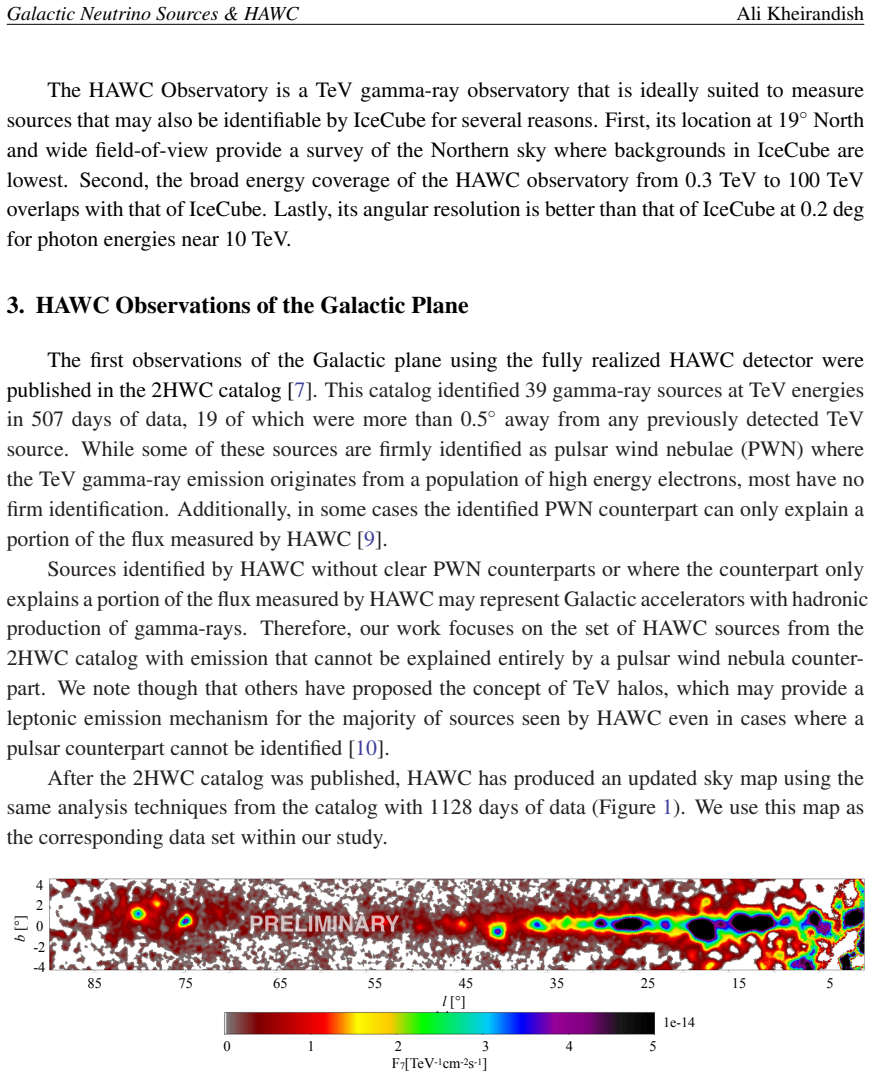
The load-bearing mechanism is a stacking likelihood ratio in which the expected neutrino signal is weighted spatially by the gamma-ray morphology from the HAWC survey: point sources for the stacked search, and the measured flux at 7 TeV at every location for the template searches. A companion ingredient is the pion-decay conversion from the gamma-ray spectrum to an expected neutrino flux, which supplies the maximal hadronic reference curve against which each upper limit is judged. The likelihood framework is the same one used for pointed neutrino source searches, and it maximizes the number of signal neutrinos against the eight-year muon-neutrino track sample.
What would settle it
Apply the same five likelihood tests to the next eight years of the same neutrino detector's exposure. If the 36.7-neutrino excess near 2HWC J1857+027 is real, the best-fit signal count should grow roughly linearly with exposure and the post-trial p-value should fall below $10^{-3}$; if the excess reverts to zero, it was a background fluctuation and the non-detection is confirmed. Independently, a gamma-ray spectral or multiwavelength demonstration that these sources' TeV emission is leptonic would invalidate the hadronic interpretation of the limits.
Extended reading notes
Core claim
The claim is that, after eight years of exposure, the neutrino sky shows no excess above background at the locations and morphologies where the HAWC survey sees TeV gamma-ray emission. The paper states that the observed signal excesses are not statistically significant for claiming evidence of neutrino emission associated with the gamma-ray emission measured by HAWC. In the absence of a detection, it sets 90% confidence upper limits on the muon-neutrino flux for each of the five hypotheses and compares those limits with the neutrino flux projected from the gamma-ray spectrum under the assumption that all detected high-energy gamma-rays are hadronic. The result is presented as marginal to expectations: for the northern-plane and stacked searches the limits begin to constrain the hadronic flux component, while for 2HWC J1908+06 the constraint is marginal and for 2HWC J1857+027 the fitted excess forces an upper limit too weak to constrain hadronic emission.
Load-bearing premise
The load-bearing premise, noted in the paper's Section 3 and assumed in Section 4, is that every gamma-ray used to build the search templates comes from pion decay; if the emission is leptonic instead, the projected neutrino fluxes do not apply and the upper limits must be reinterpreted.
Editorial extensions
If this is right
- None of the five tested hypotheses can be claimed as a source of cosmic neutrinos, so the HAWC sources do not yet provide the smoking gun for hadronic Galactic cosmic-ray acceleration.
- The 90% confidence upper limits quantitatively bound how much of the TeV gamma-ray flux from the stacked non-PWN sample and the northern-plane template can be hadronic at neutrino energies.
- The Cygnus region receives the most stringent limit because the observation under-fluctuates, and the fitted-limit convention reduces its allowed neutrino flux by an additional 60%.
- The excess around 2HWC J1857+027, though not significant, marks that region as the most promising target among those tested for continued observation.
- Because pulsar wind nebulae were excluded from the stacked search, the result constrains sources whose TeV emission is not fully accounted for by leptonic PWN models.
Reading between the lines
- If TeV halos or other leptonic mechanisms explain most of the unidentified HAWC sources, the hadronic gamma-ray-to-neutrino projection used here overestimates the expected neutrino flux; in that case the limits say little about whether these sources accelerate cosmic rays, only that they do not emit hadronic gamma-rays at the assumed level.
- The 36.7-neutrino excess at 2HWC J1857+027 is exactly the kind of marginal fluctuation that a longer exposure could confirm or rule out; doubling the exposure would be a direct test.
- The same morphology-weighted template technique could be applied to diffuse Galactic plane emission or to future, deeper gamma-ray catalogs, where the integrated signal might exceed point-source sensitivity.
- Weighting the templates by energy-dependent gamma-ray maps instead of a single 7 TeV flux map would sharpen the test, since the neutrino and gamma-ray effective areas respond differently with energy.
Signed reviews
Editorial analysis
A structured set of objections, weighed in public.
Referee Report
Summary. The paper, an ICRC 2019 proceedings contribution from the IceCube and HAWC collaborations, searches for muon-neutrino emission from HAWC-detected Galactic TeV gamma-ray sources using eight years of IceCube Northern-sky track events. It reports a stacked likelihood search over 20 non-PWN sources from the 2HWC catalog and a template search using the HAWC gamma-ray morphology over the Northern plane plus three predefined regions (Cygnus, 2HWC J1908+06, and 2HWC J1857+027). None of the five tests reaches a significant excess; the largest excess is 36.7 neutrinos toward 2HWC J1857+027 with a pre-trial p-value of 2%. In the absence of a signal, the paper places 90% C.L. upper limits on the nu_mu + antinu_mu flux at 7 TeV for each hypothesis and compares them with the neutrino flux expected if the measured HAWC gamma rays are hadronic, using the conversion of Kappes et al. [15].
Significance. If the results stand, the paper provides a useful null result: eight years of IceCube muon-neutrino data do not yet show an association with HAWC TeV sources, and the reported upper limits begin to constrain the hadronic fraction of the gamma-ray emission under the pion-decay assumption. The analysis is anchored to external HAWC observations and to an external hadronic conversion model, so the search is not circular; the only fitted parameters are signal normalizations. The stacking likelihood follows standard and previously published IceCube methodology, which is a strength. The main limitation is that the statistical evidence is reported only through pre-trial p-values, so the central "not statistically significant" statement is not fully quantified; the hadronic assumption is acknowledged but should be attached explicitly to the limit interpretation.
major comments (3)
- [Section 4, Table 1] The central claim that the observed excess is "not statistically significant" is supported only by pre-trial p-values. Table 1 lists five separate likelihood tests, and the most significant p-value is 0.02 for the 2HWC J1857+027 region. No trials-corrected p-value is reported anywhere. Since the same eight-year data set is used in five tests, some multiplicity correction is required before "not statistically significant" can be taken as a formal statement; a simple Bonferroni correction over the five reported tests would place the smallest p near 0.10. The conclusion may well survive the correction, but the paper needs to state the post-trial p-value or justify why no correction applies.
- [Section 4, Figs. 4 and 5] The 90% C.L. upper limits are presented as the main quantitative product, but no systematic uncertainties are included or discussed. The limits depend on IceCube detector response, angular resolution, and the HAWC flux map used for the template weighting, and these inputs can shift the limits by an amount that matters for the comparison with the predicted hadronic fluxes shown in Figs. 4 and 5. At minimum, a sentence stating the dominant systematics and whether the quoted limits include them is needed before the limits can be used as quantitative constraints.
- [Section 4 (template searches) and Section 5] The upper limits are interpreted as constraining the hadronic component of the gamma-ray emission, but this interpretation holds only under the assumption, stated in the abstract, that the measured HAWC gamma rays are of pion-decay origin. Section 3 explicitly notes that TeV halos provide a leptonic alternative for many of these sources. The paper should therefore state, at the point where the limits are compared with the hadronic prediction in Figs. 4 and 5, that the exclusion applies to the hadronic fraction only in the hadronic-scenario model; a leptonic origin would remove the predicted flux. The non-detection itself is unaffected, but the limit interpretation is conditional.
minor comments (5)
- [Abstract and Section 4] The abstract says "two analyses," while Section 4 describes five tests. Clarify that there are two analysis classes (stacking and template) with five source hypotheses.
- [Table 1 and Section 4] The source is called "2HWC J1908+06" in Section 4, "J1908+063 Region" in Table 1, and "MGRO J1908" in Section 5. Use one designation consistently.
- [Section 5] "The rational for identifying Galactic sources" should be "The rationale for identifying Galactic sources."
- [Section 4] "an under fluctuation of background" should be "an underfluctuation of the background" or "a downward fluctuation of the background."
- [References] Reference [13] is incomplete: the title of the proceedings contribution is missing and there is a stray comma after the authors. Please complete the reference.
Circularity Check
No circularity found: the neutrino prediction is built from external HAWC gamma-ray data and the Kappes et al. hadronic model, not from IceCube fit outputs.
full rationale
The derivation chain is not circular. HAWC supplies the gamma-ray source list, morphologies, and spectra; the expected neutrino flux is obtained from that gamma-ray emission via the external hadronuclear conversion of Kappes et al. [15]; IceCube muon-neutrino data are then compared with these templates in a stacking likelihood. The only fitted quantities are the signal normalizations n_s in each hypothesis test, which are outputs of the likelihood and are not used to build the predicted neutrino flux or the upper-limit framework. The hadronic assumption is an explicitly stated external physical hypothesis, and the non-detection conclusion does not depend on it. The two references involving one of the authors, [6] and [13], are used only to motivate region selection and to justify excluding pulsar wind nebulae, respectively; neither supplies the predicted flux, the test statistic, or a uniqueness theorem, so they are not load-bearing circular inputs. The one notable caveat, located in Section 4 and Table 1, is that the quoted p-values are pre-trial and no trials-corrected p-value is reported; this is a statistical reporting limitation affecting the strength of the null claim, but it is not a circularity in the physical or statistical derivation.
Assumptions & free parameters
free parameters (6)
- Best-fit signal normalization n_s for stacking search =
15.4
- Best-fit signal normalization n_s for Northern plane template search =
77.8
- Best-fit signal normalization n_s for Cygnus region =
0.0
- Best-fit signal normalization n_s for J1908+06 region =
12.0
- Best-fit signal normalization n_s for J1857+027 region =
36.7
- Assumed gamma-ray spectral index for HAWC map weights =
E^-2.7
assumptions (4)
- domain assumption The high-energy gamma rays observed by HAWC from these sources are produced by hadronic pion decay, and the neutrino flux is related to the gamma-ray flux via the model of Kappes et al. [15].
- domain assumption The HAWC source catalog and gamma-ray morphology are accurate and trace the neutrino emission sites.
- domain assumption The IceCube event selection and detector response from the point-source search [11] are reliable, and the background is well modeled.
- domain assumption Sources without identified PWN counterparts are candidate hadronic accelerators.
Cite this review
Pith. "Pith review of IceCube Search for Galactic Neutrino Sources based on HAWC Observations of the Galactic Plane." pith.science (2026). https://pith.science/paper/EDUNUM6F
@misc{pith2026190808546,
  author       = {Pith},
  title        = {Pith review of: IceCube Search for Galactic Neutrino Sources based on HAWC Observations of the Galactic Plane},
  year         = {2026},
  howpublished = {\url{https://pith.science/paper/EDUNUM6F}},
  note         = {Machine review of arXiv:1908.08546}
}
read the original abstract
We present a search in IceCube data for neutrino emission from Galactic TeV gamma-ray sources detected by the HAWC gamma-ray observatory. HAWC serves as the excellent instrument to complement IceCube with its energy range extending to very high energies. Assuming that the highest energy photons originate from the decay of pions, rather than from accelerated leptons, the very high energy gamma-rays observed by HAWC are expected to be correlated with neutrinos. Using eight years of IceCube data, we report on two analyses that investigate a possible neutrino--gamma ray correlation. The first is a stacked analysis of identified HAWC point sources and the second is a template method which accounts for the full morphology of HAWC sources, including their measured extension.
Figures


Figures from the paper (2 more)


Reference graph
Works this paper leans on
- [15]
- [1]
-
[2]
A. A. Abdo et al., Astrophys. J. 658 (2007) L33–L36
work page 2007
- [3]
-
[4]
M. C. Gonzalez-Garcia, F. Halzen, and S. Mohapatra, Astropart. Phys. 31 (2009) 437–444
work page 2009
-
[5]
M. C. Gonzalez-Garcia, F. Halzen, and V . Niro,Astropart. Phys. 57-58 (2014) 39–48
work page 2014
- [6]
-
[7]
A. U. Abeysekara et al., Astrophys. J. 843 (2017) 40
work page 2017
Show all 15 references
-
[8]
IceCube Collaboration, M. G. Aartsen et al., JINST 12 (2017) P03012
2017
-
[9]
VERITAS, Fermi-LA T, HA WCCollaboration, A. U. Abeysekara et al., Astrophys. J. 866 (2018) 24
2018
-
[10]
Linden and B
T. Linden and B. J. Buckman, Phys. Rev. Lett. 120 (2018) 121101
2018
-
[11]
IceCube Collaboration, M. G. Aartsen et al., Eur . Phys. J.C79 (2019) 234
2019
-
[12]
Achterberg et al., Astropart
IceCube Collaboration, A. Achterberg et al., Astropart. Phys. 26 (2006) 282–300. 7 Galactic Neutrino Sources & HA WC Ali Kheirandish
2006
-
[13]
Collaboration, Q
IceCube. Collaboration, Q. Liu and A. Kheirandish, , in Proceedings, 36th International Cosmic Ray Conference (ICRC 2019): Madison, USA, July 24-31, 2019 , 2019
2019
-
[14]
J. F. Beacom and M. D. Kistler, Phys. Rev. D75 (2007) 083001
2007
Reviewed August 14, 2026 · model on record in the stance chip above.
Discussion (0). Continue with ORCID to comment.