REVIEW 4 major objections 5 minor 107 references
Non-linear saturation and energy transport in global simulations of magneto-thermal turbulence in the stratified intracluster medium
T0 review · 4 major / 5 minor · reviewed 2026-08-12 · deepseek-v4-flash
Pith's one-line read Global simulations show the magneto-thermal instability saturates through a balance between injection and dissipation of available potential energy, marginalising the Braginskii heat flux rather than erasing the temperature gradient.
desk verdict Solid global B-MHD confirmation of the Perrone-Latter MTI saturation picture, with a useful diffusive mixing-length unification; the astrophysical numbers are calibrated fits rather than independent predictions. read the letter →
The pith
A machine-rendered reading of the paper's core claim, the machinery that carries it, and where it could break.
The reading
What carries the argument
The available potential energy (APE) of Eq. (16), its volume-averaged budget Eq. (17), and the diffusive mixing-length theory (DMLT). The APE budget separates the energy-injection rate $\varepsilon_i$ from the thermal-dissipation rate $\varepsilon_\kappa$ and the buoyancy work $A$; the saturation claim is the near-equality $\varepsilon_i \approx -\varepsilon_\kappa \approx -A$, equivalent to marginalising the Braginskii heat flux $q_B$. The DMLT sets the mixing length to the conduction length $\ell_\chi = (\chi/\omega)^{1/2}$, which makes the classical mixing-length-theory scalings identical to the Perrone-Latter diffusion scalings.
What would settle it
Run a global compressible MTI simulation with an exact APE defined relative to the sorted, minimum-total-potential-energy state, and close the budget including boundary fluxes; if the near-equality $\varepsilon_i \approx -\varepsilon_\kappa \approx -A$ breaks down, or if $q_B$ is not marginalised while the background temperature gradient is erased, the proposed saturation mechanism would be falsified.
Extended reading notes
Core claim
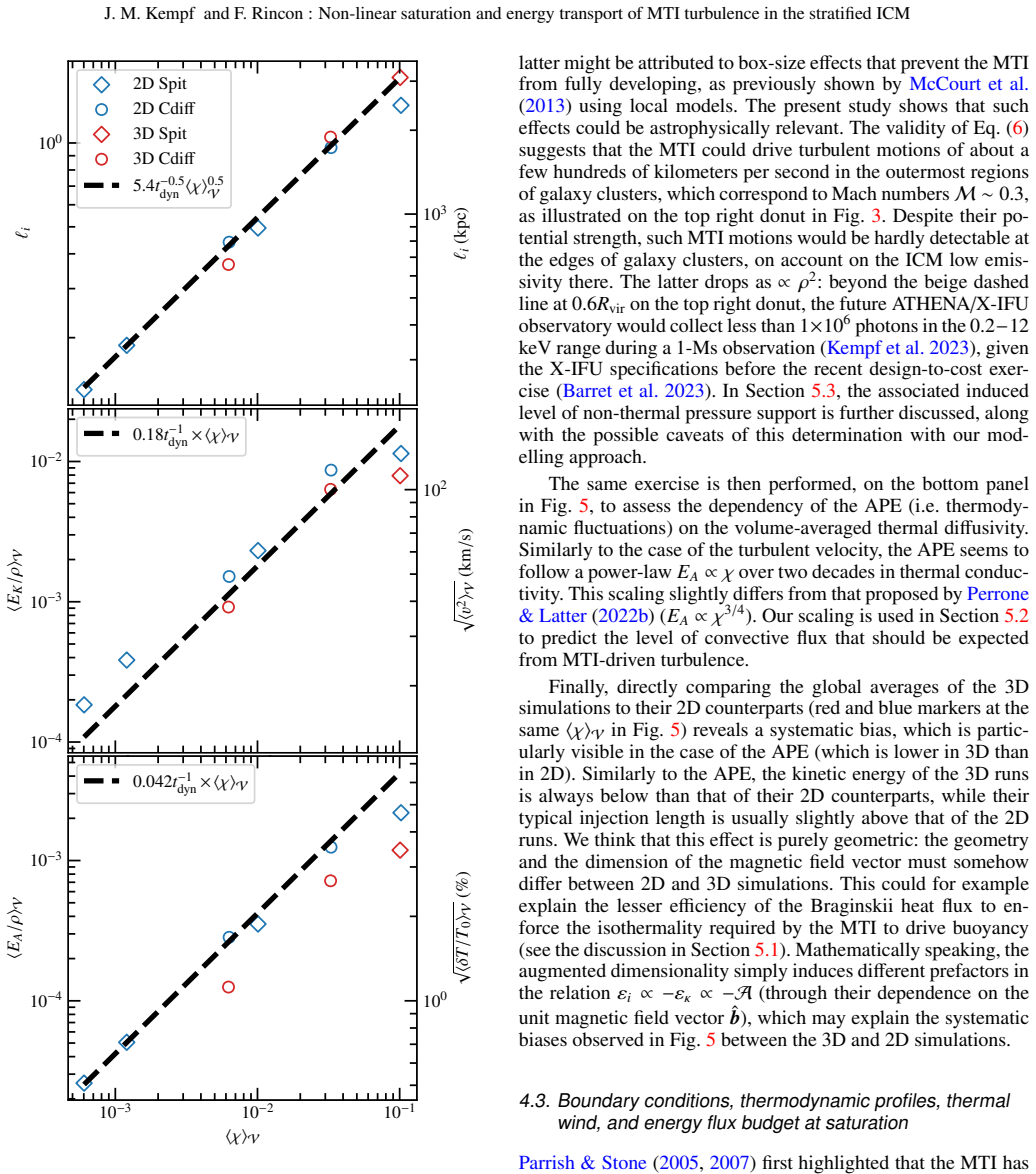
The central discovery is that the MTI saturates through $\varepsilon_i \approx -\varepsilon_\kappa \approx -A$, a dominant balance between the rate at which energy is injected into available potential energy by the anisotropic heat flux acting on the background temperature gradient, the rate at which parallel thermal conduction dissipates that APE back into background potential energy, and the reversible buoyancy work that converts APE into kinetic energy. Because $\varepsilon_i \approx -\varepsilon_\kappa$ restates $q_B \approx 0$, the MTI stops growing by marginalising the Braginskii heat flux, not by flattening the background temperature gradient. This is shown in detail for the fiducial 3D run F0, and the same balance holds across a parameter sweep of thermal conductivity spanning two decades. The paper further shows that the injection length and velocity fluctuations of the saturated turbulence obey the Perrone-Latter scalings $\ell_i \sim (\chi \omega_T)^{1/2}/N$ and $v^2 \sim (\chi \omega_T^3)^{1/2}/N$, and that these can be reinterpreted as a diffusive mixing-length theory with $\ell_m \sim \ell_\chi = (\chi/\omega)^{1/2}$.
Load-bearing premise
The quadratic APE formula (Eq. 16) is only valid for small displacements and small density perturbations, and the reference state is the spherically-averaged profile rather than the true minimum-potential-energy state; the volume-averaged budget also assumes no boundary fluxes and constant background profiles, though Fig. 2 shows the closure is imperfect.
Editorial extensions
If this is right
- The Perrone-Latter Boussinesq saturation theory holds in global, compressible, strongly stratified ICM conditions, with the balance $\varepsilon_i \approx -\varepsilon_\kappa \approx -A$ satisfied across two decades of thermal diffusivity.
- With realistic Spitzer conduction, the MTI alone drives cluster-size flows at Mach numbers up to about 0.3.
- MTI-driven turbulence provides roughly 15% non-thermal pressure support near the virial shock, but only about 5% at $R_{\mathrm{vir}}$, so its mass-bias effect is strongest in the low-density outer regions.
- Convective energy transport by the MTI is weak: the convective gravitational flux is at most about 7% of the background Braginskii heat flux, so conduction, not convection, carries the energy.
- The two existing descriptions of MTI saturation, mixing-length theory and diffusion-balance theory, are equivalent when the mixing length is taken to be the conduction length, giving a diffusive mixing-length theory.
Reading between the lines
- A natural next step is to vary $N$ and $\omega_T$ independently; the paper leaves open whether $\omega_T$ or $N$ is the correct time scale in the DMLT scalings, and this distinction becomes important in clusters where the ratio $N/\omega_T$ differs from unity.
- Because the scaling $v^2 \propto \chi$ controls all the astrophysical numbers, any kinetic mechanism that suppresses Spitzer conductivity, such as mirror modes or whistlers, would proportionally lower the Mach number and pressure support; the paper flags this but does not model it.
- If the APE framework applies to double-diffusive instabilities generally, as the paper speculates, then global fingering or thermocompositional convection should show a positive background-potential-energy-to-APE injection rate controlling saturation; testing that would extend the claim beyond the ICM.
Editorial analysis
A structured set of objections, weighed in public.
Referee Report
Summary. This paper presents global 2D and 3D Braginskii-MHD simulations of the magneto-thermal instability (MTI) in a stratified model of the intracluster medium (ICM) outskirts. The authors analyze the saturation mechanism using a volume-averaged available potential energy (APE) budget, finding that the MTI saturates through a dominant balance between APE injection by anisotropic thermal conduction and APE dissipation, which they interpret as marginalisation of the Braginskii heat flux rather than of the background temperature gradient. They further measure scaling laws for the injection length, velocity fluctuations, and temperature fluctuations as functions of the thermal diffusivity, and propose a diffusive mixing-length theory (DMLT) that unifies earlier mixing-length and Boussinesq saturation descriptions. Using that theory, they estimate that MTI-driven convection carries at most a few percent of the radial energy flux and that the turbulent pressure support can reach about 15% of the thermal pressure near the virial radius.
Significance. If the central claim holds, this is an important result: it would extend the Boussinesq saturation theory of Perrone and Latter to global, compressible, strongly stratified ICM conditions, reconcile two previously competing phenomenological descriptions, and provide quantitative estimates of MTI-driven turbulence for ICM mass-bias studies. The paper is also creditable for its explicit parameter sweep over thermal diffusivity, spectral diagnostics, careful discussion of boundary-condition effects in Appendix C, and the honest acknowledgment in Appendix B that the APE construction is approximate and that the reference state is not the minimum-TPE state. The scaling laws are presented with clear fits over more than two decades, and the 3D verification of the energy budget in run F0 is a useful step beyond purely local simulations.
major comments (4)
- [Sec. 4.1 and Appendix B, Eqs. (16)-(17) and Fig. 2] The saturation claim rests on the volume-averaged APE budget in Fig. 2, but this budget is approximate: the quadratic APE in Eq. (16) is valid only for small displacements and density perturbations, the spherically-averaged reference state is not guaranteed to be the minimum-TPE state, and the budget in Eq. (17) neglects APE boundary fluxes and the exchange term F. The inset of Fig. 2 indeed shows that ε_i+ε_κ+A does not close exactly. Because the simulation contains boundary layers and a thermal wind, the apparent equality could be dominated by these mean-flow or boundary contributions rather than by local MTI turbulent saturation. Please provide a shell-resolved or otherwise local APE budget, and quantify the magnitude of the boundary-flux term, to confirm that the ε_i≈-ε_κ balance is not an artefact of the volume average.
- [Sec. 4.1, Eqs. (18)-(19)] The inference that ε_i≈-ε_κ implies q_B≈0 is not direct. By construction, ε_i+ε_κ = q_B·∇(δT/T) in a volume-averaged sense, so the integral of q_B·∇(δT/T) being near zero does not demonstrate that q_B itself is small locally: the volume integral can vanish if ∇∥(δT/T) is zero over much of the domain, regardless of the heat-flux magnitude. To substantiate the claim that the MTI saturates by marginalising the Braginskii heat flux, the authors should show that ∇∥(δT/T) is non-zero in the regions where ε_i and ε_κ are individually large, or directly measure q_B (or the effective parallel conductivity) in the saturated state. Without such evidence, the statement in Section 4.1 that ε_i≈-ε_κ is 'just a restatement of q_B≈0' is logically overreaching.
- [Secs. 5.1-5.3, Eqs. (33)-(35) and (38)-(39)] The DMLT 'predictions' of the convective-flux ratio and non-thermal pressure support are not independent tests of the theory. The coefficients 4.6, 0.13, and 0.03 in Eqs. (33)-(35) are fitted to the same simulation suite shown in Fig. 5, and Eq. (39), when evaluated with the stated ICM parameters, returns ≈14%, which essentially reproduces the ≈15% non-thermal pressure support already measured in run S0 (see Tab. 3, where ⟨M⟩_V=0.17 gives γM²≈0.15). The abstract and conclusions should be phrased as a consistent phenomenological description calibrated on the simulations, rather than as independent predictions, unless the prefactors are validated against additional simulations or previous results in the literature.
- [Sec. 4.2, Fig. 5] The scaling laws in Fig. 5 are established primarily by 2D runs; only three 3D runs are included, and they exhibit a systematic offset from the 2D points (lower kinetic and APE energies, slightly larger injection length). Given that the magnitude predictions in Section 5 assume the same prefactors for the 3D ICM, the paper should quantify the 2D/3D systematic uncertainty in the fitted exponents and prefactors, and clarify whether the apparent two-decade scaling is robust to the exclusion of the 2D points or to the inclusion of additional 3D runs with intermediate diffusivities.
minor comments (5)
- [Throughout] The symbol M is used both for the Mach number and, in some places, for the magnetic energy (e.g., in Fig. 4, E_M(m) is the magnetic spectral density). Please distinguish the notations, for example by writing the Mach number as 𝒥 or Ma, to avoid confusion.
- [Abstract] The phrase 'about ∼ 15%' contains both 'about' and '∼'; please use one or the other throughout the text.
- [Fig. 1 caption] The caption reads 'Profile at TE and HSE'; this should be 'Profiles at TE and HSE' (plural).
- [Sec. 5.2, Eq. (38)] Equation (38) contains the ratio δ3_r^2/δ3^2, but the quantities δ3_r and δ3 are not defined in the text preceding the equation. Please define these as the radial and total velocity fluctuations, respectively, as used in Eq. (30).
- [Appendix B] The term 'extrinsic state function' is introduced without a definition; a one-sentence explanation of the concept would be helpful for readers unfamiliar with oceanographic APE terminology.
Circularity Check
The APE saturation balance is an independent measurement, but the 14% pressure support and 7% convective flux are fitted predictions from the same simulation suite.
-
fitted input called prediction
[Section 5.1, Eqs. (33)-(35); Section 5.3, Eq. (39)]
"We therefore propose the three following scalings: ℓi≈ 4.6(χ/ω)^0.5, 3^2≈ 0.13ωχ, (g0 δT/T0)^2≈ 0.03ω^3χ … Using typical values for the outermost regions r∼ 1.5Rvir leads to: pturb/p0 = 14% … (39)"
The prefactors 4.6, 0.13, and 0.03 are fitted to the same simulation suite displayed in Fig. 5, which includes the Spitzer run S0 that already reaches Mach numbers ~0.3 and hence γM^2 ≈ 15%. Evaluating Eq. (34) at the same Spitzer conductivity and dividing by the background pressure reproduces the simulation's own measured pressure support; the 14% figure is a restatement of the fit rather than an independent prediction.
-
fitted input called prediction
[Section 5.2, Eq. (38)]
"Using Eqs. (34)-(35), we rederive the ratio of the convective flux of gravitational energy, Eq. (29), to the background Braginskii conductive heat flux, Eq. (24), as: Gr,1/Qr,0 = 7% …"
The 7% ratio is assembled from the fitted scaling prefactors (Eqs. 34-35) together with measured correlation coefficients α, b_r^2, and other ratios taken from the same simulations. It therefore does not constitute an independent first-principles prediction of the convective transport efficiency; it is an interpolation of the fitted scalings and simulation statistics.
full rationale
The central saturation claim — that the MTI saturates through an APE-balance εi ≈ -εκ ≈ -A — is a direct measurement from the 3D run F0 (Fig. 2) and is not circular; it is a legitimate diagnostic result, even though the volume-averaged budget is approximate (Appendix B) and does not close exactly. The paper then imports Perrone & Latter's Boussinesq scalings, fits their power-law prefactors to its own run series (Fig. 5, Eqs. 33-35), and uses those fitted scalings to produce an ICM pressure-support estimate (Eq. 39) and a convective-flux ratio (Eq. 38). Because the fitted prefactors already encode the simulation outcomes, evaluating the scaling law at Spitzer conductivity and asserting 14% support simply recovers the ~15% already measured in run S0, making it a restatement rather than an independent prediction. The proposed DMLT is a re-expression of Perrone & Latter's conduction-length scaling in mixing-length language, but that does not by itself constitute a circular argument; the circularity arises specifically from the fitted prefactors being sold as predictive. The paper's core saturation mechanism and its scaling-law exponent tests (e.g., ℓi ∝ χ^0.5, 3 ∝ χ^0.5) retain independent content, but the quantitative ICM numbers claimed as predictions are not independent of the fitted data set. Hence a score of 6 is warranted.
Assumptions & free parameters
free parameters (4)
- DMLT prefactor for injection length (4.6) =
4.6 in Eq. (33)
- DMLT prefactor for velocity variance (0.13) =
0.13 in Eq. (34)
- DMLT prefactor for temperature variance (0.03) =
0.03 in Eq. (35)
- typical MTI turbulent frequency omega =
1 Gyr^-1
assumptions (4)
- domain assumption Braginskii-MHD with isotropic viscosity (Eq. 12) captures the large-scale MTI saturation dynamics.
- ad hoc to paper Quadratic APE definition (Eq. 16) with spherically-averaged reference state is a valid diagnostic of the saturation balance.
- domain assumption The McCourt et al. (2013) HSE atmosphere with Dirichlet temperature boundary conditions supplies an astrophysically relevant stratification and heat reservoir.
- ad hoc to paper APE boundary fluxes and the time-dependence of the background are negligible in the volume-averaged budget (Eq. 17).
Cite this review
Pith. "Pith review of Non-linear saturation and energy transport in global simulations of magneto-thermal turbulence in the stratified intracluster medium." pith.science (2026). https://pith.science/paper/EFWPIVAQ
@misc{pith2026241116242,
  author       = {Pith},
  title        = {Pith review of: Non-linear saturation and energy transport in global simulations of magneto-thermal turbulence in the stratified intracluster medium},
  year         = {2026},
  howpublished = {\url{https://pith.science/paper/EFWPIVAQ}},
  note         = {Machine review of arXiv:2411.16242}
}
abstract
Context. The magneto-thermal instability (MTI) is one of many possible drivers of stratified turbulence in the intracluster medium (ICM) outskirts of galaxy clusters, where the background temperature gradient is aligned with the gravity. This instability occurs because of the fast anisotropic conduction of heat along magnetic field lines; but to what extent it impacts the ICM dynamics, energetics and overall equilibrium is still a matter of debate. Aims. This work aims at understanding MTI turbulence in an astrophysically stratified ICM atmosphere, its saturation mechanism, and its ability to carry energy and to provide non-thermal pressure support. Methods. We perform a series of 2D and 3D numerical simulations of the MTI in global spherical models of stratified ICM, thanks to the finite-volume code IDEFIX, using Braginskii-magnetohydrodynamics. We use volume-, shell-averaged and spectral diagnostics to study the saturation mechanism of the MTI, and its radial transport energy budget. Results. The MTI is found to saturate through a dominant balance between injection and dissipation of available potential energy, which amounts to marginalising the Braginskii heat flux but not the background temperature gradient itself. Accordingly, the strength and injection length of MTI-driven turbulence exhibit clear dependencies on the thermal diffusivity. The MTI drives cluster-size motions with Mach numbers up to $\mathcal{M} \sim 0.3$, even in presence of strong stable entropy stratification. We show that such mildly compressible flows can provide about $\sim 15\%$ of non-thermal pressure support in the outermost ICM regions, and that the convective transport itself is much less efficient than conduction at radially transporting energy. Finally, we show that the MTI saturation can be described by a diffusive mixing-length theory, shedding light on the diffusive buoyant nature of the instability.
Figures


Figures from the paper (3 more)


Reference graph
Works this paper leans on
-
[1]
, " * write output.state after.block = add.period write newline
ENTRY address archiveprefix author booktitle chapter edition editor howpublished institution eprint journal key month note number organization pages publisher school series title type volume year label extra.label sort.label short.list INTEGERS output.state before.all mid.sentence after.sentence after.block FUNCTION init.state.consts #0 'before.all := #1 ...
-
[2]
write newline
" write newline "" before.all 'output.state := FUNCTION n.dashify 't := "" t empty not t #1 #1 substring "-" = t #1 #2 substring "--" = not "--" * t #2 global.max substring 't := t #1 #1 substring "-" = "-" * t #2 global.max substring 't := while if t #1 #1 substring * t #2 global.max substring 't := if while FUNCTION word.in bbl.in " " * FUNCTION format....
-
[3]
P., Beaver, M., Davids, B., et al
Abbett, W. P., Beaver, M., Davids, B., et al. 1997, , 480, 395
1997
-
[4]
2021, , 651, A3
Ahuir, J., Mathis, S., & Amard, L. 2021, , 651, A3
2021
-
[5]
W., Evrard, A
Allen, S. W., Evrard, A. E., & Mantz, A. B. 2011, , 49, 409
2011
-
[6]
Andrews, D. G. 1981, J. Fluid Mech., 107, 227
1981
-
[7]
2020, , 495, 864
Angelinelli, M., Vazza, F., Giocoli, C., et al. 2020, , 495, 864
2020
-
[8]
Balbus, S. A. 2000, , 534, 420
2000
Show all 107 references
-
[9]
Balbus, S. A. 2001, , 562, 909
2001
-
[10]
2023, Exp
Barret, D., Albouys, V., den Herder, J.-W., et al. 2023, Exp. Astron., 55, 373
2023
-
[11]
E., & Pfrommer, C
Berlok, T., Quataert, E., Pessah, M. E., & Pfrommer, C. 2021, , 504, 3435
2021
-
[12]
1958, 46, 108
B \"o hm-Vitense , E. 1958, 46, 108
1958
-
[13]
Braginskii, S. I. 1965, Reviews of Plasma Physics, 1, 205
1965
-
[14]
Braginsky, S. I. & Roberts, P. H. 1995, Geo. Astro. Fluid Dyn., 79, 1
1995
-
[15]
S., Miesch, M
Brun, A. S., Miesch, M. S., & Toomre, J. 2004, , 614, 1073
2004
-
[16]
Canuto, V. M. 1990, , 227, 282
1990
-
[17]
H., Toomre, J., Malagoli, A., & Hurlburt, N
Cattaneo, F., Brummell, N. H., Toomre, J., Malagoli, A., & Hurlburt, N. E. 1991, , 370, 282
1991
-
[18]
W., Donahue, M., Voit, G
Cavagnolo, K. W., Donahue, M., Voit, G. M., & Sun, M. 2009, , 182, 12
2009
-
[19]
A., Boles, M
Cengel, Y. A., Boles, M. A., & Kano g lu, M. 2011, Thermodynamics: An Engineering Approach, Vol. 5 (McGraw-hill New York)
2011
-
[20]
Chan, K. L. & Sofia, S. 1989, , 336, 1022
1989
-
[21]
Chandran, B. D. G. & Maron, J. L. 2004, , 602, 170
2004
-
[22]
2024, A&A, 682, A85
Dhouib, H., Baruteau, C., Mathis, S., et al. 2024, A&A, 682, A85
2024
-
[23]
F., Pfrommer, C., Reynolds, C
Drake, J. F., Pfrommer, C., Reynolds, C. S., et al. 2021, , 923, 245
2021
-
[24]
2023, , 673, A91
Dupourqu \'e , S., Clerc, N., Pointecouteau, E., et al. 2023, , 673, A91
2023
-
[25]
2019, , 621, A40
Eckert, D., Ghirardini, V., Ettori, S., et al. 2019, , 621, A40
2019
-
[26]
Eddington, A. S. 1917, The Observatory, 40, 290
1917
-
[27]
M., & Rephaeli, Y
Ferrari, C., Govoni, F., Schindler, S., Bykov, A. M., & Rephaeli, Y. 2008, , 134, 93
2008
-
[28]
E., Reifenstein, S
Fraser, A. E., Reifenstein, S. A., & Garaud, P. 2024, , 964, 184
2024
-
[29]
2006, , 457, 371
Fromang, S., Hennebelle, P., & Teyssier, R. 2006, , 457, 371
2006
-
[30]
2018, Annu
Garaud, P. 2018, Annu. Rev. Fluid Mech., 50, 275
2018
-
[31]
T., & Zhuravleva, I
Gaspari, M., Churazov, E., Nagai, D., Lau, E. T., & Zhuravleva, I. 2014, , 569, A67
2014
-
[32]
& Dintrans, B
Gastine, T. & Dintrans, B. 2008, A&A, 484, 29
2008
-
[33]
2012, , 546, A19
Gastine, T., Duarte, L., & Wicht, J. 2012, , 546, A19
2012
-
[34]
& Wicht, J
Gastine, T. & Wicht, J. 2012, Icarus, 219, 428
2012
-
[35]
& Wicht, J
Gastine, T. & Wicht, J. 2021, Icarus, 368, 114514
2021
-
[36]
2019, , 621, A41
Ghirardini, V., Eckert, D., Ettori, S., et al. 2019, , 621, A41
2019
-
[37]
& Feretti, L
Govoni, F. & Feretti, L. 2004, Int. J. Mod. Phys. D, 13, 1549
2004
-
[38]
Helander, P. 2017, J. Plasma Phys., 83, 715830401
2017
-
[39]
Helander, P. 2020, J. Plasma Phys., 86, 905860201
2020
-
[40]
& Mcintyre, M
Holliday, D. & Mcintyre, M. E. 1981, J. Fluid Mech., 107, 221
1981
-
[41]
E., Toomre, J., & Massaguer, J
Hurlburt, N. E., Toomre, J., & Massaguer, J. M. 1984, , 282, 557
1984
-
[42]
Ishisaki, Y., Ezoe, Y., Yamada, S., et al. 2018, J. Low Temp. Phys., 193, 991
2018
-
[43]
Johnson, R. E. 2010, , 716, 1573
2010
-
[44]
E., Zuhone, J., Jones, C., Forman, W
Johnson, R. E., Zuhone, J., Jones, C., Forman, W. R., & Markevitch, M. 2012, , 751, 95
2012
-
[45]
M., Rincon, F., & Clerc, N
Kempf, J. M., Rincon, F., & Clerc, N. 2023, , 680, A24
2023
-
[46]
A., Churazov, E., & Spitkovsky, A
Komarov, S., Schekochihin, A. A., Churazov, E., & Spitkovsky, A. 2018, J. Plasma Phys., 84, 905840305
2018
-
[47]
1997, Quarterly Journal of the Royal Meteorological Society, 123, 2141
Kucharski, F. 1997, Quarterly Journal of the Royal Meteorological Society, 123, 2141
1997
-
[48]
W., Bogdanovi \'c , T., Reynolds, C
Kunz, M. W., Bogdanovi \'c , T., Reynolds, C. S., & Stone, J. M. 2012, , 754, 122
2012
-
[49]
& Molendi, S
Leccardi, A. & Molendi, S. 2008, , 486, 359
2008
-
[50]
Lesur, G. R. J., Baghdadi, S., Wafflard-Fernandez , G., et al. 2023, , 677, A9
2023
-
[51]
& Del Zanna, L
Londrillo, P. & Del Zanna, L. 2004, J. Comp. Phys., 195, 17
2004
-
[52]
Lorenz, E. N. 1955, Tellus A, 7, 157
1955
-
[53]
2009, , 398, 1858
McBride, J., Fakhouri, O., & Ma, C.-P. 2009, , 398, 1858
2009
-
[54]
J., Sharma, P., & Quataert, E
McCourt, M., Parrish, I. J., Sharma, P., & Quataert, E. 2011, , 413, 1295
2011
-
[55]
McCourt, M., Quataert, E., & Parrish, I. J. 2013, , 432, 404
2013
-
[56]
D., Balsara, D
Meyer, C. D., Balsara, D. S., & Aslam, T. D. 2014, J. Comp. Phys., 257, 594
2014
-
[57]
C., MacKinnon, J
Middleton, L., Fine, E. C., MacKinnon, J. A., Alford, M. H., & Taylor, J. R. 2021, Geo. Research Letters, 48, e2021GL092779
2021
-
[58]
& Taylor, J
Middleton, L. & Taylor, J. R. 2020, J. Fluid Mech., 893, R3
2020
-
[59]
Miesch, M. S. 2005, Living Rev. Solar Phys., 2
2005
-
[60]
& Kusano, K
Miyoshi, T. & Kusano, K. 2005, J. Comp. Phys., 208, 315
2005
-
[61]
2020, , 493, 5838
Mohapatra, R., Federrath, C., & Sharma, P. 2020, , 493, 5838
2020
-
[62]
2021, , 500, 5072
Mohapatra, R., Federrath, C., & Sharma, P. 2021, , 500, 5072
2021
-
[63]
F., Frenk, C
Navarro, J. F., Frenk, C. S., & White, S. D. M. 1997, , 490, 493
1997
-
[64]
J., McCourt, M., Quataert, E., & Sharma, P
Parrish, I. J., McCourt, M., Quataert, E., & Sharma, P. 2012 a , , 422, 704
2012
-
[65]
J., McCourt, M., Quataert, E., & Sharma, P
Parrish, I. J., McCourt, M., Quataert, E., & Sharma, P. 2012 b , , 419, L29
2012
-
[66]
Parrish, I. J. & Stone, J. M. 2005, , 633, 334
2005
-
[67]
Parrish, I. J. & Stone, J. M. 2007, , 664, 135
2007
-
[68]
J., Stone, J
Parrish, I. J., Stone, J. M., & Lemaster, N. 2008, , 688, 905
2008
-
[69]
M., Berlok, T., & Pfrommer, C
Perrone, L. M., Berlok, T., & Pfrommer, C. 2024 a , , 682, A125
2024
-
[70]
M., Berlok, T., & Pfrommer, C
Perrone, L. M., Berlok, T., & Pfrommer, C. 2024 b , , 690, A292
2024
-
[71]
Perrone, L. M. & Latter, H. 2022 a , , 513, 4605
2022
-
[72]
Perrone, L. M. & Latter, H. 2022 b , , 513, 4625
2022
-
[73]
& Fabian, A
Peterson, J. & Fabian, A. 2006, Physics Reports, 427, 1
2006
-
[74]
2000, , 127, 159
Porter. 2000, , 127, 159
2000
-
[75]
& Ligni \`e res, F
Prat, V. & Ligni \`e res, F. 2014, , 566, A110
2014
-
[76]
W., Arnaud, M., Biviano, A., et al
Pratt, G. W., Arnaud, M., Biviano, A., et al. 2019, , 215, 25
2019
-
[77]
W., B \"o hringer, H., Croston, J
Pratt, G. W., B \"o hringer, H., Croston, J. H., et al. 2007, , 461, 71
2007
-
[78]
2008, , 673, 758
Quataert, E. 2008, , 673, 758
2008
-
[79]
2022, , 667, A94
Reboul-Salze , A., Guilet, J., Raynaud, R., & Bugli, M. 2022, , 667, A94
2022
-
[80]
G., Casertano, S., Yuan, W., Macri, L
Riess, A. G., Casertano, S., Yuan, W., Macri, L. M., & Scolnic, D. 2019, , 876, 85
2019
-
[81]
2015, Fluid Dynamics : An Introduction (Cham: Springer International Publishing)
Rieutord, M. 2015, Fluid Dynamics : An Introduction (Cham: Springer International Publishing)
2015
-
[82]
Rincon, F. 2019, J. Plasma Phys., 85, 205850401
2019
-
[83]
A., Quataert, E., & Verscharen, D
Riquelme, M. A., Quataert, E., & Verscharen, D. 2016, , 824, 123
2016
-
[84]
& Klein, P
Roullet, G. & Klein, P. 2009, J. Fluid Mech., 624, 45
2009
-
[85]
Ruszkowski, M., Lee, D., Br \"u ggen, M., Parrish, I., & Oh, S. P. 2011, , 740, 81
2011
-
[86]
Ruszkowski, M. & Oh, S. P. 2010, , 713, 1332
2010
-
[87]
A., Cowley, S
Schekochihin, A. A., Cowley, S. C., Kulsrud, R. M., Hammett, G. W., & Sharma, P. 2005, , 629, 139
2005
-
[88]
A., Cowley, S
Schekochihin, A. A., Cowley, S. C., Rincon, F., & Rosin, M. S. 2010, , 405, 291
2010
-
[89]
o niglichen Gesellschaft der Wissenschaften zu G \
Schwarzschild, K. 1906, Nachrichten von der K \"o niglichen Gesellschaft der Wissenschaften zu G \"o ttingen, 195, 41
1906
-
[90]
& Hammett, G
Sharma, P. & Hammett, G. W. 2007, J. Comp. Phys., 227, 123
2007
-
[91]
W., Mantz, A., et al
Simionescu, A., Allen, S. W., Mantz, A., et al. 2011, Science, 331, 1576
2011
-
[92]
1962, Physics of Fully Ionized Gases (New York: Interscience)
Spitzer, L. 1962, Physics of Fully Ionized Gases (New York: Interscience)
1962
-
[93]
Tailleux, R. 2009, J. Fluid Mech., 638, 339
2009
-
[94]
2013, Phys
Tailleux, R. 2013, Phys. Scr., T155, 014033
2013
-
[95]
Tailleux, R. 2018, J. Fluid Mech., 842, R1
2018
-
[96]
Tailleux, R. 2024, J. Fluid Mech., 994, A5
2024
-
[97]
& Dubos, T
Tailleux, R. & Dubos, T. 2024, Ocean Modelling, 188, 102339
2024
-
[98]
2011, , 728, L29
Traxler, A., Garaud, P., & Stellmach, S. 2011, , 728, L29
2011
-
[99]
2017, , 472, 3147
Vaidya, B., Prasad, D., Mignone, A., Sharma, P., & Rickler, L. 2017, , 472, 3147
2017
-
[100]
W., et al
Vazza, F., Angelinelli, M., Jones, T. W., et al. 2018, , 481, L120
2018
-
[101]
1953, Zeitschrift f \"u r Astrophysik, 32, 135
Vitense, E. 1953, Zeitschrift f \"u r Astrophysik, 32, 135
1953
-
[102]
N., Johnson, R
Volkov, A. N., Johnson, R. E., Tucker, O. J., & Erwin, J. T. 2011, , 729, L24
2011
-
[103]
B., Lombard, P
Winters, K. B., Lombard, P. N., Riley, J. J., & D'Asaro, E. A. 1995, J. Fluid Mech., 289, 115
1995
-
[104]
2015, , 450, 4184
Zhuravleva, I., Churazov, E., Ar \'e valo, P., et al. 2015, , 450, 4184
2015
-
[105]
M., Schekochihin, A
Zhuravleva, I., Churazov, E. M., Schekochihin, A. A., et al. 2014, , 788, L13
2014
-
[106]
J., ZuHone, J., et al
Zingale, M., Dursi, L. J., ZuHone, J., et al. 2002, , 143, 539
2002
-
[107]
A., Markevitch, M., Ruszkowski, M., & Lee, D
ZuHone, J. A., Markevitch, M., Ruszkowski, M., & Lee, D. 2013, , 762, 69
2013
Reviewed August 12, 2026 · model on record in the stance chip above.
Discussion (0). Continue with ORCID to comment.