REVIEW 3 major objections 4 minor 45 references
An analysis of satellite planar configurations around the MW and M31: singling out new high quality planes
T0 review · 3 major / 4 minor · reviewed 2026-08-14 · deepseek-v4-flash
Pith's one-line read Andromeda hosts a second great satellite plane, nearly perpendicular to the first, with quality rivaling the Great Plane of Andromeda.
desk verdict Careful method paper with a new M31 plane candidate, but the claimed 'comparable' quality to the GPoA is overstated and the 15° aperture is untested. read the letter →
The pith
A machine-rendered reading of the paper's core claim, the machinery that carries it, and where it could break.
The reading
What carries the argument
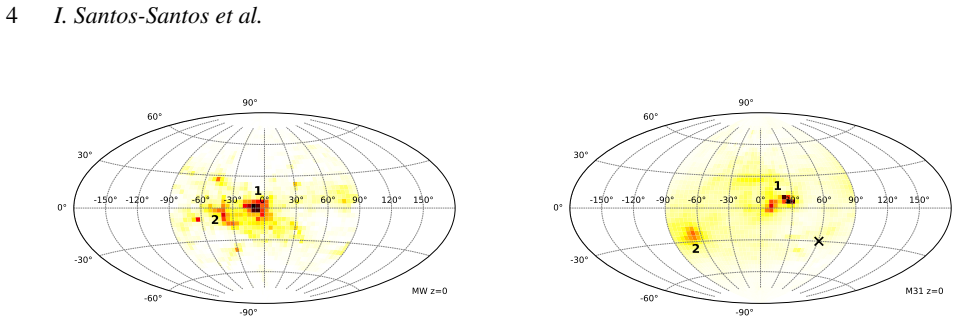
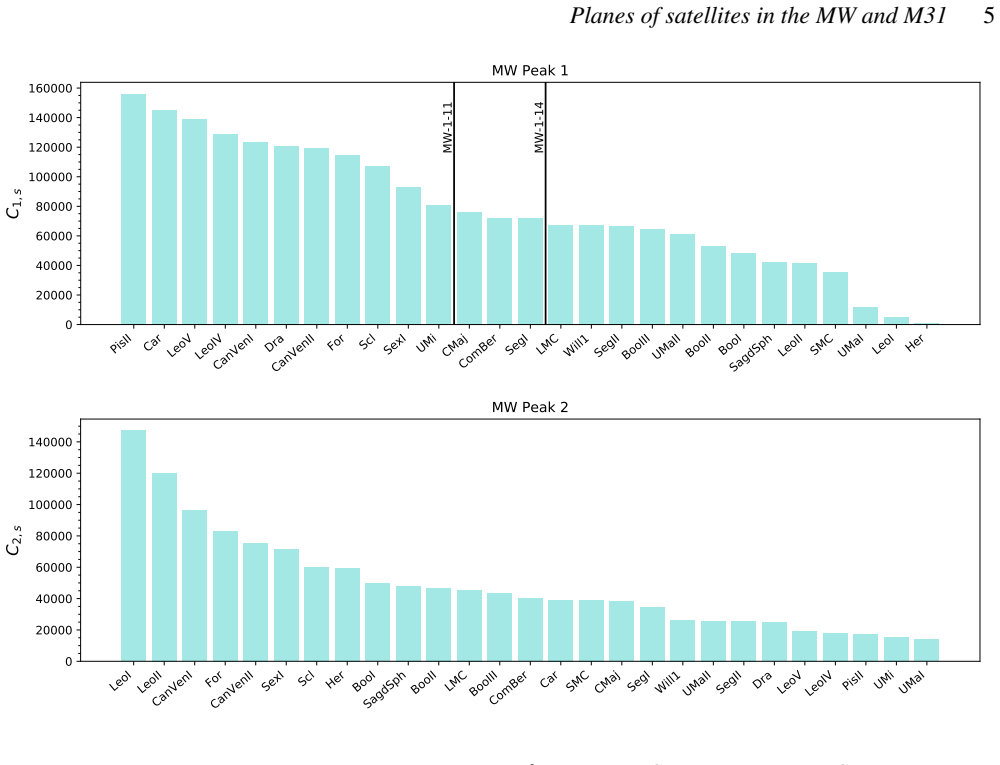
The load-bearing machinery is the extended 4-galaxy-normal density plot. The original method fits a plane to every four-satellite combination, repeats this for 100 random distance realizations per satellite, weights each resulting normal vector by $\log((a+b)/c)$, and projects them onto a sphere so that an over-density marks the normal to a dominant satellite plane. The extension counts, for each density peak, the total weighted contribution $C_{ps}$ of all 4-galaxy-normals lying within a $15^\circ$ aperture around the peak, ranks satellites by decreasing $C_{ps}$, and then iteratively fits tensor-of-inertia planes to the first 7, 8, 9, ... satellites in that order. Each over-density therefore becomes a catalog of planes of increasing $N_{\rm sat}$ whose quality is compared through $N_{\rm sat}$ and the flattening ratio $c/a$ (or rms thickness $\Delta_{\rm RMS}$), requiring $b/a \sim 1$ to confirm a genuinely planar, rather than filamentary, configuration.
What would settle it
Recompute the $C_{ps}$ ranking and the iterative plane collection from the same satellite positions using apertures of $10^\circ$ and $20^\circ$; if M31-2-18 loses its 18 members, shifts its normal by more than its quoted $\Delta_{\rm sph}=3.16^\circ$, or its $c/a$ rises well above $0.15$, the claim that it rivals the GPoA fails. A kinematic check would measure proper motions of the 18 members and test whether their orbital poles are as collimated with the plane normal as the GPoA's are.
Extended reading notes
Core claim
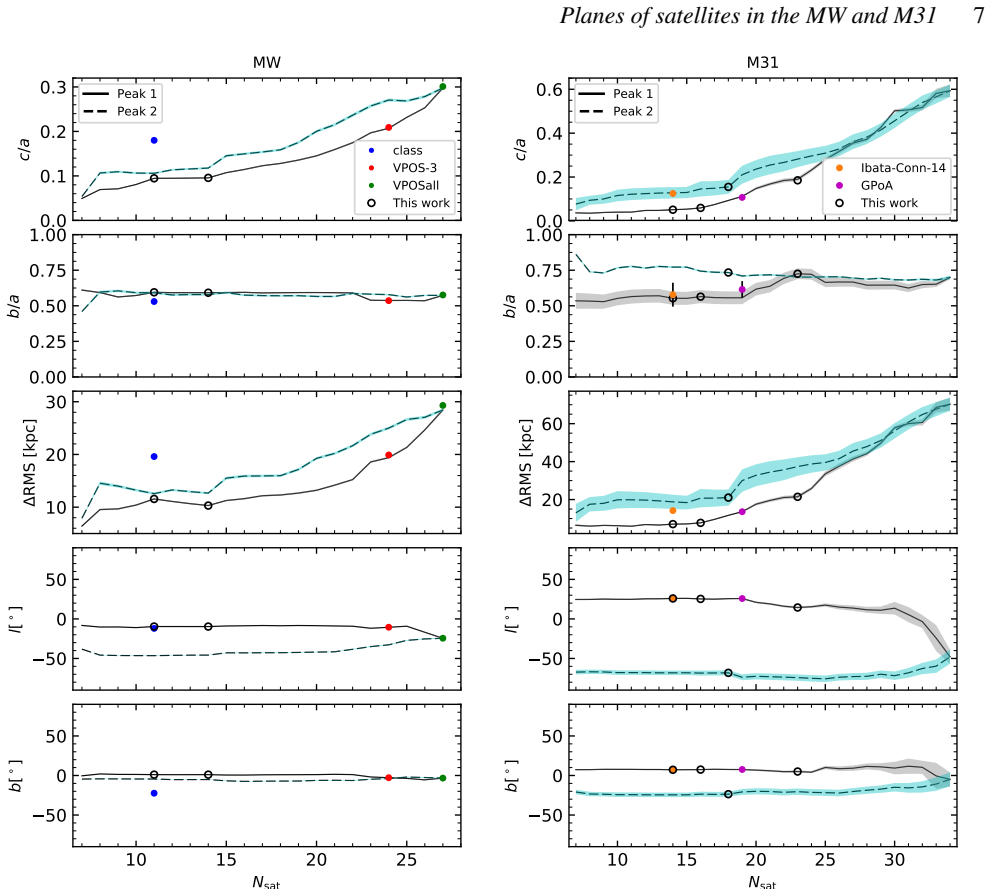
The central discovery is that the two dominant 4-galaxy-normal over-densities in each galaxy, when expanded into ordered plane collections, reveal higher-quality planes than the previously reported benchmarks. In the Milky Way, a particular combination of 11 satellites (MW-1-11) and one of 14 (MW-1-14) are nearly twice as flat as the classical plane of the 11 most luminous satellites, with short-to-long axis ratios $c/a \approx 0.095$ compared with $c/a \approx 0.18$. In M31, the peak that contains the Great Plane of Andromeda yields improved 14- and 16-satellite planes (M31-1-14 and M31-1-16), while the second, previously unstudied peak yields M31-2-18: 18 satellites with $c/a \approx 0.155 \pm 0.032$, viewed nearly face-on from the Milky Way, roughly perpendicular to the GPoA, and of quality comparable to the GPoA's $N_{\rm sat}=19$, $c/a = 0.107 \pm 0.005$. The paper also finds that a satellite's contribution to the relevant density peaks is uncorrelated with its stellar mass, meaning the best planes are not assembled from the most massive satellites.
Load-bearing premise
The ranking that decides which satellites belong to each plane depends on an untested choice of a $15^\circ$ aperture around a density peak for summing each satellite's weighted contribution, and if a different aperture changed that ranking, the singled-out planes, especially M31-2-18, could change.
Editorial extensions
If this is right
- The Milky Way's best plane is not the classical one: with $N_{\rm sat}=11$ and $c/a\approx 0.095$, MW-1-11 is much flatter, and adding three more satellites to make MW-1-14 keeps the same thinness, so any census restricted to the brightest satellites systematically misses the most planar structure.
- M31 contains two comparably good planes, not one: the 19-member GPoA and the newly found 18-member M31-2-18, which are roughly perpendicular and share ten satellites.
- Because M31-2-18 is viewed nearly face-on, its $c/a$ and $\Delta_{\rm RMS}$ carry larger distance-error bars than the GPoA's, yet it still reaches comparable quality, so the second plane is not an artifact of the binary's viewing geometry.
- Stellar mass is not correlated with $C_{ps}$ for either galaxy, so plane membership is not determined by satellite mass; any successful formation model must populate planes without preferring massive dwarfs.
Reading between the lines
- A direct test of the method's robustness would be to repeat the $C_{ps}$ ranking with apertures of, say, $10^\circ$ and $20^\circ$ around each density peak; if the 18-member set and normal direction of M31-2-18 persist, the plane is stable, and if not, the comparability claim weakens.
- Two roughly orthogonal high-quality planes in one galaxy suggest a single coherent accretion stream cannot be the whole story; models may need two separate infall directions or a process that creates near-orthogonal families of dwarf orbits.
- The same extended method could be applied to other nearby groups, such as Centaurus A, to ask whether multiple orthogonal satellite planes are common in galaxy groups or peculiar to M31.
- With future proper motions for M31 dwarfs, one could test whether the M31-2-18 members corotate as a set; the paper's line-of-sight velocity dispersion of about 90 km/s would then be compared with the full 3D orbital poles.
Signed reviews
Editorial analysis
A structured set of objections, weighed in public.
Referee Report
Summary. The paper extends the '4-galaxy-normal density plot' method of Pawlowski et al. (2013) to generate, for each dominant over-density of satellite positions around the Milky Way and M31, an ordered collection of planes with increasing member number N_sat. Plane quality is quantified via the Tensor of Inertia outputs (c/a, b/a, ΔRMS, normal direction, and distance to host). Applying this to the same 27 MW and 34 M31 confirmed satellites used by Pawlowski et al., the authors single out several high-quality planes: MW-1-11, MW-1-14, M31-1-14, M31-1-16, M31-1-23, and M31-2-18. The headline claims are that M31-2-18 (N_sat=18) has quality comparable to the Great Plane of Andromeda (GPoA, N_sat=19), that this second M31 plane is roughly perpendicular to the GPoA and viewed nearly face-on from the Milky Way, and that stellar mass does not determine a satellite's membership in the best-quality planes.
Significance. If the method and results hold, the paper provides a systematic way to build and compare satellite plane candidates at fixed N_sat or fixed flattening, and it presents the first detailed analysis of a second substantial planar structure in M31. The Monte Carlo propagation of distance uncertainties into the plane parameters is a strength, as is the explicit comparison with previously published planes (classical, VPOS-3, VPOSall, Ibata-Conn-14, GPoA) using the same satellite sample. The mass-independence test (Fig. 5) is a useful falsifiable statement. However, the central claim of comparability between M31-2-18 and the GPoA is weakened by an internal numerical inconsistency and by the lack of a sensitivity test for the key aperture parameter that defines plane membership; these issues affect the manuscript's main conclusion as currently stated.
major comments (3)
- [Sec. 3.1(iv) and Sec. 3.2] The 15-degree aperture angle used to compute the contribution C_ps of each satellite to a density peak is a free parameter, and the paper tests only bin-size stability (Sec. 3.1, final paragraph), not aperture stability. Because the ordered list of satellites by decreasing C_ps determines the membership of every plane in the collection, including M31-2-18, changing the aperture could alter which satellites are included and hence the c/a, ΔRMS, and normal directions of the singled-out planes. The authors should demonstrate that the recovered planes and their ToI parameters are stable when the aperture is varied (for example, 10 and 20 degrees), or provide a sample-independent criterion for choosing 15 degrees. Without this, the identification of M31-2-18 as a comparable-quality second plane is conditional on an untested hand-chosen parameter.
- [Sec. 4.2.1 and Tables 1-2] The statement that the differences between M31-2-18 and the GPoA are 'a 5% in N_sat, and a 10% in the c/a values' is inconsistent with the paper's own tables. From Table 1, c/a(GPoA)=0.107±0.005; from Table 2, c/a(M31-2-18)=0.155±0.032, which is a difference of roughly 45%, not 10%. In addition, ΔRMS is 13.6±0.2 kpc for the GPoA versus 21.0±4.2 kpc for M31-2-18 (a ~55% larger thickness), and D_M31 is 1.3±0.6 kpc versus 34.9±11.2 kpc. These differences are large enough that 'comparable quality' is not supported by the quoted numbers; the comparison should be reworded or the statistics revisited before the central claim can be accepted.
- [Sec. 4.2.1] The paper reports a line-of-sight velocity dispersion of σ=90.20 km/s for M31-2-18 and immediately cites Fernando et al. (2017) to state that such a plane would be erased in a short timescale. This directly undercuts the physical significance of the newly identified plane, yet the paper does not explain how a spatially well-defined but dynamically short-lived structure should be interpreted. If 'quality' is intended purely as a spatial/morphological measure, that should be stated explicitly and distinguished from dynamical stability; if the plane is meant to be physically meaningful, the velocity-dispersion argument needs to be addressed rather than merely noted.
minor comments (4)
- [Section 3.1 and References] The citation 'CRAMR 1999' appears to be a typographical corruption of Cramér; the reference entry also contains formatting errors ('V ol.', 'Y .,' etc.) that should be corrected in a journal proof.
- [Figure 1 caption] The caption reads 'M31's spin is marked with anX'; there is a missing space before 'X'. Additionally, the text states density maps are shown within l = [-90°, +90°], but the x-axis in Figure 1 extends beyond this interval; please clarify the coordinate range used.
- [Abstract and Section 4.2.1] The abstract claims M31-2-18 shows 'a quality comparable to the GPoA', while the body notes that the GPoA has one more satellite and a lower c/a and is therefore strictly higher quality. The abstract should carry the same caveat as the body to avoid overstatement.
- [Section 3.2] The statement that 'taking instead N_sat = 7 ± 2 to begin with does not alter our conclusions' is another parameter-sensitivity claim that is not demonstrated. Please provide the supporting test or remove the claim.
Circularity Check
No significant circularity: the new plane catalogue is produced by an explicitly planarity-based ranking, but the headline comparisons and mass test are anchored to independent data and prior measurements.
full rationale
The derivation chain is self-contained. The paper takes the 4-galaxy-normal density method from Pawlowski et al. (2013), summarizes it, and extends it by ranking satellites through C_ps, the sum of 4-galaxy-normal weights within a 15-degree aperture around each density peak. The ToI parameters of the resulting nested plane collection are then computed from the satellite positions. No parameter is fitted to a subset and then predicted on a closely related quantity; the 'singled out' planes are read off from the c/a and Delta_RMS versus N_sat curves, which are measurements, not predictions. Comparisons to the classical MW plane, Ibata-Conn-14, and GPoA come from independent prior work (Metz et al. 2007; Ibata et al. 2013; Conn et al. 2013; Pawlowski et al. 2013), and the mass-C_ps correlation test is external to the plane construction. The fact that selecting satellites by their contribution to a planar overdensity tends to produce flattened planes is a selection effect, but the paper does not present this as an independent first-principles prediction. The untested 15-degree aperture is a robustness caveat rather than a circular reduction, because C_ps is not defined in terms of the final plane's c/a or membership. Thus no circular step meeting the required evidentiary bar is present.
Assumptions & free parameters
free parameters (3)
- Aperture angle around density peak =
15 degrees
- Initial number of satellites for plane collection =
7
- Density map bin size =
not specified
assumptions (4)
- domain assumption The 4-galaxy-normal density plot method of Pawlowski et al. (2013) correctly identifies dominant planar configurations.
- domain assumption The McConnachie (2012) database as of 17 June 2013 gives unbiased positions and Gaussian distance uncertainties for all confirmed MW and M31 satellites.
- domain assumption Tensor of Inertia parameters (c/a, b/a, Delta_RMS) are adequate quality measures for satellite planes.
- ad hoc to paper The 15-degree aperture and the log((a+b)/c) weighting emphasize planar configurations without introducing artifacts.
Cite this review
Pith. "Pith review of An analysis of satellite planar configurations around the MW and M31: singling out new high quality planes." pith.science (2026). https://pith.science/paper/EH3A73R6
@misc{pith2026190802298,
  author       = {Pith},
  title        = {Pith review of: An analysis of satellite planar configurations around the MW and M31: singling out new high quality planes},
  year         = {2026},
  howpublished = {\url{https://pith.science/paper/EH3A73R6}},
  note         = {Machine review of arXiv:1908.02298}
}
abstract
We present a detailed characterization of planes of satellites in the Milky Way (MW) and M31 systems. To this end we introduce an extension to the '4-galaxy-normal density plot' method \citep{Pawlowski13}, by which plot over-densities signal the normal direction to predominant planes of satellites within a given sample. For a given over-density, the extension provides a \textit{collection} of planes, each including a different number of objects $N_{\rm sat}$. We apply this method to the position data of confirmed MW and M31 satellites and quantify the quality of planes through the outputs of a Tensor of Inertia plane-fitting technique. Plane quality is quantified in terms of population ($N_{\rm sat}$) and flattening (the short-to-long axis ratio $c/a$ or the rms thickness normal to the plane). Therefore, planes with the same population or flattening can be compared with each other allowing us to single-out best-quality planes. For the first time, we study the second-most predominant planar configuration of satellites in M31, singling out a plane with 18 satellite members that shows a quality comparable to the Great Plane of Andromeda (GPoA, with $N_{\rm sat}=19$) despite it being more affected by distance uncertainties. This structure is viewed nearly face-on from the MW and is approximately normal to the GPoA. Overall, we find planes of satellites around the MW and M31 with higher qualities than those previously reported with a given $N_{\rm sat}$. We also show that mass plays no role in determining a satellite's membership or not to the respective best-quality planes.
Figures

Figures from the paper (2 more)

Reference graph
Works this paper leans on
-
[1]
, " * write output.state after.block = add.period write newline
ENTRY address author booktitle chapter edition editor howpublished institution journal key month note number organization pages publisher school series title type volume year label extra.label sort.label short.list INTEGERS output.state before.all mid.sentence after.sentence after.block FUNCTION init.state.consts #0 'before.all := #1 'mid.sentence := #2 '...
-
[2]
write newline
" write newline "" before.all 'output.state := FUNCTION n.dashify 't := "" t empty not t #1 #1 substring "-" = t #1 #2 substring "--" = not "--" * t #2 global.max substring 't := t #1 #1 substring "-" = "-" * t #2 global.max substring 't := while if t #1 #1 substring * t #2 global.max substring 't := if while FUNCTION word.in bbl.in " " * FUNCTION format....
-
[3]
Bechtol K. et al. , 2015, , 807, 50
work page 2015
-
[4]
Collins M. L. M. et al. , 2013, , 768, 172
work page 2013
-
[5]
Collins M. L. M. et al. , 2015, , 799, L13
work page 2015
-
[6]
Conn A. R. et al. , 2013, , 766, 120
work page 2013
-
[7]
CRAMÉR H., 1999, Mathematical Methods of Statistics (PMS-9). Princeton University Press
work page 1999
-
[8]
Fernando N., Arias V., Guglielmo M., Lewis G. F., Ibata R. A., Power C., 2017, , 465, 641
work page 2017
Show all 45 references
-
[9]
K., Battaglia G., Pawlowski M
Fritz T. K., Battaglia G., Pawlowski M. S., Kallivayalil N., van der Marel R., Sohn T. S., Brook C., Besla G., 2018, ArXiv e-prints, arXiv:1805.00908
2018 arXiv
-
[10]
R., 1995, , 110, 1664
Fusi Pecci F., Bellazzini M., Cacciari C., Ferraro F. R., 1995, , 110, 1664
1995
-
[11]
, 2018, , 616, A12
Gaia Collaboration et al. , 2018, , 616, A12
2018
-
[12]
K., Kolatt T., Brandner W., 1999, in IAU Symposium, Vol
Grebel E. K., Kolatt T., Brandner W., 1999, in IAU Symposium, Vol. 192, The Stellar Content of Local Group Galaxies, Whitelock P., Cannon R., eds., p. 447
1999
-
[13]
Ibata R. A. et al. , 2013, , 493, 62
2013
-
[14]
C., Mackey D., Da Costa G
Keller S. C., Mackey D., Da Costa G. S., 2012, , 744, 57
2012
-
[15]
K., 2006, , 131, 1405
Koch A., Grebel E. K., 2006, , 131, 1405
2006
-
[16]
E., Belokurov V., Torrealba G., Evans N
Koposov S. E., Belokurov V., Torrealba G., Evans N. W., 2015, , 805, 130
2015
-
[17]
Kroupa P. et al. , 2010, , 523, A32
2010
-
[18]
M., 2005, , 431, 517
Kroupa P., Theis C., Boily C. M., 2005, , 431, 517
2005
-
[19]
E., Demers S., 1976, in The Galaxy and the Local Group, Vol
Kunkel W. E., Demers S., 1976, in The Galaxy and the Local Group, Vol. 182, p. 241
1976
-
[20]
I., Frenk C
Libeskind N. I., Frenk C. S., Cole S., Helly J. C., Jenkins A., Navarro J. F., Power C., 2005, , 363, 146
2005
-
[21]
Lynden-Bell D., 1976, , 174, 695
1976
-
[22]
Lynden-Bell D., 1982, The Observatory, 102, 202
1982
-
[23]
R., 1994, , 431, L17
Majewski S. R., 1994, , 431, L17
1994
-
[24]
Martin N. F. et al. , 2014, , 793, L14
2014
-
[25]
Martin N. F. et al. , 2016, , 833, 167
2016
-
[26]
J., Rix H.-W., Franco V
Mart \' nez-Delgado D., Butler D. J., Rix H.-W., Franco V. I., Pe \ n arrubia J., Alfaro E. J., Dinescu D. I., 2005, , 633, 205
2005
-
[27]
K., Zinn R., Miller L
Mateu C., Vivas A. K., Zinn R., Miller L. R., Abad C., 2009, , 137, 4412
2009
-
[28]
W., 2012, , 144, 4
McConnachie A. W., 2012, , 144, 4
2012
-
[29]
W., Irwin M
McConnachie A. W., Irwin M. J., 2006, , 365, 902
2006
-
[30]
McConnachie A. W. et al. , 2009, , 461, 66
2009
-
[31]
Metz M., Kroupa P., Jerjen H., 2007, , 374, 1125
2007
-
[32]
Metz M., Kroupa P., Jerjen H., 2009, , 394, 2223
2009
-
[33]
R., Bonifacio P., Piotto G., De Angeli F., Bedin L
Momany Y., Zaggia S. R., Bonifacio P., Piotto G., De Angeli F., Bedin L. R., Carraro G., 2004, , 421, L29
2004
-
[34]
S., Binggeli B., 2016, , 595, A119
M \"u ller O., Jerjen H., Pawlowski M. S., Binggeli B., 2016, , 595, A119
2016
-
[35]
S., Jerjen H., Lelli F., 2018, Science, 359, 534
M \"u ller O., Pawlowski M. S., Jerjen H., Lelli F., 2018, Science, 359, 534
2018
-
[36]
S., 2016, , 456, 448
Pawlowski M. S., 2016, , 456, 448
2016
-
[37]
S., Kroupa P., 2014, , 790, 74
Pawlowski M. S., Kroupa P., 2014, , 790, 74
2014
-
[38]
S., Kroupa P., Jerjen H., 2013, , 435, 1928
Pawlowski M. S., Kroupa P., Jerjen H., 2013, , 435, 1928
2013
-
[39]
S., McGaugh S
Pawlowski M. S., McGaugh S. S., 2014, , 789, L24
2014
-
[40]
S., McGaugh S
Pawlowski M. S., McGaugh S. S., Jerjen H., 2015, , 453, 1047
2015
-
[41]
S., Pflamm-Altenburg J., Kroupa P., 2012, , 423, 1109
Pawlowski M. S., Pflamm-Altenburg J., Kroupa P., 2012, , 423, 1109
2012
-
[42]
J., Tully R
Shaya E. J., Tully R. B., 2013, , 436, 2096
2013
-
[43]
B., Libeskind N
Tully R. B., Libeskind N. I., Karachentsev I. D., Karachentseva V. E., Rizzi L., Shaya E. J., 2015, , 802, L25
2015
-
[44]
Woo J., Courteau S., Dekel A., 2008, , 390, 1453
2008
-
[45]
York D. G. et al. , 2000, , 120, 1579
2000
Reviewed August 14, 2026 · model on record in the stance chip above.
Discussion (0). Continue with ORCID to comment.