Symmetric tensor decomposition on rational varieties
Pith reviewed 2026-06-25 19:58 UTC · model grok-4.3
The pith
Symmetric tensors with nodes on rational varieties admit explicit Waring decompositions under a technical assumption, which also yields new sharp upper bounds on quadrature nodes for rational curves.
A machine-rendered reading of the paper's core claim, the machinery that carries it, and where it could break.
Core claim
The authors characterize the existence of Waring decompositions for symmetric tensors whose support lies on a rational variety, under a technical assumption, and give an efficient decomposition algorithm. This generalizes Hankel tensor decompositions to the multivariate case. In the case of rational curves, they prove the existence of a quadrature formula of even strength 2N using at most N + 1 nodes that avoids any prescribed finite set of points, thereby establishing new sharp upper bounds on the minimal number of nodes required for quadrature formulae on rational curves.
What carries the argument
The generalization of Hankel tensors to the class of symmetric tensors with nodes on rational varieties, together with the existence proof for low-node even-strength quadrature formulas on rational curves.
If this is right
- An efficient algorithm computes the decomposition for this class of tensors.
- Quadrature formulas of even strength 2N on rational curves need at most N+1 nodes.
- The same bounds hold while avoiding any finite prescribed set of points.
- The framework applies directly to toric varieties as well as rational curves.
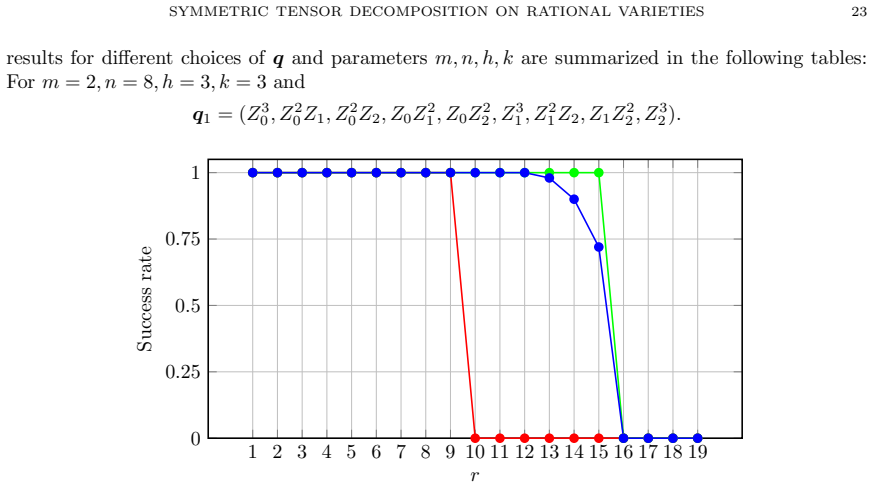
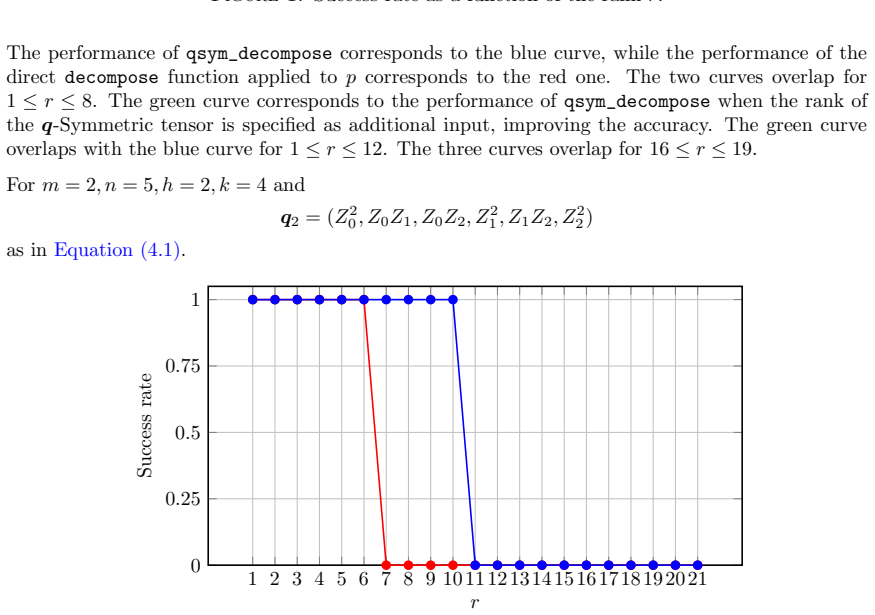
- Numerical tests show measurable improvement over classical direct decomposition methods.
Where Pith is reading between the lines
- The approach may extend to moment problems or polynomial interpolation on other algebraic varieties.
- Relaxing the technical assumption could enlarge the class of tensors that admit closed-form decompositions.
- The node bounds could inform minimal-sample designs in algebraic statistics or approximation theory.
- Implementation on toric varieties might yield practical methods for multivariate Hankel-like tensors.
Load-bearing premise
The decomposition must satisfy an unspecified technical condition for the explicit characterization and algorithm to apply.
What would settle it
A concrete symmetric tensor on a rational variety whose Waring decomposition fails to match the claimed explicit characterization, or an explicit quadrature formula of strength 2N on a rational curve that requires strictly more than N+1 nodes while avoiding the prescribed points.
Figures
read the original abstract
We study the Waring decomposition of symmetric tensors with nodes on a rational variety. We provide an explicit characterisation of the existence of such a decomposition under some technical assumption, and introduce an efficient algorithm to decompose this novel class of structured symmetric tensors. The framework directly generalizes Hankel tensors (Qi 2015) to the multivariate setting. We analyse in details the case of toric varieties and rational curves. Proving the existence of a quadrature formula of even strength 2N with at most N + 1 nodes, that avoids a prescribed finite set of points, we establish new sharp upper bounds on the minimal number of nodes for quadrature formulae on rational curves. Numerical experimentation demonstrates the gain of this approach, compared to classical direct approaches.
Editorial analysis
A structured set of objections, weighed in public.
Referee Report
Summary. The manuscript studies Waring decompositions of symmetric tensors with nodes on rational varieties. It provides an explicit characterization of the existence of such decompositions under a technical assumption, introduces an efficient algorithm generalizing the Hankel tensor case to the multivariate setting, analyzes toric varieties and rational curves in detail, and proves the existence of quadrature formulae of even strength 2N with at most N+1 nodes avoiding a prescribed finite set of points, yielding new sharp upper bounds on the minimal number of nodes for quadrature on rational curves. Numerical experiments compare the approach to classical methods.
Significance. If the technical assumption holds in a sufficiently broad class of cases and the proofs are complete, the work would extend structured tensor decomposition techniques from the Hankel setting to rational varieties, with direct implications for algebraic geometry and numerical quadrature. The explicit characterization, algorithm, and quadrature bounds would represent a concrete advance if the assumption is mild and the sharpness claims are unconditional or clearly delimited.
major comments (3)
- [Abstract, §1] Abstract and §1: The central claims—an explicit characterization, the efficient algorithm, and the new sharp upper bounds on quadrature nodes—are all conditioned on an unspecified 'technical assumption.' This assumption is load-bearing; without its precise statement (e.g., whether it is a genericity, smoothness, or rank condition), the scope of the generalization beyond Hankel tensors and the applicability of the quadrature results cannot be assessed.
- [§4] §4 (Quadrature on rational curves): The proof of existence of a strength-2N quadrature formula with ≤N+1 nodes avoiding prescribed points is used to claim 'sharp' upper bounds. The manuscript must clarify whether sharpness holds unconditionally or only under the technical assumption, and must compare the new bounds to existing unconditional results in the literature on rational curves.
- [§3] §3 (Toric varieties and algorithm): The efficiency claim for the decomposition algorithm on toric varieties lacks a complexity analysis or explicit comparison to direct methods; this is needed to substantiate the asserted gain, especially since the characterization itself depends on the technical assumption.
minor comments (2)
- [§2] Notation for the Waring rank and the node set should be introduced consistently in §2 before being used in the characterization theorem.
- [Numerical experiments] The numerical experiments section would benefit from reporting the precise dimensions, ranks, and runtimes for the toric and curve examples to allow direct reproducibility.
Simulated Author's Rebuttal
We thank the referee for the careful reading and constructive comments. We address each major comment below and will revise the manuscript accordingly to improve clarity and completeness.
read point-by-point responses
-
Referee: [Abstract, §1] Abstract and §1: The central claims—an explicit characterization, the efficient algorithm, and the new sharp upper bounds on quadrature nodes—are all conditioned on an unspecified 'technical assumption.' This assumption is load-bearing; without its precise statement (e.g., whether it is a genericity, smoothness, or rank condition), the scope of the generalization beyond Hankel tensors and the applicability of the quadrature results cannot be assessed.
Authors: We agree that the technical assumption must be stated precisely. It is a genericity condition on the points and the rank of the symmetric tensor relative to the rational variety. In the revised manuscript we will state the assumption explicitly in the abstract and §1, together with a brief discussion of the class of varieties and tensors to which it applies. revision: yes
-
Referee: [§4] §4 (Quadrature on rational curves): The proof of existence of a strength-2N quadrature formula with ≤N+1 nodes avoiding prescribed points is used to claim 'sharp' upper bounds. The manuscript must clarify whether sharpness holds unconditionally or only under the technical assumption, and must compare the new bounds to existing unconditional results in the literature on rational curves.
Authors: We will revise §4 to state explicitly that the claimed sharpness of the upper bounds holds under the technical assumption. We will also add a short comparison with existing unconditional bounds in the literature on quadrature on rational curves, indicating where the new bounds improve upon or coincide with prior unconditional results. revision: yes
-
Referee: [§3] §3 (Toric varieties and algorithm): The efficiency claim for the decomposition algorithm on toric varieties lacks a complexity analysis or explicit comparison to direct methods; this is needed to substantiate the asserted gain, especially since the characterization itself depends on the technical assumption.
Authors: We acknowledge the absence of a formal complexity analysis. In the revised §3 we will include an explicit complexity discussion (including operation counts in terms of the dimension and degree) and a direct comparison with classical unstructured decomposition methods, thereby substantiating the efficiency gain under the technical assumption. revision: yes
Circularity Check
No significant circularity; derivation remains self-contained
full rationale
The provided abstract and description present an explicit characterization of Waring decompositions under a stated technical assumption, an algorithm for structured tensors generalizing Hankel tensors via external citation (Qi 2015), and quadrature bounds derived from a separate existence proof for node-avoiding formulas on rational curves. No equations, self-citations, or steps are exhibited that reduce the central claims to fitted inputs, self-definitions, or author-overlapping uniqueness results by construction. The framework is positioned against classical direct approaches as an independent gain, satisfying the criteria for a non-circular finding.
Axiom & Free-Parameter Ledger
axioms (1)
- domain assumption Technical assumption enabling the explicit characterization of the decomposition
Reference graph
Works this paper leans on
-
[1]
C. Abrams and G. Bussi. “Enhanced sampling in molecular dynamics using metadynamics, replica-exchange, and temperature-acceleration”. In: Entropy 16.1 (2014), pp. 163–199. issn: 1099-4300. doi: 10.3390/e16010163
-
[2]
On the construction of general cubature formula by flat extensions
M. Abril Bucero, C. Bajaj, and B. Mourrain. “On the construction of general cubature formula by flat extensions”. In: Linear Algebra Appl. 502 (2016), pp. 104–125. issn: 0024-3795,1873-
2016
-
[3]
doi: 10.1016/j.laa.2015.09.052
-
[4]
3D interpolation using Hankel tensor completion by orthogo- nal matching pursuit
A. Adamo and P. Mazzucchelli. “3D interpolation using Hankel tensor completion by orthogo- nal matching pursuit”. In: Gruppo Nazionale di Geofisica della Terra Solida (GNGTS) (2014), pp. 5–11
2014
-
[5]
Nonuniform Fourier transforms for rigid-body and multidimensional rotational correlations
C. Bajaj, B. Bauer, R. Bettadapura, and A. Vollrath. “Nonuniform Fourier transforms for rigid-body and multidimensional rotational correlations”. In: SIAM J. Sci. Comput. 35.4 (2013), B821–B845. issn: 1064-8275,1095-7197. doi: 10.1137/120892386
-
[6]
Decomposition of homogeneous polynomials with low rank
E. Ballico and A. Bernardi. “Decomposition of homogeneous polynomials with low rank”. In: Mathematische Zeitschrift 271 (2012), pp. 1141–1149. doi: 10.1007/s00209-011-0907-6
-
[7]
On the X-rank with respect to linear projections of projective varieties
E. Ballico and A. Bernardi. “On the X-rank with respect to linear projections of projective varieties”. In: Mathematische Nachrichten 284.17-18 (2011), pp. 2133–2140. doi: 10.1002/m ana.200910275
work page doi:10.1002/m 2011
-
[8]
Barrilli and B
E. Barrilli and B. Mourrain. TensorDec.jl. https://github.com/AlgebraicGeometricMode ling/TensorDec.jl. 2017
2017
-
[9]
The proof of Tchakaloff’s theorem
C. Bayer and J. Teichmann. “The proof of Tchakaloff’s theorem”. In: Proc. Amer. Math. Soc. 134.10 (2006), pp. 3035–3040. issn: 0002-9939,1088-6826. doi: 10.1090/S0002-9939-06-082 49-9
-
[10]
M. Bechere. QSymDecomposition.jl. https://github.com/matteobechere/QSymDecomposit ion.jl. 2026
2026
-
[11]
A. Bernardi, J. Brachat, P. Comon, and B. Mourrain. “General tensor decomposition, moment matrices and applications”. In: Journal of Symbolic Computation 52 (2013). International Symposium on Symbolic and Algebraic Computation, pp. 51–71. issn: 0747-7171. doi: http s://doi.org/10.1016/j.jsc.2012.05.012
-
[12]
A. Bernardi, E. Carlini, M. V. Catalisano, A. Gimigliano, and A. Oneto. “The Hitchhiker Guide to: Secant Varieties and Tensor Decomposition”. In: Mathematics 6.12 (2018). issn: 2227-7390. doi: 10.3390/math6120314
-
[13]
Generalized eigen- value methods for Gaussian quadrature rules
G. Blekherman, M. Kummer, C. Riener, M. Schweighofer, and C. Vinzant. “Generalized eigen- value methods for Gaussian quadrature rules”. In: Annales Henri Lebesgue 3 (2020), pp. 1327– 1341
2020
-
[14]
J. Brachat, P. Comon, B. Mourrain, and E. Tsigaridas. “Symmetric tensor decomposition”. In: Linear Algebra Appl. 433.11-12 (2010), pp. 1851–1872. issn: 0024-3795,1873-1856. doi: 10.1016/j.laa.2010.06.046
-
[15]
Valuation of mortgage-backed securities using Brownian bridges to reduce effective dimension
R. E. Caflisch, W. J. Morokoff, and A. B. Owen. “Valuation of mortgage-backed securities using Brownian bridges to reduce effective dimension”. In: Journal of Computational Finance 1 (1997), pp. 27–46
1997
-
[16]
Algorithms for computing cubatures based on moment theory
M. Collowald and E. Hubert. “Algorithms for computing cubatures based on moment theory”. In: Stud. Appl. Math. 141.4 (2018), pp. 501–546. issn: 0022-2526,1467-9590. doi: 10.1111/s apm.12240
work page doi:10.1111/s 2018
-
[17]
P. Comon, G. Golub, L.-H. Lim, and B. Mourrain. “Symmetric Tensors and Symmetric Tensor Rank”. In: SIAM Journal on Matrix Analysis and Applications 30.3 (2008), pp. 1254–1279. doi: 10.1137/060661569
-
[18]
On the typical rank of real binary forms
P. Comon and G. Ottaviani. “On the typical rank of real binary forms”. In: Linear Multilinear Algebra 60.6 (2012), pp. 657–667. issn: 0308-1087,1563-5139. doi: 10.1080/03081087.2011 .624097
-
[19]
Constructing cubature formulae: the science behind the art
R. Cools. “Constructing cubature formulae: the science behind the art”. In: Acta numerica,
-
[20]
Vol. 6. Acta Numer. Cambridge Univ. Press, Cambridge, 1997, pp. 1–54. isbn: 0-521- 59106-6. doi: 10.1017/S0962492900002701
-
[21]
Recursiveness, positivity, and truncated moment problems
R. E. Curto and L. A. Fialkow. “Recursiveness, positivity, and truncated moment problems”. In: Houston J. Math. 17.4 (1991), pp. 603–635. issn: 0362-1588
1991
-
[22]
Solution of the singular quartic moment problem
R. E. Curto and L. A. Fialkow. “Solution of the singular quartic moment problem”. In: J. Operator Theory 48.2 (2002), pp. 315–354. issn: 0379-4024,1841-7744. REFERENCES 25
2002
-
[23]
Solution of the truncated complex moment problem for flat data
R. E. Curto and L. A. Fialkow. “Solution of the truncated complex moment problem for flat data”. In: Mem. Amer. Math. Soc. 119.568 (1996), pp. x+52. issn: 0065-9266,1947-6221. doi: 10.1090/memo/0568
-
[24]
Solution of the truncated hyperbolic moment problem
R. E. Curto and L. A. Fialkow. “Solution of the truncated hyperbolic moment problem”. In: Integral Equations Operator Theory 52.2 (2005), pp. 181–218. issn: 0378-620X,1420-8989. doi: 10.1007/s00020-004-1340-6
-
[25]
Solution of the truncated parabolic moment problem
R. E. Curto and L. A. Fialkow. “Solution of the truncated parabolic moment problem”. In: Integral Equations Operator Theory 50.2 (2004), pp. 169–196. issn: 0378-620X,1420-8989. doi: 10.1007/s00020-003-1275-3
-
[26]
Truncated K-moment problems in several variables
R. E. Curto and L. A. Fialkow. “Truncated K-moment problems in several variables”. In: J. Operator Theory 54.1 (2005), pp. 189–226. issn: 0379-4024,1841-7744
2005
-
[27]
The truncated moment problem on parallel lines
L. A. Fialkow. “The truncated moment problem on parallel lines”. In: The varied landscape of operator theory. Vol. 17. Theta Ser. Adv. Math. Theta, Bucharest, 2014, pp. 109–126. isbn: 978-606-8443-04-1
2014
-
[28]
The Effective Generalized Moment Problem
L. Gamertsfelder and B. Mourrain. “The Effective Generalized Moment Problem”. Jan. 2025
2025
-
[29]
Zur Theorie der bin¨ aren Formen
S. Gundelfinger. “Zur Theorie der bin¨ aren Formen.” In: Journal f¨ ur die reine und angewandte Mathematik 100 (1887), pp. 413–424
-
[30]
C. J. Hillar and L.-H. Lim. “Most tensor problems are NP-hard”. In: J. ACM 60.6 (2013), Art. 45, 39. issn: 0004-5411,1557-735X. doi: 10.1145/2512329
- [31]
-
[32]
A. Iarrobino and V. Kanev. Power sums, Gorenstein algebras, and determinantal loci. Vol. 1721. Lecture Notes in Mathematics. Appendix C by Iarrobino and Steven L. Kleiman. Springer- Verlag, Berlin, 1999, pp. xxxii+345. isbn: 3-540-66766-0. doi: 10.1007/BFb0093426
-
[33]
The Border Rank of the Multiplication of 2 × 2 Matrices Is Seven
J. M. Landsberg. “The Border Rank of the Multiplication of 2 × 2 Matrices Is Seven”. In:Jour- nal of the American Mathematical Society 19.2 (2006), pp. 447–459. issn: 08940347, 10886834
2006
-
[34]
Landsberg
J. Landsberg. Tensors: Geometry and Applications. Graduate studies in mathematics. Amer- ican Mathematical Society, 2012. isbn: 9780821884812
2012
-
[35]
Sums of squares, moment matrices and optimization over polynomials
M. Laurent. “Sums of squares, moment matrices and optimization over polynomials”. In: Emerging applications of algebraic geometry . Vol. 149. IMA Vol. Math. Appl. Springer, New York, 2009, pp. 157–270. isbn: 978-0-387-09685-8. doi: 10.1007/978-0-387-09686-5\_7
-
[36]
On generic and maximal k-ranks of binary forms
S. Lundqvist, A. Oneto, B. Reznick, and B. Shapiro. “On generic and maximal k-ranks of binary forms”. In: J. Pure Appl. Algebra 223.5 (2019), pp. 2062–2079. issn: 0022-4049,1873-
2019
-
[37]
doi: 10.1016/j.jpaa.2018.08.015
-
[38]
Lower bounds for the number of nodes in cubature formulae
H. M. M¨ oller. “Lower bounds for the number of nodes in cubature formulae”. In: Numerische Integration (Tagung, Math. Forschungsinst., Oberwolfach, 1978) . Vol. 45. Internat. Ser. Nu- mer. Math. Birkh¨ auser Verlag, Basel-Boston, Mass., 1979, pp. 221–230.isbn: 3-7643-1014-6
1978
-
[39]
Construction of algebraic cubature rules using poly- nomial ideal theory
C. R. Morrow and T. N. L. Patterson. “Construction of algebraic cubature rules using poly- nomial ideal theory”. In: SIAM J. Numer. Anal. 15.5 (1978), pp. 953–976. issn: 0036-1429. doi: 10.1137/0715062
-
[40]
A new criterion for normal form algorithms
B. Mourrain. “A new criterion for normal form algorithms”. In: Applied algebra, algebraic algorithms and error-correcting codes (Honolulu, HI, 1999). Vol. 1719. Lecture Notes in Com- put. Sci. Springer, Berlin, 1999, pp. 430–443. isbn: 3-540-66723-7. doi: 10.1007/3-540-467 96-3\_41
-
[41]
I. P. Mysovskikh. Interpolyatsionnye kubaturnye formuly. “Nauka”, Moscow, 1981, p. 336
1981
-
[42]
Nailwal and A
R. Nailwal and A. Zalar. Gaussian Quadratures with prescribed nodes via moment theory
-
[43]
arXiv: 2412.20849 [math.FA]
-
[44]
Y. Nesterov and A. Nemirovskii. Interior-point polynomial algorithms in convex programming. Vol. 13. SIAM Studies in Applied Mathematics. Society for Industrial and Applied Mathe- matics (SIAM), Philadelphia, PA, 1994, pp. x+405. isbn: 0-89871-319-6. doi: 10.1137/1.97 81611970791
-
[45]
Generating polynomials and symmetric tensor decompositions
J. Nie. “Generating polynomials and symmetric tensor decompositions”. In: Found. Comput. Math. 17.2 (2017), pp. 423–465. issn: 1615-3375,1615-3383. doi: 10.1007/s10208-015-9291 -7
-
[46]
Hankel Tensor Decompositions and Ranks
J. Nie and K. Ye. “Hankel Tensor Decompositions and Ranks”. In: SIAM Journal on Matrix Analysis and Applications 40.2 (2019), pp. 486–516. doi: 10.1137/18M1168285
-
[47]
J. Nie, K. Ye, and L. Zhi. Symmetric Tensor Decompositions On Varieties . 2020. arXiv: 200 3.09822 [math.NA]. REFERENCES 26
2020
-
[48]
Eigenvectors of tensors and algorithms for Waring decomposi- tion
L. Oeding and G. Ottaviani. “Eigenvectors of tensors and algorithms for Waring decomposi- tion”. In: J. Symbolic Comput. 54 (2013), pp. 9–35. issn: 0747-7171,1095-855X. doi: 10.101 6/j.jsc.2012.11.005
2013
-
[49]
Generalized identifiability of sums of squares
G. Ottaviani and E. Teixeira Turatti. “Generalized identifiability of sums of squares”. In: J. Algebra 661 (2025), pp. 641–656. issn: 0021-8693,1090-266X. doi: 10.1016/j.jalgebra.202 4.07.052
-
[50]
Exponential data fitting using multilin- ear algebra: the single-channel and multi-channel case
J. M. Papy, L. De Lathauwer, and S. Van Huffel. “Exponential data fitting using multilin- ear algebra: the single-channel and multi-channel case”. In: Numerical Linear Algebra with Applications 12.8 (2005), pp. 809–826. doi: 10.1002/nla.453
-
[51]
A dilation theory approach to cubature formulas
M. Putinar. “A dilation theory approach to cubature formulas”. In: Exposition. Math. 15.2 (1997), pp. 183–192. issn: 0723-0869
1997
-
[52]
Hankel Tensors: Associated Hankel Matrices and Vandermonde Decomposition
L. Qi. “Hankel Tensors: Associated Hankel Matrices and Vandermonde Decomposition”. In: Communications in Mathematical Sciences 13.1 (2014), pp. 113–125
2014
-
[53]
J. Radon. “Zur mechanischen Kubatur”. In: Monatsh. Math. 52 (1948), pp. 286–300. issn: 0026-9255,1436-5081. doi: 10.1007/BF01525334
-
[54]
Interpolation error estimates for mean value coordinates over convex polygons
A. Rand, A. Gillette, and C. Bajaj. “Interpolation error estimates for mean value coordinates over convex polygons”. In:Adv. Comput. Math. 39.2 (2013), pp. 327–347.issn: 1019-7168,1572-
2013
-
[55]
doi: 10.1007/s10444-012-9282-z
-
[56]
B. Reznick. “On the length of binary forms”. In: Quadratic and higher degree forms . Vol. 31. Dev. Math. Germany: Springer, 2013, pp. 207–232. doi: 10.1007/978-1-4614-7488-3\_8
-
[57]
Sums of even powers of real linear forms
B. Reznick. “Sums of even powers of real linear forms”. In: Mem. Amer. Math. Soc. 96.463 (1992), pp. viii+155. issn: 0065-9266,1947-6221. doi: 10.1090/memo/0463
-
[58]
Parameterfreie Absch¨ atzung und Realisierung von Erwartungswerten
H. W. Richter. “Parameterfreie Absch¨ atzung und Realisierung von Erwartungswerten”. In: Bl. Dtsch. Ges. Vers. Math. 3 (1957), pp. 147–161
1957
-
[59]
C. Riener and M. Schweighofer. “Optimization approaches to quadrature: new characteriza- tions of Gaussian quadrature on the line and quadrature with few nodes on plane algebraic curves, on the plane and in higher dimensions”. In: J. Complexity 45 (2018), pp. 22–54. issn: 0885-064X,1090-2708. doi: 10.1016/j.jco.2017.10.002
-
[60]
Riener and E
C. Riener and E. T. Turatti. Quadrature rules with few nodes supported on algebraic curves
-
[61]
On bivariate Gaussian cubature formulae
H. J. Schmid and Y. Xu. “On bivariate Gaussian cubature formulae”. In: Proc. Amer. Math. Soc. 122.3 (1994), pp. 833–841. issn: 0002-9939,1088-6826. doi: 10.2307/2160762
-
[62]
A kernel-based framework to tensorial data analysis
M. Signoretto, L. De Lathauwer, and J. A. Suykens. “A kernel-based framework to tensorial data analysis”. In: Neural Networks 24.8 (2011). Artificial Neural Networks: Selected Papers from ICANN 2010, pp. 861–874. issn: 0893-6080. doi: 10.1016/j.neunet.2011.05.011
-
[63]
Gaussian elimination is not optimal
V. Strassen. “Gaussian elimination is not optimal”. In: Numerische Mathematik 13.4 (Aug. 1969), pp. 354–356. doi: 10.1007/BF02165411
-
[64]
Integration formulas and orthogonal polynomials. II
A. H. Stroud. “Integration formulas and orthogonal polynomials. II”. In: SIAM J. Numer. Anal. 7 (1970), pp. 271–276. issn: 0036-1429. doi: 10.1137/0707019
-
[65]
Quadrature methods for functions of more than one variable
A. H. Stroud. “Quadrature methods for functions of more than one variable”. In: Ann. New York Acad. Sci. 86 (1960), pp. 776–791. issn: 0077-8923,1749-6632
1960
-
[66]
J. J. Sylvester. An essay on canonical forms, supplement to a sketch of a memoir on elimina- tion, transformation and canonical forms . 1904
1904
-
[67]
Formules de cubatures m´ ecaniques ` a coefficients non n´ egatifs
V. Tchakaloff. “Formules de cubatures m´ ecaniques ` a coefficients non n´ egatifs”. In:Bull. Sci. Math. (2) 81 (1957), pp. 123–134. issn: 0007-4497
1957
-
[68]
Interpolation using Hankel tensor completion
S. Trickett, L. Burroughs, and A. Milton. “Interpolation using Hankel tensor completion”. In: 2013 SEG Annual Meeting . Society of Exploration Geophysicists, 2013
2013
-
[69]
The truncated moment problem on curves y = q(x) and yxℓ = 1
A. Zalar. “The truncated moment problem on curves y = q(x) and yxℓ = 1”. In: Linear Multilinear Algebra 72.12 (2024), pp. 1922–1966. issn: 0308-1087,1563-5139. doi: 10.1080/0 3081087.2023.2212316. Matteo Bechere, Fachbereich Mathematik und Statistik, Universit¨at Konstanz, 78457 Konstanz, Germany Email address : matteo.bechere@uni-konstanz.de Salma Kuhlma...
work page doi:10.1080/0 2024
discussion (0)
Sign in with ORCID, Apple, or X to comment. Anyone can read and Pith papers without signing in.