REVIEW 2 major objections 5 minor 2 cited by
Subaru High-z Exploration of Low-Luminosity Quasars (SHELLQs). XXIV. 54 New Quasars and Candidate Obscured Quasars at $5.71 \le z \le 7.02$
T0 review · 2 major / 5 minor · reviewed 2026-08-05 · deepseek-v4-flash
Pith's one-line read The final SHELLQs spectroscopic batch adds 43 quasars, 11 obscured-quasar candidates, and 29 galaxies from the epoch of reionization.
desk verdict A useful final SHELLQs discovery catalog whose headline 43/11 split is not fully reproducible from Table 1 because four objects listed as quasars satisfy the paper's own narrow-line candidate criterion. read the letter →
The pith
A machine-rendered reading of the paper's core claim, the machinery that carries it, and where it could break.
The reading
What carries the argument
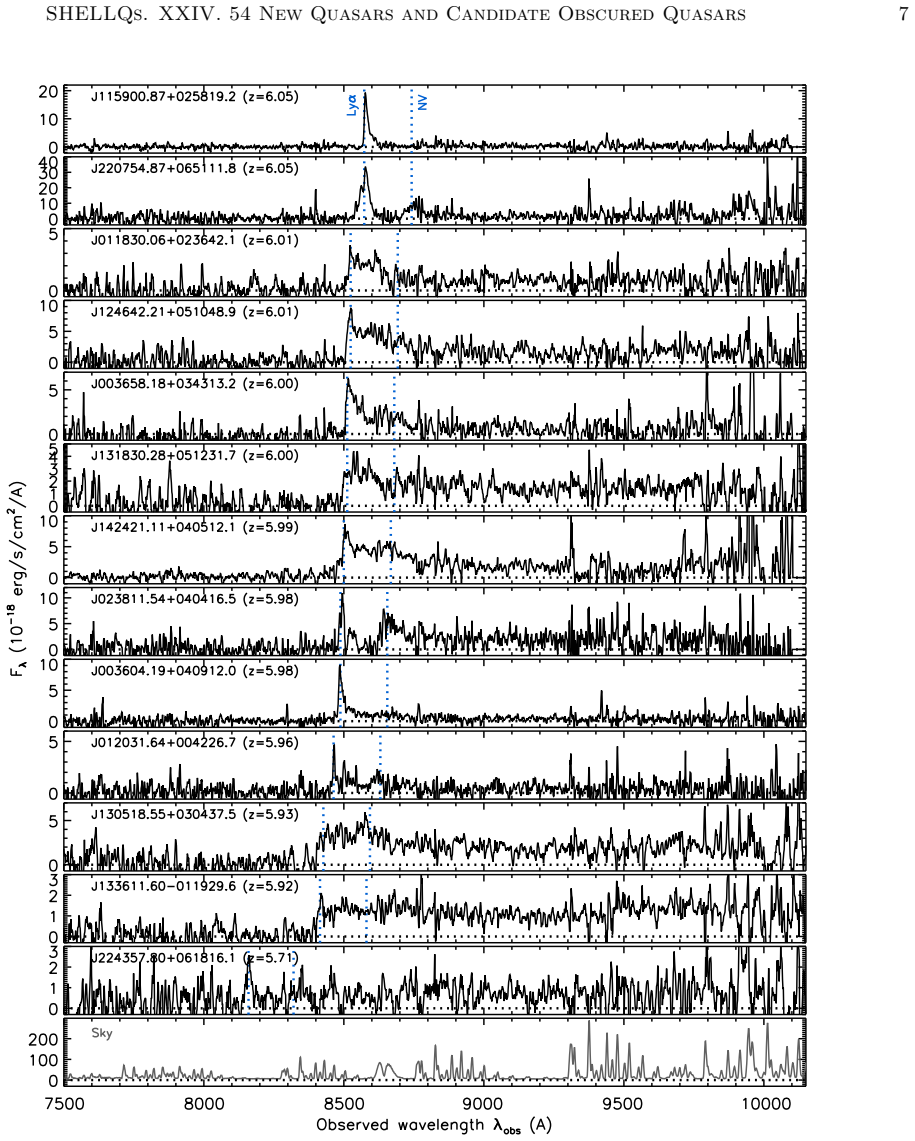
The working objects are dropout-selected quasar candidates from HSC imaging, chosen by i/z/y color cuts or a Bayesian probability algorithm and requiring a spectral break; the decisive observable is the Lyα region, where broad emission and blue continuum mark quasars, narrow bright Lyα marks candidate obscured quasars, and weak or absent Lyα marks galaxies. A relaxed image-shape criterion (µ/µ_PSF < 3.0 in the z band for i-dropouts) was added to recover more extended sources. Redshifts and line properties come from R ~ 1200–1500 optical spectroscopy with FOCAS and OSIRIS.
What would settle it
Observe the 29 newly classified galaxies with JWST/NIRSpec in the rest-optical: if a substantial fraction show broad Hα or He I lines, they are actually obscured quasars and the 43/29 split is wrong. Separately, a deep narrow-band or spectroscopic map around the two z = 5.98 galaxies would show whether there is a real overdensity or just a random pair.
Extended reading notes
Core claim
The authors claim to have spectroscopically identified the last major batch of low-luminosity quasars from the completed HSC-SSP imaging survey: 43 broad-line quasars at 5.71 ≤ z ≤ 7.02, 11 candidate obscured (narrow-line) quasars at 6.01 ≤ z ≤ 6.88, and 29 galaxies at similar redshifts, bringing the project's census of broad-line epoch-of-reionization quasars to 182. Quasars are recognized by a broad Lyα bump and blue continuum with the sharp intergalactic-medium break; objects with luminous (L > 10^43 erg/s) narrow Lyα emission are classed as candidate obscured quasars, a reading supported by JWST/NIRSpec, which found broad Balmer lines in seven of eleven previously known members. Two gala
Load-bearing premise
The classification of each object as a quasar or a galaxy rests on a visual judgment of whether a broad spectral bump is present around Lyα—a judgment the authors admit is not always straightforward; if wrong for some objects, the stated counts would change, even though the population as a whole would survive.
Editorial extensions
If this is right
- If the identifications are correct, the SHELLQs census now contains 182 broad-line quasars at 5.6 < z < 7.1, a sample large enough to anchor the faint end of the quasar luminosity function at the end of reionization.
- The z = 7.02 and z = 6.72 quasars, with M1450 ≈ −25.6 and −25.7, become high-priority targets for ALMA and JWST studies of early black-hole–host connections.
- The two z = 5.98 galaxies separated by 900 kpc give a concrete target for verifying whether a galaxy overdensity or protocluster exists in that field.
- The JWST-confirmed broad Balmer lines in previously reported narrow-line sources support using L_Lyα > 10^43 erg/s as a practical AGN selection criterion at z > 6.
- Because the shape cut was relaxed, the paper demonstrates that extended i-dropouts can also host epoch-of-reionization quasars, implying earlier size-based cuts were discarding some real sources.
Reading between the lines
- The visual quasar/galaxy split is the softest point: if better data moved even a handful of objects across the boundary, the 43/29 numbers would shift, though the existence of a substantial high-redshift population would stand.
- If the z = 5.98 pair is a genuine overdensity, the same dropout technique could be used to find protoclusters in the HSC footprint by searching for pairs of luminous galaxies at coincident redshifts, not only isolated quasars.
- The narrow-line, L > 10^43 erg/s population may be the ground-based counterpart of JWST's broad-Balmer and 'little red dot' AGNs; cross-matching the two samples could measure the obscured fraction of AGNs during reionization.
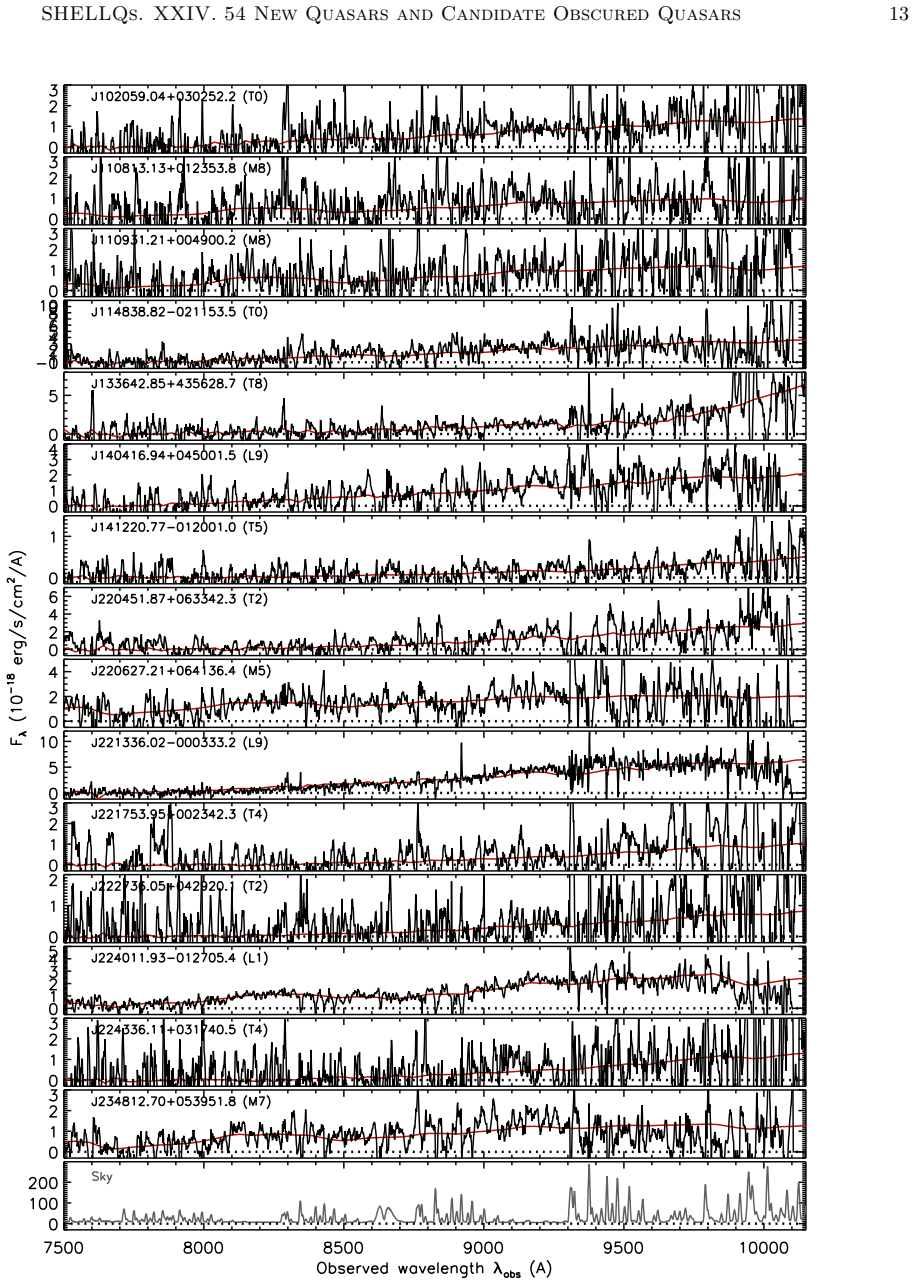
- Adding near-IR photometry would cleanly separate the 30 brown-dwarf contaminants from the 14 z ≈ 2 passive galaxies, improving the purity of future high-z quasar selections.
Editorial analysis
A structured set of objections, weighed in public.
Referee Report
Summary. This is the 24th SHELLQs paper and reports spectroscopic results for 132 photometric quasar candidates observed with Subaru/FOCAS and GTC/OSIRIS between 2021 November and 2025 March. The main result is the identification of 43 broad-line quasars at 5.71 ≤ z ≤ 7.02, 11 candidate obscured (narrow-line) quasars at 6.01 ≤ z ≤ 6.88, and 29 galaxies at z ≈ 5.56–6.28, including a z = 7.02 quasar and two luminous galaxies at z = 5.98 separated by 900 kpc that may trace an overdensity. The paper also identifies 5 [O III] emitters at z < 1, 30 Galactic brown dwarfs, and 14 passive galaxies at z ≈ 1.5–2.2 as contaminants, and it presents full spectra, line measurements, and an observation journal in Tables 1 and 2. Statistical analysis of the full SHELLQs sample is deferred to a future paper.
Significance. If the classifications are correct, this is a valuable final discovery sample from a major survey: it extends the low-luminosity quasar sample into the epoch of reionization with a z = 7.02 quasar and a possible z = 5.98 overdensity, and it adds 11 candidate obscured quasars, two of which have already been independently confirmed as mildly obscured quasars by JWST/NIRSpec. The paper is careful in flagging sky-noise features, reporting measurement uncertainties, labeling the obscured class as 'candidate,' and testing the brown-dwarf versus passive-galaxy separation with a template-fitting check. These strengths make the catalog useful for future JWST follow-up and for the planned full-sample statistical analysis. However, the exact 43/11/29 breakdown is not reproducible from Table 1 using the paper's own stated criteria, and this issue is load-bearing for the headline counts.
major comments (2)
- [§3, Table 1] Section 3 defines candidate obscured quasars as objects with LLyα > 10^43 erg/s and FWHM < 500 km/s, but Table 1 lists four objects in the Quasars section that satisfy these criteria: J135818.89−013249.7 (FWHM 430±130, log LLyα 44.07), J115900.87+025819.2 (430±30, 44.17), J023811.54+040416.5 (300±300, 43.57), and J223942.28+040943.2 (480±140, 43.24). The later sentence that quasars are identified by 'a hint of broad spectral bump around Lyα' could in principle resolve the inconsistency, but the paper does not state that these four objects show such a bump, nor does it explain how the FWHM/luminosity criterion is applied when a broad bump is present. The abstract and title counts (43 and 11) therefore cannot be checked from the published table. Please reclassify the objects or provide an explicit decision rule, including the treatment of FWHM errors and upper limits, that makes the table
- [§3, quasar/galaxy separation paragraph] The paper states that 'we classified objects with a hint of broad spectral bump around Lyα as quasars, and the remaining objects as galaxies,' and acknowledges that the separation 'is not always straightforward.' This is a subjective visual criterion with no quantitative significance threshold, yet the 43/29 split between quasars and galaxies is a headline result and will feed the forthcoming statistical analysis. Since Table 1 does not record the presence or significance of a broad component, a reader cannot reproduce the classification from the published data. Please provide a quantitative measure (e.g., the significance of a broad-line component, a Δχ² criterion, or a line-asymmetry index), or at minimum a per-object classification-quality flag distinguishing secure and marginal quasars.
minor comments (5)
- [Abstract / Table 1] The abstract states the EoR objects span 5.71 ≤ z ≤ 7.02, but the galaxy list in Table 1 includes J145945.34+415206.4 at z = 5.56. Please clarify how 'similar redshifts' is defined or adjust the stated range.
- [Table 1] J220754.87+065111.8 appears as two rows (Lyα and N V) without a merged label. Please make clear that the second row is an additional line of the same object.
- [§3, brown dwarf / passive galaxy discussion] There is a typo: 'althouth' should be 'although'.
- [Table 1 caption] Several FWHM entries are upper limits (e.g., '< 230') and many have large uncertainties. The caption should state explicitly whether FWHM values are central values from a single Gaussian fit and how upper limits are derived.
- [§2] The text uses 'S21A and S23B internal data releases' and later 'S23B DR'; define DR at first use for readers outside the HSC project.
Circularity Check
No significant circularity: the paper is an observational catalog whose classifications use stated external thresholds and visual criteria, not derived predictions.
full rationale
The paper's claims are empirical identifications from spectroscopy (43 quasars, 11 candidate obscured quasars, 29 galaxies), not a derivation chain. The classification rule for candidate obscured quasars is explicitly stated in Section 3: objects with luminous narrow Lyα (LLyα>10^43 erg/s, FWHM<500 km/s) are classified as candidate obscured quasars, based on external lower-redshift AGN statistics cited from Konno et al. 2016, Sobral et al. 2018, Spinoso et al. 2020. This threshold is not fitted to the present sample, and the resulting candidate population was independently tested with JWST/NIRSpec (Matsuoka et al. 2025), as stated in the text. The quasar/galaxy split is defined by a quoted visual criterion ('objects with a hint of broad spectral bump around Lyα as quasars, and the remaining objects as galaxies'), and the authors explicitly acknowledge that the separation is 'not always straightforward.' That is a classification-uncertainty caveat, not a circular step: no quantity is defined in terms of the outcome it is used to predict, and no fitted parameter is renamed as a prediction. The skeptic's observation that a few Table 1 objects listed as quasars have measured FWHM<500 km/s and log LLyα>43 is a reproducibility/boundary-consistency concern about the visual classification, but it does not make the conclusion circular; the paper's stated quasar criterion is the presence of a broad spectral bump, not the numerical thresholds alone. Self-citations to earlier SHELLQs papers for selection criteria and measurement procedures are contextual methodology references, and the operational rules are reproduced in this paper rather than imported as unverifiable black boxes. No equation in the paper reduces to its own inputs, and no external benchmark is replaced by a self-referential claim. The correct circularity finding is therefore a clean 0.
Assumptions & free parameters
assumptions (5)
- domain assumption HSC i-z-y photometry and the Bayesian/algebraic color selection isolate genuine z>5.6 quasar candidates.
- domain assumption Narrow Ly-alpha emitters with LLy-alpha > 10^43 erg/s and FWHM < 500 km/s are candidate obscured quasars.
- domain assumption Visual inspection of a broad spectral bump around Ly-alpha separates quasars from galaxies.
- domain assumption Brown dwarf and passive galaxy templates (Burgasser 2014, Skrzypek 2015, Coleman 1980) are adequate to identify contaminants.
- standard math Standard flat cosmology (H0=70, OmegaM=0.3) and Schlegel et al. extinction map.
Cite this review
Pith. "Pith review of Subaru High-z Exploration of Low-Luminosity Quasars (SHELLQs). XXIV. 54 New Quasars and Candidate Obscured Quasars at $5.71 \le z \le 7.02$." pith.science (2026). https://pith.science/paper/EI2I24GE
@misc{pith2026250821229,
  author       = {Pith},
  title        = {Pith review of: Subaru High-z Exploration of Low-Luminosity Quasars (SHELLQs). XXIV. 54 New Quasars and Candidate Obscured Quasars at $5.71 \le z \le 7.02$},
  year         = {2026},
  howpublished = {\url{https://pith.science/paper/EI2I24GE}},
  note         = {Machine review of arXiv:2508.21229}
}
abstract
We present spectroscopic identification of 43 quasars and 11 candidate obscured quasars in the epoch of reionization (EoR) at $5.71 \le z \le 7.02$, along with 29 galaxies at similar redshifts. This is the 24th publication from the Subaru High-$z$ Exploration of Low-Luminosity Quasars (SHELLQs) project, which exploits the Hyper Suprime-Cam (HSC) Subaru Strategic Program (SSP) imaging survey to search for EoR quasars. The HSC-SSP survey has completed, and this paper is likely the final installment of major (unobscured) quasar discoveries from the SHELLQs project. In addition to the EoR objects, we identified five strong [O III] line emitters at $z < 1$, 30 Galactic brown dwarfs, and 14 passive galaxies at $z \sim 2$, which contaminated our sample of photometric quasar candidates. The present paper focuses on describing the immediate outcome of the spectroscopic observations, while a statistical analysis of the full SHELLQs sample will be presented in our next publication.
Figures


Figures from the paper (7 more)



Forward citations
Cited by 2 Pith papers
-
Extremely UV-bright starbursts at the end of cosmic reionization
Very UV-bright galaxies at z~6 are ~6-Myr-old starbursts with high ionizing-photon efficiency, and one example shows evidence that dusty outflows push dust beyond the stars and boost its UV brightness.
-
Constraining supermassive primordial black hole clustering with the angular auto-correlation of $z\simeq 6$ quasars
MCMC comparison of projected PBH correlation functions with z≈6 quasar angular auto-correlation data yields posterior constraints f_PBH∼10^{-3}, m_PBH∼10^{12}M_⊙ for Poisson models and ξ_eff≃2.1, r_cl≃76 Mpc for clust...
Reference graph
Works this paper leans on
-
[1]
and ``O
thebibliography [1] 20pt to REFERENCES 6pt =0pt 10pt plus 3pt =0pt =0pt =1pt plus 1pt =0pt =0pt -12pt =13pt plus 1pt =20pt =13pt plus 1pt \@M =10000 =-1.0em =0pt =0pt 0pt =0pt =1.0em @enumiv\@empty 10000 10000 `\.\@m \@noitemerr \@latex@warning Empty `thebibliography' environment \@ifnextchar \@reference \@latexerr Missing key on reference command Each re...
2019
-
[2]
Aihara, H., Arimoto, N., Armstrong, R., et al.\ 2018, , 70, S4. doi:10.1093/pasj/psx066
-
[3]
J.\ 2014, Astronomical Society of India Conference Series, 11, 7
Burgasser, A. J.\ 2014, Astronomical Society of India Conference Series, 11, 7. doi:10.48550/arXiv.1406.4887
-
[4]
Cepa, J., Aguiar, M., Escalera, V. G., et al.\ 2000, , 4008, 623. doi:10.1117/12.395520
-
[5]
Coleman, G. D., Wu, C.-C., & Weedman, D. W.\ 1980, , 43, 393. doi:10.1086/190674
doi:10.1086/190674 1980
-
[6]
D., et al.\ 2025, arXiv:2505.03876
Ding, X., Onoue, M., Silverman, J. D., et al.\ 2025, arXiv:2505.03876. doi:10.48550/arXiv.2505.03876
-
[7]
Ding, X., Onoue, M., Silverman, J. D., et al.\ 2023, , 621, 51. doi:10.1038/s41586-023-06345-5
-
[8]
Euclid Collaboration, Barnett, R., Warren, S. J., et al.\ 2019, , 631, A85. doi:10.1051/0004-6361/201936427
Show all 177 references
-
[9]
E., Labbe, I., Goulding, A
Greene, J. E., Labbe, I., Goulding, A. D., et al.\ 2024, , 964, 39. doi:10.3847/1538-4357/ad1e5f
2024 doi
-
[10]
doi:10.3847/1538-4357/ad029e
Harikane, Y., Zhang, Y., Nakajima, K., et al.\ 2023, , 959, 39. doi:10.3847/1538-4357/ad029e
2023 doi
-
[11]
doi:10.3847/1538-4357/ada27b
Iwamoto, R., Matsuoka, Y., Imanishi, M., et al.\ 2025, , 979, 183. doi:10.3847/1538-4357/ada27b
2025 doi
-
[12]
doi:10.3847/1538-4357/abf6dc
Izumi, T., Matsuoka, Y., Fujimoto, S., et al.\ 2021, , 914, 36. doi:10.3847/1538-4357/abf6dc
2021 doi
-
[13]
doi:10.3847/1538-4357/abd7ef
Izumi, T., Onoue, M., Matsuoka, Y., et al.\ 2021, , 908, 235. doi:10.3847/1538-4357/abd7ef
2021 doi
-
[14]
doi:10.1093/pasj/psz096
Izumi, T., Onoue, M., Matsuoka, Y., et al.\ 2019, , 71, 111. doi:10.1093/pasj/psz096
2019 doi
-
[15]
doi:10.1093/pasj/psy026
Izumi, T., Onoue, M., Shirakata, H., et al.\ 2018, , 70, 36. doi:10.1093/pasj/psy026
2018 doi
-
[16]
doi:10.1093/pasj/54.6.819
Kashikawa, N., Aoki, K., Asai, R., et al.\ 2002, , 54, 6, 819. doi:10.1093/pasj/54.6.819
2002 doi
-
[17]
doi:10.1093/pasj/psaa074
Kato, N., Matsuoka, Y., Onoue, M., et al.\ 2020, , 72, 84. doi:10.1093/pasj/psaa074
2020 doi
-
[18]
D., Finkelstein, S
Kocevski, D. D., Finkelstein, S. L., Barro, G., et al.\ 2025, , 986, 2, 126. doi:10.3847/1538-4357/adbc7d
2025 doi
-
[19]
D., Onoue, M., Inayoshi, K., et al.\ 2023, , 954, L4
Kocevski, D. D., Onoue, M., Inayoshi, K., et al.\ 2023, , 954, L4. doi:10.3847/2041-8213/ace5a0
2023 doi
-
[20]
doi:10.3847/0004-637X/823/1/20
Konno, A., Ouchi, M., Nakajima, K., et al.\ 2016, , 823, 1, 20. doi:10.3847/0004-637X/823/1/20
2016 doi
-
[21]
Matsuoka, Y., Iwasawa, K., Onoue, M., et al.\ 2018a, , 237, 5
-
[22]
doi:10.3847/1538-4357/ab3c60
Matsuoka, Y., Iwasawa, K., Onoue, M., et al.\ 2019, , 883, 183. doi:10.3847/1538-4357/ab3c60
2019 doi
-
[23]
doi:10.3847/1538-4365/ac3d31
Matsuoka, Y., Iwasawa, K., Onoue, M., et al.\ 2022, , 259, 18. doi:10.3847/1538-4365/ac3d31
2022 doi
-
[24]
doi:10.3847/2041-8213/ad35c7
Matsuoka, Y., Izumi, T., Onoue, M., et al.\ 2024, , 965, L4. doi:10.3847/2041-8213/ad35c7
2024 doi
-
[25]
doi:10.1086/524193
Matsuoka, Y., Kawara, K., & Oyabu, S.\ 2008, , 673, 62. doi:10.1086/524193
2008 doi
-
[26]
doi:10.48550/arXiv.2505.04825
Matsuoka, Y., Onoue, M., Iwasawa, K., et al.\ 2025, , arXiv:2505.04825. doi:10.48550/arXiv.2505.04825
2025 doi
-
[27]
doi:10.3847/2041-8213/acd69f
Matsuoka, Y., Onoue, M., Iwasawa, K., et al.\ 2023, , 949, L42. doi:10.3847/2041-8213/acd69f
2023 doi
-
[28]
Matsuoka, Y., Onoue, M., Kashikawa, N., et al.\ 2016, , 828, 26
2016
-
[29]
Matsuoka, Y., Onoue, M., Kashikawa, N., et al.\ 2018b, , 70, S35
-
[30]
doi:10.3847/2041-8213/ab0216
Matsuoka, Y., Onoue, M., Kashikawa, N., et al.\ 2019, , 872, L2. doi:10.3847/2041-8213/ab0216
2019 doi
-
[31]
doi:10.1086/518399
Matsuoka, Y., Oyabu, S., Tsuzuki, Y., et al.\ 2007, , 663, 781. doi:10.1086/518399
2007 doi
-
[32]
A., Kashikawa, N., et al.\ 2018c, , 869, 150
Matsuoka, Y., Strauss, M. A., Kashikawa, N., et al.\ 2018c, , 869, 150
-
[33]
P., Brammer, G., et al.\ 2024, , 963, 129
Matthee, J., Naidu, R. P., Brammer, G., et al.\ 2024, , 963, 129. doi:10.3847/1538-4357/ad2345
2024 doi
-
[34]
doi:10.1093/pasj/psx063
Miyazaki, S., Komiyama, Y., Kawanomoto, S., et al.\ 2018, , 70, S1. doi:10.1093/pasj/psx063
2018 doi
-
[35]
J., Patel, M., Warren, S
Mortlock, D. J., Patel, M., Warren, S. J., et al.\ 2012, , 419, 1, 390. doi:10.1111/j.1365-2966.2011.19710.x
2012
-
[36]
Oke, J. B. & Gunn, J. E.\ 1983, , 266, 713. doi:10.1086/160817
1983 doi
- [37]
-
[38]
doi:10.3847/2041-8213/aca9d3
Onoue, M., Inayoshi, K., Ding, X., et al.\ 2023, , 942, L17. doi:10.3847/2041-8213/aca9d3
2023 doi
-
[39]
doi:10.3847/1538-4357/ab29e9
Onoue, M., Kashikawa, N., Matsuoka, Y., et al.\ 2019, , 880, 77. doi:10.3847/1538-4357/ab29e9
2019 doi
-
[40]
doi:10.3847/1538-4357/ac0f07
Onoue, M., Matsuoka, Y., Kashikawa, N., et al.\ 2021, , 919, 61. doi:10.3847/1538-4357/ac0f07
2021 doi
-
[41]
doi:10.1088/1538-3873/acb293
Rigby, J., Perrin, M., McElwain, M., et al.\ 2023, , 135, 1046, 048001. doi:10.1088/1538-3873/acb293
2023 doi
-
[42]
doi:10.3847/1538-4357/ada943
Sawamura, M., Izumi, T., Nakanishi, K., et al.\ 2025, , 980, 121. doi:10.3847/1538-4357/ada943
2025 doi
-
[43]
J., Finkbeiner, D
Schlegel, D. J., Finkbeiner, D. P., & Davis, M.\ 1998, , 500, 2, 525. doi:10.1086/305772
1998 doi
-
[44]
J., Faherty, J
Skrzypek, N., Warren, S. J., Faherty, J. K., et al.\ 2015, , 574, A78. doi:10.1051/0004-6361/201424570
2015 doi
-
[45]
doi:10.1093/mnras/sty782
Sobral, D., Matthee, J., Darvish, B., et al.\ 2018, , 477, 2, 2817. doi:10.1093/mnras/sty782
2018 doi
-
[46]
doi:10.1051/0004-6361/202038756
Spinoso, D., Orsi, A., L \'o pez-Sanjuan, C., et al.\ 2020, , 643, A149. doi:10.1051/0004-6361/202038756
2020 doi
-
[47]
doi:10.3847/1538-4357/ad045e
Takahashi, A., Matsuoka, Y., Onoue, M., et al.\ 2024, , 960, 112. doi:10.3847/1538-4357/ad045e
2024 doi
-
[48]
doi:10.1088/0004-637X/750/2/137
Toshikawa, J., Kashikawa, N., Ota, K., et al.\ 2012, , 750, 2, 137. doi:10.1088/0004-637X/750/2/137
2012 doi
-
[49]
doi:10.1093/pasj/psab122
Aihara, H., AlSayyad, Y., Ando, M., et al.\ 2022, , 74, 247. doi:10.1093/pasj/psab122
2022 doi
-
[50]
B., Casey, C
Akins, H. B., Casey, C. M., Berg, D. A., et al.\ 2025, , 980, 2, L29. doi:10.3847/2041-8213/adab76
2025 doi
- [51]
-
[52]
A., Greene, J
Alexandroff, R., Strauss, M. A., Greene, J. E., et al.\ 2013, , 435, 4, 3306. doi:10.1093/mnras/stt1500
2013 doi
-
[53]
T., Bogd \'a n, \'A ., Kov \'a cs, O
Ananna, T. T., Bogd \'a n, \'A ., Kov \'a cs, O. E., et al.\ 2024, , 969, L18. doi:10.3847/2041-8213/ad5669
2024 doi
-
[54]
A., Phillips, M
Baldwin, J. A., Phillips, M. M., & Terlevich, R.\ 1981, , 93, 5. doi:10.1086/130766
1981 doi
-
[55]
Baggen, J. F. W., van Dokkum, P., Brammer, G., et al.\ 2024, , 977, L13. doi:10.3847/2041-8213/ad90b8
2024 doi
-
[56]
G., Kocevski, D
Barro, G., P \'e rez-Gonz \'a lez, P. G., Kocevski, D. D., et al.\ 2024, , 963, 128. doi:10.3847/1538-4357/ad167e
2024 doi
-
[57]
Boroson, T. A. & Green, R. F.\ 1992, , 80, 109. doi:10.1086/191661
1992 doi
-
[58]
D., Natarajan, P., et al.\ 2024, Nature Astronomy, 8, 126
Bogd \'a n, \'A ., Goulding, A. D., Natarajan, P., et al.\ 2024, Nature Astronomy, 8, 126. doi:10.1038/s41550-023-02111-9
2024 doi
-
[59]
J., Oesch, P
Bouwens, R. J., Oesch, P. A., Stefanon, M., et al.\ 2021, , 162, 47. doi:10.3847/1538-3881/abf83e
2021 doi
-
[60]
Bowler, R. A. A., Dunlop, J. S., McLure, R. J., et al.\ 2015, , 452, 1817. doi:10.1093/mnras/stv1403
2015 doi
-
[61]
J., Curtis-Lake, E., et al.\ 2024, , 535, 2, 1796
Boyett, K., Bunker, A. J., Curtis-Lake, E., et al.\ 2024, , 535, 2, 1796. doi:10.1093/mnras/stae2430
2024 doi
-
[62]
C., et al.\ 2000, , 533, 682
Calzetti, D., Armus, L., Bohlin, R. C., et al.\ 2000, , 533, 682. doi:10.1086/308692
2000 doi
-
[63]
doi:10.3847/2041-8213/ac94d0
Castellano, M., Fontana, A., Treu, T., et al.\ 2022, , 938, L15. doi:10.3847/2041-8213/ac94d0
2022 doi
-
[64]
C., McLure, R
Carnall, A. C., McLure, R. J., Dunlop, J. S., et al.\ 2023, , 619, 716. doi:10.1038/s41586-023-06158-6
2023 doi
- [65]
-
[66]
doi:10.1038/s41586-024-07860-9
Carniani, S., Hainline, K., D'Eugenio, F., et al.\ 2024, , 633, 318. doi:10.1038/s41586-024-07860-9
2024 doi
-
[67]
M., Akins, H
Casey, C. M., Akins, H. B., Kokorev, V., et al.\ 2024, , 975, L4. doi:10.3847/2041-8213/ad7ba7
2024 doi
-
[68]
E., Sanders, R
Clarke, L., Shapley, A. E., Sanders, R. L., et al.\ 2024, , 977, 133. doi:10.3847/1538-4357/ad8ba4
2024 doi
-
[69]
P., et al.\ 2017, , 545, 457
Decarli, R., Walter, F., Venemans, B. P., et al.\ 2017, , 545, 457. doi:10.1038/nature22358
2017 doi
-
[70]
doi:10.3847/1538-4357/ab297f
Decarli, R., Dotti, M., Ba \ n ados, E., et al.\ 2019, , 880, 157. doi:10.3847/1538-4357/ab297f
2019 doi
-
[71]
doi:10.1051/0004-6361/201936813
Decarli, R., Mignoli, M., Gilli, R., et al.\ 2019, , 631, L10. doi:10.1051/0004-6361/201936813
2019 doi
-
[72]
doi:10.1051/0004-6361/202347755
de Graaff, A., Rix, H.-W., Carniani, S., et al.\ 2024, , 684, A87. doi:10.1051/0004-6361/202347755
2024 doi
-
[73]
L., et al.\ 2013, , 763, 145
Dom \' nguez, A., Siana, B., Henry, A. L., et al.\ 2013, , 763, 145. doi:10.1088/0004-637X/763/2/145
2013 doi
-
[74]
T., McLure, R
Donnan, C. T., McLure, R. J., Dunlop, J. S., et al.\ 2024, , 533, 3222. doi:10.1093/mnras/stae2037
2024 doi
-
[75]
A.\ 2023, , 61, 373
Fan, X., Ba \ n ados, E., & Simcoe, R. A.\ 2023, , 61, 373. doi:10.1146/annurev-astro-052920-102455
2023 doi
-
[76]
doi:10.1093/mnras/stv2794
Feltre, A., Charlot, S., & Gutkin, J.\ 2016, , 456, 3354. doi:10.1093/mnras/stv2794
2016 doi
-
[77]
L., Bagley, M
Finkelstein, S. L., Bagley, M. B., Ferguson, H. C., et al.\ 2023, , 946, L13. doi:10.3847/2041-8213/acade4
2023 doi
-
[78]
L., Ryan, R
Finkelstein, S. L., Ryan, R. E., Papovich, C., et al.\ 2015, , 810, 71. doi:10.1088/0004-637X/810/1/71
2015 doi
-
[79]
R., Siana, B., Kriek, M., et al.\ 2019, , 873, 102
Freeman, W. R., Siana, B., Kriek, M., et al.\ 2019, , 873, 102. doi:10.3847/1538-4357/ab0655
2019 doi
-
[80]
R., et al.\ 2024, , 977, 250
Fujimoto, S., Wang, B., Weaver, J. R., et al.\ 2024, , 977, 250. doi:10.3847/1538-4357/ad9027
2024 doi
-
[81]
J., Labb \'e , I., Zitrin, A., et al.\ 2024, , 628, 57
Furtak, L. J., Labb \'e , I., Zitrin, A., et al.\ 2024, , 628, 57. doi:10.1038/s41586-024-07184-8
2024 doi
-
[82]
doi:10.1088/0004-637X/733/2/101
Genzel, R., Newman, S., Jones, T., et al.\ 2011, , 733, 101. doi:10.1088/0004-637X/733/2/101
2011 doi
-
[83]
E., Alexandroff, R., Strauss, M
Greene, J. E., Alexandroff, R., Strauss, M. A., et al.\ 2014, , 788, 1, 91. doi:10.1088/0004-637X/788/1/91
2014 doi
-
[84]
Greene, J. E. & Ho, L. C.\ 2005, , 630, 122. doi:10.1086/431897
2005 doi
- [85]
-
[86]
D., Greene, J
Goulding, A. D., Greene, J. E., Setton, D. J., et al.\ 2023, , 955, L24. doi:10.3847/2041-8213/acf7c5
2023 doi
-
[87]
doi:10.1093/mnras/stw1716
Gutkin, J., Charlot, S., & Bruzual, G.\ 2016, , 462, 1757. doi:10.1093/mnras/stw1716
2016 doi
-
[88]
doi:10.3847/1538-4365/ac3dfc
Harikane, Y., Ono, Y., Ouchi, M., et al.\ 2022, , 259, 20. doi:10.3847/1538-4365/ac3dfc
2022 doi
-
[89]
Heckman, T. M. & Best, P. N.\ 2014, , 52, 589. doi:10.1146/annurev-astro-081913-035722
2014 doi
- [90]
-
[91]
K., Yamanaka, S., Ouchi, M., et al.\ 2020, , 72, 101
Inoue, A. K., Yamanaka, S., Ouchi, M., et al.\ 2020, , 72, 101. doi:10.1093/pasj/psaa100
2020 doi
-
[92]
doi:10.48550/arXiv.2505.04826
Iwasawa, K., Gilli, R., Vito, F., et al.\ 2025, arXiv:2505.04826. doi:10.48550/arXiv.2505.04826
2025 doi
-
[93]
M., et al.\ 2024, , 636, 594
Juod z balis, I., Maiolino, R., Baker, W. M., et al.\ 2024, , 636, 594. doi:10.1038/s41586-024-08210-5
2024 doi
-
[94]
M., et al.\ 2025, arXiv:2504.03551
Juod z balis, I., Maiolino, R., Baker, W. M., et al.\ 2025, arXiv:2504.03551. doi:10.48550/arXiv.2504.03551
2025 doi
-
[95]
& Heckman, T
Kauffmann, G. & Heckman, T. M.\ 2009, , 397, 135. doi:10.1111/j.1365-2966.2009.14960.x
2009
-
[96]
M., Tremonti, C., et al.\ 2003, , 346, 1055
Kauffmann, G., Heckman, T. M., Tremonti, C., et al.\ 2003, , 346, 1055. doi:10.1111/j.1365-2966.2003.07154.x
2003
-
[97]
doi:10.1093/pasj/psy056
Kawanomoto, S., Uraguchi, F., Komiyama, Y., et al.\ 2018, , 70, 66. doi:10.1093/pasj/psy056
2018 doi
- [98]
-
[99]
J., Dopita, M
Kewley, L. J., Dopita, M. A., Sutherland, R. S., et al.\ 2001, , 556, 121. doi:10.1086/321545
2001 doi
-
[100]
doi:10.1051/0004-6361/202348857
Killi, M., Watson, D., Brammer, G., et al.\ 2024, , 691, A52. doi:10.1051/0004-6361/202348857
2024 doi
-
[101]
doi:10.3847/2041-8213/ad037a
Kokorev, V., Fujimoto, S., Labbe, I., et al.\ 2023, , 957, L7. doi:10.3847/2041-8213/ad037a
2023 doi
-
[102]
& Harikane, Y.\ 2024, arXiv:2407.04777
Kokubo, M. & Harikane, Y.\ 2024, arXiv:2407.04777. doi:10.48550/arXiv.2407.04777
2024 doi
-
[103]
doi:10.1093/pasj/psx131
Konno, A., Ouchi, M., Shibuya, T., et al.\ 2018, , 70, S16. doi:10.1093/pasj/psx131
2018 doi
-
[104]
Korista, K. T. & Goad, M. R.\ 2004, , 606, 749. doi:10.1086/383193
2004 doi
-
[105]
R., Shapley, A
Kulas, K. R., Shapley, A. E., Kollmeier, J. A., et al.\ 2012, , 745, 33. doi:10.1088/0004-637X/745/1/33
2012 doi
-
[106]
doi:10.1038/s41586-023-05786-2
Labb \'e , I., van Dokkum, P., Nelson, E., et al.\ 2023, , 616, 266. doi:10.1038/s41586-023-05786-2
2023 doi
-
[107]
E., Bezanson, R., et al.\ 2025, , 978, 92
Labbe, I., Greene, J. E., Bezanson, R., et al.\ 2025, , 978, 92. doi:10.3847/1538-4357/ad3551
2025 doi
- [108]
-
[109]
L., Finkelstein, S
Larson, R. L., Finkelstein, S. L., Kocevski, D. D., et al.\ 2023, , 953, L29. doi:10.3847/2041-8213/ace619
2023 doi
-
[110]
R.\ 2007, , 377, L74
Liddle, A. R.\ 2007, , 377, L74. doi:10.1111/j.1745-3933.2007.00306.x
2007
-
[111]
doi:10.48550/arXiv.2504.08039
Lin, X., Fan, X., Wang, F., et al.\ 2025, arXiv:2504.08039. doi:10.48550/arXiv.2504.08039
2025 doi
-
[112]
doi:10.3847/1538-4357/ad6565
Lin, X., Wang, F., Fan, X., et al.\ 2024, , 974, 147. doi:10.3847/1538-4357/ad6565
2024 doi
-
[113]
doi:10.1051/0004-6361/202449904
Llerena, M., Amor \' n, R., Pentericci, L., et al.\ 2024, , 691, A59. doi:10.1051/0004-6361/202449904
2024 doi
- [114]
-
[115]
E., Setton, D
Ma, Y., Greene, J. E., Setton, D. J., et al.\ 2025, , 981, 191. doi:10.3847/1538-4357/ada613
2025 doi
- [116]
- [117]
-
[118]
doi:10.1051/0004-6361/202347640
Maiolino, R., Scholtz, J., Curtis-Lake, E., et al.\ 2024, , 691, A145. doi:10.1051/0004-6361/202347640
2024 doi
-
[119]
doi:10.1051/0004-6361/201833528
Matthee, J., Sobral, D., Gronke, M., et al.\ 2018, , 619, A136. doi:10.1051/0004-6361/201833528
2018 doi
-
[120]
doi:10.48550/arXiv.2412.04224
Mazzolari, G., Gilli, R., Maiolino, R., et al.\ 2024, arXiv:2412.04224. doi:10.48550/arXiv.2412.04224
2024 doi
-
[121]
doi:10.48550/arXiv.2408.15615
Mazzolari, G., Scholtz, J., Maiolino, R., et al.\ 2024, arXiv:2408.15615. doi:10.48550/arXiv.2408.15615
2024 doi
-
[122]
doi:10.1051/0004-6361/202450407
Mazzolari, G., \"U bler, H., Maiolino, R., et al.\ 2024, , 691, A345. doi:10.1051/0004-6361/202450407
2024 doi
-
[123]
doi:10.1051/0004-6361/202450708
Moya-Sierralta, C., Gonz \'a lez-L \'o pez, J., Infante, L., et al.\ 2024, , 692, A98. doi:10.1051/0004-6361/202450708
2024 doi
- [124]
-
[125]
P., Oesch, P
Naidu, R. P., Oesch, P. A., Brammer, G., et al.\ 2025, arXiv:2505.11263
2025
-
[126]
& Maiolino, R.\ 2022, , 513, 5134
Nakajima, K. & Maiolino, R.\ 2022, , 513, 5134. doi:10.1093/mnras/stac1242
2022 doi
-
[127]
F., Genzel, R., F \"o rster-Schreiber, N
Newman, S. F., Genzel, R., F \"o rster-Schreiber, N. M., et al.\ 2012, , 761, 43. doi:10.1088/0004-637X/761/1/43
2012 doi
-
[128]
Osterbrock, D. E. & Ferland, G. J.\ 2006, , Astrophysics of gaseous nebulae and active galactic nuclei
2006
-
[129]
Osterbrock, D. E. & Pogge, R. W.\ 1985, , 297, 166. doi:10.1086/163513
1985 doi
-
[130]
doi:10.1093/pasj/psx074
Ouchi, M., Harikane, Y., Shibuya, T., et al.\ 2018, , 70, S13. doi:10.1093/pasj/psx074
2018 doi
-
[131]
& Narayan, R.\ 2024, , 976, 96
Pacucci, F. & Narayan, R.\ 2024, , 976, 96. doi:10.3847/1538-4357/ad84f7
2024 doi
-
[132]
doi:10.1051/0004-6361/202452422
Perger, K., Fogasy, J., Frey, S., et al.\ 2025, , 693, L2. doi:10.1051/0004-6361/202452422
2025 doi
- [133]
-
[134]
S., & Kotilainen, J.\ 2020, , 249, 17
Rakshit, S., Stalin, C. S., & Kotilainen, J.\ 2020, , 249, 17. doi:10.3847/1538-4365/ab99c5
2020 doi
-
[135]
E., Greene, J
Reines, A. E., Greene, J. E., & Geha, M.\ 2013, , 775, 116. doi:10.1088/0004-637X/775/2/116
2013 doi
-
[136]
D., Tacchella, S., et al.\ 2024, , 970, 31
Robertson, B., Johnson, B. D., Tacchella, S., et al.\ 2024, , 970, 31. doi:10.3847/1538-4357/ad463d
2024 doi
- [137]
-
[138]
F., Davies, F
Schindler, J.-T., Hennawi, J. F., Davies, F. B., et al.\ 2024, arXiv:2411.11534. doi:10.48550/arXiv.2411.11534
2024 doi
-
[139]
Selsing, J., Fynbo, J. P. U., Christensen, L., et al.\ 2016, , 585, A87. doi:10.1051/0004-6361/201527096
2016 doi
- [140]
- [141]
-
[142]
L., Genzel, R., Quataert, E., et al.\ 2009, , 701, 955
Shapiro, K. L., Genzel, R., Quataert, E., et al.\ 2009, , 701, 955. doi:10.1088/0004-637X/701/2/955
2009 doi
-
[143]
F., Faucher-Gigu \`e re, C.-A., et al.\ 2020, , 495, 3252
Shen, X., Hopkins, P. F., Faucher-Gigu \`e re, C.-A., et al.\ 2020, , 495, 3252. doi:10.1093/mnras/staa1381
2020 doi
-
[144]
T., Strauss, M
Shen, Y., Richards, G. T., Strauss, M. A., et al.\ 2011, , 194, 45. doi:10.1088/0067-0049/194/2/45
2011 doi
-
[145]
doi:10.3847/1538-4357/ab03d9
Shen, Y., Wu, J., Jiang, L., et al.\ 2019, , 873, 1, 35. doi:10.3847/1538-4357/ab03d9
2019 doi
-
[146]
doi:10.1093/pasj/psx122
Shibuya, T., Ouchi, M., Konno, A., et al.\ 2018, , 70, S14. doi:10.1093/pasj/psx122
2018 doi
-
[147]
M., Barger, A
Songaila, A., Hu, E. M., Barger, A. J., et al.\ 2018, , 859, 91. doi:10.3847/1538-4357/aac021
2018 doi
-
[148]
doi:10.1093/mnras/stae1970
Stepney, M., Banerji, M., Tang, S., et al.\ 2024, , 533, 3, 2948. doi:10.1093/mnras/stae1970
2024 doi
-
[149]
& Laor, A.\ 2012, , 423, 1, 600
Stern, J. & Laor, A.\ 2012, , 423, 1, 600. doi:10.1111/j.1365-2966.2012.20901.x
2012
-
[150]
A., Lyu, J., Rieke, G
Stone, M. A., Lyu, J., Rieke, G. H., et al.\ 2024, , 964, 90. doi:10.3847/1538-4357/ad2a57
2024 doi
-
[151]
Storey, P. J. & Zeippen, C. J.\ 2000, , 312, 4, 813. doi:10.1046/j.1365-8711.2000.03184.x
2000
-
[152]
M., Harrison, C
Swinbank, A. M., Harrison, C. M., Tiley, A. L., et al.\ 2019, , 487, 381. doi:10.1093/mnras/stz1275
2019 doi
-
[153]
J., Cowie, L
Taylor, A. J., Cowie, L. L., Barger, A. J., et al.\ 2021, , 914, 79. doi:10.3847/1538-4357/abfc4b
2021 doi
- [154]
- [155]
- [156]
-
[157]
doi:10.3847/1538-4357/abe94a
Toba, Y., Ueda, Y., Gandhi, P., et al.\ 2021, , 912, 2, 91. doi:10.3847/1538-4357/abe94a
2021 doi
- [158]
-
[159]
Tsuzuki, Y., Kawara, K., Yoshii, Y., et al.\ 2006, , Fe II Emission in 14 Low-Redshift Quasars. I. Observations, 650, 1, 57. doi:10.1086/506376
2006 doi
-
[160]
doi:10.1051/0004-6361/202346137
\"U bler, H., Maiolino, R., Curtis-Lake, E., et al.\ 2023, , 677, A145. doi:10.1051/0004-6361/202346137
2023 doi
- [161]
-
[162]
E., Richards, G
Vanden Berk, D. E., Richards, G. T., Bauer, A., et al.\ 2001, , 122, 549. doi:10.1086/321167
2001 doi
-
[163]
doi:10.1051/0004-6361:200809648
Verhamme, A., Schaerer, D., Atek, H., et al.\ 2008, , 491, 89. doi:10.1051/0004-6361:200809648
2008 doi
-
[164]
doi:10.1051/0004-6361:20065554
Verhamme, A., Schaerer, D., & Maselli, A.\ 2006, , 460, 397. doi:10.1051/0004-6361:20065554
2006 doi
-
[165]
doi:10.1051/0004-6361:20035714
V \'e ron-Cetty, M.-P., Joly, M., & V \'e ron, P.\ 2004, , The unusual emission line spectrum of I Zw 1, 417, 515. doi:10.1051/0004-6361:20035714
2004 doi
- [166]
- [167]
-
[168]
doi:10.3847/2041-8213/ad55f7
Wang, B., Leja, J., de Graaff, A., et al.\ 2024, , 969, L13. doi:10.3847/2041-8213/ad55f7
2024 doi
-
[169]
C., Alberts, S., Ji, Z., et al.\ 2024, , 968, 34
Williams, C. C., Alberts, S., Ji, Z., et al.\ 2024, , 968, 34. doi:10.3847/1538-4357/ad3f17
2024 doi
-
[170]
doi:10.1038/nature14241
Wu, X.-B., Wang, F., Fan, X., et al.\ 2015, , 518, 512. doi:10.1038/nature14241
2015 doi
-
[171]
J., Albert, L., Arzoumanian, D., et al.\ 2010, , 140, 2, 546
Willott, C. J., Albert, L., Arzoumanian, D., et al.\ 2010, , 140, 2, 546. doi:10.1088/0004-6256/140/2/546
2010 doi
-
[172]
doi:10.3847/1538-4357/ac2b32
Yang, J., Wang, F., Fan, X., et al.\ 2021, , 923, 262. doi:10.3847/1538-4357/ac2b32
2021 doi
-
[173]
doi:10.3847/2041-8213/acc9c8
Yang, J., Wang, F., Fan, X., et al.\ 2023, , 951, 1, L5. doi:10.3847/2041-8213/acc9c8
2023 doi
-
[174]
G., Adelman, J., Anderson, J
York, D. G., Adelman, J., Anderson, J. E., et al.\ 2000, , The Sloan Digital Sky Survey: Technical Summary, 120, 3, 1579. doi:10.1086/301513
2000 doi
-
[175]
T., et al.\ 2024, , 974, L26
Yue, M., Eilers, A.-C., Ananna, T. T., et al.\ 2024, , 974, L26. doi:10.3847/2041-8213/ad7eba
2024 doi
-
[176]
L., Hamann, F., P \^a ris, I., et al.\ 2016, , 459, 3144
Zakamska, N. L., Hamann, F., P \^a ris, I., et al.\ 2016, , 459, 3144. doi:10.1093/mnras/stw718
2016 doi
-
[177]
doi:10.1086/504869
Zhou, H., Wang, T., Yuan, W., et al.\ 2006, , 166, 128. doi:10.1086/504869
2006 doi
Reviewed August 5, 2026 · model on record in the stance chip above.
Discussion (0). Sign in to comment.