REVIEW 4 major objections 5 minor 59 references
Electrically tunable momentum space polarization singularities in liquid crystal microcavities
T0 review · 4 major / 5 minor · reviewed 2026-08-08 · deepseek-v4-flash
Pith's one-line read The paper claims that momentum-space polarization singularities can be generated and electrically tuned in a planar liquid-crystal microcavity without symmetry-breaking patterning, with positions and meron texture controlled by…
desk verdict First demonstration of electrically tunable momentum-space C-points in a liquid-crystal microcavity, but the tunability claim needs a quantitative overlay with theory before I'd call it fully verified. read the letter →
The pith
A machine-rendered reading of the paper's core claim, the machinery that carries it, and where it could break.
The reading
What carries the argument
The load-bearing object is a $2\times 2$ non-Hermitian $k\cdot p$ Hamiltonian, $H = h_0(k)\mathbb{1} + \mathbf{h}(k)\cdot\boldsymbol{\sigma}$, written in a rotated polarization basis, with $h_1 = \Delta + i\delta\Gamma + \delta_x k_x^2 + \delta_y k_y^2$ and $h_3 = -2\alpha k_y$. The linear-in-$k_y$ term is the Rashba-Dresselhaus spin-orbit coupling generated by the tilted director; it makes the eigenmodes circularly polarized along $k_y$ and creates the conditions for the singularities. C-point positions follow from setting the rotated Stokes parameter $S_1$ to zero, giving Eq. (6), $k_{y,\mathrm{CP}} = \pm\sqrt{ \frac{\Delta}{\Sigma(m) \frac{4Lc\sqrt{m(m+1)}}{\pi^3(2m+1)} \left(\frac{\varepsilon_{xz}}{\varepsilon_{zz}}\right)^2 - \delta_y} }$, which explains why the singularities exist only for positive detuning. Diabolical points and exceptional points follow from $h_1^2+h_3^2=0$, leading to Eq. (7). The same Hamiltonian, through Eq. (5), yields the full Stokes field, and the Berreman-Schubert transfer-matrix calculation serves as an independent numerical check.
What would settle it
Apply two different voltages that produce the same measured detuning $\Delta$ and compare the C-point positions: if they differ, the detuning-only model is wrong, because Eq. (6) would predict identical positions.
Extended reading notes
Core claim
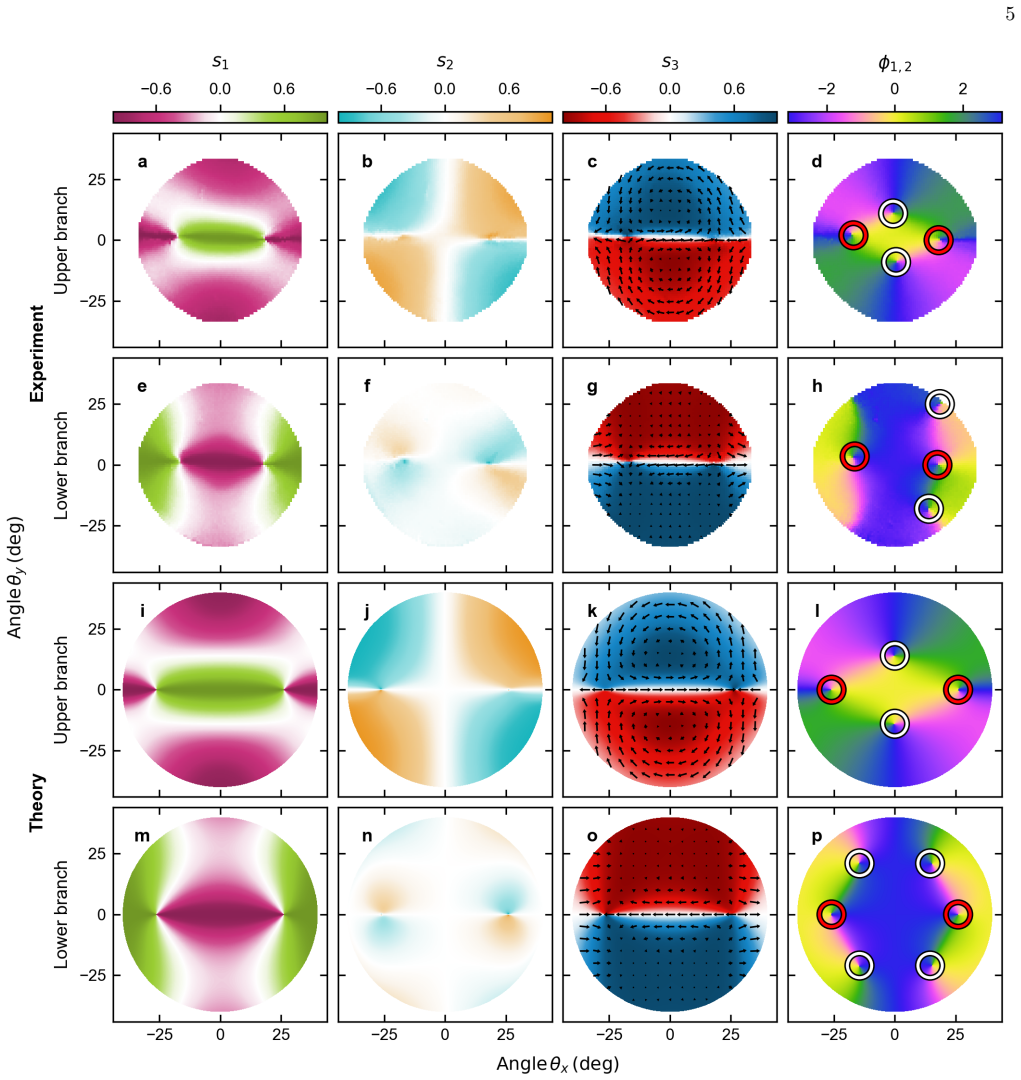
On the paper's own terms, the central discovery is that a highly birefringent planar liquid-crystal microcavity, retaining many symmetries, hosts electrically tunable half-charge polarization singularities in its momentum-space band structure: lemon-type C-points with winding $w=1/2$ and star-type diabolical points with winding $w=-1/2$, the latter appearing as pairs of exceptional points under polarization-dependent losses. The C-points sit on the $k_x=0$ axis at positions set by Eq. (6), which depends on the detuning $\Delta$ and fixed cavity parameters; positive detuning admits the singularities and negative detuning removes the upper-branch ones. Angle-resolved polarization tomography of white-light transmission confirms the predicted Stokes field, showing two C-points and two diabolical points in the upper branch for $\Delta>0$, four C-points predicted in the lower branch (two outside the field of view), and continuous voltage-controlled motion of the C-points as $\Delta$ varies. The same tuning also flips the meron texture between Bloch and N\'eel type, which the authors connect to a momentum-space analogue of skyrmionic helicity switching.
Load-bearing premise
The electrical-tuning prediction assumes that voltage only changes the energy difference between the two polarized cavity modes, while all other optical parameters of the cavity remain fixed; if reorienting the liquid crystal molecules also changes those other parameters, the predicted motion of the singularities would not match the experiments.
Editorial extensions
If this is right
- Applying voltage alone can continuously move the C-points in momentum space and change how many singularities are present, with no changes to the sample.
- The sign of the detuning acts as a switch in this Rashba-Dresselhaus regime: positive detuning produces C-points and diabolical points in the upper branch, while negative detuning removes them.
- The same electrical knob flips the meron texture between Bloch-type and N\'eel-type, which also reorients the M\"obius-strip discontinuity of the polarization ellipse in reciprocal space.
- The authors argue the platform is suited for tunable lasing, strong light-matter coupling, and non-Hermitian photonic studies, since the cavity keeps many symmetries and can be driven with gain.
- Because the singularities are located at specific emission angles, voltage selection of the detuning selects which transmitted beam angle carries a chosen circular polarization and winding.
Reading between the lines
- A testable extension the authors do not pursue: if the director reorientation changes $\delta_y$ or $\alpha$ as well as $\Delta$, their Eq. (6) predicts the C-point trajectory would bend or move off the $k_x=0$ axis, so mapping the full Stokes field at high voltages would distinguish detuning-only tuning from parameter-dependent tuning.
- The mechanism should transfer to other birefringent cavities with electrically controllable director orientation, so the operating wavelength could be shifted by changing the Bragg mirrors without altering the singularity physics.
- Because the C-points sit at specific emission angles, the device could act as a voltage-addressed polarization router: a beam emitted at a chosen angle would carry a selected handedness and meron texture, a functionality the paper mentions only as a future direction.
Signed reviews
Editorial analysis
A structured set of objections, weighed in public.
Referee Report
Summary. The manuscript reports the generation and electrical tuning of momentum-space polarization singularities in the far-field transmission of a planar liquid-crystal microcavity. The authors combine angle-resolved Stokes tomography with two theoretical approaches: a 2x2 non-Hermitian k.p Hamiltonian and a Berreman-Schuberttransfer-matrix calculation. They identify lemon-type C-points with winding w=1/2 and star-type diabolical-point/exceptional-point structures with w=-1/2, and they show that the C-point positions and their Bloch/Néel meron texture change with applied voltage through the resulting detuning. The central claim is that this provides electrically tunable, multiple half-charge momentum-space polarization singularities in a microcavity that does not require nanopatterning.
Significance. If fully substantiated, the result would be a useful step beyond static photonic-crystal-slab implementations of momentum-space polarization singularities, because the tuning is electrical, continuous, and reversible in a planar geometry. The paper is commendable for combining experiment, an ab initio 2x2 Hamiltonian without phenomenological fitting parameters, and full transfer-matrix simulations, and for openly discussing the limitations of the 2x2 model. The data are deposited in a public repository, which is a further strength. However, the quantitative verification of the tunability claim is currently incomplete, and this is what prevents the paper from being accepted as is.
major comments (4)
- [Experimental results, Fig. 4 and Eq. (6)] The central claim that the C-points are electrically tuned is supported only by a sequence of Stokes-phase images in Fig. 4 and Fig. S7. The paper does not plot the measured C-point coordinates in momentum space against the prediction of Eq. (6), nor against the Berreman model, as a function of detuning. This matters because Eq. (6) contains delta_y and Sigma(m), and the SM equations (S3)-(S4) show that delta_y and alpha depend on the director angle theta, which is precisely what the voltage changes. The text even notes that 'the sign of delta_y varies with theta' after Eq. (6). Therefore, the observed motion cannot be attributed to the detuning mechanism alone unless all coefficients are evaluated at each voltage. A quantitative overlay of measured and predicted C-point trajectories, with the voltage-dependent parameters specified, is needed to substantiate the tunability claim.
- [Methods, 'Non-Hermitian modification of 2-mode Hamiltonian'] The authors themselves state that the 2x2 Hamiltonian is inadequate and that fourth-order terms and coupling to Bragg modes are necessary to reproduce the observed C-points, e.g., the additional C-points in the lower branch. Since Eq. (6) is derived from this 2x2 Hamiltonian in the Supplemental Material (Section I.B), the quantitative accuracy of Eq. (6) for the C-point trajectory is not established by the derivation alone. The paper should either validate Eq. (6) against the Berreman model over the full voltage range, or state explicitly which features of the observed tuning are expected to survive beyond the 2x2 approximation.
- [Diabolical points, Eq. (7) and Fig. 4] The abstract and introduction claim electrically tunable multiple half-charge polarization singularities, which includes the diabolical points/exceptional points as well as C-points. However, the tuning demonstration in Fig. 4 and Fig. S7 covers only the lemon-type C-points. No experimental series is shown in which the positions of the diabolical points or exceptional points change with voltage, even though Eq. (7) predicts a detuning dependence. Without such data, the claim of tunability of the full set of singularities is too broad.
- [Experimental results, Stokes tomography methodology] The manuscript reports no error bars or uncertainties on the measured Stokes parameters or on the extracted positions of the C-points and diabolical points. The text acknowledges in Fig. 2 that 'experimental errors in the measured Stokes parameters can increase' at high angles, but no quantitative uncertainty analysis is provided. Given that the tunability claim rests on comparing singularity positions across voltage settings, reporting uncertainties on those positions is necessary for a quantitative assessment.
minor comments (5)
- [Eq. (6) and following text] The sentence 'the sign of delta_y varies with theta' is important but terse; the authors should specify the range of theta or the cavity thickness condition under which delta_y changes sign, since this directly affects the existence of C-points.
- [Fig. 4 and Fig. S7] These figures would benefit from numeric axis labels and explicit voltage or detuning values in the panels. Currently the reader cannot determine the actual angular positions of the singularities or the voltage step sizes from the figure alone.
- [Affiliation list] There are typographical errors in the affiliations: 'Instiute' should be 'Institute' in two places.
- [Eq. (6) typesetting] Equation (6) contains visible LaTeX artifacts ('/radicaltp/radicalvertex/radicalvertex') that should be corrected to a standard square-root symbol.
- [Supplemental Material, Figs. S13-S14] The captions state that the opposite sign of s3 is due to the opposite sign of the angle for experiment and theory; this is worth explaining in the main text or in a sentence in the caption, as it may confuse readers regarding the comparison.
Circularity Check
No significant circularity: the C-point positions follow analytically from a parameter-free k·p Hamiltonian and standard Berreman transfer-matrix calculations, with the molecular tilt angle set by the measured detuning rather than by the singularity positions.
full rationale
The paper's central derivation is not circular. Equation (6) (and its supplement Eq. S34) gives the C-point wavevector ky,CP as an explicit analytical solution of the condition S1 = S2 = 0 in the Hermitian limit of the two-mode Hamiltonian, using coefficients (Δ, δy, εxz, εzz, Σ) that are computed from the dielectric tensor and cavity geometry (SM Eqs. S1–S8), not fitted to the observed C-point locations. The molecular tilt angle θ is set by matching the measured mode detuning (SM Section I.C: θ = 1.02θr and 0.98θr for positive and negative detuning, where θr is the zero-detuning angle), which is a different observable from the singularity position; the C-point prediction is therefore a nontrivial consequence of the model rather than a restatement of its input. The independent Berreman–Schubert transfer-matrix calculation uses the same physical parameters and reproduces the measured Stokes textures and singularity positions, providing an external cross-check rather than a self-referential loop. Self-citations to the authors' prior work (e.g., Refs. [30–32,35–38]) supply the Hamiltonian framework and past validation, but the present experimental observations and the analytic derivation stand independently. The acknowledged discrepancy for negative detuning, where the 2×2 Hamiltonian misses extra C-points in the lower branch and the authors invoke Bragg-mode interactions, is a model limitation explicitly addressed in the text, not a circular reduction. Finally, the lack of a quantitative overlay of measured C-point trajectories onto Eq. (6) in Fig. 4 is an evidence-strength concern about how completely the tunability is verified, not a circularity: the data are not being used to define the prediction. Overall, no step in the derivation chain reduces by construction to its own inputs.
Assumptions & free parameters
free parameters (5)
- Molecular tilt angle θ (Sample A simulation) =
31.4 deg
- Molecular tilt angle θ (Sample B simulation) =
33.5 deg
- Relative tilt angles in Hamiltonian =
1.02θr and 0.98θr
- Mirror strength parameters ζX, ζY =
82 and 78 µm^-1
- Cavity thickness L in Hamiltonian =
2120 nm
assumptions (4)
- domain assumption The planar microcavity can be described by a two-mode paraxial Hamiltonian with complex coefficients in the Rashba-Dresselhaus regime.
- domain assumption The liquid crystal layer is a homogeneous uniaxial birefringent medium with a single director tilt angle and no in-plane spatial variation.
- domain assumption The applied voltage changes only the director tilt angle and hence the detuning Δ, leaving other Hamiltonian coefficients effectively unchanged.
- standard math The k·p perturbation expansion from ref [38] gives the correct mode coupling and rotation matrix for the cavity.
Cite this review
Pith. "Pith review of Electrically tunable momentum space polarization singularities in liquid crystal microcavities." pith.science (2026). https://pith.science/paper/EIFLARGO
@misc{pith2026250207430,
  author       = {Pith},
  title        = {Pith review of: Electrically tunable momentum space polarization singularities in liquid crystal microcavities},
  year         = {2026},
  howpublished = {\url{https://pith.science/paper/EIFLARGO}},
  note         = {Machine review of arXiv:2502.07430}
}
read the original abstract
Momentum space polarization singularities of light appear as vectorial twists in the scattered and radiated far field patterns of exotic photonic structures. They relate to important concepts such as bound states in the continuum, spatiotemporal light steering, polarization M\"obius strips, Berry curvature and associated topological photonic phenomena. Polarization singularities, such as completely circularly polarized C-points, are readily designed in real space through interference of differently polarized beams. In momentum space, they require instead sophisticated patterning of photonic crystal slabs of reduced symmetries in order to appear in the corresponding band structure with scarce in-situ tunability. Here, we show that momentum space singularities can be generated and, importantly, electrically tuned in the band structure of a highly birefringent planar liquid crystal microcavity that retains many symmetries. Our results agree with theoretical predictions and offer exciting possibilities for integration of momentum space polarization singularities in spinoptronic technologies.
Figures


Figures from the paper (1 more)

Reference graph
Works this paper leans on
-
[1]
Ruchi, P. Senthilkumaran, and S. K. Pal, Phase singular- ities to polarization singularities, International Journal of Optics 2020, 2812803 (2020)
work page 2020
-
[2]
Q. Wang, C.-H. Tu, Y.-N. Li, and H.-T. Wang, Polar- ization singularities: Progress, fundamental physics, and prospects, APL Photonics6, 040901 (2021)
work page 2021
-
[3]
K. Y. Bliokh, M. A. Alonso, and M. R. Dennis, Geomet- ric phases in 2D and 3D polarized fields: geometrical, dynamical, and topological aspects, Reports on Progress in Physics82, 122401 (2019)
work page 2019
-
[4]
Y. Shen, Q. Zhang, P. Shi, L. Du, X. Yuan, and A. V. Zayats, Optical skyrmions and other topological quasi- particles of light, Nature Photonics18, 15 (2024)
2024
-
[5]
G. Milione, H. I. Sztul, D. A. Nolan, and R. R. Alfano, Higher-order Poincaré sphere, Stokes parameters, and the angular momentum of light, Phys. Rev. Lett.107, 053601 (2011)
work page 2011
-
[6]
F. Cardano, E. Karimi, L. Marrucci, C. de Lisio, and E.Santamato,Generationanddynamicsofopticalbeams with polarization singularities, Opt. Express 21, 8815 (2013)
work page 2013
-
[7]
Y. Zeng, G. Hu, K. Liu, Z. Tang, and C.-W. Qiu, Dynam- ics of topological polarization singularity in momentum space, Phys. Rev. Lett.127, 176101 (2021)
work page 2021
- [8]
Show all 59 references
-
[9]
Y. Guo, M. Xiao, Y. Zhou, and S. Fan, Arbitrary polar- ization conversion with a photonic crystal slab, Advanced Optical Materials7, 1801453 (2019)
2019
-
[10]
J. Wang, H. Li, Y. Ma, M. Zhao, W. Liu, B. Wang, S. Wu, X. Liu, L. Shi, T. Jiang, and J. Zi, Routing val- ley exciton emission of a WS2 monolayer via delocalized Bloch modes of in-plane inversion-symmetry-broken pho- tonic crystal slabs, Light: Science & Applications9, 148 (2020)
2020
-
[11]
A. D. Kiselev, Singularities in polarization resolved an- gular patterns: transmittance of nematic liquid crystal cells, Journal of Physics: Condensed Matter19, 246102 (2007)
2007
-
[12]
C. Guo, M. Xiao, Y. Guo, L. Yuan, and S. Fan, Meron spin textures in momentum space, Phys. Rev. Lett.124, 106103 (2020)
2020
-
[13]
H. M. Doeleman, F. Monticone, W. den Hollander, A. Alù, and A. F. Koenderink, Experimental observa- tion of a polarization vortex at an optical bound state in the continuum, Nature Photonics12, 397 (2018)
2018
-
[14]
W. Liu, B. Wang, Y. Zhang, J. Wang, M. Zhao, F. Guan, X. Liu, L. Shi, and J. Zi, Circularly polarized states spawning from bound states in the continuum, Phys. Rev. Lett.123, 116104 (2019)
2019
-
[15]
X. Yin, J. Jin, M. Soljačić, C. Peng, and B. Zhen, Ob- servation of topologically enabled unidirectional guided resonances, Nature580, 467 (2020)
2020
-
[16]
F. Wang, X. Yin, Z. Zhang, Z. Chen, H. Wang, P. Li, Y. Hu, X. Zhou, and C. Peng, Fundamentals and appli- cations of topological polarization singularities, Frontiers in Physics10, 10.3389/fphy.2022.862962 (2022)
2022
-
[17]
W. Ye, Y. Gao, and J. Liu, Singular points of polariza- tions in the momentum space of photonic crystal slabs, Phys. Rev. Lett.124, 153904 (2020)
2020
-
[18]
H. Qin, Z. Su, M. Liu, Y. Zeng, M.-C. Tang, M. Li, Y. Shi, W. Huang, C.-W. Qiu, and Q. Song, Arbitrarily polarized bound states in the continuum with twisted photonic crystal slabs, Light: Science & Applications12, 66 (2023)
2023
-
[19]
K. Y. Bliokh, M. A. Alonso, D. Sugic, M. Perrin, F. Nori, and E. Brasselet, Polarization singularities and möbius stripsinsoundandwater-surfacewaves,PhysicsofFluids 33, 077122 (2021), https://pubs.aip.org/aip/pof/article- pdf/doi/10.1063/5.0056333/13832609/077122_1_online.pdf
2021 doi
-
[20]
Y. Shen, X. Wang, Z. Xie, C. Min, X. Fu, Q. Liu, M. Gong, and X. Yuan, Optical vortices 30 years on: OAM manipulation from topological charge to multiple singularities, Light: Science & Applications8, 90 (2019)
2019
-
[21]
Freund, A
I. Freund, A. I. Mokhun, M. S. Soskin, O. V. Angelsky, and I. I. Mokhun, Stokes singularity relations, Opt. Lett. 27, 545 (2002)
2002
-
[22]
W. Liu, W. Liu, L. Shi, and Y. Kivshar, Topological po- larization singularities in metaphotonics, Nanophotonics 10, 1469 (2021)
2021
-
[23]
J. Ni, C. Huang, L.-M. Zhou, M. Gu, Q. Song, Y. Kivshar, and C.-W. Qiu, Multidimensional phase singularities in nanophotonics, Science 374, eabj0039 (2021)
2021
-
[24]
S. Kim, B. H. Woo, S.-C. An, Y. Lim, I. C. Seo, D.-S. Kim, S. Yoo, Q.-H. Park, and Y. C. Jun, Topological control of 2D perovskite emission in the strong coupling regime, Nano Letters21, 10076 (2021)
2021
-
[25]
N. H. M. Dang, S. Zanotti, E. Drouard, C. Chevalier, G. Trippé-Allard, M. Amara, E. Deleporte, V. Ardiz- zone, D. Sanvitto, L. C. Andreani, C. Seassal, D. Gerace, and H. S. Nguyen, Realization of polaritonic topological charge at room temperature using polariton bound states i...
2022
-
[26]
Ardizzone, F
V. Ardizzone, F. Riminucci, S. Zanotti, A. Gianfrate, M. Efthymiou-Tsironi, D. G. Suàrez-Forero, F. Todisco, M. De Giorgi, D. Trypogeorgos, G. Gigli, K. Baldwin, L. Pfeiffer, D. Ballarini, H. S. Nguyen, D. Gerace, and D. Sanvitto, Polariton Bose-Einstein condensate from a boun...
2022
-
[27]
A. Chen, W. Liu, Y. Zhang, B. Wang, X. Liu, L. Shi, L. Lu, and J. Zi, Observing vortex polarization singu- larities at optical band degeneracies, Phys. Rev. B99, 180101 (2019)
2019
-
[28]
X. Zhao, J. Wang, X. Wang, L. Shi, and J. Zi, Emer- gence of momentum-space topological half vortices in an anisotropic cavity, Phys. Rev. Appl.20, 054059 (2023). 10
2023
-
[29]
Zayats, Spin–orbit interactions of light, Nature Photonics 9, 796 (2015)
K.Y.Bliokh, F.J.Rodríguez-Fortuño, F.Nori,andA.V. Zayats, Spin–orbit interactions of light, Nature Photonics 9, 796 (2015)
2015
-
[30]
M. Król, I. Septembre, P. Oliwa, M. Kędziora, K. Łempicka-Mirek, M. Muszyński, R. Mazur, P. Moraw- iak, W. Piecek, P. Kula, W. Bardyszewski, P. G. Lagoudakis, D. D. Solnyshkov, G. Malpuech, B. Piętka, and J. Szczytko, Annihilation of exceptional points from different Dirac val...
2022
-
[31]
Rechcińska, M
K. Rechcińska, M. Król, R. Mazur, P. Morawiak, R. Mirek, K. Łempicka, W. Bardyszewski, M. Ma- tuszewski, P. Kula, W. Piecek, P. G. Lagoudakis, B. Piętka, and J. Szczytko, Engineering spin-orbit syn- thetic Hamiltonians in liquid-crystal optical cavities, Sci- ence 366, 727 (2019)
2019
-
[32]
M. Król, K. Rechcińska, H. Sigurdsson, P. Oliwa, R. Mazur, P. Morawiak, W. Piecek, P. Kula, P. G. Lagoudakis, M. Matuszewski, W. Bardyszewski, B. Piętka, and J. Szczytko, Realizing optical persistent spin helix and Stern-Gerlach deflection in an anisotropic liquid crystal micr...
2021
-
[33]
D. W. Berreman, Optics in stratified and anisotropic me- dia: 4×4-matrix formulation, J. Opt. Soc. Am.62, 502 (1972)
1972
-
[35]
Mazur, P
K.Lekenta, M.Król, R.Mirek, K.Łempicka, D.Stephan, R. Mazur, P. Morawiak, P. Kula, W. Piecek, P. G. Lagoudakis, B. Piętka, and J. Szczytko, Tunable opti- cal spin Hall effect in a liquid crystal microcavity, Light: Science & Applications7, 74 (2018)
2018
-
[36]
M. Król, H. Sigurdsson, K. Rechcińska, P. Oliwa, K. Tyszka, W. Bardyszewski, A. Opala, M. Matuszewski, P. Morawiak, R. Mazur, W. Piecek, P. Kula, P. G. Lagoudakis, B. Piętka, and J. Szczytko, Observation of second-order meron polarization textures in optical mi- crocavities, O...
2021
-
[37]
Łempicka-Mirek, M
K. Łempicka-Mirek, M. Król, H. Sigurdsson, A. Win- cukiewicz, P. Morawiak, R. Mazur, M. Muszyński, W. Piecek, P. Kula, T. Stefaniuk, M. Kamińska, L. D. Marco, P. G. Lagoudakis, D. Ballarini, D. Sanvitto, J. Szczytko, and B. Piętka, Electrically tunable Berry curvature and stro...
2022
-
[38]
Oliwa, W
P. Oliwa, W. Bardyszewski, and J. Szczytko, Quantum mechanical-like approach with non-Hermitian effective Hamiltonians in spin-orbit coupled optical cavities, Phys. Rev. Res.6, 013324 (2024)
2024
-
[39]
See Supplemental Materials
-
[40]
Kavokin, J
A. Kavokin, J. J. Baumberg, G. Malpuech, and F. P. Laussy, Microcavities(OUP Oxford, 2007)
2007
-
[41]
E. J. Bergholtz, J. C. Budich, and F. K. Kunst, Ex- ceptional topology of non-Hermitian systems, Rev. Mod. Phys. 93, 015005 (2021)
2021
-
[42]
W. Chen, Q. Yang, Y. Chen, and W. Liu, Evolution and global charge conservation for polarization singularities emerging from non-Hermitian degeneracies, Proceedings of the National Academy of Sciences118, e2019578118 (2021)
2021
-
[43]
R. Su, E. Estrecho, D. Biegańska, Y. Huang, M. Wur- dack, M. Pieczarka, A. G. Truscott, T. C. H. Liew, E. A. Ostrovskaya, and Q. Xiong, Direct measurement of a non-Hermitian topological invariant in a hybrid light- matter system, Science Advances7, eabj8905 (2021)
2021
-
[44]
Richter, T
S. Richter, T. Michalsky, C. Sturm, B. Rosenow, M. Grundmann, and R. Schmidt-Grund, Exceptional points in anisotropic planar microcavities, Physical Re- view A95, 10.1103/physreva.95.023836 (2017)
2017 doi
-
[45]
C.Liu, J.Jiang, C.Zhang, Q.Wang, H.Zhang, D.Zheng, Y. Li, Y. Ma, H. Algaidi, X. Gao, Z. Hou, W. Mi, J.-m. Liu, Z.Qiu,andX.Zhang,Controllableskyrmionicphase transition between Néel skyrmions and Bloch skyrmionic bubbles in van der Waals ferromagnet Fe3−δGeTe2, Ad- vanced Scienc...
2023
-
[46]
T. Zhu, C. Guo, J. Huang, H. Wang, M. Orenstein, Z. Ruan, and S. Fan, Topological optical differentiator, Nature Communications12, 680 (2021)
2021
-
[47]
C. Guo, M. Xiao, M. Orenstein, and S. Fan, Structured 3d linear space–time light bullets by nonlocal nanopho- tonics, Light: Science & Applications10, 160 (2021)
2021
-
[48]
Ornelas, I
P. Ornelas, I. Nape, R. de Mello Koch, and A. Forbes, Non-local skyrmions as topologically resilient quan- tum entangled states of light, Nature Photonics 10.1038/s41566-023-01360-4 (2024)
2024 doi
-
[49]
Muszyński, M
M. Muszyński, M. Król, K. Rechcińska, P. Oliwa, M. Kędziora, K. Łempicka-Mirek, R. Mazur, P. Moraw- iak, W. Piecek, P. Kula, P. G. Lagoudakis, B. Piętka, and J. Szczytko, Realizing persistent-spin-helix lasing in the regime of Rashba-Dresselhaus spin-orbit coupling in a dye-fi...
2022
-
[50]
Cilibrizzi, H
P. Cilibrizzi, H. Sigurdsson, T. C. H. Liew, H. Ohadi, A. Askitopoulos, S. Brodbeck, C. Schneider, I. A. She- lykh, S. Höfling, J. Ruostekoski, and P. Lagoudakis, Half- skyrmion spin textures in polariton microcavities, Phys. Rev. B94, 045315 (2016)
2016
-
[51]
Y. Li, X. Ma, X. Zhai, M. Gao, H. Dai, S. Schu- macher, and T. Gao, Manipulating polariton condensates by Rashba-Dresselhaus coupling at room temperature, Nature Communications13, 3785 (2022)
2022
-
[52]
Colas, L
D. Colas, L. Dominici, S. Donati, A. A. Pervishko, T. C. Liew, I. A. Shelykh, D. Ballarini, M. de Giorgi, A. Bra- mati, G. Gigli, E. d. Valle, F. P. Laussy, A. V. Kavokin, and D. Sanvitto, Polarization shaping of Poincaré beams by polariton oscillations, Light: Science & Appli...
2015
-
[53]
Larocque, D
H. Larocque, D. Sugic, D. Mortimer, A. J. Taylor, R.Fickler, R.W.Boyd, M.R.Dennis,andE.Karimi,Re- constructing the topology of optical polarization knots, Nature Physics14, 1079 (2018)
2018
-
[54]
strength ofδ-mirrors
Y.-M. R. Hu, E. A. Ostrovskaya, and E. Estrecho, Wave- packet dynamics in a non-Hermitian exciton-polariton system, Phys. Rev. B108, 115404 (2023). Electrically tunable momentum space polarization singularities in liquid crystal microcavities PrzemysławOliwa, 1 Piotr Kapuścińs...
2023 arXiv
-
[55]
The dis- persion relations of refractive index forTiO2 and SiO2 layers are presented in Fig
Sample A Sample A consists of two Distributed Bragg Reflec- tors (DBRs) centered at 550 nm, made from 6 pairs of TiO2/SiO2 layers, with SiO2 as the top layer. The dis- persion relations of refractive index forTiO2 and SiO2 layers are presented in Fig. S12. In this calculation,...
-
[56]
The dis- persion relations of refractive index forTiO2 and SiO2 layers are presented in Fig
Sample B Sample B consists of two Distributed Bragg Reflec- tors (DBRs) centered at 530 nm, made from 6 pairs of TiO2/SiO2 layers, with SiO2 as the top layer. The dis- persion relations of refractive index forTiO2 and SiO2 layers are presented in Fig. S12. In this calculation,...
-
[57]
Oliwa, W
P. Oliwa, W. Bardyszewski, and J. Szczytko, Quantum mechanical-like approach with non-Hermitian effective Hamiltonians in spin-orbit coupled optical cavities, Phys. Rev. Res. 6, 013324 (2024)
2024
-
[58]
Łempicka, W
K.Rechcińska, M.Król, R.Mazur, P.Morawiak, R.Mirek, K. Łempicka, W. Bardyszewski, M. Matuszewski, P. Kula, W. Piecek, P. G. Lagoudakis, B. Piętka, and J. Szczytko, Engineering spin-orbit synthetic Hamiltonians in liquid- crystal optical cavities, Science366, 727 (2019)
2019
-
[59]
D. W. Berreman, Optics in stratified and anisotropic me- dia: 4 ×4-matrix formulation, J. Opt. Soc. Am. 62, 502 (1972)
1972
-
[60]
Schubert, Polarization-dependent optical parameters of arbitrarily anisotropic homogeneous layered systems, Phys
M. Schubert, Polarization-dependent optical parameters of arbitrarily anisotropic homogeneous layered systems, Phys. Rev. B53, 4265 (1996)
1996
Reviewed August 8, 2026 · model on record in the stance chip above.
Discussion (0). Continue with ORCID to comment.