The Immersed Discontinuous Galerkin Method for Elliptic Interface Problems
Pith reviewed 2026-06-28 13:49 UTC · model grok-4.3
The pith
Explicit linear immersed finite element functions satisfy interface jump conditions exactly without local solves and support an immersed discontinuous Galerkin scheme with optimal convergence rates.
A machine-rendered reading of the paper's core claim, the machinery that carries it, and where it could break.
Core claim
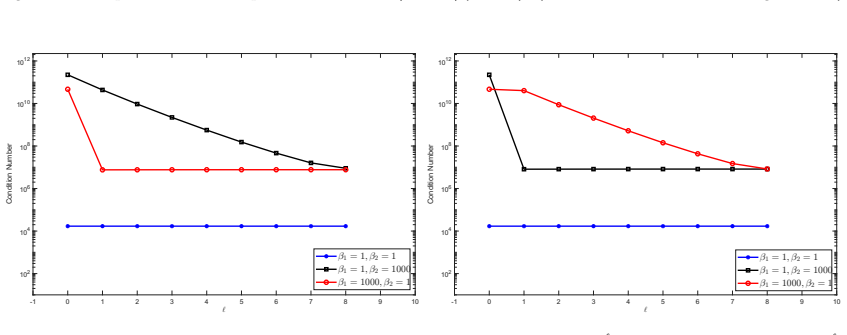
The constructed IFE functions achieve optimal approximation properties and satisfy the essential trace inequalities with constants independent of the interface cut; the resulting IDG scheme attains optimal convergence rates in the H1 and L2 norms, and the condition numbers of the stiffness matrices are robust with respect to the interface location.
What carries the argument
The explicit linear IFE functions that precisely satisfy the interface jump conditions on the actual interface in closed form.
If this is right
- The IFE functions attain optimal approximation order in the energy norm with constants independent of the cut.
- The immersed DG scheme converges at the optimal rates in both the H1 and L2 norms.
- Stiffness-matrix condition numbers remain bounded independently of how the interface intersects the mesh.
Where Pith is reading between the lines
- The same explicit-construction idea could be tested on quadratic or higher IFE spaces to check whether the independence from cut location persists.
- Because no local solves are needed at each time step, the method may extend directly to moving-interface problems without repeated remeshing.
Load-bearing premise
The explicit construction of the linear IFE functions is assumed to be possible in closed form while exactly satisfying the interface jump conditions for arbitrary interface cuts through the element, without requiring additional local solves or auxiliary problems.
What would settle it
A sequence of successively refined meshes in which the observed H1 convergence rate drops below first order, or the stiffness-matrix condition number grows unboundedly, for at least one fixed family of interface cuts.
Figures
read the original abstract
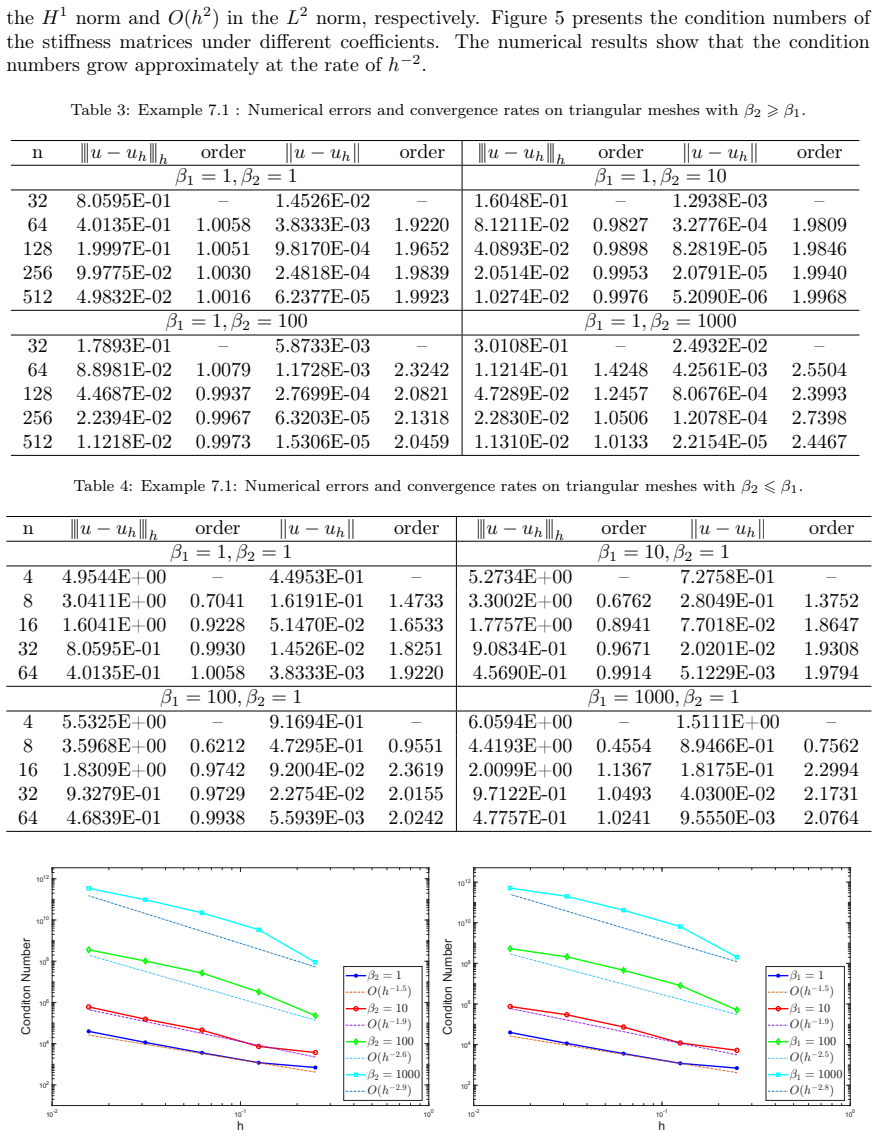
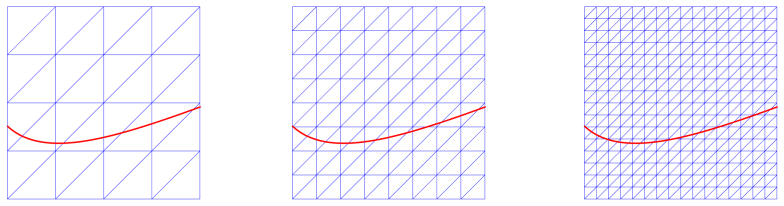
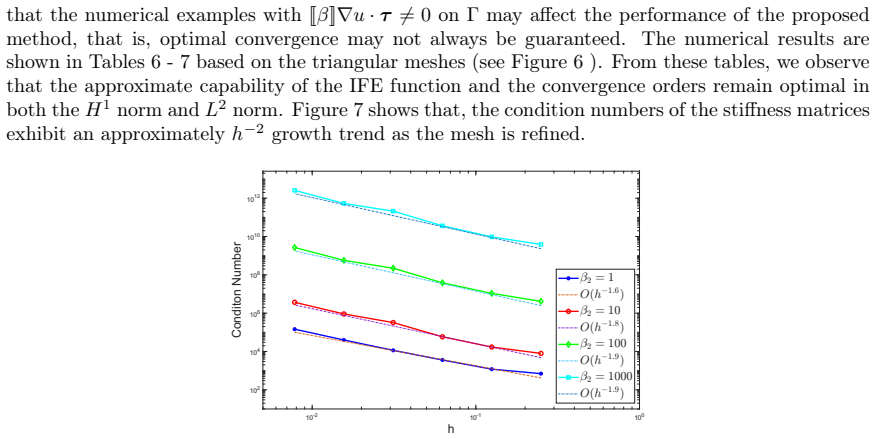
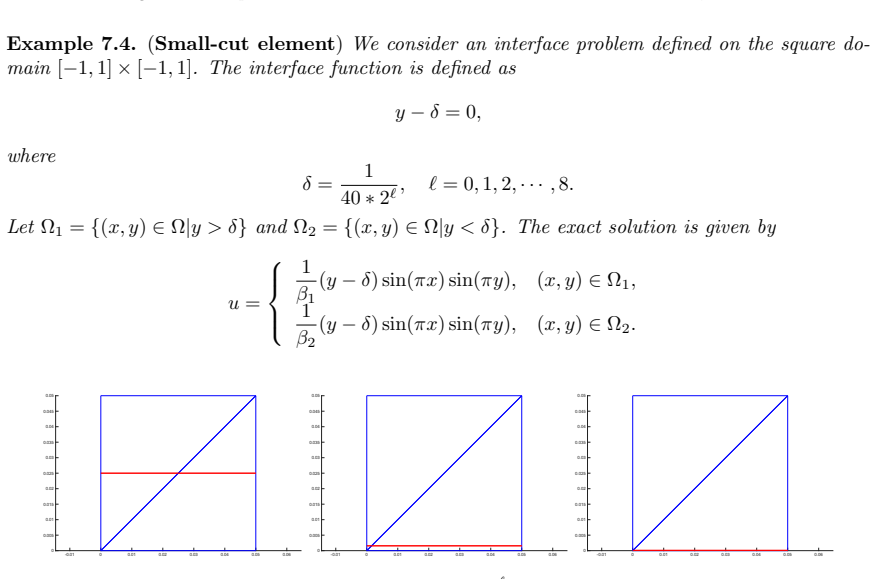
This paper is devoted to construction and convergence analysis of the linear explicit immersed finite element (IFE) function. For the interface elements, the proposed IFE functions precisely satisfy the interface conditions on the actual interface. The IFE functions are constructed in an explicit form and can be obtained directly without solving any auxiliary problems or local linear systems. Although the constructed IFE functions are non-polynomial, we establish rigorous theoretical analysis showing that they achieve optimal approximation properties and satisfy the essential trace inequalities. And the constants in the analysis are independent of how the interface cuts through the elements. Based on these IFE functions, an immersed discontinuous Galerkin numerical scheme is developed. Several numerical experiments are implemented to confirm that both the IFE functions and the numerical method achieve optimal convergence rates in the $H^1$ and $L^2$ norms. Furthermore, the numerical results indicate that the condition numbers of the stiffness matrices are robust with respect to the interface location.
Editorial analysis
A structured set of objections, weighed in public.
Referee Report
Summary. The paper constructs linear explicit immersed finite element (IFE) functions for elliptic interface problems. These functions exactly satisfy the jump conditions [u]=0 and [β ∂_n u]=0 on the true interface segment inside cut elements and are given in closed-form explicit (non-polynomial) expressions that require no auxiliary problems or local linear systems. The manuscript proves that the IFE functions attain optimal approximation properties and satisfy essential trace inequalities with constants independent of the interface cut position. An immersed discontinuous Galerkin (IDG) scheme is formulated from these functions; numerical experiments are reported to confirm optimal H¹ and L² convergence rates together with stiffness-matrix condition numbers that remain robust with respect to interface location.
Significance. If the explicit closed-form construction and the cut-independent analysis hold, the work supplies a practical advance for interface problems by eliminating per-element local solves while retaining optimal rates and robustness. This combination of explicit formulas, rigorous cut-independent estimates, and supporting numerics would strengthen the toolkit for elliptic problems with complex or moving interfaces.
major comments (2)
- [Construction of IFE functions] Abstract and construction section: the central claim that the linear IFE functions are obtained in explicit closed form while exactly enforcing both jump conditions for arbitrary cuts (including near-vertex configurations) is load-bearing for all subsequent approximation theory, trace inequalities, and conditioning results. The manuscript must exhibit the explicit expressions and demonstrate that they remain defined and stable without hidden divisions by quantities that vanish for certain cut geometries.
- [Approximation properties and trace inequalities] Analysis section on approximation properties: the proof that the approximation constants and trace inequalities are independent of the cut position must be checked for completeness; any step that implicitly depends on the distance from the interface to element vertices or edges would undermine the claimed cut-independence.
minor comments (1)
- [Numerical experiments] Numerical experiments section: the description of the test interfaces and the range of cut configurations examined should be expanded to make the robustness claim fully reproducible.
Simulated Author's Rebuttal
We thank the referee for the careful reading and for highlighting the potential practical value of the explicit IFE construction. We respond to each major comment below.
read point-by-point responses
-
Referee: [Construction of IFE functions] Abstract and construction section: the central claim that the linear IFE functions are obtained in explicit closed form while exactly enforcing both jump conditions for arbitrary cuts (including near-vertex configurations) is load-bearing for all subsequent approximation theory, trace inequalities, and conditioning results. The manuscript must exhibit the explicit expressions and demonstrate that they remain defined and stable without hidden divisions by quantities that vanish for certain cut geometries.
Authors: Section 3 derives and displays the explicit closed-form expressions for the linear IFE functions by directly enforcing [u]=0 and [β ∂_n u]=0 on the true interface segment inside each cut element. The resulting formulas are non-polynomial but closed-form, expressed solely in terms of the interface intersection coordinates and the coefficient β; no auxiliary problems or local linear systems are solved. For near-vertex cuts the denominators are geometric quantities (edge-segment lengths) that remain positive whenever the interface intersects two distinct edges, which is required for a valid interface element. We will add a short remark in Section 3 explicitly confirming that the expressions are defined and bounded for all admissible cuts, thereby making the stability statement more prominent. revision: partial
-
Referee: [Approximation properties and trace inequalities] Analysis section on approximation properties: the proof that the approximation constants and trace inequalities are independent of the cut position must be checked for completeness; any step that implicitly depends on the distance from the interface to element vertices or edges would undermine the claimed cut-independence.
Authors: Sections 4 and 5 prove optimal H¹ and L² approximation properties together with the required trace inequalities. The arguments rely on the exact satisfaction of the jump conditions by the explicit IFE functions, followed by standard polynomial approximation on the two sub-elements and inverse-trace estimates whose constants are controlled uniformly by the element diameter and the jump in β. All intermediate bounds are written so that they depend only on these quantities and never on the distance from the interface to a vertex or edge; the cut ratio appears only in terms that cancel or remain bounded. The proofs are therefore complete and cut-independent as stated. revision: no
Circularity Check
No significant circularity; explicit construction and independent analysis
full rationale
The paper presents an explicit closed-form construction of linear IFE functions that satisfy the interface jump conditions exactly on the true interface segment, followed by separate rigorous proofs of optimal approximation properties and cut-independent trace inequalities. No load-bearing steps reduce by definition or self-citation to fitted inputs; the central claims rest on direct construction plus mathematical analysis rather than renaming or circular re-use of results. This is the standard non-circular pattern for a numerical analysis paper deriving new basis functions and proving their properties.
Axiom & Free-Parameter Ledger
axioms (2)
- domain assumption The interface is sufficiently regular (e.g., Lipschitz or C^1) so that the jump conditions are well-defined and the problem is well-posed.
- standard math The background mesh is shape-regular and quasi-uniform.
Reference graph
Works this paper leans on
-
[1]
Mu, Lin and Wang, Junping and Ye, Xiu , TITLE =. J. Comput. Appl. Math. , FJOURNAL =. 2015 , PAGES =. doi:10.1016/j.cam.2015.02.001 , URL =
-
[2]
Wang, Junping and Ye, Xiu , TITLE =. Adv. Comput. Math. , FJOURNAL =. 2016 , NUMBER =. doi:10.1007/s10444-015-9415-2 , URL =
-
[3]
The finite element method for elliptic equations with discontinuous coefficients , JOURNAL =
Babu. The finite element method for elliptic equations with discontinuous coefficients , JOURNAL =. 1970 , PAGES =. doi:10.1007/bf02248021 , URL =
-
[4]
Bramble, James H. and King, J. Thomas , TITLE =. Adv. Comput. Math. , FJOURNAL =. 1996 , NUMBER =. doi:10.1007/BF02127700 , URL =
-
[5]
Chen, Zhiming and Zou, Jun , TITLE =. Numer. Math. , FJOURNAL =. 1998 , NUMBER =. doi:10.1007/s002110050336 , URL =
-
[6]
LeVeque, Randall J. and Li, Zhi Lin , TITLE =. SIAM J. Numer. Anal. , FJOURNAL =. 1994 , NUMBER =. doi:10.1137/0731054 , URL =
-
[7]
2006 , publisher=
The immersed interface method: numerical solutions of PDEs involving interfaces and irregular domains , author=. 2006 , publisher=
2006
-
[8]
Burman, Erik and Claus, Susanne and Hansbo, Peter and Larson, Mats G. and Massing, Andr\'. Cut. Internat. J. Numer. Methods Engrg. , FJOURNAL =. 2015 , NUMBER =. doi:10.1002/nme.4823 , URL =
-
[9]
Hansbo, Anita and Hansbo, Peter , TITLE =. Comput. Methods Appl. Mech. Engrg. , FJOURNAL =. 2002 , NUMBER =. doi:10.1016/S0045-7825(02)00524-8 , URL =
-
[10]
Mathematics of Computation , volume=
A new multiscale finite element method for high-contrast elliptic interface problems , author=. Mathematics of Computation , volume=
-
[11]
SIAM Rev
Hetmaniuk, Ulrich , TITLE =. SIAM Rev. , FJOURNAL =. 2011 , NUMBER =
2011
-
[12]
Melenk, J. M. and Babu. The partition of unity finite element method: basic theory and applications , JOURNAL =. 1996 , NUMBER =. doi:10.1016/S0045-7825(96)01087-0 , URL =
-
[13]
International journal for numerical methods in engineering , volume=
Partition of unity enrichment for bimaterial interface cracks , author=. International journal for numerical methods in engineering , volume=. 2004 , publisher=
2004
-
[14]
An extended finite element method for modeling crack growth with frictional contact , JOURNAL =
Dolbow, John and Mo\". An extended finite element method for modeling crack growth with frictional contact , JOURNAL =. 2001 , NUMBER =. doi:10.1016/S0045-7825(01)00260-2 , URL =
-
[15]
Sukumar, N. and Chopp, D. L. and Mo\". Modeling holes and inclusions by level sets in the extended finite-element method , JOURNAL =. 2001 , NUMBER =. doi:10.1016/S0045-7825(01)00215-8 , URL =
-
[16]
Stable generalized finite element method (
Babu. Stable generalized finite element method (. Comput. Methods Appl. Mech. Engrg. , FJOURNAL =. 2012 , PAGES =. doi:10.1016/j.cma.2011.09.012 , URL =
-
[17]
Strongly stable generalized finite element method: application to interface problems , JOURNAL =
Babu. Strongly stable generalized finite element method: application to interface problems , JOURNAL =. 2017 , PAGES =. doi:10.1016/j.cma.2017.08.008 , URL =
-
[18]
Kergrene, Kenan and Babu. Stable generalized finite element method and associated iterative schemes; application to interface problems , JOURNAL =. 2016 , PAGES =. doi:10.1016/j.cma.2016.02.030 , URL =
-
[19]
Strongly stable generalized finite element method (
Zhang, Qinghui and Banerjee, Uday and Babu. Strongly stable generalized finite element method (. Comput. Methods Appl. Mech. Engrg. , FJOURNAL =. 2019 , PAGES =. doi:10.1016/j.cma.2018.10.018 , URL =
-
[20]
Li, Zhilin , TITLE =. Appl. Numer. Math. , FJOURNAL =. 1998 , NUMBER =. doi:10.1016/S0168-9274(98)00015-4 , URL =
-
[21]
Li, Zhilin and Lin, Tao and Wu, Xiaohui , TITLE =. Numer. Math. , FJOURNAL =. 2003 , NUMBER =. doi:10.1007/s00211-003-0473-x , URL =
-
[22]
Guo, Ruchi and Lin, Tao , TITLE =. IMA J. Numer. Anal. , FJOURNAL =. 2019 , NUMBER =. doi:10.1093/imanum/drx074 , URL =
-
[23]
SIAM Journal on Numerical Analysis
An analysis of a broken P1-nonconforming finite element method for interface problems , author=. SIAM Journal on Numerical Analysis. , volume =
-
[24]
He, Xiaoming and Lin, Tao and Lin, Yanping , TITLE =. Numer. Methods Partial Differential Equations , FJOURNAL =. 2012 , NUMBER =. doi:10.1002/num.20620 , URL =
-
[25]
Adjerid, Slimane and Ben-Romdhane, Mohamed and Lin, Tao , TITLE =. Int. J. Numer. Anal. Model. , FJOURNAL =. 2014 , NUMBER =
2014
-
[26]
Guo, Ruchi and Lin, Tao , TITLE =. SIAM J. Numer. Anal. , FJOURNAL =. 2019 , NUMBER =. doi:10.1137/18M121318X , URL =
-
[27]
Adjerid, Slimane and Guo, Ruchi and Lin, Tao , TITLE =. Int. J. Numer. Anal. Model. , FJOURNAL =. 2017 , NUMBER =
2017
-
[28]
Adjerid, Slimane and Lin, Tao and Meghaichi, Haroun , TITLE =. Comput. Methods Appl. Mech. Engrg. , FJOURNAL =. 2024 , PAGES =. doi:10.1016/j.cma.2023.116703 , URL =
-
[29]
, TITLE =
Ciarlet, Philippe G. , TITLE =. 1978 , PAGES =
1978
-
[30]
Adjerid, Slimane and Lin, Tao and Meghaichi, Haroun , TITLE =. Comput. Methods Appl. Mech. Engrg. , FJOURNAL =. 2025 , NUMBER =. doi:10.1016/j.cma.2025.117829 , URL =
-
[31]
Arnold, Douglas N. , TITLE =. SIAM J. Numer. Anal. , FJOURNAL =. 1982 , NUMBER =. doi:10.1137/0719052 , URL =
-
[32]
2008 , publisher=
Discontinuous Galerkin methods for solving elliptic and parabolic equations: theory and implementation , author=. 2008 , publisher=
2008
-
[33]
IEEE Trans
Modeling Electrostatic Levitation of Dust Particles on Lunar Surface , AUTHOR=. IEEE Trans. Plasma Sci. , FJOURNAL=
-
[34]
The mathematics of reservoir simulation , SERIES =. 1983 , PAGES =. doi:10.1137/1.9781611971071 , URL =
-
[35]
Numerical simulation of breakup of a viscous drop in simple shear flow through a volume-of-fluid method , AUTHOR=. Phys. Fluids , issue=
-
[36]
Ji, Haifeng and Li, Zhilin , TITLE =. J. Sci. Comput. , FJOURNAL =. 2026 , NUMBER =. doi:10.1007/s10915-025-03155-x , URL =
-
[37]
Ji, Haifeng , TITLE =. J. Sci. Comput. , FJOURNAL =. 2022 , NUMBER =. doi:10.1007/s10915-022-01839-2 , URL =
-
[38]
Ji, Haifeng and Wang, Feng and Chen, Jinru and Li, Zhilin , TITLE =. ESAIM Math. Model. Numer. Anal. , FJOURNAL =. 2023 , NUMBER =. doi:10.1051/m2an/2023047 , URL =
-
[39]
Adjerid, Slimane and Chaabane, Nabil and Lin, Tao , TITLE =. Comput. Methods Appl. Mech. Engrg. , FJOURNAL =. 2015 , PAGES =. doi:10.1016/j.cma.2015.04.006 , URL =
-
[40]
Camp, Brian and Lin, Tao and Lin, Yanping and Sun, Weiwei , TITLE =. Adv. Comput. Math. , FJOURNAL =. 2006 , NUMBER =. doi:10.1007/s10444-004-4139-8 , URL =
-
[41]
Lin, T. and Lin, Y. and Sun, W.-W. and Wang, Z. , TITLE =. J. Comput. Appl. Math. , FJOURNAL =. 2011 , NUMBER =. doi:10.1016/j.cam.2011.01.041 , URL =
-
[42]
Lin, Tao and Lin, Yanping and Zhang, Xu , TITLE =. SIAM J. Numer. Anal. , FJOURNAL =. 2015 , NUMBER =. doi:10.1137/130912700 , URL =
-
[43]
Lin, Tao and Sheen, Dongwoo and Zhang, Xu , TITLE =. J. Comput. Phys. , FJOURNAL =. 2013 , PAGES =. doi:10.1016/j.jcp.2013.03.053 , URL =
-
[44]
Lin, Tao and Yang, Qing and Zhang, Xu , TITLE =. J. Sci. Comput. , FJOURNAL =. 2015 , NUMBER =. doi:10.1007/s10915-015-9989-3 , URL =
discussion (0)
Sign in with ORCID, Apple, or X to comment. Anyone can read and Pith papers without signing in.