REVIEW 4 major objections 4 minor 25 references
Walls for $G$-Hilb via Reid's Recipe
T0 review · 4 major / 4 minor · reviewed 2026-08-14 · deepseek-v4-flash
Pith's one-line read This paper proves that the chamber of stability parameters defining the G-Hilbert scheme for a finite abelian subgroup of SL(3,C) can be described explicitly by finitely many inequalities computed from Reid's recipe, with each wall's…
desk verdict A genuinely combinatorial way to write down the walls of C0 for G-Hilb A3, with a clean wall classification; the main gap is that the proof of the load-bearing algorithm omits the meeting-of-champions case and only sketches boundary curves. read the letter →
The pith
A machine-rendered reading of the paper's core claim, the machinery that carries it, and where it could break.
The reading
What carries the argument
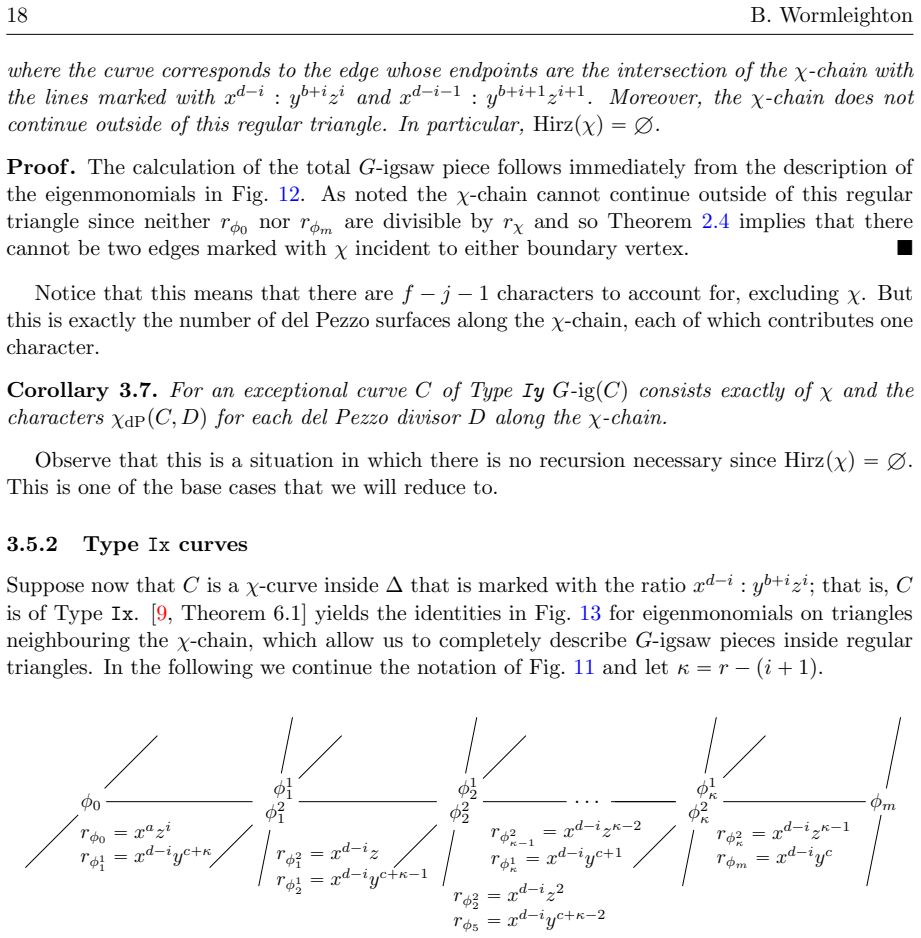
The carrying object is the total $G$-igsaw piece $G\text{-igp}(C)$ of an exceptional curve $C$: the set of characters labelling the monomials of a $G$-cluster that participate in the $G$-igsaw transformation when passing across $C$. The unlocking procedure (Algorithm 3.3) computes $G\text{-igp}(C)$ from Reid's recipe alone: start with the character $\chi$ marking $C$; add one character from each del Pezzo divisor along the $\chi$-chain, the characters marking Hirzebruch divisors along the $\chi$-chain, and then recursively the total $G$-igsaw pieces of the curves $E$ 'downstream' of $C$ at those Hirzebruch divisors. This reduces every wall inequality to a finite, purely combinatorial calculation on the triangulation of the junior simplex, and it provides the redundancy tests that identify which inequalities are walls and which are merely consequences of others.
What would settle it
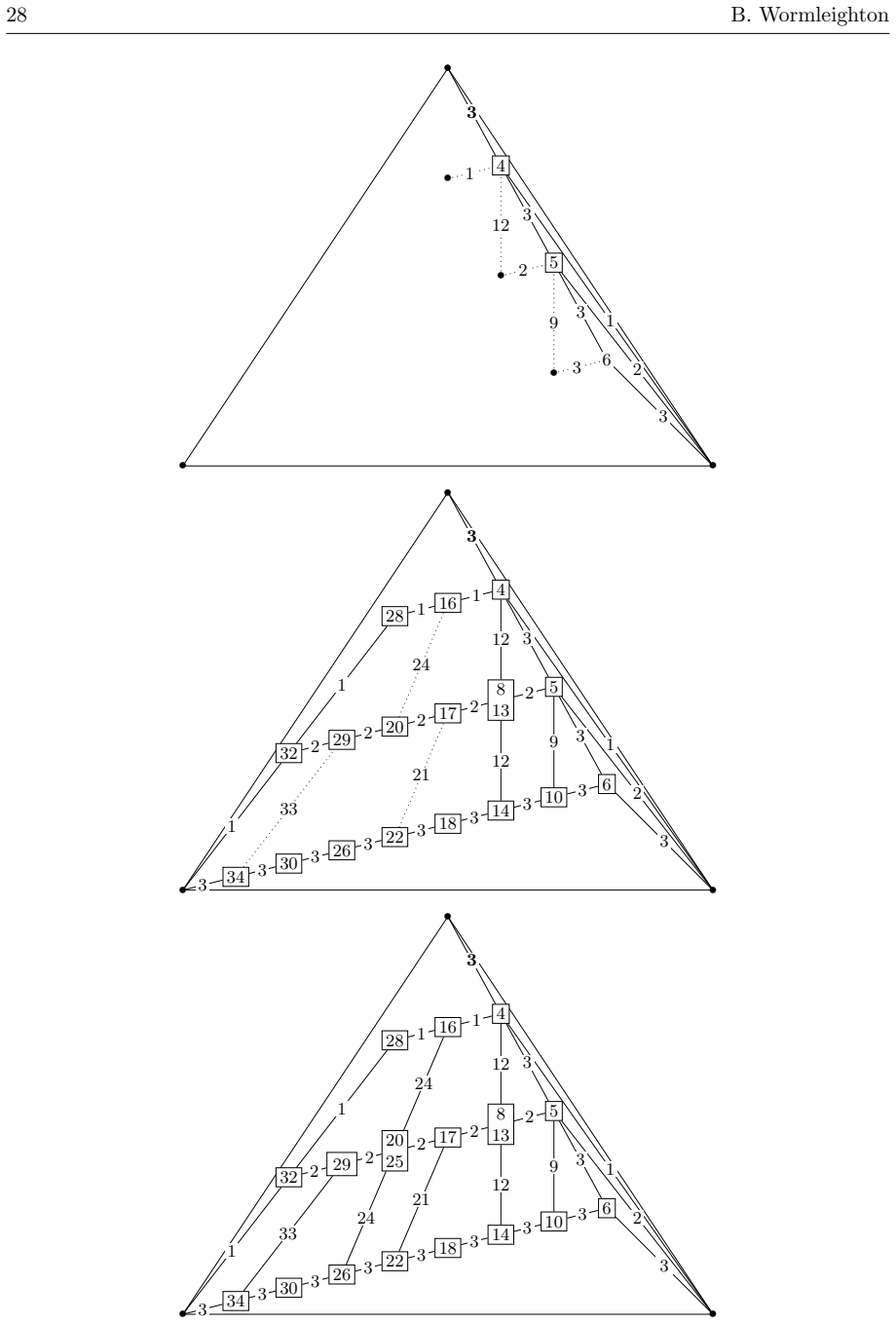
Take a finite abelian group whose triangulation of the junior simplex has a meeting-of-champions triangle of positive side length (for example $G=\frac{1}{25}(1,3,21)$), choose an exceptional curve inside that triangle, and compare the set of characters produced by the unlocking procedure with the set of characters whose tautological line bundles restrict non-trivially to that curve (equivalently, the characters appearing in the monomial ideals of the two adjacent $G$-clusters). Any disagreement would falsify Algorithm 3.3 and hence the wall inequalities of Theorem 4.17.
Extended reading notes
Core claim
The central claim is Theorem 4.17: for any finite abelian $G\subset \mathrm{SL}(3,\mathbb{C})$, the walls of the chamber $C_0$ for $G\text{-Hilb}\,\mathbb{A}^3$ are exactly one Type I wall for each exceptional $(-1,-1)$-curve, one Type III wall for each generalised long side, one Type 0 wall for each irreducible exceptional divisor, and all remaining walls are of Type 0 and come from divisors parameterising a rigid quotient. The inequalities that carve out $C_0$ are computed by the unlocking procedure (Algorithm 3.3), which determines the total $G$-igsaw piece $G\text{-igp}(C)$ of each exceptional curve $C$: the set of characters whose monomials are exchanged when a $G$-cluster moves across $C$. A curve inequality is the sum $\sum_{\chi\in G\text{-igp}(C)}\theta(\chi)>0$, with a doubled contribution $2\theta(\chi^2)$ for $(-1,-3)$-curves, and divisor inequalities are sums of the same characters over all curves inside the divisor. The paper shows that no Type II walls occur and that every flop in a $(-1,-1)$-curve is realised by a Type I wall-crossing from $C_0$, both by purely combinatorial means.
Load-bearing premise
The central claim collapses if for some exceptional curve the unlocking procedure returns the wrong set of characters in the total $G$-igsaw piece; the paper proves this computation in full for the main curve types but leaves the meeting-of-champions case omitted and the boundary-curve case sketched.
Editorial extensions
If this is right
- The chamber $C_0$ for $G\text{-Hilb}\,\mathbb{A}^3$ can be written down explicitly as a finite intersection of half-spaces for any finite abelian $G$, using only the triangulation of the junior simplex and Reid's recipe.
- Each wall of $C_0$ has an identified birational type: Type I walls flop a single $(-1,-1)$-curve, Type III walls contract a divisor to a curve along a generalised long side, and Type 0 walls leave the underlying variety unchanged.
- There are no Type II walls in $C_0$, and every flop in a $(-1,-1)$-curve of $G\text{-Hilb}$ is induced by a wall-crossing directly from $C_0$.
- The Type 0 walls coming from rigid quotients can be reconstructed combinatorially from the set of curves whose full $G$-igsaw characters appear in the wall equation, so the wall-and-chamber decomposition is algorithmically accessible.
- Because the description depends only on the combinatorics of the exceptional fibre, the same procedure transfers to other crepant resolutions obtained by variation of GIT quotient.
Reading between the lines
- A proof of the unlocking procedure for curves inside a meeting-of-champions triangle would complete the present classification and could be checked by comparing its output with a direct monomial-ideal computation of $G$-igsaw pieces.
- The summand-redundancy criterion used in Section 4 suggests a general test for whether a nonnegative wall inequality in a toric GIT chamber is redundant: decompose its character support into total $G$-igsaw pieces and divisor inequalities.
- One could reverse the logic and use an explicitly computed wall chamber for another crepant resolution to reconstruct a partial Reid's recipe, and then ask whether that marking has categorical content along the lines the paper suggests as future work.
- The explicit chamber description should make wall-crossing of related moduli spaces, such as iterated Hilbert schemes, computationally tractable by comparing their stability parameters against the inequalities for $C_0$.
Signed reviews
Editorial analysis
A structured set of objections, weighed in public.
Referee Report
Summary. The paper addresses the chamber C0 in the stability space defining G-Hilb A^3 for a finite abelian subgroup G of SL(3,C). The author proposes a combinatorial 'unlocking procedure' (Algorithm 3.3) that computes the total G-igsaw piece G-igp(C) for each exceptional curve from the data of Reid's recipe, and then uses these pieces to write explicit inequalities for C0 (Propositions 1.2, 2.6, 4.1, 4.2). The main classification is Theorem 4.17: the walls of C0 are Type I walls for p-1,-1-curves, Type III walls for generalized long sides, Type 0 walls for irreducible exceptional divisors, and Type 0 walls from rigid quotients. The paper also gives several worked examples, including G = 1/30(25,2,3), G = 1/35(1,3,31), and G = 1/25(1,3,21).
Significance. If the central claim is fully established, this paper provides a valuable explicit combinatorial description of the chamber C0 and of the birational types of its walls, converting the abstract Craw-Ishii inequalities into concrete formulas that can be read off a triangulation. The treatment is not circular: the G-igsaw computations are checked against external inputs such as Craw's Theorem 2.4, Nakamura's Unique Valley Lemma, and the Craw-Ishii inequalities, and the worked examples reproduce known redundancies and wall types. The main weakness is that the proof of Algorithm 3.3 is incomplete for two classes of curves, and those cases are needed for the wall classification. The paper is therefore promising and likely correct, but the central claim is not yet fully supported in the present text.
major comments (4)
- [§3.5.4] The validity of Algorithm 3.3 for Type Ic curves, those inside a meeting-of-champions triangle, is asserted with the sentence 'For brevity we omit it.' This is not an empty case: Example 4.16, with G = 1/25(1,3,21), has a meeting-of-champions triangle of side length 2, and such triangles contain Type Ic p-1,-1-curves. Since G-igp(C) computed by Algorithm 3.3 is used in every curve inequality (Propositions 1.2, 4.1, 4.2) and hence in the wall classification of Theorem 4.17, the omitted argument is load-bearing and should be supplied in full.
- [§3.6] The proof that Algorithm 3.3 is valid for boundary curves is only a sketch. Key steps are supported by phrases such as 'one can check', 'variations of the arguments above work just as well for the cases not depicted', and 'counting up all these monomials and comparing them with a socle calculation shows' that the algorithm is valid, without the actual checks or counts being written. Boundary curves are needed for the Type III classification in Section 4.6 and therefore for Theorem 4.17, so this gap directly affects the central claim.
- [§4.3, Proposition 4.4] The necessity argument for Type I walls is not fully justified. After Eq. (4.1), the proof asserts that any other inequality featuring the character chi cannot be a summand of (4.1), based on informal observations about other chi-curves and about divisors along the chi-chain. This is a key step: without it, Proposition 4.4 does not establish that every p-1,-1-curve gives a wall of C0. A complete case analysis is needed here.
- [§4.7] The final paragraph of Section 4.7 says that 'the unlocking procedure allows the check of which walls from rigid quotients are necessary to be performed combinatorially', but the actual criterion is not provided in the paper. Since Theorem 4.17 asserts that each remaining wall is of Type 0 and comes from a rigid quotient, the statement is incomplete without either an explicit criterion or a precise reference to where such a criterion is proved.
minor comments (4)
- [Proposition 1.2] In the formula for a p1,-3-curve, the displayed expression ends with '= 0', but it should evidently be '> 0' as in Proposition 4.2.
- [§2.2] In the sentence 'Mark the curve C with the character by whichG acts on m1', there is a missing space between 'which' and 'G'.
- [§4.3] In the sentence 'where we classify the p0,-2q-curves producing those walls', the notation 'p0,-2q' does not match the notation used elsewhere, such as 'p-2,0q-curves' in the introduction; please make the notation consistent.
- [Example 4.6] In the inequality labeled (B6), the terms '2 theta16' and '4 theta26' appear twice; this looks like a typesetting error and should be corrected.
Circularity Check
No significant circularity: the wall computation is a combinatorialisation of external Craw–Ishii, Craw, and Nakamura results, with no fitted parameters and no load-bearing self-citation.
full rationale
The paper's central claim is an explicit combinatorial description of the chamber C0 for G-Hilb A3 and its walls. The derivation does not reduce to its own inputs. The abstract inequalities from Craw–Ishii [10] are external results, and the paper repeatedly states that it is combinatorialising them: 'One can view some of the results herein as a combinatorialisation of [10, Theorem 9.5]' (Section 1). The unlocking procedure (Algorithm 3.3) computes the characters in a total G-igsaw piece G-igp(C); its validity is justified using Reid's recipe, Craw's Theorem 6.1 on tautological bundle relations [9, Theorem 6.1], and Nakamura's Unique Valley Lemma [22, Lemma 3.3], none of which are derived from the wall inequalities being proved. The formula θ(ϕ_C0(O_C)) = Σ_{χ∈G-igp(C)} deg(R_χ|C)θ(χ) is explicitly presented as a consequence of [10, Corollary 5.2] together with the observation that characters outside G-igp(C) have R_χ|C ≅ O_C; this is a repackaging of an external theorem, not a self-derived prediction. The wall classification in Theorem 4.17 is assembled from previously proved propositions and lemmas (Propositions 4.1, 4.2, 4.4, Lemma 4.15, Corollary 4.3), with redundancy checks performed by nonnegative summand decompositions; no parameter is fitted to data and no quantity called a prediction is defined in terms of the target result. The only self-citation, reference [18] to forthcoming work with Ito, is not load-bearing. The genuine caveats are omitted proofs: Section 3.5.4 says for Type Ic curves only 'For brevity we omit it', and Section 3.6 sketches boundary curves with 'one can check' and 'counting up all these monomials'. These are gaps in justification, not circular reasoning, and therefore do not affect the circularity score.
Assumptions & free parameters
assumptions (4)
- domain assumption Relations between tautological line bundles are generated by Reid's recipe divisibility rules, as stated in Craw's Theorem 6.1.
- domain assumption The abstract inequalities from Craw-Ishii ([10, Section 9]) are sufficient to define the chamber C0.
- domain assumption The socle of a torus-invariant G-cluster is correctly described by the marking of divisors (Lemma 3.5, [10, Lemma 9.1]) and by Nakamura's Unique Valley Lemma [22, Lemma 3.3].
- domain assumption Coefficients of Type I and Type III wall inequalities lie in {0,1}, per Lemma 4.7 from [10, Corollaries 6.3 and 6.5].
Cite this review
Pith. "Pith review of Walls for $G$-Hilb via Reid's Recipe." pith.science (2026). https://pith.science/paper/EJ3RGHQ2
@misc{pith2026190805748,
  author       = {Pith},
  title        = {Pith review of: Walls for $G$-Hilb via Reid's Recipe},
  year         = {2026},
  howpublished = {\url{https://pith.science/paper/EJ3RGHQ2}},
  note         = {Machine review of arXiv:1908.05748}
}
abstract
The three-dimensional McKay correspondence seeks to relate the geometry of crepant resolutions of Gorenstein $3$-fold quotient singularities $\mathbb{A}^3/G$ with the representation theory of the group $G$. The first crepant resolution studied in depth was the $G$-Hilbert scheme $G\text{-Hilb}\,\mathbb{A}^3$, which is also a moduli space of $\theta$-stable representations of the McKay quiver associated to $G$. As the stability parameter $\theta$ varies, we obtain many other crepant resolutions. In this paper we focus on the case where $G$ is abelian, and compute explicit inequalities for the chamber of the stability space defining $G\text{-Hilb}\,\mathbb{A}^3$ in terms of a marking of exceptional subvarieties of $G\text{-Hilb}\,\mathbb{A}^3$ called Reid's recipe. We further show which of these inequalities define walls. This procedure depends only on the combinatorics of the exceptional fibre and has applications to the birational geometry of other crepant resolutions.
Figures


Figures from the paper (26 more)








Reference graph
Works this paper leans on
-
[1]
Artin M., Verdier J.L., Reflexive modules over rational double points, Math. Ann. 270 (1985), 79–82
work page 1985
-
[2]
Batyrev V.V., Dais D.I., Strong McKay correspondence, string-theoretic Hodge numbers and mirror sym- metry, Topology 35 (1996), 901–929, arXiv:alg-geom/9410001
arXiv 1996
-
[3]
Bocklandt R., Craw A., Quintero V´ elez A., Geometric Reid’s recipe for dimer models, Math. Ann. 361 (2015), 689–723, arXiv:1305.0156
work page Pith review arXiv 2015
- [4]
- [5]
-
[6]
Derived Reid's recipe for abelian subgroups of SL3(C)
Cautis S., Craw A., Logvinenko T., Derived Reid’s recipe for abelian subgroups of SL 3pCq, J. Reine Angew. Math. 727 (2017), 1–48, arXiv:1205.3110
work page Pith review arXiv 2017
-
[7]
A derived approach to geometric McKay correspondence in dimension three
Cautis S., Logvinenko T., A derived approach to geometric McKay correspondence in dimension three, J. Reine Angew. Math. 636 (2009), 193–236, arXiv:0803.2990
work page Pith review arXiv 2009
-
[8]
Thesis, Warwick University, 2001
Craw A., The McKay correspondence and representations of the McKay quiver, Ph.D. Thesis, Warwick University, 2001. 38 B. Wormleighton
work page 2001
Show all 25 references
-
[9]
Algebra 285 (2005), 682–705, arXiv:math.AG/0010053
Craw A., An explicit construction of the McKay correspondence for A-Hilb C3, J. Algebra 285 (2005), 682–705, arXiv:math.AG/0010053
2005
-
[10]
Craw A., Ishii A., Flops of G-Hilb and equivalences of derived categories by variation of GIT quotient, Duke Math. J. 124 (2004), 259–307, arXiv:math.AG/0211360
2004
-
[11]
Craw A., Ito Y., Karmazyn J., Multigraded linear series and recollement, Math. Z. 289 (2018), 535–565, arXiv:1701.01679
2018 arXiv
-
[12]
Congr., Vol
Craw A., Reid M., How to calculate A-Hilb C3, in Geometry of Toric Varieties, S´ emin. Congr., Vol. 6, Soc. Math. France, Paris, 2002, 129–154, arXiv:math.AG/9909085
2002
-
[13]
131 (2002), 267–290, arXiv:math.AG/9903187
Denef J., Loeser F., Motivic integration, quotient singularities and the McKay correspondence, Compositio Math. 131 (2002), 267–290, arXiv:math.AG/9903187
2002
-
[14]
Ishii A., Ito Y., Nolla de Celis A., On G{N-Hilb of N-Hilb, Kyoto J. Math. 53 (2013), 91–130, arXiv:1108.2310
2013 arXiv
-
[15]
Ishii A., Ueda K., Dimer models and the special McKay correspondence, Geom. Topol. 19 (2015), 3405–3466, arXiv:0905.0059
2015 arXiv
-
[16]
Ito Y., Nakajima H., McKay correspondence and Hilbert schemes in dimension three, Topology 39 (2000), 1155–1191, arXiv:math.AG/9803120
2000
-
[17]
Japan Acad
Ito Y., Nakamura I., McKay correspondence and Hilbert schemes, Proc. Japan Acad. Ser. A Math. Sci. 72 (1996), 135–138
1996
-
[18]
Ito Y., Wormleighton B., Wall-crossing for iterated G-Hilbert schemes, in preparation
-
[19]
King A.D., Moduli of representations of finite-dimensional algebras, Quart. J. Math. 45 (1994), 515–530
1994
-
[20]
Logvinenko T., Derived McKay correspondence via pure-sheaf transforms, Math. Ann. 341 (2008), 137–167, arXiv:math.AG/0606791
2008
-
[21]
McKay J., Cartan matrices, finite groups of quaternions, and Kleinian singularities, Proc. Amer. Math. Soc. 81 (1981), 153–154
1981
-
[22]
Algebraic Geom
Nakamura I., Hilbert schemes of abelian group orbits, J. Algebraic Geom. 10 (2001), 757–779
2001
-
[23]
Reid M., La correspondance de McKay, arXiv:math.AG/9911165
-
[24]
Takahashi K., On essential representations in the McKay correpondence for SL3pCq, Master’s Thesis, Nagoya University, 2011
2011
-
[25]
Wilson P.M.H., The K¨ ahler cone on Calabi–Yau threefolds, Invent. Math. 107 (1992), 561–583
1992
Reviewed August 14, 2026 · model on record in the stance chip above.
Discussion (0). Continue with ORCID to comment.