Bifurcation and global continuation of travelling-rotating Schr\"odinger maps on the sphere
Pith reviewed 2026-06-30 05:25 UTC · model grok-4.3
The pith
The equatorial branch of travelling-rotating Schrödinger maps on the sphere bifurcates at λ_k = R√(k²-1) for k≥2 and continues globally in the regular non-polar class.
A machine-rendered reading of the paper's core claim, the machinery that carries it, and where it could break.
Core claim
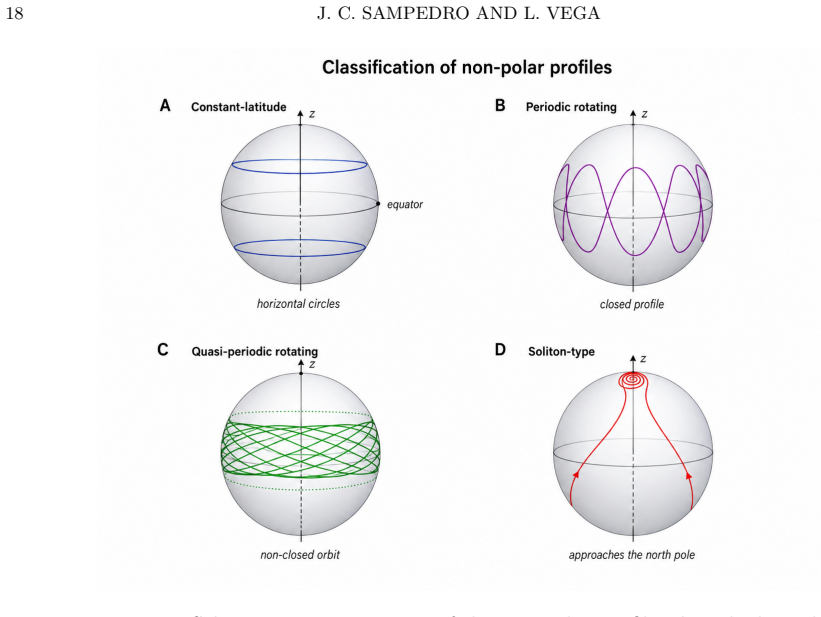
We prove bifurcation from the equatorial branch at λ_k=R√(k²-1), k≥2, and establish a global continuation alternative inside the regular non-polar class. The possible boundary mechanisms are pole contact, vertical collapse, and double-root degeneration. Numerical continuation of the equatorial branches suggests convergence to the north-pole boundary. Up to gauge, the reconstructed vortex filaments are of Kida type.
What carries the argument
Two first integrals reducing the profile equation to a scalar cubic equation for the vertical component, which admits an elliptic-function description and explicit closure conditions.
Load-bearing premise
The two first integrals reduce the profile equation to a scalar cubic equation for the vertical component whose solutions remain inside the regular non-polar class for the entire continuation branch.
What would settle it
An explicit or numerical construction of a bifurcating branch that reaches vertical collapse at a finite parameter value without pole contact or double-root degeneration would show the listed boundary mechanisms are incomplete.
Figures


read the original abstract
We study travelling-rotating solutions of the Schr\"odinger map equation into the sphere, viewed as tangent profiles of rigid vortex filaments. Two first integrals reduce the profile equation to a scalar cubic equation for the vertical component, giving an elliptic-function description and explicit closure conditions. We prove bifurcation from the equatorial branch at $\lambda_k=R\sqrt{k^2-1}$, $k\ge2$, and establish a global continuation alternative inside the regular non-polar class. The possible boundary mechanisms are pole contact, vertical collapse, and double-root degeneration. Numerical continuation of the equatorial branches suggests convergence to the north-pole boundary. Up to gauge, the reconstructed vortex filaments are of Kida type.
Editorial analysis
A structured set of objections, weighed in public.
Referee Report
Summary. The manuscript claims to prove local bifurcation of travelling-rotating Schrödinger maps from the equatorial branch at λ_k = R√(k²-1) for k≥2, together with a global continuation alternative inside the regular non-polar class whose only possible exits are pole contact, vertical collapse, and double-root degeneration. The profile equation is reduced via two first integrals to a scalar cubic whose elliptic solutions yield explicit closure conditions; numerical continuation of the equatorial branches is reported to approach the north-pole boundary. Up to gauge the reconstructed filaments are of Kida type.
Significance. If the reduction and continuation statements hold, the work supplies a rigorous local-to-global theory for a concrete family of solutions to the Schrödinger map equation that are directly linked to rigid vortex filaments. The explicit elliptic-function description and the clean list of admissible boundary mechanisms constitute a genuine technical contribution that could serve as a template for related problems in geometric PDEs.
minor comments (2)
- The abstract states that the two first integrals reduce the profile equation to a scalar cubic, but the explicit form of that cubic and the precise closure conditions are not displayed; adding these expressions would improve readability without lengthening the abstract appreciably.
- The numerical continuation is invoked to suggest convergence to the north-pole boundary, yet no description is given of the discretization, step-size control, or verification that the computed profiles remain inside the regular non-polar class; a short paragraph or appendix entry on these points would strengthen the claim.
Simulated Author's Rebuttal
We thank the referee for the positive assessment of our manuscript, the accurate summary of the bifurcation and global continuation results, and the recommendation for minor revision. No specific major comments were raised in the report.
Circularity Check
No significant circularity
full rationale
The paper's core steps—reduction via two first integrals to a scalar cubic ODE, elliptic-function parametrization with explicit closure conditions, local bifurcation from the equatorial branch at the explicitly stated λ_k = R√(k²-1), and the global continuation alternative whose exits are defined by the three boundary mechanisms—are presented as direct consequences of the profile equation and standard elliptic theory. No load-bearing step reduces by construction to a fitted parameter, self-citation, or renamed input; the λ_k values are not described as outputs of an internal fit. The derivation remains self-contained against external elliptic-function results.
Axiom & Free-Parameter Ledger
free parameters (1)
- R
axioms (2)
- domain assumption Two first integrals exist that reduce the travelling-rotating profile equation to a scalar cubic in the vertical component.
- standard math Standard existence and continuation theory for elliptic functions and ODEs on the sphere applies inside the regular non-polar class.
Reference graph
Works this paper leans on
-
[1]
Abramowitz and I
M. Abramowitz and I. A. Stegun,Handbook of Mathematical Functions with Formulas, Graphs, and Mathematical Tables, National Bureau of Standards Applied Mathematics Series, Vol. 55, U.S. Government Printing Office, Washington, D.C., 1964
1964
-
[2]
R. J. Arms and F. R. Hama,Localized-induction concept on a curved vortex and motion of an elliptic vortex ring, Phys. Fluids8(1965), no. 4, 553–559
1965
-
[3]
Banica and L
V. Banica and L. Vega,On the stability of a singular vortex dynamics, Comm. Math. Phys.286 (2009), 593–627
2009
-
[4]
Banica and L
V. Banica and L. Vega,Scattering for 1D cubic NLS and singular vortex dynamics, J. Eur. Math. Soc. (JEMS)14(2012), no. 1, 209–253
2012
-
[5]
Banica and L
V. Banica and L. Vega,The initial value problem for the binormal flow with rough data, Ann. Sci. ´Ec. Norm. Sup´ er. (4)48(2015), no. 6, 1423–1455
2015
-
[6]
Betchov,On the curvature and torsion of an isolated vortex filament, J
R. Betchov,On the curvature and torsion of an isolated vortex filament, J. Fluid Mech.22(1965), no. 3, 471–479
1965
-
[7]
M. G. Crandall and P. H. Rabinowitz,Bifurcation from simple eigenvalues, J. Funct. Anal.8(1971), 321–340
1971
-
[8]
L. S. Da Rios,Sul moto d’un liquido indefinito con un filetto vorticoso di forma qualunque, Rend. Circ. Mat. Palermo22(1906), 117–135
1906
-
[9]
de la Hoz and L
F. de la Hoz and L. Vega,Vortex filament equation for a regular polygon, Nonlinearity27(2014), no. 12, 3031–3057
2014
-
[10]
Garc´ ıa and L
C. Garc´ ıa and L. Vega,Steady solutions for the Schr¨ odinger map equation, Comm. Partial Differential Equations49(2024), no. 5–6, 505–542
2024
-
[11]
Guti´ errez, J
S. Guti´ errez, J. Rivas and L. Vega,Formation of singularities and self-similar vortex motion under the localized induction approximation, Comm. Partial Differential Equations28(2003), no. 5–6, 927–968
2003
-
[12]
Hasimoto,A soliton on a vortex filament, J
H. Hasimoto,A soliton on a vortex filament, J. Fluid Mech.51(1972), no. 3, 477–485
1972
-
[13]
R. L. Jerrard and D. Smets,On Schr¨ odinger maps fromT 1 toS 2, Ann. Sci. ´Ec. Norm. Sup´ er. (4) 45(2012), no. 4, 637–680
2012
-
[14]
Kida,A vortex filament moving without change of form, J
S. Kida,A vortex filament moving without change of form, J. Fluid Mech.112(1981), 397–409
1981
-
[15]
Kielh¨ ofer,Bifurcation Theory: An Introduction with Applications to Partial Differential Equa- tions, second ed., Applied Mathematical Sciences, vol
H. Kielh¨ ofer,Bifurcation Theory: An Introduction with Applications to Partial Differential Equa- tions, second ed., Applied Mathematical Sciences, vol. 156, Springer, New York, 2012
2012
-
[16]
Langer and R
J. Langer and R. Perline,Poisson geometry of the filament equation, J. Nonlinear Sci.1(1991), 71–93
1991
-
[17]
Langer and D
J. Langer and D. A. Singer,Knotted elastic curves inR 3, J. London Math. Soc. (2)30(1984), no. 3, 512–520
1984
-
[18]
L´ opez-G´ omez,Spectral Theory and Nonlinear Functional Analysis, Chapman and Hall/CRC Re- search Notes in Mathematics, vol
J. L´ opez-G´ omez,Spectral Theory and Nonlinear Functional Analysis, Chapman and Hall/CRC Re- search Notes in Mathematics, vol. 426, CRC Press, Boca Raton (FL), 2001
2001
-
[19]
P. H. Rabinowitz,Some global results for nonlinear eigenvalue problems, J. Funct. Anal.7(1971), 487–513
1971
-
[20]
P. G. Saffman,Vortex Dynamics, Cambridge Monographs on Mechanics and Applied Mathematics, Cambridge University Press, Cambridge, 1992. 66 J. C. SAMPEDRO AND L. VEGA Departamento de Matem´atica Aplicada y Ciencias de la Computaci ´on, Avenida de los Castros 46, Universidad de Cantabria (UC), Santander, 39005, Spain. Email address:juancarlos.sampedro@unican...
1992
discussion (0)
Sign in with ORCID, Apple, or X to comment. Anyone can read and Pith papers without signing in.