REVIEW 42 references
Selected open cluster sample for validating atmospheric parameters: Application to Gaia and other surveys
T0 review · reviewed 2026-08-07 · deepseek-v4-flash
Pith's one-line read Using 130 open clusters as a benchmark, this work measures the systematic offsets and scatter in Teff and logg from Gaia DR3, LAMOST DR11, APOGEE DR17, and GALAH DR4, finding that FGK stars agree best.
The pith
A machine-rendered reading of the paper's core claim, the machinery that carries it, and where it could break.
The reading
Across all surveys, the agreement is best for F, G, and K stars, with temperature scatter usually under 260 K, while B/A stars show large negative temperature offsets and M stars show positive offsets. The scatter in temperature shrinks for cooler stars in most catalogs, while the scatter in gravity grows. The authors are candid that the benchmark itself is imperfect: the model tracks do not include rotation, which matters for hot stars, and the reddening correction uses a coefficient calibrated only for stars between 5250 and 7000 K. So part of the reported B/A and M offsets could be model error rather than survey error. The paper's main contribution is a cleaner sample and an updated set of offset tables for users of these surveys.
Extended reading notes
Core claim
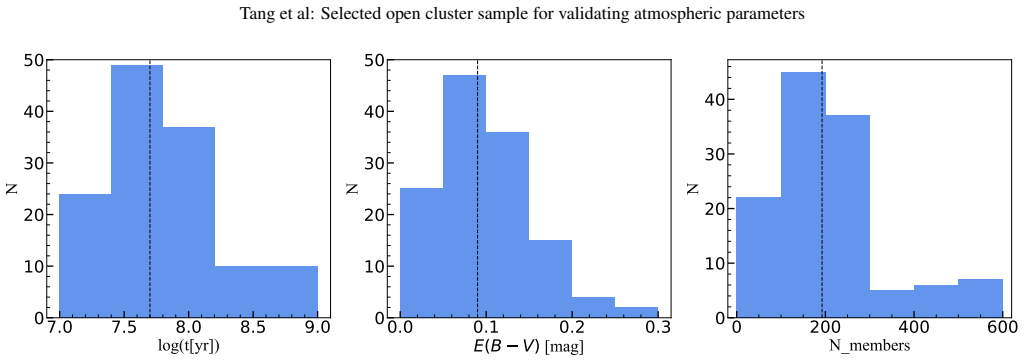
For 130 clean open clusters, the median Teff and logg deviations between the four surveys (Gaia DR3 GSP-Phot/GSP-Spec/ESP-HS, LAMOST DR11, APOGEE DR17, GALAH DR4) and PARSEC isochrone references are smaller for F, G, and K stars than for B, A, and M stars, and the dispersion of Teff decreases while the dispersion of logg increases toward cooler stars. If correct, these tables provide spectral-type dependent offsets for calibrating survey parameters.
Load-bearing premise
The isochrone references are unbiased. Specifically, non-rotating PARSEC isochrones evaluated at Qin23's ages and metallicities, combined with fixed extinction coefficients calibrated only for 5250-7000 K, give the correct Teff and logg for every retained member, especially B/A stars. Section 2.2 step (1) takes Qin23 parameters as true, and Sect 4.5 acknowledges rotation, age error, and model uncertainties are not included. If this assumption fails, the reported B/A and M offsets mix survey bias with model bias.
Editorial analysis
A structured set of objections, weighed in public.
Assumptions & free parameters
free parameters (6)
- log(age) per cluster (130 values) =
7.0 to 9.0 dex, from Qin23
- [M/H] per cluster (130 values) =
adopted from Qin23, not tabulated
- Distance modulus (m-M)0 per cluster =
adopted from Qin23, not tabulated
- E(B-V) per cluster =
0 to 0.3 mag from Qin23
- Binary mass ratio cutoff q =
0.5
- Photometric quality threshold N in |C*| < N sigma_C* =
3
assumptions (4)
- domain assumption Non-rotating PARSEC isochrones give unbiased Teff and logg for given age and metallicity.
- domain assumption After removing q>0.5 binaries, remaining cluster members behave as single stars on the isochrone.
- domain assumption Fixed extinction coefficients AG=2.74 times E(B-V) and E(BP-RP)=1.339 times E(B-V) apply to all member stars.
- ad hoc to paper Cluster ages, metallicities, distance moduli, and reddenings from Qin23 are the true values.
Cite this review
Pith. "Pith review of Selected open cluster sample for validating atmospheric parameters: Application to Gaia and other surveys." pith.science (2026). https://pith.science/paper/EJHG3FYJ
@misc{pith2026250514034,
  author       = {Pith},
  title        = {Pith review of: Selected open cluster sample for validating atmospheric parameters: Application to Gaia and other surveys},
  year         = {2026},
  howpublished = {\url{https://pith.science/paper/EJHG3FYJ}},
  note         = {Machine review of arXiv:2505.14034}
}
read the original abstract
Reliable stellar atmospheric parameters are essential for probing stellar structure and evolution, and for stellar population studies. However, various deviations appear in comparisons with different ground-based spectroscopic surveys. We aim to select high-quality open cluster members and employ the atmospheric parameters provided by the theoretical isochrones of open clusters as a benchmark to assess the quality of stellar atmospheric parameters from Gaia DR3 and other ground-based spectroscopic surveys, such as LAMOST DR11, APOGEE DR17, and GALAH DR4. We selected 130 open clusters with well-defined main sequences within 500 pc of the solar neighborhood as a benchmark sample to estimate the reference atmospheric parameters of the members from the best-fit isochrones of those clusters. By comparing the atmospheric parameters provided by different spectroscopic surveys to the theoretical parameters, we found that the atmospheric parameter deviation and the corresponding dispersions exhibit different variations. The atmospheric parameter deviations of F, G, and K-type stars are smaller than those of B, A, and M-type stars for most surveys. For most samples, the dispersion of Teff decreases as temperature decreases, whereas the dispersion of logg shows the opposite trend.
Figures


Figures from the paper (5 more)


Reference graph
Works this paper leans on
-
[1]
2022, ApJS, 259, 35
Abdurro’uf, Accetta, K., Aerts, C., et al. 2022, ApJS, 259, 35
2022
-
[2]
2023, A&A, 674, A27
Andrae, R., Fouesneau, M., Sordo, R., et al. 2023, A&A, 674, A27
2023
-
[3]
2014, A&A, 569, A111
Blanco-Cuaresma, S., Soubiran, C., Heiter, U., & Jofré, P. 2014, A&A, 569, A111
2014
-
[4]
Bossini, D., Vallenari, A., Bragaglia, A., et al. 2019, A&A, 623, A108
work page 2019
-
[5]
Brandner, W., Calissendorff, P., & Kopytova, T. 2023, A&A, 677, A162
work page 2023
- [6]
-
[7]
2021, MNRAS, 506, 150
Buder, S., Sharma, S., Kos, J., et al. 2021, MNRAS, 506, 150
2021
-
[8]
2020, A&A, 640, A1
Cantat-Gaudin, T., Anders, F., Castro-Ginard, A., et al. 2020, A&A, 640, A1
2020
Show all 42 references
-
[9]
2018, A&A, 618, A93
Cantat-Gaudin, T., Jordi, C., Vallenari, A., et al. 2018, A&A, 618, A93
2018
-
[10]
& VandenBerg, D
Casagrande, L. & VandenBerg, D. A. 2018, MNRAS, 479, L102
2018
-
[11]
2020, A&A, 635, A45
Castro-Ginard, A., Jordi, C., Luri, X., et al. 2020, A&A, 635, A45
2020
-
[12]
2022, A&A, 661, A118
Castro-Ginard, A., Jordi, C., Luri, X., et al. 2022, A&A, 661, A118
2022
-
[13]
L., Sordo, R., Pailler, F., et al
Creevey, O. L., Sordo, R., Pailler, F., et al. 2023, A&A, 674, A26
2023
-
[14]
2012, Research in Astronomy and Astrophysics, 12, 1197 De Angeli, F., Weiler, M., Montegriffo, P., et al
Cui, X.-Q., Zhao, Y .-H., Chu, Y .-Q., et al. 2012, Research in Astronomy and Astrophysics, 12, 1197 De Angeli, F., Weiler, M., Montegriffo, P., et al. 2023, A&A, 674, A2
2012
-
[15]
2023, A&A, 674, A28
Fouesneau, M., Frémat, Y ., Andrae, R., et al. 2023, A&A, 674, A28
2023
-
[16]
2022, A&A, 668, A4 Gaia Collaboration, Prusti, T., de Bruijne, J
Fu, X., Bragaglia, A., Liu, C., et al. 2022, A&A, 668, A4 Gaia Collaboration, Prusti, T., de Bruijne, J. H. J., et al. 2016, A&A, 595, A1 Gaia Collaboration, Vallenari, A., Brown, A. G. A., et al. 2023, A&A, 674, A1 García Pérez, A. E., Allende Prieto, C., Holtzman, J. A., et ...
2022
-
[17]
Hunt, E. L. & Reffert, S. 2021, A&A, 646, A104
2021
-
[18]
Hunt, E. L. & Reffert, S. 2023, A&A, 673, A114
2023
-
[19]
2024, ApJ, 971, 71
Jiang, Y ., Zhong, J., Qin, S., et al. 2024, ApJ, 971, 71
2024
-
[20]
M., et al
Jordi, C., Gebran, M., Carrasco, J. M., et al. 2010, A&A, 523, A48
2010
-
[21]
& Moitinho, A
Krone-Martins, A. & Moitinho, A. 2014, A&A, 561, A57
2014
-
[22]
Lada, C. J. & Lada, E. A. 2003, ARA&A, 41, 57
2003
-
[23]
2018, gAIA-C3-TN-LU-LL-124
Lindegren, L. 2018, gAIA-C3-TN-LU-LL-124
2018
-
[24]
& Pang, X
Liu, L. & Pang, X. 2019, ApJS, 245, 32
2019
-
[25]
R., Schiavon, R
Majewski, S. R., Schiavon, R. P., Frinchaboy, P. M., et al. 2017, AJ, 154, 94
2017
-
[26]
2017, ApJ, 835, 77
Marigo, P., Girardi, L., Bressan, A., et al. 2017, ApJ, 835, 77
2017
-
[27]
2017, The Journal of Open Source Software, 2, 205
McInnes, L., Healy, J., & Astels, S. 2017, The Journal of Open Source Software, 2, 205
2017
-
[28]
S., & Caetano, T
Monteiro, H., Dias, W. S., & Caetano, T. C. 2010, A&A, 516, A2
2010
-
[29]
A., Çakmak, H., Michel, R., & Karata¸ s, Y
Netopil, M., Oralhan, ˙I. A., Çakmak, H., Michel, R., & Karata¸ s, Y . 2022, MN- RAS, 509, 421
2022
-
[30]
S., Perren, G
Pera, M. S., Perren, G. I., Moitinho, A., Navone, H. D., & Vazquez, R. A. 2021, A&A, 650, A109 Portegies Zwart, S. F., McMillan, S. L. W., & Gieles, M. 2010, ARA&A, 48, 431
2021
-
[31]
2023, ApJS, 265, 12
Qin, S., Zhong, J., Tang, T., & Chen, L. 2023, ApJS, 265, 12
2023
-
[32]
2021, Research in Astronomy and As- trophysics, 21, 045
Qin, S.-M., Li, J., Chen, L., & Zhong, J. 2021, Research in Astronomy and As- trophysics, 21, 045
2021
-
[33]
A., et al
Recio-Blanco, A., de Laverny, P., Palicio, P. A., et al. 2023, A&A, 674, A29
2023
-
[34]
H., Ann, H
Sim, G., Lee, S. H., Ann, H. B., & Kim, S. 2019, Journal of Korean Astronomical Society, 52, 145
2019
-
[35]
J., Fossati, L., Passy, J
Stancliffe, R. J., Fossati, L., Passy, J. C., & Schneider, F. R. N. 2016, A&A, 586, A119
2016
-
[36]
Valenti, J. A. & Piskunov, N. 2012, SME: Spectroscopy Made Easy, Astro- physics Source Code Library, record ascl:1202.013
2012
-
[37]
G., & Degl’Innocenti, S
Valle, G., Dell’Omodarme, M., Prada Moroni, P. G., & Degl’Innocenti, S. 2013, A&A, 549, A50
2013
-
[38]
2024, arXiv e-prints, arXiv:2411.12987
Wang, F., Fang, M., Fu, X., et al. 2024, arXiv e-prints, arXiv:2411.12987
2024 arXiv
-
[39]
L., Li, H.-N., et al
Wu, Y ., Luo, A. L., Li, H.-N., et al. 2011, Research in Astronomy and Astro- physics, 11, 924
2011
-
[40]
2012, Research in Astronomy and Astrophysics, 12, 723
Zhao, G., Zhao, Y .-H., Chu, Y .-Q., Jing, Y .-P., & Deng, L.-C. 2012, Research in Astronomy and Astrophysics, 12, 723
2012
-
[41]
Zhong, J., Chen, L., Kouwenhoven, M. B. N., et al. 2019, A&A, 624, A34
2019
-
[42]
Zhong, J., Chen, L., Wu, D., et al. 2020, A&A, 640, A127 Article number, page 10 of 11 Tang et al: Selected open cluster sample for validating atmospheric parameters Appendix A: Reference atmospheric parameters catalog We provide the catalog with atmospheric parameters of the ...
2020
Reviewed August 7, 2026 · model on record in the stance chip above.
Discussion (0). Continue with ORCID to comment.