REVIEW 2 major objections 6 minor 1 cited by
Randomized Krylov-Schur eigensolver with deflation
T0 review · 2 major / 6 minor · reviewed 2026-08-05 · deepseek-v4-flash
Pith's one-line read Randomized Krylov-Schur eigensolver computes a few eigenpairs of large nonsymmetric matrices 2–4x faster than deterministic restarted methods, with comparable accuracy.
desk verdict A genuinely useful randomized Krylov-Schur with sound algebra and real speedups, but the embedding assumption is unchecked and the headline deflation is never tested. read the letter →
The pith
A machine-rendered reading of the paper's core claim, the machinery that carries it, and where it could break.
The reading
What carries the argument
The engine of the method is the randomized $\varepsilon$-embedding—a matrix $\Omega\in\mathbb{R}^{d\times n}$ that approximately preserves norms on a $k$-dimensional subspace—used to define sketch-orthonormal bases, for which $(\Omega U_k)^T(\Omega U_k)=I_k$. Orthogonalization, Rayleigh-Ritz, residual estimation, and the deflation projector $P^\Omega_{U_q}=U_q(\Omega U_q)^\dagger\Omega$ all act on the sketch $S=\Omega U$ or in the small space $\mathbb{R}^d$, while the full-space vectors are updated by cheap triangular solves. This keeps per-iteration cost low, and the Schur form of the small Rayleigh quotient $T_k$ provides the stable reordering mechanism that replaces shifted QR for restart
What would settle it
Run rKS on a matrix with a clustered spectrum that forces many restarts, using the recommended sparse-sign sketch with d = 2m. If, before convergence, the condition number of the stored sketch S_k grows beyond a fixed factor, or the ratio between the true residual $\|A\tilde x - \tilde\lambda \tilde x\|/\|A\tilde x\|$ and the estimate $|b^T y|/|\tilde\lambda|$ exceeds $\sqrt{(1+\varepsilon)/(1-\varepsilon)} \approx 2.4$, then the ε-embedding assumption is violated for that run.
Extended reading notes
Core claim
The central object is the sketch-orthonormal Krylov-Schur decomposition $$AU_k = U_k T_k + u_{k+1} b_k^T,$$ where $(U_k,u_{k+1})$ is orthonormal after multiplication by a random $\varepsilon$-embedding $\Omega$ and $T_k$ is block upper-triangular (Definition 2.4). The paper shows that every Krylov decomposition is equivalent to a randomized Arnoldi factorization in the sense of spanning the same space (Theorem 2.2), and that one cycle of rKS—expand to length $k+p$, reorder the Schur form, truncate—produces the same subspace as one cycle of rIRA with the same shifts (Theorem 3.1). It then shows that a converged eigenpair can be locked by zeroing the corresponding entries of $b$; if those entr
Load-bearing premise
The argument assumes that the fixed random sketching matrix Ω remains an ε-embedding for the Krylov subspace at every restart; in the implementation this is only guaranteed with high probability, and if it fails the sketched basis becomes ill-conditioned, so the residual estimates and deflation error bounds no longer hold.
Editorial extensions
If this is right
- rKS inherits the polynomial-filtering convergence of randomized IRA because each restart cycle yields the same Krylov subspace spans (Theorem 3.1).
- A converged eigenpair can be locked when its $|b_i|$ entry is below $\eta$; the remaining computation runs on a perturbed operator whose restriction to the active Krylov space has error bounded by $\sqrt{q}\sqrt{(1+\varepsilon)/(1-\varepsilon)}\,\eta$ (Theorem 4.2).
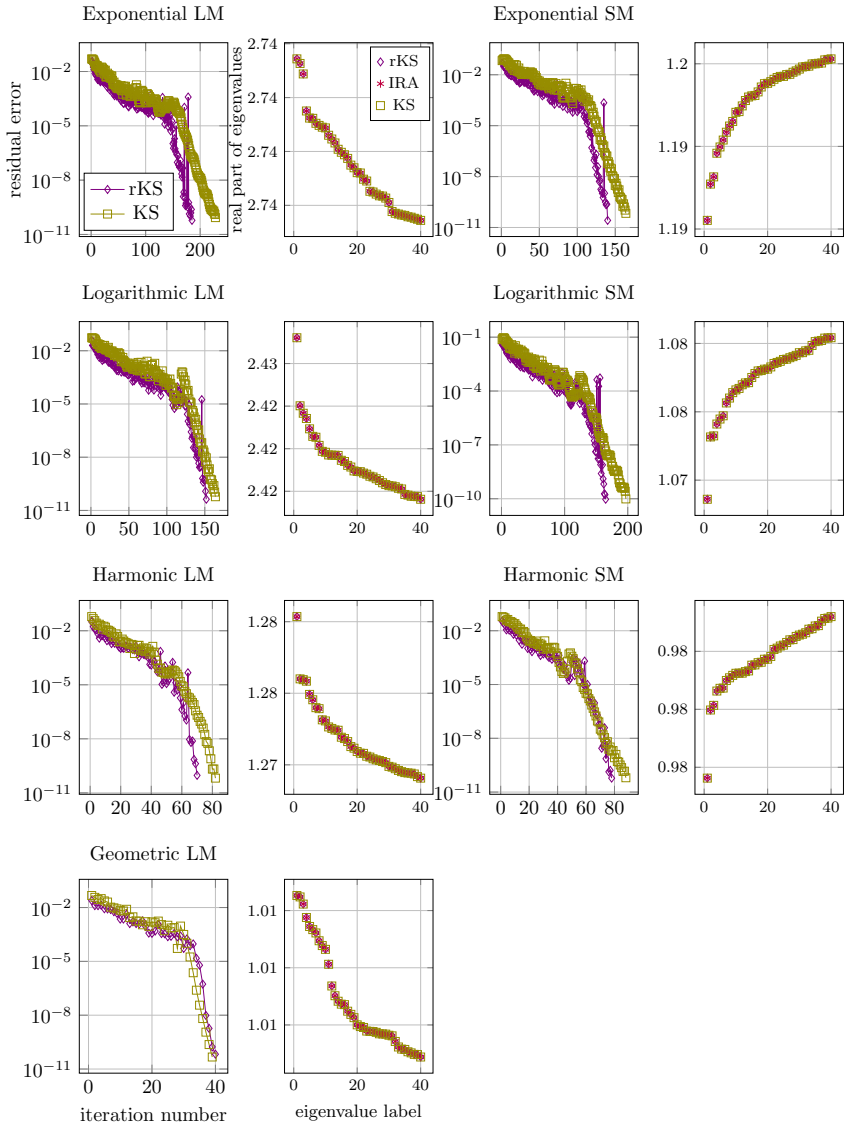
- In numerical experiments on synthetic and real sparse matrices, rKS is 2–4 times faster than deterministic IRA and Krylov-Schur, finds the same eigenvalues, and often needs the fewest restarts.
- Because the sketch $S$ is stored and updated, the contraction and expansion steps operate in dimension $d\ll n$, so the method scales to matrices with millions of rows.
- The method is less sensitive to the ratio between Krylov dimension and number of wanted eigenvalues, easing the choice of subspace size.
Reading between the lines
- The authors leave implicit that the probabilistic guarantee on $\Omega$ suggests a practical safeguard: monitoring the condition number of the stored sketch $S_k$ during restarts and re-drawing or enlarging the embedding if it degrades.
- Since the residual estimate (4.9) approximates $\|A\tilde x\|$ by $|\tilde\lambda|\,\|\tilde x\|$, it is weakest for smallest-modulus targets; the exact bound (4.10) avoids that approximation and would be the safer convergence test for smallest-modulus eigenproblems.
- The convergence spikes seen in the residual plots hint that randomization can temporarily disturb the approximate eigenvalues; if confirmed more broadly, it may explain both the sometimes-fewer iterations and the need for a slightly relaxed deflation threshold.
- The backward-error bound grows like $\sqrt{q}\,\eta$, so if the number of locked vectors $q$ is large, the threshold $\eta$ may need to shrink to keep the perturbed problem faithful.
Signed reviews
Editorial analysis
A structured set of objections, weighed in public.
Referee Report
Summary. The paper introduces a randomized Krylov-Schur eigensolver (rKS) for computing a small number of eigenpairs of large nonsymmetric matrices. It defines sketch-orthonormal Krylov(-Schur) decompositions, proves their equivalence to randomized Arnoldi factorizations, and shows that one rKS cycle is equivalent to the randomized Implicitly Restarted Arnoldi method, so that polynomial-filtering convergence transfers. It then derives residual estimators and a deflation procedure for converged eigenpairs, with backward-error bounds in Theorem 4.2, and reports numerical experiments on synthetic and SuiteSparse matrices showing 2--4x speedups over deterministic IRA/KS.
Significance. If the claims hold, the paper provides a simple, scalable randomized eigensolver with a plausible theoretical justification for convergence and deflation. The algebraic framework is clean and the sketch-orthonormal decomposition viewpoint is a natural extension of Stewart's Krylov-Schur framework. The main positive elements are the explicit factorization equivalences, the use of Schur reordering instead of shifted QR, and the experimental demonstration of consistent speedups on large sparse problems. However, the central guarantees are conditional on an epsilon-embedding hypothesis that the implemented algorithm does not verify, and the deflation backward-error theorem contains a real-diagonalization step that is not valid for real Schur forms with 2-by-2 blocks.
major comments (2)
- [Section 4.4, Theorem 4.2] The proof of Theorem 4.2 assumes an eigendecomposition T_qq W = W D with a real diagonal D (equivalently, real eigenvectors forming a basis). But T_qq is a block upper-triangular real Schur form with 1-by-1 and 2-by-2 diagonal blocks. A 2-by-2 block such as [[0,-1],[1,0]] has no real diagonalization, and even a triangular block with repeated real eigenvalues can be defective. Consequently the claimed existence of real unit vectors Z and a real diagonal D satisfying the bound in eq. (4.33) is not established for the general stated setting. This is load-bearing for the subspace-deflation contribution. The theorem should be restated either for Schur vectors (block-diagonal D), over the complex field, or under an explicit diagonalizability assumption.
- [Definition 1.1 / Remark 1, Section 5, and Theorem 4.2] All theoretical results are conditional on Omega being an epsilon-embedding for each Krylov subspace encountered, but the implementation uses one fixed sparse-sign sketch with d=2m, zeta=8 and no verification that the embedding property holds for the polynomial-filtered subspaces produced across restarts. The paper gives no oblivious-subspace-embedding guarantee for this parameter regime and no failure probability for the union of subspaces seen by the algorithm. This is not merely a formal gap: if at some restart the current subspace contains a direction nearly annihilated by Omega, then in Algorithm 2 line 8 beta_{j+1} can be tiny while ||u~_{j+1}|| is O(1), so u_{j+1} has huge norm. The sketched basis S remains orthonormal by construction, but U becomes ill-conditioned, and the residual estimator in eq. (4.9) and the deflation bound in eq. (4.32) can fail silently because they rely on
minor comments (6)
- [Algorithm 2, line 9] The expression 'U_{j+1} = (U_j u_{k+p+1} = ...)' contains an index typo; it should be 'u_{j+1}'.
- [Figure 7 caption] The caption says 'The execution times for each method are reported in Fig. 7'; this should refer to Fig. 6.
- [Section 4.2] The text refers to 'line 4 of Algorithm 2' for deflated sketch-orthogonalization. In Algorithm 2, line 4 is w_j = A u_j, while the projection is performed in line 6. Please update the reference.
- [Section 4.1, eq. (4.9)] Equation (4.9) is presented as a bound but uses the approximation ||Omega(A x~)|| ~= |lambda|. This is an estimate rather than a rigorous inequality unless ||A x~|| ~= |lambda| ||x~|| is justified. It would be clearer to state it as a heuristic and to base convergence certificates on the exact bound in eq. (4.10) or on true residuals.
- [Theorem 4.2, eq. (4.34)] The notation ||E|K||_{F,2} is nonstandard and ambiguous. Define the norm of the restriction of E to K explicitly.
- [Section 1.1] Corollary 1.0.1 should be numbered as Corollary 1.1; the current numbering is unusual.
Circularity Check
No significant circularity: the randomized Krylov-Schur derivations are self-contained; self-citations to prior rIRA work are not load-bearing.
full rationale
The paper's central results are derived from explicit algebraic relations and the stated ε-embedding hypothesis, not from fitted constants or circular definitions. Theorem 2.2 is proved by similarity and translation operations that preserve the span, followed by Householder reductions to Hessenberg form; the equivalence is established by construction rather than assumed. Theorem 3.1 proves span equality after a restart cycle using the fact that the two small matrices are similar via the orthonormal change of basis between sketch-orthonormal bases; the argument is self-contained once the rIRA and rKS update rules are fixed. The residual estimator in (4.9) is obtained from the algebraic identity A x̃ − λ̃ x̃ = u_{k+1} b_k^T y together with the ε-embedding inequalities; the '≈' step is explicitly flagged, and Remark 2 gives an exact alternative that does not rely on that approximation. Deflation bounds in Theorem 4.2 are direct consequences of the assumption |b_i| ≤ η under the stated ε-embedding for the Krylov subspace; no hidden parameter is fitted to the experimental outputs. The sketching parameters d = 2m and ζ = 8 are hand-chosen, not tuned to reproduce benchmark results, and η is a user-supplied tolerance. Citations to [dDG24] provide a uniqueness theorem and polynomial-filtering background, but the equivalence proof in this paper does not reduce to those citations: the existence direction is proved in detail, and the algorithm and its error bounds stand even without the uniqueness clause. The skeptic's concern that the fixed sparse-sign sketch may not remain an ε-embedding for every subspace encountered during restarts is a correctness and robustness gap, not a circularity of the derivation chain, since the paper explicitly states the embedding hypothesis and does not define its targets in terms of that hypothesis.
Assumptions & free parameters
free parameters (4)
- Sketch dimension ratio d/m =
2
- Sparse embedding nonzeros per row zeta =
8
- Convergence tolerance eta =
1e-10
- Krylov dimension m relative to k =
2k (or varying from 1.5k to 4k)
assumptions (8)
- domain assumption Omega is an epsilon-embedding for the current Krylov subspace at each restart
- standard math Oblivious subspace embeddings exist with d = O(k/eps^2)
- standard math Randomized Implicit Q theorem from [dDG24]
- standard math Stewart's deterministic Krylov decomposition equivalence lemmas
- domain assumption Krylov subspace Kk(A,v1) has full dimension k
- domain assumption Retained Ritz values are distinct from discarded ones
- domain assumption No zero eigenvalues among locked vectors
- domain assumption Residual estimation uses ||Ax|| approx |lambda| ||x||
Cite this review
Pith. "Pith review of Randomized Krylov-Schur eigensolver with deflation." pith.science (2026). https://pith.science/paper/EJZE5MTF
@misc{pith2026250805400,
  author       = {Pith},
  title        = {Pith review of: Randomized Krylov-Schur eigensolver with deflation},
  year         = {2026},
  howpublished = {\url{https://pith.science/paper/EJZE5MTF}},
  note         = {Machine review of arXiv:2508.05400}
}
read the original abstract
This work introduces a novel algorithm to solve large-scale eigenvalue problems and seek a small set of eigenpairs. The method, called randomized Krylov-Schur (rKS), has a simple implementation and benefits from fast and efficient operations in low-dimensional spaces, such as sketch-orthogonalization processes and stable reordering of Schur factorizations. It also includes a practical deflation technique for converged eigenpairs, enabling the computation of the eigenspace associated with a given part of the spectrum. Numerical experiments are provided to demonstrate the scalability and accuracy of the method.
Figures


Figures from the paper (4 more)



Forward citations
Cited by 1 Pith paper
-
Randomized biorthogonalization through a two-sided Gram-Schmidt process
Randomized two-sided Gram-Schmidt builds bases Q and P with (ΩQ)^T ΩP = I, at about half the cost and often with better conditioning than the deterministic version.
Reference graph
Works this paper leans on
-
[1]
Randomized cholesky qr factorizations, 2022
Oleg Balabanov. Randomized cholesky qr factorizations, 2022
work page 2022
-
[2]
Zhaojun Bai and James W. Demmel. On swapping diagonal blocks in real schur form. Linear Algebra and its Applications , 186:75--95, June 1993
work page 1993
-
[3]
Julia: A fresh approach to numerical computing
Jeff Bezanson, Alan Edelman, Stefan Karpinski, and Viral B Shah. Julia: A fresh approach to numerical computing. SIAM review , 59(1):65--98, 2017
work page 2017
-
[4]
Randomized block gram-schmidt process for solution of linear systems and eigenvalue problems, 2021
Oleg Balabanov and Laura Grigori. Randomized block gram-schmidt process for solution of linear systems and eigenvalue problems, 2021
work page 2021
-
[5]
Randomized gram--schmidt process with application to GMRES
Oleg Balabanov and Laura Grigori. Randomized gram--schmidt process with application to GMRES . SIAM Journal on Scientific Computing , 44(3):A1450--A1474, jun 2022
work page 2022
-
[6]
Liam Burke, Stefan Güttel, and Kirk M. Soodhalter. Gmres with randomized sketching and deflated restarting, 2023
work page 2023
-
[7]
Michael W. Mahoney Boyd. Randomized algorithms for matrices and data. Foundations and Trends® in Machine Learning , 3(2):123--224, 2010
work page 2010
-
[8]
Randomized implicitly restarted arnoldi method for the non-symmetric eigenvalue problem, 2024
Jean-Guillaume de Damas and Laura Grigori. Randomized implicitly restarted arnoldi method for the non-symmetric eigenvalue problem, 2024
work page 2024
Show all 47 references
-
[9]
Davis and Yifan Hu
Timothy A. Davis and Yifan Hu. The university of florida sparse matrix collection. ACM Transactions on Mathematical Software , 38(1):1--25, November 2011
2011
-
[10]
Petros Drineas, Ravi Kannan, and Michael W. Mahoney. Fast monte carlo algorithms for matrices i: Approximating matrix multiplication. SIAM Journal on Computing , 36(1):132--157, January 2006
2006
-
[11]
Petros Drineas, Ravi Kannan, and Michael W. Mahoney. Fast monte carlo algorithms for matrices ii: Computing a low-rank approximation to a matrix. SIAM Journal on Computing , 36(1):158--183, January 2006
2006
-
[12]
Randomized sketching of nonlinear eigenvalue problems
Stefan Güttel, Daniel Kressner, and Bart Vandereycken. Randomized sketching of nonlinear eigenvalue problems. SIAM Journal on Scientific Computing , 46(5):A3022--A3043, September 2024
2024
-
[13]
Giraud, J
L. Giraud, J. Langou, and M. Rozloznik. The loss of orthogonality in the gram-schmidt orthogonalization process. Computers and Mathematics with Applications , 50(7):1069--1075, October 2005
2005
-
[14]
Gene H. Golub. Matrix computations . John Hopkins, 2013
2013
-
[15]
Randomized sketching for krylov approximations of large-scale matrix functions
Stefan Güttel and Marcel Schweitzer. Randomized sketching for krylov approximations of large-scale matrix functions. SIAM Journal on Matrix Analysis and Applications , 44(3):1073--1095, July 2023
2023
-
[16]
A sketch-and-select arnoldi process, 2023
Stefan Güttel and Igor Simunec. A sketch-and-select arnoldi process, 2023
2023
-
[17]
Randomized householder qr, 2024
Laura Grigori and Edouard Timsit. Randomized householder qr, 2024
2024
-
[18]
Golub and Henk A
Gene H. Golub and Henk A. van der Vorst. Eigenvalue computation in the 20th century. Journal of Computational and Applied Mathematics , 123(1-2):35--65, nov 2000
2000
-
[19]
Accuracy and stability of numerical algorithms
Nicholas J Higham. Accuracy and stability of numerical algorithms . SIAM, 2002
2002
-
[20]
Halko, P
N. Halko, P. G. Martinsson, and J. A. Tropp. Finding structure with randomness: Probabilistic algorithms for constructing approximate matrix decompositions. SIAM Review , 53(2):217--288, jan 2011
2011
-
[21]
Jolliffe and Jorge Cadima
Ian T. Jolliffe and Jorge Cadima. Principal component analysis: a review and recent developments. Philosophical Transactions of the Royal Society A: Mathematical, Physical and Engineering Sciences , 374(2065):20150202, April 2016
-
[22]
Randomized flexible gmres with deflated restarting
Yongseok Jang, Laura Grigori, Emeric Martin, and Cédric Content. Randomized flexible gmres with deflated restarting. Numerical Algorithms , March 2024
2024
-
[23]
Extensions of lipschitz mappings into a hilbert space
William B Johnson, Joram Lindenstrauss, et al. Extensions of lipschitz mappings into a hilbert space. Contemporary mathematics , 26(189-206):1, 1984
1984
-
[24]
Numerical Methods for General and Structured Eigenvalue Problems
Daniel Kressner. Numerical Methods for General and Structured Eigenvalue Problems . Springer, 2005
2005
-
[25]
Block algorithms for reordering standard and generalized schur forms
Daniel Kressner. Block algorithms for reordering standard and generalized schur forms. ACM Transactions on Mathematical Software , 32(4):521--532, December 2006
2006
-
[26]
Fast randomized non-hermitian eigensolvers based on rational filtering and matrix partitioning
Vassilis Kalantzis, Yuanzhe Xi, and Lior Horesh. Fast randomized non-hermitian eigensolvers based on rational filtering and matrix partitioning. SIAM Journal on Scientific Computing , 43(5):S791--S815, jan 2021
2021
-
[27]
Lin, J.E
R.M. Lin, J.E. Mottershead, and T.Y. Ng. A state-of-the-art review on theory and engineering applications of eigenvalue and eigenvector derivatives. Mechanical Systems and Signal Processing , 138:106536, April 2020
2020
-
[28]
Deflation techniques for an implicitly restarted arnoldi iteration
R Lehoucq and D Sorensen. Deflation techniques for an implicitly restarted arnoldi iteration. SIAM Journal on Matrix Analysis and Applications , 17(4):789--821, 1995
1995
-
[29]
ARPACK users' guide: solution of large-scale eigenvalue problems with implicitly restarted Arnoldi methods
Richard B Lehoucq, Danny C Sorensen, and Chao Yang. ARPACK users' guide: solution of large-scale eigenvalue problems with implicitly restarted Arnoldi methods . SIAM, 1998
1998
-
[30]
Randomized numerical linear algebra: A perspective on the field with an eye to software
Riley Murray, James Demmel, Michael W Mahoney, N Benjamin Erichson, Maksim Melnichenko, Osman Asif Malik, Laura Grigori, Piotr Luszczek, Michal Derezinski, Miles E Lopes, et al. Randomized numerical linear algebra: A perspective on the field with an eye to software. 2022
2022
-
[31]
Per-Gunnar Martinsson and Joel A. Tropp. Randomized numerical linear algebra: Foundations and algorithms. Acta Numerica , 29:403--572, may 2020
2020
-
[32]
Yuji Nakatsukasa and Joel A. Tropp. Fast and accurate randomized algorithms for linear systems and eigenvalue problems. SIAM Journal on Matrix Analysis and Applications , 45(2):1183--1214, June 2024
2024
-
[33]
A geneo domain decomposition method for saddle point problems
Frédéric Nataf and Pierre-Henri Tournier. A geneo domain decomposition method for saddle point problems. Comptes Rendus. Mécanique , 351(S1):667--684, April 2024
2024
-
[34]
H. J. Pain. The Physics of Vibrations and Waves . Wiley, April 2005
2005
-
[35]
A fast randomized algorithm for overdetermined linear least-squares regression
Vladimir Rokhlin and Mark Tygert. A fast randomized algorithm for overdetermined linear least-squares regression. Proceedings of the National Academy of Sciences , 105(36):13212--13217, sep 2008
2008
-
[36]
Iterative methods for sparse linear systems
Yousef Saad. Iterative methods for sparse linear systems . SIAM, 2003
2003
-
[37]
Numerical methods for large eigenvalue problems: revised edition
Yousef Saad. Numerical methods for large eigenvalue problems: revised edition . SIAM, 2011
2011
-
[38]
S. A. Shahzadeh Fazeli, Nahid Emad, and Zifan Liu. A key to choose subspace size in implicitly restarted arnoldi method. Numerical Algorithms , 70(2):407--426, January 2015
2015
-
[39]
Saibaba, Jonghyun Lee, and Peter K
Arvind K. Saibaba, Jonghyun Lee, and Peter K. Kitanidis. Randomized algorithms for generalized hermitian eigenvalue problems with application to computing karhunen lo \` e ve expansion. Numerical Linear Algebra with Applications , 23(2):314--339, nov 2015
2015
-
[40]
D. C. Sorensen. Implicit application of polynomial filters in a k-step arnoldi method. SIAM Journal on Matrix Analysis and Applications , 13(1):357--385, jan 1992
1992
-
[41]
G. W. Stewart. Addendum to a krylov--schur algorithm for large eigenproblems. SIAM Journal on Matrix Analysis and Applications , 24(2):599--601, January 2002
2002
-
[42]
G. W. Stewart. A krylov--schur algorithm for large eigenproblems. SIAM Journal on Matrix Analysis and Applications , 23(3):601--614, jan 2002
2002
-
[43]
Stabilized krylov subspace recurrences via randomized sketching
Valeria Simoncini and YiHong Wang. Stabilized krylov subspace recurrences via randomized sketching. Numerical Linear Algebra with Applications , 32(3), May 2025
2025
-
[44]
Randomized orthogonal projection methods for krylov subspace solvers, 2023
Edouard Timsit, Laura Grigori, and Oleg Balabanov. Randomized orthogonal projection methods for krylov subspace solvers, 2023
2023
-
[45]
J. H. Wilkinson. The algebraic eigenvalue problem . Clarendon Press, 1988
1988
-
[46]
Woodruff
David P. Woodruff. Sketching as a tool for numerical linear algebra. Foundations and Trends in Theoretical Computer Science , 10(1-2):1--157, 2014
2014
-
[47]
A randomized feast algorithm for generalized eigenvalue problems, 2016
Guojian Yin. A randomized feast algorithm for generalized eigenvalue problems, 2016
2016
Reviewed August 5, 2026 · model on record in the stance chip above.
Discussion (0). Continue with ORCID to comment.