Field-tunable quadruple-Q states driven by momentum-space frustration
Pith reviewed 2026-06-26 11:10 UTC · model grok-4.3
The pith
Momentum-space frustration and biquadratic coupling stabilize multiple distinct quadruple-Q spin states in a square-lattice model under an applied field.
A machine-rendered reading of the paper's core claim, the machinery that carries it, and where it could break.
Core claim
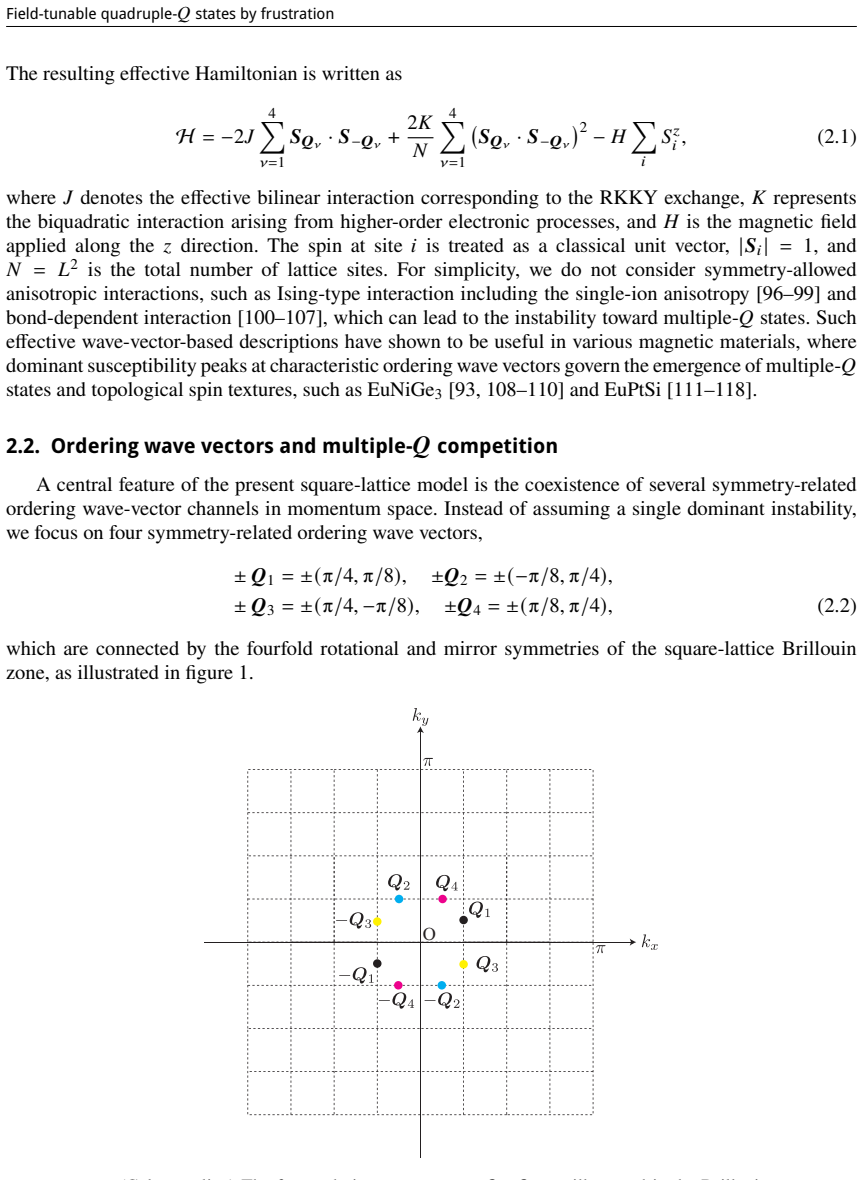
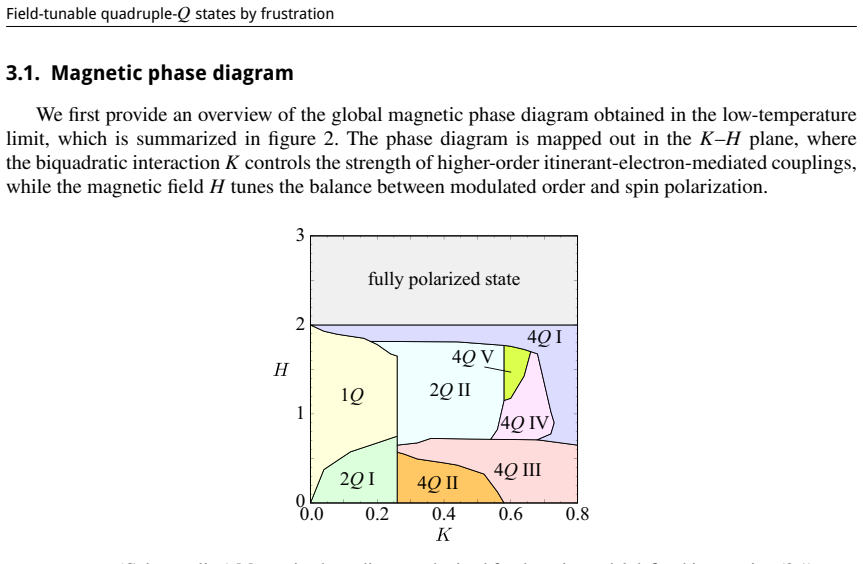
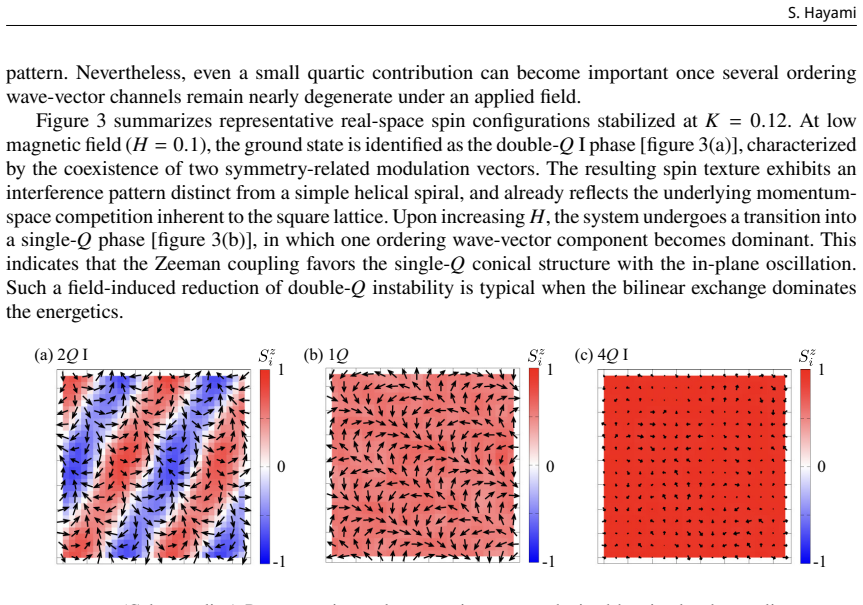
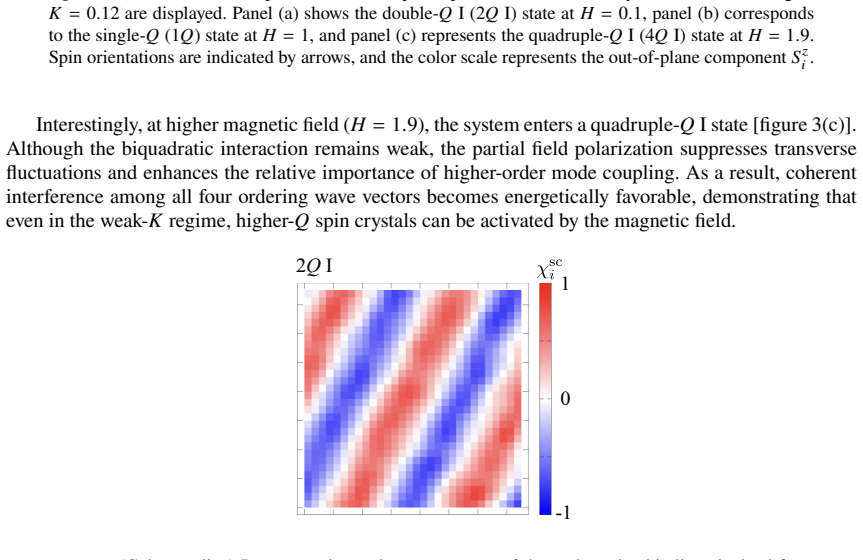
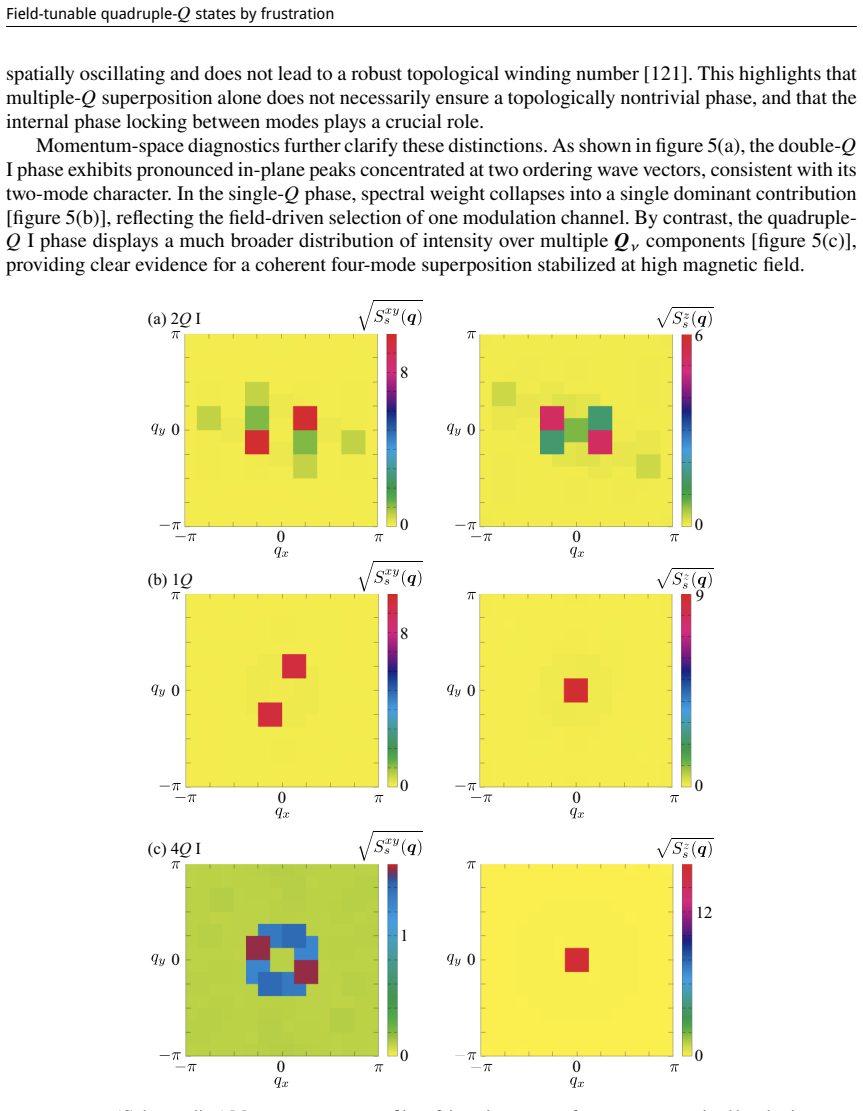
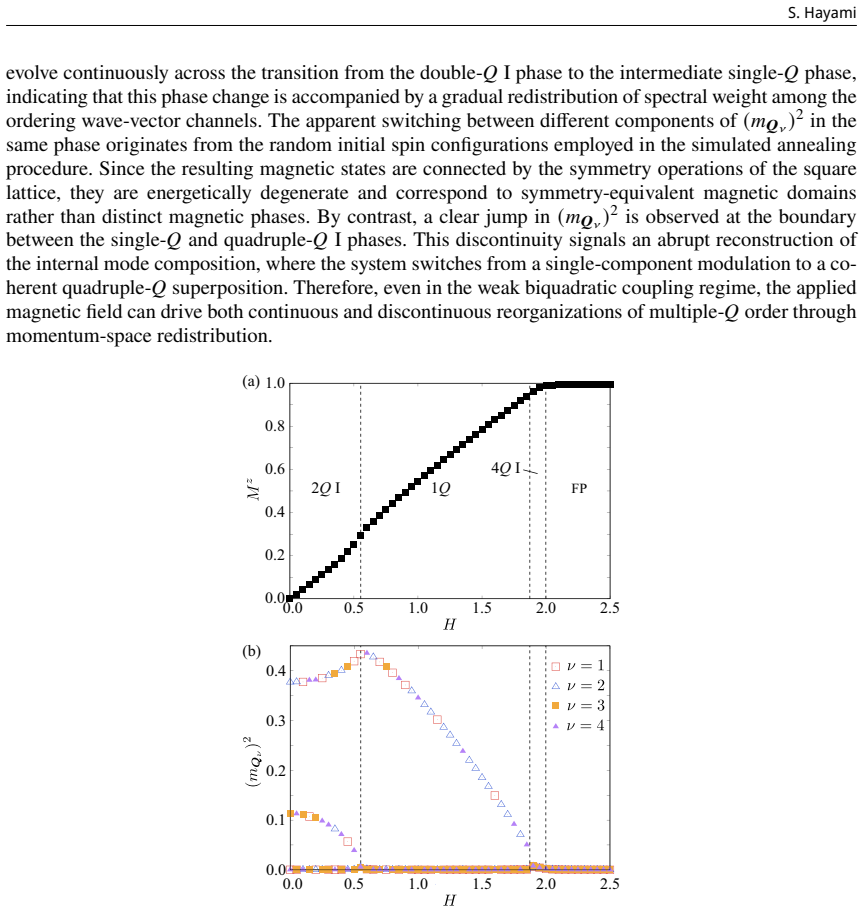
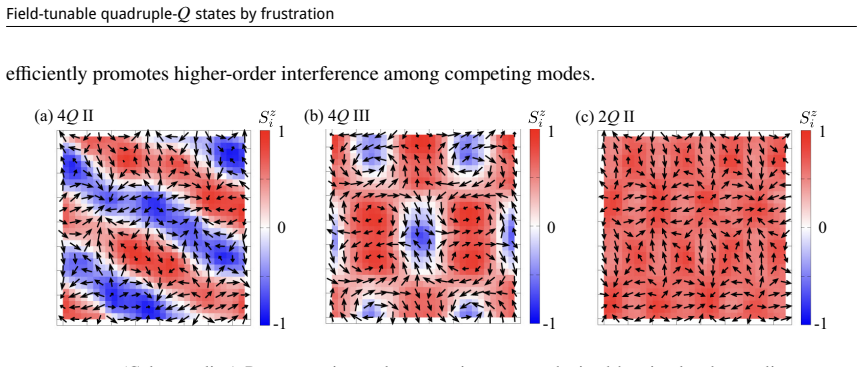
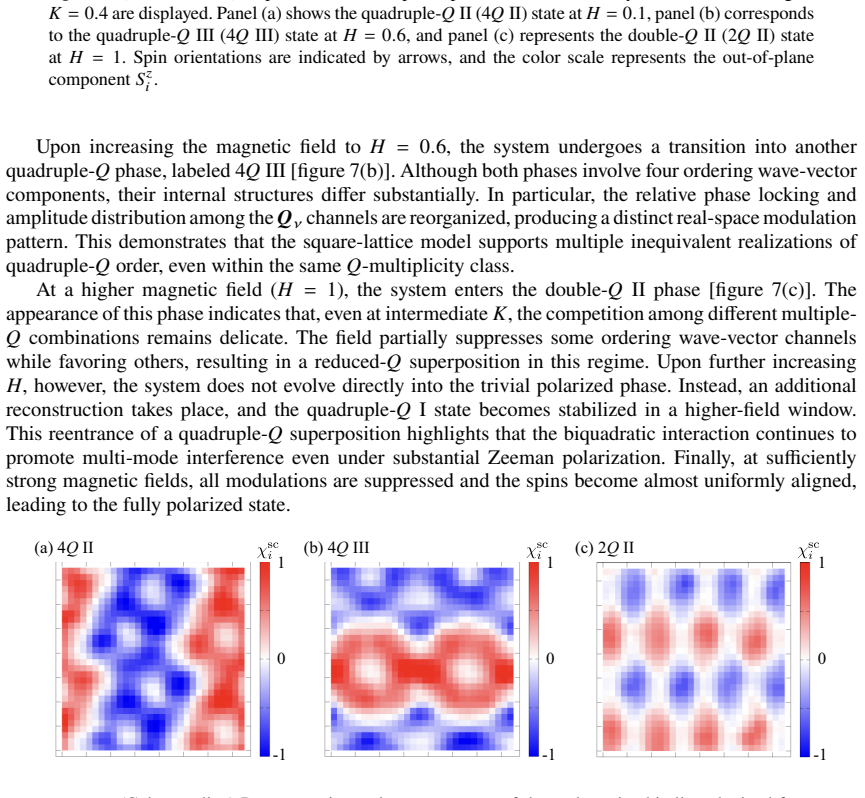
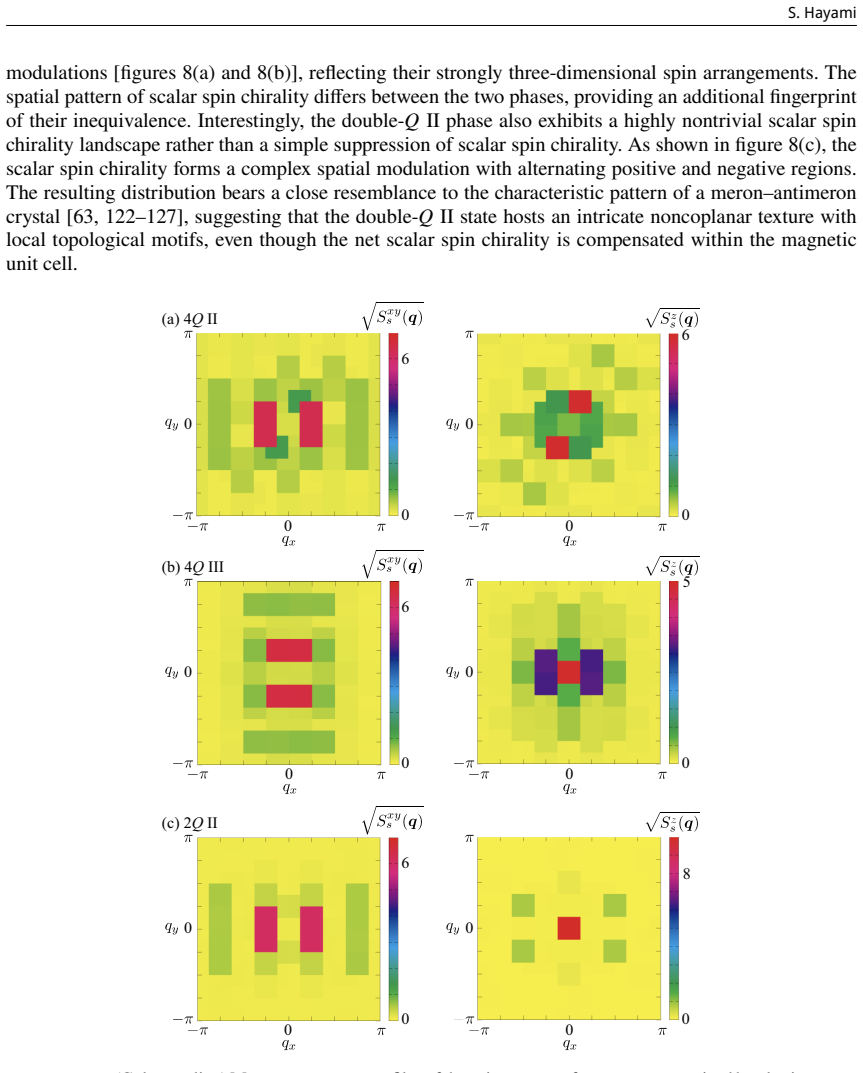
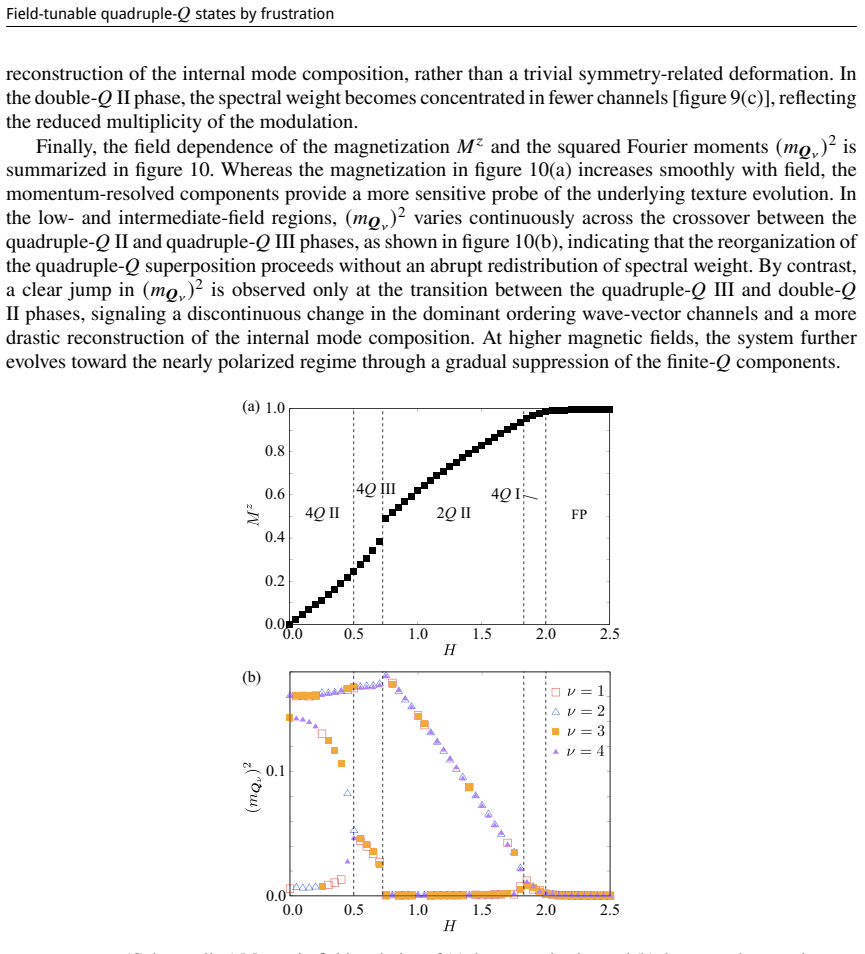
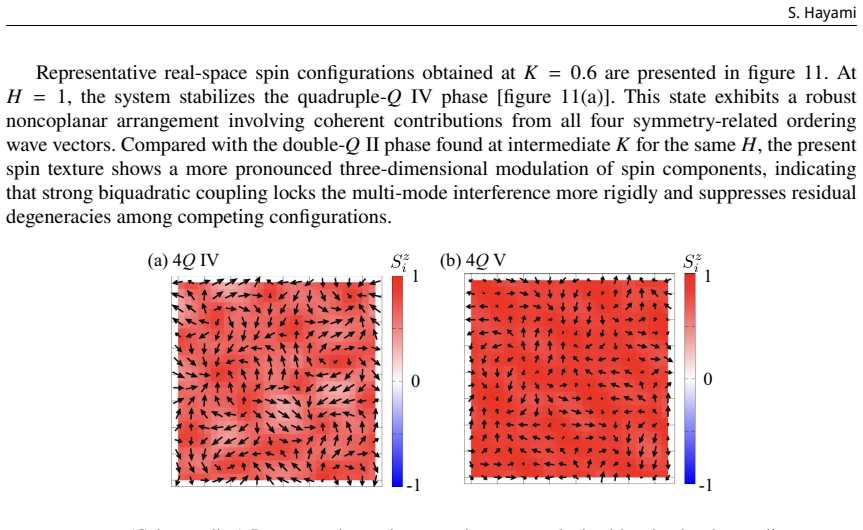
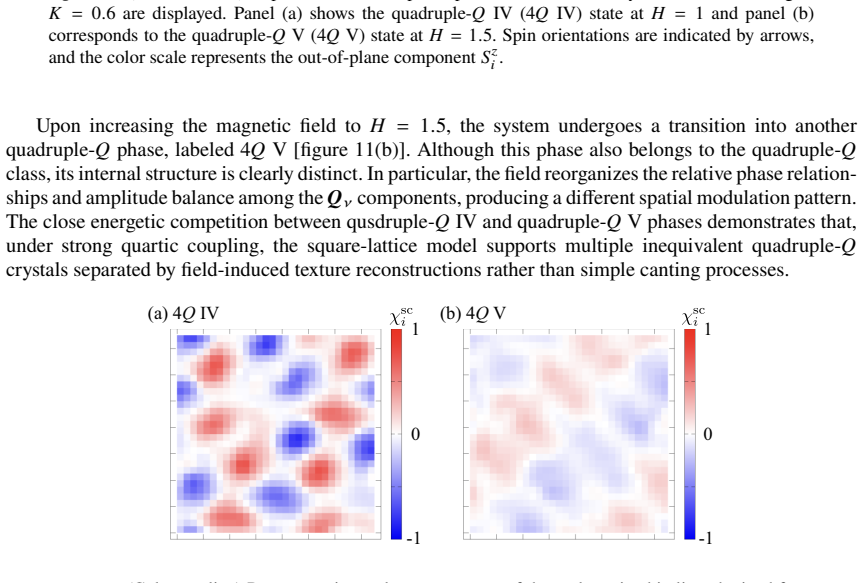
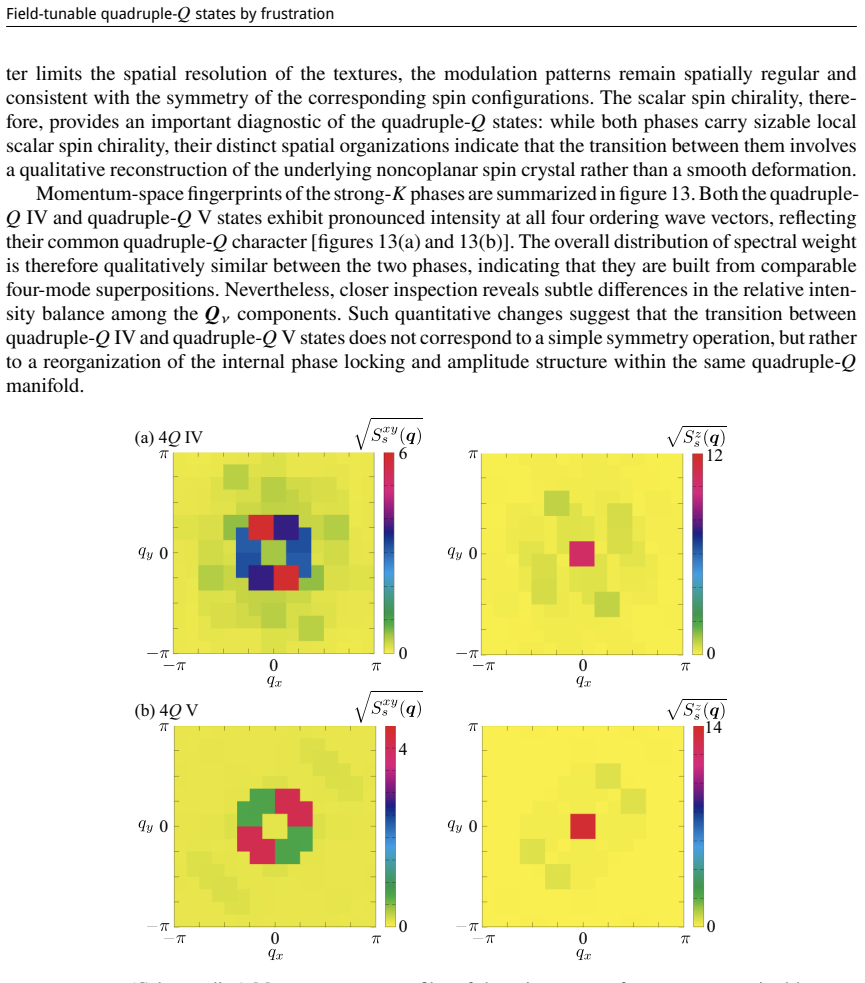
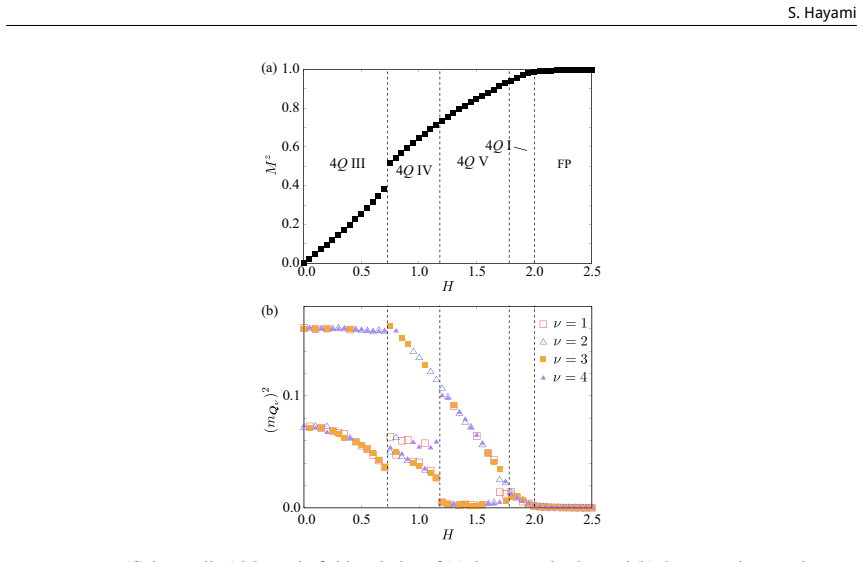
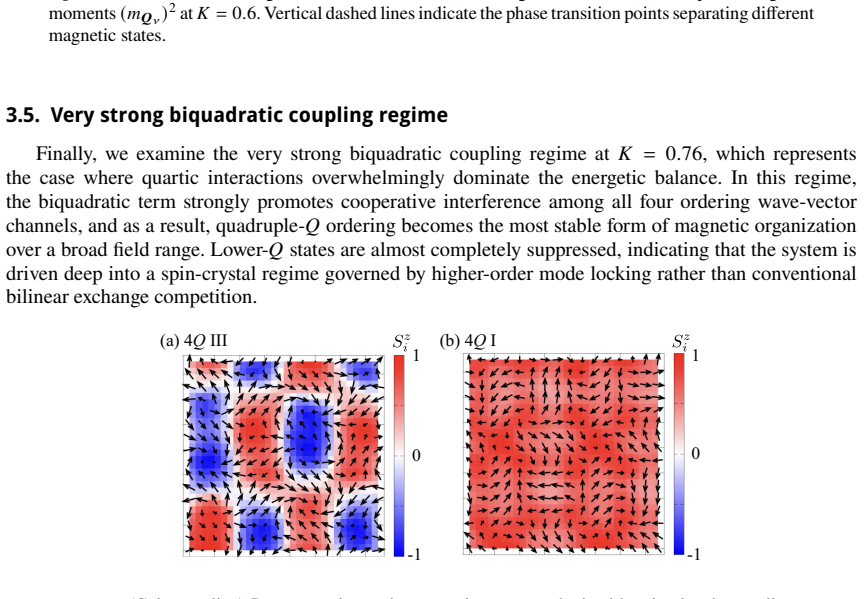
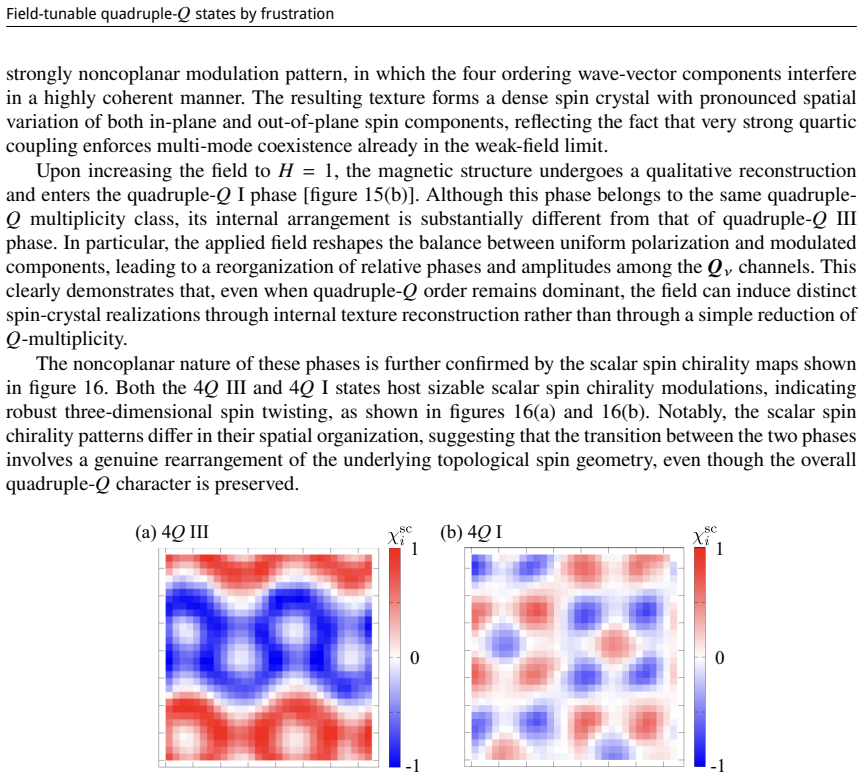
In a minimal momentum-space spin Hamiltonian on the square lattice with interactions restricted to four symmetry-related ordering wave vectors, the combination of bilinear and biquadratic terms under an out-of-plane magnetic field produces successive transitions among single-Q, double-Q, and multiple inequivalent quadruple-Q states. These quadruple-Q states share the same wave vectors but differ in phase locking, amplitude distribution, and noncoplanarity, which in turn generate distinct real-space spin textures and scalar spin chirality patterns.
What carries the argument
Minimal momentum-space spin Hamiltonian with bilinear and biquadratic interactions on four symmetry-related wave vectors.
If this is right
- Different phase lockings among the quadruple-Q states produce distinct noncoplanar textures and scalar spin chirality patterns.
- Field strength acts as a tuning parameter that drives transitions between single-Q, double-Q, and inequivalent quadruple-Q states.
- Biquadratic interactions are required to stabilize the quadruple-Q manifold beyond what bilinear terms alone can achieve.
- The same wave-vector set can host multiple quadruple-Q states with qualitatively different real-space properties.
Where Pith is reading between the lines
- The same momentum-frustration mechanism could be tested on other lattices with four-fold symmetric nesting vectors.
- Transport signatures such as topological Hall resistivity might distinguish the inequivalent quadruple-Q states in experiment.
- Generalizing the model to include longer-range interactions could further enrich the phase diagram while preserving the quadruple-Q route.
Load-bearing premise
The chosen minimal momentum-space spin Hamiltonian with only bilinear and biquadratic interactions on four symmetry-related wave vectors sufficiently captures the essential physics of real itinerant electron systems on the square lattice.
What would settle it
A material expected to realize the model that shows only single-Q or double-Q order across the full field range, with no quadruple-Q states detected by neutron scattering or other probes, would falsify the stabilization mechanism.
Figures
read the original abstract
Multiple-$Q$ magnetism in itinerant electron systems enables complex spin crystals and noncoplanar textures even in centrosymmetric settings. We study a minimal momentum-space spin model on a square lattice with four symmetry-related ordering wave vectors, including bilinear and biquadratic interactions under an out-of-plane magnetic field. Using simulated annealing, we obtain the field-dependent phase diagram and identify successive transitions among single-$Q$, double-$Q$, and multiple inequivalent quadruple-$Q$ states. The quadruple-$Q$ manifold exhibits rich internal structures: the states sharing the same wave vectors differ in phase locking, amplitude distribution, and noncoplanarity, leading to distinct real-space textures and scalar spin chirality patterns. Our results demonstrate that momentum-space frustration and biquadratic coupling provide an efficient route to stabilizing diverse quadruple-$Q$ spin crystals, offering a general framework for higher-order spin textures in centrosymmetric itinerant magnets.
Editorial analysis
A structured set of objections, weighed in public.
Referee Report
Summary. The paper claims that a minimal momentum-space spin model on the square lattice with four symmetry-related ordering wave vectors, incorporating bilinear and biquadratic interactions under an out-of-plane magnetic field, yields a field-dependent phase diagram with successive transitions among single-Q, double-Q, and multiple inequivalent quadruple-Q states. Using simulated annealing, the authors identify rich internal structures within the quadruple-Q manifold, differing in phase locking, amplitude distribution, and noncoplanarity, which produce distinct real-space textures and scalar spin chirality patterns. The results are presented as demonstrating that momentum-space frustration and biquadratic coupling provide an efficient route to stabilizing diverse quadruple-Q spin crystals, offering a general framework for higher-order spin textures in centrosymmetric itinerant magnets.
Significance. If the numerical results hold, this work offers a concrete phenomenological demonstration that biquadratic terms combined with momentum-space frustration on symmetry-related wave vectors can generate a variety of quadruple-Q states with tunable properties, which is of interest to the study of complex magnetism in centrosymmetric itinerant systems. It could serve as a useful minimal model for exploring higher-order spin textures, potentially guiding material searches, though its broader applicability depends on establishing connections to microscopic electronic models.
major comments (2)
- [Introduction / Model Hamiltonian] The Hamiltonian (bilinear + biquadratic terms on four symmetry-related Q vectors) is introduced as a minimal model without derivation from an underlying itinerant-electron Hamiltonian (e.g., RKKY expansion of a Hubbard or Kondo-lattice model on the square lattice). This is load-bearing for the abstract's claim that the results offer 'a general framework for higher-order spin textures in centrosymmetric itinerant magnets', as it is unclear whether the biquadratic interactions and momentum-space frustration arise naturally or require external parameter tuning.
- [Methods / Numerical simulations] No details are provided on system sizes, annealing protocols, number of independent runs, or convergence checks for the simulated annealing used to construct the phase diagram and identify the quadruple-Q states. This is load-bearing for the central results, as the identification of multiple inequivalent quadruple-Q states with distinct internal structures relies on the reliability of these numerics.
Simulated Author's Rebuttal
We thank the referee for their careful reading of the manuscript and for the constructive comments. We address each major comment below and will incorporate revisions to improve the presentation of the model and the numerical methods.
read point-by-point responses
-
Referee: [Introduction / Model Hamiltonian] The Hamiltonian (bilinear + biquadratic terms on four symmetry-related Q vectors) is introduced as a minimal model without derivation from an underlying itinerant-electron Hamiltonian (e.g., RKKY expansion of a Hubbard or Kondo-lattice model on the square lattice). This is load-bearing for the abstract's claim that the results offer 'a general framework for higher-order spin textures in centrosymmetric itinerant magnets', as it is unclear whether the biquadratic interactions and momentum-space frustration arise naturally or require external parameter tuning.
Authors: The Hamiltonian is presented as a minimal phenomenological model chosen to isolate the effects of momentum-space frustration among four symmetry-related wave vectors together with biquadratic interactions. While we do not perform an explicit microscopic derivation (e.g., via RKKY expansion of a Hubbard or Kondo-lattice model) in this work, the form is motivated by effective spin interactions known to appear in itinerant magnets. The abstract's reference to a 'general framework' concerns the demonstration that these ingredients suffice to produce the reported sequence of quadruple-Q states and their internal structures, rather than a claim that the parameters emerge without tuning in every material. To clarify this distinction, we will add a short paragraph in the introduction discussing the phenomenological character of the model and referencing related microscopic studies of multiple-Q states. revision: yes
-
Referee: [Methods / Numerical simulations] No details are provided on system sizes, annealing protocols, number of independent runs, or convergence checks for the simulated annealing used to construct the phase diagram and identify the quadruple-Q states. This is load-bearing for the central results, as the identification of multiple inequivalent quadruple-Q states with distinct internal structures relies on the reliability of these numerics.
Authors: We agree that the absence of these technical details is an important omission. In the revised manuscript we will insert a dedicated subsection (or expand the existing Methods section) that specifies the lattice sizes used (typically up to 48 imes48 sites with periodic boundaries), the annealing schedule and temperature range, the number of independent runs performed for each field value, and the convergence and state-identification criteria employed to distinguish the inequivalent quadruple-Q configurations. revision: yes
Circularity Check
No circularity; results follow from direct numerical simulation of an explicitly stated phenomenological model
full rationale
The paper defines a minimal momentum-space Hamiltonian with bilinear and biquadratic interactions restricted to four symmetry-related wave vectors, then applies simulated annealing to obtain the field-dependent phase diagram and the internal structures of the quadruple-Q states. All reported states, transitions, and textures are outputs of this numerical minimization; no parameters are fitted to external data and then relabeled as predictions, no self-citations are invoked to justify uniqueness or forbid alternatives, and no ansatz is smuggled through prior work. The derivation chain is therefore self-contained within the chosen model and its numerical solution.
Axiom & Free-Parameter Ledger
axioms (2)
- domain assumption The square lattice possesses four symmetry-related ordering wave vectors that dominate the magnetic instability.
- domain assumption Bilinear and biquadratic interactions are sufficient to capture the essential energetics under an out-of-plane field.
Reference graph
Works this paper leans on
-
[1]
Grüner G., Rev. Mod. Phys., 1994,66, 1–24, doi:10.1103/RevModPhys.66.1
-
[2]
Baltz V., Manchon A., Tsoi M., Moriyama T., Ono T., Tserkovnyak Y., Rev. Mod. Phys., 2018,90, 015005, doi:10.1103/RevModPhys.90.015005
-
[3]
Yambe R., Hayami S., Phys. Rev. B, 2022,106, 174437, doi:10.1103/PhysRevB.106.174437
-
[4]
Bak P., Lebech B., Phys. Rev. Lett., 1978,40, 800–803, doi:10.1103/PhysRevLett.40.800
-
[5]
McEwen K. A., Walker M. B., Phys. Rev. B, 1986,34, 1781–1783, doi:10.1103/PhysRevB.34.1781
-
[6]
Zochowski S., McEwen K., J. Magn. Magn. Mater., 1986,54, 515–516, doi:10.1016/0304-8853(86)90688-8
-
[7]
Forgan E., Rainford B., Lee S., Abell J., Bi Y., J. Phys.: Condens. Matter, 1990,2, No. 50, 10211, doi:10.1088/0953-8984/2/50/026
-
[8]
Longfield M. J., Paixão J. A., Bernhoeft N., Lander G. H., Phys. Rev. B, 2002,66, 054417, doi:10.1103/PhysRevB.66.054417
-
[9]
Bernhoeft N., Paixão J. A., Detlefs C., Wilkins S. B., Javorský P., Blackburn E., Lander G. H., Phys. Rev. B, 2004,69, 174415, doi:10.1103/PhysRevB.69.174415
-
[10]
Stewart J., Ehlers G., Wills A., Bramwell S. T., Gardner J., J. Phys.: Condens. Matter, 2004,16, No. 28, L321, doi:10.1088/0953-8984/16/28/L01
-
[11]
Watson D., Forgan E. M., Nuttall W. J., Stirling W. G., Fort D., Phys. Rev. B, 1996,53, 726–730, doi:10.1103/PhysRevB.53.726
-
[12]
Harris A. B., Schweizer J., Phys. Rev. B, 2006,74, 134411, doi:10.1103/PhysRevB.74.134411. 23705-17 S. Hayami
-
[13]
SchweizerJ.,GivordF.,BoucherleJ.,BourdarotF.,RessoucheE.,J.Phys.:Condens.Matter,2008,20,No.13, 135204, doi:10.1088/0953-8984/20/13/135204
-
[14]
Szabó A., Orlandi F., Manuel P., Phys. Rev. Lett., 2022,129, 247201, doi:10.1103/PhysRevLett.129.247201
-
[15]
Skyrme T. H. R., Nucl. Phys., 1962,31, 556–569, doi:10.1016/0029-5582(62)90775-7
-
[16]
N., Yablonskii D
Bogdanov A. N., Yablonskii D. A., Sov. Phys. JETP, 1989,68, 101
1989
-
[17]
Bogdanov A., Hubert A., J. Magn. Magn. Mater., 1994,138, No. 3, 255–269, doi:10.1016/0304- 8853(94)90046-9
-
[18]
RößlerU.K.,BogdanovA.N.,PfleidererC.,Nature,2006,442,No.7104,797–801,doi:10.1038/nature05056
-
[19]
Mühlbauer S., Binz B., Jonietz F., Pfleiderer C., Rosch A., Neubauer A., Georgii R., Böni P., Science, 2009, 323, No. 5916, 915–919, doi:10.1126/science.1166767
-
[20]
YiS.D.,OnodaS.,NagaosaN.,HanJ.H.,Phys.Rev.B,2009,80,054416,doi:10.1103/PhysRevB.80.054416
-
[21]
7300, 901–904, doi:10.1038/nature09124
YuX.Z.,OnoseY.,KanazawaN.,ParkJ.H.,HanJ.H.,MatsuiY.,NagaosaN.,TokuraY.,Nature,2010,465, No. 7300, 901–904, doi:10.1038/nature09124
-
[22]
Butenko A. B., Leonov A. A., Rößler U. K., Bogdanov A. N., Phys. Rev. B, 2010,82, 052403, doi:10.1103/PhysRevB.82.052403
-
[23]
Münzer W., Neubauer A., Adams T., Mühlbauer S., Franz C., Jonietz F., Georgii R., Böni P., Pedersen B., Schmidt M., Rosch A., Pfleiderer C., Phys. Rev. B, 2010,81, 041203, doi:10.1103/PhysRevB.81.041203
-
[24]
Adams T., Mühlbauer S., Neubauer A., Münzer W., Jonietz F., Georgii R., Pedersen B., Böni P., Rosch A., Pfleiderer C., J. Phys. Conf. Ser., 2010,200, No. 3, 032001, doi:10.1088/1742-6596/200/3/032001
-
[25]
YuX.Z.,KanazawaN.,OnoseY.,KimotoK.,ZhangW.,IshiwataS.,MatsuiY.,TokuraY.,Nat.Mater.,2011, 10, No. 2, 106–109, doi:10.1038/nmat2916
-
[26]
Heinze S., von Bergmann K., Menzel M., Brede J., Kubetzka A., Wiesendanger R., Bihlmayer G., Blügel S., Nat. Phys., 2011,7, No. 9, 713–718, doi:10.1038/nphys2045
-
[27]
Adams T., Mühlbauer S., Pfleiderer C., Jonietz F., Bauer A., Neubauer A., Georgii R., Böni P., Keiderling U., EverschorK.,GarstM.,RoschA.,Phys.Rev.Lett.,2011,107,217206,doi:10.1103/PhysRevLett.107.217206
-
[28]
Nagaosa N., Tokura Y., Nat. Nanotechnol., 2013,8, No. 12, 899–911, doi:10.1038/nnano.2013.243
-
[29]
Hayami S., Phys. Rev. B, 2022,105, 014408, doi:10.1103/PhysRevB.105.014408
-
[30]
Dzyaloshinsky I., J. Phys. Chem. Solids, 1958,4, No. 4, 241–255, doi:10.1016/0022-3697(58)90076-3
-
[31]
Moriya T., Phys. Rev., 1960,120, No. 1, 91, doi:10.1103/PhysRev.120.91
-
[32]
Nagaosa N., Sinova J., Onoda S., MacDonald A. H., Ong N. P., Rev. Mod. Phys., 2010,82, 1539–1592, doi:10.1103/RevModPhys.82.1539
-
[33]
Xiao D., Chang M.-C., Niu Q., Rev. Mod. Phys., 2010,82, 1959–2007, doi:10.1103/RevModPhys.82.1959
-
[34]
Ohgushi K., Murakami S., Nagaosa N., Phys. Rev. B, 2000,62, R6065–R6068, doi:10.1103/PhysRevB.62.R6065
-
[35]
5513, 2573–2576, doi:10.1126/science.1058161
Taguchi Y., Oohara Y., Yoshizawa H., Nagaosa N., Tokura Y., Science, 2001,291, No. 5513, 2573–2576, doi:10.1126/science.1058161
-
[36]
Tatara G., Kawamura H., J. Phys. Soc. Jpn., 2002,71, No. 11, 2613–2616, doi:10.1143/JPSJ.71.2613
-
[37]
Machida Y., Nakatsuji S., Maeno Y., Tayama T., Sakakibara T., Onoda S., Phys. Rev. Lett., 2007,98, No. 5, 057203, doi:10.1103/PhysRevLett.98.057203
-
[38]
Shindou R., Nagaosa N., Phys. Rev. Lett., 2001,87, 116801, doi:10.1103/PhysRevLett.87.116801
-
[39]
Martin I., Batista C. D., Phys. Rev. Lett., 2008,101, 156402, doi:10.1103/PhysRevLett.101.156402
-
[40]
Neubauer A., Pfleiderer C., Binz B., Rosch A., Ritz R., Niklowitz P. G., Böni P., Phys. Rev. Lett., 2009,102, 186602, doi:10.1103/PhysRevLett.102.186602
-
[41]
Takatsu H., Yonezawa S., Fujimoto S., Maeno Y., Phys. Rev. Lett., 2010,105, No. 13, 137201, doi:10.1103/PhysRevLett.105.137201
-
[42]
Ueland B. G., Miclea C. F., Kato Y., Ayala-Valenzuela O., McDonald R. D., Okazaki R., Tobash P. H., Torrez M. A., Ronning F., Movshovich R., Fisk Z., Martin E. D. B. I., Thompson J. D., Nat. Commun., 2012, 3, 1067, doi:10.1038/ncomms2075
-
[43]
Hamamoto K., Ezawa M., Nagaosa N., Phys. Rev. B, 2015,92, 115417, doi:10.1103/PhysRevB.92.115417
-
[44]
Nakazawa K., Bibes M., Kohno H., J. Phys. Soc. Jpn., 2018,87, No. 3, 033705, doi:10.7566/JPSJ.87.033705
-
[45]
Tokura Y., Nagaosa N., Nat. Commun., 2018,9, No. 1, 3740, doi:10.1038/s41467-018-05759-4
-
[46]
Hayami S., Yambe R., Phys. Rev. Res., 2021,3, 043158, doi:10.1103/PhysRevResearch.3.043158
-
[47]
Hayami S., Yatsushiro M., Phys. Rev. B, 2022,106, 014420, doi:10.1103/PhysRevB.106.014420
-
[48]
Eto R., Pohle R., Mochizuki M., Phys. Rev. Lett., 2022,129, 017201, doi:10.1103/PhysRevLett.129.017201
-
[49]
Akagi Y., Motome Y., J. Phys. Soc. Jpn., 2010,79, No. 8, 083711, doi:10.1143/JPSJ.79.083711
-
[50]
Barros K., Kato Y., Phys. Rev. B, 2013,88, 235101, doi:10.1103/PhysRevB.88.235101
-
[51]
Venderbos J. W. F., Kourtis S., van den Brink J., Daghofer M., Phys. Rev. Lett., 2012,108, 126405, doi:10.1103/PhysRevLett.108.126405. 23705-18 Field-tunable quadruple-𝑄states by frustration
-
[52]
Jiang K., Zhang Y., Zhou S., Wang Z., Phys. Rev. Lett., 2015,114, 216402, doi:10.1103/PhysRevLett.114.216402
-
[53]
Venderbos J. W. F., Phys. Rev. B, 2016,93, 115108, doi:10.1103/PhysRevB.93.115108
-
[54]
Barros K., Venderbos J. W. F., Chern G.-W., Batista C. D., Phys. Rev. B, 2014,90, 245119, doi:10.1103/PhysRevB.90.245119
-
[55]
Ghosh S., O’Brien P., Henley C. L., Lawler M. J., Phys. Rev. B, 2016,93, 024401, doi:10.1103/PhysRevB.93.024401
-
[56]
Takagi R., White J., Hayami S., Arita R., Honecker D., Rønnow H., Tokura Y., Seki S., Sci. Adv., 2018,4, No. 11, eaau3402, doi:10.1126/sciadv.aau3402
-
[57]
Wang Z., Su Y., Lin S.-Z., Batista C. D., Phys. Rev. Lett., 2020,124, 207201, doi:10.1103/PhysRevLett.124.207201
-
[58]
Saito H., Kon F., Hidaka H., Amitsuka H., Kwanghee C., Hagihala M., Kamiyama T., Itoh S., Nakajima T., Phys. Rev. B, 2023,108, 094440, doi:10.1103/PhysRevB.108.094440
-
[59]
Ruderman M. A., Kittel C., Phys. Rev., 1954,96, 99–102, doi:10.1103/PhysRev.96.99
-
[60]
Kasuya T., Prog. Theor. Phys., 1956,16, No. 1, 45–57, doi:10.1143/PTP.16.45
-
[61]
Rev., 1957,106, 893–898, doi:10.1103/PhysRev.106.893
Yosida K., Phys. Rev., 1957,106, 893–898, doi:10.1103/PhysRev.106.893
-
[62]
Saha S. R., Sugawara H., Matsuda T. D., Sato H., Mallik R., Sampathkumaran E. V., Phys. Rev. B, 1999,60, 12162–12165, doi:10.1103/PhysRevB.60.12162
-
[63]
6456, 914–918, doi:10.1126/science.aau0968
Kurumaji T., Nakajima T., Hirschberger M., Kikkawa A., Yamasaki Y., Sagayama H., Nakao H., Taguchi Y., Arima T.-h., Tokura Y., Science, 2019,365, No. 6456, 914–918, doi:10.1126/science.aau0968
-
[64]
HirschbergerM.,SpitzL.,NomotoT.,KurumajiT.,GaoS.,MasellJ.,NakajimaT.,KikkawaA.,YamasakiY., Sagayama H., Nakao H., Taguchi Y., Arita R., Arima T.-h., Tokura Y., Phys. Rev. Lett., 2020,125, 076602, doi:10.1103/PhysRevLett.125.076602
-
[65]
NomotoT.,KoretsuneT.,AritaR.,Phys.Rev.Lett.,2020,125,117204,doi:10.1103/PhysRevLett.125.117204
-
[66]
Kumar R., Iyer K. K., Paulose P. L., Sampathkumaran E. V., Phys. Rev. B, 2020,101, 144440, doi:10.1103/PhysRevB.101.144440
-
[67]
Spachmann S., Elghandour A., Frontzek M., Löser W., Klingeler R., Phys. Rev. B, 2021,103, 184424, doi:10.1103/PhysRevB.103.184424
-
[68]
Nanotechnol., 2020,15, 444, doi:10.1038/s41565-020-0684-7
KhanhN.D.,NakajimaT.,YuX.,GaoS.,ShibataK.,HirschbergerM.,YamasakiY.,SagayamaH.,NakaoH., Peng L., Nakajima K., Takagi R., Arima T.-h., Tokura Y., Seki S., Nat. Nanotechnol., 2020,15, 444, doi:10.1038/s41565-020-0684-7
-
[69]
Matsuyama N., Nomura T., Imajo S., Nomoto T., Arita R., Sudo K., Kimata M., Khanh N. D., Takagi R., TokuraY.,SekiS.,KindoK.,KohamaY.,Phys.Rev.B,2023,107,104421,doi:10.1103/PhysRevB.107.104421
-
[70]
Wood G. D. A., Khalyavin D. D., Mayoh D. A., Bouaziz J., Hall A. E., Holt S. J. R., Orlandi F., Manuel P., Blügel S., Staunton J. B., Petrenko O. A., Lees M. R., Balakrishnan G., Phys. Rev. B, 2023,107, L180402, doi:10.1103/PhysRevB.107.L180402
-
[71]
EremeevS.V.,GlazkovaD.,PoelchenG.,KraikerA.,AliK.,TarasovA.V.,SchulzS.,KliemtK.,ChulkovE.V., StolyarovV.S.,ErnstA.,KrellnerC.,UsachovD.Yu.,VyalikhD.V.,NanoscaleAdv.,2023,5,No.23,6678– 6687, doi:10.1039/D3NA00435J
-
[72]
SpethmannJ.,KhanhN.D.,YoshimochiH.,TakagiR.,HayamiS.,MotomeY.,WiesendangerR.,SekiS.,von Bergmann K., Phys. Rev. Mater., 2024,8, 064404, doi:10.1103/PhysRevMaterials.8.064404
-
[73]
D., Kondo T., Science, 2025,388, No
Dong Y., Kinoshita Y., Ochi M., Nakachi R., Higashinaka R., Hayami S., Wan Y., Arai Y., Huh S., Hashimoto M., Lu D., Tokunaga M., Aoki Y., Matsuda T. D., Kondo T., Science, 2025,388, No. 6747, 624–630, doi:10.1126/science.adj7710
-
[74]
Nakamura S., Kabeya N., Kobayashi M., Araki K., Katoh K., Ochiai A., Phys. Rev. B, 2018,98, 054410, doi:10.1103/PhysRevB.98.054410
-
[75]
Hirschberger M., Nakajima T., Gao S., Peng L., Kikkawa A., Kurumaji T., Kriener M., Yamasaki Y., Sagayama H., Nakao H., Ohishi K., Kakurai K., Taguchi Y., Yu X., Arima T.-H., Tokura Y., Nat. Commun., 2019,10, No. 1, 5831, doi:10.1038/s41467-019-13675-4
-
[76]
Phys., 2021,23, 023039, doi:10.1088/1367-2630/abdef9
Hirschberger M., Hayami S., Tokura Y., New J. Phys., 2021,23, 023039, doi:10.1088/1367-2630/abdef9
-
[77]
Nakamura S., Kabeya N., Kobayashi M., Araki K., Katoh K., Ochiai A., Phys. Rev. B, 2023,107, 014422, doi:10.1103/PhysRevB.107.014422
-
[78]
Ogunbunmi M. O., Nair H. S., Strydom A. M., Crit. Rev. Solid State Mater. Sci., 2023,48, No. 4, 480–501, doi:10.1080/10408436.2022.2075827
-
[79]
Gao S., Zaharko O., Tsurkan V., Su Y., White J. S., Tucker G. S., Roessli B., Bourdarot F., Sibille R., ChernyshovD.,FennellT.,LoidlA.,RüeggC.,Nat.Phys.,2017,13,No.2,157–161,doi:10.1038/nphys3914
-
[80]
Gao S., Rosales H. D., Gómez Albarracín F. A., Tsurkan V., Kaur G., Fennell T., Steffens P., Boehm M., ČermákP.,SchneidewindA.,RessoucheE.,CabraD.C.,RüeggC.,ZaharkoO.,Nature,2020,586,No.7828, 23705-19 S. Hayami 37–41, doi:10.1038/s41586-020-2716-8
discussion (0)
Sign in with ORCID, Apple, or X to comment. Anyone can read and Pith papers without signing in.