Bayesian Changepoint Detection for Smart Sensing of Battery Degradation: Cycle-Level Health Indicators and PyMC Implementation
Pith reviewed 2026-06-26 01:01 UTC · model grok-4.3
The pith
Bayesian changepoint detection on the charge-to-discharge time ratio identifies the onset of accelerated degradation in lithium-ion batteries from standard BMS telemetry.
A machine-rendered reading of the paper's core claim, the machinery that carries it, and where it could break.
Core claim
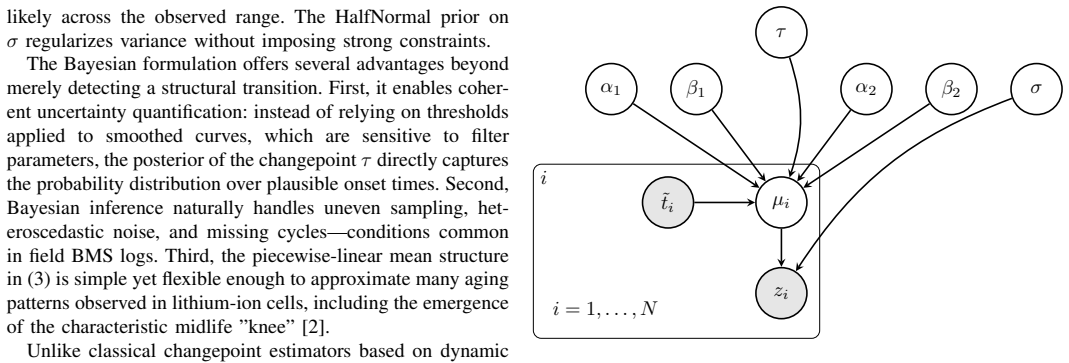
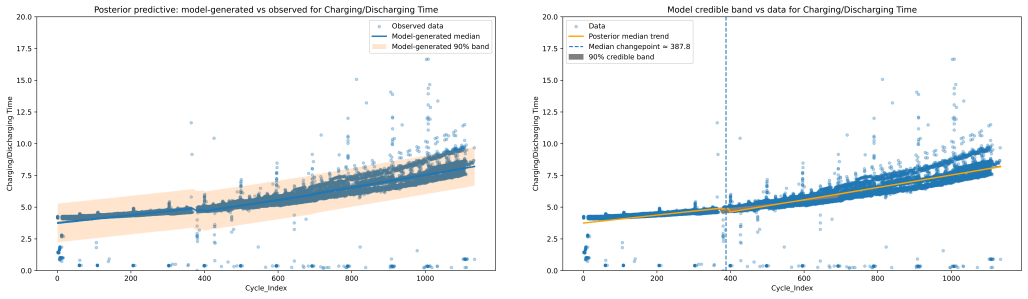
A Bayesian single-changepoint model is applied to the cycle-level health indicator defined as the ratio of charge time to discharge time. This yields posterior distributions for the onset time of accelerated degradation and the pre- and post-change slopes, along with posterior predictive checks. On an open 18650-cell remaining useful life dataset, the model identifies consistent midlife changepoints with narrow highest-density intervals.
What carries the argument
Bayesian single-changepoint model implemented in PyMC using Hamiltonian Monte Carlo, applied to the cycle-level health indicator given by the ratio of charge time to discharge time.
If this is right
- The model produces posterior distributions for onset time and pre/post-degradation slopes from standard BMS telemetry without raw waveforms.
- Posterior predictive checks become available for assessing model fit on cycle-level data.
- Consistent midlife changepoints with narrow highest-density intervals appear across cells in the open RUL dataset.
- The formulation remains lightweight enough for smart-sensing deployment on embedded BMS platforms.
Where Pith is reading between the lines
- The single-changepoint assumption may need extension to multiple changepoints if degradation involves several distinct phases.
- Testing the same ratio indicator on batteries of different chemistries or form factors would clarify whether the physical meaning holds generally.
- Real-time updating of the posterior as new cycles arrive could turn the method into an online monitoring tool.
Load-bearing premise
The ratio of charge time to discharge time is a physically meaningful cycle-level health indicator whose changepoint reliably marks the onset of accelerated degradation.
What would settle it
Experiments on additional 18650 or similar cell datasets where the true degradation onset is independently verified by capacity or internal resistance measurements show that the inferred changepoints fall outside known onset windows or exhibit wide highest-density intervals.
Figures
read the original abstract
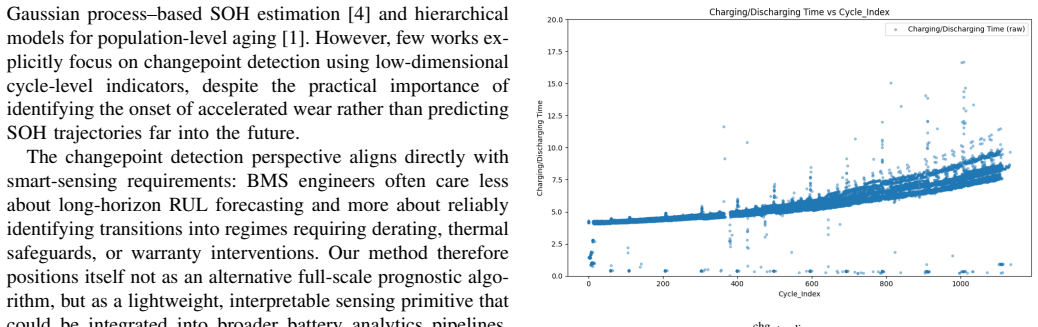
Reliable detection of the onset of accelerated degradation is central to safe and cost-efficient operation of lithium-ion batteries. This paper presents a Bayesian single-changepoint model applied to a simple but physically meaningful cycle-level health indicator (HI), defined as the ratio of charge time to discharge time. The indicator is computed directly from voltage-current telemetry typically available in battery management systems (BMS), without access to raw waveforms. The changepoint model is implemented in PyMC using Hamiltonian Monte Carlo and produces posterior distributions for onset time and pre/post-degradation slopes, together with posterior predictive checks. Experiments on an open 18650-cell remaining useful life (RUL) dataset show consistent midlife changepoints with narrow highest-density intervals. The formulation is lightweight, interpretable, and amenable to smart-sensing deployment on embedded BMS platforms.
Editorial analysis
A structured set of objections, weighed in public.
Referee Report
Summary. The paper presents a Bayesian single-changepoint model applied to the ratio of charge time to discharge time as a cycle-level health indicator for detecting the onset of accelerated degradation in lithium-ion batteries. The model is implemented in PyMC using Hamiltonian Monte Carlo, yielding posteriors for onset time and pre/post slopes along with posterior predictive checks. Experiments on one open 18650-cell RUL dataset are reported to show consistent midlife changepoints with narrow highest-density intervals. The approach is positioned as lightweight and suitable for BMS deployment using standard telemetry.
Significance. If the central modeling choice holds, the work offers an interpretable Bayesian framework for uncertainty-aware changepoint detection that could support embedded smart-sensing applications. Strengths include the use of an open dataset, explicit PyMC implementation, and focus on a telemetry-derived indicator that avoids raw waveform access. These elements aid reproducibility and practical deployment if the indicator's reliability is established.
major comments (3)
- [Abstract / Experiments] Abstract and Experiments section: the claim of 'consistent midlife changepoints with narrow highest-density intervals' on the open dataset cannot be assessed without reported details on data exclusion rules, number of cells analyzed, definition of 'midlife', or quantitative comparison to known degradation onsets.
- [Methods] Methods section: prior specifications for the changepoint location, slopes, and noise parameters are not provided, which is load-bearing for interpreting the reported posterior distributions and narrow HDIs.
- [Introduction / Experiments] The central modeling assumption that the charge-to-discharge time ratio is a physically meaningful HI whose changepoint reliably marks accelerated degradation onset lacks validation against established degradation markers or alternative indicators.
minor comments (1)
- [Methods] Notation for highest-density intervals and posterior predictive checks should be defined explicitly on first use for clarity.
Simulated Author's Rebuttal
We are grateful to the referee for their thorough review and constructive suggestions. We address each of the major comments in turn below.
read point-by-point responses
-
Referee: [Abstract / Experiments] Abstract and Experiments section: the claim of 'consistent midlife changepoints with narrow highest-density intervals' on the open dataset cannot be assessed without reported details on data exclusion rules, number of cells analyzed, definition of 'midlife', or quantitative comparison to known degradation onsets.
Authors: We agree with this assessment. The revised manuscript will provide the missing details in the Experiments section, including data exclusion rules, the exact number of cells analyzed from the open dataset, a precise definition of 'midlife', and quantitative comparisons to established degradation onsets reported in the dataset or literature. This will allow readers to fully evaluate the consistency and narrowness of the reported intervals. revision: yes
-
Referee: [Methods] Methods section: prior specifications for the changepoint location, slopes, and noise parameters are not provided, which is load-bearing for interpreting the reported posterior distributions and narrow HDIs.
Authors: We thank the referee for pointing this out. The revised Methods section will explicitly document the prior distributions chosen for the changepoint location, the pre- and post-changepoint slopes, and the noise parameters. These priors will be justified based on domain knowledge, and the PyMC implementation code will be made available to ensure the posteriors can be interpreted correctly. revision: yes
-
Referee: [Introduction / Experiments] The central modeling assumption that the charge-to-discharge time ratio is a physically meaningful HI whose changepoint reliably marks accelerated degradation onset lacks validation against established degradation markers or alternative indicators.
Authors: We recognize that additional validation would strengthen the central assumption. In the revision, we will include in the Experiments section a comparison of the changepoint detections against capacity-based degradation markers available in the open dataset. We will also discuss the physical basis of the HI in more detail in the Introduction. A more extensive validation against multiple alternative indicators across several datasets is planned for future work but exceeds the current scope. revision: partial
Circularity Check
No significant circularity
full rationale
The paper defines a cycle-level health indicator directly from telemetry as the ratio of charge time to discharge time, then applies a standard Bayesian single-changepoint model (implemented via PyMC and HMC) to infer posterior distributions over onset time and pre/post slopes. This is ordinary probabilistic inference on an observed time series; the posteriors and predictive checks do not reduce by construction to quantities defined from the fitted parameters themselves. No self-citation chain, uniqueness theorem, or ansatz is invoked to justify the central modeling choice, and the empirical claims rest on consistency observed on an external open dataset rather than on any tautological mapping from inputs to outputs.
Axiom & Free-Parameter Ledger
Reference graph
Works this paper leans on
-
[1]
Critical review of state-of-health estimation meth- ods of li-ion batteries for real applications,
M. Berecibar, M. Garmendia, I. Villarreal, N. Omar, J. Van Mierlo, and P. Van den Bossche, “Critical review of state-of-health estimation meth- ods of li-ion batteries for real applications,”Renewable and Sustainable Energy Reviews, vol. 56, pp. 572–587, 2016
2016
-
[2]
Physics-based lithium-ion battery models: A survey,
W. Visser, C. D. Laird, and J. Sun, “Physics-based lithium-ion battery models: A survey,”Journal of The Electrochemical Society, vol. 163, no. 7, pp. A1070–A1077, 2016
2016
-
[3]
A review of machine learning for lithium-ion battery management systems,
W. Li, J. Wu, J. Du, and D. Long, “A review of machine learning for lithium-ion battery management systems,”Renewable and Sustainable Energy Reviews, vol. 132, p. 110017, 2020
2020
-
[4]
Gaussian process regression for flexible and interpretable battery health modeling,
R. R. Richardson, M. A. Osborne, and D. A. Howey, “Gaussian process regression for flexible and interpretable battery health modeling,” Journal of Power Sources, vol. 390, pp. 262–273, 2018
2018
-
[5]
A review of bayesian methods for lithium-ion battery state-of-health estimation,
Y . Wang, K. Liu, Y . Chen, and B. Chen, “A review of bayesian methods for lithium-ion battery state-of-health estimation,”Journal of Power Sources, vol. 414, pp. 199–210, 2019
2019
-
[6]
A bayesian analysis for change point problems,
D. Barry and J. A. Hartigan, “A bayesian analysis for change point problems,”Journal of the American Statistical Association, vol. 88, no. 421, pp. 309–319, 1993
1993
-
[7]
Towards smart sensing of battery degradation modelling: Bayesian approach,
A. Jarosz-Kozyro, W. Bauer, and J. Baranowski, “Towards smart sensing of battery degradation modelling: Bayesian approach,” Preprints, September 2025, submitted to Sensors. [Online]. Available: https://doi.org/10.20944/preprints202509.2395.v1
-
[8]
Online estimation of lithium-ion battery degradation based on voltage relaxation,
K. Liu, Y . Li, X. Zhang, H. Wang, and G. Zhang, “Online estimation of lithium-ion battery degradation based on voltage relaxation,”Applied Energy, vol. 275, p. 115361, 2020
2020
-
[9]
Advances in electrochemical impedance spectroscopy for battery diagnostics,
A. Nov ´akov´a, M. Klein, and P. Haverlik, “Advances in electrochemical impedance spectroscopy for battery diagnostics,”Electrochimica Acta, vol. 476, p. 142222, 2024
2024
-
[10]
Optical fiber sensing for real-time temperature and stress monitoring in lithium-ion batteries,
S. Jeong, M. Lee, and Y . Park, “Optical fiber sensing for real-time temperature and stress monitoring in lithium-ion batteries,”Energy Storage Materials, vol. 64, pp. 789–803, 2024
2024
-
[11]
Battery remaining useful life (rul) dataset,
I. Vi ˜nuales, “Battery remaining useful life (rul) dataset,” Kaggle, 2022, https://www.kaggle.com/datasets/ignaciovinuales/battery-rul
2022
-
[12]
The No-U-turn sampler: adaptively setting path lengths in Hamiltonian Monte Carlo,
M. D. Hoffman and A. Gelman, “The No-U-turn sampler: adaptively setting path lengths in Hamiltonian Monte Carlo,”Journal of Machine Learning Research, vol. 15, no. 1, pp. 1593–1623, 2014
2014
-
[13]
Probabilistic program- ming in Python using PyMC3,
J. Salvatier, T. V . Wiecki, and C. Fonnesbeck, “Probabilistic program- ming in Python using PyMC3,”PeerJ Computer Science, vol. 2, p. e55, 2016
2016
-
[14]
ArviZ: A unified library for exploratory analysis of bayesian models in Python,
R. Kumar, C. C. Carroll, A. Hartikainen, and O. A. Martin, “ArviZ: A unified library for exploratory analysis of bayesian models in Python,” Journal of Open Source Software, vol. 4, no. 33, p. 1143, 2019
2019
-
[15]
Predictive control and estimation for autonomous battery management,
G. C. Goodwin, M. M. Seron, and J. De Don ´a, “Predictive control and estimation for autonomous battery management,”Annual Reviews in Control, vol. 48, pp. 205–214, 2019
2019
discussion (0)
Sign in with ORCID, Apple, or X to comment. Anyone can read and Pith papers without signing in.