REVIEW 2 major objections 4 minor 27 references
Fast Nonoverlapping Block Jacobi Method for the Dual Rudin--Osher--Fatemi Model
T0 review · 2 major / 4 minor · reviewed 2026-08-14 · deepseek-v4-flash
Pith's one-line read Block-parallel denoising solver reaches O(1/n^2) energy decay
desk verdict Solid O(1/n) analysis for a known method and a plausible O(1/n^2) accelerated variant whose proof rests on an unverified pseudometric transfer; worth refereeing but needs the FISTA gap closed. read the letter →
The pith
A machine-rendered reading of the paper's core claim, the machinery that carries it, and where it could break.
The reading
What carries the argument
The load-bearing object is the pre-relaxed local solution operator $P_k(q) = \arg\min_{p_k\in W_k} \{F_k(N_c p_k - (N_c-1)R_k q; q) + \chi_{C_k}(p_k)\}$, which inserts the relaxation parameter into the local problem rather than applying it as a separate outer averaging step. The outer update $p^{(n+1)} = \sum_{k=1}^{N_c} R_k^* P_k(q^{(n)})$ is then a proximal descent with respect to the pseudometric $d(p,q) = \bigl(\sum_k \|\operatorname{div} R_k^*R_k(p-q)\|_2^2\bigr)^{1/2} = \sqrt{2D(p,q)}$, where $D$ is the sum of local Bregman distances. Lemma 3.11 shows that this update satisfies the exact inequality $F(p) - F(P(q)) \ge D(p,P(q)) - D(p,q)$, the same template as the fundamental lemma behind FISTA's accelerated convergence proof, so the standard momentum recursion $t_{n+1} = (1+\sqrt{1+4t_n^2})/2$ applies directly.
What would settle it
Check whether the pseudometric $D$ has a nonzero kernel on the feasible set: if two distinct dual fields $p$ and $q$ satisfy $\operatorname{div} R_k^*R_k(p-q)=0$ for every color $k$, then the $D$-term cannot separate them, and the telescoping bound that yields the constant $4N_c$ in Theorem 3.14 would require an additional argument. A direct numerical test of Algorithm 3.3 on a small image, plotting $\log(F(p^{(n)})-F(p^*))$ against $\log n$, would also settle the claimed $O(1/n^2)$ slope.
Extended reading notes
Core claim
The paper's central result is Theorem 3.14: for the fast pre-relaxed block Jacobi method (Algorithm 3.3), the dual energy gap is bounded by $$F($p^{{(n)}}$)-F(p^*) \le \frac{4N_c}{(n+1)^2}\bigl(F($p^{{(0)}}$)-F(p^*)+2c_1\bigr),$$ with $c_1=7(MN_s+M_sN-\frac{11}{7}M_sN_s)$ depending on image dimensions and subdomain counts, while the relaxed block Jacobi method (Algorithm 3.1) is shown in Theorem 3.3 to converge at rate $O(1/n)$. The improvement comes from a modification called pre-relaxation: the relaxation parameter is folded into the local subproblem, so the outer update is exactly a proximal descent with respect to a pseudometric, matching the condition that the FISTA acceleration proof requires. The paper also proves that the convergence-rate constants depend on the number of colors $N_c$ and the total interface length of the partition, and verifies numerically that the accelerated method reaches the same denoising quality as full FISTA while taking far fewer wall-clock seconds.
Load-bearing premise
The O(1/$n^{2}$) proof assumes that the block-local divergence pseudometric $\sqrt{2D}$ satisfies all the metric inequalities needed in the FISTA telescoping argument, even though the paper does not show this pseudometric is positive definite on the feasible set.
Editorial extensions
If this is right
- The accelerated method's energy gap decays as $O(1/n^2)$ regardless of the image $f$ and the weight $\alpha$, so the worst-case rate is insensitive to noise level and regularization strength.
- Each outer iteration keeps the same per-iteration cost as the relaxed method because local problems remain ROF-type denoising problems; existing local solvers can be plugged in unchanged.
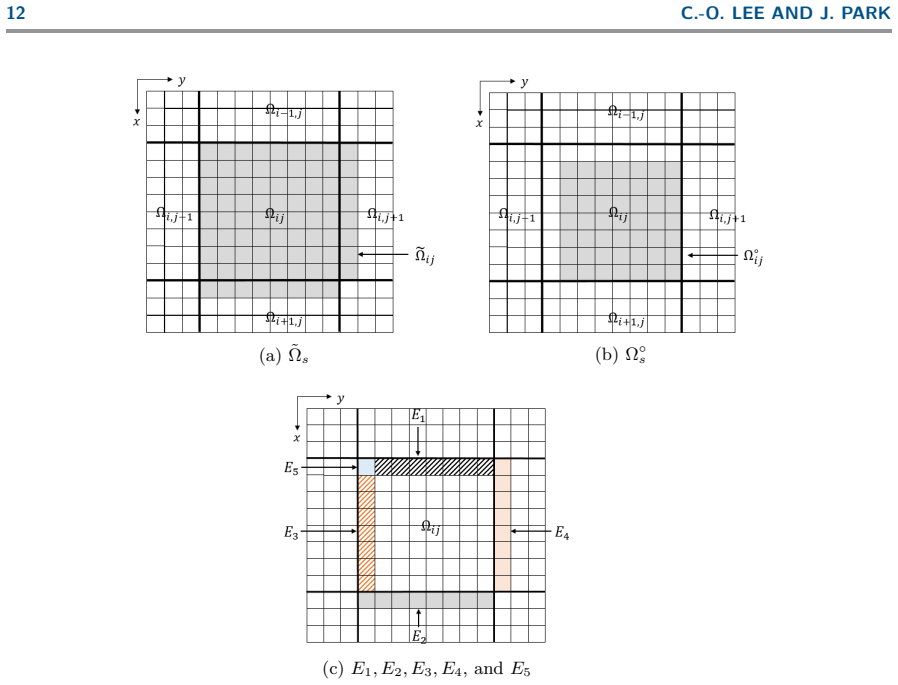
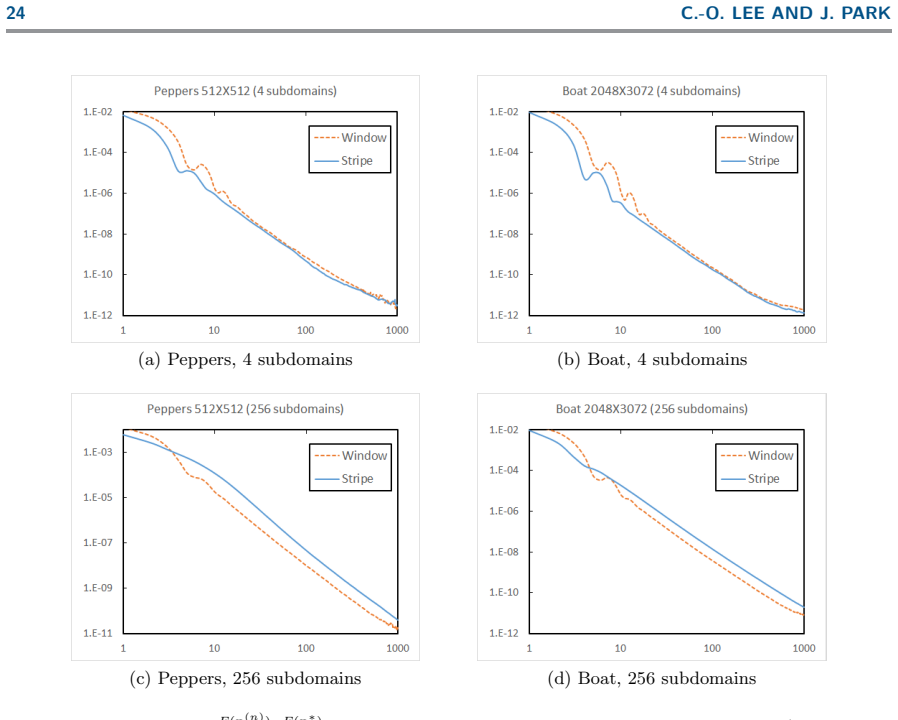
- The constants reveal a design trade-off: stripe-shaped decompositions with two colors converge faster when few subdomains are used, while window-shaped decompositions win for many subdomains because their total interface length grows only as the square root of the subdomain count.
- Wall-clock experiments show the speed-up is realized in practice: on a 2048 x 3072 image, the fast method reaches the energy tolerance in about 4.7 seconds with a 16 x 16 partition versus about 53 seconds for full-problem FISTA.
Reading between the lines
- The same pre-relaxation trick should apply to other nonsmooth convex problems whose duals decompose over nonoverlapping blocks, as long as the local divergence pseudometric has the needed decay; one testable extension is total variation minimization with $L^1$ fidelity.
- The proof inherits FISTA's metric assumptions without verifying that the pseudometric is positive definite on the feasible set; if a nonzero direction lies in its nullspace, the stated constant could fail even if the rate survives.
- Because the momentum step is taken in the dual variable, the recovered primal image may inherit non-monotone energy behavior; using a monotone variant of the momentum step would give a strictly decreasing energy while retaining the $O(1/n^2)$ complexity.
- Overlapping decompositions are not covered by this analysis, but numerical experiments comparing overlap sizes would indicate whether the acceleration is a property of the splitting structure rather than of nonoverlap itself.
Signed reviews
Editorial analysis
A structured set of objections, weighed in public.
Referee Report
Summary. The paper develops nonoverlapping block Jacobi methods for the Fenchel–Rockafellar dual of the discrete Rudin–Osher–Fatemi model. The authors prove an O(1/n) energy convergence rate for the relaxed block Jacobi method (Algorithm 3.1), introduce a pre-relaxed variant (Algorithm 3.2) that has an explicit forward-backward splitting structure, and then propose a FISTA-type accelerated version (Algorithm 3.3) for which they claim an O(1/n^2) energy convergence rate. The convergence-rate constants are expressed in terms of the number of colors N_c and a constant c_1 that depends on the image size and the number of subdomains. The paper also discusses local solvers, a three-coloring scheme, and reports numerical experiments comparing the methods on two test images with various decompositions and parameters.
Significance. If the O(1/n^2) theorem is made fully rigorous, the paper gives a meaningful contribution: it provides the first accelerated nonoverlapping domain-decomposition method for the dual ROF model with the same per-iteration cost as the unaccelerated block Jacobi method, and it gives explicit dependence of the convergence constant on the image size and subdomain interfaces. The O(1/n) analysis of Algorithm 3.1 and the derivation of the fundamental inequalities (Lemmas 3.2, 3.10, 3.11) are careful and appear correct. The numerical results support the practical interest of the method and show plausible agreement with the theoretical rates. The main weakness is the proof of the accelerated rate, which relies on a one-sentence transfer of the Beck–Teboulle FISTA argument to a pseudometric setting without fully stating the hypotheses needed for that transfer.
major comments (2)
- [§3.2, Theorem 3.14 (and Theorem 3.12)] The O(1/n^2) bound is obtained by direct citation to Theorem 4.4 of [2] after replacing the Euclidean norm by the expression ||·|| = (Σ_k ||div R_k^* R_k(·)||^2)^{1/2} = sqrt(2D), with D defined in (2.6). Since the discrete divergence operator has a nontrivial kernel, D is only a positive semidefinite quadratic form, and the paper never verifies that the Beck–Teboulle telescoping argument remains valid for this pseudometric. The concern is load-bearing because Theorem 3.14 is the only argument for the central O(1/n^2) claim. I believe the transfer is in fact valid, since the FISTA proof uses only algebraic identities valid for any symmetric positive semidefinite bilinear form, but the authors must write out the transfer or prove the telescoping bound directly, rather than leaving the non-Euclidean replacement to a citation.
- [§3.2, Lemma 3.11 and Algorithm 3.3] Lemma 3.11 is stated for p,q∈C, but in Algorithm 3.3 the extrapolated points q^(n+1) = p^(n+1) + ((t_n-1)/t_{n+1})(p^(n+1)-p^(n)) need not belong to C. The FISTA argument requires Lemma 3.11 with q equal to these extrapolated points, and also with p=q in the decrease inequality. The proof of Lemma 3.11 actually carries over without change to q∈W, because the local operators P_k are defined on all of W and the optimality condition (3.17) does not use q∈C. The lemma statement and proof should be extended to this broader domain before Theorem 3.14 can be applied to Algorithm 3.3.
minor comments (4)
- [§5] The numerical experiments solve local problems approximately, using FISTA with the stated stopping criteria, while the theoretical results in Section 3 assume exact local solves. The paper should explicitly acknowledge this gap; the numerical evidence is indicative but does not by itself validate the exact-solve theory.
- [§2.2] The symbol N is used both for the image width in §2.1 and for the number of subdomains in §2.2 (N = M_s × N_s). This is a potential source of confusion and should be resolved, for example by using N_pix for the pixel dimension.
- [§5, Figure 5.2] The log-log plots of energy decay are informative, but the curves for the O(1/n) methods appear to have different slopes; adding reference lines with slopes -1 and -2 would make the claimed rates more immediately visible to the reader.
- [Remark 3.15] The remark that the rates are independent of f and α is correct, but it would be helpful to note that the initial energy difference F(p^(0))-F(p*) in the bounds does depend on f and α, even though the other constants do not.
Circularity Check
No circularity: the convergence rates are proved from the paper's own lemmas plus an external, parameter-free FISTA theorem; self-citations are contextual only.
full rationale
The derivation chain is self-contained. For Algorithm 3.1, Lemma 3.2 is proved directly from convexity, Lemma 2.1 (which is obtained by a direct calculation), and Lemma 2.2, whose proof refers to an external optimality argument in [8]; Theorem 3.3 then telescopes these inequalities, and the constants are derived analytically in Lemma 3.5 and Corollary 3.7 rather than fitted from data. For the accelerated method, Lemma 3.11 is proved from Lemma 2.1, Lemma 3.10, and convexity, giving exactly the form of the fundamental inequality in Beck and Teboulle's FISTA paper [2]. Theorem 3.12 and Theorem 3.14 invoke Theorems 3.1 and 4.4 of [2] as external, parameter-free benchmarks, merely replacing L and the Euclidean norm by N_c and the pseudometric sqrt(2D). No fitted quantity is renamed a prediction: the numerical p* is only a benchmark for plotting, and the constants in the theorems are proven, not calibrated. The self-citations [17]-[19] concern the coloring technique and existing domain decomposition methods and do not enter the proof of the rates. The fact that sqrt(2D) is only a pseudometric is a possible correctness gap in transferring the FISTA argument, but it is not circularity: D is not defined in terms of the target rates, and no self-citation is used to force the O(1/n^2) conclusion.
Assumptions & free parameters
assumptions (5)
- standard math Fenchel-Rockafellar dual equivalence of discrete ROF: a solution p* of (2.2) gives u* = f + α^{-1} div p*.
- standard math Discrete gradient and divergence are adjoint, div = -∇*, with the stated finite-difference boundary conditions.
- standard math Optimality conditions for minimizing convex nonsmooth functionals with characteristic functions are valid for the local problems (variational inequalities).
- ad hoc to paper The Beck-Teboulle FISTA convergence theorem extends verbatim when the Euclidean norm is replaced by the pseudometric sqrt(2D), where D(p,q)=1/2 sum_k ||div R_k^* R_k(p-q)||^2.
- domain assumption The rectangular domain decomposition can be colored with N_c colors so that same-color subdomains are independent and sum_k R_k^* R_k = I.
Cite this review
Pith. "Pith review of Fast Nonoverlapping Block Jacobi Method for the Dual Rudin--Osher--Fatemi Model." pith.science (2026). https://pith.science/paper/EKIUKWHG
@misc{pith2026190801327,
  author       = {Pith},
  title        = {Pith review of: Fast Nonoverlapping Block Jacobi Method for the Dual Rudin--Osher--Fatemi Model},
  year         = {2026},
  howpublished = {\url{https://pith.science/paper/EKIUKWHG}},
  note         = {Machine review of arXiv:1908.01327}
}
abstract
We consider nonoverlapping domain decomposition methods for the Rudin--Osher--Fatemi~(ROF) model, which is one of the standard models in mathematical image processing. The image domain is partitioned into rectangular subdomains and local problems in subdomains are solved in parallel. Local problems can adopt existing state-of-the-art solvers for the ROF model. We show that the nonoverlapping relaxed block Jacobi method for a dual formulation of the ROF model has the $O(1/n)$ convergence rate of the energy functional, where $n$ is the number of iterations. Moreover, by exploiting the forward-backward splitting structure of the method, we propose an accelerated version whose convergence rate is $O(1/n^2)$. The proposed method converges faster than existing domain decomposition methods both theoretically and practically, while the main computational cost of each iteration remains the same. We also provide the dependence of the convergence rates of the block Jacobi methods on the image size and the number of subdomains. Numerical results for comparisons with existing methods are presented.
Figures


Figures from the paper (12 more)




Reference graph
Works this paper leans on
-
[2]
A. Beck and M. Teboulle , A fast iterative shrinkage-thresholding algorithm for linear inverse problems, SIAM J. Imaging Sci., 2 (2009), pp. 183–202
work page 2009
-
[1]
A. Beck and M. Teboulle , Fast gradient-based algorithms for constrained total variation image de- noising and deblurring problems , IEEE Trans. Image. Process., 18 (2009), pp. 2419–2434
work page 2009
-
[3]
Beck and L
A. Beck and L. Tetruashvili , On the convergence of block coordinate descent type methods , SIAM J. Optim., 23 (2013), pp. 2037–2060
2013
-
[4]
L. M. Bregman , The relaxation method of finding the common point of convex sets and its application to the solution of problems in convex programming, USSR Comp. Math. Math. Phys., 7 (1967), pp. 200– 217
work page 1967
-
[5]
Chambolle, An algorithm for total variation minimization and applications , J
A. Chambolle, An algorithm for total variation minimization and applications , J. Math. Imaging Vision, 20 (2004), pp. 89–97
work page 2004
-
[6]
A. Chambolle and T. Pock , A first-order primal-dual algorithm for convex problems with applications to imaging, J. Math. Imaging Vision, 40 (2011), pp. 120–145
work page 2011
-
[7]
A. Chambolle and T. Pock , A remark on accelerated block coordinate descent for computing the prox- imity operators of a sum of convex functions , SMAI J. Comput. Math., 1 (2015), pp. 29–54
work page 2015
-
[8]
H. Chang, X.-C. Tai, L.-L. W ang, and D. Yang , Convergence rate of overlapping domain decomposi- 26 C.-O. LEE AND J. PARK tion methods for the Rudin-Osher-Fatemi model based on a dual formulation , SIAM J. Imaging Sci., 8 (2015), pp. 564–591
work page 2015
Show all 27 references
-
[9]
P. L. Combettes and V. R. W ajs , Signal recovery by proximal forward-backward splitting , Multiscale Model. Simul., 4 (2005), pp. 1168–1200
2005
-
[10]
Fornasier, A
M. Fornasier, A. Langer, and C.-B. Sch ¨onlieb, A convergent overlapping domain decomposition method for total variation minimization , Numer. Math., 116 (2010), pp. 645–685
2010
-
[11]
Fornasier and C.-B
M. Fornasier and C.-B. Sch ¨onlieb, Subspace correction methods for total variation and l1- minimization, SIAM J. Numer. Anal., 47 (2009), pp. 3397–3428
2009
-
[12]
Goldstein and S
T. Goldstein and S. Osher , The split Bregman method for L1-regularized problems, SIAM J. Imaging Sci., 2 (2009), pp. 323–343
2009
-
[13]
Hinterm ¨uller and A
M. Hinterm ¨uller and A. Langer , Subspace correction methods for a class of nonsmooth and nonaddi- tive convex variational problems with mixed L1/L2 data-fidelity in image processing, SIAM J. Imaging Sci., 6 (2013), pp. 2134–2173
2013
-
[14]
Hinterm ¨uller and A
M. Hinterm ¨uller and A. Langer , Non-overlapping domain decomposition methods for dual total vari- ation based image denoising , J. Sci. Comput., 62 (2015), pp. 456–481
2015
-
[15]
Langer, S
A. Langer, S. Osher, and C.-B. Sch ¨onlieb, Bregmanized domain decomposition for image restoration, J. Sci. Comput., 54 (2013), pp. 549–576
2013
-
[16]
C.-O. Lee, J. H. Lee, H. Woo, and S. Yun , Block decomposition methods for total variation by primal–dual stitching, J. Sci. Comput., 68 (2016), pp. 273–302
2016
-
[17]
Lee and C
C.-O. Lee and C. Nam , Primal domain decomposition methods for the total variation minimization, based on dual decomposition, SIAM J. Sci. Comput., 39 (2017), pp. B403–B423
2017
-
[18]
C.-O. Lee, C. Nam, and J. Park , Domain decomposition methods using dual conversion for the total variation minimization with L1 fidelity term, J. Sci. Comput., 78 (2019), pp. 951–970
2019
-
[19]
Lee, E.-H
C.-O. Lee, E.-H. Park, and J. Park , A finite element approach for the dual Rudin–Osher–Fatemi model and its nonoverlapping domain decomposition methods , SIAM J. Sci. Comput., 41 (2019), pp. B205–B228
2019
-
[20]
Quarteroni and A
A. Quarteroni and A. V alli , Domain Decomposition Methods for Partial Differential Equations , Ox- ford University Press, New York, 1999
1999
-
[21]
R. T. Rockafellar , Convex Analysis, Princeton University Press, New Jersey, 2015
2015
-
[22]
L. I. Rudin, S. Osher, and E. F atemi , Nonlinear total variation based noise removal algorithms , Phys. D, 60 (1992), pp. 259–268
1992
-
[23]
Shefi and M
R. Shefi and M. Teboulle , On the rate of convergence of the proximal alternating linearized minimiza- tion algorithm for convex problems , EURO J. Comput. Optim., 4 (2016), pp. 27–46
2016
-
[24]
Toselli and O
A. Toselli and O. Widlund , Domain Decomposition Methods-Algorithms and Theory, vol. 34, Springer, Berlin, 2005
2005
-
[25]
Tseng, Convergence of a block coordinate descent method for nondifferentiable minimization, J
P. Tseng, Convergence of a block coordinate descent method for nondifferentiable minimization, J. Optim. Theory Appl., 109 (2001), pp. 475–494
2001
-
[26]
W ang, J
Y. W ang, J. Yang, W. Yin, and Y. Zhang , A new alternating minimization algorithm for total variation image reconstruction, SIAM J. Imaging Sci., 1 (2008), pp. 248–272
2008
-
[27]
Wu and X.-C
C. Wu and X.-C. Tai , Augmented Lagrangian method, dual methods, and split Bregman iteration for ROF, vectorial TV, and high order models , SIAM J. Imaging Sci., 3 (2010), pp. 300–339
2010
Reviewed August 14, 2026 · model on record in the stance chip above.
Discussion (0). Continue with ORCID to comment.