REVIEW 1 major objections 2 minor 4 cited by
Minimal Isometric Embeddings of Graphs into Abelian Groups: Theory, Algorithms, and Applications to Signal Processing over Networks
T0 review · 1 major / 2 minor · reviewed 2026-06-30 · grok-4.3
Pith's one-line read Every connected graph on n vertices isometrically embeds into a Cayley graph of (Z_2)^k with k at most n-1.
desk verdict The paper gives a constructive universal algorithm for isometric embeddings of any connected graph into (Z_2)^k Cayley graphs with k <= n-1, using new metric-parallelism relations and a Cocycle/Quotient Labeling Theorem, confirmed by exhaustive checks on all graphs up to 7 vertices. read the letter →
The pith
A machine-rendered reading of the paper's core claim, the machinery that carries it, and where it could break.
The reading
What carries the argument
The Cocycle/Quotient Labeling Theorem, which turns any edge partition into a most-generic consistent vertex labeling as a GF(2) quotient whose dimension is t minus the rank of the cycle-class parity matrix and fails only by shortcuts.
What would settle it
A single connected graph on eight or more vertices for which the algorithm produces no isometric embedding into any (Z_2)^k Cayley graph with k <= n-1.
Extended reading notes
Core claim
The central claim is that any connected graph G admits an isometric embedding into a Cayley graph of (Z_2)^k with k <= n-1; the proof proceeds by introducing edge relations that capture metric parallelism, pruning them transitively into candidate partitions, and applying the Cocycle/Quotient Labeling Theorem to obtain a GF(2) quotient labeling of dimension k = t - rank(A) that fails only by shortcuts, which are repaired via an isometric spanning-tree embedding, with the result verified exhaustively on all 995 connected graphs of at most seven vertices and extended to products of cyclic groups via the Smith Normal Form.
Load-bearing premise
The transitive prune on the edge relations always produces partitions that let the labeling theorem yield consistent labelings failing only by shortcuts that the repair loop can correct to isometry.
Editorial extensions
If this is right
- The minimal embedding dimension satisfies k >= max(diam(G), ceil(log2 n)).
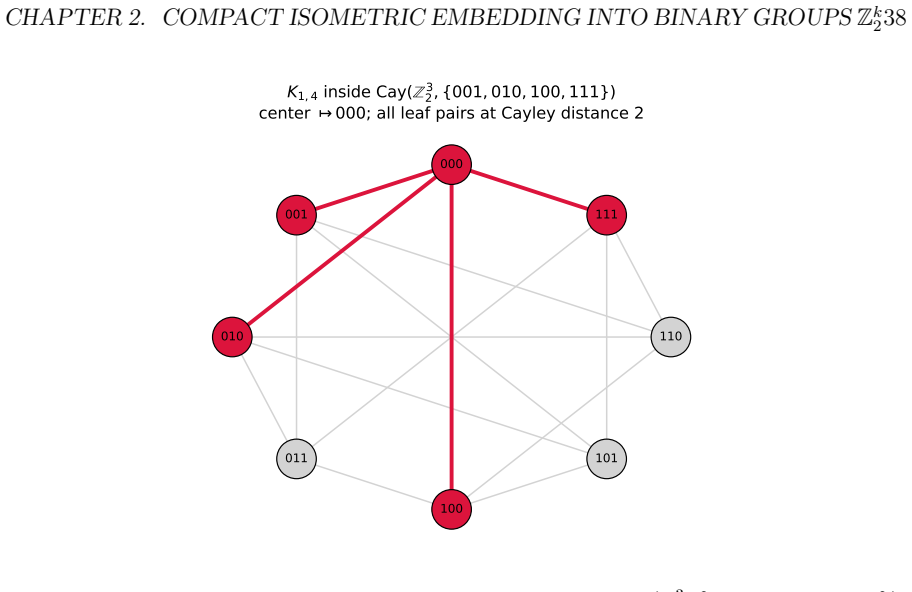
- Stars K_{1,q} admit embeddings with dimension ceil(log2 q) + 1, exponentially below the naive bound.
- Odd cycles require dimension exactly n-1.
- The same quotient machinery generalizes via Smith Normal Form to embeddings into arbitrary finite abelian groups.
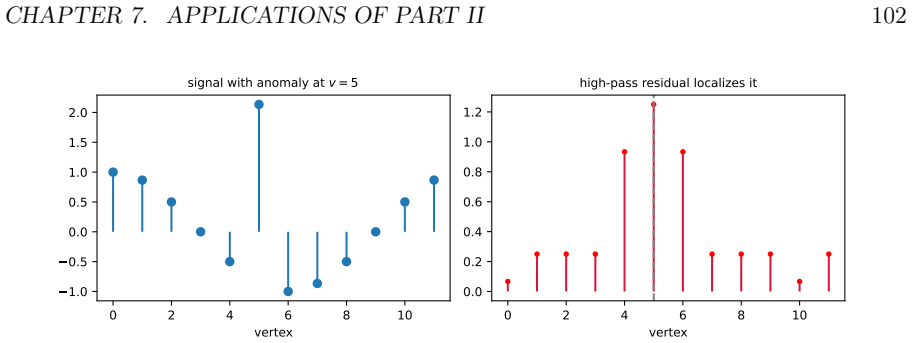
- The embeddings preserve convolution theorems, translation-modulation duality, and Plancherel identities for graph signals.
Reading between the lines
- The algorithm could be run on larger random graphs to test whether k <= n-1 remains tight or admits tighter universal bounds.
- Minimal-dimension search might be implemented by enumerating pruned partitions and selecting the smallest successful labeling.
- The framework suggests that many matrix-based graph Fourier transforms are special cases of the group Fourier transform on the host abelian group.
- Bipartite graphs may recover known hypercube or partial-cube embeddings as special cases of the same construction.
Signed reviews
Editorial analysis
A structured set of objections, weighed in public.
Referee Report
Summary. The manuscript develops a framework for isometric embeddings of arbitrary connected graphs into Cayley graphs of abelian groups, centered on metric parallelism relations (phi, Phi, Psi) with a transitive prune, the Cocycle/Quotient Labeling Theorem producing GF(2) labelings from edge partitions (failing only by shortcuts), and a shortcut-repair loop yielding embeddings into (Z_2)^k with k ≤ n-1. It includes bounds (e.g., stars satisfy k_min = ceil(log2 q) + 1; odd cycles require k = n-1), a generalization to Z via Smith Normal Form, exhaustive verification on all 995 connected graphs with n ≤ 7, and applications to Group-Embedding-based Graph Signal Processing (GE-GSP) preserving Fourier properties exactly.
Significance. If the universal embedding result and repair procedure hold, the work supplies a rigorous algebraic host for exact harmonic analysis, convolution, and wavelets on irregular graphs, addressing a core limitation of matrix-based GSP. The parameter-free nature of the construction, the explicit bounds for stars and cycles, and the exhaustive verification on all small graphs are notable strengths that support falsifiability and reproducibility.
major comments (1)
- [Cocycle/Quotient Labeling Theorem] Cocycle/Quotient Labeling Theorem: the claim that the shortcut-repair loop always terminates in an isometric spanning-tree embedding (yielding the universal k ≤ n-1 result) is load-bearing; the manuscript must supply an explicit termination argument that applies beyond the n ≤ 7 exhaustive check, as the theorem statement indicates failure occurs only by shortcuts but does not detail why the loop cannot cycle or produce non-isometric results on larger graphs.
minor comments (2)
- The count of 995 connected graphs with n ≤ 7 should be verified against standard enumerations (e.g., OEIS A001349) and stated with the exact enumeration source.
- Notation for the cycle-class parity matrix A and the rank computation k = t - rank(A) should be defined explicitly at first use in the theorem statement.
Simulated Author's Rebuttal
We thank the referee for the positive assessment and the constructive major comment. We address it point by point below.
read point-by-point responses
-
Referee: [Cocycle/Quotient Labeling Theorem] Cocycle/Quotient Labeling Theorem: the claim that the shortcut-repair loop always terminates in an isometric spanning-tree embedding (yielding the universal k ≤ n-1 result) is load-bearing; the manuscript must supply an explicit termination argument that applies beyond the n ≤ 7 exhaustive check, as the theorem statement indicates failure occurs only by shortcuts but does not detail why the loop cannot cycle or produce non-isometric results on larger graphs.
Authors: We agree that an explicit termination argument is required to support the universal result beyond the n ≤ 7 verification. The current text states that the loop terminates in an isometric spanning-tree embedding but relies on the theorem's shortcut-only failure mode without a general proof against cycling or non-isometry. In revision we will add a formal argument: each repair step eliminates at least one shortcut (by adjusting the GF(2) labels on the affected partition) while preserving distances on all non-shortcut edges and never increasing the quotient dimension k; a potential function equal to the number of shortcut edges therefore strictly decreases, guaranteeing termination after finitely many steps with no cycles possible. The resulting labeling is isometric by the theorem's guarantee that the only possible inconsistencies are shortcuts. revision: yes
Circularity Check
No significant circularity
full rationale
The derivation chain rests on the stated Cocycle/Quotient Labeling Theorem (which produces GF(2) labelings from edge partitions after transitive prune, failing only by shortcuts) together with a repair loop that reaches an isometric spanning-tree embedding; the universal bound k ≤ n-1 follows directly from this construction. Exhaustive verification on all 995 connected graphs with n ≤ 7 supplies independent confirmation rather than a fit to the same data. No self-citations, fitted parameters renamed as predictions, or self-definitional reductions appear in the provided chain; the result is self-contained against external benchmarks.
Assumptions & free parameters
assumptions (2)
- standard math Basic axioms of graph theory and abelian group theory
- domain assumption Existence of edge partitions from the relations that allow consistent labeling
invented entities (2)
-
Metric parallelism edge relations (phi, Phi, Psi)
-
Cocycle/Quotient labeling
Cite this review
Pith. "Pith review of Minimal Isometric Embeddings of Graphs into Abelian Groups: Theory, Algorithms, and Applications to Signal Processing over Networks." pith.science (2026). https://pith.science/paper/EKJTVWNJ
@misc{pith2026260629391,
  author       = {Pith},
  title        = {Pith review of: Minimal Isometric Embeddings of Graphs into Abelian Groups: Theory, Algorithms, and Applications to Signal Processing over Networks},
  year         = {2026},
  howpublished = {\url{https://pith.science/paper/EKJTVWNJ}},
  note         = {Machine review of arXiv:2606.29391}
}
read the original abstract
This dissertation develops a framework for embedding arbitrary connected graphs isometrically into Cayley graphs of abelian groups, with applications to harmonic analysis on networks. It addresses representing irregular graph-structured data within highly symmetric algebraic hosts, on which classical Fourier theory applies verbatim rather than by analogy. The theoretical core is twofold. First, we introduce edge relations phi, Phi, and Psi that detect metric parallelism, a strict generalization of the Djokovic-Winkler relation beyond bipartite and partial-cube structures, with a transitive prune operation converting them into candidate same-generator edge partitions. Second, we prove the Cocycle/Quotient Labeling Theorem: any edge partition induces a most-generic consistent vertex labeling as a GF(2) quotient of dimension k = t - rank(A), where A is the cycle-class parity matrix; the labeling can fail only by shortcuts, never by stretching. With a shortcut-repair loop terminating in the isometric spanning-tree embedding, this gives a universal algorithm: every connected graph G embeds isometrically into a Cayley graph of (Z_2)^k with k <= n-1, verified exhaustively on all 995 connected graphs of at most seven vertices. A bounds theory follows: k >= max(diam(G), ceil(log2 n)); stars satisfy k_min(K_{1,q}) = ceil(log2 q) + 1, exponentially below the naive dimension; odd cycles require k = n-1. We then generalize the quotient machinery from GF(2) to Z via the Smith Normal Form, giving embeddings into products of cyclic groups. The primary application is harmonic analysis: these embeddings ground Fourier analysis, convolution, and wavelet transforms on graph signals, preserving translation-modulation duality, convolution theorems, and Plancherel identities that matrix-based graph signal processing lacks. We name this framework Group-Embedding-based Graph Signal Processing (GE-GSP).
Figures


Figures from the paper (51 more)








Forward citations
Cited by 4 Pith papers
-
Minimal Isometric Embeddings of Graphs into Cayley Graphs of Finite Abelian Groups
A quotient labeling theorem using Smith normal form produces certified isometric embeddings of any connected graph into abelian Cayley graphs, often far smaller than the hypercube baseline.
-
Dimension and Order Bounds for Isometric Embeddings of Graphs into Abelian Cayley Graphs, and the Abelian Dividend
Every connected graph embeds isometrically into an abelian Cayley host of order at least max(n, 2 diam), binary dimension at least max(diam, ceil(log2 n)), with exact values for stars and odd cycles and a census showi...
-
Tight Wavelet Frames on Graphs via Isometric Group Embedding
A spectral band-pass wavelet construction on an isometric abelian-Cayley host gives exact tight-frame reconstruction for any graph signal, with a harmonic-extension completion rule.
-
Harmonic Analysis on Graphs via Isometric Group Embedding: A Canonical Fourier Transform, Shift, and Convolution for Network Signals
By embedding any network into a symmetric group graph, graph Fourier analysis becomes exact and translation-like, at the cost of host size.
Reference graph
Works this paper leans on
-
[1]
(2009).Computational Complexity: A Modern Approach
Arora, S., & Barak, B. (2009).Computational Complexity: A Modern Approach. Cambridge University Press
2009
-
[2]
C. D. Godsil, On Cayley graph isomorphisms,Ars Combinatoria, vol. 15, pp. 231– 246, 1983
1983
-
[3]
Alspach, Isomorphisms of Cayley graphs on abelian groups, inGraph Symmetry: Algebraic Methods and Applications, NATO ASI Series C, vol
B. Alspach, Isomorphisms of Cayley graphs on abelian groups, inGraph Symmetry: Algebraic Methods and Applications, NATO ASI Series C, vol. 497, pp. 1–23, 1997
1997
-
[4]
Babai, Automorphism groups, isomorphism, reconstruction, inHandbook of Com- binatorics, 1996
L. Babai, Automorphism groups, isomorphism, reconstruction, inHandbook of Com- binatorics, 1996
1996
-
[5]
Barab´ asi, Network Science,Cambridge University Press, 2016
A.-L. Barab´ asi, Network Science,Cambridge University Press, 2016
2016
-
[6]
Barab´ asi and R
A.-L. Barab´ asi and R. Albert, Emergence of scaling in random networks,Science, vol. 286, pp. 509–512, 1999
1999
-
[7]
Biggs, Algebraic Graph Theory,Cambridge University Press, 2nd ed., 1993
N. Biggs, Algebraic Graph Theory,Cambridge University Press, 2nd ed., 1993
1993
-
[8]
Bollob´ as, Modern Graph Theory,Springer, 1998
B. Bollob´ as, Modern Graph Theory,Springer, 1998
1998
Show all 195 references
-
[9]
J. A. Bondy and U. S. R. Murty, Graph Theory with Applications,North-Holland, 1976
1976
-
[10]
Borg and P
I. Borg and P. J. F. Groenen, Modern Multidimensional Scaling: Theory and Appli- cations,Springer, 2005
2005
-
[11]
Brillouin, Wave Propagation in Periodic Structures,Dover, 1953
L. Brillouin, Wave Propagation in Periodic Structures,Dover, 1953
1953
-
[12]
Chartrand and P
G. Chartrand and P. Zhang,Introduction to Graph Theory, McGraw-Hill, 2006
2006
-
[13]
Cayley, Desiderata and suggestions: No
A. Cayley, Desiderata and suggestions: No. 2. The theory of groups: Graphical representation,American Journal of Mathematics, vol. 1, no. 2, pp. 174–176, 1878
-
[14]
S. Chen, A. Sandryhaila, J. M. F. Moura, and J. Kovacevi´ c, Signal recovery on graphs: Variational perspective,IEEE Transactions on Signal Processing, vol. 63, no. 19, pp. 5239–5254, 2015
2015
-
[15]
F. R. K. Chung,Spectral Graph Theory, American Mathematical Society, 1997
1997
-
[16]
Chepoi, Isometric subgraphs of hypercubes,Discrete Mathematics, vol
V. Chepoi, Isometric subgraphs of hypercubes,Discrete Mathematics, vol. 219, pp. 25–52, 2000. 110 BIBLIOGRAPHY111
2000
-
[17]
Chiba and T
N. Chiba and T. Nishizeki, Arboricity and subgraph listing algorithms,SIAM Jour- nal on Computing, vol. 14, no. 1, pp. 210–223, 1985
1985
-
[18]
R. R. Coifman and S. Lafon, Diffusion maps,Applied and Computational Harmonic Analysis, vol. 21, no. 1, pp. 5–30, 2006
2006
-
[19]
T. H. Cormen, C. E. Leiserson, R. L. Rivest, and C. Stein, Introduction to Algo- rithms,MIT Press, 3rd ed., 2009
2009
-
[20]
Cvetkovic, P
D. Cvetkovic, P. Rowlinson, and S. Simic,An Introduction to the Theory of Graph Spectra, Cambridge University Press, 2010
2010
-
[21]
Diestel, Graph Theory,Springer, 5th ed., 2017
R. Diestel, Graph Theory,Springer, 5th ed., 2017
2017
-
[22]
D. Z. Djokovi´ c, Distance preserving subgraphs of hypercubes,Journal of Combina- torial Theory, Series B, vol. 14, no. 3, pp. 263–267, 1973
1973
-
[23]
T. Ekim, P. Hell, J. Stacho, and D. de Werra, Polar cographs,Discrete Applied Mathematics, vol. 156, pp. 1652–1660, 2011
2011
-
[24]
G. B. Folland, A Course in Abstract Harmonic Analysis,CRC Press, 1995
1995
-
[25]
Gavish, B
M. Gavish, B. Nadler, and R. R. Coifman, Multiscale wavelets on trees, graphs and high dimensional data: Theory and applications to semi supervised learning, in ICML, 2010
2010
-
[26]
Godsil and G
C. Godsil and G. Royle, Algebraic Graph Theory,Springer, 2001
2001
-
[27]
R. L. Graham and H. O. Pollak, On the addressing problem for loop switching,Bell System Technical Journal, vol. 50, no. 8, pp. 2495–2519, 1971
1971
-
[28]
R. L. Graham, On primitive graphs and optimal vertex assignments,Annals of the New York Academy of Sciences, vol. 319, pp. 170–186, 1978
1978
-
[29]
Hammack,Handbook of Product Graphs, CRC Press, 2nd ed., 2012
R. Hammack,Handbook of Product Graphs, CRC Press, 2nd ed., 2012
2012
-
[30]
Harary,Graph Theory, Addison-Wesley, 1969
F. Harary,Graph Theory, Addison-Wesley, 1969
1969
-
[31]
D. K. Hammond, P. Vandergheynst, and R. Gribonval, Wavelets on graphs via spectral graph theory,Applied and Computational Harmonic Analysis, vol. 30, no. 2, pp. 129–150, 2011
2011
-
[32]
Hell and J
P. Hell and J. Nesetril, Graphs and Homomorphisms,Oxford University Press, 2004
2004
-
[33]
T. Hey, S. Tansley, and K. Tolle, The Fourth Paradigm: Data-Intensive Scientific Discovery,Microsoft Research, 2009
2009
-
[34]
Imrich and S
W. Imrich and S. Klavˇ zar, Product Graphs: Structure and Recognition,Wiley, 2010
2010
-
[35]
Katznelson, An Introduction to Harmonic Analysis,Cambridge University Press, 3rd ed., 2004
Y. Katznelson, An Introduction to Harmonic Analysis,Cambridge University Press, 3rd ed., 2004
2004
-
[36]
Leskovec, J
J. Leskovec, J. Kleinberg, and C. Faloutsos, Graph evolution: Densification and shrinking diameters,ACM TKDD, vol. 1, no. 1, 2007. BIBLIOGRAPHY112
2007
-
[37]
Lubotzky, Discrete Groups, Expanding Graphs and Invariant Measures, Birkh¨ auser, 1994
A. Lubotzky, Discrete Groups, Expanding Graphs and Invariant Measures, Birkh¨ auser, 1994
1994
-
[38]
van der Maaten and G
L. van der Maaten and G. Hinton, Visualizing data using t-SNE,Journal of Machine Learning Research, vol. 9, pp. 2579–2605, 2008
2008
-
[39]
J., & Sloane, N
MacWilliams, F. J., & Sloane, N. J. A. (1977).The Theory of Error-Correcting Codes. North-Holland
1977
-
[40]
Mallat,A Wavelet Tour of Signal Processing: The Sparse Way, 3rd ed., Academic Press, 2009
S. Mallat,A Wavelet Tour of Signal Processing: The Sparse Way, 3rd ed., Academic Press, 2009
2009
-
[41]
C. H. Li, On isomorphisms of finite Cayley graphs—a survey,Discrete Mathematics, vol. 256, no. 1–2, pp. 301–334, 2002
2002
-
[42]
J. M. F. Moura, Algebraic signal processing,Encyclopedia of Systems and Control, 2015
2015
-
[43]
S. K. Narang and A. Ortega, Perfect reconstruction two-channel wavelet filter banks for graph structured data,IEEE Trans. Signal Processing, vol. 60, no. 6, pp. 2786– 2799, 2012
2012
-
[44]
A., & Chuang, I
Nielsen, M. A., & Chuang, I. L. (2010).Quantum Computation and Quantum Infor- mation(10th anniv. ed.). Cambridge University Press
2010
-
[45]
M. E. J. Newman, The structure and function of complex networks,SIAM Review, vol. 45, no. 2, pp. 167–256, 2003
2003
-
[46]
M. E. J. Newman, Networks,Oxford University Press, 2nd ed., 2018
2018
-
[47]
Ortega, P
A. Ortega, P. Frossard, J. Kovaˇ cevi´ c, J. M. F. Moura, and P. Vandergheynst, Graph signal processing: Overview, challenges, and applications,Proceedings of the IEEE, vol. 106, no. 5, pp. 808–828, 2018
2018
-
[48]
Paul, On isometric embeddings of graphs into hypercubes,Discrete Mathematics, vol
R. Paul, On isometric embeddings of graphs into hypercubes,Discrete Mathematics, vol. 339, 2016
2016
-
[49]
Puschel and J
M. Puschel and J. M. F. Moura, Algebraic signal processing theory: Foundation and 1-D time,IEEE Transactions on Signal Processing, vol. 51, no. 12, 2003
2003
-
[50]
Puschel and J
M. Puschel and J. M. F. Moura, Algebraic signal processing theory: Cooley-Tukey type algorithms for DCTs and DSTs,IEEE Transactions on Signal Processing, 2008
2008
-
[51]
Rudin, Fourier Analysis on Groups,Wiley, 1962
W. Rudin, Fourier Analysis on Groups,Wiley, 1962
1962
-
[52]
Sabidussi, On a class of fixed-point-free graphs,Proceedings of the American Mathematical Society, vol
G. Sabidussi, On a class of fixed-point-free graphs,Proceedings of the American Mathematical Society, vol. 9, no. 5, pp. 800–804, 1958
1958
-
[53]
Sandryhaila and J
A. Sandryhaila and J. M. F. Moura, Discrete signal processing on graphs,IEEE Transactions on Signal Processing, vol. 61, no. 7, pp. 1644–1656, 2013
2013
-
[54]
Sandryhaila and J
A. Sandryhaila and J. M. F. Moura, Big data analysis with signal processing on graphs: Representation and processing of massive data sets with irregular structure, IEEE Signal Processing Magazine, vol. 31, no. 5, pp. 80–90, 2014. BIBLIOGRAPHY113
2014
-
[55]
D. I. Shuman, P. Vandergheynst, and P. Frossard, Stabilizing graph-based transforms with wiener filtering, inICASSP, 2011
2011
-
[56]
D. I. Shuman, S. K. Narang, P. Frossard, A. Ortega, and P. Vandergheynst, The emerging field of signal processing on graphs: Extending high-dimensional data anal- ysis to networks and other irregular domains,IEEE Signal Processing Magazine, vol. 30, no. 3, pp. 83–98, 2013
2013
-
[57]
Stankovic, D
L. Stankovic, D. Mandic, M. Dakovic, and M. Brajovic, Graph signal process- ing—Part I: Fundamentals and selected applications,IEEE Signal Processing Mag- azine, vol. 36, no. 6, pp. 117–119, 2019
2019
-
[58]
Sternberg, Group Theory and Physics,Cambridge University Press, 2004
S. Sternberg, Group Theory and Physics,Cambridge University Press, 2004
2004
-
[59]
Terras, Fourier Analysis on Finite Groups and Applications,Cambridge Univer- sity Press, 1999
A. Terras, Fourier Analysis on Finite Groups and Applications,Cambridge Univer- sity Press, 1999
1999
-
[60]
von Luxburg, A tutorial on spectral clustering,Statistics and Computing, vol
U. von Luxburg, A tutorial on spectral clustering,Statistics and Computing, vol. 17, no. 4, pp. 395–416, 2007
2007
-
[61]
D. J. Watts, A simple model of global cascades on random networks,Proceedings of the National Academy of Sciences, vol. 99, no. 9, pp. 5766–5771, 2002
2002
-
[62]
D. B. West, Introduction to Graph Theory,Prentice Hall, 2nd ed., 2001
2001
-
[63]
Wiener, Extrapolation, Interpolation, and Smoothing of Stationary Time Series, MIT Press, 1949
N. Wiener, Extrapolation, Interpolation, and Smoothing of Stationary Time Series, MIT Press, 1949
1949
-
[64]
P. M. Winkler, Isometric embedding in products of complete graphs,Discrete Applied Mathematics, vol. 7, no. 2, pp. 221–225, 1984
1984
-
[65]
Zhang, X
X. Zhang, X. Dong, and P. Frossard, Learning of structured graph dictionaries with convolutional sparse coding,IEEE Transactions on Signal Processing, 2018
2018
-
[66]
Burago, Y
D. Burago, Y. Burago, and S. Ivanov, A Course in Metric Geometry,American Mathematical Society, 2001
2001
-
[67]
Daubechies, Ten Lectures on Wavelets,SIAM, 1992
I. Daubechies, Ten Lectures on Wavelets,SIAM, 1992
1992
-
[68]
Dally, W. J. (1990). Performance analysis ofk-aryn-cube interconnection networks. IEEE Transactions on Computers, 39(6), 775-785
1990
-
[69]
D. A. Holton and J. Sheehan, The Petersen Graph,Cambridge University Press, 1992
1992
-
[70]
Leighton, F. T. (1992).Introduction to Parallel Algorithms and Architectures: Ar- rays, Trees, Hypercubes. Morgan Kaufmann
1992
-
[71]
Peter and H
F. Peter and H. Weyl, Die Vollst¨ andigkeit der primitiven Darstellungen einer geschlossenen kontinuierlichen Gruppe,Mathematische Annalen, vol. 97, pp. 737– 755, 1927
1927
-
[72]
J. J. Rotman, An Introduction to the Theory of Groups,Springer, 4th ed., 1995. BIBLIOGRAPHY114
1995
-
[73]
Serre, Linear Representations of Finite Groups,Springer, 1977
J.-P. Serre, Linear Representations of Finite Groups,Springer, 1977
1977
-
[74]
Sugiura, Unitary Representations and Harmonic Analysis,North-Holland, 1975
M. Sugiura, Unitary Representations and Harmonic Analysis,North-Holland, 1975
1975
-
[75]
A. V. Oppenheim and R. W. Schafer,Discrete-Time Signal Processing, Prentice Hall, 3rd ed., 2009
2009
-
[76]
Kovaˇ cevi´ c and M
J. Kovaˇ cevi´ c and M. Vetterli, Nonseparable multidimensional filter banks and wavelets,IEEE Trans. Signal Processing, 1996
1996
-
[77]
Ovchinnikov, Partial cubes: structures, characterizations, and constructions,Dis- crete Mathematics, vol
S. Ovchinnikov, Partial cubes: structures, characterizations, and constructions,Dis- crete Mathematics, vol. 308, no. 23, pp. 5597–5621, 2008
2008
-
[78]
Klavˇ zar, K
S. Klavˇ zar, K. Knauer, and T. Marc, On the Djokovi´ c–Winkler relation and its closure in subdivisions of fullerenes, triangulations, and chordal graphs, arXiv:1906.06111 [math.CO], 2019
1906
-
[79]
Xie, Y.-D
Y.-T. Xie, Y.-D. Feng, and S.-J. Xu, A relation between the cube polynomials of partial cubes and the clique polynomials of their crossing graphs,Journal of Graph Theory, vol. 106, pp. 907–922, 2024
2024
-
[80]
Hellmuth, B
M. Hellmuth, B. J. Schmidt, G. E. Scholz, and S. Thekkumpadan Puthiyaveedu, The complement of the Djokovi´ c–Winkler relation,Discrete Mathematics, vol. 348, no. 3, 2025 (arXiv:2311.18284)
2025
-
[81]
D. S. Dummit and R. M. Foote,Abstract Algebra, Wiley, 3rd ed., 2004
2004
-
[82]
I. N. Herstein,Topics in Algebra, Wiley, 2nd ed., 1975
1975
-
[83]
Fulton and J
W. Fulton and J. Harris,Representation Theory: A First Course, Springer-Verlag, 1991
1991
-
[84]
T. P. Hayes, Randomizing cellular automata, ACM Transactions on Modeling and Computer Simulation, 2006
2006
-
[85]
A. Y. Kitaev, Fault-tolerant quantum computation by anyons,Annals of Physics, vol. 303, no. 1, pp. 2–30, 2003
2003
-
[86]
W. W. Zachary, An information flow model for conflict and fission in small groups, Journal of Anthropological Research, vol. 33, no. 4, pp. 452–473, 1977
1977
-
[87]
J. W. Cooley and J. W. Tukey, An algorithm for the machine calculation of complex Fourier series,Mathematics of Computation, vol. 19, no. 90, pp. 297–301, 1965
1965
-
[88]
D. L. Donoho and P. B. Stark, Uncertainty principles and signal recovery,SIAM Journal on Applied Mathematics, vol. 49, no. 3, pp. 906–931, 1989
1989
-
[89]
Unser, Sampling—50 years after Shannon,Proceedings of the IEEE, vol
M. Unser, Sampling—50 years after Shannon,Proceedings of the IEEE, vol. 88, no. 4, pp. 569–587, 2000
2000
-
[90]
M. M. Bronstein, J. Bruna, Y. LeCun, A. Szlam, and P. Vandergheynst, Geometric deep learning: going beyond Euclidean data,IEEE Signal Processing Magazine, vol. 34, no. 4, pp. 18–42, 2017. BIBLIOGRAPHY115
2017
-
[91]
Hatcher,Algebraic Topology, Cambridge University Press, 2002
A. Hatcher,Algebraic Topology, Cambridge University Press, 2002
2002
-
[92]
Barab´ asi and Z
A.-L. Barab´ asi and Z. N. Oltvai, Network biology: understanding the cell’s functional organization,Nature Reviews Genetics, vol. 5, no. 2, pp. 101–113, 2004
2004
-
[93]
Gavili and X.-P
A. Gavili and X.-P. Zhang, On the shift operator, graph frequency, and optimal filtering in graph signal processing,IEEE Transactions on Signal Processing, vol. 65, no. 23, pp. 6303–6318, 2017
2017
-
[94]
Deza and M
M. Deza and M. Laurent,Geometry of Cuts and Metrics, Algorithms and Combina- torics 15, Springer, 1997
1997
-
[95]
Bandelt and V
H.-J. Bandelt and V. Chepoi, Metric graph theory and geometry: a survey, inSurveys on Discrete and Computational Geometry, Contemporary Mathematics 453, AMS, pp. 49–86, 2008
2008
-
[96]
Shi and J
J. Shi and J. M. F. Moura, Graph signal processing: Modulation, convolution, and sampling,arXiv:1912.06762, 2019
1912
-
[97]
Available: https://eneocameroon.cm
ENEO Cameroon,Notre carte ´ electrique (Distribution network), 2024. Available: https://eneocameroon.cm
2024
-
[98]
M. C. Ngono and B. Ndzana, Current State of Energy Production in Cameroon and Projection for 2035,Journal of Power and Energy Engineering, vol. 12, pp. 47–69, 2024
-
[99]
Onanena, R
R. Onanena, R. Tchuidjan, F. Biya Motto, and M. Mamche Gatchessi, Improvement of the Voltage Quality in an Electrical Network via the Loopback: Case of the Southern Interconnected Grid (SIG) of Cameroon,Journal of Power and Energy Engineering, vol. 9, no. 3, pp. 25–41, 2021
2021
-
[100]
African Development Bank,Chad–Cameroon 225kV Electrical Grid Interconnection Project — Summary Environmental and Social Impact Assessment, AfDB, 2018
2018
-
[101]
Business in Cameroon, Electricity: Cameroon instructs industrial rationing again,
-
[102]
Available: https://www.businessincameroon.com
-
[103]
World Bank,Cameroon–Chad Power Interconnection Project (P168185): Imple- mentation Status and Results Report, World Bank Group, 2025
2025
-
[104]
Afrik21, Chad–Cameroon:$385 million from IDA for electricity interconnection,
-
[105]
Available: https://www.afrik21.africa
-
[106]
K. P. Eswaran and R. E. Tarjan, Augmentation Problems,SIAM Journal on Com- puting, vol. 5, no. 4, pp. 653–665, 1976
1976
-
[107]
Lavin and S
A. Lavin and S. Ahmad, Evaluating Real-Time Anomaly Detection Algorithms — The Numenta Anomaly Benchmark, in14th IEEE Int. Conf. on Machine Learning and Applications (ICMLA), 2015, pp. 38–44
2015
-
[108]
D. J. Watts and S. H. Strogatz, Collective dynamics of small-world networks,Na- ture, vol. 393, no. 6684, pp. 440–442, 1998. BIBLIOGRAPHY116
1998
-
[109]
Easley and J
D. Easley and J. Kleinberg,Networks, Crowds, and Markets: Reasoning About a Highly Connected World, Cambridge University Press, 2010
2010
-
[110]
Bullmore and O
E. Bullmore and O. Sporns, Complex brain networks: Graph theoretical analysis of structural and functional systems,Nature Reviews Neuroscience, vol. 10, pp. 186– 198, 2009
2009
-
[111]
Hagmann et al., Mapping the structural core of human cerebral cortex,PLoS Biology, vol
P. Hagmann et al., Mapping the structural core of human cerebral cortex,PLoS Biology, vol. 6, no. 7, e159, 2008
2008
-
[112]
Huang, T
W. Huang, T. A. W. Bolton, J. D. Medaglia, D. S. Bassett, A. Ribeiro, and D. Van De Ville, A graph signal processing perspective on functional brain imaging,Proc. IEEE, vol. 106, no. 5, pp. 868–885, 2018
2018
-
[113]
Leskovec, A
J. Leskovec, A. Rajaraman, and J. D. Ullman,Mining of Massive Datasets, Cam- bridge University Press, 2nd ed., 2014
2014
-
[114]
Muthukrishnan, Data streams: algorithms and applications,Foundations and Trends in Theoretical Computer Science, vol
S. Muthukrishnan, Data streams: algorithms and applications,Foundations and Trends in Theoretical Computer Science, vol. 1, no. 2, pp. 117–236, 2005
2005
-
[115]
Das Sarma, S
A. Das Sarma, S. Gollapudi, and R. Panigrahy, Estimating PageRank on graph streams,Journal of the ACM, vol. 58, no. 3, 2010
2010
-
[116]
Bhattacharya, M
S. Bhattacharya, M. Henzinger, and D. Nanongkai, New deterministic approxima- tion algorithms for fully dynamic matching,Proceedings of the 47th ACM STOC, pp. 398–407, 2015
2015
-
[117]
Lov´ asz,Large Networks and Graph Limits, American Mathematical Society, 2012
L. Lov´ asz,Large Networks and Graph Limits, American Mathematical Society, 2012
2012
-
[118]
Klein, Computing the edit-distance between unrooted ordered trees, Algorithms and Data Structures, 1991
R. Klein, Computing the edit-distance between unrooted ordered trees, Algorithms and Data Structures, 1991
1991
-
[119]
Eppstein, Recognizing partial cubes in quadratic time, inProc
D. Eppstein, Recognizing partial cubes in quadratic time, inProc. SODA, pp. 1258–1266, 2008
2008
-
[120]
S. V. Shpectorov, On scale embeddings of graphs into hypercubes,European Journal of Combinatorics, vol. 14, no. 2, pp. 117–130, 1993
1993
-
[121]
Chepoi, Isometric subgraphs of Hamming graphs andd-convexity,Cybernetics, vol
V. Chepoi, Isometric subgraphs of Hamming graphs andd-convexity,Cybernetics, vol. 24, pp. 6–11, 1988
1988
-
[122]
Linial, E
N. Linial, E. London, and Y. Rabinovich, The geometry of graphs and some of its algorithmic applications,Combinatorica, vol. 15, no. 2, pp. 215–245, 1995
1995
-
[123]
Bourgain, On Lipschitz embedding of finite metric spaces in Hilbert space,Israel J
J. Bourgain, On Lipschitz embedding of finite metric spaces in Hilbert space,Israel J. Math., vol. 52, pp. 46–52, 1985
1985
-
[124]
R. L. Graham and P. M. Winkler, On isometric embeddings of graphs,Transactions of the American Mathematical Society, vol. 288, no. 2, pp. 527–536, 1985
1985
-
[125]
I. F. Akyildiz, W. Su, Y. Sankarasubramaniam, and E. Cayirci, Wireless sensor networks: a survey,Computer Networks, vol. 38, no. 4, pp. 393–422, 2002. BIBLIOGRAPHY117
2002
-
[126]
Penrose,Random Geometric Graphs, Oxford University Press, 2003
M. Penrose,Random Geometric Graphs, Oxford University Press, 2003
2003
-
[127]
Girault, P
B. Girault, P. Gon¸ calves, and E. Fleury, Translation on graphs: An isometric shift operator,IEEE Signal Processing Letters, vol. 22, no. 12, pp. 2416–2420, 2015
2015
-
[128]
J. A. Deri and J. M. F. Moura, Spectral projector-based graph Fourier transforms, IEEE J. Sel. Topics Signal Processing, vol. 11, no. 6, pp. 785–795, 2017
2017
-
[129]
Girault, A
B. Girault, A. Ortega, and S. S. Narayanan, Irregularity-aware graph Fourier trans- forms,IEEE Trans. Signal Processing, vol. 66, no. 21, pp. 5746–5761, 2018
2018
-
[130]
A. G. Marques, S. Segarra, and G. Mateos, Signal processing on directed graphs, IEEE Signal Processing Magazine, vol. 37, no. 6, pp. 99–116, 2020
2020
-
[131]
Perraudin and P
N. Perraudin and P. Vandergheynst, Stationary signal processing on graphs,IEEE Trans. Signal Processing, vol. 65, no. 13, pp. 3462–3477, 2017
2017
-
[132]
I Shuman, B
D. I Shuman, B. Ricaud, and P. Vandergheynst, Vertex-frequency analysis on graphs,Appl. Comput. Harmon. Anal., vol. 40, no. 2, pp. 260–291, 2016
2016
-
[133]
Pesenson, Sampling in Paley–Wiener spaces on combinatorial graphs,Trans
I. Pesenson, Sampling in Paley–Wiener spaces on combinatorial graphs,Trans. Amer. Math. Soc., vol. 360, no. 10, pp. 5603–5627, 2008
2008
-
[134]
A. Anis, A. Gadde, and A. Ortega, Efficient sampling set selection for bandlimited graph signals using graph spectral proxies,IEEE Trans. Signal Processing, vol. 64, no. 14, pp. 3775–3789, 2016
2016
-
[135]
Tanaka, Spectral domain sampling of graph signals,IEEE Trans
Y. Tanaka, Spectral domain sampling of graph signals,IEEE Trans. Signal Pro- cessing, vol. 66, no. 14, pp. 3752–3767, 2018
2018
-
[136]
Tanaka, Y
Y. Tanaka, Y. C. Eldar, A. Ortega, and G. Cheung, Sampling signals on graphs: From theory to applications,IEEE Signal Processing Magazine, vol. 37, no. 6, pp. 14–30, 2020
2020
-
[137]
A. G. Marques, S. Segarra, G. Leus, and A. Ribeiro, Sampling of graph signals with successive local aggregations,IEEE Trans. Signal Processing, vol. 64, no. 7, pp. 1832–1843, 2016
2016
-
[138]
G. Puy, N. Tremblay, R. Gribonval, and P. Vandergheynst, Random sampling of bandlimited signals on graphs,Appl. Comput. Harmon. Anal., vol. 44, no. 2, pp. 446–475, 2018
2018
-
[139]
Tsitsvero, S
M. Tsitsvero, S. Barbarossa, and P. Di Lorenzo, Signals on graphs: Uncertainty principle and sampling,IEEE Trans. Signal Processing, vol. 64, no. 18, pp. 4845– 4860, 2016
2016
-
[140]
Gadde and A
A. Gadde and A. Ortega, A probabilistic interpretation of sampling theory of graph signals, inProc. IEEE ICASSP, pp. 3257–3261, 2015
2015
-
[141]
X. Wang, P. Liu, and Y. Gu, Local-set-based graph signal reconstruction,IEEE Trans. Signal Processing, vol. 63, no. 9, pp. 2432–2444, 2015
2015
-
[142]
Romero, M
D. Romero, M. Ma, and G. B. Giannakis, Kernel-based reconstruction of graph signals,IEEE Trans. Signal Processing, vol. 65, no. 3, pp. 764–778, 2017. BIBLIOGRAPHY118
2017
-
[143]
Zhu and M
X. Zhu and M. Rabbat, Approximating signals supported on graphs, inProc. IEEE ICASSP, pp. 3921–3924, 2012
2012
-
[144]
Thanou, D
D. Thanou, D. I Shuman, and P. Frossard, Learning parametric dictionaries for signals on graphs,IEEE Trans. Signal Processing, vol. 62, no. 15, pp. 3849–3862, 2014
2014
-
[145]
X. Dong, D. Thanou, P. Frossard, and P. Vandergheynst, Learning Laplacian matrix in smooth graph signal representations,IEEE Trans. Signal Processing, vol. 64, no. 23, pp. 6160–6173, 2016
2016
-
[146]
Kalofolias, How to learn a graph from smooth signals, inProc
V. Kalofolias, How to learn a graph from smooth signals, inProc. AISTATS, pp. 920–929, 2016
2016
-
[147]
H. E. Egilmez, E. Pavez, and A. Ortega, Graph learning from data under Laplacian and structural constraints,IEEE J. Sel. Topics Signal Processing, vol. 11, no. 6, pp. 825–841, 2017
2017
-
[148]
Mateos, S
G. Mateos, S. Segarra, A. G. Marques, and A. Ribeiro, Connecting the dots: Iden- tifying network structure via graph signal processing,IEEE Signal Processing Mag- azine, vol. 36, no. 3, pp. 16–43, 2019
2019
-
[149]
Segarra, A
S. Segarra, A. G. Marques, and A. Ribeiro, Optimal graph-filter design and appli- cations to distributed linear network operators,IEEE Trans. Signal Processing, vol. 65, no. 15, pp. 4117–4131, 2017
2017
-
[150]
Sandryhaila and J
A. Sandryhaila and J. M. F. Moura, Discrete signal processing on graphs: Graph filters for sensor networks, inProc. IEEE ICASSP, pp. 1080–1084, 2014
2014
-
[151]
Stankovi´ c, D
L. Stankovi´ c, D. Mandic, et al., Graph signal processing — Part II: Processing and analyzing signals on graphs,arXiv:1909.10325, 2019
1909
-
[152]
X. Dong, D. Thanou, L. Toni, M. Bronstein, and P. Frossard, Graph signal pro- cessing for machine learning,IEEE Signal Processing Magazine, vol. 37, no. 6, pp. 117–127, 2020
2020
-
[153]
G. Leus, A. G. Marques, J. M. F. Moura, A. Ortega, and D. I Shuman, Graph sig- nal processing: History, development, impact, and outlook,IEEE Signal Processing Magazine, vol. 40, no. 4, pp. 49–60, 2023
2023
-
[154]
Fiedler, Algebraic connectivity of graphs,Czechoslovak Math
M. Fiedler, Algebraic connectivity of graphs,Czechoslovak Math. J., vol. 23, no. 2, pp. 298–305, 1973
1973
-
[155]
Spielman, Spectral graph theory, inCombinatorial Scientific Computing, Chap- man and Hall/CRC, 2012
D. Spielman, Spectral graph theory, inCombinatorial Scientific Computing, Chap- man and Hall/CRC, 2012
2012
-
[156]
Hoory, N
S. Hoory, N. Linial, and A. Wigderson, Expander graphs and their applications, Bull. Amer. Math. Soc., vol. 43, pp. 439–561, 2006
2006
-
[157]
A. E. Brouwer and W. H. Haemers,Spectra of Graphs, Springer, 2012
2012
-
[158]
Lov´ asz, Random Walks on Graphs: A Survey, Combinatorics, Paul Erd¨ os is Eighty, vol
L. Lov´ asz, Random Walks on Graphs: A Survey, Combinatorics, Paul Erd¨ os is Eighty, vol. 2, 1993. BIBLIOGRAPHY119
1993
-
[159]
A. Y. Ng, M. I. Jordan, and Y. Weiss, On spectral clustering: Analysis and an algorithm,Advances in Neural Information Processing Systems, vol. 14, 2002
2002
-
[160]
S. K. Narang and A. Ortega, Compact support biorthogonal wavelet filterbanks for arbitrary undirected graphs,IEEE Trans. Signal Processing, vol. 61, no. 19, pp. 4673–4685, 2013
2013
-
[161]
I Shuman, C
D. I Shuman, C. Wiesmeyr, N. Holighaus, and P. Vandergheynst, Spectrum- adapted tight graph wavelet and vertex-frequency frames,IEEE Trans. Signal Pro- cessing, vol. 63, no. 16, pp. 4223–4235, 2015
2015
-
[162]
Leonardi and D
N. Leonardi and D. Van De Ville, Tight wavelet frames on multislice graphs,IEEE Trans. Signal Processing, vol. 61, no. 13, pp. 3357–3367, 2013
2013
-
[163]
Tremblay and P
N. Tremblay and P. Borgnat, Graph wavelets for multiscale community mining, IEEE Trans. Signal Processing, vol. 62, no. 20, pp. 5227–5239, 2014
2014
-
[164]
Crovella and E
M. Crovella and E. Kolaczyk, Graph wavelets for spatial traffic analysis, inProc. IEEE INFOCOM, vol. 3, pp. 1848–1857, 2003
2003
-
[165]
Strang and T
G. Strang and T. Nguyen, Wavelets and Filter Banks,Wellesley-Cambridge Press, 1996
1996
-
[166]
Vetterli and J
M. Vetterli and J. Kovaˇ cevi´ c, Wavelets and Subband Coding,Prentice Hall, 1995
1995
-
[167]
R. A. DeVore and G. G. Lorentz,Constructive Approximation, Springer-Verlag, 1993
1993
-
[168]
Sweldens, The lifting scheme: A construction of second generation wavelets, SIAM J
W. Sweldens, The lifting scheme: A construction of second generation wavelets, SIAM J. Math. Anal., vol. 29, no. 2, pp. 511–546, 1998
1998
-
[169]
C. E. Heil and D. F. Walnut, Continuous and discrete wavelet transforms,SIAM Review, vol. 31, no. 4, pp. 628–666, 1989
1989
-
[170]
Antoine and P
J.-P. Antoine and P. Vandergheynst, Wavelets on the 2-sphere: A group-theoretical approach,Appl. Comput. Harmon. Anal., vol. 7, no. 3, pp. 262–291, 1999
1999
-
[171]
Geller and A
D. Geller and A. Mayeli, Continuous wavelets on compact manifolds,Mathematis- che Zeitschrift, vol. 262, pp. 895–927, 2009
2009
-
[172]
Bruna, W
J. Bruna, W. Zaremba, A. Szlam, and Y. LeCun, Spectral networks and locally connected networks on graphs, inProc. ICLR, 2014
2014
-
[173]
Defferrard, X
M. Defferrard, X. Bresson, and P. Vandergheynst, Convolutional neural networks on graphs with fast localized spectral filtering, inProc. NeurIPS, pp. 3844–3852, 2016
2016
-
[174]
T. N. Kipf and M. Welling, Semi-supervised classification with graph convolutional networks, inProc. ICLR, 2017
2017
-
[175]
Veliˇ ckovi´ c, G
P. Veliˇ ckovi´ c, G. Cucurull, A. Casanova, A. Romero, P. Li` o, and Y. Bengio, Graph attention networks, inProc. ICLR, 2018. BIBLIOGRAPHY120
2018
-
[176]
F. Gama, A. G. Marques, G. Leus, and A. Ribeiro, Convolutional neural network architectures for signals supported on graphs,IEEE Trans. Signal Processing, vol. 67, no. 4, pp. 1034–1049, 2019
2019
-
[177]
Isufi, F
E. Isufi, F. Gama, D. I Shuman, and S. Segarra, Graph filters for signal processing and machine learning on graphs,IEEE Trans. Signal Processing, 2024
2024
-
[178]
W. J. Dally and B. Towles,Principles and Practices of Interconnection Networks, Morgan Kaufmann, 2004
2004
-
[179]
Saad,Iterative Methods for Sparse Linear Systems, SIAM, 2nd ed., 2003
Y. Saad,Iterative Methods for Sparse Linear Systems, SIAM, 2nd ed., 2003
2003
-
[180]
Thakur, R
R. Thakur, R. Rabenseifner, and W. Gropp, Optimization of collective communi- cation operations in MPICH,International Journal of High Performance Computing Applications, vol. 19, no. 1, pp. 49–66, 2005
2005
-
[181]
Cappello, A
F. Cappello, A. Geist, W. Gropp, S. Kale, B. Kramer, and M. Snir, Toward exascale resilience,International Journal of High Performance Computing Applications, vol. 23, no. 4, pp. 374–388, 2009
2009
-
[182]
Storjohann, Near optimal algorithms for computing Smith normal forms of in- teger matrices, inProc
A. Storjohann, Near optimal algorithms for computing Smith normal forms of in- teger matrices, inProc. ISSAC, pp. 267–274, 1996
1996
-
[183]
Dumas, B
J.-G. Dumas, B. D. Saunders, and G. Villard, On efficient sparse integer matrix Smith normal form computations,J. Symbolic Computation, vol. 32, no. 1–2, pp. 71–99, 2001
2001
-
[184]
Newman,Integral Matrices, Academic Press, 1972
M. Newman,Integral Matrices, Academic Press, 1972
1972
-
[185]
Cohen,A Course in Computational Algebraic Number Theory, Springer, 1993
H. Cohen,A Course in Computational Algebraic Number Theory, Springer, 1993
1993
-
[186]
E. M. Stein and G. Weiss,Introduction to Fourier Analysis on Euclidean Spaces, Princeton Univ. Press, 1971
1971
-
[187]
Diaconis,Group Representations in Probability and Statistics, IMS Lecture Notes, vol
P. Diaconis,Group Representations in Probability and Statistics, IMS Lecture Notes, vol. 11, 1988
1988
-
[188]
Connes,Noncommutative Geometry, Academic Press, 1994
A. Connes,Noncommutative Geometry, Academic Press, 1994
1994
-
[189]
Seress,Permutation Group Algorithms, Cambridge University Press, 2003
´A. Seress,Permutation Group Algorithms, Cambridge University Press, 2003
2003
-
[190]
Gottesman, Stabilizer codes and quantum error correction, Ph.D
D. Gottesman, Stabilizer codes and quantum error correction, Ph.D. dissertation, Caltech, 1997
1997
-
[191]
Carlsson, Topology and data,Bulletin of the American Mathematical Society, vol
G. Carlsson, Topology and data,Bulletin of the American Mathematical Society, vol. 46, no. 2, pp. 255–308, 2009
2009
-
[192]
D. L. Donoho, De-noising by soft-thresholding,IEEE Transactions on Information Theory, vol. 41, no. 3, pp. 613–627, 1995
1995
-
[193]
Hagberg, P
A. Hagberg, P. Swart, and D. Schult, Exploring network structure, dynamics, and function using NetworkX, inProceedings of the 7th Python in Science Conference, 2008. 121
2008
-
[194]
D. E. Knuth,The Stanford GraphBase: A Platform for Combinatorial Computing, Addison-Wesley, 1993
1993
-
[195]
W. L. Hamilton,Graph Representation Learning, Morgan & Claypool Publishers, 2020. Appendices Appendix A TheΦΨ/Cofactor Machinery: Operational Details This appendix records the operational detail of the first-campaign heuristics — the Φ- relation cross-tests, the Ψ chain merge,...
2020
Reviewed June 30, 2026 · model on record in the stance chip above.
Discussion (0). Continue with ORCID to comment.