REVIEW 2 major objections 6 minor 4 references
Thermal Radiation Exchange between Nanoparticles Heated by Arc Discharge
T0 review · 2 major / 6 minor · reviewed 2026-08-07 · deepseek-v4-flash
Pith's one-line read The paper claims that re-radiation from larger, hotter nanoparticles materially heats smaller neighbors, raising a 5 nm particle's temperature by about 23 K at baseline and up to roughly 350 K when conduction cooling is weak.
desk verdict The paper's central effect sizes are likely overestimated by about a factor of ten because the inter-particle heating term uses a geometric view factor without the receiver's Rayleigh absorption efficiency. read the letter →
The pith
A machine-rendered reading of the paper's core claim, the machinery that carries it, and where it could break.
The reading
What carries the argument
The mechanism is the diffuse-surface geometrical view factor between a small spherical element and a larger sphere, $F_{d1-2}=0.5\,(1-\sqrt{1-R^2})$ with $R=a/h$ (Eq. A-1), together with the reciprocity relation $F_{2-d1}=(a_1/a_2)^2\,F_{d1-2}$ (Eq. A-2), where $a$ is the radius of the larger particle and $h$ the center-to-center separation. The model takes the larger particle's radiative cooling power $Q_{rad}$ and assigns a fraction $F$ times the number of identical surrounding particles $N$ as additional heating absorbed by the small particle, grafted onto the baseline single-particle balance of Ref. [1], in which arc absorption scales as $T_{arc}^5$, particle radiative cooling scales as $T_p^5$, conduction follows Eq. (6), and thermionic emission contributes a further cooling term. The view factor is the single new object that converts isolated-particle results into a cloud-coupled prediction.
What would settle it
A many-body fluctuational-electrodynamics calculation of the same geometry — a 5 nm radius particle inside a shell of 100 particles of 50 nm radius at 500 nm separation, with the same gas pressure and arc temperature — would settle the view-factor model: if the predicted re-absorption heating differs substantially from the paper's about 23 K baseline (or from the about 350 K low-conduction cases), the central quantitative claim fails. Alternatively, a time-resolved laser-induced incandescence experiment comparing a bimodal particle cloud with a monodisperse small-particle cloud at the same pressure and gas temperature would directly test the predicted excess temperature of the small particles.
Extended reading notes
Core claim
The central claim is that inter-particle thermal radiation exchange cannot be neglected in computing nanoparticle temperatures in the Rayleigh regime (particle radius much smaller than the radiation wavelength) under arc-discharge conditions. Because absorption scales with particle volume while conduction cooling scales with surface area, larger particles reach higher equilibrium temperatures than smaller ones; those hotter larger particles then re-radiate, and a fraction of that re-radiated power is absorbed by nearby smaller particles, raising the small particle's equilibrium temperature above the isolated-particle prediction. The paper quantifies this by adding the radiative cooling power of surrounding larger particles, weighted by a view factor and by the number $N$ of such particles, to the small particle's heat balance. The magnitude of the effect grows with particle number density, with closer spacing, with weaker gas conduction (lower pressure or heavier buffer gas), and with higher arc temperature.
Load-bearing premise
The load-bearing premise is that a geometric view factor derived for macroscopic, diffusely emitting surfaces correctly gives the fraction of thermal radiation exchanged between nanoparticles that actually emit as electric dipoles, at separations comparable to the dominant radiation wavelength; if that geometric factor is not valid for sub-wavelength emitters, the computed inter-particle heating is not quantitatively reliable.
Editorial extensions
If this is right
- Isolated-particle models underpredict the equilibrium temperature of small nanoparticles in polydisperse clouds; the correction grows as the number density of larger particles rises and as their separation shrinks.
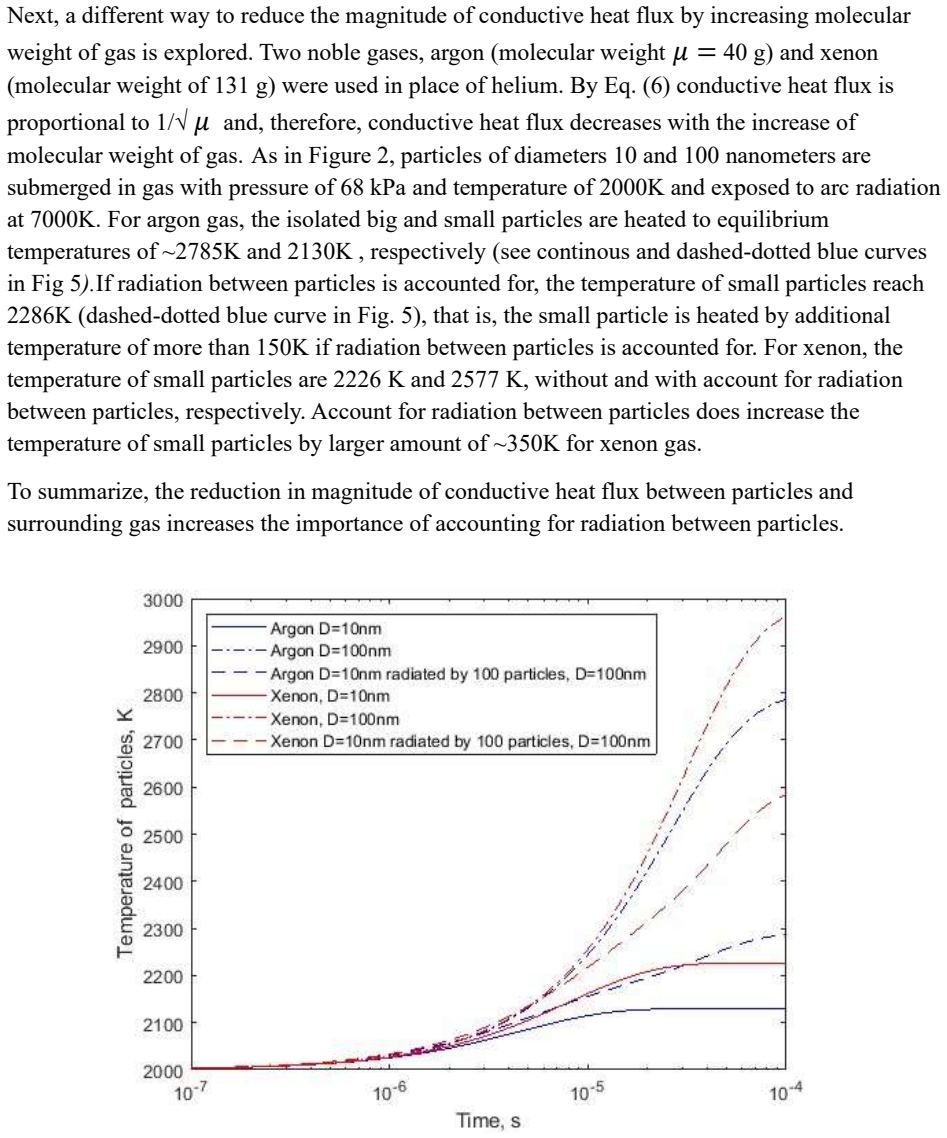
- Reducing conduction cooling amplifies the effect: halving the pressure twice raises the small-particle excess from about 23 K to more than 200 K, and using xenon instead of helium raises it to about 350 K.
- Raising the arc temperature from 7000 K to 8000 K about doubles the inter-particle heating of the small particle (23 K to 47 K), and raising it to 9000 K brings the excess above 100 K.
- The corrected temperatures are the input needed to predict downstream consequences the paper lists: melting and sticking of particles, gas heating by particles, and the cloud's opacity to arc radiation.
Reading between the lines
- The view-factor treatment treats sub-wavelength dipole emitters as diffuse macroscopic surfaces; a full fluctuational-electrodynamics calculation at 500 nm separation, comparable to the dominant thermal wavelength, could shift the magnitude of the baseline 23 K heating, and near-field effects would only strengthen the exchange at smaller separations, a direction the paper flags as future work.
- The predicted small-particle temperature excess is observable in principle: time-resolved laser-induced incandescence comparing a bimodal particle cloud against a monodisperse small-particle cloud at identical pressure and gas temperature should show the excess growing as pressure drops.
- The same re-radiation mechanism may apply beyond arc synthesis, for example to soot or other volumetrically absorbing nanoaerosols with a broad size distribution, where larger aggregates could heat smaller primary particles above isolated-particle predictions.
Editorial analysis
A structured set of objections, weighed in public.
Referee Report
Summary. The paper extends a single-particle radiation heating model for nanoparticles in an arc discharge (Ref. 1) by adding an inter-particle radiative exchange term. The new term is computed as the total thermal emission power Q_rad of a neighboring larger particle (Eq. 5) multiplied by a geometric view factor F (Eqs. A-1/A-2) and by the number N of such neighbors. Parametric studies vary gas pressure, noble gas species, and arc temperature, reporting that re-radiation from larger particles raises the temperature of smaller particles by 23 K in the baseline case and by up to roughly 100-350 K in the modified cases (Figures 3-6). The paper concludes that inter-particle thermal radiation is important for accurate nanoparticle temperature prediction and that smaller particles are heated more than isolated-particle models predict.
Significance. The topic is relevant to nanoparticle synthesis in arc discharges and to dusty plasma modeling. The manuscript has some strengths: it validates the isolated-particle baseline against Ref. 1, checks time-step convergence, and makes a concrete forward prediction with no free parameters tuned to the reported temperature increases. However, the central inter-particle heating term is physically incomplete: it omits the receiving particle's absorption efficiency, which overestimates the exchanged power by about an order of magnitude. In addition, the diffuse-surface view factor is applied to Rayleigh-regime emitters without justification, and the baseline separation is comparable to the dominant thermal wavelength. If the absorption-efficiency error is corrected, the reported temperature increases shrink to a few kelvin to tens of kelvin, which does not support the paper's main claim that re-radiation by larger particles is important.
major comments (2)
- [Section 2, paragraph after Eq. (11); Appendix, Eqs. (A-1)-(A-2)] The inter-particle heating is implemented as N*F*Q_rad, where F is a geometric view factor and Q_rad is the total thermal emission power of the neighboring particle (Eq. 5). This omits the receiving particle's absorption efficiency Q_abs = C_abs/(pi*a^2) approximately equal to 8*pi*a*E(m)/lambda defined via Eq. (1). For a = 5 nm, E(m) = 0.35, and lambda approximately 500 nm, Q_abs is about 0.088, so the absorbed power should be N*F*Q_abs*Q_rad, roughly 11 times smaller than used. Consequently the reported temperature increases are overestimated by about an order of magnitude: the baseline 23 K increase becomes about 2 K, and the increases in Figures 4-6 (up to about 350 K) reduce to at most tens of kelvin. This invalidates the abstract's conclusion that re-radiation by larger nanoparticles is important.
- [Appendix and Section 3 (Fig. 3)] The view factors of Eqs. (A-1)-(A-2), taken from diffuse-surface radiative transfer (Ref. 24), are not applicable to Rayleigh-regime particles, which emit as electric dipoles with a strongly non-isotropic pattern. The paper does not justify using a diffuse-surface view factor for sub-wavelength emitters. Additionally, the baseline inter-particle distance of 500 nm is comparable to the dominant thermal wavelength of about 500 nm, where near-field coupling can contribute; the manuscript only notes this for the 250 nm case in Figure 3. Even if the missing absorption efficiency is corrected, the magnitude of the inter-particle term remains uncertain.
minor comments (6)
- [Eq. (3)] The text says 'c=299792458 m/s is the speed of sound'; it should be the speed of light.
- [Section 3 and Figure 1] The text says the validation follows Ref. 1 with particles submerged in gas at 1500 K, but the Figure 1 caption states 2000 K; this inconsistency should be resolved.
- [Section 2] The text refers to 'the equation (13) is solved numerically', but the energy balance is Eq. (11); the equation number should be corrected.
- [References] There are duplicate references: Ref. 11 and Ref. 15 are the same Michelsen paper, and Ref. 16 and Ref. 22 are the same Michelsen et al. paper.
- [Abstract and Section 3] The abstract states that the distance between particles is larger than the dominant radiation wavelength, but the text later describes the 500 nm separation as comparable to the wavelength and the 250 nm separation as smaller than the characteristic thermal wavelength; the abstract should be made consistent.
- [Section 2, after Eq. (11)] The modified energy balance with the inter-particle term is described verbally but not written as an explicit equation, which hampers reproducibility and verification of the sign and factor N.
Circularity Check
No significant circularity: the central inter-particle heating result is a forward-model output, and the principal self-citation is independently reproduced.
full rationale
The paper's central claim, that re-radiation by larger heated nanoparticles materially raises the temperature of smaller particles, is not circular. The isolated-particle baseline is taken from Ref. [1], by one of the present authors, but the paper independently reproduces that prior result in Fig. 1: the computed stationary temperatures (1877.16 K and 1539.31 K for 50 nm and 5 nm particles) match Ref. [1]'s values (1878.87 K and 1539.47 K) to within about one kelvin. This is reproduction, not circular reliance. The new inter-particle effect is added to the energy balance, Eq. (11), as an explicit forward term Q_rad multiplied by view factor F and particle number N; the reported temperature increases (about 23 K in the baseline, up to roughly 100-350 K under varied gas and arc conditions) are direct numerical solutions of the resulting ODE, with no free parameter fitted to those increases. The view factor itself is taken from an external textbook (Siegel and Howell), not from the authors' own prior work. The possible mismatch between a geometric view factor for diffusely emitting macroscopic surfaces and the absorption properties of Rayleigh particles, including the omission of the receiver's absorption efficiency highlighted by the skeptic, is a physical-modeling or correctness concern, not a circularity: the result is not equal to its input by construction, and the derivation chain does not reduce to a fit or to a self-citation. The self-citation to Shneider's earlier model is load-bearing only for the baseline thermal balance, and that baseline is independently validated within the paper. Therefore no specific circular step meeting the required standard is present.
Assumptions & free parameters
free parameters (3)
- E(m), broadband absorption function =
0.35 (literature range 0.32-0.4)
- Thermal accommodation coefficient alpha_T =
0.1
- Cloud geometry: 100 big particles at 500 nm distance =
N=100, h=500 nm, number density 1.25e19 m^-3
assumptions (5)
- domain assumption Rayleigh regime: particle radius much smaller than radiation wavelength; absorption and emission are volumetric and proportional to r^3
- domain assumption Arc radiation is grey body radiation with emissivity zeta=0.8 and Planck spectrum at T_arc
- ad hoc to paper Radiation exchange between particles is computed with diffuse-surface view factors from Siegel and Howell (Eqs. A-1, A-2)
- ad hoc to paper All big particles are at equal distance on a sphere around the small particle
- domain assumption Near-field radiative transfer is neglected for separations >= 500 nm; for 250 nm the result is presented as a lower limit
Cite this review
Pith. "Pith review of Thermal Radiation Exchange between Nanoparticles Heated by Arc Discharge." pith.science (2026). https://pith.science/paper/EKPYWXYD
@misc{pith2026250607808,
  author       = {Pith},
  title        = {Pith review of: Thermal Radiation Exchange between Nanoparticles Heated by Arc Discharge},
  year         = {2026},
  howpublished = {\url{https://pith.science/paper/EKPYWXYD}},
  note         = {Machine review of arXiv:2506.07808}
}
read the original abstract
The heating of particles by plasma radiation plays a critical role in space science involving dusty plasma as well as in industrial processes such as plasma vapor deposition, microchip production, etching and plasma fusion. Numerical modeling of radiation heat transfer from plasma to nano-scale particles includes exchange of scattered thermal radiation between particles-an effect that was neglected in prior studies in which temperature of particles was estimated. Thermal modeling of gas loaded with nanoparticles differs from a typical multiphase flow, where particles are assumed to be in thermal equilibrium with the surrounding gas. In contrast, the temperature of nanoparticles heated by radiation is significantly higher than the local gas temperature. The nanoparticles volume heating by radiation is markedly different from conventional surface heating experience by macroscale particles. The larger particles are heated to higher temperatures than smaller ones. The study includes numerical modeling of thermal radiation scattered by particles in the Rayleigh regime in where particles radii are much smaller compared to the radiation wavelength and the distance between particles is larger than the dominant radiation wavelength. The study investigates the effects of reduction in conduction heat flux by reducing the gas pressure and using alternating noble gases. Additionally, it investigates the role of enhancement of radiation heat flux from the arc. The computational results show that the re-radiation by larger, heated nanoparticles is important to obtain the accurate temperature of particles. This inter-particle thermal interaction leads to higher temperatures in smaller particles than models assuming thermally isolated particles would predict.
Figures


Figures from the paper (3 more)


Reference graph
Works this paper leans on
-
[1]
1M. N. Shneider, Carbon nanoparticles in the radiation field of the stationary arc discharge, Physics of Plasmas 22, 073303 (2015). 2 J. M. Mitrani and M. N. Shneider, Time-resolved laser-induced incandescence from multiwalled carbon nanotubes in air, Applied Physics Letters 106, 043102 (2015). 3 V . Vekselman, Y . Raitses, and M. N. Shneider, Nanoparticl...
work page 2015
-
[3]
15 5 V .E. Fortov et al, Complex (dusty) plasmas: Current status, open issues, perspectives, Physics Reports 421, pp. 1 – 103 (2005). 6 L Boufendi et al, Dusty plasma for nanotechnology, Journal of Physics D: Applied Physics 44(17):174035 (2011). 7 X. Fan, W. Zheng and D. J. Singh, Light scattering and surface plasmons on small spherical particles, Light:...
work page 2005
-
[1983]
18 K. J. Daun, G. J. Smallwood, F. Liu, Investigation of Thermal Accommodation Coefficients in Time-Resolved Laser-Induced Incandescence, J. of Heat Transfer, 130, 121201-32008 (2008). 19 T. A. Sipkens, R. Mansmann, K. J. Daun, N. Petermann, J.T. Titantah, M. Karttunen, H. Wiggers, T. Dreier, C. Schulz, In situ nanoparticle size measurements of gas-borne ...
work page 2008
-
[2020]
Preprint arXiv:2003.13288v1 [cond-mat.mes-hall]. 30 Mar
work page Pith review arXiv 2003
Reviewed August 7, 2026 · model on record in the stance chip above.
Discussion (0). Sign in to comment.