Implementation of Linear Regression and Linear Interpolation using Reaction Networks
Pith reviewed 2026-06-27 07:29 UTC · model grok-4.3
The pith
Reaction networks can implement linear regression and interpolation by encoding outputs as steady-state species concentrations.
A machine-rendered reading of the paper's core claim, the machinery that carries it, and where it could break.
Core claim
The authors establish that linear regression and linear interpolation can be realized inside reaction networks by constructing modules whose steady-state concentrations compute the required arithmetic operations, with a generalized division module handling negative values, and confirm the match to standard results on synthetic data.
What carries the argument
A novel generalized division module that performs division on negative numbers at steady state.
If this is right
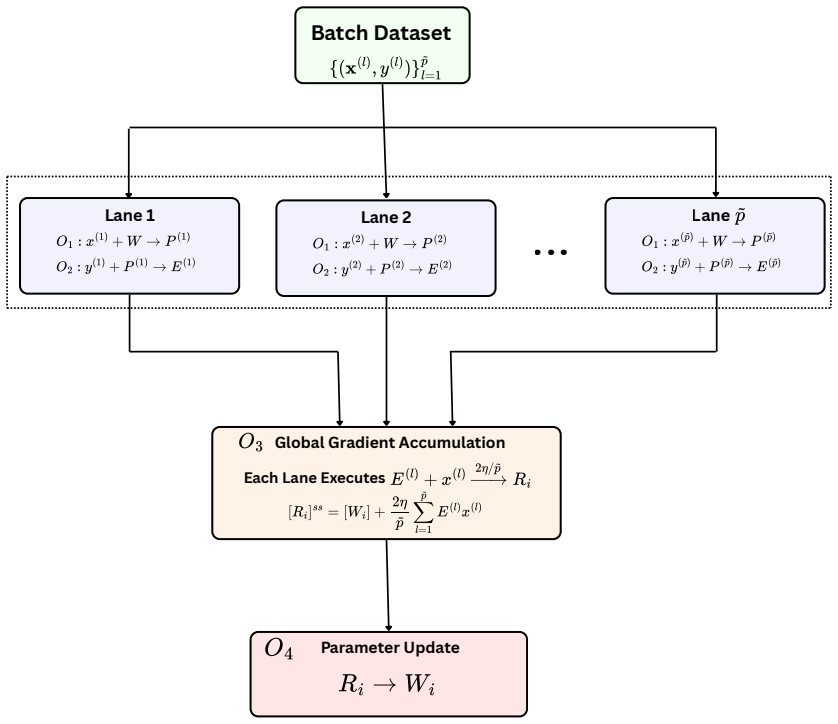
- Univariate linear regression is realized by mapping data and parameters to reaction rates and reading the result from a steady-state concentration.
- Multivariate linear regression follows the same encoding once the division module is available.
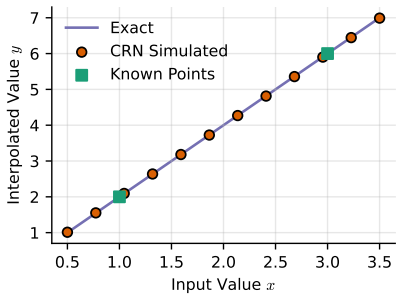
- Linear interpolation is obtained by an analogous network that solves for the interpolated value at steady state.
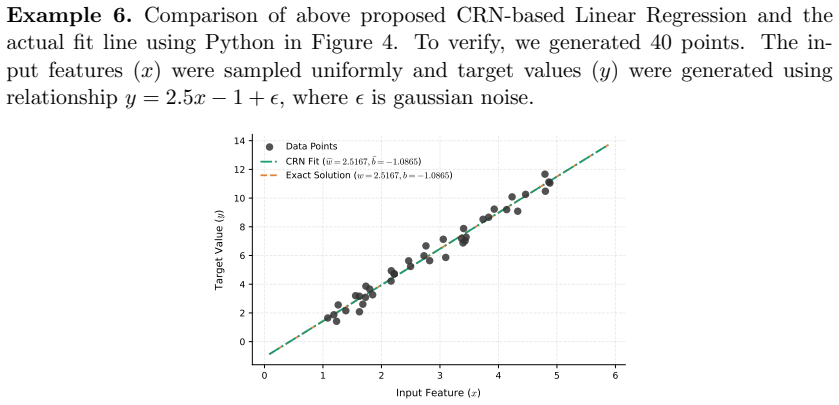
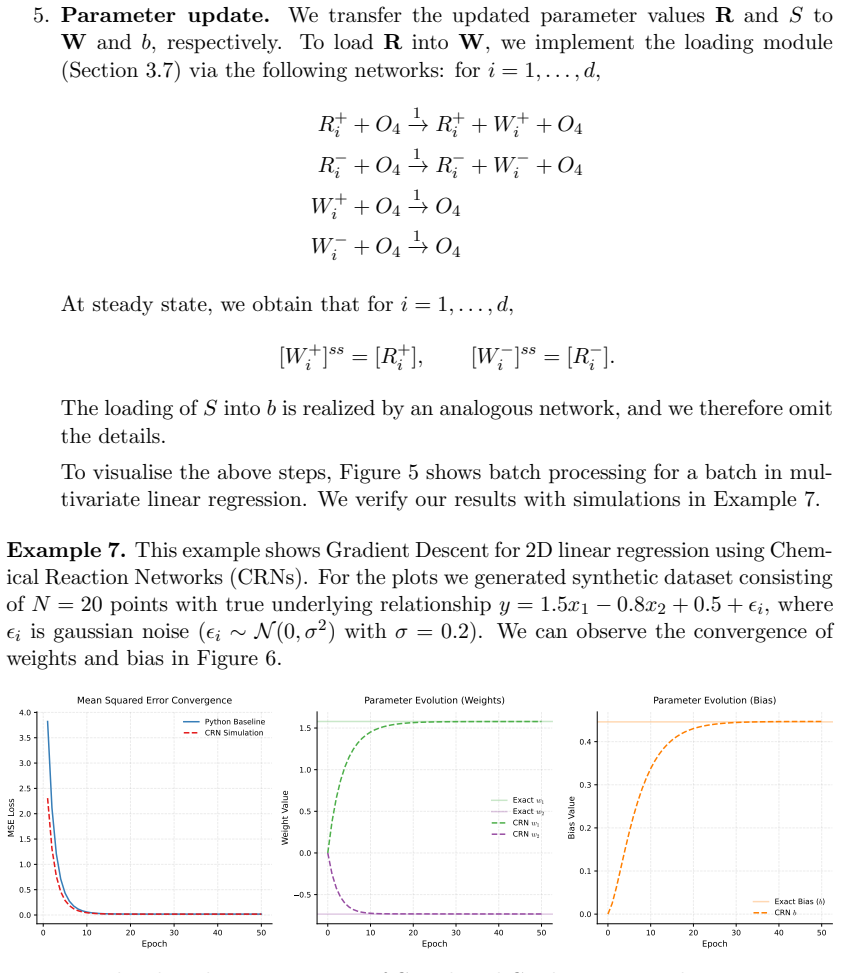
- Verification on synthetic data sets shows numerical agreement with ordinary least-squares calculations.
Where Pith is reading between the lines
- The same steady-state encoding could be tried for other arithmetic-heavy tasks such as basic clustering or simple classification.
- If the division module remains stable under noisy or time-varying inputs, the networks might function in fluctuating biological environments.
- Connecting the networks to real sensor molecules could allow direct chemical processing of experimental measurements.
Load-bearing premise
A reaction network can be built whose steady-state concentrations exactly reproduce arithmetic division for negative inputs without extra uncontrolled behavior or external tuning.
What would settle it
Construct or simulate the division module and test whether its steady-state output for a pair of negative inputs equals the exact quotient, or deviates when rate constants or initial conditions change.
Figures
read the original abstract
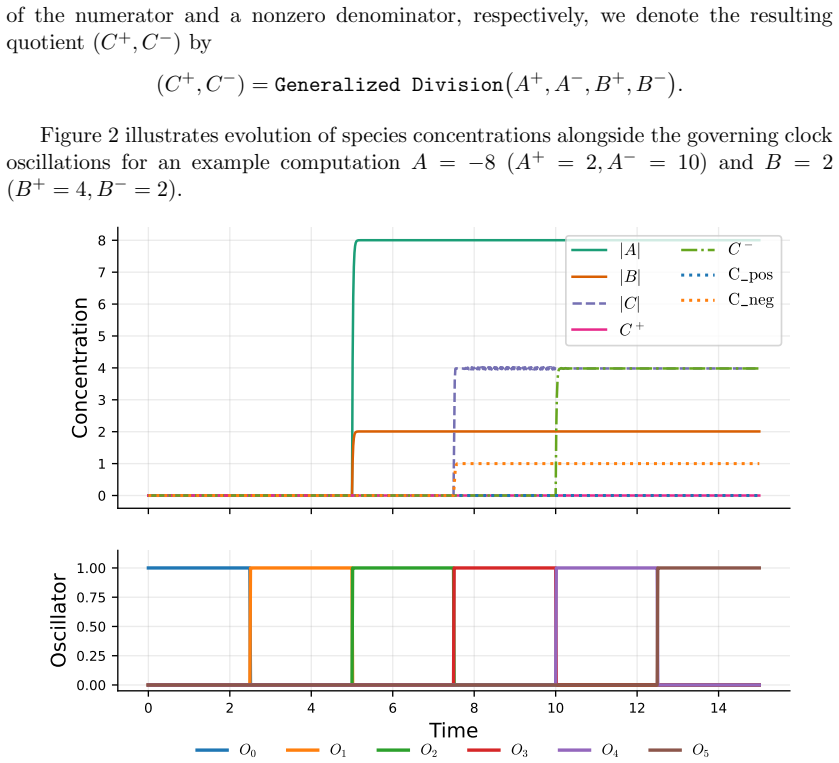
Performing statistical inference is an essential component of data science. Our focus in this work is on two inference techniques, viz. regression and interpolation. We propose a reaction network based approach that can implement linear regression (both univariate and multivariate) and linear interpolation. We do this by encoding the steady state concentration of species as the output of these inference techniques. Towards this, we use a novel generalized division module that can handle division of negative numbers. We verify our results by comparing them with in-silico implementation on standard synthetic datasets.
Editorial analysis
A structured set of objections, weighed in public.
Referee Report
Summary. The manuscript proposes implementing univariate and multivariate linear regression as well as linear interpolation via chemical reaction networks, with the steady-state concentrations of designated species encoding the fitted coefficients or interpolated values. A novel generalized division module is introduced to handle signed quantities (via non-negative species encoding), and the constructions are asserted to have been verified by comparison to standard in-silico implementations on synthetic datasets.
Significance. If the reaction-network constructions are shown to reach exact arithmetic steady states for the required operations, including division of negative numbers, the work would constitute a concrete biochemical realization of elementary statistical inference primitives. Such a result could be relevant to molecular computing and synthetic biology; however, the absence of any network diagrams, mass-action equations, or quantitative verification data prevents assessment of whether this potential is realized.
major comments (2)
- [Methods / Division Module] The central claim depends on a generalized division module that produces exact steady-state quotients for inputs that may be negative. No reaction list, mass-action ODEs, or equilibrium analysis is supplied to demonstrate that the difference of paired non-negative species converges to a/b independently of rate constants and initial conditions. This construction is load-bearing for both the regression and interpolation results.
- [Results] Verification is described only at the level of the abstract (comparison with in-silico implementations on synthetic datasets). No error metrics, concentration time-series, stability analysis, or tables comparing network steady states to arithmetic regression outputs appear in the results, making it impossible to evaluate whether the claimed exact encoding holds.
minor comments (1)
- [Methods] Notation for signed quantities (e.g., how positive and negative parts are represented by distinct species) is not introduced before being used in the division module description.
Simulated Author's Rebuttal
We thank the referee for the detailed and constructive report. The two major comments correctly identify that the current manuscript lacks explicit reaction lists, ODEs, equilibrium derivations, and quantitative verification data. We have revised the manuscript to supply these elements in full, strengthening the presentation of the generalized division module and the empirical validation.
read point-by-point responses
-
Referee: [Methods / Division Module] The central claim depends on a generalized division module that produces exact steady-state quotients for inputs that may be negative. No reaction list, mass-action ODEs, or equilibrium analysis is supplied to demonstrate that the difference of paired non-negative species converges to a/b independently of rate constants and initial conditions. This construction is load-bearing for both the regression and interpolation results.
Authors: We agree that the generalized division module requires explicit documentation. The revised manuscript now includes: (i) the complete reaction list for the module, (ii) the full mass-action ODE system, and (iii) the equilibrium analysis proving that the signed output species converge to the exact quotient a/b for any non-zero denominator, independent of rate constants (within the regime where all species remain non-negative) and initial conditions. The proof proceeds by setting the time derivatives to zero and solving the resulting algebraic system, confirming the steady-state encoding. revision: yes
-
Referee: [Results] Verification is described only at the level of the abstract (comparison with in-silico implementations on synthetic datasets). No error metrics, concentration time-series, stability analysis, or tables comparing network steady states to arithmetic regression outputs appear in the results, making it impossible to evaluate whether the claimed exact encoding holds.
Authors: We accept this observation. The revised Results section now contains: error metrics (maximum absolute deviation and relative error) across multiple synthetic datasets, representative concentration time-series plots demonstrating convergence to the arithmetic targets, a brief stability analysis around the computed equilibria, and side-by-side tables comparing the network steady-state values to the exact linear-regression and interpolation outputs. These additions confirm that the steady-state concentrations match the statistical results to machine precision under the tested conditions. revision: yes
Circularity Check
No significant circularity; construction is direct encoding via designed CRN modules
full rationale
The paper constructs reaction networks whose mass-action dynamics are engineered so that designated species' steady-state concentrations equal the outputs of linear regression or interpolation (including via a generalized division module for signed quantities). This is an explicit implementation claim, not a statistical fit to data that is then relabeled as a prediction, nor a self-definition where the target quantity is presupposed in the module definition. Verification proceeds by external comparison to standard in-silico regression on synthetic datasets, with no load-bearing self-citation chains, uniqueness theorems imported from the same authors, or ansatzes smuggled via prior work. The derivation chain therefore remains self-contained and does not reduce to its inputs by construction.
Axiom & Free-Parameter Ledger
Reference graph
Works this paper leans on
-
[1]
L. Adleman. Molecular computation of solutions to combinatorial problems.Sci- ence, pages 1021–1024, 1994
1994
-
[2]
Anderson, B
D. Anderson, B. Joshi, and A. Deshpande. On reaction network implementations of neural networks.J. R. Soc. Interface, 18(177):20210031, 2021
2021
-
[3]
Computing algebraic functions with biochemical reaction networks.Artif Life, 15(1):5–19, 2009
H J Buisman, H M M ten Eikelder, P A J Hilbers, and A M L Liekens. Computing algebraic functions with biochemical reaction networks.Artif Life, 15(1):5–19, 2009
2009
-
[4]
Cardelli and A
L. Cardelli and A. Csik´ asz-Nagy. The cell cycle switch computes approximate majority.Sci. Rep., 2(1):656, 2012. 28
2012
-
[5]
L. Ceze, J. Nivala, and K. Strauss. Molecular digital data storage using dna.Nat. Rev. Genet., May 2019
2019
-
[6]
H. Chen, D. Doty, and D. Soloveichik. Rate-independent computation in continuous chemical reaction networks. ITCS ’14, page 313–326, New York, NY, USA, 2014. Association for Computing Machinery. ISBN 9781450326988
2014
-
[7]
A. Choudhary, J. Jin, and A. Deshpande. Implementation of support vector ma- chines using reaction networks.https://arxiv.org/abs/2503.19115, 2025
arXiv 2025
-
[8]
Y. Fan, X. Zhang, C. Gao, and D. Dochain. Automatic implementation of neu- ral networks through reaction networks–part i: Circuit design and convergence analysis.arXiv preprint arXiv:2311.18313, 2023
arXiv 2023
-
[9]
Springer, 2019
Martin Feinberg.Foundations of chemical reaction network theory, volume 202 of Applied Mathematical Sciences. Springer, 2019
2019
-
[10]
Gines, A
G. Gines, A. J. Genot, and Y. Rondelez.Parallel Computations with DNA-Encoded Chemical Reaction Networks, pages 349–369. Springer Nature Singapore, Singa- pore, 2023. ISBN 978-981-19-9891-1
2023
-
[11]
Gopalkrishnan
M. Gopalkrishnan. A scheme for molecular computation of maximum likelihood estimators for log-linear models. InInternational Conference on DNA-Based Com- puters, pages 3–18. Springer, 2016
2016
-
[12]
Guldberg and P
C. Guldberg and P. Waage. Studies Concerning Affinity.CM Forhandlinger: Videnskabs-Selskabet I Christiana, 35(1864):1864, 1864
-
[13]
Gunawardena
J. Gunawardena. Chemical reaction network theory for in-silico biologists.Notes available for download at http://vcp. med. harvard. edu/papers/crnt. pdf, 2003
2003
-
[14]
Connah G. M. Johnson, Nicolas Bohm Agostini, William R. Cannon, and An- tonino Tumeo. Computing with a chemical reservoir. In2024 IEEE Inter- national Conference on Rebooting Computing (ICRC), pages 1–7, 2024. doi: 10.1109/ICRC64395.2024.10937022
-
[15]
Kenney and E
J. Kenney and E. Keeping. Linear regression and correlation.Math. Stat., 1: 252–285, 1962
1962
-
[16]
Biological robustness.Nat Rev Genet, 5(11):826–837, November 2004
Hiroaki Kitano. Biological robustness.Nat Rev Genet, 5(11):826–837, November 2004
2004
-
[17]
Kuznetsov.Elements of applied bifurcation theory
Y. Kuznetsov.Elements of applied bifurcation theory. Springer, 1998
1998
-
[18]
R. Pei, E. Matamoros, M. Liu, D. Stefanovic, and M. Stojanovic. Training a molecular automaton to play a game.Nat. Nanotechnol., 5(11):773, 2010
2010
-
[19]
Shang, C
Z. Shang, C. Zhou, and Q. Zhang. Chemical reaction networks programming for solving equations.Curr. Issues Mol. Biol., 44(4):1725–1739, 2022. ISSN 1467-3045. 29
2022
-
[20]
Simmel, B
F. Simmel, B. Yurke, and H. Singh. Principles and applications of nucleic acid strand displacement reactions.Chem. Rev., 119(10):6326–6369, 2019
2019
-
[21]
Strogatz.Nonlinear dynamics and chaos: with applications to physics, biology, chemistry, and engineering
S. Strogatz.Nonlinear dynamics and chaos: with applications to physics, biology, chemistry, and engineering. Chapman and Hall/CRC, 2024
2024
-
[22]
Vasi´ c, D
M. Vasi´ c, D. Soloveichik, and S. Khurshid. CRN++: Molecular programming language.Nat. Comput., 19(2):391–407, 2020
2020
-
[23]
Levinthal’s paradox.Proceedings of the National Academy of Sciences, 89(1):20–22, 1992
R Zwanzig, A Szabo, and B Bagchi. Levinthal’s paradox.Proceedings of the National Academy of Sciences, 89(1):20–22, 1992. 30
1992
discussion (0)
Sign in with ORCID, Apple, or X to comment. Anyone can read and Pith papers without signing in.