High-p_(rm T) physics and jet production
Pith reviewed 2026-06-26 18:47 UTC · model grok-4.3
The pith
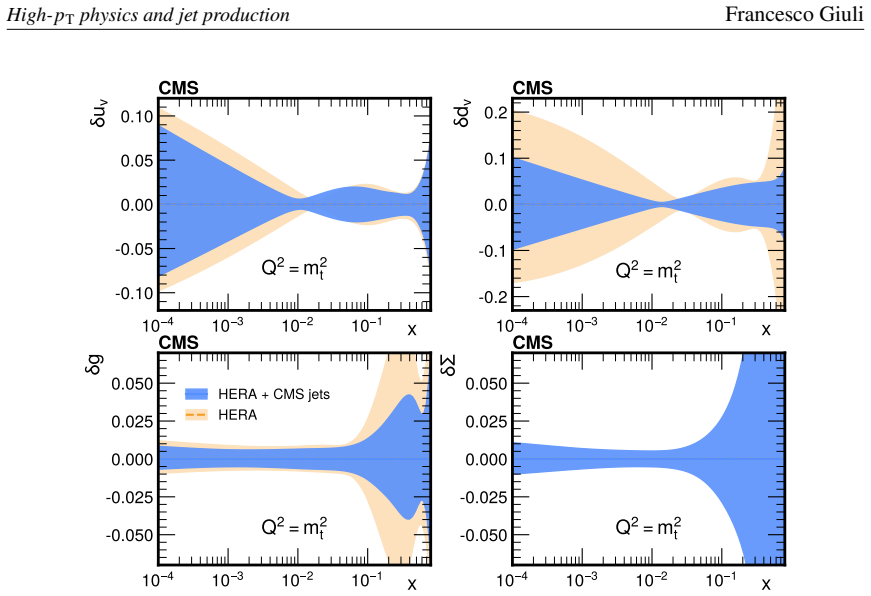
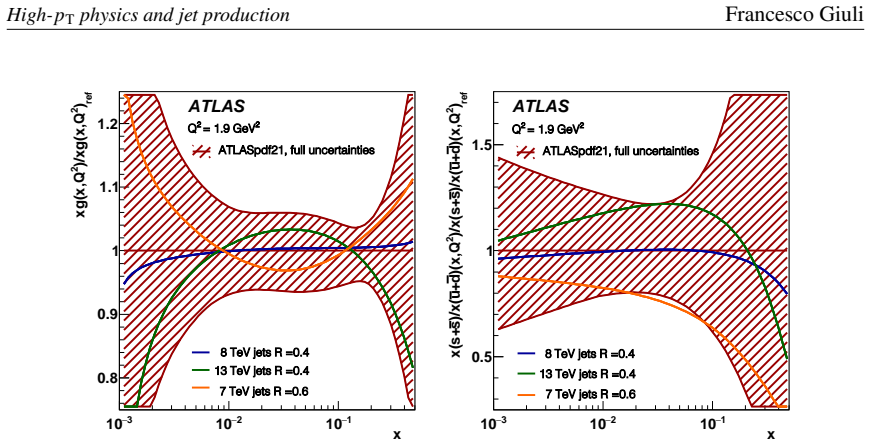
Inclusive jet measurements from CMS and ATLAS constrain the gluon distribution at large Bjorken x and enable extractions of α_s(m_Z) compatible with the world average.
A machine-rendered reading of the paper's core claim, the machinery that carries it, and where it could break.
Core claim
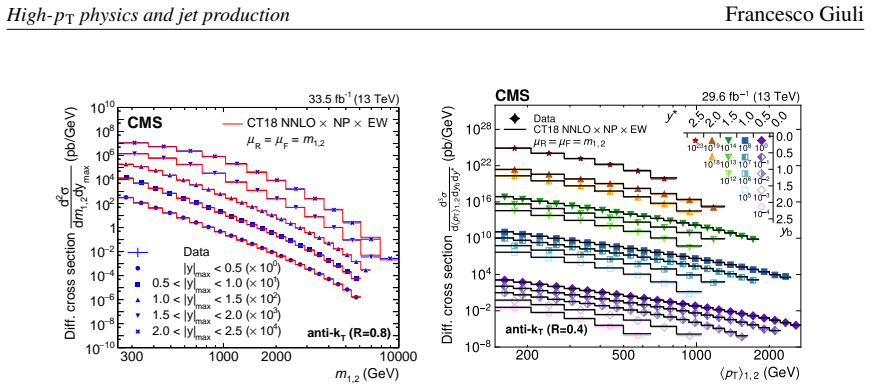
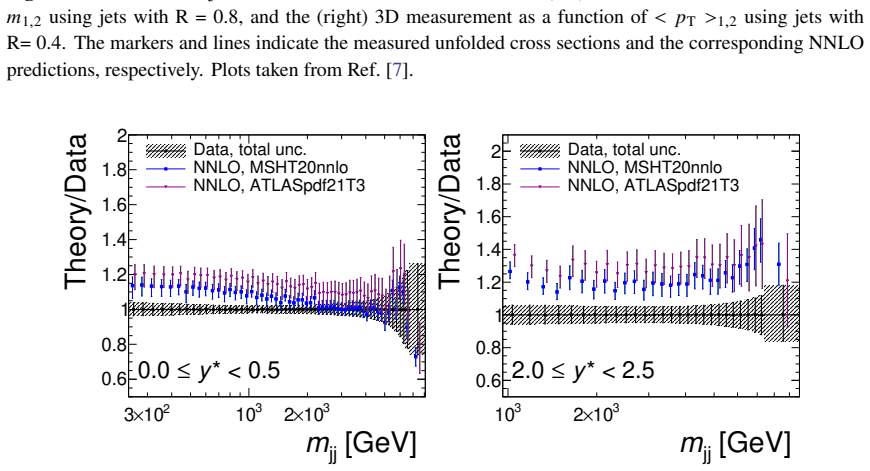
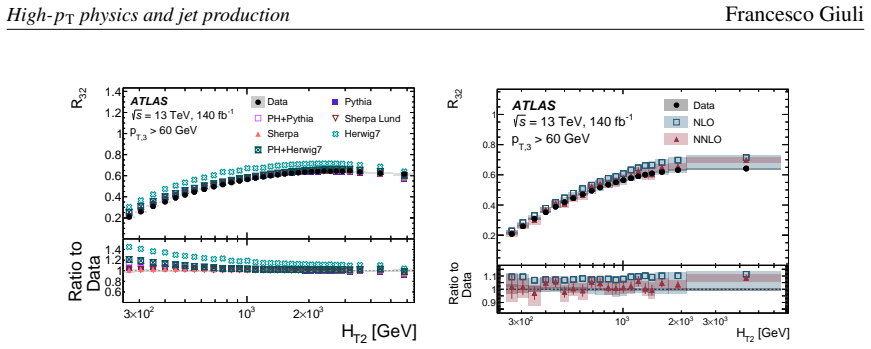
Jet production is the dominant high-p_T process at hadron colliders and serves as a central testing ground for perturbative QCD, parton distribution functions and determinations of the strong coupling. Inclusive jet measurements from CMS and ATLAS constrain the gluon distribution at large Bjorken x and enable extractions of α_s(m_Z) compatible with the world average. Dijet measurements supply complementary sensitivity through the dijet invariant mass, rapidity separation and longitudinal boost, while ratios of inclusive jet multiplicities reduce several experimental and PDF uncertainties and directly probe additional QCD radiation.
What carries the argument
Comparison of measured inclusive jet cross sections, dijet kinematics and multiplicity ratios to NNLO perturbative QCD predictions after inclusion of non-perturbative and electroweak corrections.
If this is right
- The gluon distribution is constrained at large Bjorken x, improving global PDF fits used for high-energy predictions.
- Extractions of α_s(m_Z) from inclusive jets are compatible with the world average.
- Dijet observables provide complementary sensitivity to the gluon through invariant mass, rapidity separation and boost.
- Ratios of jet multiplicities suppress experimental and PDF uncertainties while probing additional QCD radiation.
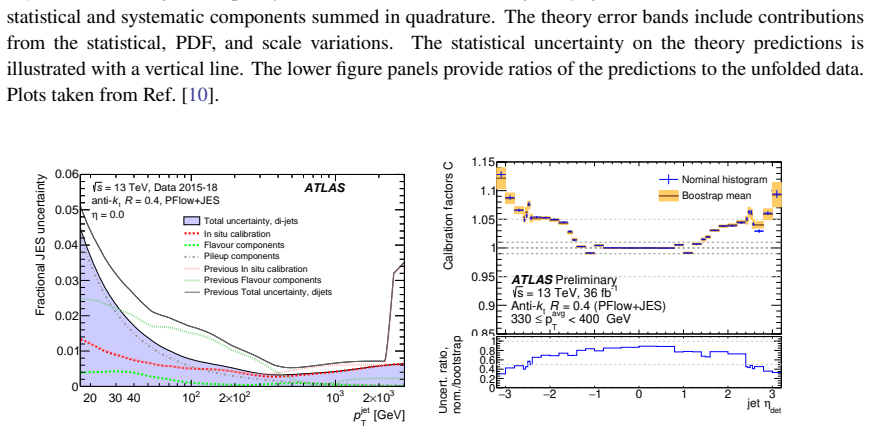
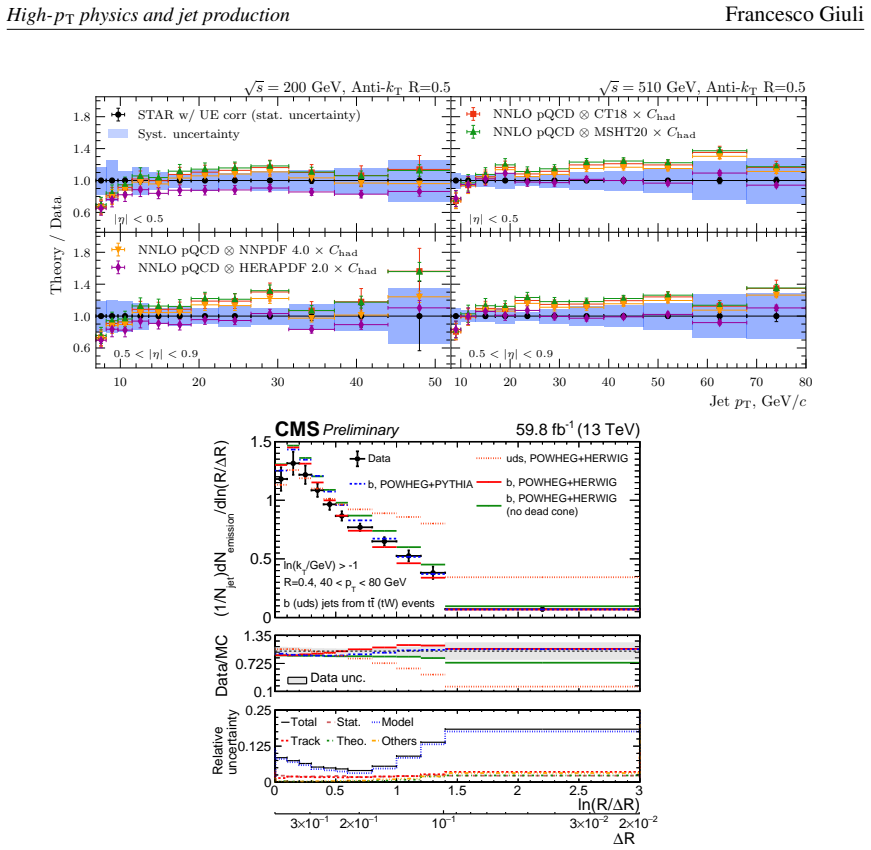
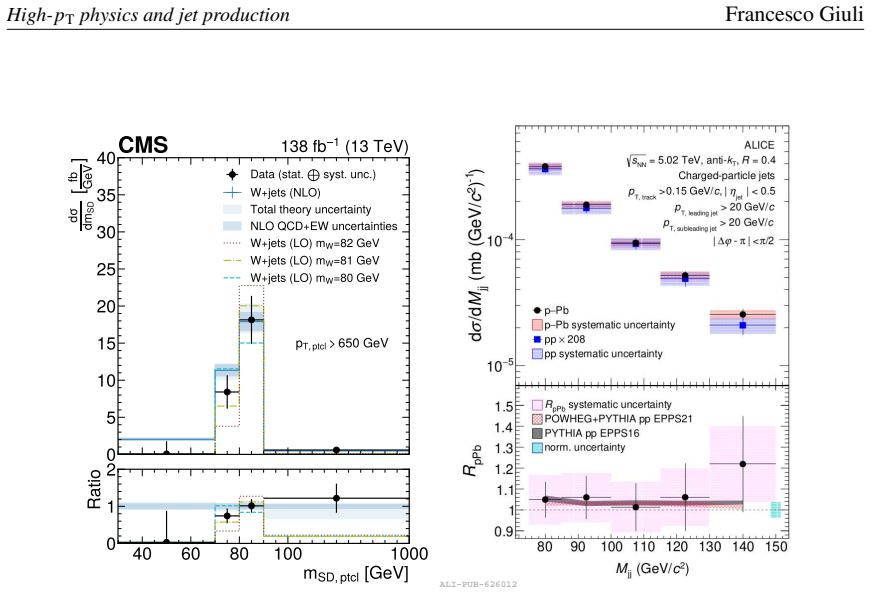
- Recent jet-energy calibration progress and substructure results from RHIC, ALICE and CMS support applications in Run 3 and future global analyses.
Where Pith is reading between the lines
- These high-x gluon constraints could affect predictions for processes such as high-mass vector-boson production where the gluon density enters at large momentum fractions.
- Integration of the LHC jet results with lower-energy data from RHIC may extend the kinematic range covered by global PDF determinations.
- Jet substructure measurements could supply independent tests of the modelling of QCD radiation that go beyond inclusive rate observables.
Load-bearing premise
Next-to-next-to-leading-order perturbative QCD predictions, after inclusion of non-perturbative and electroweak corrections, accurately describe the measured jet observables without large unaccounted systematic effects.
What would settle it
An extraction of α_s(m_Z) from the jet data that differs from the world average by more than the combined experimental and theoretical uncertainties would indicate that the theoretical description or the treatment of systematic effects requires revision.
Figures
read the original abstract
Jet production is the dominant high-$p_{\rm T}$ process at hadron colliders and provides a central testing ground for perturbative QCD, parton distribution functions and determinations of the strong coupling. This contribution summarises recent measurements of inclusive-jet, dijet and jet-multiplicity observables presented at DIS2026, with emphasis on the interplay between experimental precision, next-to-next-to-leading-order predictions, non-perturbative and electroweak corrections, and the treatment of correlated systematic uncertainties. Inclusive jet measurements from CMS and ATLAS constrain the gluon distribution at large Bjorken $x$ and enable extractions of $\alpha_s(m_Z)$ compatible with the world average. Dijet measurements provide complementary sensitivity through the dijet invariant mass, rapidity separation and longitudinal boost, while ratios of inclusive jet multiplicities reduce several experimental and PDF uncertainties and directly probe additional QCD radiation. Recent progress in jet-energy calibration, together with new results from RHIC, ALICE and CMS on jet substructure and heavy-quark radiation, illustrates the breadth of current high-$p_{\rm T}$ jet physics and its relevance for Run~3 and future global PDF analyses.
Editorial analysis
A structured set of objections, weighed in public.
Referee Report
Summary. This conference summary contribution reviews recent inclusive-jet, dijet, and jet-multiplicity measurements from CMS, ATLAS, ALICE, and RHIC presented at DIS2026. It highlights the interplay of experimental precision with NNLO pQCD predictions (including non-perturbative and electroweak corrections), the treatment of correlated systematics, and the resulting constraints on the gluon PDF at large Bjorken x together with α_s(m_Z) extractions that are compatible with the world average. Complementary sensitivities from dijet mass, rapidity separation, and multiplicity ratios are noted, along with progress in jet-energy calibration and substructure observables.
Significance. If the reported experimental results and their interpretation hold, the summary usefully consolidates the current status of high-p_T jet physics for the PDF and QCD community. It explicitly credits the constraining power of published CMS/ATLAS inclusive-jet data on the gluon distribution and the consistency of α_s determinations, which directly informs global fits and Run-3 planning. As a proceedings contribution it adds no new derivation but provides a concise, referenced overview that can aid readers tracking the interplay between data and theory.
minor comments (1)
- The abstract and summary refer to 'DIS2026' without a footnote or reference clarifying whether this is a future or hypothetical conference; a brief clarification would aid readers.
Simulated Author's Rebuttal
We thank the referee for the positive assessment of our conference summary contribution and the recommendation to accept. The referee's summary accurately reflects the manuscript's content and purpose.
Circularity Check
No circularity: summary of external measurements only
full rationale
The document is a conference summary contribution that reports published CMS and ATLAS inclusive-jet, dijet and multiplicity results together with existing NNLO pQCD calculations. No new derivations, fits, parameters or predictions are introduced inside the paper; all central claims (gluon PDF constraints at large x, α_s(m_Z) compatibility) are presented as direct consequences of those external measurements. No equations, self-citations or ansätze appear that could reduce any statement to its own inputs by construction. The text is therefore self-contained against external benchmarks.
Axiom & Free-Parameter Ledger
Reference graph
Works this paper leans on
-
[1]
CMSCollaboration,“MeasurementandQCDanalysisofdouble-differentialinclusivejetcross sections in proton-proton collisions at√𝑠=13TeV”, JHEP02(2022) 142; Addendum JHEP 12(2022) 035, arXiv:2111.10431
arXiv 2022
-
[2]
Determinationofthestrongcouplinganditsrunningfrommeasurements of inclusive jet production
CMSCollaboration,“Determinationofthestrongcouplinganditsrunningfrommeasurements of inclusive jet production”, Phys. Lett. B868(2025) 139651, arXiv:2412.16665
arXiv 2025
-
[3]
H1andZEUSCollaborations,“Combinationofmeasurementsofinclusivedeepinelastic𝑒 ± 𝑝 scattering cross sections and QCD analysis of HERA data”, Eur. Phys. J. C75(2015) 580, arXiv:1506.06042
Pith/arXiv arXiv 2015
-
[4]
ATLASCollaboration,“Determinationofthepartondistributionfunctionsoftheprotonusing diverse ATLAS data from𝑝 𝑝collisions at√𝑠=7, 8 and 13 TeV”, Eur. Phys. J. C82(2022) 438, arXiv:2112.11266
arXiv 2022
-
[5]
xFitter 2.0.0: an open source QCD fit framework
xFitter Developers’ Team, “xFitter 2.0.0: an open source QCD fit framework”, PoS DIS2017 (2018) 203, arXiv:1709.01151
Pith/arXiv arXiv 2018
-
[6]
ATLAS Collaboration, “Measurement of the inclusive jet cross-sections in proton-proton collisionsat √𝑠=8TeVwiththeATLASdetector”, JHEP09(2017)020, arXiv:1706.03192
Pith/arXiv arXiv 2017
-
[7]
CMS Collaboration, “Measurement of multidifferential cross sections for dijet production in proton-proton collisions at√𝑠=13TeV”, Eur. Phys. J. C85(2025) 72, arXiv:2312.16669
arXiv 2025
-
[8]
ATLASCollaboration,“Measurementofinclusivejetanddijetcross-sectionsinproton-proton collisionsat √𝑠=13TeVwiththeATLASdetector”,JHEP05(2018)195,arXiv:1711.02692
Pith/arXiv arXiv 2018
-
[9]
ATLASCollaboration,“Measurementofinclusivedijetcross-sectionsinproton-protoncolli- sions at√𝑠=13TeV with the ATLAS detector”, arXiv:2512.19073
-
[10]
Measurements of jet cross-section ratios in 13 TeV proton-proton collisions with ATLAS
ATLAS Collaboration, “Measurements of jet cross-section ratios in 13 TeV proton-proton collisions with ATLAS”, Phys. Rev. D110(2024) 072019, arXiv:2405.20206
arXiv 2024
-
[11]
ATLAS Collaboration, “A precise measurement of the jet energy scale derived from single- particle measurements andin situtechniques inproton-proton collisionsat√𝑠=13TeVwith the ATLAS detector”, Eur. Phys. J. C85(2025) 927, arXiv:2407.15627
arXiv 2025
-
[12]
Evaluating the statistical uncertainties and statistical consistency of constraints for the jet𝜂-intercalibration in ATLAS
ATLAS Collaboration, “Evaluating the statistical uncertainties and statistical consistency of constraints for the jet𝜂-intercalibration in ATLAS”, ATL-PHYS-PUB-2025-027
2025
-
[13]
Inclusive jetcross section in𝑝 𝑝collisions at√𝑠=200and 510 GeV
STAR Collaboration, “Inclusive jetcross section in𝑝 𝑝collisions at√𝑠=200and 510 GeV”, arXiv:2603.28695
-
[14]
Evidence of the dead-cone effect in bottom quark initiated jets
CMS Collaboration, “Evidence of the dead-cone effect in bottom quark initiated jets”, CMS- PAS-SMP-25-008 (2026). 10 High-𝑝 T physics and jet productionFrancesco Giuli
2026
-
[15]
CMS Collaboration, “Measurement of the jet mass in hadronic decays of boosted W bosons at 13 TeV and extraction of the W boson mass”, arXiv:2603.19963
-
[16]
Dijetinvariantmassofcharged-particlejetsinppandp–Pbcollisions at √𝑠NN =5.02TeV
ALICECollaboration,“Dijetinvariantmassofcharged-particlejetsinppandp–Pbcollisions at √𝑠NN =5.02TeV”, arXiv:2604.07961. 11
discussion (0)
Sign in with ORCID, Apple, or X to comment. Anyone can read and Pith papers without signing in.