REVIEW 4 major objections 5 minor 21 references
FollowUpBot: An LLM-Based Conversational Robot for Automatic Postoperative Follow-up
T0 review · 4 major / 5 minor · reviewed 2026-08-06 · deepseek-v4-flash
Pith's one-line read This paper claims that FollowUpBot, an edge-deployed LLM robot, automates postoperative follow-up end-to-end and, in GPT-4o-simulated dialogues, covers every required symptom and generates structured reports with high field-level accuracy.
desk verdict A coherent integration of known components whose headline performance figures are trapped in a GPT-4o-generated closed loop, plus a real-deployment claim with no numbers behind it. read the letter →
The pith
A machine-rendered reading of the paper's core claim, the machinery that carries it, and where it could break.
The reading
What carries the argument
The load-bearing mechanism is the field-tracking pipeline: a prioritized list of report fields, each with a label, type, and description, drives the conversation, and a report LLM extracts values from the dialogue while an NLI cross-encoder (nli-deberta-v3-base) maps free-form answers to the closest predefined option by entailment score. This converts an open-ended LLM conversation into a format-strict structured report, and the ablation table shows that it is the main source of accuracy.
What would settle it
Take the robot's field-tracking and NLI pipeline and apply it to transcripts of real postoperative follow-up conversations collected independently of the field list; if single-choice accuracy on those transcripts falls well below 91% or the robot never asks about symptoms a patient spontaneously reports, the synthetic evaluation overstates real-world readiness.
Extended reading notes
Core claim
The central claim is that a fully automated, on-device conversational robot can handle structured postoperative follow-up end-to-end without sending patient data to the cloud. FollowUpBot tracks a prioritized list of follow-up fields, prompts each in turn with an edge-deployed medical LLM, accepts speech, touch, or text input, verifies free-form answers against valid options with an NLI cross-encoder, and writes the results into the hospital's report template. In the authors' evaluation, the modular pipeline is what makes report generation work: adding NLI raises single-choice accuracy from 18.48% to 82.16%, and adding explicit field tracking raises it further to 91.44%, while numerical accuracy reaches 99.20%. The authors interpret these results as evidence that LLM-based follow-up robots can be both complete in symptom coverage and accurate in documentation.
Load-bearing premise
The evaluation assumes that GPT-4o, used to create the patient profiles and to play the patient's role and rate satisfaction, behaves like real postoperative patients well enough that the robot's 100% coverage and accuracy numbers transfer to a hospital ward.
Editorial extensions
If this is right
- A hospital could assign routine bedside follow-up to the robot without sending patient data to the cloud, freeing nurses for higher-acuity work.
- The field-tracking plus NLI pipeline can be reused for any structured clinical form where free-form dialogue must become typed entries.
- The ablation results identify exactly which components are needed for high report accuracy: field descriptions, NLI verification, and explicit field tracking.
- Because the robot accepts speech, touch, and text, it can accommodate patients whose pain, weakness, or sedation makes one modality unusable.
Reading between the lines
- The 100% coverage number likely depends on the fact that the simulated patient profiles were built from the same field template the robot is designed to ask about; an independent test with real patient dialogues is the natural next step.
- The NLI-based normalization result suggests a general recipe for making LLM output conform to rigid medical forms, applicable beyond follow-up to admission notes, discharge summaries, and other structured documentation.
- The paper says the robot completed real-patient follow-ups but reports no data from those encounters; publishing those records would let readers check whether the synthetic results survive contact with real ward conversations.
- An unmeasured cost is edge-computing overhead: on-device LLM inference latency and energy use would determine whether the privacy benefit is practical at ward scale.
Editorial analysis
A structured set of objections, weighed in public.
Referee Report
Summary. The paper presents FollowUpBot, an LLM-based mobile robot for postoperative in-hospital follow-up, integrating three modules: automatic navigation to patient beds, a multimodal and privacy-preserving follow-up dialogue system using edge-deployed LLMs, and automatic generation of structured postoperative reports. The evaluation is carried out on a synthetic dataset of 100 postoperative cases generated by GPT-4o, with GPT-4o also simulating patient responses and satisfaction ratings. The authors report 100% symptom coverage, higher satisfaction than a WiNGPT2 prompting-only baseline, and report-generation accuracies of 91.44% on single-choice fields, 99.20% on numerical fields, and 0.8513 BERTScore F1 on text fields (Table I). A single sentence in Section V states that the robot was deployed and tested with real patients in Guangdong Provincial People's Hospital, but no data from that deployment are reported.
Significance. If the performance claims were established through independent validation, FollowUpBot would be a useful systems contribution: it combines physical navigation, edge-deployed privacy-preserving LLM interaction, field tracking, and template-based report generation in a way that addresses real operational concerns in postoperative care. The modular design is reasonable, the ablation study provides evidence that NLI-based answer verification and explicit field tracking improve report formatting, and the demonstration video and interface figures help convey the system's intended workflow. However, the current quantitative evidence is not convincing as a clinical evaluation because every headline metric is produced inside a closed GPT-4o loop: the same model creates the patient profiles, the dialogues, the ground-truth reports, and the satisfaction scores. The coverage metric is also close to tautological given that the robot's field-tracking mechanism sequentially queries the very template that was used to construct the simulated patients. For these reasons, the significance of the reported numbers for real-world clinical adoption is currently limited.
major comments (4)
- [Section V] The quantitative evaluation is entirely self-referential: GPT-4o generates the 100 patient profiles and the field-level annotated dialogues, GPT-4o simulates the patient during follow-up, and GPT-4o also assesses patient satisfaction. There is no human or clinician annotation of the ground-truth reports, no independent verification of coverage, and no validated satisfaction instrument. As a result, the reported coverage, satisfaction, and report-accuracy numbers do not establish performance on real postoperative patients. The authors should add human expert annotation of generated reports, clinician assessment of coverage, and a validated satisfaction measure, or clearly re-scope the claims as a synthetic feasibility study.
- [Section V-A and Section III-C] The 100% coverage result is nearly tautological. The robot maintains a prioritized list of follow-up fields from the hospital's template and marks each field completed after querying it, while the GPT-4o-generated patient profiles and dialogues are constructed from the same field template. Thus the metric mainly verifies that the state machine enumerates its own pre-defined field list, not that clinically meaningful symptoms were correctly elicited from realistic, possibly non-cooperative patients. The coverage metric should be defined against an independent set of clinically required symptoms, applied to dialogues that include symptoms outside the template, and evaluated on real patient interactions.
- [Section V] The one-sentence real-deployment claim ('deployed and tested in Guangdong Provincial People's Hospital... completed automatic follow-up with real patients') provides no sample size, completion rate, outcome data, or ethics/consent details. As written, this assertion cannot serve as external validation and should either be substantiated with quantitative deployment results or removed from the paper's claims.
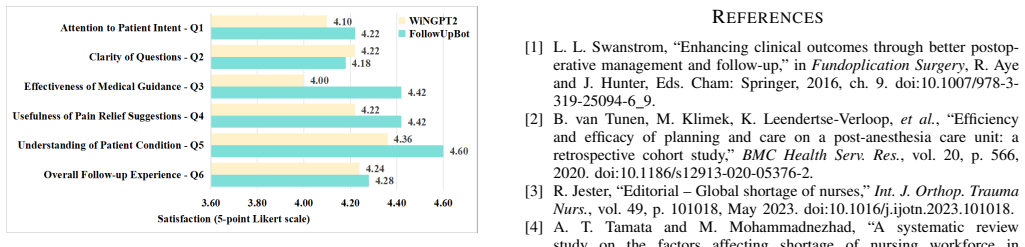
- [Table I and Figure 4] All quantitative results are presented as point estimates: Table I reports averages over five repeats without variance, confidence intervals, or statistical significance tests, and Figure 4 shows satisfaction scores without error bars. Given that the satisfaction ratings come from the same GPT-4o simulator used to generate the dialogues, the authors must report variability and significance tests before claiming that FollowUpBot outperforms the WiNGPT2 baseline.
minor comments (5)
- [Abstract and Section IV] The demonstration URL appears as 'watch?v= uFgDO7NoK0' with a space; this is likely a typo and should be corrected to the valid YouTube URL.
- [Section V-B and Table I] The text reports '0.8512 BERTScore F1' for text fields, while Table I reports 0.8513; these should be made consistent.
- [Figure 4] The six satisfaction aspects included in Figure 4 are not enumerated in the text or caption; the authors should define them explicitly.
- [References] Reference [13] appears to contain a dangling citation to 'Surg. Innov., vol. 30, no. 1, pp. 45–52, 2023' that is not connected to the main article; the bibliography should be cleaned up.
- [Section V-A] The baseline is referred to as 'WiNGPT2' and 'WiNGPT2-Llama-3-8B-Chat' without a precise description of the prompting-only setup used in the comparison; the authors should specify the prompt template and model version.
Circularity Check
Headline metrics are produced inside a closed GPT-4o loop: 100% coverage is forced by a field-tracking state machine that exhausts the same template used to construct the synthetic patients, satisfaction is GPT-4o rating its own simulated patients, and report 'accuracy' is Llama agreeing with GPT-4o-generated ground truth.
-
self definitional
[Section III-A, III-C and Section V-A]
"It maintains a prioritized list of follow-up fields (e.g., headache, dizziness, nausea) and queries each field sequentially using a local medical LLM. ... The robot maintains a list of fields from the hospital’s follow-up template ... It dynamically selects the next unfilled field and guides the medical LLM to elicit patient responses. ... Coverage measures the proportion of clinically required symptoms addressed during the dialogue. Our robot achieves 100% coverage, while WiNGPT2 only covers 53.8%."
Coverage is defined as the proportion of clinically required symptoms addressed, and the robot's control flow is to iterate over the hospital template's field list, marking each field completed until none remain. The synthetic GPT-4o-generated cases contain field-level annotations and structured reports built around the same follow-up fields (headache, dizziness, nausea, etc.). A state machine that sequentially queries a finite list and does not stop until the list is empty will always score 100% on that list; WiNGPT2's 53.8% merely reflects the absence of such a loop. Thus the headline 100% coverage is true by construction rather than an empirical finding about clinically meaningful symptom elicitation.
-
other
[Section V-A and Figure 4]
"To evaluate follow-up quality, we simulate patient interactions using GPT-4o based on 100 patient profiles. ... Satisfaction is assessed after each dialogue by the simulator across six aspects on a 5-point Likert scale."
The same GPT-4o that generates the 100 patient profiles and plays the patient in the simulated dialogues also rates satisfaction, since the 'simulator' is GPT-4o. No human patients, clinicians, or validated satisfaction instruments are involved. The reported satisfaction advantage is therefore a self-evaluation: the model that defines the patient's behavior also defines the patient's preferences. This does not transfer to real postoperative patients and is not an independent outcome; it is the generator grading its own interaction.
1 more flagged steps
-
other
[Section V-B and Table I]
"To quantitatively evaluate robot components, we constructed a synthetic dataset of 100 postoperative follow-up cases using GPT-4o. Each case includes a patient profile, a multi-turn dialogue with field-level annotations, and a structured report. ... a report LLM (Llama-3.1-8B) extracts field values from dialogue content. ... NLI alignment significantly improves accuracy, especially for structured fields."
The ground-truth reports used to score Table I are the 'structured report' generated by GPT-4o as part of the synthetic dataset, while the dialogues being mined are also GPT-4o-generated. The reported 91.44% choice accuracy, 99.20% numerical accuracy, and 0.8513 BERTScore F1 therefore measure how well Llama-3.1-8B agrees with GPT-4o's own annotations inside a closed generation loop, not accuracy against independent clinical records or clinician-verified ground truth. The paper presents this as 'report generation accuracy,' but the evidential chain for the labels is self-contained: the same model writes both the input dialogue and the reference report.
full rationale
The circularity is concentrated in the evaluation, not in the system construction. Step 1 is the clearest instance: coverage is defined over the same finite field list that the robot's controller is designed to enumerate exhaustively, and the GPT-4o-generated cases inherit that list, so 100% coverage is achieved by construction. Steps 2 and 3 show the same closed GPT-4o loop for the other two headline metrics: the model that plays the patient also grades satisfaction, and the model that generates the dialogues also generates the ground-truth structured reports used to score extraction. The deployment sentence in Section V ('FollowUpBot was deployed and tested in Guangdong Provincial People’s Hospital, where it successfully navigated real inpatient wards and completed automatic follow-up with real patients') supplies no sample size, completion rate, outcomes, or consent details, so it cannot break the loop or serve as external validation. No load-bearing self-citation chain is present; the co-authored edge-computing citation [11] is background and does not carry the quantitative claims. The report extraction module has genuine algorithmic content (NLI and Llama-3.1-8B) and could score low on a truly independent, clinician-annotated corpus, which is why the score is 6 rather than higher.
Assumptions & free parameters
assumptions (4)
- domain assumption Edge deployment of the LLM ensures patient data privacy.
- domain assumption GPT-4o simulated patients approximate real postoperative patient behavior.
- domain assumption The hospital follow-up template and field list are clinically complete and correct.
- domain assumption NLI entailment scores correctly map free-form answers to predefined report options.
Cite this review
Pith. "Pith review of FollowUpBot: An LLM-Based Conversational Robot for Automatic Postoperative Follow-up." pith.science (2026). https://pith.science/paper/ELQZTEN6
@misc{pith2026250715502,
  author       = {Pith},
  title        = {Pith review of: FollowUpBot: An LLM-Based Conversational Robot for Automatic Postoperative Follow-up},
  year         = {2026},
  howpublished = {\url{https://pith.science/paper/ELQZTEN6}},
  note         = {Machine review of arXiv:2507.15502}
}
read the original abstract
Postoperative follow-up plays a crucial role in monitoring recovery and identifying complications. However, traditional approaches, typically involving bedside interviews and manual documentation, are time-consuming and labor-intensive. Although existing digital solutions, such as web questionnaires and intelligent automated calls, can alleviate the workload of nurses to a certain extent, they either deliver an inflexible scripted interaction or face private information leakage issues. To address these limitations, this paper introduces FollowUpBot, an LLM-powered edge-deployed robot for postoperative care and monitoring. It allows dynamic planning of optimal routes and uses edge-deployed LLMs to conduct adaptive and face-to-face conversations with patients through multiple interaction modes, ensuring data privacy. Moreover, FollowUpBot is capable of automatically generating structured postoperative follow-up reports for healthcare institutions by analyzing patient interactions during follow-up. Experimental results demonstrate that our robot achieves high coverage and satisfaction in follow-up interactions, as well as high report generation accuracy across diverse field types. The demonstration video is available at https://www.youtube.com/watch?v=_uFgDO7NoK0.
Figures


Figures from the paper (1 more)
Reference graph
Works this paper leans on
-
[1]
Enhancing clinical outcomes through better postop- erative management and follow-up,
L. L. Swanstrom, “Enhancing clinical outcomes through better postop- erative management and follow-up,” in Fundoplication Surgery, R. Aye and J. Hunter, Eds. Cham: Springer, 2016, ch. 9. doi:10.1007/978-3- 319-25094-6 9
doi:10.1007/978-3- 2016
-
[2]
B. van Tunen, M. Klimek, K. Leendertse-Verloop, et al. , “Efficiency and efficacy of planning and care on a post-anesthesia care unit: a retrospective cohort study,” BMC Health Serv. Res. , vol. 20, p. 566,
-
[3]
Editorial – Global shortage of nurses,
R. Jester, “Editorial – Global shortage of nurses,” Int. J. Orthop. Trauma Nurs., vol. 49, p. 101018, May 2023. doi:10.1016/j.ijotn.2023.101018
-
[4]
A systematic review study on the factors affecting shortage of nursing workforce in the hospitals,
A. T. Tamata and M. Mohammadnezhad, “A systematic review study on the factors affecting shortage of nursing workforce in the hospitals,” Nurs. Open , vol. 10, no. 3, pp. 1247–1257, 2023. doi:10.1002/nop2.1434
-
[5]
M. He, M. Chen, Y . Ji, and G. Lu, “Effectiveness of smartphone app- based interventions after surgery on quality of recovery among cancer patients: a systematic review and meta-analysis,” Ann. Med., vol. 56, no. 1, p. 2390167, 2024. doi:10.1080/07853890.2024.2390167
arXiv 2024
-
[6]
Wearable devices for patient monitoring in the early postoperative period: a liter- ature review,
T. Amin, R. J. Mobbs, N. Mostafa, L. W. Sy, and W. J. Choy, “Wearable devices for patient monitoring in the early postoperative period: a liter- ature review,” Mhealth, vol. 7, p. 50, Jul. 2021. doi:10.21037/mhealth- 20-131
-
[7]
T. Dwyer, G. Hoit, D. Burns, J. Higgins, J. Chang, D. Whelan, I. Kiroplis, and J. Chahal, “Use of an artificial intelligence conversational agent (chatbot) for hip arthroscopy patients following surgery,”Arthrosc. Sports Med. Rehabil., vol. 5, Mar. 2023. doi:10.1016/j.asmr.2023.01.020
-
[8]
Data security and data protection in cloud privacy systems,
H. Kapoh, P. Aprilyana, Y . Sumampow, M. Mailake, F. Manimpurung, and H. Pakaya, “Data security and data protection in cloud privacy systems,” J. Syntax Admiration , vol. 5, no. 11, pp. 4801–4809, 2024. doi:10.46799/jsa.v5i11.1768
Show all 21 references
-
[9]
An analysis of the cloud computing security problem,
M. Almorsy, J. Grundy, and I. M ¨uller, “An analysis of the cloud computing security problem,” arXiv preprint arXiv:1609.01107 , 2016
2016 arXiv
-
[10]
Use of digital and telemedicine tools for postoperative pain management at home: a scoping review of health professionals’ roles and clinical outcomes,
G. Azzellino, E. Aitella, L. Ginaldi, P. Vagnarelli, and M. De Mar- tinis, “Use of digital and telemedicine tools for postoperative pain management at home: a scoping review of health professionals’ roles and clinical outcomes,” J. Clin. Med. , vol. 14, p. 4009, 2025. doi:10.3...
2025 doi
-
[11]
Edge- Shard: efficient LLM inference via collaborative edge computing,
M. Zhang, X. Shen, J. Cao, Z. Cui, and S. Jiang, “Edge- Shard: efficient LLM inference via collaborative edge computing,” IEEE Internet Things J. , vol. 12, no. 10, pp. 13119–13131, 2025. doi:10.1109/JIOT.2024.3524255
2025
-
[12]
Digital health interventions and patient safety in abdominal surgery: a systematic review and meta-analysis,
A. Grygorian, D. Montano, M. Shojaa, M. Ferencak, and N. Schmitz, “Digital health interventions and patient safety in abdominal surgery: a systematic review and meta-analysis,” JAMA Netw. Open, vol. 7, no. 4, p. e248555, 2024. doi:10.1001/jamanetworkopen.2024.8555
2024
-
[13]
Mobile applications in clinical and perioperative care for anesthesia: narrative review,
S. Pan and L. Q. Rong, “Mobile applications in clinical and perioperative care for anesthesia: narrative review,” J. Med. Internet Res. , vol. 23, no. 9, p. e25115, Sep. 2021. doi:10.2196/25115. Surg. Innov., vol. 30, no. 1, pp. 45–52, 2023
2021 doi
-
[14]
Wearable devices to monitor recovery after abdominal surgery: scoping review,
C. I. Wells, W. Xu, J. A. Penfold, et al., “Wearable devices to monitor recovery after abdominal surgery: scoping review,” BJS Open , vol. 6, no. 2, p. zrac031, 2022. doi:10.1093/bjsopen/zrac031
2022 doi
-
[15]
Artificial intelligence in postoperative care: assessing large language models for patient rec- ommendations in plastic surgery,
C. A. Gomez-Cabello, S. Borna, S. M. Pressman, S. A. Haider, A. Sehgal, B. C. Leibovich, and A. J. Forte, “Artificial intelligence in postoperative care: assessing large language models for patient rec- ommendations in plastic surgery,” Healthcare, vol. 12, p. 1083, 2024. doi:...
2024 doi
-
[16]
Telemedicine follow-up after surgery: A randomized controlled study,
F. Li, K. Yang, and S. Xu, “Telemedicine follow-up after surgery: A randomized controlled study,” Lancet Digit. Health , vol. 4, no. 8, pp. e578–e586, 2022
2022
-
[17]
Telehealth in elderly surgical patients: Barriers and enablers,
H. Zhao, W. Lin, and L. Zhang, “Telehealth in elderly surgical patients: Barriers and enablers,” Geriatr. Nurs., vol. 44, pp. 45–51, 2023
2023
-
[18]
Privacy risks in cloud-based health systems: Regulatory perspectives and technical challenges,
L. Yuan, C. Ma, and L. Zhou, “Privacy risks in cloud-based health systems: Regulatory perspectives and technical challenges,” IEEE J. Biomed. Health Inform. , vol. 26, no. 5, pp. 1748–1759, 2022
2022
-
[19]
Data security and compliance in digital health: A review of current frameworks,
X. Wang, F. Li, and J. Gao, “Data security and compliance in digital health: A review of current frameworks,” Health Inform. J., vol. 30, no. 1, pp. 1–13, 2024
2024
-
[20]
Integrating AI systems into hospital workflows: Challenges and best practices,
Y . Liu, H. Zhang, and M. Sun, “Integrating AI systems into hospital workflows: Challenges and best practices,” J. Biomed. Inform., vol. 139, p. 104301, 2023
2023
-
[2020]
doi:10.1186/s12913-020-05376-2
Reviewed August 6, 2026 · model on record in the stance chip above.
Discussion (0). Sign in to comment.