Computational and analytical studies of a new nonlocal phase-field crystal model in two dimensions
Pith reviewed 2026-05-23 23:05 UTC · model grok-4.3
The pith
A data-driven nonlocal phase-field crystal model matches material structure factor data up to the second peak.
A machine-rendered reading of the paper's core claim, the machinery that carries it, and where it could break.
Core claim
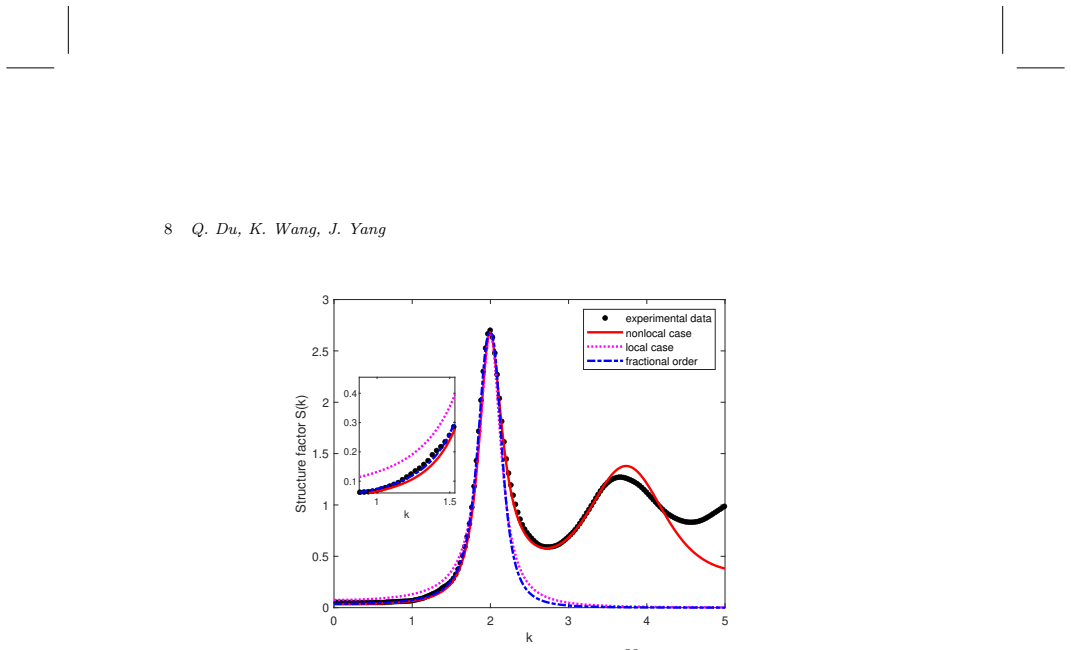
The nonlocal phase-field crystal model incorporates a finite range of spatial nonlocal interactions through a data-driven kernel fitted to the structure factor, allowing it to account for both repulsive and attractive effects and match experimental data up to the second peak, an achievement not possible with other PFC variants. Both the local phase-field crystal and fractional phase-field crystal models are distinct scaling limits of this nonlocal model.
What carries the argument
The data-driven nonlocal kernel fitted to the structure factor, which defines the finite-range interactions and enables retention of material properties in the NPFC model.
If this is right
- The NPFC model retains material properties better and is therefore more suitable for characterizing liquid-solid transition systems.
- Fourier spectral discretizations of the NPFC are convergent and asymptotically compatible, making them robust across different parameter ranges.
- Two-dimensional numerical experiments show the NPFC can simulate crystal structures and grain boundaries effectively.
- The local and fractional PFC models arise as scaling limits, confirming that the NPFC framework is more general.
Where Pith is reading between the lines
- Fitting the kernel only to the structure factor may overlook higher-order correlations needed for accurate phase-transition dynamics.
- The asymptotically compatible discretizations could support simulations that vary the interaction range continuously without reformulating the scheme.
- The same data-driven kernel construction might improve accuracy in other nonlocal phase-field models for materials beyond crystals.
- Testing the model against direct molecular dynamics data on grain boundary energies would provide an independent check on the fitting procedure.
Load-bearing premise
The specific functional form of the nonlocal kernel is correctly identified by fitting to the structure factor alone.
What would settle it
A calculation or experiment in which the NPFC model matches the structure factor to the second peak yet fails to reproduce observed crystal growth rates or grain boundary motion would show the fitting approach is insufficient.
Figures


read the original abstract
A nonlocal phase-field crystal (NPFC) model is presented as a nonlocal counterpart of the local phase-field crystal (LPFC) model and a special case of the structural PFC (XPFC) derived from classical field theory for crystal growth and phase transition. The NPFC incorporates a finite range of spatial nonlocal interactions that can account for both repulsive and attractive effects. The specific form is data-driven and determined by a fitting to the materials structure factor, which can be much more accurate than the LPFC and previously proposed fractional variant. In particular, it is able to match the experimental data of the structure factor up to the second peak, an achievement not possible with other PFC variants studied in the literature. Both LPFC and fractional PFC (FPFC) are also shown to be distinct scaling limits of the NPFC, which reflects the generality. The advantage of NPFC in retaining material properties suggests that it may be more suitable for characterizing liquid-solid transition systems. Moreover, we study numerical discretizations using Fourier spectral methods, which are shown to be convergent and asymptotically compatible, making them robust numerical discretizations across different parameter ranges. Numerical experiments are given in the two-dimensional case to demonstrate the effectiveness of the NPFC in simulating crystal structures and grain boundaries.
Editorial analysis
A structured set of objections, weighed in public.
Referee Report
Summary. The manuscript introduces a nonlocal phase-field crystal (NPFC) model whose interaction kernel is determined by fitting to the material structure factor S(k). It claims this yields a match to experimental S(k) data up to the second peak, unlike LPFC or FPFC variants, while establishing LPFC and FPFC as distinct scaling limits of NPFC. Fourier spectral discretizations are shown to be convergent and asymptotically compatible, with 2D numerical experiments demonstrating crystal structures and grain boundaries.
Significance. If the S(k) fit produces demonstrably better predictions of phase-transition dynamics or material properties (e.g., elastic constants, grain-boundary energies) than LPFC/FPFC, the NPFC would represent a useful data-informed extension of existing PFC models. The scaling-limit results and asymptotically compatible discretizations are clear strengths that would remain valuable even if the superiority claim requires further support.
major comments (2)
- [Abstract] Abstract: the central claim that NPFC is 'more suitable for characterizing liquid-solid transition systems' because it matches experimental S(k) up to the second peak rests on a kernel fitted directly to S(k). This renders the reported improvement a consequence of the fitting step rather than an independent test; no additional validation on quantities such as radial distribution functions, elastic moduli, or grain-boundary energies is described to confirm that the S(k) match improves the nonlinear dynamics of the phase transition.
- [Numerical methods] Numerical discretization section: convergence and asymptotic compatibility of the Fourier spectral scheme are asserted, yet the manuscript provides neither the explicit discretization analysis, error tables, nor sensitivity tests with respect to the nonlocal kernel parameters that would allow verification of these properties across the claimed parameter ranges.
Simulated Author's Rebuttal
We thank the referee for the constructive comments, which help clarify the scope and presentation of our results. We address each major comment below and indicate the revisions planned for the next version of the manuscript.
read point-by-point responses
-
Referee: [Abstract] Abstract: the central claim that NPFC is 'more suitable for characterizing liquid-solid transition systems' because it matches experimental S(k) up to the second peak rests on a kernel fitted directly to S(k). This renders the reported improvement a consequence of the fitting step rather than an independent test; no additional validation on quantities such as radial distribution functions, elastic moduli, or grain-boundary energies is described to confirm that the S(k) match improves the nonlinear dynamics of the phase transition.
Authors: The referee is correct that the improved match to experimental S(k) up to the second peak follows directly from fitting the nonlocal kernel to the data. This is by design: the NPFC is formulated precisely to allow such data-driven flexibility, overcoming the structural limitations of the LPFC (quadratic dispersion) and FPFC (power-law kernel) that prevent fitting beyond the first peak. The structure factor is the central experimental observable that PFC-type models are constructed to reproduce, so the ability to match an additional peak constitutes a substantive modeling advance. The manuscript demonstrates the consequences for phase-transition dynamics through 2D simulations of crystal structures and grain boundaries. We agree, however, that explicit comparisons on derived quantities (e.g., grain-boundary energies or elastic moduli) would provide stronger independent support. We will add such quantitative comparisons in the revised manuscript. revision: yes
-
Referee: [Numerical methods] Numerical discretization section: convergence and asymptotic compatibility of the Fourier spectral scheme are asserted, yet the manuscript provides neither the explicit discretization analysis, error tables, nor sensitivity tests with respect to the nonlocal kernel parameters that would allow verification of these properties across the claimed parameter ranges.
Authors: The manuscript asserts convergence and asymptotic compatibility on the basis of standard Fourier spectral analysis for nonlocal integro-differential equations, together with the known theory for asymptotically compatible schemes. We acknowledge that the current text does not include explicit error tables or parameter-sensitivity studies. We will expand the numerical-methods section to include (i) a concise outline of the discretization analysis, (ii) numerical error tables for representative kernel parameters, and (iii) sensitivity tests confirming robustness across the relevant parameter regimes. revision: yes
Circularity Check
NPFC superiority in matching S(k) to second peak is by construction from data-driven fitting to that same quantity
specific steps
-
fitted input called prediction
[Abstract]
"The specific form is data-driven and determined by a fitting to the materials structure factor, which can be much more accurate than the LPFC and previously proposed fractional variant. In particular, it is able to match the experimental data of the structure factor up to the second peak, an achievement not possible with other PFC variants studied in the literature."
The kernel is explicitly chosen via fitting to S(k) data; the paper then claims the improved match to S(k) up to the second peak as evidence of superiority. The match is enforced by the fitting procedure itself rather than emerging as an independent result or prediction from the model equations.
full rationale
The paper's central modeling claim and evidence of advantage over LPFC/FPFC rests on the nonlocal kernel being fitted to the structure factor S(k), after which the resulting match to experimental S(k) (up to the second peak) is presented as a derived achievement. This reduces the 'prediction' or 'advantage' directly to the fitting input by construction, with no shown independent validation on dynamics, elastic properties, or higher-order correlations. LPFC/FPFC are derived as scaling limits, but that does not rescue the load-bearing S(k) claim from the fitting step.
Axiom & Free-Parameter Ledger
free parameters (1)
- nonlocal kernel parameters
axioms (2)
- domain assumption The NPFC is a special case of the structural PFC derived from classical field theory.
- standard math Fourier spectral methods applied to the nonlocal operator remain convergent and asymptotically compatible.
Reference graph
Works this paper leans on
-
[1]
C. V. Achim, M. Karttunen, K. R. Elder, E. Granato, T. Ala-Nissila, and S. C. Ying, Phase diagram and commensurate-incommensurate transitions in the phase field crystal model with an external pinning potential, Phys. Rev. E , 74(2) (2006): 021104
work page 2006
-
[2]
M. Ainsworth and Z. Mao, Phase field crystal based prediction of temperature and density dependence of elastic constants through a structural phase transition,Physical Review B., 100 (2019), 104101
work page 2019
-
[3]
M. Ainsworth and Z. Mao, Fractional phase-field crystal modelling: analysis, approx- imation and pattern formation, IMA J. Appl. Math. , 85 (2020), 231–262
work page 2020
-
[4]
B. Aksoylu and M. L. Parks, Variational theory and domain decomposition for non- local problems, Appl. Math. Comput. , 217 (2011), 6498–6515
work page 2011
- [5]
-
[6]
V.Ankudinov, Structural phase-field crystal model for Lennard-Jones pair interaction potential, Modelling Simul. Mater. Sci. Eng. , 30(2022):064002. Nonlocal phase-field crystal models in two dimensions 37
work page 2022
-
[7]
Applebaum , Levy processes and stochastic calculus , Cambridge Stud
D. Applebaum , Levy processes and stochastic calculus , Cambridge Stud. Adv. Math. , 93 (2004), Cambridge University Press, Cambridge, UK
work page 2004
- [8]
-
[9]
P. W. Bates and A. Chmaj , An integrodifferential model for phase transitions: Sta- tionary solutions in higher space dimensions, J. Statist. Phys. , 95 (1999), 1119–1139
work page 1999
-
[10]
F. Bobaru and M. Duangpanya, The peridynamic formulation for transient heat con- duction , Internat. J. Heat Mass Transfer , 53 (2010), 4047–4059
work page 2010
- [11]
-
[12]
N. Burch and R. B. Lehoucq, Classical, nonlocal, and fractional diffusion equations on bounded domains, Internat. J. Multiscale Comput. Engrg. , 9 (2011), 661–674
work page 2011
-
[13]
O. Burkovska and M. Gunzburger, On a nonlocal Cahn-Hilliard model permitting sharp interfaces, Arxiv 2004.14379, (2020)
-
[14]
X. Chen and M. Gunzburger, Continuous and discontinuous finite element methods for a peridynamics model of mechanics, Comput. Methods Appl. Mech. Engrg. , 200 (2011), 1237–1250
work page 2011
-
[15]
M. Cheng and J. Warren, An efficient algorithm for solving the phase field crystal model, J. Comput. Phys. , 227.12 (2008), 6241–6248
work page 2008
-
[16]
Q. Du, Nonlocal modeling, analysis and computation, CBMS-NSF regional conference series in applied mathematics, 94, (2020)
work page 2020
-
[17]
Q. Du, M. Gunzburger, R. B. Lehoucq, and K. Zhou, Analysis and approximation of nonlocal diffusion problems with volume constraints, SIAM Rev., 56 (2012), 676–696
work page 2012
-
[18]
Q. Du, M. Gunzburger, R. B. Lehoucq, and K. Zhou, A nonlocal vector calculus, non- local volume-constrained problems, and nonlocal balance laws, Math. Models Methods Appl. Sci. , 23 (2013), 493–540
work page 2013
-
[19]
Q. Du, Y. Tao, X. Tian and J. Yang, Asymptotically compatible discretization of multidimensional nonlocal diffusion models and approximation of nonlocal Green’s functions, IMA J. Numer. Anal., 39(2) (2019), 607–625
work page 2019
- [20]
- [21]
-
[22]
Eckhaus, Studies in non-linear stability theory , Springer Science & Business Media, 6(2012)
W. Eckhaus, Studies in non-linear stability theory , Springer Science & Business Media, 6(2012)
work page 2012
-
[23]
O. Eder, B. Kunsch, M. Suda, E. Erdpresser and H. Stiller, The strudture factor of liquid copper at 1319 K and 1833K, J. Phys. F: Metal Phys. , 10 (1980), 183
work page 1980
-
[24]
K. R. Elder and M. Grant, Modeling elastic and plastic deformations in nonequilibrium processing using phase field crystals, Phys. Rev. E , 70(5) (2004), 051605
work page 2004
-
[25]
K. R. Elder, M. Katakowski, M. Haataja and M. Grant, Modeling elasticity in crystal growth, Phys. Rev. Lett. , 88(24) (2002), 245701
work page 2002
-
[26]
E. Emmrich and O. Weckner, On the well-posedness of the linear peridynamic model and its convergence towards the Navier equation of linear elasticity, Commun. Math. Sci., 5 (2007), 851–864
work page 2007
-
[27]
H. Emmerich, H. L¨ owen, R. Wittkowskib, T. Gruhna, G.I. T´ oth, G. Tegze and L. Gr´ an´ asy, Phase-field-crystal models for condensed matter dynamics on atomic length and diffusive time scales: an overview, Adv. Phys., 61 (2012), 665–743. 38 Q. Du, K. Wang, J. Yang
work page 2012
-
[28]
P. Fife , Some nonclassical trends in parabolic and parabolic-like evolutions, Trends in nonlinear analysis , Springer Berlin Heidelberg, (2003), 153–191
work page 2003
-
[29]
H. Gomez and X. Nogueira, An unconditionally energy-stable method for the phase field crystal equation, Comput. Methods Appl. Mech. Engrg. , 249/252 (2012), 52–61
work page 2012
-
[30]
M. Greenwood, N. Provatas, and J. Rottler, Free energy functionals for efficient phase field crystal modeling of structural phase transformationsPhys. Rev. Lett., 105 (2010), 045702
work page 2010
-
[31]
Z. Hu, S. Wise, C. Wang and J. Lowengrub, Stable and efficient finite-difference nonlinear-multigrid schemes for the phase-field crystal equation, J. Comput. Phys. , 228 (2009), 5323–5339
work page 2009
-
[32]
B. Kilic and E. Madenci, Coupling of peridynamic theory and the finite element method, J. Mech. Materials Structures , 5 (2010), 707–733
work page 2010
-
[33]
Y. Li, R. Slevinsky, Fast and accurate algorithms for the computation of spheri- cally symmetric nonlocal diffusion operators on lattices, J. Comput. Phys. , 397(2019), 108870
work page 2019
- [34]
-
[35]
R. Macek and S. A. Silling, Peridynamics via finite element analysis, Finite Elements Analy. Design, 43 (2007), 1169–1178
work page 2007
-
[36]
T. Mengesha and Q. Du, Analysis of a scalar nonlocal peridynamic model with a sign changing kernel, Discrete Cont. Dyn. B , 18(5)(2013), 1415–1437
work page 2013
-
[37]
S. K. Mkhonta, K. R. Elder, and Z. F. Huang, Exploring the Complex World of Two-Dimensional Ordering with Three Modes, Phys. Rev. Lett. , 111 (2013), 035501
work page 2013
-
[38]
G. Palatucci, O. Savin and E. Valdinoci, Peridynamic analysis of fiber-reinforced com- posite materials, J. Mech. Materials Structures , 7 (2012), 45–84
work page 2012
-
[39]
N. Provatas, J.A. Dantzig, B. Athreya, P. Chan, P. Stefanovic, N. Goldenfeld, K.R. El- der, Using the phase-field crystal method in the multiscale modeling of microstructure evolution, JOM, 59 (2007), 83
work page 2007
-
[40]
Yussouff, First-principles order-parameter theory of freez- ing, Phys
TV Ramakrishnan and M. Yussouff, First-principles order-parameter theory of freez- ing, Phys. Rev. B , 19(5) (1979), 2775
work page 1979
-
[41]
P. Seleson, M. Parks, M. Gunzburger, and R. Lehoucq, Peridynamics as an upscaling of molecular dynamics, Multiscale Model. Simul. , 8 (2009), 204–227
work page 2009
-
[42]
M. Seymour and N. Provatas, Structural phase field crystal approach for model- ing graphene and other two-dimensional structures, Physical Review B. , 93 (2016), 035447
work page 2016
-
[43]
Smith and N, Provatas, Generalization of the binary structural phase field crystal model
N. Smith and N, Provatas, Generalization of the binary structural phase field crystal model. Physical Review Materials , 1 (2017), 053407
work page 2017
-
[44]
J. Shen and J. Xu, Convergence and error analysis for the scalar auxiliary variable (SAV) schemes to gradient flows, SIAM J. Numer. Anal. , 56(5) (2018), 2895–2912
work page 2018
-
[45]
J. Shen, J. Xu and J. Yang, The scalar auxiliary variable (SAV) approach for gradient flows, J. Comput. Phys. , 353 (2018), 407–416
work page 2018
-
[46]
J. Shen, J. Xu and J. Yang, A new class of efficient and robust energy stable schemes for gradient flows, SIAM Rev., 61 (2019), 474–506
work page 2019
-
[47]
Silling, Reformulation of elasticity theory for discontinuities and long-range forces, J
S.A. Silling, Reformulation of elasticity theory for discontinuities and long-range forces, J. Mech. Phys. Solids , 48 (2000), 175–209
work page 2000
-
[48]
S. A. Silling and E. Askari, A meshfree method based on the peridynamic model of solid mechanics, Comput. Structures, 83 (2005), 1526–1535
work page 2005
-
[49]
S. A. Silling and R. B. Lehoucq, Peridynamic theory of solid mechanics, Adv. Appl. Mech., 44 (2010), 73–168
work page 2010
-
[50]
S. A. Silling, O. Weckner, E. Askari, and F. Bobaru, Crack nucleation in a peridynamic Nonlocal phase-field crystal models in two dimensions 39 solid, Internat. J. Fracture , 162 (2010), 219–227
work page 2010
-
[51]
I. Starodumov, V. Ankudinov and I. Nizovtseva, A review of continuous modeling of periodic pattern formation with modified phase-field crystal models. The European Physical Journal Special Topics , 231 (2022), 1135–1145
work page 2022
-
[52]
J. Swift and P. C. Hohenberg, Hydrodynamic fluctuations at the convective instability, Phys. Rev. A , 15(1) (1977), 319
work page 1977
-
[53]
X. Tian and Q. Du, Analysis and comparison of different approximations to nonlocal diffusion and linear peridynamic equations, SIAM J. Numer. Anal. , 51 (2013), 3458– 3482
work page 2013
-
[54]
X. Tian and Q. Du, Asymptotically compatible schemes and applications to robust discretization of nonlocal models, SIAM J. Numer. Anal. , 52 (2014), 1641–1665
work page 2014
-
[55]
S. van Teeffelen, R. Backofen, A. Voigt and H. L¨ owen, Derivation of the phase-field- crystal model for colloidal solidification, Phys. Rev. E , 79(5) (2009),051404
work page 2009
-
[56]
L. Tuckerman and D. Barkley, Bifurcation analysis of the Eckhaus instability, Physica D: Nonlinear Phenomena , 46(1) (1990), 57–86
work page 1990
-
[57]
H. Wang and H. Tian, A fast Galerkin method with efficient matrix assembly and storage for a peridynamic model, J. Comput. Phys. , 240 (2012), 49–57
work page 2012
-
[58]
Y. Waseda and K. Suzuki, Structure factor and atomic distribution in liquid metals by X-ray diffraction, Physica status solidi (b) , 49 (1972), 339–347
work page 1972
-
[59]
S. Wise, C. Wang and J. Lowengrub, An energy-stable and convergent finite-difference scheme for the phase-field crystal equation, SIAM J. Numer. Anal. , 47 (2009), 2269– 2288
work page 2009
-
[60]
J. Yarnell, M. Katz, R. Wenzel and S. Koenig, Structure factor and radial distribution function for liquid argon at 85K, Phys. Rev. A , 7(6) (1973), 21–30
work page 1973
-
[61]
K. Zhou and Q. Du, Mathematical and numerical analysis of linear peridynamic mod- els with nonlocal boundary conditions, SIAM J. Numer. Anal. , 48 (2010), 1759–1780
work page 2010
discussion (0)
Sign in with ORCID, Apple, or X to comment. Anyone can read and Pith papers without signing in.