REVIEW 2 major objections 4 minor 10 references
Teukolsky on slowly-rotating Kerr-de Sitter in the vanishing $\Lambda$ limit
T0 review · 2 major / 4 minor · reviewed 2026-08-03 · deepseek-v4-flash
Pith's one-line read This paper proves Λ-uniform energy, Morawetz, and r^p-weighted estimates for the Teukolsky system on slowly rotating Kerr-de Sitter, and recovers the Kerr Teukolsky estimates in the vanishing Λ limit.
desk verdict Genuinely new Lambda-uniform Teukolsky estimates with a serious proof; the main referee issue is the asserted uniform ellipticity of sigma1-sigma2 in the trapping regime, which should be fixed or explicitly imported from a stated lemma. read the letter →
The pith
A machine-rendered reading of the paper's core claim, the machinery that carries it, and where it could break.
The reading
What carries the argument
The argument rests on a physical-space Chandrasekhar transformation of the Teukolsky equation into a wave-transport system coupling a generalized Regge-Wheeler equation for q with transport equations for A. Energy control uses the almost-Killing vector field eT, a modified time translation that is timelike through the trapped region. The Morawetz estimate combines a physical-space multiplier away from trapping with pseudodifferential, frequency-dependent multipliers near the trapped set, exploiting the normally hyperbolic structure of the trapped set: the two root symbols σ₁, σ₂ of the principal wave symbol remain elliptic uniformly in Λ, allowing the Malgrange preparation theorem to factor
What would settle it
Compute the principal-symbol difference σ₁ − σ₂ on the trapped set for a sequence Λₙ → 0 with a fixed ratio |a|/M. If for some admissible ratio the symbol difference vanishes at a trapped point for arbitrarily small Λ, the ellipticity premise behind Lemma 8.28 fails and the Morawetz estimate (Proposition 9.1) would not follow from the given proof; a direct check of normal hyperbolicity (sign of H²_p r) uniformly in Λ would settle the issue.
Extended reading notes
Core claim
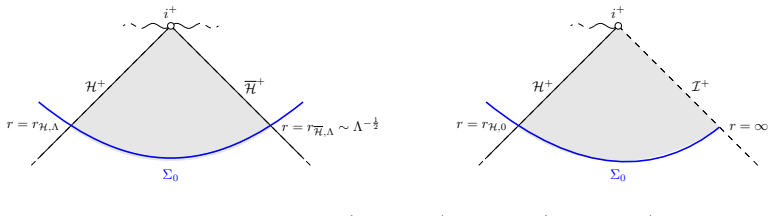
The central claim is Theorem 5.2: for solutions (q, A) to the Teukolsky wave-transport system on a slowly rotating Kerr-de Sitter background, for any s ≥ 0, δ ∈ (0,1), and p ∈ [δ, 2−δ], there exists Λ₀ > 0 such that uniformly for Λ ∈ (0, Λ₀], the combined energy-flux, Morawetz, and r^p-weighted bulk norm BEF_p^s[q,A](τ₁,τ₂) is controlled by the initial energy E_p^s[q,A](τ₁), with the constant independent of Λ. The estimate covers the entire domain of outer communication up to r ∼ Λ^{−1/2}. Letting Λ → 0 recovers the Teukolsky integrated decay estimates on slowly rotating Kerr.
Load-bearing premise
The load-bearing premise is that, uniformly for Λ ∈ (0,Λ₀] and |a| ≪ M, the trapped set remains normally hyperbolic and the two root symbols σ₁ − σ₂ stay elliptic, so the pseudodifferential Morawetz multiplier can be factored via the Malgrange preparation theorem and the sum-of-squares positivity holds; if that degenerates, the trapping-region Morawetz estimate collapses.
Editorial extensions
If this is right
- For every fixed slowly rotating Kerr-de Sitter member with Λ small, solutions to Teukolsky satisfy integrated decay with constants uniform in Λ, so polynomial-type decay is established on a region reaching the cosmological horizon scale.
- Taking Λ → 0 recovers the Teukolsky Morawetz and energy estimates on slowly rotating Kerr, giving a new proof of those results from a unified framework.
- The Λ-uniformity provides the quantitative bridge needed to connect Kerr-de Sitter exponential decay to Kerr polynomial decay in the vanishing cosmological constant conjecture.
- The same wave-transport structure and norm framework works for all spin weights s ≥ 0 of the Teukolsky equation, as the theorem is stated uniformly in s.
Reading between the lines
- A natural testable extension is to drop the slowly-rotating assumption |a| ≪ M and seek Λ-uniform estimates for all subextremal |a| < M; degeneracy of trapping at extremality would be the main obstacle.
- The estimates are linear, fixed-background results: applying them to the full Einstein equations would require coupling the metric perturbation with the same Λ-uniform norms, which lies beyond the paper.
- The r^p-weighted estimates with Λ-weighting at top order suggest the transition from Kerr polynomial decay to Kerr-de Sitter exponential decay occurs around timescales t ∼ Λ^{−1/2}, consistent with the domain chosen in the paper.
Editorial analysis
A structured set of objections, weighed in public.
Referee Report
Summary. The paper derives the Teukolsky wave-transport system on exact Kerr-de Sitter backgrounds using the non-integrable formalism of [GKS24], and proves Λ-uniform energy, Morawetz and r^p-weighted estimates for this system. The main result, Theorem 5.2, asserts a bound BEF^s_p[q,A](τ1,τ2) ≲ E^s_p[q,A](τ1) uniformly over Λ∈(0,Λ0], with the domain extending to r∼Λ^{-1/2}. As an application, Corollary 5.3 recovers the known Kerr Teukolsky estimates of [DHR19a; Ma20] by taking the vanishing-Λ limit.
Significance. If the main theorem is correct, the paper provides the first Λ-uniform integrated local-energy-decay estimate for the Teukolsky system on slowly-rotating Kerr-de Sitter, thereby giving a quantitative bridge between the Kerr-de Sitter and Kerr stability problems. The proof is long and structured, with explicit multiplier choices and exact computations for the Kerr-de Sitter metric; the limiting argument in Section 15 is a natural way to recover the Kerr estimates. No circularity is apparent: the main estimate is proved for the exact Kerr-de Sitter system and then used to derive the Kerr result. The two issues identified below are specific gaps in the proof as written, rather than objections to the overall strategy.
major comments (2)
- [§8.6–§9.2 (Lemmas 9.8 and 9.15)] The factorisation p = g^{-1}(T,T)(σ−σ1)(σ−σ2) and the subsequent Malgrange/preparation arguments divide by σ1−σ2, e.g. in equations (9.33)–(9.36) and in the first sentence of the proof of Lemma 9.15. The coercivity of the trapping Morawetz estimate, in particular (9.53), therefore requires σ1−σ2 to be elliptic uniformly for Λ∈(0,Λ0], |a|≪M, on the trapping neighbourhood. Lemma 8.28, the only statement imported from [Fan22a], gives existence, smoothness of r_trap, and the instability inequality; it does not state or prove a quantitative lower bound for |σ1−σ2|. Section 8.6 merely asserts that σ1,σ2 are 'distinct smooth real symbols.' Since this is the only mechanism handling the photon-sphere obstruction, the proof of Proposition 9.1 is incomplete as written. A direct computation of the discriminant of p as a quadratic in σ, with a uniform lower bound on the trapping neighbourhood, should
- [§10.2, Proposition 10.11(2)] The displayed lower bound K^{(Λ)} > Λ r^{p+1}|q∇4ψ|^2 + Λ r^{p+1}|r^{-1}ψ|^2 is not consistent with the computation in the proof. The proof's final line (for 2K) yields the coefficient (2−p)/6 Λ r^{p+1} for |q∇4ψ|^2 and Λ/3 (2−p) r^{p−1}|ψ|^2; the K^{(Λ)} defined in part (1) has coefficient Λ/3(2−p)r^{p+1}|∇4|^2 and Λ/3(p^2+p−2)r^{p−1}|ψ|^2, which is negative in |ψ|^2 for p<1 before the m_Λ terms are included. The asserted lower bound therefore appears false as written. Since Proposition 10.1 relies on these bulk terms to absorb the far-region errors, the factor and sign need to be corrected and the subsequent absorption of the Err terms re-checked.
minor comments (4)
- [§5.4, Remark 5.4] The remark states that boundary flux control in Corollary 5.3 'can easily be recovered a posteriori' but does not give the argument. Since the corollary statement includes flux terms, the recovery should be spelled out or the corollary should be stated without them.
- [§9, Proposition 9.1] The statement uses a time τ* that is not defined in the text available to the reader. Please define it explicitly.
- [§8.6, definition of ˚Mor] The cutoff ˚χ and the operators D_t−σ_j(D,x) are introduced informally. It would help to specify the symbol classes and the order of the cutoffs used in the microlocal norm.
- [§10.2, proof of Proposition 10.11] The proof appears to compute 2K_{X,q,m}[ψ] but the proposition states K; the factor of 1/2 should be made explicit to avoid confusion with the signs and constants in the subsequent estimates.
Circularity Check
No significant circularity: the Lambda-uniform KdS estimate is proved directly, and the Kerr estimate is recovered as a Lambda->0 corollary; self-citations are background, not the conclusion.
full rationale
I walked the derivation chain from the Teukolsky wave-transport system (4.7)-(4.8) through the energy estimate (Prop. 7.1), Morawetz estimate (Prop. 9.1), r^p-weighted estimates (Prop. 10.1), redshift and transport estimates, up to Theorem 5.2. The central estimate is proved for the exact Kerr-de Sitter metric, not assumed or fitted. The only place where an imported structural fact is load-bearing is the trapping-region Morawetz argument: Section 9.2 uses the existence and normal hyperbolicity of the trapped set, imported via Lemma 8.28 from [Fan22a], and the ellipticity of sigma1-sigma2. That import is a self-citation (Fang), but Lemma 8.28 is a geometric statement about the trapped set of the exact KdS metric, not the a priori estimate being proved; it does not include the target result among its assumptions. Likewise, the non-integrable formalism and commutator identities taken from [GKS20; GKS24] are background calculus used to derive the system, not a substitute for the estimate. No fitted parameter is renamed as a prediction, and Corollary 5.3 recovers the Kerr estimate as a limiting consequence of the proved Lambda-uniform estimate rather than using it as an input. The skeptic concern about an unproven uniform ellipticity of sigma1-sigma2 is a possible hypothesis gap in the trapping proof, not a circularity: an unproven premise is not the same as assuming the conclusion. Therefore no circular step is exhibited and the circularity score is 0.
Assumptions & free parameters
free parameters (7)
- Lambda0
- delta_trap
- delta_red
- delta_H
- delta
- R
- r0
assumptions (5)
- domain assumption The trapped set of slowly-rotating Kerr-de Sitter is normally hyperbolic with the properties in Lemma 8.28, imported from [Fan22a].
- domain assumption Non-integrable null structure identities and commutator formulas from [GKS24] hold on Kerr-de Sitter with the Lambda modifications indicated in Section 6.5.
- standard math Standard pseudodifferential calculus on vector bundles: Schwartz kernel theorem, Weyl quantization, Malgrange preparation theorem, and Garding-type inequalities.
- domain assumption For slowly-rotating, small-Lambda Kerr-de Sitter, the global geometric estimates on tau, t, the null frames, and the spacetime regions hold (Proposition 3.18 and 3.20).
- domain assumption Finite initial energy norms in Theorem 5.2 and the weighted decay assumption (5.34) in Corollary 5.3.
Cite this review
Pith. "Pith review of Teukolsky on slowly-rotating Kerr-de Sitter in the vanishing $\Lambda$ limit." pith.science (2026). https://pith.science/paper/ELYDXDFJ
@misc{pith2026260104117,
  author       = {Pith},
  title        = {Pith review of: Teukolsky on slowly-rotating Kerr-de Sitter in the vanishing $\Lambda$ limit},
  year         = {2026},
  howpublished = {\url{https://pith.science/paper/ELYDXDFJ}},
  note         = {Machine review of arXiv:2601.04117}
}
abstract
As a first step towards resolving a vanishing cosmological constant black hole stability conjecture, we prove energy, Morawetz and rp-weighted estimates for solutions to the Teukolsky equations on a slowly-rotating Kerr-de Sitter background, which we derive using an extension of the non-integrable formalism of [GKS24]. The main feature of our estimates is their uniformity with respect to the cosmological constant $\Lambda>0$ (thus allowed to tend to 0), while they hold on the whole domain of outer communications, extending up to $\Lambda^{-\frac{1}{2}}$. As an application of our result, we recover well-known corresponding estimates for solutions to Teukolsky on a slowly-rotating Kerr background in the limit $\Lambda\to 0$.
Figures


Figures from the paper (1 more)

Reference graph
Works this paper leans on
-
[1]
Annals of Mathematics182(3) (2015), pp
[AB15] Andersson, Lars and Blue, Pieter.Hidden Symmetries and Decay for the Wave Equation on the Kerr Spacetime. Annals of Mathematics182(3) (2015), pp. 787–853. [BH08] Bony, Jean-Francois and H¨ afner, Dietrich.Decay and Non-Decay of the Local Energy for the Wave Equation on the De Sitter–Schwarzschild Metric. Communications in Mathematical Physics282(3)...
2015
-
[2]
Acta Mathematica222(1) (2019), pp
[DHR19b] Dafermos, Mihalis, Holzegel, Gustav, and Rodnianski, Igor.The Linear Stability of the Schwarzschild Solution to Gravitational Perturbations. Acta Mathematica222(1) (2019), pp. 1–214. [DR09] Dafermos, Mihalis and Rodnianski, Igor.The Redshift Effect and Radiation Decay on Black Hole Spacetimes. Communications on Pure and Applied Mathematics62(7) (...
2019
-
[6]
Communications in Mathematical Physics107(4) (1986), pp
[Fri86] Friedrich, Helmut.On the Existence ofn-Geodesically Complete or Future Complete Solu- tions of Einstein ’s Field Equations with Smooth Asymptotic Structure. Communications in Mathematical Physics107(4) (1986), pp. 587–609. 191 [GKS20] Giorgi, Elena, Klainerman, Sergiu, and Szeftel, J´ er´ emie.A General Formalism for the Sta- bility of Kerr. arXiv...
arXiv 1986
-
[41]
Princeton University Press, Prince- ton, NJ, 1993, pp
Princeton Mathematical Series. Princeton University Press, Prince- ton, NJ, 1993, pp. x+514. 514 pp. [CT22] Casals, Marc and Teixeira Da Costa, Rita.Hidden Spectral Symmetries and Mode Stability of Subextremal Kerr(-de Sitter) Black Holes. Communications in Mathematical Physics394(2) (2022), pp. 797–832. [Daf+21] Dafermos, Mihalis, Holzegel, Gustav, Rodni...
1993
-
[147]
[ST20] Shlapentokh-Rothman, Yakov and Teixeira da Costa, Rita.Boundedness and Decay for the Teukolsky Equation on Kerr in the Full Subextremal Range a<M: Frequency Space Analysis. arXiv:2007.07211. Pre-published. [ST23] Shlapentokh-Rothman, Yakov and Teixeira da Costa, Rita.Boundedness and Decay for the Teukolsky Equation on Kerr in the Full Subextremal R...
arXiv 2007
-
[919]
XVIth International Congress on Mathematical Physics
[DR10a] Dafermos, Mihalis and Rodnianski, Igor.A New Physical-Space Approach to Decay for the Wave Equation with Applications to Black Hole Spacetimes.XVIth International Congress on Mathematical Physics. XVIth International Congress on Mathematical Physics. Prague, Czech Republic: WORLD SCIENTIFIC, 2010, pp. 421–432. [DR10b] Dafermos, Mihalis and Rodnian...
arXiv 2010
-
[2007]
[HPV25] Hintz, Peter, Petersen, Oliver, and Vasy, Andr´ as.Conditional Non-Linear Stability of Kerr-de Sitter Spacetimes in the Full Subextremal Range. arXiv:2508.06620 [gr-qc]. Pre-published. [HV16] Hintz, Peter and Vasy, Andr´ as.Global Analysis of Quasilinear Wave Equations on Asymptot- ically Kerr-de Sitter Spaces. International Mathematics Research N...
arXiv 2016
-
[2020]
Annals of PDE8(2) (2022)
[KS22a] Klainerman, Sergiu and Szeftel, J´ er´ emie.Construction of GCM Spheres in Perturbations of Kerr. Annals of PDE8(2) (2022). [KS22b] Klainerman, Sergiu and Szeftel, J´ er´ emie.Effective Results on Uniformization and Intrinsic GCM Spheres in Perturbations of Kerr. Annals of PDE8(2) (2022). [KS23] Klainerman, Sergiu and Szeftel, J´ er´ emie.Kerr Sta...
2022
Show all 10 references
-
[2022]
arXiv:2112.07183, accepted in Annals of PDE,
[Fan22b] Fang, Allen Juntao.Nonlinear Stability of the Slowly-Rotating Kerr-de Sitter Family. arXiv:2112.07183, accepted in Annals of PDE,
-
[3726]
Communications in Mathematical Physics377(3) (2020), pp
[Ma20] Ma, Siyuan.Uniform Energy Bound and Morawetz Estimate for Extreme Components of Spin Fields in the Exterior of a Slowly Rotating Kerr Black Hole II: Linearized Gravity. Communications in Mathematical Physics377(3) (2020), pp. 2489–2551. [Mav24] Mavrogiannis, Georgios.Qu...
2020 arXiv
Reviewed August 3, 2026 · model on record in the stance chip above.
Discussion (0). Continue with ORCID to comment.