REVIEW 2 major objections 5 minor 41 references
The Discovery of Secondary Lobes in the Seyfert Galaxy NGC 2639
T0 review · 2 major / 5 minor · reviewed 2026-08-14 · deepseek-v4-flash
Pith's one-line read New polarization-sensitive VLA observations reveal a previously unknown pair of north-south radio lobes in NGC 2639, nearly perpendicular to the known east-west lobes, implying a roughly 90-degree jet reorientation between two episodes of…
desk verdict A plausible but not fully proven discovery of a second, orthogonal lobe pair in NGC 2639; the key weakness is the unexplained flat spectral index of the northern lobe. read the letter →
The pith
A machine-rendered reading of the paper's core claim, the machinery that carries it, and where it could break.
The reading
What carries the argument
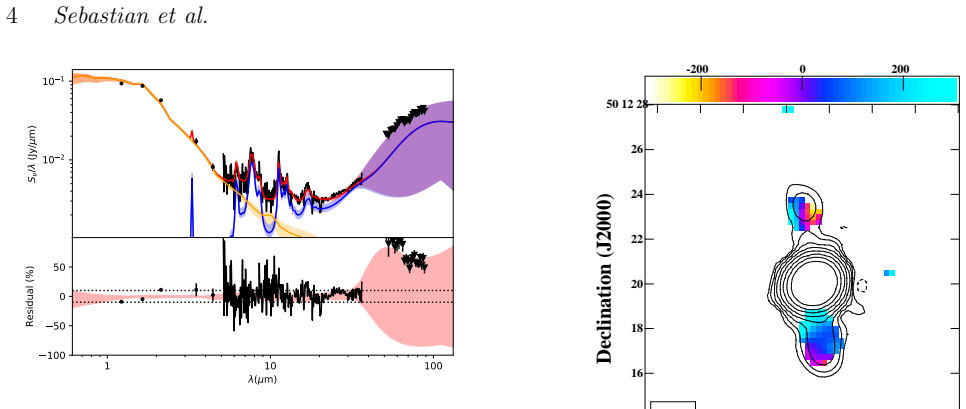
The central object is the newly identified pair of north-south radio lobes, revealed by their high fractional polarization in 5 GHz VLA observations. The argument that they are AGN lobes rests on four pieces of evidence: (1) the collimated morphology within the host galaxy; (2) fractional polarization of 20-30%, far above typical disk emission; (3) magnetic fields aligned with the lobe axes and rotation-measure gradients on kpc scales indicative of organized helical or toroidal fields; and (4) an infrared SED that requires no AGN component, with radio-derived star formation exceeding infrared-derived star formation. The authors also combine archival VLBA data showing a parsec-scale jet at an intermediate position angle, and compare the source to the Seyferts Mrk 6 and NGC 2992, which show similar multiple lobe pairs.
What would settle it
A spectral index map or redshift measurement of the north-south lobes that places them at a different distance than NGC 2639, or a detection of a background galaxy behind the source, would invalidate the association. Conversely, higher-resolution images showing a continuous jet connecting the core to the N-S lobes, or a spectral break consistent with a separate older episode, would confirm the interpretation.
Extended reading notes
Core claim
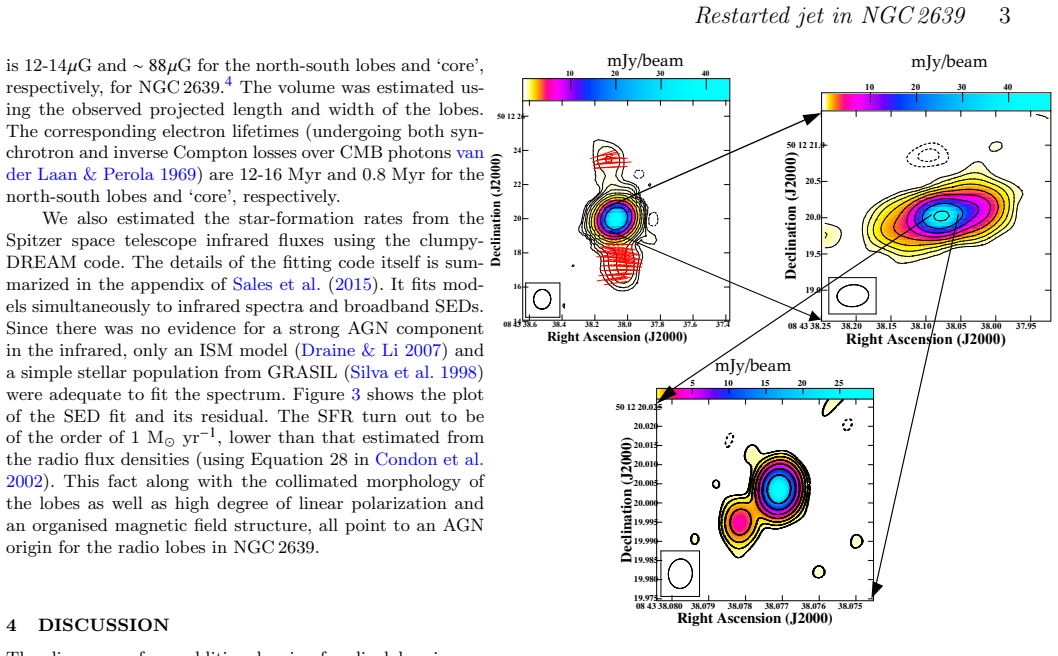
Using 5 GHz polarization-sensitive VLA observations, the authors discover a previously unreported pair of north-south radio lobes in NGC 2639, in addition to the known east-west lobe structure. The new lobes have average fractional polarizations of 20% ± 3% and 30% ± 7%, with magnetic fields aligned along the lobe axes and slight changes in orientation near the lobe ends suggestive of an S-shaped outflow. In-band rotation measure images show gradients in both lobes, indicating organized magnetic field structures on kpc scales. The infrared SED is well fitted by an ISM-plus-stellar model, and the star formation rate inferred from radio emission is higher than that from the infrared, supporting an AGN origin for the lobes. The authors argue that the near-orthogonal orientation of the two lobe pairs, together with the undisturbed optical morphology, favors a minor gas-rich merger that created a new accretion disk and flipped the jet direction by about 90 degrees between activity episodes.
Load-bearing premise
The north-south polarized structures are real radio lobes belonging to NGC 2639, not background objects or artifacts of the host galaxy's disk or interstellar medium.
Editorial extensions
If this is right
- NGC 2639 becomes only the third Seyfert galaxy known to host two pairs of kpc-scale radio lobes at different orientations, after Mrk 6 and NGC 2992.
- The near-90-degree flip in jet direction, if produced by a minor merger, implies that gas-rich minor mergers can reset the accretion disk orientation and jet axis without visibly disrupting the host galaxy.
- The duty-cycle estimate of 44% and two outflow events gives an average outflow duration of about 22 Myr, comparable to the electron lifetime in the northern lobe, supporting episodic activity on tens-of-Myr timescales.
- The organized magnetic fields and RM gradients in the lobes provide evidence for helical or toroidal magnetic fields in Seyfert jets on kiloparsec scales.
Reading between the lines
- If 2 of 10 Seyferts in the authors' sample show multiple lobe pairs, the occurrence rate of jet reorientation may be far higher than the incidence of binary black holes; a larger sample could test whether minor mergers are the dominant cause.
- The orthogonal geometry of the two lobe pairs could be used to distinguish discrete reorientation from precession: if the parsec-scale jet is slowly changing its position angle in future VLBI epochs, that would support precession or a wobbling disk rather than a single flip.
- The RM gradients suggest that the lobes' magnetic fields carry information about the flow; comparing the Faraday rotation with X-ray-derived electron densities and magnetic field strengths could determine whether the observed RM arises in the lobes themselves or in foreground galactic gas.
Signed reviews
Editorial analysis
A structured set of objections, weighed in public.
Referee Report
Summary. This paper reports new VLA 5 GHz full-polarization observations of the Seyfert galaxy NGC 2639. The authors identify a previously unreported pair of north-south radio lobes, nearly perpendicular to the known east-west radio structures, and argue that the galaxy hosts two kpc-scale lobe pairs from different activity epochs. The analysis includes total intensity, polarization, in-band spectral index and rotation measure maps, estimates of minimum-energy magnetic fields and electron lifetimes, and an infrared SED fit for the star formation rate. The paper considers jet precession, binary black holes, and restarted activity after a minor merger, and concludes that a minor gas-rich merger is the most likely explanation for the near-90 degree jet reorientation.
Significance. If the identification of the north-south structures as a second lobe pair is correct, the paper adds a rare Seyfert example of multiple kpc-scale lobe pairs at large mutual angle, with direct relevance to jet reorientation and recurrent AGN activity. The observational work uses standard CASA/AIPS calibration and imaging, provides quantitative spectral-index and RM maps, and compares new and archival VLA and VLBA data, which makes the basic results reproducible. The discovery claim is, however, load-bearing on the interpretation of the northern component as a lobe, and the reported spectral index of that component is a significant unaddressed problem. The paper's impact therefore rests on resolving this issue.
major comments (2)
- [Section 3, Figure 4] The mean spectral index of the northern 'lobe' is -0.26 +/- 0.05, statistically indistinguishable from the core value of -0.16 +/- 0.02 and very different from the southern lobe value of -1.4 +/- 0.3. For a symmetric pair of kpc-scale lobes from the same activity episode, the two lobes should have similar optically thin spectra; a difference of more than one in spectral index is not addressed in the manuscript. The flat-spectrum northern component could be a jet knot, a background source, or a region contaminated by core emission at the 1.2-arcsec beam, in which case the 'pair' is not a pair and the central claim is substantially weakened. The authors should specify the exact region used for the spectral-index average, demonstrate that the northern component is resolved from the core, and quantitatively discuss the alternative identifications.
- [Section 4] The restarted-activity argument in the Discussion compares the estimated outflow duration of 22 Myr with the 'electron lifetime of the northern lobe' of ~16 Myr to support the episodic-activity model. This is internally inconsistent with the flat spectral index of the northern component reported in Section 3. If the northern component is not an aged, steep-spectrum lobe, a synchrotron-loss lifetime computed under the stated minimum-energy assumptions (k=1, filling factor=1) does not apply to it. The authors should remove this comparison or rework it after establishing that the northern component is a genuine lobe.
minor comments (5)
- [Section 2] Section 2 states that the spectral index maps were made with a restoring beam of 1.22" x 1.22", while the Figure 4 caption quotes a beam of 1.15" x 1.00"; please clarify which beam applies to the spectral-index image.
- [Section 3] The text alternates between 'northern lobe' and 'northern lobes' when referring to the spectral index and polarization measurements; please use consistent terminology for the two components.
- [References] The name 'O'Dea' appears in inconsistent forms in the author affiliations and in the Sebastian et al. (2019) reference entry; please standardize the formatting.
- [Section 4] The formula tau_flow = 44 tau_8 n^-1 Myr is hard to parse; please write it explicitly as tau_flow = (44 tau_8 / n) Myr and state whether n is the total number of outflows.
- [Section 4] The brightness-asymmetry discussion is confusing: the text says the western outflow may be Doppler-boosted at ~100 pc scales, while the eastern jet is the approaching one in the VLBI images; please clarify which side is expected to be brighter at each scale.
Circularity Check
No significant circularity: the lobe discovery rests on new VLA polarization data, not on fitted parameters or self-citations.
full rationale
The paper's central claim — the discovery of a second pair of radio lobes in NGC 2639 — is an observational result based on new 5 GHz VLA polarization-sensitive observations. The identification of the north-south lobes is supported by direct imaging (Figures 1 and 2), high fractional polarization, and organized magnetic field structures, all of which are measured quantities rather than outputs of a model that presupposes the conclusion. The spectral index, rotation measure, magnetic field strength, electron lifetime, and star-formation rate estimates in Section 3 are post-hoc characterizations of the detected structures; they are not fitted parameters used to predict the lobes' existence. The comparison of SFRs from infrared SED fitting and radio emission is a consistency check, not a prediction derived from a fitted model. Self-citations appear (e.g., Sebastian et al. 2018, 2019; Kharb et al. 2006, 2010; Gallimore et al. 2006; O'Dea & Owen 1987), but they are used for context, data-reduction procedures, or previously known properties of the source, and none is load-bearing for the new discovery. The paper explicitly notes the small sample size caveat and acknowledges the difficulty of identifying the diffuse extension as lobes without polarization data, but these are honest limitations, not circular reasoning. No equation in the paper reduces to its own input, and no fitted parameter is renamed as a prediction. The derivation chain is therefore self-contained with respect to the new observations.
Assumptions & free parameters
assumptions (3)
- domain assumption The north-south extended radio structures are physically associated with NGC 2639 and are not background sources or imaging artifacts.
- standard math The magnetic field orientation is inferred as perpendicular to the observed electric vectors assuming optically thin synchrotron emission.
- domain assumption The RM gradients originate in the lobes themselves rather than in unrelated foreground Faraday rotation.
Cite this review
Pith. "Pith review of The Discovery of Secondary Lobes in the Seyfert Galaxy NGC 2639." pith.science (2026). https://pith.science/paper/EOB4N6YH
@misc{pith2026190809396,
  author       = {Pith},
  title        = {Pith review of: The Discovery of Secondary Lobes in the Seyfert Galaxy NGC 2639},
  year         = {2026},
  howpublished = {\url{https://pith.science/paper/EOB4N6YH}},
  note         = {Machine review of arXiv:1908.09396}
}
abstract
We report the discovery of a secondary pair of radio lobes in the Seyfert galaxy NGC 2639 with polarization-sensitive observations with the Karl G. Jansky Very Large Array (VLA). The presence of these lobes, which are aligned nearly perpendicular to the known set of radio lobes observed in the east-west direction, has not been reported previously in the literature. The in-band rotation measure image shows gradients in both the lobes indicative of organised magnetic field structures on kpc-scales. The magnetic field structure is aligned with the jet/lobe direction in both the lobes. Based on the settled optical morphology of the host galaxy, it is likely that a minor merger that did not disrupt the host galaxy structure is responsible for the observed features in NGC 2639. This also explains the near 90$^o$ change in the jet direction; the current jet direction being the result of a new accretion disk formed by the minor merger, whose direction was a result of the angular momentum of the inflowing merger gas.
Figures

Figures from the paper (1 more)

Reference graph
Works this paper leans on
-
[1]
write newline
" write newline "" before.all 'output.state := FUNCTION fin.entry write newline FUNCTION new.block output.state before.all = 'skip after.block 'output.state := if FUNCTION new.sentence output.state after.block = 'skip output.state before.all = 'skip after.sentence 'output.state := if if FUNCTION not #0 #1 if FUNCTION and 'skip pop #0 if FUNCTION or pop #1...
-
[2]
write newline
" write newline "" before.all 'output.state := FUNCTION fin.entry write newline FUNCTION new.block output.state before.all = 'skip after.block 'output.state := if FUNCTION new.sentence output.state after.block = 'skip output.state before.all = 'skip after.sentence 'output.state := if if FUNCTION not #0 #1 if FUNCTION and 'skip pop #0 if FUNCTION or pop #1...
-
[3]
Akujor C. E., Leahy J. P., Garrington S. T., Sanghera H., Spencer R. E., Schilizzi R. T., 1996, @doi [ ] 10.1093/mnras/278.1.1 , https://ui.adsabs.harvard.edu/abs/1996MNRAS.278....1A 278, 1
-
[4]
Asada K., Inoue M., Uchida Y., Kameno S., Fujisawa K., Iguchi S., Mutoh M., 2002, @doi [ ] 10.1093/pasj/54.3.L39 , https://ui.adsabs.harvard.edu/abs/2002PASJ...54L..39A 54, L39
-
[6]
Baldi R. D., et al., 2018b, @doi [ ] 10.1093/mnras/sty342 , https://ui.adsabs.harvard.edu/abs/2018MNRAS.476.3478B 476, 3478
-
[7]
Barnes J. E., Hernquist L. E., 1991, @doi [ ] 10.1086/185978 , https://ui.adsabs.harvard.edu/abs/1991ApJ...370L..65B 370, L65
doi:10.1086/185978 1991
-
[8]
Barnes J. E., Hernquist L., 1996, @doi [ ] 10.1086/177957 , https://ui.adsabs.harvard.edu/abs/1996ApJ...471..115B 471, 115
doi:10.1086/177957 1996
-
[9]
Begelman M. C., Blandford R. D., Rees M. J., 1980, @doi [ ] 10.1038/287307a0 , https://ui.adsabs.harvard.edu/abs/1980Natur.287..307B 287, 307
doi:10.1038/287307a0 1980
Show all 41 references
-
[10]
D., Icke V., 1978, @doi [ ] 10.1093/mnras/185.3.527 , https://ui.adsabs.harvard.edu/abs/1978MNRAS.185..527B 185, 527
Blandford R. D., Icke V., 1978, @doi [ ] 10.1093/mnras/185.3.527 , https://ui.adsabs.harvard.edu/abs/1978MNRAS.185..527B 185, 527
1978 doi
-
[11]
Capetti A., Balmaverde B., 2006, @doi [ ] 10.1051/0004-6361:20054490 , https://ui.adsabs.harvard.edu/abs/2006A&A...453...27C 453, 27
2006 doi
-
[12]
J., Cotton W
Condon J. J., Cotton W. D., Broderick J. J., 2002, @doi [ ] 10.1086/341650 , http://adsabs.harvard.edu/abs/2002AJ....124..675C 124, 675
2002 doi
-
[13]
Dennett-Thorpe J., Scheuer P. A. G., Laing R. A., Bridle A. H., Pooley G. G., Reich W., 2002, @doi [ ] 10.1046/j.1365-8711.2002.05106.x , https://ui.adsabs.harvard.edu/abs/2002MNRAS.330..609D 330, 609
2002
-
[14]
T., Li A., 2007, @doi [ ] 10.1086/511055 , https://ui.adsabs.harvard.edu/abs/2007ApJ...657..810D 657, 810
Draine B. T., Li A., 2007, @doi [ ] 10.1086/511055 , https://ui.adsabs.harvard.edu/abs/2007ApJ...657..810D 657, 810
2007 doi
-
[15]
N., 1984, @doi [ ] 10.1086/162128 , https://ui.adsabs.harvard.edu/abs/1984ApJ...281..554F 281, 554
Fiedler R., Henriksen R. N., 1984, @doi [ ] 10.1086/162128 , https://ui.adsabs.harvard.edu/abs/1984ApJ...281..554F 281, 554
1984 doi
-
[16]
Foreman G., Volonteri M., Dotti M., 2009, @doi [ ] 10.1088/0004-637X/693/2/1554 , https://ui.adsabs.harvard.edu/abs/2009ApJ...693.1554F 693, 1554
2009 doi
-
[17]
M., Madsen G
Gaensler B. M., Madsen G. J., Chatterjee S., Mao S. A., 2008, @doi [ ] 10.1071/AS08004 , https://ui.adsabs.harvard.edu/abs/2008PASA...25..184G 25, 184
2008 doi
-
[18]
F., Axon D
Gallimore J. F., Axon D. J., O'Dea C. P., Baum S. A., Pedlar A., 2006, @doi [ ] 10.1086/504593 , https://ui.adsabs.harvard.edu/abs/2006AJ....132..546G 132, 546
2006 doi
-
[19]
T., Leahy J
Garrington S. T., Leahy J. P., Conway R. G., Laing R. A., 1988, @doi [ ] 10.1038/331147a0 , https://ui.adsabs.harvard.edu/abs/1988Natur.331..147G 331, 147
1988 doi
-
[20]
A., et al., 2017, @doi [ ] 10.1093/mnras/stw2414 , http://adsabs.harvard.edu/abs/2017MNRAS.464.1333I 464, 1333
Irwin J. A., et al., 2017, @doi [ ] 10.1093/mnras/stw2414 , http://adsabs.harvard.edu/abs/2017MNRAS.464.1333I 464, 1333
2017 doi
-
[21]
Kakkad D., et al., 2018, @doi [ ] 10.1051/0004-6361/201832790 , https://ui.adsabs.harvard.edu/abs/2018A&A...618A...6K 618, A6
2018 doi
-
[22]
P., Baum S
Kharb P., O'Dea C. P., Baum S. A., Colbert E. J. M., Xu C., 2006, @doi [ ] 10.1086/507945 , http://adsabs.harvard.edu/abs/2006ApJ...652..177K 652, 177
2006 doi
-
[23]
C., O'Dea C
Kharb P., Gabuzda D. C., O'Dea C. P., Shastri P., Baum S. A., 2009, @doi [ ] 10.1088/0004-637X/694/2/1485 , https://ui.adsabs.harvard.edu/abs/2009ApJ...694.1485K 694, 1485
2009 doi
-
[24]
H., Hardcastle M
Kharb P., Hota A., Croston J. H., Hardcastle M. J., O'Dea C. P., Kraft R. P., Axon D. J., Robinson A., 2010, @doi [ ] 10.1088/0004-637X/723/1/580 , http://adsabs.harvard.edu/abs/2010ApJ...723..580K 723, 580
2010 doi
-
[25]
V., Merritt D., 2017, @doi [Nature Astronomy] 10.1038/s41550-017-0256-4 , https://ui.adsabs.harvard.edu/abs/2017NatAs...1..727K 1, 727
Kharb P., Lal D. V., Merritt D., 2017, @doi [Nature Astronomy] 10.1038/s41550-017-0256-4 , https://ui.adsabs.harvard.edu/abs/2017NatAs...1..727K 1, 727
2017 doi
-
[26]
V., Shastri P., Gabuzda D
Lal D. V., Shastri P., Gabuzda D. C., 2004, @doi [ ] 10.1051/0004-6361:20040486 , https://ui.adsabs.harvard.edu/abs/2004A&A...425...99L 425, 99
2004 doi
-
[27]
K., Wu X.-B., Cao S
Liu F. K., Wu X.-B., Cao S. L., 2003, @doi [ ] 10.1046/j.1365-8711.2003.06235.x , https://ui.adsabs.harvard.edu/abs/2003MNRAS.340..411L 340, 411
2003
-
[28]
Magorrian J., et al., 1998, @doi [ ] 10.1086/300353 , https://ui.adsabs.harvard.edu/abs/1998AJ....115.2285M 115, 2285
1998 doi
-
[29]
M \'a rquez I., et al., 1999, @doi [ ] 10.1051/aas:1999516 , http://adsabs.harvard.edu/abs/1999A
1999 doi
-
[30]
W., Mulchaey J
Martini P., Regan M. W., Mulchaey J. S., Pogge R. W., 2003, @doi [ ] 10.1086/367817 , http://adsabs.harvard.edu/abs/2003ApJS..146..353M 146, 353
2003 doi
-
[31]
D., 2002, @doi [Science] 10.1126/science.1074688 , https://ui.adsabs.harvard.edu/abs/2002Sci...297.1310M 297, 1310
Merritt D., Ekers R. D., 2002, @doi [Science] 10.1126/science.1074688 , https://ui.adsabs.harvard.edu/abs/2002Sci...297.1310M 297, 1310
2002 doi
-
[32]
J., Baes M., Singh M., 2017, @doi [ ] 10.1093/mnrasl/slw256 , https://ui.adsabs.harvard.edu/abs/2017MNRAS.467L..56N 467, L56
Nandi S., Jamrozy M., Roy R., Larsson J., Saikia D. J., Baes M., Singh M., 2017, @doi [ ] 10.1093/mnrasl/slw256 , https://ui.adsabs.harvard.edu/abs/2017MNRAS.467L..56N 467, L56
2017 doi
-
[33]
P., 1989, , https://ui.adsabs.harvard.edu/abs/1989A&A...210...35O 210, 35
O'Dea C. P., 1989, , https://ui.adsabs.harvard.edu/abs/1989A&A...210...35O 210, 35
1989
-
[34]
P., Owen F
O'Dea C. P., Owen F. N., 1987, @doi [ ] 10.1086/165182 , https://ui.adsabs.harvard.edu/abs/1987ApJ...316...95O 316, 95
1987 doi
-
[35]
J., 2011, @doi [ ] 10.1051/0004-6361/201117104 , http://adsabs.harvard.edu/abs/2011A
Rau U., Cornwell T. J., 2011, @doi [ ] 10.1051/0004-6361/201117104 , http://adsabs.harvard.edu/abs/2011A
2011 doi
-
[36]
J., Konar C., Kulkarni V
Saikia D. J., Konar C., Kulkarni V. K., 2006, @doi [ ] 10.1111/j.1365-2966.2005.09926.x , https://ui.adsabs.harvard.edu/abs/2006MNRAS.366.1391S 366, 1391
2006
-
[37]
A., et al., 2015, @doi [ ] 10.1088/0004-637X/799/1/25 , https://ui.adsabs.harvard.edu/abs/2015ApJ...799...25S 799, 25
Sales D. A., et al., 2015, @doi [ ] 10.1088/0004-637X/799/1/25 , https://ui.adsabs.harvard.edu/abs/2015ApJ...799...25S 799, 25
2015 doi
-
[39]
H., Joshi R., Wadadekar Y., 2018, @doi [ ] 10.1093/mnras/stx2631 , https://ui.adsabs.harvard.edu/abs/2018MNRAS.473.4926S 473, 4926
Sebastian B., Ishwara-Chandra C. H., Joshi R., Wadadekar Y., 2018, @doi [ ] 10.1093/mnras/stx2631 , https://ui.adsabs.harvard.edu/abs/2018MNRAS.473.4926S 473, 4926
2018 doi
-
[40]
Sebastian B., Kharb P., Dea C. P. O., Colbert E. J. M., Baum S. A., 2019, arXiv e-prints, https://ui.adsabs.harvard.edu/abs/2019arXiv190712765S p. arXiv:1907.12765
2019 arXiv
-
[41]
L., Bressan A., Danese L., 1998, @doi [ ] 10.1086/306476 , https://ui.adsabs.harvard.edu/abs/1998ApJ...509..103S 509, 103
Silva L., Granato G. L., Bressan A., Danese L., 1998, @doi [ ] 10.1086/306476 , https://ui.adsabs.harvard.edu/abs/1998ApJ...509..103S 509, 103
1998 doi
-
[42]
J., Baum S
Thean A., Pedlar A., Kukula M. J., Baum S. A., O'Dea C. P., 2000, @doi [ ] 10.1046/j.1365-8711.2000.03401.x , https://ui.adsabs.harvard.edu/abs/2000MNRAS.314..573T 314, 573
2000
-
[43]
C., 1969, , http://adsabs.harvard.edu/abs/1969A
van der Laan H., Perola G. C., 1969, , http://adsabs.harvard.edu/abs/1969A
1969
Reviewed August 14, 2026 · model on record in the stance chip above.
Discussion (0). Continue with ORCID to comment.