Anomalous thermopower from the drag of overdamped collective modes
Pith reviewed 2026-07-03 05:33 UTC · model grok-4.3
The pith
Overdamped collective modes with rising low-T damping produce thermopower anomalies via a drag mechanism.
A machine-rendered reading of the paper's core claim, the machinery that carries it, and where it could break.
Core claim
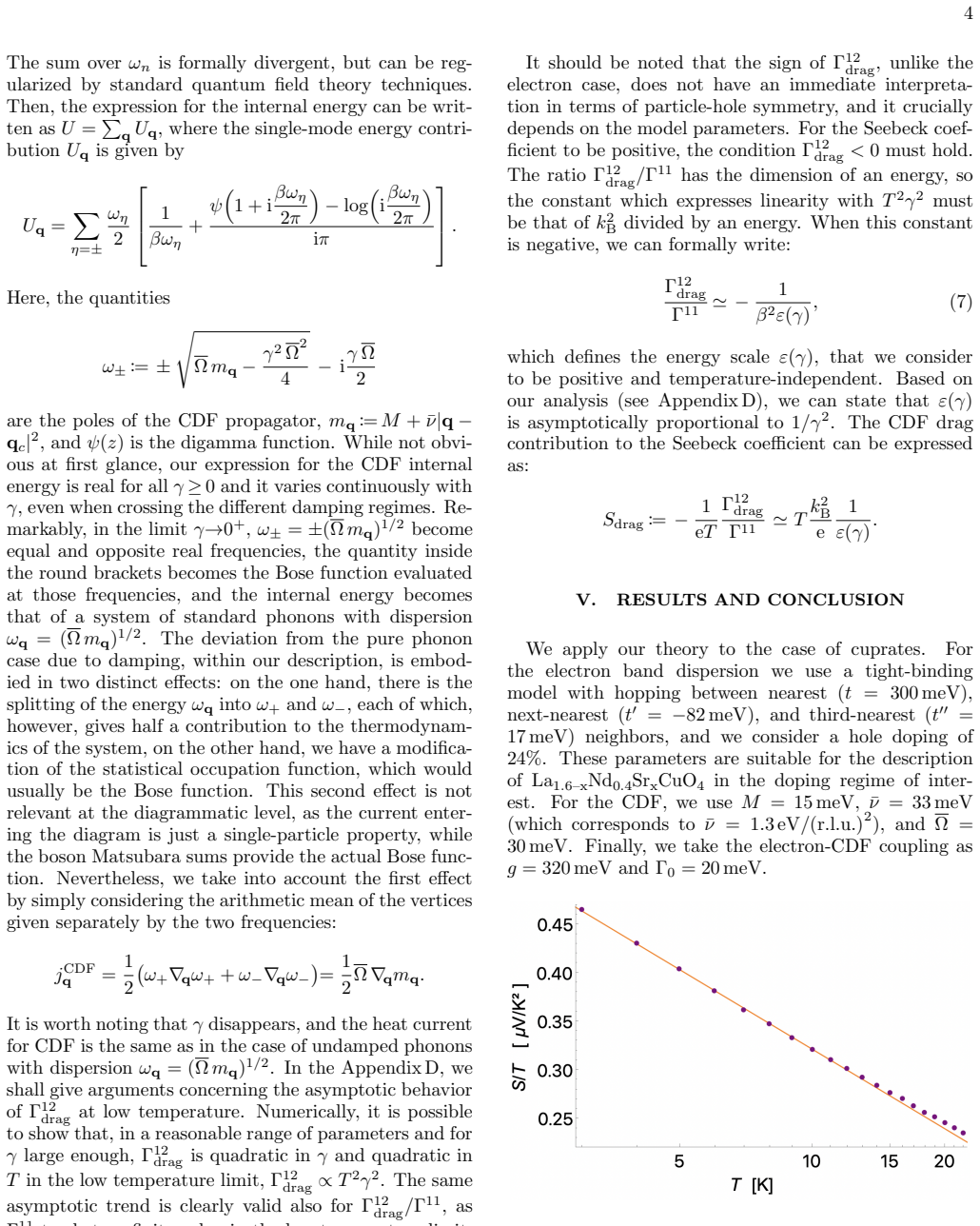
A mechanism similar to the standard phonon drag can give rise to anomalies in the thermopower of a metal, if the dragged collective mode is overdamped, with a damping coefficient that increases with lowering the temperature. This finding adds a piece to the puzzle of the strange-metal behavior observed in many different systems and supports the proposal that overdamped charge density fluctuations can be responsible for such a behavior in high-temperature superconducting cuprates.
What carries the argument
Drag of overdamped collective modes whose damping coefficient increases upon lowering temperature, producing the logarithmic thermopower anomaly.
If this is right
- The Seebeck coefficient develops a logarithmic divergence at low temperature.
- The effect occurs specifically in metals hosting overdamped charge density fluctuations.
- It accounts for the observed ratio anomaly in the thermopower of high-Tc cuprates.
- Overdamped modes thereby contribute to the broader strange-metal transport phenomenology.
Where Pith is reading between the lines
- The same damping trend could generate related anomalies in other thermoelectric coefficients.
- Measurements that track collective-mode linewidth versus temperature could directly test the required condition.
- The mechanism may apply to strange-metal signatures reported in organic conductors or heavy-fermion compounds.
Load-bearing premise
The damping coefficient of the overdamped collective mode increases upon lowering temperature.
What would settle it
Direct measurement showing that the damping coefficient of the relevant collective mode decreases or stays flat with decreasing temperature, or absence of the logarithmic thermopower feature in a system confirmed to host such modes.
Figures
read the original abstract
Inspired by the observation of a Seebeck coefficient ratio that exhibits a seemingly logarithmic divergence at low temperature in high-temperature superconducting cuprates, we show that a mechanisms similar to the standard phonon drag can give rise to anomalies in the thermopower of a metal, if the dragged collective mode is overdamped, with a damping coefficient that increases with lowering the temperature. Our finding adds a piece to the puzzle of the strange-metal behavior observed in many different systems and supports our proposal that overdamped charge density fluctuations can be responsible of such a behavior in high-temperature superconducting cuprates.
Editorial analysis
A structured set of objections, weighed in public.
Referee Report
Summary. The manuscript proposes that a phonon-drag-like mechanism involving overdamped collective modes (e.g., charge-density fluctuations) can produce a logarithmic anomaly in the low-temperature thermopower (Seebeck coefficient ratio) of metals, provided the mode damping coefficient increases upon cooling. This is offered as an explanation for strange-metal behavior in cuprate superconductors, building on experimental observations of apparent log divergences.
Significance. If the central derivation holds and the damping temperature dependence is independently justified, the result would supply a concrete, falsifiable mechanism linking overdamped modes to thermopower anomalies, thereby strengthening the case that charge-density fluctuations contribute to non-Fermi-liquid transport in the cuprates. The analogy to phonon drag is conceptually clean and could be tested against existing or future thermopower data.
major comments (2)
- [Abstract and model definition] The manuscript states that the damping coefficient of the overdamped mode must increase with decreasing temperature to obtain the reported logarithmic anomaly (see the abstract and the paragraph introducing the drag mechanism). If this Γ(T) dependence is introduced by hand rather than derived from the mode dispersion, the charge-density-fluctuation spectrum, or a microscopic interaction, the anomaly follows tautologically from the input assumption and does not constitute an independent prediction of the theory.
- [Derivation of thermopower] The central claim that the mechanism is 'similar to the standard phonon drag' but yields qualitatively new behavior for overdamped modes requires an explicit comparison of the resulting thermopower formula with the conventional phonon-drag expression. Without this side-by-side derivation (including the role of the damping term), it is unclear whether the logarithmic divergence is a robust consequence of overdamping or an artifact of the chosen Γ(T).
minor comments (1)
- [Notation] Notation for the collective-mode damping and the Seebeck ratio should be defined once at first use and used consistently; several symbols appear without prior definition in the abstract and early paragraphs.
Simulated Author's Rebuttal
We thank the referee for their thoughtful and constructive report. The comments highlight important points about the assumptions in our model and the need for clearer comparison to standard phonon drag. We address both major comments below and will revise the manuscript to incorporate clarifications and an explicit comparison, while maintaining the core result that the mechanism produces the logarithmic anomaly under the stated conditions on the damping.
read point-by-point responses
-
Referee: The manuscript states that the damping coefficient of the overdamped mode must increase with decreasing temperature to obtain the reported logarithmic anomaly (see the abstract and the paragraph introducing the drag mechanism). If this Γ(T) dependence is introduced by hand rather than derived from the mode dispersion, the charge-density-fluctuation spectrum, or a microscopic interaction, the anomaly follows tautologically from the input assumption and does not constitute an independent prediction of the theory.
Authors: We agree that the temperature dependence of Γ(T) is introduced phenomenologically rather than derived microscopically in the present work. The manuscript's central result is conditional: given an overdamped mode whose damping increases upon cooling, the drag mechanism yields the observed logarithmic anomaly in the Seebeck coefficient ratio. This is not claimed to be a first-principles prediction of Γ(T) itself but rather a demonstration that such a drag process can account for the experimental feature when the damping condition is met. The assumption is motivated by the broader strange-metal phenomenology in cuprates, where similar T-dependent damping appears in other observables. In the revised manuscript we will add explicit language clarifying the phenomenological nature of Γ(T), discuss possible microscopic origins (e.g., coupling to other fluctuations), and emphasize that the result remains falsifiable against thermopower data once independent constraints on Γ(T) are available. revision: yes
-
Referee: The central claim that the mechanism is 'similar to the standard phonon drag' but yields qualitatively new behavior for overdamped modes requires an explicit comparison of the resulting thermopower formula with the conventional phonon-drag expression. Without this side-by-side derivation (including the role of the damping term), it is unclear whether the logarithmic divergence is a robust consequence of overdamping or an artifact of the chosen Γ(T).
Authors: We accept that a direct side-by-side comparison would improve clarity. The derivation in the manuscript starts from the same momentum-transfer drag framework used for phonons but replaces the phonon propagator with an overdamped collective-mode susceptibility whose imaginary part is controlled by Γ. The key difference arises because the overdamped pole structure, combined with Γ increasing as T decreases, converts the usual power-law integrals into a logarithm. To address the comment we will add a new subsection (or appendix) that writes the standard phonon-drag Seebeck formula next to the overdamped-mode result, explicitly isolating the contribution of the damping term and showing how it produces the log T behavior rather than the conventional T^3 or T^5 terms. This will demonstrate that the anomaly is a direct consequence of overdamping plus the Γ(T) assumption, not an artifact of the specific functional form chosen for Γ. revision: yes
Circularity Check
Log anomaly in thermopower follows directly from assumed increase of damping with decreasing T
specific steps
-
fitted input called prediction
[Abstract]
"we show that a mechanisms similar to the standard phonon drag can give rise to anomalies in the thermopower of a metal, if the dragged collective mode is overdamped, with a damping coefficient that increases with lowering the temperature."
The logarithmic anomaly is advertised as a result of the drag mechanism, yet the derivation is conditional on (and directly produces the anomaly from) the externally supplied assumption that damping grows as T decreases. Without an independent derivation of Γ(T) from the charge-density-fluctuation dynamics, the anomaly is tautological with the input condition rather than a genuine prediction.
full rationale
The paper presents the anomalous thermopower as arising from a phonon-drag-like mechanism applied to an overdamped mode. However, the key logarithmic divergence is obtained only by positing that the damping coefficient Γ increases upon cooling; this T-dependence is introduced as a prerequisite rather than derived from the collective-mode spectrum or microscopic interactions. Consequently the reported anomaly reduces to a restatement of the input assumption. No self-citations or fitted parameters are visible in the provided text, but the central claim is conditional on an undemonstrated dynamical input.
Axiom & Free-Parameter Ledger
Reference graph
Works this paper leans on
-
[1]
L. D. Landau, Sov. Phys. JETP 3 , 920 (1956); ibid. 5 , 101 (1957); ibid. 8 , 70 (1958)
1956
-
[2]
G. R. Stewart, Rev. Mod. Phys. 73 , 797 (2001)
2001
-
[3]
Legros, et al., Nat
A. Legros, et al., Nat. Phys. 15 , 142 (2019)
2019
-
[4]
R. L. Greene, et al., Annu. Rev. Condens. Matter Phys. 11 , 213 (2020)
2020
-
[5]
Doiron-Leyraud, et al., Phys
N. Doiron-Leyraud, et al., Phys. Rev. B 80 , 214531 (2009)
2009
-
[6]
Walmsley, et al., Phys
P. Walmsley, et al., Phys. Rev. Lett. 110 , 257002 (2013)
2013
-
[7]
Gurvitch and A
T. Gurvitch and A. T. Fiory, Phys. Rev. Lett. 59 , 1337 (1987)
1987
-
[8]
Proust and L
C. Proust and L. P. Taillefer, Annu. Rev. Condens. Matter Phys. 10 , 409 (2019)
2019
-
[9]
C. M. Varma, Rev. Mod. Phys. 92 , 031001 (2020)
2020
-
[10]
N. E. Hussey, J. Phys.: Condens. Matt. 20 , 123201 (2008)
2008
-
[11]
Hwang, et al., Phys
J. Hwang, et al., Phys. Rev. Lett. 100 , 137005 (2008)
2008
-
[12]
Michon, et al., Nature 567 , 218–222 (2019)
B. Michon, et al., Nature 567 , 218–222 (2019)
2019
-
[13]
Michon, et al., Nat
B. Michon, et al., Nat. Commun. 14 , 3033 (2023)
2023
-
[14]
Gourgout, et al., Phys
A. Gourgout, et al., Phys. Rev. X 12 , 011037 (2022)
2022
-
[15]
C. M. Varma, et al., Phys. Rev. Lett. 63 , 1996 (1989)
1996
-
[16]
Hlubina R
R. Hlubina R. and T. M. Rice, Phys. Rev. B 51 , 9253 (1995)
1995
-
[17]
Ghiringhelli, et al., Science 337 , 821 (2012)
G. Ghiringhelli, et al., Science 337 , 821 (2012)
2012
-
[18]
Chang, et al., Nat
J. Chang, et al., Nat. Phys. 8 , 871 (2012)
2012
-
[19]
Comin, et al., Science 343 , 390 (2014)
R. Comin, et al., Science 343 , 390 (2014)
2014
-
[20]
Blanco-Canosa, et al., Phys
S. Blanco-Canosa, et al., Phys. Rev. B 90 , 054513 (2014)
2014
-
[21]
Castellani, C
C. Castellani, C. Di Castro, and M. Grilli, Phys. Rev. Lett. 75 , 4650 (1995)
1995
-
[22]
Andergassen, et al., Phys
S. Andergassen, et al., Phys. Rev. Lett. 87 , 056401 (2001)
2001
-
[23]
Caprara, et al., Phys
S. Caprara, et al., Phys. Rev. B 95 , 224511 (2017)
2017
-
[24]
Arpaia and G
R. Arpaia and G. Ghiringhelli, J. Phys. Soc. Jpn. 90 , 111005 (2021)
2021
-
[25]
Raimondi, C
R. Raimondi, C. Castellani, et al., Phys. Rev. B 47 , 3331 (1993)
1993
-
[26]
F. Becca M. Tarquini, et al., Phys. Rev. B 54 (17), 12443-12457 (1996)
1996
-
[27]
Arpaia, et al., Science 365 , 906–910 (2019)
R. Arpaia, et al., Science 365 , 906–910 (2019)
2019
-
[28]
Seibold, et al., Comm
G. Seibold, et al., Comm. Phys. 4 7, (2021)
2021
-
[29]
Caprara, et al., Comm
S. Caprara, et al., Comm. Phys. 5 , 10 (2022)
2022
-
[30]
Mirarchi, et al., Cond
G. Mirarchi, et al., Cond. Matt. 7 (1), 29 (2022)
2022
-
[31]
Mirarchi and S
G. Mirarchi and S. Caprara, Cond. Matt. 9 (1), 52 (2024)
2024
-
[32]
Grilli, et al., Symm
M. Grilli, et al., Symm. 15 (3), 569 (2023)
2023
-
[33]
G. D. Mahan, Many-Particle Physics (Springer Science & Business Media, New York, 2013)
2013
-
[34]
I. I. Hanna and E. H. Sondheimer, Proc. R. Soc. Lond. A 239 247–266 (1957)
1957
-
[35]
Ziman, Phil
J. Ziman, Phil. Mag. 4 , 371-379 (1959)
1959
-
[36]
J. C. Ward, Phys. Rev. 77 , 293 (1950)
1950
-
[37]
J. C. Ward, Proc. Phys. Soc. 64 , 54 (1951)
1951
-
[38]
Metzner and C
W. Metzner and C. Di Castro, Phys. Rev. B 47 , 16107 (1993)
1993
-
[39]
P. B. Allen, Phys. Rev. B 92 , 054305 (2015)
2015
-
[40]
R. J. Hardy, Phys. Rev. 132 , 168 (1963)
1963
-
[41]
L. G. MacDowell, Mol. Phys. 96 , 881 (1999)
1999
-
[42]
Carbogno, R
C. Carbogno, R. Ramprasad, and M. Scheffler, Phys. Rev. Lett. 118 , 175901 (2017)
2017
-
[43]
Helfand, Phys
E. Helfand, Phys. Rev. 119 , 1 (1960)
1960
-
[44]
P. L. Taylor and O. Heinonen, A Quantum Approach to Condensed Matter (Cambridge University Press, 2002)
2002
-
[45]
Cutler and N
M. Cutler and N. F. Mott, Phys. Rev. 181 , 1336 (1969)
1969
-
[46]
Georges and J
A. Georges and J. Mravlje, Phys. Rev. Research 3 , 043132 (2021)
2021
-
[47]
Gurevich, J
L. Gurevich, J. Phys. 9 , 477 (1945)
1945
-
[48]
Gurevich, J
L. Gurevich, J. Phys. 10 , 67 (1946)
1946
-
[49]
J. M. Ziman, Electrons and Phonons: The Theory of Transport Phenomena in Solids (Oxford University Press 1960)
1960
-
[50]
Baumann, Ann
K. Baumann, Ann. of Phys. 23 (2), 221 (1963)
1963
-
[51]
H. P. R. Frederikse, Phys. Rev. 92 (2), 248–252 (1953)
1953
-
[52]
T. H. Geballe and G. W. Hull, Phys. Rev. 94 (5), 1134–1140 (1954)
1954
-
[53]
D. K. C. Macdonald , W. B. Pearson, and I. M. Templeton, Proc. R. Soc. Lond. A 248 , 107 (1958)
1958
-
[54]
Mazza, et al., Phys
G. Mazza, et al., Phys. Rev. B 87 , 014511 (2013)
2013
-
[55]
R. Kubo, J. Phys. Soc. Jpn. 12 (6), 570 (1957)
1957
-
[56]
R. Kubo, M. Yokota, and S. Nakajima, J. Phys. Soc. Jpn. 12 , 1203 (1957)
1957
-
[57]
Kubo, Rep
R. Kubo, Rep. Prog. Phys. 29 , 255 (1966)
1966
-
[58]
Tong, Kinetic Theory (University of Cambridge Graduate Course, 2012)
D. Tong, Kinetic Theory (University of Cambridge Graduate Course, 2012)
2012
-
[59]
G. V. Chester, Rep. Prog. Phys. 26 , 411 (1963)
1963
-
[60]
L. P. Kadanoff and P. C. Martin, Ann. of Phys. 281 , 800 (2000)
2000
-
[61]
Spera and S
F. Spera and S. Caprara, in preparation (2026)
2026
discussion (0)
Sign in with ORCID, Apple, or X to comment. Anyone can read and Pith papers without signing in.