REVIEW 3 major objections 4 minor 17 references
CMB Constraints on Quantized Spatial Curvature $\Omega_K$ in globally CPT-symmetric universes
T0 review · 3 major / 4 minor · reviewed 2026-08-04 · deepseek-v4-flash
Pith's one-line read Two independent quantization conditions, one from conformal-time periodicity and one from the finite volume of a closed universe, restrict spatial curvature ΩK to a discrete set of values.
desk verdict A well-written extension of the authors' own program, but the central quantization-matching condition is unjustified—rational commensurability would already give shared modes and would destroy the discrete ΩK prediction. read the letter →
The pith
A machine-rendered reading of the paper's core claim, the machinery that carries it, and where it could break.
The reading
What carries the argument
The consistency condition Δk~ = N√κ~, where Δk~ is the spacing between wave vectors allowed by the periodicity of perturbations in conformal time, √κ~ is the spacing of the finite-volume quantization of a closed spatial geometry, and N is a positive integer. The paper computes Δk~ by integrating the cosmological perturbation equations (perfect fluid before recombination, Boltzmann hierarchy for radiation anisotropy afterward) adapted to nonzero curvature, then filters Planck 2018 MCMC samples to keep those satisfying Δk~/√κ~≈N. The integer N indexes the discrete curvature ladders.
What would settle it
Take the paper's own perturbation solver and compute Δk~/√κ~ continuously as ΩK varies. If one finds mode-sharing—i.e., the periodic-derived spectrum and the closed-universe integer spectrum have common wave vectors—at any rational non-integer ratio, the integer-only condition is false. A second decisive test: run a Planck+BAO+SNe MCMC with curvature free and check whether any integer-rung region survives with acceptable likelihood; if the best-fit ΩK lies between rungs, the discrete prediction is excluded.
Extended reading notes
Core claim
The paper's central claim is that consistency between the quantization of perturbation wave vectors imposed by conformal-time periodicity and the quantization imposed by the finite volume of a closed universe restricts spatial curvature to a discrete set. For integer N=3,4,5,6,7,… the allowed values are ΩK∈[−0.076,−0.039,−0.024,−0.016,−0.012,…]. After numerically solving the perturbation equations with radiation anisotropy and Boltzmann hierarchy, modifying a Boltzmann solver to use only the allowed discrete modes, and post-processing Planck 2018 chains, the N=4 solution is favored, with Ωm≈0.467 and H0≈55 km/s/Mpc. The authors stress that this disagrees with flat ΛCDM and other probes but a
Load-bearing premise
The load-bearing premise is that the two quantization conditions can only be consistent when their spacing ratio is an exact integer N; nothing in the paper rules out rational ratios, which would allow every curvature value.
Editorial extensions
If this is right
- Spatial curvature is not free in this framework: only the countable set ΩK≈[−0.076,−0.039,−0.024,…] is allowed.
- Planck 2018 CMB data alone select N=4, corresponding to ΩK≈−0.039, Ωm≈0.467, H0≈55 km/s/Mpc.
- Larger N give smaller |ΩK|, so the ladder approaches spatial flatness as N grows.
- Distinguishing which rung is real requires joint analysis with BAO and supernova data that treat curvature as a free parameter.
- The favored solution yields H0≈55 km/s/Mpc, well below values from other cosmological probes.
Reading between the lines
- The requirement that the ratio of the two spacings be an exact integer rather than any rational number is not derived; if rational ratios were permitted, the discrete ΩK set would become dense and this central prediction would dissolve.
- A joint fit with BAO and supernovae that marginalizes over curvature could exclude all integer rungs simultaneously, which would falsify the quantization framework rather than just the N=4 preference.
- The framework implies subtle oscillatory features in the CMB power spectrum from sparse k-sampling for low N; future high-resolution CMB measurements could look for these.
- One might test the quantization directly by computing Δk~/√κ~ from the perturbation solver across a continuous range of ΩK and checking whether modes are actually shared at rational rather than integer ratios.
Editorial analysis
A structured set of objections, weighed in public.
Referee Report
Summary. The paper claims that in a spatially closed universe, two independent quantization conditions on comoving wave numbers must be consistent: one from the periodicity of perturbations in a globally CPT-symmetric background, and one from the finite spatial volume. Imposing this consistency is said to restrict the spatial curvature ΩK to a discrete set of values, approximately [−0.076, −0.039, −0.024, −0.016, −0.012, …] for integer labels N=3,4,5,6,7,… . The authors compute the periodic-derived mode spacing Δk̃ using a modified Boltzmann treatment with radiation anisotropy and curvature, modify CLASS to include discrete mode sampling, and then post-process Planck 2018 MCMC chains by filtering samples where Δk̃/√κ̃ ≈ N (within ±2%). They report that Planck 2018 data favour N=4, corresponding to ΩK≈−0.039, Ωm≈0.467 and H0≈55 km/s/Mpc.
Significance. If the central consistency condition were rigorously derived, the paper would supply a genuinely novel theoretical constraint on spatial curvature and a falsifiable set of discrete predictions that can be tested against CMB data. The authors make use of public Planck chains, adapt an existing Boltzmann solver, and present a concrete numerical pipeline, which are commendable. However, the central discreteness result rests on an unproved and, as stated, unjustified integer-multiple matching condition rather than the weaker and physically more natural condition that the two mode sets merely share modes. Because the allowed ΩK values become dense under the weaker condition, the headline prediction and the N=4 best-fit are not robust. The manuscript therefore does not currently support its central claim.
major comments (3)
- [§II B] The consistency condition Δk̃ = N√κ̃ with N∈N is asserted without derivation. The periodic condition selects modes k̃ ∈ {n Δk̃}, while the closed-geometry quantization selects k̃ ∈ {j√κ̃}. A non-empty intersection requires only that Δk̃/√κ̃ be rational, say p/q in lowest terms; the physical modes are then {m p√κ̃}. The paper's integer condition is the q=1 subcase, and no physical argument is given for why every periodic mode must also be a geometric mode. Since Δk̃ depends continuously on the cosmological parameters, requiring mere rationality makes the allowed ΩK values a dense set, destroying the discrete prediction that is the paper's main result.
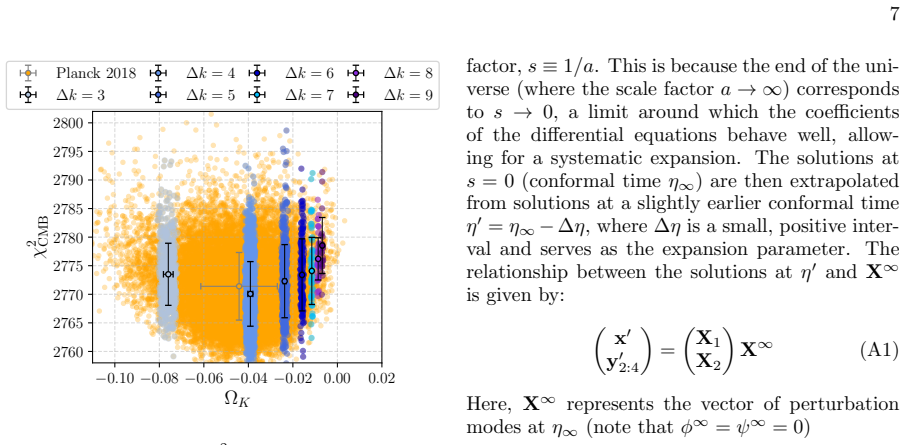
- [§IV B] The post-processing filter retains MCMC samples for which Δk̃/√κ̃ is approximately an integer within ±2%. This numerical implementation implicitly imposes the q=1 subcase of the matching condition; samples with rational ratio p/q (q>1) are discarded even though their physical spectrum, being multiples of p√κ̃, is identical to the q=1 spectrum with integer p. Moreover, because Δk̃ depends on H0 and Ωb (as stated in §III B), the ±2% tolerance corresponds to a continuous range of ΩK values, so the apparent 'discrete islands' in Fig. 3 are actually finite-width bands. The paper does not quantify how the results depend on the chosen tolerance.
- [§V, Fig. 4] The claimed Δχ² minimum at N=4 is obtained by post-processing the standard ΛCDM+ΩK Planck chains, rather than by evaluating the likelihood of the discrete-mode model. The paper does not report the number of surviving samples after filtering, nor does it validate that the standard model's likelihood surface is a good approximation for the modified discrete-spectrum model on the scales that dominate the χ² differences. Without such validation, the statistical preference for N=4 over the neighbouring integer solutions is not established.
minor comments (4)
- [§II A] The quantization condition is first quoted as √3 k̃ η∞ = nπ/2 and later as nπ after imposing the ρm∝1/|a|^3 scaling. The text should clarify which condition is actually used in the numerical calculation and why the symmetry at η∞ restricts to nπ.
- [§IV A, Fig. 1] The figure caption uses 'k = 14, k = 9, k = 1' while the text uses 'N' for the fundamental mode spacing. Please unify the notation and define whether these are values of N or of the physical mode index j'.
- [§III A] The quartic equation for a0 is stated to have a unique positive real root, but the parameter ranges are not specified. It would be helpful to state the domain in which this uniqueness holds and how the root is selected in the numerical implementation.
- [Appendix A] The Taylor-expansion matrices are presented without derivation, making the numerical computation difficult to reproduce or check. In particular, Eq. (A1) is dimensionally ambiguous: X∞ is defined as a four-component vector while x′ has six components. Please specify the dimensions and ordering of all matrices and vectors.
Circularity Check
Discrete ΩK set is imposed by the integer-ratio condition Δk̃=N√κ̃; rational commensurability would give a dense set, so the central prediction reduces to the assumption.
-
self definitional
[Section II B (Basic idea); Section IV B (Post-processing Planck 2018 MCMC Samples)]
"For consistency between the periodic-derived quantization and the geometric quantization, the periodic-derived spacing ∆˜k=N√˜κ, where N∈N. Requiring such consistency restricts the possible values of spatial curvature, ˜κ (and thus ΩK), to a discrete set..."
This is the load-bearing step that produces the central discrete prediction. The two quantization conditions give two arithmetic progressions of wavevectors: {nΔk̃} from periodicity and {j√κ̃} from the closed geometry. A non-empty intersection only requires Δk̃/√κ̃ ∈ Q, say p/q in lowest terms; the physical modes are then {m p√κ̃}, identical for every reduced fraction p/q. By imposing instead the integer subcase Δk̃=N√κ̃, the paper builds discreteness in by fiat. Section IV B then retains only Planck samples with Δk̃/√κ̃≈N, so the 'discrete islands' in Fig. 3 and the list [-0.076,-0.039,-0.024,...] are a re-expression of the integer-ratio assumption, not a consequence of the two quantization conditions. Rational-ratio cases with the same physical spectra are discarded by the ±2% integer fi
full rationale
The paper contains substantial independent numerical work: solving the cosmological perturbation equations with radiation anisotropy and a Boltzmann hierarchy, and comparing the resulting spectra with Planck 2018 chains. Those components are not circular. However, the central claim that ΩK takes the discrete values [-0.076,-0.039,-0.024,...] is not a consequence of the two quantization conditions alone. The periodic-induced modes and the closed-geometry modes are arithmetic progressions; consistency requires only that their ratio be rational, in which case the allowed physical modes are multiples of the reduced numerator times √κ̃. The paper instead assumes Δk̃=N√κ̃ with N∈N (Section II B) and then filters the Planck MCMC samples to Δk̃/√κ̃≈N (Section IV B), thereby discarding all rational p/q cases even though they yield identical physical spectra. Thus the discreteness and the numerical list are built into the integer-ratio assumption rather than derived from the stated physics. The Planck-data comparison is an honest external step, but it operates on the islands pre-selected by that assumption, so the headline prediction remains partially circular by construction.
Assumptions & free parameters
free parameters (1)
- MCMC filtering tolerance =
±2%
assumptions (5)
- domain assumption The universe is globally CPT-symmetric with a periodic conformal time coordinate, so the scale factor is periodic and there exists a future conformal boundary η∞.
- ad hoc to paper Matter density scales as ρm ∝ 1/|a|^3 rather than 1/a^3, so the anti-universe phase has positive energy and the background evolution is symmetric.
- domain assumption Physical consistency requires perturbation solutions to be periodic at η∞, yielding the quantization condition √3 k̃ η∞ = nπ for symmetric modes.
- ad hoc to paper The periodic-derived mode spacing must be an integer multiple of the closed-universe mode spacing: Δk̃ = N√κ̃ with N∈N.
- domain assumption The standard ΛCDM+ΩK likelihood surface is a good approximation for the discrete-mode model.
Cite this review
Pith. "Pith review of CMB Constraints on Quantized Spatial Curvature $\Omega_K$ in globally CPT-symmetric universes." pith.science (2026). https://pith.science/paper/EQIW3UFV
@misc{pith2026250910379,
  author       = {Pith},
  title        = {Pith review of: CMB Constraints on Quantized Spatial Curvature $\Omega_K$ in globally CPT-symmetric universes},
  year         = {2026},
  howpublished = {\url{https://pith.science/paper/EQIW3UFV}},
  note         = {Machine review of arXiv:2509.10379}
}
abstract
The periodic solution of the Friedmann equation in conformal time, implies that only cosmological perturbations exhibiting corresponding symmetries are physically permissible, leading to a discrete spectrum of allowed wave vectors. Furthermore, in a spatially closed universe, these wave vectors are independently constrained to be integers. Matching these two distinct quantization conditions provides a novel theoretical constraint on the possible values of spatial curvature. In this work, we numerically solve the cosmological perturbation equations, incorporating radiation anisotropy and higher-order Boltzmann terms, to calculate these discrete wave vectors with improved precision. Subsequently, we generate Cosmic Microwave Background (CMB) power spectra for different characteristic spacings of these quantized wave vectors. Finally, we apply the constraint to Planck 2018 observational data to determine the cosmological parameters. This analysis yields a discrete set of allowed values for the spatial curvature, $\Omega_K$, including $[-0.076,-0.039, -0.024, -0.016, -0.012, \dots]$.
Figures


Figures from the paper (2 more)

Reference graph
Works this paper leans on
-
[1]
Planck Collaboration, A&A641, A6 (2020), arXiv:1807.06209 [astro-ph.CO]
arXiv 2020
-
[2]
B. R. Dinda, Phys. Rev. D105, 063524 (2022)
2022
-
[3]
E. Di Valentino, A. Melchiorri, and J. Silk, Na- ture Astronomy4, 196 (2020), arXiv:1911.02087 [astro-ph.CO]
arXiv 2020
-
[4]
W. Handley, Phys. Rev. D103, L041301 (2021), arXiv:1908.09139 [astro-ph.CO]
arXiv 2021
-
[5]
A. Glanville, C. Howlett, and T. Davis, MN- RAS517, 3087 (2022), arXiv:2205.05892 [astro- ph.CO]
arXiv 2022
-
[6]
L. Boyle and N. Turok, arXiv e-prints , arXiv:2109.06204 (2021), arXiv:2109.06204 [hep- th]
arXiv 2021
-
[7]
L. Boyle and N. Turok, Physics Letters B849, 138442 (2024), arXiv:2210.01142 [gr-qc]
arXiv 2024
-
[8]
L. Boyle and N. Turok, arXiv e-prints , arXiv:2110.06258 (2021), arXiv:2110.06258 [hep- th]
arXiv 2021
Show all 17 references
-
[9]
Boyle, M
L. Boyle, M. Teuscher, and N. Turok, arXiv e-prints , arXiv:2208.10396 (2022), arXiv:2208.10396 [hep-ph]
2022 arXiv
-
[10]
Turok and L
N. Turok and L. Boyle, arXiv e-prints , arXiv:2302.00344 (2023), arXiv:2302.00344 [hep- ph]
2023 arXiv
-
[11]
A. N. Lasenby, W. J. Handley, D. J. Bartlett, and C. S. Negreanu, Phys. Rev. D105, 083514 (2022), arXiv:2104.02521 [gr-qc]
2022 arXiv
-
[12]
Deng and W
W.-N. Deng and W. Handley, Phys. Rev. D110, 103528 (2024)
2024
-
[13]
Prathaban and W
M. Prathaban and W. Handley, Phys. Rev. D105, 123508 (2022), arXiv:2111.14588 [astro-ph.CO]
2022 arXiv
-
[14]
D. J. Bartlett, W. J. Handley, and A. N. Lasenby, Phys. Rev. D105, 083515 (2022), arXiv:2104.01938 [astro-ph.CO]
2022 arXiv
-
[15]
V. F. Mukhanov, H. A. Feldman, and R. H. Bran- denberger, Phys. Rep.215, 203 (1992)
1992
-
[16]
D. Blas, J. Lesgourgues, and T. Tram, Journal of Cosmology and Astroparticle Physics2011(07), 034
-
[17]
Handley, The Journal of Open Source Software 4, 1414 (2019)
W. Handley, The Journal of Open Source Software 4, 1414 (2019)
2019
Reviewed August 4, 2026 · model on record in the stance chip above.
Discussion (0). Sign in to comment.