REVIEW 4 major objections 4 minor 58 references
Fishing for Jellyfish Galaxies: Exploring ram-pressure stripping with crowd science
T0 review · 4 major / 4 minor · reviewed 2026-08-03 · deepseek-v4-flash
Pith's one-line read This paper claims that thousands of untrained volunteers, each casting votes on galaxy images, can reliably identify galaxies whose gas is being stripped by the hot intracluster medium, producing a catalogue of 6,739 jellyfish candidates—th
desk verdict A genuinely useful citizen-science RPS catalogue with transparent calibration, but the single-cluster in-sample threshold tuning and a 53% vs 20% velocity discrepancy mean the quantitative claims need a careful second look before the catalogue is used for science. read the letter →
The pith
A machine-rendered reading of the paper's core claim, the machinery that carries it, and where it could break.
The reading
What carries the argument
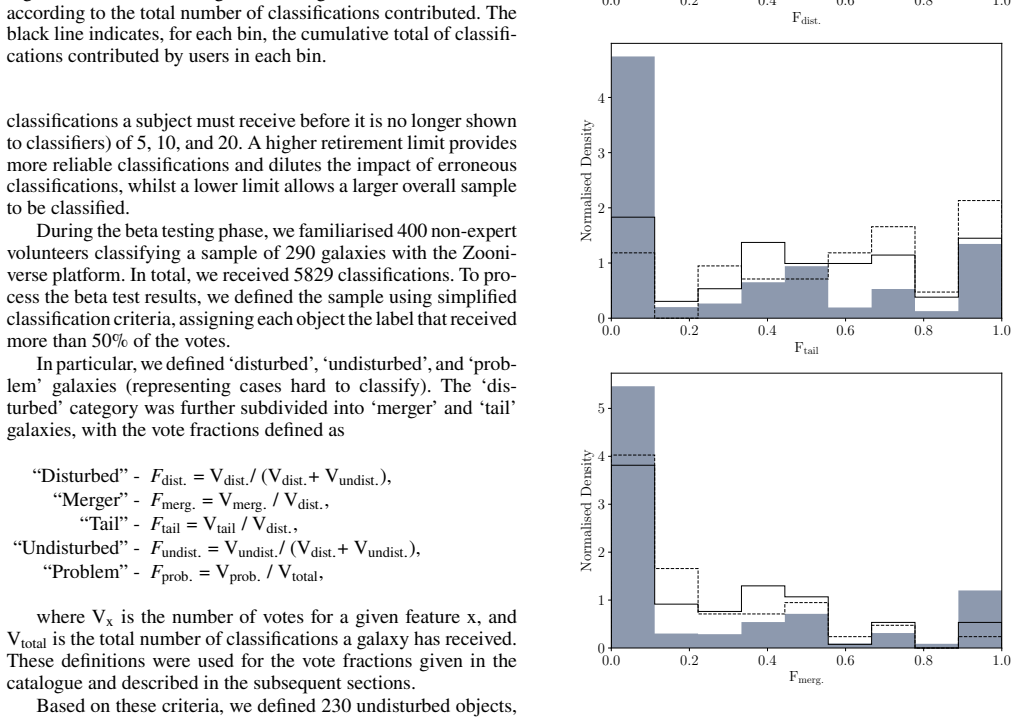
The central mechanism is the vote-fraction threshold given in Eq. (3): a galaxy is a stripping candidate when F_dist ≥ 0.39 and simultaneously F_merg ≤ 0.23 or F_tail ≥ 0.37. These thresholds were tuned with a Monte Carlo sweep over the expert-labelled Abell 1644 sample to balance purity and completeness, and they are then applied unchanged to the rest of the sample. The debiasing step—downweighting volunteers who classified fewer than ten galaxies—sharpens the vote fractions slightly but is not critical once the thresholds are tuned.
What would settle it
Classify a second cluster with full expert labels (e.g., Abell 1367) and measure the purity and completeness of the citizen criteria; if they fall far from P=0.63 and C=0.57, the transferability assumption fails. Alternatively, take a random subset of the 6,739 candidates and search for extraplanar ionized gas with integral-field spectroscopy; a low confirmation rate would weaken the physical interpretation.
Extended reading notes
Core claim
By aggregating approximately ten independent volunteer classifications per galaxy into vote fractions (disturbed, merging, tail) and calibrating thresholds against expert labels of 403 galaxies in Abell 1644, the authors derive a simple selection rule—F_dist ≥ 0.39 and (F_merg ≤ 0.23 or F_tail ≥ 0.37)—that identifies ram-pressure-stripping candidates with purity 0.63 and completeness 0.57. Applied to all 79 clusters, this yields 6,739 stripping candidates (3,910 with prominent tails), 5,430 merger candidates, and 29,729 undisturbed galaxies. The candidate fraction rises from ~10% in groups to ~20–30% in massive clusters, and the candidates show higher velocities, bluer g−r colours, lower Sér
Load-bearing premise
The thresholds calibrated on expert classifications of one cluster (Abell 1644) are applied unchanged to all 79 clusters, assuming that volunteer voting behaviour and the visibility of stripping signatures do not change with cluster redshift, mass, or image quality.
Editorial extensions
If this is right
- The catalogue of 6,739 candidates triples or more the number of visually identified ram-pressure-stripping galaxies available for statistical study.
- The rising candidate fraction with cluster mass strengthens the evidence that ram-pressure stripping is a major transformation channel in massive clusters, not just a rare phenomenon.
- The candidates' higher velocities and bluer colours support the picture that they are recent infallers on radial orbits, as predicted by simulations of ram-pressure stripping.
- The public release of 37,599 visually classified galaxies provides a resource for future studies of galaxy transformation, mergers, and cluster environments.
- The sample can serve as a training set for automated machine-learning classifiers aimed at finding stripping candidates in even larger surveys.
Reading between the lines
- We infer that the vote-fraction thresholds could be re-calibrated per cluster with a modest number of expert labels per cluster, which would likely improve global purity and completeness beyond the single-cluster calibration; the released catalogue makes such a test straightforward.
- The 5,430 merger candidates offer a way to separate gravitational from hydrodynamical transformation statistically: if the stripping fraction rises with cluster mass while the merger fraction does not, that contrast directly shows the two mechanisms respond differently to environment—an analysis the paper only sketches.
- Since the project used only optical broadband images, we infer that adding H-alpha or UV data for the tail-bearing candidates would test directly whether the tails are sites of ongoing star formation, a signature the paper measures in aggregate via SDSS but not for individual tails.
Signed reviews
Editorial analysis
A structured set of objections, weighed in public.
Referee Report
Summary. The paper presents 'Fishing for Jellyfish Galaxies', a Zooniverse citizen-science project that visually classifies 49,703 late-type galaxies in the fields of 79 clusters/groups from DECaLS. Volunteers voted on disturbance, merger, and tail-like features; the vote fractions were debiased and calibrated against expert labels for all 403 galaxies in Abell 1644. The adopted thresholds in Eq. (3) yield a claimed purity P=0.63 and completeness C=0.57, and are applied to the full sample to produce 6,739 ram-pressure-stripping candidates (3,910 with tails), 5,430 merger candidates, and 29,729 undisturbed galaxies. The authors further report that the candidate fraction rises from ~10% in groups to ~20–30% in massive clusters, that candidates have bluer colours, elevated star-formation rates, and distinct phase-space positions, and that the catalogue is intended as a homogeneous resource for future RPS studies.
Significance. If the calibration transfers to the full 79-cluster sample, this would be the largest homogeneous visually selected catalogue of ram-pressure-stripping candidates to date, and a valuable training set for automated methods. The project is well matched to the journal's scope and has several clear strengths: the calibration procedure and vote-fraction definitions are described transparently; the catalogue is released; and the physical checks (phase-space, SFR, colour) are not circular, because the volunteers were not given any physical parameters. The literature cross-match in Fig. 3 and the internal consistency of the SFR/colour trends provide encouraging support for the method. However, the central quantitative claims — the size of the candidate catalogue and the environmental fractions — rest on an in-sample, single-cluster calibration that is not independently validated.
major comments (4)
- [Sect. 3.4, Eq. (3), and Fig. D.1] The thresholds Fdist≥0.39 & (Fmerg≤0.23 or Ftail≥0.37) are selected by a Monte Carlo search and then evaluated on the same 403 expert-labelled galaxies in Abell 1644. No sample splitting, cross-validation, or independent held-out cluster is reported, so P=0.63 and C=0.57 are in-sample estimates and are likely optimistic. These thresholds are then applied unchanged to all 79 clusters spanning z~0.003–0.056 and log M~13.3–15.2, implicitly assuming that volunteer voting behaviour and the visibility of low-surface-brightness features are constant across redshift, mass, and image quality. The cross-match with literature RPS galaxies in Fig. 3 is a distributional comparison, not a quantitative purity/completeness measurement on a separate cluster. I request an external validation (e.g., a second cluster with expert labels, or a ‘known-RPS’ sample treated as a held-out set) or, failing that, th
- [Abstract vs. Sect. 4.3] The abstract claims a 'median clustercentric velocity 53% higher than the general cluster population', but Sect. 4.3 reports only a ~20% shift in absolute line-of-sight velocities (with K-S p-values of 0.0032 and 0.0007). No 53% value appears in the body text, and the paper does not explain how a median clustercentric velocity is derived from line-of-sight data. This is a direct numerical inconsistency in a headline result. The authors should either substantiate the 53% figure with the relevant calculation or correct the abstract.
- [Sect. 4.2, Figs. 7 and 8] The two figures use different definitions of the candidate fraction: Fig. 7 divides by all classified subjects in the cluster, while Fig. 8 divides by star-forming galaxies with M*>10^9.7 in a spectroscopic/SDSS-overlap subset. The text states both show the same trend, but the denominators and sample restrictions differ, so the quantitative fractions (10% vs 20–30%) are not directly comparable and may be affected by the different selection functions. The paper should state which definition is used in each figure and whether the trend with halo mass is robust to the denominator choice.
- [Sect. 4.3, Fig. 9] The text says SC galaxies are at larger cluster-centric radii than undisturbed galaxies by ~10%, which is in the opposite direction of the usually quoted expectation for RPS galaxies (lower cluster-centric radii, e.g., Jaffé et al. 2015). The discussion interprets the velocity difference as consistent with recent infall but does not address the radial discrepancy. If this offset is real it deserves comment; if it is a selection effect of the 4xR500 aperture or the spectroscopic membership cut, that should be stated explicitly.
minor comments (4)
- [Abstract and Conclusions] The abstract/conclusions state that classifications were obtained 'across 82 clusters', while Sect. 2.2 and Tables 1–2 enumerate 79 clusters. Please reconcile the number.
- [Caption of Fig. D.1] The caption says the dashed lines mark thresholds '(0.39, 0.77, 0.37)', but Eq. (3) is written as Fdist≥0.39 & (Fmerg≤0.23 or Ftail≥0.37). Since 0.77 = 1−0.23, the caption is using the non-merger fraction while the text uses the merger fraction; make the relation explicit.
- [Tables 1 and 2] Abell 671 appears in both Table 1 and Table 2, with 186 and 11 galaxies respectively. The Table 2 note says bold entries indicate additional coverage of DR9 clusters, but Abell 671 is not bold. Clarify whether this is a duplicate entry or a deliberate additional sample.
- [Sect. 3.4] There is a typo in 'Fig., D.1' and the sentence 'Whilst the purity level... indicates that this sample is subject to contamination' is followed by a direct comparison to a stricter threshold; consider moving the stricter-threshold test into a dedicated paragraph.
Circularity Check
No significant circularity: calibrated thresholds are transparently in-sample, and the physical checks use parameters blind to the classifiers.
full rationale
The paper's derivation chain is not circular in the sense defined here. The vote-fraction thresholds in Eq. (3) are explicitly fitted to expert classifications of 403 galaxies in Abell 1644 (Sect. 3.4), and the reported purity P=0.63 and completeness C=0.57 are presented as calibration results on that same sample, not as independent predictions. The subsequent catalogue counts and environmental fractions are applications of those calibrated thresholds, not quantities that were used to choose the thresholds. The phase-space, colour, Sérsic-index, and SFR comparisons use parameters (velocity, radius, g-r colour, stellar mass, SFR) that were not provided to the volunteers, and the paper explicitly notes this: 'The classifiers were provided no information on the physical parameters. Correlations with phase-space position and star-formation rate... can therefore be interpreted as confirmation that the visually classified samples experience hydrodynamical interactions.' The only notable self-citation is to Crossett et al. (2025), used as a literature compilation of known RPS galaxies for validation (Sect. 3.6 and Fig. 3); the thresholds and catalogue definitions are not derived from that compilation, so the self-citation is not load-bearing. The main weakness—single-cluster, in-sample calibration without a held-out cluster—is a generalisation-risk concern, not a circularity of the kind where a prediction reduces by construction to its inputs.
Assumptions & free parameters
free parameters (7)
- Fdist threshold =
0.39
- Fmerg threshold =
0.23
- Ftail threshold =
0.37
- Retirement limit =
10 classifications
- Debiasing downweight =
50% for users with fewer than 10 classifications
- Problem threshold =
>80% problem votes
- Sample selection cuts =
g,r<19 mag; half-light radius >2 arcsec; Sersic n<2.5 for SER sources
assumptions (7)
- standard math LambdaCDM cosmology with Omega_m=0.3 and H0=70 km/s/Mpc
- domain assumption Optical morphology (tails, disturbance) in DECaLS broadband images is a valid indicator of ram-pressure stripping
- domain assumption Expert visual labels for the 403 Abell 1644 galaxies are reliable ground truth for RPS
- domain assumption Volunteer voting behaviour and stripping-signal visibility transfer from Abell 1644 to all 79 clusters
- domain assumption The non-merging branch of the workflow separates hydrodynamical stripping from mergers
- domain assumption Spectroscopic membership cuts R<2*R200 and |Delta_V_LOS|<4*sigma define cluster membership
- domain assumption SDSS/MPA-JHU cross-match at 3 arcsec correctly identifies counterparts
Cite this review
Pith. "Pith review of Fishing for Jellyfish Galaxies: Exploring ram-pressure stripping with crowd science." pith.science (2026). https://pith.science/paper/EQO6PIW7
@misc{pith2026260728739,
  author       = {Pith},
  title        = {Pith review of: Fishing for Jellyfish Galaxies: Exploring ram-pressure stripping with crowd science},
  year         = {2026},
  howpublished = {\url{https://pith.science/paper/EQO6PIW7}},
  note         = {Machine review of arXiv:2607.28739}
}
abstract
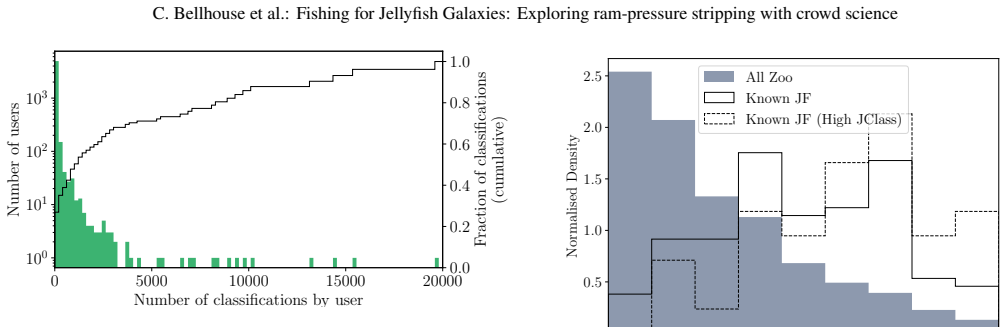
Aims: We present the first results of Fishing for Jellyfish Galaxies, a pilot citizen-science project using Zooniverse to identify galaxies undergoing ram-pressure stripping (RPS). Methods: Volunteers visually inspected colour images of late-type galaxies from the Dark Energy Camera Legacy Survey, from a sample of 49,703 galaxies selected within $4 \times R_{500}$ of clusters and groups, restricted to galaxies brighter than 19th magnitude in the g and r bands, and with a minimum half-light radius of 2 arcseconds, to aid classification. We detail our data processing, including debiasing classifications and optimising vote-fraction thresholds to maximise completeness and purity, calibrated against a ground-truth set of pre-labelled galaxies. Results: Our final catalogue contains 6739 jellyfish candidates (6621 new), 5430 merger candidates, and 29,729 undisturbed galaxies, with 3910 jellyfish exhibiting prominent tail-like morphologies. We find that the fraction of RPS candidates rises from ~10% in galaxy groups to ~20-30% in massive clusters, confirming the findings of previous studies carried out on smaller samples. For the subset of our RPS candidate sample with spectroscopic data, we measure a median clustercentric velocity 53% higher than the general cluster population, consistent with galaxies in early stages of accretion into the cluster. They are also typically late-type blue galaxies with elevated star-formation rates, in agreement with expectations. These results demonstrate that citizen scientists can reliably identify galaxies that undergo environmental processes. We provide the initial release of 37,599 visually classified galaxies as a resource for future studies of galaxy transformation in clusters.
Figures

Figures from the paper (8 more)


Reference graph
Works this paper leans on
-
[1]
A., Phillips, M
Baldwin, J. A., Phillips, M. M., & Terlevich, R. 1981, PASP, 93, 5
1981
-
[2]
P., Nichol, R
Bamford, S. P., Nichol, R. C., Baldry, I. K., et al. 2009, MNRAS, 393, 1324
2009
-
[3]
L., Smith, R., et al
Bellhouse, C., McGee, S. L., Smith, R., et al. 2021, MNRAS, 500, 1285
2021
-
[4]
2022, ApJ, 937, 18
Bellhouse, C., Poggianti, B., Moretti, A., et al. 2022, ApJ, 937, 18
2022
-
[5]
M., Jaffé, Y., et al
Biviano, A., Poggianti, B. M., Jaffé, Y., et al. 2024, ApJ, 965, 117
2024
-
[6]
L., Randall, S
Blanton, E. L., Randall, S. W., Clarke, T. E., et al. 2011, ApJ, 737, 99
2011
-
[7]
& Gavazzi, G
Boselli, A. & Gavazzi, G. 2006, PASP, 118, 517
2006
-
[8]
& Valtonen, M
Byrd, G. & Valtonen, M. 1990, ApJ, 350, 89
1990
Show all 58 references
-
[9]
2011, PASA, 28, 128 CidFernandes,R.,Stasińska,G.,Schlickmann,M.S.,etal.2010,MNRAS,403, 1036
Cameron, E. 2011, PASA, 28, 128 CidFernandes,R.,Stasińska,G.,Schlickmann,M.S.,etal.2010,MNRAS,403, 1036
2011
-
[10]
P., Jaffé, Y
Crossett, J. P., Jaffé, Y. L., McGee, S. L., et al. 2025, A&A, 694, A204
2025
-
[11]
J., Lang, D., et al
Dey, A., Schlegel, D. J., Lang, D., et al. 2019, AJ, 157, 168
2019
-
[12]
2006, A&A, 445, 805
Fasano, G., Marmo, C., Varela, J., et al. 2006, A&A, 445, 805
2006
-
[13]
2020, A&A, 638, A114
Finoguenov, A., Rykoff, E., Clerc, N., et al. 2020, A&A, 638, A114
2020
-
[14]
T., Honscheid, K., et al
Flaugher, B., Diehl, H. T., Honscheid, K., et al. 2015, AJ, 150, 150
2015
-
[15]
2016, MNRAS, 455, 2028
Fossati, M., Fumagalli, M., Boselli, A., et al. 2016, MNRAS, 455, 2028
2016
-
[16]
2014, MNRAS, 445, 175
Genel, S., Vogelsberger, M., Springel, V., et al. 2014, MNRAS, 445, 175
2014
-
[17]
M., Omizzolo, A., et al
George, K., Poggianti, B. M., Omizzolo, A., et al. 2024, A&A, 690, A337
2024
-
[18]
2025, A&A, 696, A228
Giunchi, E., Scarlata, C., Werle, A., et al. 2025, A&A, 696, A228
2025
-
[19]
2015, A&A, 581, A41
Gullieuszik, M., Poggianti, B., Fasano, G., et al. 2015, A&A, 581, A41
2015
-
[20]
Gunn, J. E. & Gott, III, J. R. 1972, ApJ, 176, 1
1972
-
[21]
2023, A&A, 675, A118 Jaffé, Y
Ignesti, A., Vulcani, B., Botteon, A., et al. 2023, A&A, 675, A118 Jaffé, Y. L., Poggianti, B. M., Moretti, A., et al. 2018, MNRAS, 476, 4753 Jaffé, Y. L., Smith, R., Candlish, G. N., et al. 2015, MNRAS, 448, 1715
2023
-
[22]
Kenney, J. D. P., van Gorkom, J. H., & Vollmer, B. 2004, AJ, 127, 3361
2004
-
[23]
P., Bellhouse, C., & McGee, S
Kolcu, T., Crossett, J. P., Bellhouse, C., & McGee, S. 2022, MNRAS, 515, 5877
2022
-
[24]
J., Schawinski, K., Slosar, A., et al
Lintott, C. J., Schawinski, K., Slosar, A., et al. 2008, MNRAS, 389, 1179 Lourenço, A. C. C., Jaffé, Y. L., Vulcani, B., et al. 2023, MNRAS, 526, 4831 Matijević, L., Tomičić, N., Marasco, A., et al. 2026, A&A, 707, A40
2008
-
[25]
2016, MNRAS, 455, 2994
McPartland, C., Ebeling, H., Roediger, E., & Blumenthal, K. 2016, MNRAS, 455, 2994
2016
-
[26]
1983, ApJ, 264, 24
Merritt, D. 1983, ApJ, 264, 24
1983
-
[27]
C., Bothun, G
Mihos, J. C., Bothun, G. D., & Richstone, D. O. 1993, ApJ, 418, 82 Moore,B.,Katz,N.,Lake,G.,Dressler,A.,&Oemler,A.1996,Nature,379,613
1993
-
[28]
F., Frenk, C
Navarro, J. F., Frenk, C. S., & White, S. D. M. 1996, ApJ, 462, 563
1996
-
[29]
M., et al
Peluso, G., Vulcani, B., Poggianti, B. M., et al. 2022, ApJ, 927, 130
2022
-
[30]
W., Pointecouteau, E., & Melin, J
Piffaretti, R., Arnaud, M., Pratt, G. W., Pointecouteau, E., & Melin, J. B. 2011, A&A, 534, A109
2011
-
[31]
M., Fasano, G., Omizzolo, A., et al
Poggianti, B. M., Fasano, G., Omizzolo, A., et al. 2016, AJ, 151, 78
2016
-
[32]
M., Ignesti, A., Gitti, M., et al
Poggianti, B. M., Ignesti, A., Gitti, M., et al. 2019, ApJ, 887, 155
2019
-
[33]
M., Vulcani, B., Tomicic, N., et al
Poggianti, B. M., Vulcani, B., Tomicic, N., et al. 2025, A&A, 699, A357 Raddick,M.J.,Bracey,G.,Gay,P.L.,etal.2013,arXive-prints,arXiv:1303.6886
2025 arXiv
-
[34]
2017, ApJ, 843, 128
Rhee, J., Smith, R., Choi, H., et al. 2017, ApJ, 843, 128
2017
-
[35]
Roberts, I. D. & Parker, L. C. 2020, MNRAS, 495, 554
2020
-
[36]
D., van Weeren, R
Roberts, I. D., van Weeren, R. J., Timmerman, R., et al. 2022, A&A, 658, A44 Roediger,E.,Brüggen,M.,Owers,M.S.,Ebeling,H.,&Sun,M.2014,MNRAS, 443, L114
2022
-
[37]
L., Smith, R., et al
Salinas, V., Jaffé, Y. L., Smith, R., et al. 2024, MNRAS, 533, 341 Sampaio,V.M.,Aragón-Salamanca,A.,Merrifield,M.R.,etal.2023,MNRAS, 524, 5327 Sampaio,V.M.,deCarvalho,R.R.,Aragón-Salamanca,A.,etal.2024,MNRAS, 532, 982 Sampaio,V.M.,deCarvalho,R.R.,Ferreras,I.,Aragón-Salamanca,A...
2024
-
[38]
2017, ApJ, 840, L7 Sifón, C., Finoguenov, A., Haines, C
Sheen, Y.-K., Smith, R., Jaffé, Y., et al. 2017, ApJ, 840, L7 Sifón, C., Finoguenov, A., Haines, C. P., et al. 2025, A&A, 697, A92
2017
-
[39]
2015, MNRAS, 452, 575
Sijacki, D., Vogelsberger, M., Genel, S., et al. 2015, MNRAS, 452, 575
2015
-
[40]
& Baade, W
Spitzer, Jr., L. & Baade, W. 1951, ApJ, 113, 413
1951
-
[41]
2000, MNRAS, 312, 859
Springel, V. 2000, MNRAS, 312, 859
2000
-
[42]
2020, ApJ, 905, L22
Stroe, A., Hussaini, M., Husemann, B., Sobral, D., & Tremblay, G. 2020, ApJ, 905, L22
2020
-
[43]
Stroe, A., Oosterloo, T., Röttgering, H. J. A., et al. 2015, MNRAS, 452, 2731
2015
-
[44]
2006, ApJ, 637, L81
Sun, M., Jones, C., Forman, W., et al. 2006, ApJ, 637, L81
2006
-
[45]
Tinsley, B. M. & Larson, R. B. 1979, MNRAS, 186, 503 Tomičić, N., Hughes, A., Kreckel, K., et al. 2018, ApJ, 869, L38
1979
-
[46]
1977, in Evolution of Galaxies and Stellar Populations, ed
Toomre, A. 1977, in Evolution of Galaxies and Stellar Populations, ed. B. M. Tinsley & R. B. G. Larson, D. Campbell (Yale University Observatory), 401 Article number, page 12 C. Bellhouse et al.: Fishing for Jellyfish Galaxies: Exploring ram-pressure stripping with crowd science
1977
-
[47]
1993, ApJ, 408, 57
Valluri, M. 1993, ApJ, 408, 57
1993
-
[48]
2014, MNRAS, 444, 1518
Vogelsberger, M., Genel, S., Springel, V., et al. 2014, MNRAS, 444, 1518
2014
-
[49]
Vollmer, B., Cayatte, V., Balkowski, C., & Duschl, W. J. 2001, ApJ, 561, 708
2001
-
[50]
M., Gullieuszik, M., et al
Vulcani, B., Poggianti, B. M., Gullieuszik, M., et al. 2018, ApJ, 866, L25
2018
-
[51]
M., Moretti, A., et al
Vulcani, B., Poggianti, B. M., Moretti, A., et al. 2021, ApJ, 914, 27
2021
-
[52]
M., Smith, R., et al
Vulcani, B., Poggianti, B. M., Smith, R., et al. 2022, ApJ, 927, 91
2022
-
[53]
2023, ApJ, 948, L15
Vulcani, B., Treu, T., Calabrò, A., et al. 2023, ApJ, 948, L15
2023
-
[54]
2022, MNRAS, 509, 3966
Walmsley, M., Lintott, C., Géron, T., et al. 2022, MNRAS, 509, 3966
2022
-
[55]
W., Lintott, C
Willett, K. W., Lintott, C. J., Bamford, S. P., et al. 2013, MNRAS, 435, 2835
2013
-
[56]
2010, AJ, 140, 1814
Yagi, M., Yoshida, M., Komiyama, Y., et al. 2010, AJ, 140, 1814
2010
-
[57]
G., Adelman, J., Anderson, Jr., J
York, D. G., Adelman, J., Anderson, Jr., J. E., et al. 2000, AJ, 120, 1579
2000
-
[58]
D., Pillepich, A., Rohr, E., & Nelson, D
Zinger, E., Joshi, G. D., Pillepich, A., Rohr, E., & Nelson, D. 2024, MNRAS, 527, 8257 Article number, page 13 A&A proofs:manuscript no. main Appendix A: Redshift of the cluster sample FigureA.1showsthedistributionofredshiftsoftheclusterscon- sidered in our sample, which is re...
2024
Reviewed August 3, 2026 · model on record in the stance chip above.
Discussion (0). Continue with ORCID to comment.