REVIEW 3 major objections 4 minor 78 references
A holomorphic Kolmogorov-Arnold network framework for solving elliptic problems on arbitrary 2D domains
T0 review · 3 major / 4 minor · reviewed 2026-08-06 · deepseek-v4-flash
Pith's one-line read The paper claims that holomorphic neural networks, extended via Vekua operators and Laurent-series/logarithmic-conjugation terms, solve Laplace, biharmonic, elasticity, and Helmholtz problems on arbitrary 2D domains with boundary-only…
desk verdict A genuinely useful PIHKAN and a clean Helmholtz demo, but the multiply-connected extension is oversold: the log-conjugation transfer to Table 1 is unproven and false for the biharmonic row. read the letter →
The pith
A machine-rendered reading of the paper's core claim, the machinery that carries it, and where it could break.
The reading
What carries the argument
The load-bearing object is the holomorphic representation of PDE solutions: for Laplace, biharmonic, linear elasticity, and Helmholtz, the unknown field is built from holomorphic potentials by formulas such as those in the paper's Table 1, so the PDE is satisfied by construction and only boundary conditions need to be learned. The new architecture PIHKAN replaces exponential-activation MLPs with Kolmogorov-Arnold layers whose trainable activations are monomials $\sum_{p=0}^{P} W_{p}z^{p}$, chosen because the monomials are $L^2$-orthogonal on the unit disc and on the unit circle, and it is stabilized by a variance-preserving weight initialization. The Helmholtz extension uses the Vekua operator $V_\beta[g](x)=g(x)-\int_0^1 \frac{J_1(\beta|x|\sqrt{1-t})}{2\sqrt{1-t}\beta|x|}g(tx)\,dt$, which maps harmonic functions to Helmholtz solutions. The multiply connected extension uses the logarithmic-conjugation and Laurent form $\phi_n(z)=\phi_{n,0}(z)+\sum_s \phi_{n,s}(1/(z-z_s))+\sum_s c_{n,s}\log(z-z_s)$, with trainable real coefficients $c_{n,s}$, so a single network plus small singular subnetworks covers each hole without domain decomposition.
What would settle it
Run the Laurent-based PIHKAN on Helmholtz or biharmonic problems over an annular or multi-hole domain with non-constant boundary data and compare against a high-resolution FEM reference; if the relative $L^2(\Omega)$ error does not converge toward the FEM solution as epochs, polynomial degree, and boundary points are increased, the claimed completeness of the log-term extension for non-Laplace problems is false.
Extended reading notes
Core claim
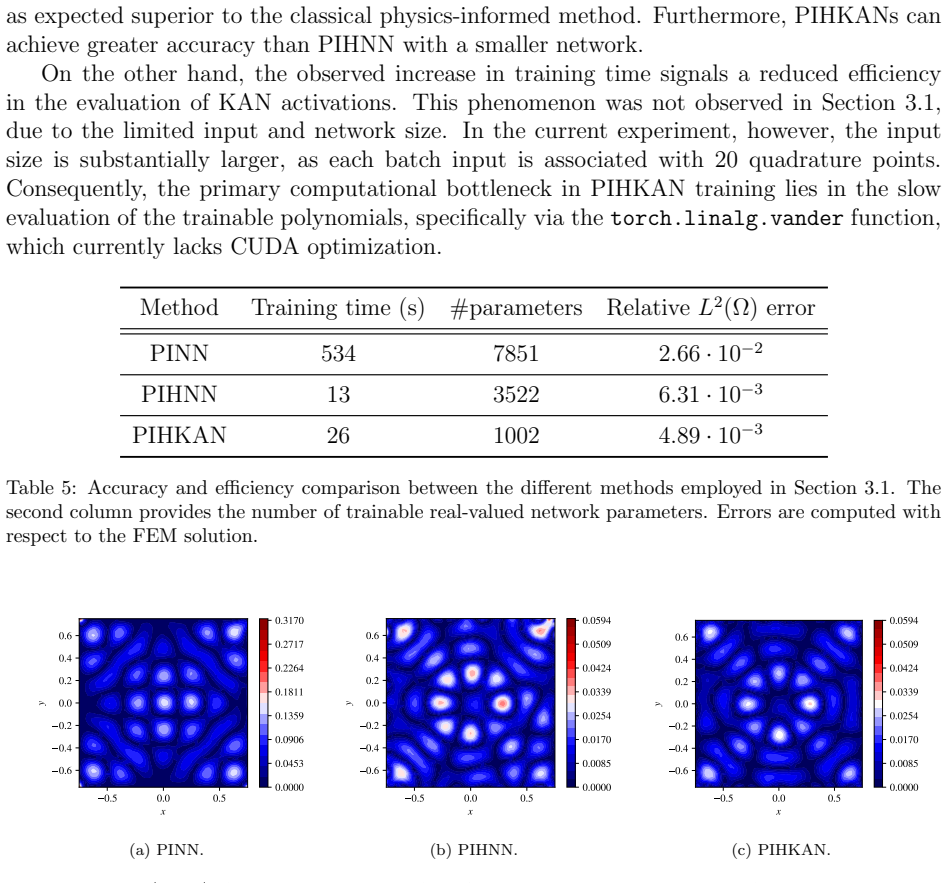
The central claim is that every 2D elliptic problem admitting a holomorphic potential representation — Laplace, biharmonic, linear elasticity, and now Helmholtz via the Vekua operator $V_\beta$ — can be solved by a holomorphic neural network trained only on the boundary, and that multiply connected domains are no longer a barrier. The paper introduces PIHKAN, a KAN whose trainable activations are complex monomials $\sum_{p=0}^{P} W_{p}z^{p}$, with an initialization that keeps variance near unity across layers, and augments each potential with terms $\sum_{s} c_{n,s}\log(z-z_s)$ and $\sum_{s} \phi_{n,s}(1/(z-z_s))$ to cover holes. In the reported tests PIHKAN reaches relative $L^2(\Omega)$ errors of $1.76\times10^{-2}$ on the L-shaped Laplace benchmark and $4.89\times10^{-3}$ on a Helmholtz square with wave number $\beta\approx18$, versus $1.18\times10^{-1}$ and $2.66\times10^{-2}$ for vanilla PINNs; on the multiply connected elasticity benchmark the Laurent-based PIHKAN reduces the $\sigma_{yy}$ error to $8.43\times10^{-3}$, where domain-decomposition PIHNN reaches $4.70\times10^{-2}$.
Load-bearing premise
The method relies on the assumption that the logarithmic-conjugation correction proven for harmonic functions also completes the complex-potential representations for biharmonic, linear-elasticity, and Helmholtz equations on domains with holes, an assumption the paper verifies numerically only for one symmetric linear-elasticity case.
Editorial extensions
If this is right
- On all tested benchmarks the holomorphic methods match or beat FEM reference accuracy using only boundary training points, so interior collocation becomes unnecessary for these elliptic PDE classes.
- PIHKAN reaches the reported accuracies with roughly half to one-third the parameters of the MLP-based PIHNN, implying similar savings should appear in any 2D problem with holomorphic potentials.
- The Laurent/log construction replaces domain decomposition for multiply connected domains, so holes, cracks, and inclusions can be handled by one base network plus small subnetworks per hole.
- The Vekua-operator route opens boundary-only training for wave problems, and the Helmholtz square test at $\beta\approx18$ shows acoustic benchmarks are within reach.
- Boundary-based residual adaptive sampling cuts the Laplace error from $1.76\times10^{-2}$ to $7.13\times10^{-3}$ at negligible extra cost, identifying adaptive boundary collocation as a cheap accuracy lever.
Reading between the lines
- The paper validates the Laurent/log construction on only one symmetric elasticity example; if the log-completion conjecture transfers, the same one-network construction should handle asymmetric multi-hole Helmholtz and biharmonic problems, which is a direct next experiment the paper leaves open.
- Because the PDE is hard-coded, inverse problems such as identifying hole location, shape, or boundary impedance from interior measurements would reduce to fitting a boundary/interior measurement loss; the paper does not explore this direction.
- The monomial-basis KAN inherits polynomial approximation theory, so for smooth potentials error should decay rapidly as the polynomial degree $P$ increases; this implies $P$-refinement may be a cheaper accuracy path than adding layers, which the paper does not demonstrate.
- The reported KAN-versus-MLP wall-clock gap is attributed to unoptimized evaluation of the polynomial activations; a closed-form or recurrence-based evaluation would likely close most of the gap, leaving PIHKAN both smaller and faster than PIHNN.
Editorial analysis
A structured set of objections, weighed in public.
Referee Report
Summary. The paper proposes three extensions to physics-informed holomorphic neural networks (PIHNNs): a Kolmogorov-Arnold variant called PIHKAN based on monomial (polynomial) activation functions; a Vekua-operator treatment of the 2D Helmholtz equation; and a Laurent-series/logarithmic-conjugation ansatz, Eq. (15)-(16), intended to remove the restriction of holomorphic networks to simply-connected domains. Numerical tests are reported for the Poisson/Laplace problem on an L-shaped domain, the Helmholtz equation on a square, and linear elasticity on a square with a circular hole, comparing PIHKAN, PIHNN, classical PINN, and FEM. The central claim is that holomorphic networks can now solve Laplace, biharmonic, elasticity, and Helmholtz problems on arbitrary multiply-connected 2D domains with boundary-only training and high accuracy.
Significance. If the mathematical claims were fully supported, the paper would make a valuable contribution to physics-informed machine learning: boundary-only training, hard PDE satisfaction, sharply smaller parameter counts, and an alternative to domain decomposition for multiply-connected geometries. The numerical study is reported with concrete hyperparameters, parameter counts, and FEM reference solutions, and the PIHKAN results on the three benchmarks show consistently lower relative L2 errors than the compared PINN/domain-decomposition baselines; the ablation study in Table 3 and the RAD experiment in Table 4 are useful additions. However, the multiply-connected extension -- the paper's headline novelty -- is not established for the biharmonic and Helmholtz rows of Table 1, and the single multiply-connected test does not exercise the logarithmic-conjugation terms at all. The central claim is therefore stronger than the evidence and mathematics in the manuscript support.
major comments (3)
- [Section 2.4, Eq. (16) and Table 1 (biharmonic row)] The assertion that applying Eq. (15) to each complex potential is sufficient to extend all representations in Table 1 to multiply-connected domains is false for the biharmonic equation. On the annulus 1<|z|<2, u(r)=r^2 log r is biharmonic. With z_s=0, the ansatz (16) generates terms of the form Re(zbar z^n) (radial only for n=1, giving r^2), Re(zbar z^{-k}) for k>=1 (all carrying angular factors e^{-i(k+1)theta}), and logarithmic terms whose real parts are log r or r theta sin theta; no combination, even with infinite Laurent series, produces the radial mode r^2 log r. The exact solution therefore lies outside the model class. A correct extension needs additional multivalued potentials (for example z log z in phi_1) or a separate biharmonic logarithmic-conjugation theorem with proof; the sentence 'Since all representations in Table 1 stem from the holomorphic characterization of harmonic functions' does not supply this.
- [Section 2.4, Eq. (3) (Helmholtz row)] For the Helmholtz equation, the claimed transfer to multiply-connected domains is unsupported. The Vekua operator in Eq. (3) integrates g(tx) along the segment from 0 to x; if the domain is not star-shaped with respect to the chosen origin, or if the origin lies inside a hole, the integral samples points outside Omega and the formula is not defined. The paper includes no multiply-connected Helmholtz test and no modification of the Vekua operator for such domains. Moreover, Eq. (2) requires the image of F* to equal the kernel of F, so the Helmholtz representation needs a concrete surjectivity statement; Section 4 itself notes that 'little is known' about whether the Vekua map is surjective. The authors should either state the precise hypotheses from [44] under which surjectivity holds or explicitly restrict the Helmholtz claim to simply-connected (e.g., star-shaped) domains.
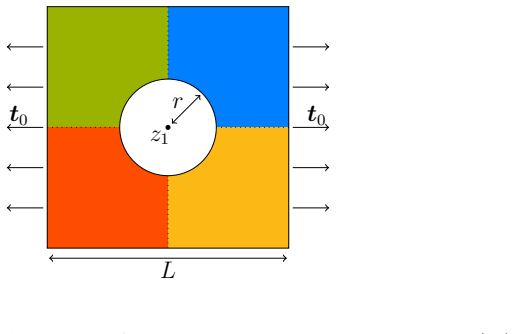
- [Section 3.3, Table 6] The only multiply-connected numerical experiment, the centered-hole elasticity benchmark, does not validate the logarithmic-conjugation part of the proposed method. For this symmetric problem with a self-equilibrated traction system, the Kolosov-Muskhelishvili potentials are single-valued and no log(z-z_s) term is active; the Laurent ansatz is exercised only through the negative powers 1/(z-z_1). Table 6 therefore demonstrates that negative powers help here, but it gives no evidence that Eq. (15) transfers Axler's theorem to elasticity, let alone to the biharmonic and Helmholtz rows. A test in which log terms are genuinely required (for plate bending with a hole, or an elasticity problem with nonzero resultant force) would be needed to support the central claim.
minor comments (4)
- [Table 5 caption] The caption of Table 5 says 'comparison between the different methods employed in Section 3.1', but the table reports the Helmholtz experiment of Section 3.2.
- [Table 1 and Section 3.3] In the displayed Kolosov-Muskhelishvili formulas, the complex-conjugate bars appear to be missing: the standard displacement formula has kappa phi_1 - z \overline{phi_1'} - \overline{phi_2}, not kappa phi_1 - z phi_1' - phi_2. If the bars are present in the typeset version, the plain-text rendering is misleading; if they are absent, the formulas are incorrect.
- [Section 2.4, Eq. (16)] The phrase that z_s 'should be chosen as the most internal point of B_s' is ambiguous for non-circular holes; the operative mathematical requirement is that the Laurent expansion with center z_s converges on the annular region between the hole and the outer boundary, which depends on the distance to the boundary of the hole, not just on a point selected inside it.
- [Section 2.3] The paper gives no universal-approximation statement for PIHKANs. For the method to be a convergent solver as network size grows, the ansatz class must be dense in the relevant holomorphic function spaces; for polynomial activations this can presumably be obtained from polynomial/Runge approximation, but the assumption is not stated in the manuscript.
Circularity Check
No significant circularity: representations are external, training is boundary-only, and FEM is the independent reference.
full rationale
The derivation chain is self-contained with respect to its inputs. The holomorphic representations in Table 1 (Goursat, Kolosov–Muskhelishvili, Vekua) are taken from external classical references, and the Vekua operator for Helmholtz is attributed to Moiola et al.; none of these representations is derived from the paper's own fitted quantities. PIHNN/PIHKAN training enforces Equation (2) as a hard constraint and minimizes only the boundary residual in Equation (9), so the reported L2 errors are computed against independent FEM solutions rather than recovered from training data. The architecture contribution (monomial PIHKAN layer, Eq. (12)) is a genuine representation choice; its universal approximation property is cited from external work, and its weight initialization is a heuristic derivation, neither of which makes the benchmark results true by definition. Self-citations to Calafà et al. [30, 31] appear only as prior-baseline context (e.g., 'as already expected from Calafà et al. [30]' and the replicated Section 4.1.2 benchmark), and the multiply-connected benchmark is validated against FEM; no load-bearing claim reduces to these citations. The main mathematical weakness, the unproved transfer of Axler's logarithmic-conjugation theorem to the biharmonic, elasticity, and Helmholtz rows in Section 2.4, is a correctness/completeness concern rather than a circularity: the paper asserts the transfer by analogy ('Since all representations in Table 1 stem from the holomorphic characterization of harmonic functions'), but this assertion is not established by defining the conclusion into the premise. It should be scored as a correctness risk, not as a circular step.
Assumptions & free parameters
free parameters (1)
- z_s (Laurent expansion centers) =
origin (center of the circular hole) in Section 3.3
assumptions (4)
- standard math Axler's logarithmic conjugation theorem: every harmonic function on a multiply connected domain can be written as Re(phi) + sum c_s log|z - z_s|
- domain assumption The Vekua operator V_beta maps harmonic functions onto solutions of the Helmholtz equation with sufficient completeness for boundary training
- ad hoc to paper The logarithmic-conjugation correction extends unchanged to biharmonic, elasticity, and Helmholtz representations in Table 1
- domain assumption Inputs after normalization are approximately standard complex Gaussian, used to derive the PIHKAN weight initialization
Cite this review
Pith. "Pith review of A holomorphic Kolmogorov-Arnold network framework for solving elliptic problems on arbitrary 2D domains." pith.science (2026). https://pith.science/paper/ERI4JNV4
@misc{pith2026250722678,
  author       = {Pith},
  title        = {Pith review of: A holomorphic Kolmogorov-Arnold network framework for solving elliptic problems on arbitrary 2D domains},
  year         = {2026},
  howpublished = {\url{https://pith.science/paper/ERI4JNV4}},
  note         = {Machine review of arXiv:2507.22678}
}
read the original abstract
Physics-informed holomorphic neural networks (PIHNNs) have recently emerged as efficient surrogate models for solving differential problems. By embedding the underlying problem structure into the network, PIHNNs require training only to satisfy boundary conditions, often resulting in significantly improved accuracy and computational efficiency compared to traditional physics-informed neural networks (PINNs). In this work, we improve and extend the application of PIHNNs to two-dimensional problems. First, we introduce a novel holomorphic network architecture based on the Kolmogorov-Arnold representation (PIHKAN), which achieves higher accuracy with reduced model complexity. Second, we develop mathematical extensions that broaden the applicability of PIHNNs to a wider class of elliptic partial differential equations, including the Helmholtz equation. Finally, we propose a new method based on Laurent series theory that enables the application of holomorphic networks to multiply-connected plane domains, thereby removing the previous limitation to simply-connected geometries.
Figures


Figures from the paper (9 more)




Reference graph
Works this paper leans on
-
[44]
Andrea Moiola, Ralf Hiptmair, and Ilaria Perugia. Vekua theory for the helmholtz operator.Zeitschrift f¨ ur angewandte Mathematik und Physik, 62(5):779–807, 2011. doi: 10.1007/s00033-011-0142-3. 26
-
[1]
Deep learning.nature, 521(7553): 436–444, 2015
Yann LeCun, Yoshua Bengio, and Geoffrey Hinton. Deep learning.nature, 521(7553): 436–444, 2015. doi: 10.1038/nature14539
- [2]
-
[3]
George Cybenko. Approximation by superpositions of a sigmoidal function.Mathemat- ics of control, signals and systems, 2(4):303–314, 1989. doi: 10.1007/BF02551274
-
[4]
Physics-informed machine learning.Nature Reviews Physics, 3(6):422–440,
George Em Karniadakis, Ioannis G Kevrekidis, Lu Lu, Paris Perdikaris, Sifan Wang, and Liu Yang. Physics-informed machine learning.Nature Reviews Physics, 3(6):422–440,
-
[5]
Hyuk Lee and In Seok Kang. Neural algorithm for solving differential equations.Journal of Computational Physics, 91(1):110–131, 11 1990. ISSN 0021-9991. doi: 10.1016/ 0021-9991(90)90007-N
work page 1990
-
[6]
Dimitris C. Psichogios and Lyle H. Ungar. A hybrid neural network-first principles approach to process modeling.AIChE Journal, 38(10):1499–1511, 1992. doi: 10.1002/ aic.690381003
work page 1992
-
[7]
M. W. M. G. Dissanayake and Nhan Phan-Thien. Neural-network-based approximations for solving partial differential equations.Communications in Numerical Methods in Engineering, 10(3):195–201, 1994. doi: doi.org/10.1002/cnm.1640100303
Show all 78 references
-
[8]
A. J. Meade and A. A. Fernandez. Solution of nonlinear ordinary differential equations by feedforward neural networks.Mathematical and Computer Modelling, 20(9):19–44, 11 1994. ISSN 0895-7177. doi: 10.1016/0895-7177(94)00160-X
1994 doi
-
[9]
A. J. Meade and A. A. Fernandez. The numerical solution of linear ordinary differential equations by feedforward neural networks.Mathematical and Computer Modelling, 19 (12):1–25, 6 1994. ISSN 0895-7177. doi: 10.1016/0895-7177(94)90095-7. 23
1994 doi
-
[10]
Artificial neural networks for solving ordinary and partial differential equations.IEEE Transactions on Neural Networks, 9(5):987–1000, 1998
Isaac E Lagaris, Aristidis Likas, and Dimitrios I Fotiadis. Artificial neural networks for solving ordinary and partial differential equations.IEEE Transactions on Neural Networks, 9(5):987–1000, 1998. doi: 10.1109/72.712178
1998 doi
-
[11]
Karniadakis
Maziar Raissi, Paris Perdikaris, and George E. Karniadakis. Physics-informed neural networks: A deep learning framework for solving forward and inverse problems involving nonlinear partial differential equations.Journal of Computational physics, 378:686–707,
-
[12]
Scientific machine learning through physics–informed neural networks: Where we are and what’s next.Journal of Scientific Computing, 92 (3):88, 2022
Salvatore Cuomo, Vincenzo Schiano Di Cola, Fabio Giampaolo, Gianluigi Rozza, Maziar Raissi, and Francesco Piccialli. Scientific machine learning through physics–informed neural networks: Where we are and what’s next.Journal of Scientific Computing, 92 (3):88, 2022. doi: 10.100...
2022 doi
- [13]
-
[14]
On the representation of continuous functions of many variables by superposition of continuous functions of one variable and addition
Andrei Nikolaevich Kolmogorov. On the representation of continuous functions of many variables by superposition of continuous functions of one variable and addition. In Doklady Akademii Nauk, volume 114, pages 953–956. Russian Academy of Sciences, 1957
1957
-
[15]
Kolmogorov- Arnold networks (KANs) for time series analysis.arXiv preprint, 2024
Cristian J Vaca-Rubio, Luis Blanco, Roberto Pereira, and M` arius Caus. Kolmogorov- Arnold networks (KANs) for time series analysis.arXiv preprint, 2024. doi: 10.48550/ arXiv.2405.08790
2024 doi
-
[16]
Mohamed Abd Elaziz, Ibrahim Ahmed Fares, and Ahmad O. Aseeri. CKAN: Convolu- tional Kolmogorov–Arnold networks model for intrusion detection in IoT environment. IEEE Access, 12:134837–134851, 2024. doi: 10.1109/ACCESS.2024.3462297
2024
- [17]
-
[18]
Kolmogorov-Arnold networks for time series: Bridging predictive power and interpretability.arXiv preprint, 2024
Kunpeng Xu, Lifei Chen, and Shengrui Wang. Kolmogorov-Arnold networks for time series: Bridging predictive power and interpretability.arXiv preprint, 2024. doi: 10. 48550/arXiv.2406.02496
-
[19]
Zhaoyang Zhang, Qingwang Wang, Yinxing Zhang, Tao Shen, and Weiyi Zhang. Physics-informed neural networks with hybrid Kolmogorov-Arnold network and aug- mented Lagrangian function for solving partial differential equations.Scientific Reports, 15(1):10523, 2025. doi: 10.1038/s4...
2025 doi
-
[20]
Kolmogorov-Arnold networks (KAN) for time series classification and robust analysis
Chang Dong, Liangwei Zheng, and Weitong Chen. Kolmogorov-Arnold networks (KAN) for time series classification and robust analysis. InInternational Confer- ence on Advanced Data Mining and Applications, pages 342–355. Springer, 2024. doi: 10.1007/978-981-96-0840-9 24. 24
2024 doi
-
[21]
B-spline signal processing
Michael Unser, Akram Aldroubi, and Murray Eden. B-spline signal processing. I. The- ory.IEEE transactions on signal processing, 41(2):821–833, 1993. doi: 10.1109/78. 193220
1993 doi
- [22]
- [23]
-
[24]
Chebyshev polynomial-based Kolmogorov- Arnold networks: An efficient architecture for nonlinear function approximation.arXiv preprint, 2024
Sidharth SS, Keerthana A R, and Anas KP. Chebyshev polynomial-based Kolmogorov- Arnold networks: An efficient architecture for nonlinear function approximation.arXiv preprint, 2024. doi: 10.48550/arXiv.2405.07200
-
[25]
Deepokan: Deep operator network based on Kolmogorov arnold networks for mechanics problems.Computer Methods in Applied Mechanics and Engineering, 436:117699, 2025
Diab W Abueidda, Panos Pantidis, and Mostafa E Mobasher. Deepokan: Deep operator network based on Kolmogorov arnold networks for mechanics problems.Computer Methods in Applied Mechanics and Engineering, 436:117699, 2025. doi: 10.1016/j.cma. 2024.117699
2025
-
[26]
Learning nonlinear operators via DeepONet based on the universal approxi- mation theorem of operators.Nature machine intelligence, 3(3):218–229, 2021
Lu Lu, Pengzhan Jin, Guofei Pang, Zhongqiang Zhang, and George Em Karni- adakis. Learning nonlinear operators via DeepONet based on the universal approxi- mation theorem of operators.Nature machine intelligence, 3(3):218–229, 2021. doi: 10.1038/s42256-021-00302-5
2021 doi
-
[27]
From PINNs to PIKANs: Recent advances in physics-informed machine learning.Machine Learning for Compu- tational Science and Engineering, 1(1):1–43, 2025
Juan Diego Toscano, Vivek Oommen, Alan John Varghese, Zongren Zou, Nazanin Ah- madi Daryakenari, Chenxi Wu, and George Em Karniadakis. From PINNs to PIKANs: Recent advances in physics-informed machine learning.Machine Learning for Compu- tational Science and Engineering, 1(1):...
2025 doi
-
[28]
Khemraj Shukla, Juan Diego Toscano, Zhicheng Wang, Zongren Zou, and George Em Karniadakis. A comprehensive and F AIR comparison between MLP and KAN rep- resentations for differential equations and operator networks.Computer Methods in Applied Mechanics and Engineering, 431:117...
2024
-
[29]
Benjamin C Koenig, Suyong Kim, and Sili Deng. KAN-ODEs: Kolmogorov–Arnold network ordinary differential equations for learning dynamical systems and hidden physics.Computer Methods in Applied Mechanics and Engineering, 432:117397, 2024. doi: 10.1016/j.cma.2024.117397
2024
-
[30]
Engsig-Karup, and Tito Andriollo
Matteo Calaf` a, Emil Hovad, Allan P. Engsig-Karup, and Tito Andriollo. Physics- informed holomorphic neural networks (PIHNNs): Solving 2D linear elasticity prob- lems.Computer Methods in Applied Mechanics and Engineering, 432:117406, 2024. ISSN 0045-7825. doi: 10.1016/j.cma.2...
2024
-
[31]
Solving plane crack prob- lems via enriched holomorphic neural networks.Engineering Fracture Mechanics, page 111133, 2025
Matteo Calaf` a, Henrik Myhre Jensen, and Tito Andriollo. Solving plane crack prob- lems via enriched holomorphic neural networks.Engineering Fracture Mechanics, page 111133, 2025. doi: 10.1016/j.engfracmech.2025.111133. 25
2025
-
[32]
Higher Mathematics Series
Walter Rudin.Real and Complex Analysis. Higher Mathematics Series. McGraw-Hill, 3 edition, 1987. ISBN 0070542341
1987
-
[33]
E. Goursat. Sur l’´ equation ∆∆u= 0.Bulletin de la Soci´ et´ e Math´ ematique de France, 26:236–237, 1898
-
[34]
Antony P. S. Selvadurai.Partial differential equations in mechanics 2: The Biharmonic equation, Poisson’s equation. Springer Science & Business Media, 2013. ISBN 978-3- 540-67284-5. doi: 10.1007/978-3-662-09205-7
2013 doi
-
[35]
Gould and Yuan Feng.Introduction to linear elasticity, volume 2
Phillip L. Gould and Yuan Feng.Introduction to linear elasticity, volume 2. Springer,
-
[36]
Gury V. Kolosov. On an application of complex function theory to a plane problem of the mathematical theory of elasticity.Yuriev, Russia, 1909
1909
-
[37]
Noordhoff Groningen, 1977
Nikola ˘ ı Ivanovich Muskhelishvili.Some basic problems of the mathematical theory of elasticity. Noordhoff Groningen, 1977. ISBN 978-90-481-8245-9. doi: 10.1007/ 978-94-017-3034-1
1977
-
[38]
An iterative method for the Helmholtz equation.Journal of Computational Physics, 49(3):443–457, 1983
Alvin Bayliss, Charles I Goldstein, and Eli Turkel. An iterative method for the Helmholtz equation.Journal of Computational Physics, 49(3):443–457, 1983. doi: 10.1016/0021-9991(83)90139-0
1983 doi
-
[39]
Helmholtz equation–least-squares method for recon- structing the acoustic pressure field.The Journal of the Acoustical Society of America, 102(4):2020–2032, 1997
Zhaoxi Wang and Sean F Wu. Helmholtz equation–least-squares method for recon- structing the acoustic pressure field.The Journal of the Acoustical Society of America, 102(4):2020–2032, 1997. doi: 10.1016/0898-1221(85)90162-2
2020 doi
-
[40]
A fast method for the solution of the Helmholtz equation.Journal of Computational Physics, 230(12):4403–4418, 2011
Eldad Haber and Scott MacLachlan. A fast method for the solution of the Helmholtz equation.Journal of Computational Physics, 230(12):4403–4418, 2011. doi: 10.1016/j. jcp.2011.01.015
2011 doi
-
[41]
WORLD SCIENTIFIC, 1991
Robert G Dean and Robert A Dalrymple.Water Wave Mechanics for Engineers and Scientists. WORLD SCIENTIFIC, 1991. doi: 10.1142/1232
1991 doi
-
[42]
Boundary integrated neural networks and code for acoustic radiation and scattering.International Journal of Mechanical System Dynamics, 4(2):131–141, 2024
Wenzhen Qu, Yan Gu, Shengdong Zhao, Fajie Wang, and Ji Lin. Boundary integrated neural networks and code for acoustic radiation and scattering.International Journal of Mechanical System Dynamics, 4(2):131–141, 2024. doi: 10.1002/msd2.12109
2024 doi
-
[43]
Boundary integral neural networks for acoustic radiation prediction from noisy boundary data
Johannes D Schmid, Simone Preuss, Lukas Maicher, and Steffen Marburg. Boundary integral neural networks for acoustic radiation prediction from noisy boundary data. Journal of Theoretical and Computational Acoustics, 2440002:36, 2025. doi: 10.1142/ S2591728524400024
2025
-
[45]
I. N. Vekua.New Methods for Solving Elliptic Equations. North-Holland Series in Applied Mathematics & Mechanics. Elsevier Science Publishing Co Inc., 1967. ISBN 9780720423532
1967
-
[46]
A survey of i
Peter Henrici. A survey of i. n. vekua’s theory of elliptic partial differential equations with analytic coefficients.Zeitschrift f¨ ur angewandte Mathematik und Physik ZAMP, 8 (3):169–203, 1957. doi: 10.1007/BF01600500
1957 doi
-
[47]
Anastassiou
George A. Anastassiou. Univariate hyperbolic tangent neural network approximation. Mathematical and Computer Modelling, 53(5-6):1111–1132, 2011. doi: 10.1016/j.mcm. 2010.11.072
2011 doi
-
[48]
Convergence analysis of two-layer neural networks with ReLU activation.Advances in neural information processing systems, 30, 2017
Yuanzhi Li and Yang Yuan. Convergence analysis of two-layer neural networks with ReLU activation.Advances in neural information processing systems, 30, 2017
2017
-
[49]
The influence of the sigmoid function parameters on the speed of backpropagation learning
Jun Han and Claudio Moraga. The influence of the sigmoid function parameters on the speed of backpropagation learning. InInternational workshop on artificial neural networks, pages 195–201. Springer, 1995. doi: 10.1007/3-540-59497-3 175
1995 doi
-
[50]
An extension of the back-propagation algorithm to complex numbers
Tohru Nitta. An extension of the back-propagation algorithm to complex numbers. Neural Networks, 10(8):1391–1415, 1997. doi: 10.1016/S0893-6080(97)00036-1
1997 doi
-
[51]
Studies in Computational Intelligence
Akira Hirose.Complex-Valued Neural Networks. Studies in Computational Intelligence. Springer, 2 edition, 2012. ISBN 978-3-642-27632-3. doi: 10.1007/978-3-642-27632-3
2012 doi
-
[52]
Deep complex networks.arXiv preprint, 2017
Chiheb Trabelsi, Olexa Bilaniuk, Ying Zhang, Dmitriy Serdyuk, Sandeep Subramanian, Joao Felipe Santos, Soroush Mehri, Negar Rostamzadeh, Yoshua Bengio, and Christo- pher J Pal. Deep complex networks.arXiv preprint, 2017. doi: 10.48550/arXiv.1705. 09792
2017 doi
- [53]
-
[54]
On the limited memory BFGS method for large scale op- timization.Mathematical programming, 45(1):503–528, 1989
Dong C Liu and Jorge Nocedal. On the limited memory BFGS method for large scale op- timization.Mathematical programming, 45(1):503–528, 1989. doi: 10.1007/BF01589116
1989 doi
-
[55]
Zur formalen theorie der funktionen von mehr komplexen ver¨ anderlichen.Mathematische Annalen, 97(1):357–375, 1927
Wilhelm Wirtinger. Zur formalen theorie der funktionen von mehr komplexen ver¨ anderlichen.Mathematische Annalen, 97(1):357–375, 1927. doi: 10.1007/ BF01447872
1927
-
[56]
Springer Nature Switzerland, Cham, 2024
Josiah Park and Stephan Wojtowytsch.Qualitative Neural Network Approximation over R and C: Elementary Proofs for Analytic and Polynomial Activation, chapter 3, pages 31–64. Springer Nature Switzerland, Cham, 2024. ISBN 978-3-031-66497-7. doi: 10.1007/978-3-031-66497-7 3
2024 doi
-
[57]
Gentile, Mario Dagrada, Chul Lee, Seong-Hyok S
Atiyo Ghosh, Antonio A. Gentile, Mario Dagrada, Chul Lee, Seong-Hyok S. Kim, Hyukgeun Cha, Yunjun Choi, Dongho Kim, Jeong-Il Kye, and Vincent E. Elfving. Harmonic neural networks. InInternational Conference on Machine Learning, pages 11340–11359. PMLR, 2023. doi: 10.5555/36184...
2023
-
[58]
A review on weight initialization strategies for neural networks.Artificial intelligence review, 55(1):291–322,
Meenal V Narkhede, Prashant P Bartakke, and Mukul S Sutaone. A review on weight initialization strategies for neural networks.Artificial intelligence review, 55(1):291–322,
-
[59]
Understanding the difficulty of training deep feed- forward neural networks
Xavier Glorot and Yoshua Bengio. Understanding the difficulty of training deep feed- forward neural networks. InProceedings of the thirteenth international conference on artificial intelligence and statistics, pages 249–256. JMLR Workshop and Conference Proceedings, 2010
2010
-
[60]
Delving deep into rectifiers: Surpassing human-level performance on imagenet classification
Kaiming He, Xiangyu Zhang, Shaoqing Ren, and Jian Sun. Delving deep into rectifiers: Surpassing human-level performance on imagenet classification. InProceedings of the IEEE international conference on computer vision, pages 1026–1034, 2015. doi: 10. 1109/ICCV.2015.123
2015
-
[61]
Importance of input data normalization for the applica- tion of neural networks to complex industrial problems.IEEE Transactions on nuclear science, 44(3):1464–1468, 1997
Jorge Sola and Joaquin Sevilla. Importance of input data normalization for the applica- tion of neural networks to complex industrial problems.IEEE Transactions on nuclear science, 44(3):1464–1468, 1997. doi: 10.1109/23.589532
1997 doi
-
[62]
Anderson.Fracture mechanics: fundamentals and applications
Ted L. Anderson.Fracture mechanics: fundamentals and applications. CRC press, 2017. ISBN 9781315370293. doi: 10.1201/9781315370293
2017 doi
-
[63]
Jagtap and George Em Karniadakis
Ameya D. Jagtap and George Em Karniadakis. Extended physics-informed neural net- works (XPINNs): A generalized space-time domain decomposition based deep learning framework for nonlinear partial differential equations.Communications in Computa- tional Physics, 28(5), 11 2020. ...
2020 doi
-
[64]
Harmonic functions from a complex analysis viewpoint.The American mathematical monthly, 93(4):246–258, 1986
Sheldon Axler. Harmonic functions from a complex analysis viewpoint.The American mathematical monthly, 93(4):246–258, 1986. doi: 10.1080/00029890.1986.11971799
1986
-
[65]
Howie.Laurent Series and the Residue Theorem, chapter 8, pages 137–
John M. Howie.Laurent Series and the Residue Theorem, chapter 8, pages 137–
-
[66]
PyTorch: An imperative style, high-performance deep learning library.Advances in neural infor- mation processing systems, 32, 2019
Adam Paszke, Sam Gross, Francisco Massa, Adam Lerer, James Bradbury, Gregory Chanan, Trevor Killeen, Zeming Lin, Natalia Gimelshein, Luca Antiga, et al. PyTorch: An imperative style, high-performance deep learning library.Advances in neural infor- mation processing systems, 32...
2019
-
[67]
New development in FreeFem++.Journal of numerical mathematics, 20(3-4):251–266, 2012
Fr´ ed´ eric Hecht. New development in FreeFem++.Journal of numerical mathematics, 20(3-4):251–266, 2012. doi: 10.1515/jnum-2012-0013
2012 doi
-
[68]
Zhiping Mao and Xuhui Meng. Physics-informed neural networks with residual/gradient-based adaptive sampling methods for solving partial differential equa- tions with sharp solutions.Applied Mathematics and Mechanics, 44(7):1069–1084, 2023. doi: 10.1007/s10483-023-2994-7
2023 doi
-
[69]
Separable physics-informed neural networks
Junwoo Cho, Seungtae Nam, Hyunmo Yang, Seok-Bae Yun, Youngjoon Hong, and Eunbyung Park. Separable physics-informed neural networks. In A. Oh, T. Naumann, 28 A. Globerson, K. Saenko, M. Hardt, and S. Levine, editors,Advances in Neural In- formation Processing Systems, volume 36...
2023
-
[70]
DeepXDE: A deep learning library for solving differential equations.SIAM Review, 63(1):208–228, 2021
Lu Lu, Xuhui Meng, Zhiping Mao, and George Em Karniadakis. DeepXDE: A deep learning library for solving differential equations.SIAM Review, 63(1):208–228, 2021. doi: 10.1137/19M1274067
2021 doi
-
[71]
A comparison between multilayer perceptrons and Kolmogorov-Arnold networks for multi-task classification in sitting posture recognition
David Carneros-Prado, Luis Caba˜ nero-G´ omez, Esperanza Johnson, Iv´ an Gonz´ alez, Jes´ us Fontecha, and Ram´ on Herv´ as. A comparison between multilayer perceptrons and Kolmogorov-Arnold networks for multi-task classification in sitting posture recognition. IEEE Access, 20...
2024
-
[72]
Chenxi Wu, Min Zhu, Qinyang Tan, Yadhu Kartha, and Lu Lu. A comprehensive study of non-adaptive and residual-based adaptive sampling for physics-informed neural networks.Computer Methods in Applied Mechanics and Engineering, 403:115671, 2023. doi: 10.1016/j.cma.2022.115671. 29
2023
-
[152]
ISBN 978-1-4471-0027-0
Springer London, London, 2003. ISBN 978-1-4471-0027-0. doi: 10.1007/ 978-1-4471-0027-0 8
2003
- [1994]
-
[2011]
doi: 10.1007/978-3-030-42227-1
-
[2019]
doi: 10.1016/j.jcp.2018.10.045
2018 doi
-
[2021]
doi: 10.1038/s42254-021-00314-5
-
[2022]
doi: 10.1007/s10462-021-10033-z
Reviewed August 6, 2026 · model on record in the stance chip above.
Discussion (0). Continue with ORCID to comment.