REVIEW 2 major objections 5 minor 66 references
Morph: ChirpTransformer-based Encoder-decoder Co-design for Reliable LoRa Communication
T0 review · 2 major / 5 minor · reviewed 2026-08-06 · deepseek-v4-flash
Pith's one-line read Morph claims LoRa symbols can be decoded 6.4 dB below the SF-12 noise limit by encoding data in the spreading factor itself and classifying it with a neural network.
desk verdict Solid co-design with a strong ablation, but the headline 6.4 dB SNR gain is measured against synthetic AWGN, not the real channel. read the letter →
The pith
A machine-rendered reading of the paper's core claim, the machinery that carries it, and where it could break.
The reading
What carries the argument
The load-bearing object is the SF-configuration-based Morph symbol: a fixed-duration interval (the period of an SF-12 chirp, $2^{12}/BW$ seconds at 125 kHz) filled by base up-chirps from one of four spreading factors, so that the symbol's time-frequency pattern encodes 2 bits. The decoder's job is a 4-class classification of that pattern from a coarse STFT spectrogram (64 frequency bins by 129 time samples), using a bidirectional GRU and convolutional mask generator pruned by L1-norm weight selection. On the transmitter side, the enabler is the ChangeChannelFhss hardware interrupt of the SX1278 radio, which lets a COTS node change its spreading factor between adjacent symbols of one packet; the paper keeps the hopping frequency constant so the packet stays on a single channel. These pieces work together to turn the 'how many bits per symbol' tradeoff into a machine-learning margin: a longer effective chirp duration is not needed because the classifier can separate four chirp-rate patterns below the noise floor.
What would settle it
Run Morph over the air with a calibrated attenuator set so that the received SNR is near -28.8 dB and no synthetic noise is injected; if the measured symbol error rate at that SNR exceeds 1%, the claimed threshold is not reproduced.
Extended reading notes
Core claim
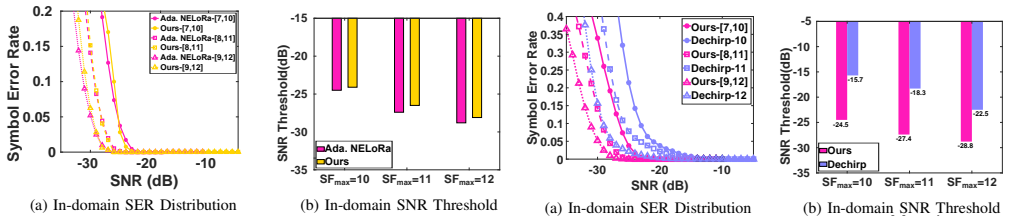
The paper's central claim is that LoRa reliability at extremely low SNR can be extended by co-designing the encoder and decoder: the transmitter encodes data in the spreading-factor configuration of a symbol rather than only in its initial frequency, and a neural decoder classifies that configuration. Morph symbols use four SF configurations (e.g., SF-9, SF-10, SF-11, SF-12) to represent 2-bit data, with every symbol lasting exactly as long as an SF-12 chirp, so the data rate approximates that of an SF-15 chirp while the encoder stays compatible with off-the-shelf SX1278 LoRa nodes through the standard frequency-hopping interrupt. The decoder turns each symbol into a coarse STFT spectrogram and runs a lightweight convolutional/GRU network to recognize the SF configuration, replacing the 4096-class problem of standard LoRa with a 4-class problem. The paper reports a symbol error rate below 1% down to -28.8 dB SNR, 6.4 dB lower than the -22.4 dB threshold of standard SF-12 dechirp decoding, with the decoder using 3.14x less memory than NELoRa and 4.77x faster inference than an adapted NELoRa model. On a 20-location NLoS campus deployment, the preamble detector keeps packet loss below 6% at every location, whereas standard LoRa loses more than 90% of packets at half of them.
Load-bearing premise
The claimed -28.8 dB threshold is measured on clean recordings with synthetic white noise added in software, and the real-world gain depends on that synthetic noise behaving like genuine weak-signal conditions such as fading, interference, and clock offsets.
Editorial extensions
If this is right
- A LoRa link that standard SF-12 cannot decode below -22.4 dB SNR becomes usable down to -28.8 dB, extending the coverage area by about 2.38x under the urban link model the paper cites.
- Existing SX1278-family nodes can adopt Morph without hardware changes because the encoder only uses the standard frequency-hopping interrupt to switch spreading factors between symbols.
- The 4-class neural decoder runs in 17.19 MB and takes 0.26 s per symbol on a Raspberry Pi, so real-time decoding fits on a local gateway rather than requiring cloud offload.
- At the campus-scale NLoS deployment, Morph's preamble detection kept packet loss below 6% at all 20 locations, while standard LoRa lost over 90% of packets at 10 of them.
Reading between the lines
- Not directly tested in the paper: an over-the-air sweep with calibrated attenuation would separate the encoder's true SNR gain from the synthetic-noise emulation used to produce the headline thresholds.
- The encoding trick is not LoRa-specific; any chirp-spread-spectrum radio with configurable chirp rates could trade data rate for a classifier-friendly symbol set, provided the receiver has enough computation for a small neural decoder.
- Because a Morph symbol carries 2 bits in the time of an SF-12 chirp, the 6.4 dB gain comes with roughly a six-fold data-rate reduction, so the design favors applications that have slack in throughput but need range.
- The paper's cross-domain tests show thresholds degrade by about 2.4 dB when moving to new environments without retraining, so a deployment-time fine-tuning step may be needed to hold the full gain in practice.
Editorial analysis
A structured set of objections, weighed in public.
Referee Report
Summary. The paper proposes Morph, a LoRa physical-layer encoder-decoder co-design. The encoder uses four spreading-factor configurations (e.g., SF-9 through SF-12) within a single SFmax-duration symbol to encode 2 bits, implemented on COTS LoRa nodes by exploiting the ChangeChannelFhss interrupt to switch SFs during packet transmission. The decoder is a customized neural network that classifies the SF configuration from STFT spectrograms, with input-size tuning, a GRU-based lightweight architecture, pruning, and initial-phase augmentation for few-shot generalization. Against baselines including dechirp, Cor, Ostinato, and IFO-2, the paper claims an SNR threshold of -28.8 dB (6.4 dB below standard LoRa SF-12) and a 3.14x more memory-efficient decoder than NELoRa. The evaluation combines synthetic noise-added I/Q traces, indoor testbeds, and a 20-node campus-scale deployment.
Significance. If the central claims were fully validated, the 6.4 dB extension of LoRa's SNR tolerance at roughly a six-fold data-rate reduction would be practically significant for NLoS IoT links, and the neural decoder efficiency improvement would support edge deployment. The ablation structure is a genuine strength: Cor isolates the DNN gain, IFO-2 isolates the benefit of the SF-configuration encoding, and Ostinato provides a repetition-based baseline. The encoder implementation on COTS hardware via the frequency-hopping interrupt is a clever and well-documented contribution, supported by spectrum and current-profile measurements. The few-shot phase augmentation is also a reasonable practical step. The main risk is that the headline SNR threshold is produced by synthetic AWGN emulation and is not corroborated by low-SNR over-the-air measurements at the same SER criterion.
major comments (2)
- [§II-B, §VI-A, §VI-C, §VI-E] The headline result, reliable decoding at -28.8 dB SNR (6.4 dB below SF-12 dechirp), is obtained by adding Gaussian white noise with controlled amplitude to I/Q traces recorded at 30+ dB SNR, and the DNN is trained with the same additive-noise augmentation. This emulates stationary AWGN on already-detected symbols but does not exercise frequency-selective or colored noise, multipath fading, residual CFO/SFO beyond the calibration step, AGC behavior, or interference, which dominate real low-SNR NLoS links. The only over-the-air low-SNR evidence, the campus-scale test in §VI-E, reports median SER of 40.54% (Fig. 20b) rather than the 1% SER used to define the threshold, and it does not report per-position SNR or compare decoding SER against standard LoRa dechirp. The cross-domain thresholds in Fig. 17 degrade by 2.4 dB on average without retraining, further indicating environment sensitivity. As written, the 6.4 dB gain is an in-distribution synthetic benchmark rather than a validated OTA gain; the paper needs additional OTA experiments with known per-link SNR (e.g., controlled attenuation or per-position SNR estimates) and a clear statement of how the 1% SER threshold maps to the campus-scale results.
- [§VI-B, Table I] The efficiency comparison against 'Comp. NELoRa' in Table I uses the experimental results reported in the original NELoRa paper rather than measurements taken in this work with the same hardware, software, and input size. The compressed NELoRa model is for SF-10 chirps with a 1024x33 input, while Morph and Ada. NELoRa use 64x129 inputs, so the 8.89x total-memory reduction and 3.73x inference speedup are not independently established. The 3.14x memory efficiency cited in the abstract is measured against an adapted NELoRa model, not the published compressed model. Please reproduce the compressed baseline in the same measurement setup or clearly label these numbers as previously reported, and discuss the effect of the input-size mismatch on the comparison.
minor comments (5)
- [§VI-E, Figs. 19-20] Figures 19 and 20 use the legend label 'ChirpTransformer' while the text and captions refer to 'Morph'; since ChirpTransformer is the name of the prior encoder work, these labels should be corrected to avoid confusion.
- [§III] The data-rate expressions '2BW/212' and '1.875BW/212' should be written as 2BW/2^12 and 1.875BW/2^12 (or with a superscript), as the current notation is easy to misread as division by 212.
- [§VI-A, Fig. 14] The caption of Figure 14 says it compares SNR threshold and data rate, but the figure only plots SNR threshold; the data-rate values are not shown, and the x-axis labels (e.g., 'Cor1Ostinato-1IFO-2-10SH-[7-10]') are concatenated with no spacing and are difficult to read.
- [§VI-B] Table I reports an inference time of 0.26 s per symbol on a Raspberry Pi, which exceeds the 32.768 ms duration of an SF-12 symbol; the statement that 'such small inference latency... allow us to decoder symbols in real-time' is therefore inconsistent and should be clarified (e.g., by specifying whether the 0.26 s is per packet, or by revising the real-time claim).
- [§VI-E] In the decoding SER paragraph, the sentence 'the SER of Morph is significantly lower than Ostinato, which exceeds 75% at all 20 positions' is ambiguous: the relative clause appears to refer to Ostinato, not Morph, and should be reworded to state which system's SER exceeds 75%.
Circularity Check
No material circularity in the central SNR claim; only minor, non-load-bearing self-citations for the encoder/decoder lineage and the compressed-NELoRa efficiency figures.
full rationale
The headline SNR result (-28.8 dB, 6.4 dB below LoRa SF-12) is not circular: it is obtained by evaluating the DNN decoder on held-out symbols (20% of the collected high-SNR traces) that are noise-emulated with the same AWGN augmentation used for training, against in-paper baselines (Cor, IFO-2, Ostinato, Dechirp) implemented under the same conditions. Training and test do share the same additive-Gaussian-noise model, which limits external validity for real non-AWGN low-SNR channels, but this is a validation concern rather than a definitional or constructed reduction. The paper does rely on self-cited prior work for its design lineage (ChirpTransformer for the encoder, NELoRa for the neural decoder) and imports compressed-NELoRa memory and latency numbers from the authors' own earlier paper for one efficiency comparison in Table I; these are minor self-citations and are not load-bearing for the central reliability claim, which is anchored to independent in-paper baselines.
Assumptions & free parameters
free parameters (3)
- STFT frequency bins =
64
- Preamble detection threshold =
6 sigma
- Phase augmentation distribution =
Uniform initial phase
assumptions (4)
- domain assumption SX1278 ChangeChannelFhss interrupt can safely change Spreading Factor mid-packet on COTS nodes with negligible latency.
- domain assumption Adding controlled Gaussian white noise to high-SNR recorded I/Q symbols produces valid low-SNR test data.
- domain assumption The fixed 4-class, 64x129 spectrogram input retains enough information for reliable classification at -28.8 dB while suppressing noise.
- domain assumption Preamble detection via a 6-sigma correlation threshold works at extremely low SNR.
Cite this review
Pith. "Pith review of Morph: ChirpTransformer-based Encoder-decoder Co-design for Reliable LoRa Communication." pith.science (2026). https://pith.science/paper/ES2RXZ3G
@misc{pith2026250722851,
  author       = {Pith},
  title        = {Pith review of: Morph: ChirpTransformer-based Encoder-decoder Co-design for Reliable LoRa Communication},
  year         = {2026},
  howpublished = {\url{https://pith.science/paper/ES2RXZ3G}},
  note         = {Machine review of arXiv:2507.22851}
}
read the original abstract
In this paper, we propose Morph, a LoRa encoder-decoder co-design to enhance communication reliability while improving its computation efficiency in extremely-low signal-to-noise ratio (SNR) situations. The standard LoRa encoder controls 6 Spreading Factors (SFs) to tradeoff SNR tolerance with data rate. SF-12 is the maximum SF providing the lowest SNR tolerance on commercial off-the-shelf (COTS) LoRa nodes. In Morph, we develop an SF-configuration based encoder to mimic the larger SFs beyond SF-12 while it is compatible with COTS LoRa nodes. Specifically, we manipulate four SF configurations of a Morph symbol to encode 2-bit data. Accordingly, we recognize the used SF configuration of the symbol for data decoding. We leverage a Deep Neural Network (DNN) decoder to fully capture multi-dimensional features among diverse SF configurations to maximize the SNR gain. Moreover, we customize the input size, neural network structure, and training method of the DNN decoder to improve its efficiency, reliability, and generalizability. We implement Morph with COTS LoRa nodes and a USRP N210, then evaluate its performance on indoor and campus-scale testbeds. Results show that we can reliably decode data at -28.8~dB SNR, which is 6.4~dB lower than the standard LoRa with SF-12 chirps. In addition, the computation efficiency of our DNN decoder is about 3x higher than state-of-the-art.
Figures


Figures from the paper (10 more)




Reference graph
Works this paper leans on
-
[1]
Z. Sun, T. Ni, H. Yang, K. Liu, Y . Zhang, T. Gu, and W. Xu, “Flora: Energy-efficient, reliable, and beamforming-assisted over-the-air firmware update in lora networks,” in Proceedings of ACM/IEEE IPSN , 2023
work page 2023
-
[2]
Lora networking techniques for large-scale and long- term iot: A down-to-top survey,
C. Li and Z. Cao, “Lora networking techniques for large-scale and long- term iot: A down-to-top survey,”ACM Computing Surveys, vol. 55, no. 3, pp. 1–36, 2022
work page 2022
-
[3]
Prism: High-throughput lora backscatter with non-linear chirps,
Y . Ren, P. Cai, J. Jiang, J. Du, and Z. Cao, “Prism: High-throughput lora backscatter with non-linear chirps,” in Proceedings of IEEE INFOCOM, 2023
work page 2023
-
[4]
Known and unknown facts of lora: Experiences from a large-scale measurement study,
J. C. Liando, A. Gamage, A. W. Tengourtius, and M. Li, “Known and unknown facts of lora: Experiences from a large-scale measurement study,” ACM Transactions on Sensor Networks , vol. 15, no. 2, p. 16, 2019
work page 2019
-
[5]
On the coverage of lpwans: range evaluation and channel attenuation model for lora technology,
J. Petajajarvi, K. Mikhaylov, A. Roivainen, T. Hanninen, and M. Pet- tissalo, “On the coverage of lpwans: range evaluation and channel attenuation model for lora technology,” in Proceedings of IEEE ITST , 2015
work page 2015
-
[6]
Toward reliable and scalable long range networking for rural iot,
Y . Ren, “Toward reliable and scalable long range networking for rural iot,” Ph.D. dissertation, Michigan State University, 2025
work page 2025
-
[7]
Canopy closure estimates with greenorbs: sustainable sensing in the forest,
L. Mo, Y . He, Y . Liu, J. Zhao, S.-J. Tang, X.-Y . Li, and G. Dai, “Canopy closure estimates with greenorbs: sustainable sensing in the forest,” in Proceedings of Sensys , 2009
work page 2009
-
[8]
Citysee: Urban CO 2 monitoring with sensors,
X. Mao, X. Miao, Y . He, X.-Y . Li, and Y . Liu, “Citysee: Urban CO 2 monitoring with sensors,” in Proceedings of IEEE INFOCOM , 2012
work page 2012
Show all 66 references
-
[9]
Aeroecho: Towards agri- cultural low-power wide-area backscatter with aerial excitation source,
Y . Ren, G. Li, Y . Liu, Y . Dong, and Z. Cao, “Aeroecho: Towards agri- cultural low-power wide-area backscatter with aerial excitation source,” in Proceedings of IEEE INFOCOM , 2025
2025
-
[10]
Is there light at the ends of the tunnel? wireless sensor networks for adaptive lighting in road tunnels,
M. Ceriotti, M. Corr `a, L. D’Orazio, R. Doriguzzi, D. Facchin, S. Guna, G. P. Jesi, R. L. Cigno, L. Mottola, A. L. Murphy et al., “Is there light at the ends of the tunnel? wireless sensor networks for adaptive lighting in road tunnels,” in Processing of ACM/IEEE IPSN , 2011
2011
-
[11]
State of the art in lp-wan solutions for industrial iot services,
R. Sanchez-Iborra and M.-D. Cano, “State of the art in lp-wan solutions for industrial iot services,” Sensors, vol. 16, no. 5, p. 708, 2016
2016
-
[12]
Losee: Long-range shared bike commu- nication system based on lorawan protocol
Y . Yao, Z. Ma, and Z. Cao, “Losee: Long-range shared bike commu- nication system based on lorawan protocol.” in Proceedings of EWSN , 2019, pp. 407–412
2019
-
[13]
Deeplora: Learning accurate path loss model for long distance links in lpwan,
L. Liu, Y . Yao, Z. Cao, and M. Zhang, “Deeplora: Learning accurate path loss model for long distance links in lpwan,” in Proceedings of IEEE INFOCOM, 2021
2021
-
[14]
Multi- node concurrent localization in lora networks: Optimizing accuracy and efficiency,
J. Lin, R. Xiong, Z. Xu, W. Tian, C. Chen, X. Dong, and J. Luo, “Multi- node concurrent localization in lora networks: Optimizing accuracy and efficiency,” in Proceedings of IEEE INFOCOM , 2024
2024
-
[15]
Do lora low-power wide-area networks scale?
M. C. Bor, U. Roedig, T. V oigt, and J. M. Alonso, “Do lora low-power wide-area networks scale?” in Proceedings of ACM MSWiM , 2016
2016
-
[16]
Evaluation of lora and lorawan for wireless sensor networks,
A. J. Wixted, P. Kinnaird, H. Larijani, A. Tait, A. Ahmadinia, and N. Strachan, “Evaluation of lora and lorawan for wireless sensor networks,” in Proceedings of IEEE SENSORS , 2016
2016
-
[17]
Long-range communications in unlicensed bands: The rising stars in the iot and smart city scenarios,
M. Centenaro, L. Vangelista, A. Zanella, and M. Zorzi, “Long-range communications in unlicensed bands: The rising stars in the iot and smart city scenarios,” IEEE Wireless Communications , vol. 23, no. 5, pp. 60–67, 2016
2016
-
[18]
Lora from the city to the mountains: Exploration of hardware and environmental factors,
O. Iova, A. Murphy, G. P. Picco, L. Ghiro, D. Molteni, F. Ossi, and F. Cagnacci, “Lora from the city to the mountains: Exploration of hardware and environmental factors,” in Proceedings of EWSN , 2017
2017
-
[19]
Demystifying low-power wide-area communications for city iot applications,
S. Kartakis, B. D. Choudhary, A. D. Gluhak, L. Lambrinos, and J. A. McCann, “Demystifying low-power wide-area communications for city iot applications,” in Proceedings of ACM WiNTECH , 2016
2016
-
[20]
A technical overview of lora and lorawan,
L. Alliance, “A technical overview of lora and lorawan,” in https://lora- alliance.org/resource-hub/what-lorawanr, Retrieved by Nov 19th 2020
2020
-
[21]
Is lorawan really wide? fine-grained lora link-level measurement in an urban environment,
Y . Ren, L. Liu, C. Li, Z. Cao, and S. Chen, “Is lorawan really wide? fine-grained lora link-level measurement in an urban environment,” in Proceedings of IEEE ICNP , 2022
2022
-
[22]
Charm: Exploiting Geographical Diversity through Coherent Combining in Low-Power Wide-Area Networks,
A. Dongare, R. Narayanan, A. Gadre, A. Luong, A. Balanuta, S. Kumar, B. Iannucci, and A. Rowe, “Charm: Exploiting Geographical Diversity through Coherent Combining in Low-Power Wide-Area Networks,” in Proceedings of ACM/IEEE IPSN , 2018
2018
-
[23]
Empowering Low- Power Wide Area Networks in Urban Settings,
R. Eletreby, D. Zhang, S. Kumar, and O. Ya ˘gan, “Empowering Low- Power Wide Area Networks in Urban Settings,” in Proceedings of ACM SIGCOMM, 2017
2017
-
[24]
Frequency configuration for low-power wide-area networks in heart- beat,
A. Gadre, R. Narayanan, A. Luong, A. Rowe, B. Iannucci, and S. Kumar, “Frequency configuration for low-power wide-area networks in heart- beat,” in Proceedings of USENIX NSDI , 2020
2020
-
[25]
Nelora: Towards ultra-low snr lora communication with neural-enhanced demodulation,
C. Li, H. Guo, S. Tong, X. Zeng, Z. Cao, M. Zhang, Q. Yan, L. Xiao, J. Wang, and Y . Liu, “Nelora: Towards ultra-low snr lora communication with neural-enhanced demodulation,” in Proceedings of ACM Sensys , 2021
2021
-
[26]
Don’t miss weak packets: Boosting lora reception with antenna diversities,
N. Hou, X. Xia, and Y . Zheng, “Don’t miss weak packets: Boosting lora reception with antenna diversities,” in Proceedings of IEEE INFOCOM, 2022
2022
-
[27]
Nelora-bench: A bench- mark for neural-enhanced lora demodulation,
J. Du, Y . Ren, M. Zhang, Y . Liu, and Z. Cao, “Nelora-bench: A bench- mark for neural-enhanced lora demodulation,” International Conference on Learning Representations (ICLR) Workshop on Machine Learning for IoT, 2023
2023
-
[28]
Chirptransformer: Versatile lora encoding for low-power wide- area iot,
C. Li, Y . Ren, S. Tong, S. I. Siam, M. Zhang, J. Wang, Y . Liu, and Z. Cao, “Chirptransformer: Versatile lora encoding for low-power wide- area iot,” in Proceedings of ACM MobiSys , 2024
2024
-
[29]
Sx1278/77/78/79 datasheet,
Semtech, “Sx1278/77/78/79 datasheet,” https://www.semtech.com/ products/wireless-rf/lora-core/sx1278, retrieved by Nov 25 2023
2023
-
[30]
Combating packet collisions using non- stationary signal scaling in LPW ANs,
S. Tong, J. Wang, and Y . Liu, “Combating packet collisions using non- stationary signal scaling in LPW ANs,” inProceedings of ACM MobiSys, 2020
2020
-
[31]
CoLoRa: Enabling Multi-Packet Recep- tion in LoRa,
S. Tong, Z. Xu, and J. Wang, “CoLoRa: Enabling Multi-Packet Recep- tion in LoRa,” in Proceedings of IEEE INFOCOM , 2020
2020
-
[32]
Transmission of information 1,
R. V . Hartley, “Transmission of information 1,” Bell System technical journal, vol. 7, no. 3, pp. 535–563, 1928
1928
-
[33]
Communication in the presence of noise,
C. E. Shannon, “Communication in the presence of noise,” Proceedings of the IRE , vol. 37, no. 1, pp. 10–21, 1949
1949
-
[34]
Importance estimation for neural network pruning,
P. Molchanov, A. Mallya, S. Tyree, I. Frosio, and J. Kautz, “Importance estimation for neural network pruning,” in Proceedings of the IEEE/CVF Conference on Computer Vision and Pattern Recognition , 2019, pp. 11 264–11 272
2019
-
[35]
Flops counter for convolutional networks in py- torch framework,
flops counter.pytorch, “Flops counter for convolutional networks in py- torch framework,” in https://github.com/sovrasov/flops-counter.pytorch, Retrieved by Dec 15th 2021
2021
-
[36]
Learning to compare: Relation network for few-shot learning,
F. Sung, Y . Yang, L. Zhang, T. Xiang, P. H. Torr, and T. M. Hospedales, “Learning to compare: Relation network for few-shot learning,” in Proceedings of IEEE conference on computer vision and pattern recog- nition, 2018
2018
-
[37]
Push the limit of acoustic gesture recognition,
Y . Wang, J. Shen, and Y . Zheng, “Push the limit of acoustic gesture recognition,” in Proceedings of IEEE INFOCOM , 2020
2020
-
[38]
Ostinato: Combating lora weak links in real deployments,
Z. Xu, P. Xie, J. Wang, and Y . Liu, “Ostinato: Combating lora weak links in real deployments,” in Proceedings of IEEE ICNP , 2022
2022
-
[39]
Pytorch profiler,
“Pytorch profiler,” https://pytorch.org/tutorials/recipes/recipes/profiler recipe.html, 2021
2021
-
[40]
Demeter: Reliable cross-soil lpwan with low-cost signal polarization alignment,
Y . Ren, W. Sun, J. Du, H. Zeng, Y . Dong, M. Zhang, S. Chen, Y . Liu, T. Li, and Z. Cao, “Demeter: Reliable cross-soil lpwan with low-cost signal polarization alignment,” in Proceedings of ACM MobiCom, 2024
2024
-
[41]
Xcopy: Boosting weak links for reliable lora communication,
X. Xia, Q. Chen, N. Hou, Y . Zheng, and M. Li, “Xcopy: Boosting weak links for reliable lora communication,” in Proceedings of ACM MobiCom, 2023
2023
-
[42]
Loratrimmer: Optimal energy condensation with chirp trimming for lora weak signal decoding,
J. Du, Y . Liu, Y . Ren, L. Liu, and Z. Cao, “Loratrimmer: Optimal energy condensation with chirp trimming for lora weak signal decoding,” in Proceedings of ACM MobiCom , 2024
2024
-
[43]
Enabling reliable lora decoding under cross-channel interference,
F. Yu, X. Zheng, D. Xia, L. Liu, and H. Ma, “Enabling reliable lora decoding under cross-channel interference,” in Proceedings of IEEE INFOCOM, 2025
2025
-
[44]
Resolve cross-channel interference for lora,
F. Yu, X. Zheng, Y . Ma, L. Liu, and H. Ma, “Resolve cross-channel interference for lora,” in Proceedings of IEEE ICDCS , 2024
2024
-
[45]
Slora: A systematic framework for synergic interference resilience in lpwan,
Q. Xu, K. Sun, S. Wang, P. Chen, and Z. Yin, “Slora: A systematic framework for synergic interference resilience in lpwan,” in Proceedings of IEEE ICNP , 2023
2023
-
[46]
Fdlora: Tackling downlink-uplink asymmetry with full-duplex lora gateways,
S. Yu, X. Xia, Z. Zhang, N. Hou, and Y . Zheng, “Fdlora: Tackling downlink-uplink asymmetry with full-duplex lora gateways,” in Pro- ceedings of ACM SenSys , 2024
2024
-
[47]
Revolutionizing lora gateway with xgate: Scalable concurrent transmission across massive logical channels,
S. Yu, X. Xia, N. Hou, Y . Zheng, and T. Gu, “Revolutionizing lora gateway with xgate: Scalable concurrent transmission across massive logical channels,” in Proceedings of ACM MobiCom , 2024
2024
-
[48]
Sclora: Leveraging multi- dimensionality in decoding collided lora transmissions,
B. Hu, Z. Yin, S. Wang, Z. Xu, and T. He, “Sclora: Leveraging multi- dimensionality in decoding collided lora transmissions,” in Proceedings of IEEE ICNP , 2020
2020
-
[49]
Enabling concurrency for non- orthogonal lora channels,
F. Yu, X. Zheng, L. Liu, and H. Ma, “Enabling concurrency for non- orthogonal lora channels,” in Proceedings of ACM MobiCom , 2023
2023
-
[50]
A cloud-optimized link layer for low-power wide-area networks,
A. Balanuta, N. Pereira, S. Kumar, and A. Rowe, “A cloud-optimized link layer for low-power wide-area networks,” in Proceedings of ACM MobiSys, 2020
2020
-
[51]
Deep ai enabled ubiquitous wireless sensing: A survey,
C. Li, Z. Cao, and Y . Liu, “Deep ai enabled ubiquitous wireless sensing: A survey,” ACM Computing Surveys , 2021
2021
-
[52]
Rf-based 3d skeletons,
M. Zhao, Y . Tian, H. Zhao, M. A. Alsheikh, T. Li, R. Hristov, Z. Kabelac, D. Katabi, and A. Torralba, “Rf-based 3d skeletons,” in Proceedings of ACM SIGCOMM, 2018
2018
-
[53]
Capturing the human figure through a wall,
F. Adib, C.-Y . Hsu, H. Mao, D. Katabi, and F. Durand, “Capturing the human figure through a wall,” ACM Transactions on Graphics (TOG) , vol. 34, no. 6, pp. 1–13, 2015
2015
-
[54]
Towards 3d human pose construction using wifi,
W. Jiang, H. Xue, C. Miao, S. Wang, S. Lin, C. Tian, S. Murali, H. Hu, Z. S. Sun, and L. Su, “Towards 3d human pose construction using wifi,” in Proceedings of ACM MobiCom , 2020
2020
-
[55]
Wistress: Contactless stress monitoring using wireless signals,
U. Ha, S. Madani, and F. Adib, “Wistress: Contactless stress monitoring using wireless signals,” Proceedings of the ACM on Interactive, Mobile, Wearable and Ubiquitous Technologies, vol. 5, no. 3, pp. 1–37, 2021
2021
-
[56]
Emotion recognition using wireless signals,
M. Zhao, F. Adib, and D. Katabi, “Emotion recognition using wireless signals,” in Proceedings of ACM MobiCom , 2016
2016
-
[57]
Zero-effort cross-domain gesture recognition with wifi,
Y . Zheng, Y . Zhang, K. Qian, G. Zhang, Y . Liu, C. Wu, and Z. Yang, “Zero-effort cross-domain gesture recognition with wifi,” in Proceedings of ACM MobiSys , 2019
2019
-
[58]
Wihf: Enable user identified gesture recognition with wifi,
C. Li, M. Liu, and Z. Cao, “Wihf: Enable user identified gesture recognition with wifi,” in Proceedings of IEEE INFOCOM , 2020
2020
-
[59]
DeepSense: Enabling Carrier Sense in Low-Power Wide Area Networks Using Deep Learning,
J. Chan, A. Wang, A. Krishnamurthy, and S. Gollakota, “DeepSense: Enabling Carrier Sense in Low-Power Wide Area Networks Using Deep Learning,” arXiv:1904.10607 [cs], 2019
1904 arXiv
-
[60]
Srlora: Neural-enhanced lora weak signal decoding with multi-gateway super resolution,
J. Du, Y . Ren, Z. Zhu, C. Li, Z. Cao, Q. Ma, and Y . Liu, “Srlora: Neural-enhanced lora weak signal decoding with multi-gateway super resolution,” in Proceedings of ACM MobiHoc , 2023
2023
-
[61]
Hydra: Accurate multi-modal leaf wetness sensing with mm-wave and camera fusion,
Y . Liu, M. Gan, H. Zeng, L. Liu, Y . Dong, and Z. Cao, “Hydra: Accurate multi-modal leaf wetness sensing with mm-wave and camera fusion,” in Proceedings of ACM MobiCom , 2024
2024
-
[62]
Adonis: Neural-enhanced fine-grained leaf wetness sensing with efficient mmwave imaging,
Y . Liu, M. Gan, G. Li, Y . Dong, and Z. Cao, “Adonis: Neural-enhanced fine-grained leaf wetness sensing with efficient mmwave imaging,” in Proceedings of IEEE INFOCOM , 2025
2025
-
[63]
Poster: mmleaf: Versatile leaf wetness detection via mmwave sensing,
M. Gan, Y . Liu, L. Liu, C. Wu, Y . Dong, H. Zeng, and Z. Cao, “Poster: mmleaf: Versatile leaf wetness detection via mmwave sensing,” in Proceedings of ACM MobiSys , 2023
2023
-
[64]
Proteus: : Enhanced mmwave leaf wetness detection with cross- modality knowledge transfer,
Y . Liu, M. Gan, H. Zeng, Y . Ren, G. Li, Y . Dong, X. Tan, and Z. Cao, “Proteus: : Enhanced mmwave leaf wetness detection with cross- modality knowledge transfer,” in Proceedings of ACM SenSys , 2025
2025
-
[65]
Sateriot: High-performance ground-space networking for rural iot,
Y . Ren, A. Gamage, L. Liu, M. Li, S. Chen, Y . Dong, and Z. Cao, “Sateriot: High-performance ground-space networking for rural iot,” in Proceedings of ACM MobiCom , 2024
2024
-
[66]
Adapting lora ground stations for low-latency imaging and inference from lora-enabled cubesats,
A. Gadre, Z. Machester, and S. Kumar, “Adapting lora ground stations for low-latency imaging and inference from lora-enabled cubesats,”ACM Transactions on Sensor Networks , vol. 20, no. 5, pp. 1–30, 2024
2024
Reviewed August 6, 2026 · model on record in the stance chip above.
Discussion (0). Continue with ORCID to comment.