REVIEW 3 major objections 5 minor 3 references
Joint JWST-DECam Lensing Reveals That the Bullet Cluster Is a Minor Merger
T0 review · 3 major / 5 minor · reviewed 2026-08-03 · deepseek-v4-flash
Pith's one-line read JWST-DECam lensing shows the Bullet Cluster is a 10:1 minor merger, not a major one.
desk verdict First robust three-halo mass decomposition of the Bullet Cluster, giving a ~10:1 ratio, but the result flips to ~2:1 if you impose a mass-concentration relation, and the profile tests don't quite close that gap. read the letter →
The pith
A machine-rendered reading of the paper's core claim, the machinery that carries it, and where it could break.
The reading
What carries the argument
Three-halo Navarro-Frenk-White (NFW) profile fitting with freely varying concentrations, anchored by projected masses from strong lensing within 150 kpc of each brightest cluster galaxy and constrained by wide-field DECam weak-lensing shear out to roughly 7 Mpc. The strong-lensing masses act as boundary conditions that break the mass-concentration degeneracy and mitigate merger-induced model bias, while the wide-field coverage removes the need for uncertain extrapolation to the virial radius.
What would settle it
Measure the subcluster's virial mass independently of lensing, for example through deep spectroscopy of its member galaxies (expected velocity dispersion of roughly 550-650 km/s for a 1.5e14 solar-mass halo, versus 800-950 km/s for a 3.8e14 halo) or through spatially resolved X-ray temperature and density mapping; a true subcluster mass near 4e14 solar masses would falsify the minor-merger claim.
Extended reading notes
Core claim
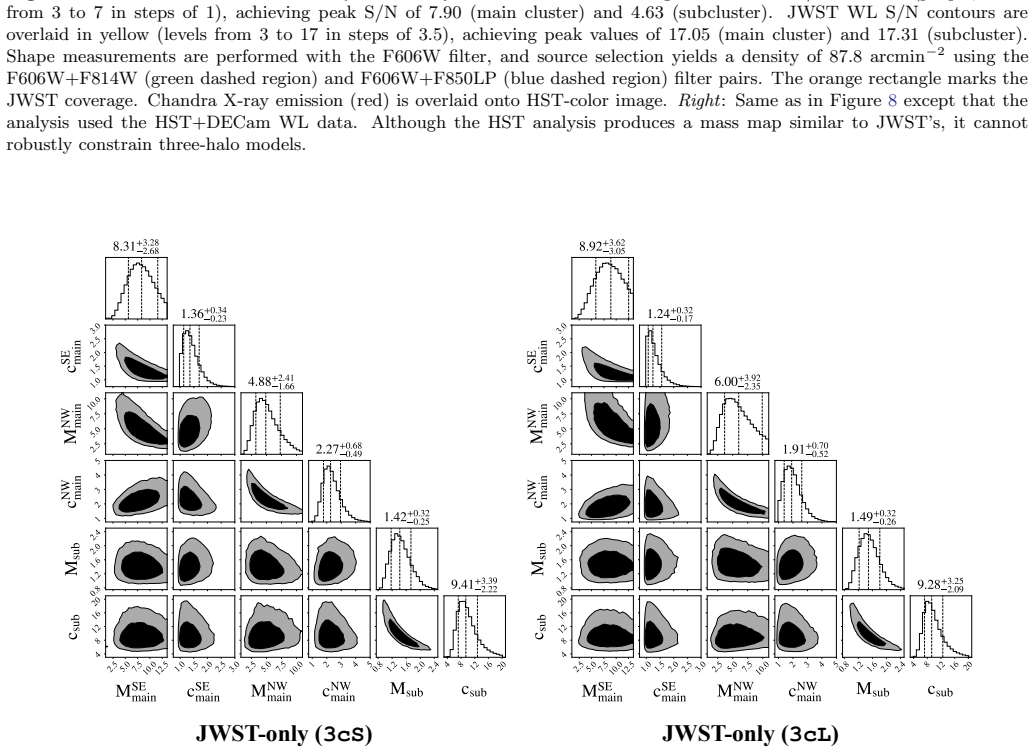
The paper reports the first virial masses for all three components of the Bullet Cluster, derived from a joint weak-plus-strong lensing analysis. The main cluster splits into two comparable halos, Main-SE and Main-NW, with M200c = 6.09 and 4.74 times 10^14 solar masses, and the subcluster has M200c = 1.49 times 10^14 solar masses. Summing the two main halos gives M200c = 15.11 times 10^14 solar masses, so the main-to-subcluster mass ratio is 10.14, classifying the Bullet Cluster as a minor merger. This reconciles the previously conflicting observational ratios with the initial conditions required by simulations that reproduce the bow shock and dark-matter/gas offsets.
Load-bearing premise
The minor-merger conclusion rests on letting each halo's concentration float freely rather than imposing the standard mass-concentration relation; the paper's own robustness test shows that imposing that relation flips the inferred mass ratio from ~10:1 to ~2:1.
Editorial extensions
If this is right
- Resolves the long-standing tension between observational mass ratios (~2:1 to ~100:1) and the ~5:1 to 10:1 initial conditions that simulations need to reproduce the bullet's shock and dark-matter/gas offset.
- Shows the main cluster is itself bimodal, with two comparable-mass halos separated by 170 kpc, implying the main cluster experienced a prior merger before the bullet collision.
- Demonstrates that earlier strong-lensing-only mass ratios were driven largely by the arbitrary choice of truncation radius, not by the data.
- Provides updated halo masses and concentrations for future hydrodynamical modeling of the Bullet Cluster, replacing the simplified two-halo initial conditions.
- Establishes that fitting merging clusters with free halo concentrations is decisively preferred over imposing a standard mass-concentration relation (log Bayes factor 15.86 in favor of free concentrations).
Reading between the lines
- If the 10:1 classification holds, dark-matter self-interaction cross-section constraints calibrated with ~2:1 initial conditions will need to be re-evaluated, since those simulations assumed a much more equal-mass encounter.
- The ~50-degree tilt between the main cluster's internal merger axis and the primary bullet axis is a testable prediction: deeper radio observations should reveal a second relic oriented perpendicular to that NW-SE axis.
- The same JWST-plus-wide-field-plus-strong-lensing anchoring approach could be applied to other merging clusters; if similar 10:1 systems turn out to be common, mass-function and scaling-relation studies of disturbed clusters may require revision.
- The subcluster's unusually high inferred concentration (c ~ 9.7) hints at strong tidal stripping, which would make its NFW-based virial mass more sensitive to modeling assumptions than the quoted uncertainties suggest.
Signed reviews
Editorial analysis
A structured set of objections, weighed in public.
Referee Report
Summary. This paper presents a joint weak+strong lensing analysis of the Bullet Cluster using JWST/NIRCam and DECam data. The authors model the system as three NFW halos (Main-SE, Main-NW, Subcluster) with free concentrations and no imposed mass-concentration relation, anchored by strong-lensing projected masses from their earlier Cha et al. (2025) reconstruction. They report M200c = 15.11^{+2.48}_{-2.10} × 10^14 Msun for the main cluster and 1.49^{+0.32}_{-0.25} × 10^14 Msun for the subcluster, yielding a mass ratio 10.14^{+3.22}_{-2.47}, which they claim definitively classifies the Bullet Cluster as a minor merger. The paper includes extensive robustness tests: WL-only vs WL+SL, two-halo vs three-halo Bayes factors, alternative density profiles, LSS error estimation, HST comparison, and tests of imposing the Diemer & Joyce M-c relation. The central claim is that this resolves the long-standing discrepancy between observed mass ratios (~2:1 to ~100:1) and simulation-based requirements (~5:1 to 10:1).
Significance. If the result holds, it would be a significant step: using JWST's high source density to resolve three halos and wide-field DECam to constrain the virial scale would provide the first observational determination of the Bullet Cluster's mass ratio from lensing alone, with implications for dark-matter self-interaction constraints and merger modeling. The paper's strengths are the unusually thorough systematic checks: PSF diagnostics, LSS error accounting, model-comparison Bayes factors, and cross-checks between JWST and HST. The WL-only and WL+SL results are statistically consistent (Section 5.2.6), mitigating concerns about circularity in the SL anchoring. However, the minor-merger classification is not robust to the choice of concentration prior: imposing the standard M-c relation flips the ratio to ~1.95 (Section 5.2.1, Table 3). The paper argues the data decisively favor free concentrations, but this comparison does not resolve the underlying profile-extrapolation uncertainty. The claim of a 'definitive' classification is therefore overstated in its current form.
major comments (3)
- [§5.2.1, Table 3] The mass ratio is 10.14 when concentrations are free (3cS) but 1.95 when the Diemer & Joyce (2019) M-c relation is imposed (3MS), with the main-cluster mass dropping from 15.11 to 7.36 ×10^14 Msun and the subcluster rising from 1.49 to 3.79 ×10^14 Msun. The paper's 'decisive' Bayes factor (ln BF = 15.86) compares two NFW models differing only in the concentration prior; it does not quantify the physical prior uncertainty. Because merging clusters are known to deviate from average relations, the uniform prior is motivated, but the conclusion that the Bullet Cluster is a minor merger rests entirely on this choice. The authors should present the ratio as conditional on the adopted prior and provide a quantitative assessment (e.g., a prior-weighted mixture or a simulation-based prior for merging systems) rather than asserting a definitive classification.
- [§5.2.3] The TNFW test uses the Oguri & Hamana (2011) truncation radius, which the authors themselves state is unsuitable for rapidly merging halos, citing Walker et al. (2025) that such systems have much smaller truncation radii. A smaller truncation radius would steepen the outer density profile and reduce the extrapolated M200c of the main halos, potentially lowering the mass ratio. The paper does not test this physically motivated alternative. The fact that Main-SE's concentration hits the lower prior boundary (c=1) in the Einasto and TNFW tests indicates the inner profile shape is weakly constrained, so the fiducial masses—dominated by outer NFW extrapolation—are not robust to this omission.
- [§4.2.4, Table 2] The main-cluster halos are inferred with very low concentrations (c_SE ≈ 1.7, c_NW ≈ 2.5), which drive the large M200c values. The paper attributes this to merging, but no independent validation is provided, and the concentration priors (uniform 1–20) are wide. The mass-ratio conclusion is therefore sensitive to the prior range on c; the authors should demonstrate stability under narrower or physically motivated priors.
minor comments (5)
- [§5.2.1] The M-c relation is imposed as a delta function without scatter. The authors should note that including intrinsic scatter would weaken the Bayes-factor comparison and partially bridge the two ratios.
- [§5.2.2] The statement that the two-halo model 2cS 'failed to converge' is abrupt; clarify whether this is a posterior-sampling failure or a physical impossibility (e.g., the SL-anchored masses cannot be jointly reproduced).
- [§3.4.2] The description of the redshift assignment for DECam sources is clear, but the effective source redshift z_eff = 0.560 and the β correction would benefit from a brief justification of the DESY3GOLD GOODS-S control field choice versus other control fields.
- [Figure 9] The caption states 'definitively establishes' the minor-merger scenario; given the major-comment concerns, this wording should be softened to reflect the model dependence.
- [General] There are a few typographical issues (e.g., 'corresponding author' line formatting, a duplicated reference entry for Finner et al. 2023a/2023b). These do not affect the science.
Circularity Check
No circular-by-construction derivation; central ratio is independently reproduced by the WL-only configuration, and the self-citations are not load-bearing.
full rationale
The central mass ratio M_Main/M_Sub = 10.14 is not equal by construction to any input. It is obtained from MCMC fits of three NFW halos to unbinned galaxy ellipticities (Eq. 8) plus projected-mass anchoring. The anchoring masses come from the authors' own Cha et al. (2025) reconstruction and are imposed as hard constraints ('We discard any proposed MCMC sample whose projected masses are inconsistent with the anchoring values'), which is a self-citation. However, this input is not load-bearing for the minor-merger claim: the WL-only 3cL configuration gives M_Main = 15.68e14 Msun, M_Sub = 1.54e14 Msun, ratio = 10.21 (Table 2), statistically identical to the fiducial 3cS result. The fragile modeling choice is the free NFW concentration with a wide uniform prior and no M-c relation; this is supported by a data-driven Bayes factor, ln(BF(3cS)(3MS)) = 15.86 (Section 5.2.1), rather than by the self-cited Lee et al. (2023)/Finner et al. (2025) simulation claims alone. The reported alternative with an imposed Diemer & Joyce (2019) relation (ratio ~1.95) is a model-dependence/fragility issue, not a circular step. Similarly, the TNFW test explicitly notes Walker et al. (2025) makes the standard truncation formula 'unsuitable' for rapid mergers, leaving a smaller-truncation model untested; this is an acknowledged robustness limitation, not a reduction of the prediction to the input. No fitted parameter is renamed as a prediction, and no uniqueness theorem is imported from the authors' prior work. Score 2 reflects only the minor non-load-bearing self-citations.
Assumptions & free parameters
free parameters (6)
- M200c, Main-SE =
6.09e14 Msun
- c200c, Main-SE =
1.68
- M200c, Main-NW =
4.74e14 Msun
- c200c, Main-NW =
2.50
- M200c, Subcluster =
1.49e14 Msun
- c200c, Subcluster =
9.72
assumptions (7)
- domain assumption Each component is modeled with an NFW density profile.
- domain assumption There are exactly three halos, centered at the three BCG positions.
- domain assumption The mass-concentration relation is not valid for these merging halos, so concentration is left free.
- domain assumption Flat Lambda-CDM cosmology with H0=70, Omega_M=0.3, Omega_Lambda=0.7.
- domain assumption The DESY3GOLD control field redshift distribution is representative of the DECam background sources.
- domain assumption The SL-projected masses from Cha et al. (2025) used as anchors are correct.
- domain assumption The line-of-sight separations of the three halos are negligible when integrating the 3D density grid.
Cite this review
Pith. "Pith review of Joint JWST-DECam Lensing Reveals That the Bullet Cluster Is a Minor Merger." pith.science (2026). https://pith.science/paper/ESIWBJFF
@misc{pith2026251203150,
  author       = {Pith},
  title        = {Pith review of: Joint JWST-DECam Lensing Reveals That the Bullet Cluster Is a Minor Merger},
  year         = {2026},
  howpublished = {\url{https://pith.science/paper/ESIWBJFF}},
  note         = {Machine review of arXiv:2512.03150}
}
abstract
We present the first robust virial masses of the Bullet Cluster's three individual components from a joint weak+strong lensing analysis combining JWST/NIRCam and DECam observations. Despite its status as the benchmark system for dark matter and merger studies, inferred mass ratios for the Bullet Cluster have spanned a wide range from $\sim$2:1 to $\gtrsim$10:1 over more than two decades. We revisit this tension through three key advances: (1) JWST's exceptional data quality enables us to resolve three distinct halos, (2) DECam's wide-field coverage beyond its virial radius eliminates the need for extrapolation, and (3) high-fidelity strong-lensing priors mitigate weak-lensing model bias. We obtain $M_{200c} = 15.11^{+2.48}_{-2.10} \times 10^{14}M_{\odot}$ for the main cluster and $1.49^{+0.32}_{-0.25} \times 10^{14}M_{\odot}$ for the subcluster, yielding a mass ratio of $10.14^{+3.22}_{-2.47}$, definitively classifying the Bullet Cluster as a minor merger. This result reconciles the long-standing tension in the mass ratio and provides updated initial parameters for future modeling of this iconic system.
Figures


Figures from the paper (8 more)


Reference graph
Works this paper leans on
-
[1]
, " * write output.state after.block = add.period write newline
ENTRY address archivePrefix author booktitle chapter doi edition editor eprint howpublished institution journal key month number organization pages publisher school series title misctitle type volume year version url label extra.label sort.label short.list INTEGERS output.state before.all mid.sentence after.sentence after.block FUNCTION init.state.consts ...
-
[2]
write newline
" write newline "" before.all 'output.state := FUNCTION format.url url empty "" new.block "" url * "" * if FUNCTION format.eprint eprint empty "" archivePrefix empty "" archivePrefix "arXiv" = new.block " " eprint * " " * new.block " " eprint * " " * if if if FUNCTION format.doi doi empty "" " " doi * " " * if FUNCTION format.pid doi empty eprint empty ur...
-
[3]
b^y3 y+ `֬Vķ N o5 I` S A5F N W;!j֪f
thebibliography [1] 20pt to REFERENCES 6pt =0pt -12pt 10pt plus 3pt =0pt =0pt =1pt plus 1pt =0pt =0pt -12pt =13pt plus 1pt =20pt =13pt plus 1pt \@M =10000 =-1.0em =0pt =0pt 0pt =0pt =1.0em @enumiv\@empty 10000 10000 `\.\@m \@noitemerr \@latex@warning Empty `thebibliography' environment \@ifnextchar \@reference \@latexerr Missing key on reference command E...
arXiv 2021
Reviewed August 3, 2026 · model on record in the stance chip above.
Discussion (0). Continue with ORCID to comment.