Uniform Interpolation of Basic Tense Logic
Pith reviewed 2026-07-01 02:32 UTC · model grok-4.3
The pith
Basic tense logic has the uniform interpolation property.
A machine-rendered reading of the paper's core claim, the machinery that carries it, and where it could break.
Core claim
This paper establishes the uniform interpolation theorem for basic tense logic by extending Visser's semantic argument formulated in terms of layered bisimulation to the converse accessibility relation.
What carries the argument
Layered bisimulation construction adapted to the converse accessibility relation in Kripke models.
If this is right
- Basic tense logic satisfies uniform interpolation.
- The layered bisimulation method generalizes from one-way modal logic to two-way variants.
- No extra frame conditions are imposed by the result.
- The uniform interpolation property is preserved under addition of the converse operator.
Where Pith is reading between the lines
- The same adaptation might apply to other operators in temporal logics.
- This could support algorithms that compute uniform interpolants for tense logic formulas.
- Comparisons of interpolation strength become possible across modal logics with and without converse.
Load-bearing premise
Visser's layered bisimulation construction extends directly to the converse accessibility relation without requiring additional semantic conditions or adjustments.
What would settle it
A concrete formula in basic tense logic that lacks any uniform interpolant in the common variables would disprove the theorem.
Figures
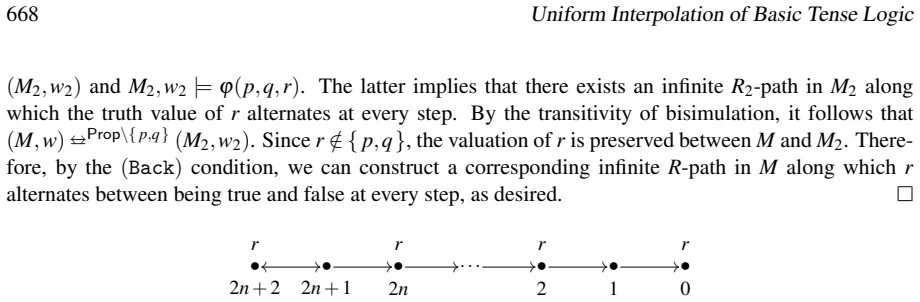
read the original abstract
This paper establishes the uniform interpolation theorem for basic tense logic, which is also known as two-way modal logic or modal logic with converse. First introduced by Arthur Prior, basic tense logic is a syntactic expansion of basic modal logic with a converse modality. Its corresponding accessibility relation is defined as the converse of the standard accessibility relation in a given Kripke model. Although basic tense logic has been widely studied since its introduction, its uniform interpolation property has yet to be fully established. For basic modal logic K, Albert Visser (1996) provided a semantic argument formulated in terms of layered (or bounded) bisimulation, explicitly attributing the uniform interpolation property of K to Silvio Ghilardi. This paper extends Visser's semantic argument to demonstrate that basic tense logic also enjoys the uniform interpolation property.
Editorial analysis
A structured set of objections, weighed in public.
Referee Report
Summary. The paper claims to establish the uniform interpolation theorem for basic tense logic (K_t) by extending Visser's 1996 layered-bisimulation semantic argument from basic modal logic K, taking the accessibility relation to be bidirectional to accommodate the converse (past) modality introduced by Prior.
Significance. If the extension holds, the result fills a documented gap for tense logic and shows that the layered-bisimulation technique scales symmetrically to two-way models without new semantic conditions or parameters. The argument is presented as a direct adaptation of an existing, non-circular construction.
major comments (1)
- [proof of the main theorem (around the extension of the layered bisimulation)] The central claim rests on the assertion that Visser's construction extends directly once accessibility is made bidirectional. The manuscript should include an explicit check (perhaps in the proof of the main theorem) that the bisimulation clauses for the converse modality preserve the layered depth bounds and the interpolation extraction step; without this verification the adaptation step remains unexamined even if the one-directional case is sound.
minor comments (2)
- [Introduction / abstract] The abstract and introduction cite Visser (1996) and Ghilardi but do not give a precise pointer to the theorem or section of Visser's paper that is being adapted; adding the reference would aid readers.
- [preliminaries] Notation for the two accessibility relations (R and R^{-1}) and the corresponding modalities should be introduced once and used consistently; occasional shifts between 'future'/'past' and 'forward'/'backward' reduce clarity.
Simulated Author's Rebuttal
We thank the referee for the detailed reading and the helpful suggestion regarding the proof presentation. We address the comment below and will revise accordingly.
read point-by-point responses
-
Referee: [proof of the main theorem (around the extension of the layered bisimulation)] The central claim rests on the assertion that Visser's construction extends directly once accessibility is made bidirectional. The manuscript should include an explicit check (perhaps in the proof of the main theorem) that the bisimulation clauses for the converse modality preserve the layered depth bounds and the interpolation extraction step; without this verification the adaptation step remains unexamined even if the one-directional case is sound.
Authors: We agree that an explicit verification would make the adaptation clearer. In the revised manuscript we will insert, immediately after the statement of the main theorem, a short paragraph that checks the two required properties: (i) that the additional bisimulation clause for the converse modality respects the layered depth bound (by symmetry with the forward clause), and (ii) that the interpolation extraction step carries over verbatim once the accessibility relation is treated as bidirectional. The argument relies only on the fact that the layered bisimulation relation is defined symmetrically for both directions and that the depth bound is preserved under the converse relation; no new semantic parameters are introduced. revision: yes
Circularity Check
No significant circularity; derivation extends external semantic argument
full rationale
The paper's central result is an extension of Visser's 1996 layered-bisimulation argument (explicitly attributed to Ghilardi) from modal logic K to basic tense logic K_t. The construction is described as carrying over once the accessibility relation is treated as bidirectional, with no equations, parameters, or definitions that reduce the target theorem to the paper's own inputs by construction. No self-citations appear; the cited sources are independent prior work. The argument is therefore self-contained against the external benchmark of Visser's construction and does not exhibit any of the enumerated circularity patterns.
Axiom & Free-Parameter Ledger
axioms (1)
- domain assumption Kripke models with converse accessibility relation for the tense modalities
Reference graph
Works this paper leans on
-
[1]
Akbar Tabatabai, R
A. Akbar Tabatabai, R. Iemhoff & R. Jalali (2022): Uniform Lyndon interpolation for intuitionistic mono- tone modal logic . In D. Fernández-Duque, A. Palmigiano & S. Pinchinat, editors: Advances in Modal Logic, 14, Colledge Publications, pp. 77–96. Available at http://www.aiml.net/volumes/volume14/ 09-AkbarTabatabai-Iemhoff-Jalali.pdf
2022
-
[2]
A. Akbar Tabatabai, R. Iemhoff & R. Jalali (2024): Uniform lyndon interpolation for basic non-normal modal and conditional logics. Journal of Logic and Computation, doi:10.1093/logcom/exae057. 672 Uniform Interpolation of Basic Tense Logic
-
[3]
van Benthem (1991): The Logic of Time, 2 edition
J. van Benthem (1991): The Logic of Time, 2 edition. Synthese Library 156, Reidel, Dordrecht
1991
-
[4]
N. Bezhanishvili, B. ten Cate & R. Iemhoff (2025): Six Proofs of Interpolation for the Modal Logic K, doi:10.48550/ARXIV .2510.16398
work page internal anchor Pith review doi:10.48550/arxiv 2025
-
[5]
Bílková (2007): Uniform Interpolation and Propositional Quantifiers in Modal Logics
M. Bílková (2007): Uniform Interpolation and Propositional Quantifiers in Modal Logics. Studia Logica 85, pp. 1–31, doi:10.1007/s11225-007-9021-5
-
[6]
Blackburn (1990): Nominal Tense Logic and Other Sorted Intensional Frameworks
P. Blackburn (1990): Nominal Tense Logic and Other Sorted Intensional Frameworks. Ph.D. thesis, Centre for Cognitive Science, University of Edinburgh
1990
-
[7]
Blackburn, M
P. Blackburn, M. de Rijke & Y . Venema (2001): Modal Logic. Cambridge Tracts in Theoretical Computer Science, Cambridge University Press, Cambridge
2001
-
[8]
P. Blackburn, T. Braüner & J. L. Kofod (2023): An Axiom System for Basic Hybrid Logic with Propositional Quantifiers. In: Logic, Language, Information, and Computation, Springer Nature Switzerland, pp. 118–134, doi:10.1007/978-3-031-39784-4_8
-
[9]
P. R. Blackburn, T. Braüner & J. L. Kofod (2020): Remarks on Hybrid Modal Logic with Propositional Quantfiers. In P. Hasle, D. Jakobsen & P. Øhrstrøm, editors: The Metaphysics of Time: Themes from Prior, Logic and Philosophy of Time 4, Aalborg Universitetsforlag, pp. 401–426
2020
-
[10]
J. P. Burgess (1984): Basic Tense Logic. In D. Gabbay & F. Guenthner, editors: Handbook of Philosophical Logic, II, Reidel, Dordrecht, pp. 89–133
1984
-
[11]
ten Cate (2005): Model theory for extended modal languages
B. ten Cate (2005): Model theory for extended modal languages . Ph.D. thesis, University of Amsterdam, Institute for Logic, Language and Computation
2005
-
[12]
B. ten Cate, E. Franconi & I. Seylan (2013): Beth Definability in Expressive Description Logics. Journal of Artificial Intelligence Research 48, pp. 347–414, doi:10.1613/jair.4057
-
[13]
Chagrov & M
A. Chagrov & M. Zakharyaschev (1997): Modal Logic. Oxford Logic Guides 35, Oxford Science Publica- tions, Oxford
1997
-
[14]
D’Agostino (2008): Interpolation in non-classical logics
G. D’Agostino (2008): Interpolation in non-classical logics . Synthese 164(3), pp. 421–435, doi:10.1007/s11229-008-9359-x
-
[15]
G. D’Agostino & G. Lenzi (2015): Bisimulation quantifiers and uniform interpolation for guarded first order logic. Theoretical Computer Science 563, pp. 75–85, doi:10.1016/j.tcs.2014.08.015
-
[16]
G. D’Agostino, G. Lenzi & T. French (2006):µ-programs, uniform interpolation and bisimulation quantifiers for modal logics. Journal of Applied Non-Classical Logics 16(3-4), pp. 297–309, doi:10.3166/jancl.16.297- 309
-
[17]
L. Fang, Y . Liu & H. van Ditmarsch (2019): Forgetting in multi-agent modal logics. Artificial Intelligence 266, pp. 51–80, doi:10.1016/j.artint.2018.08.003
-
[18]
H. Férée, I. van der Giessen, S. van Gool & I. Shillito (2024): Mechanised Uniform Interpolation for Modal Logics K, GL, and iSL. In: Automated Reasoning, Springer Nature Switzerland, pp. 43–60, doi:10.1007/978- 3-031-63501-4_3
-
[19]
Fine (1975): Normal forms in modal logic
K. Fine (1975): Normal forms in modal logic. Notre Dame Journal of Formal Logic 16(2), pp. 229–237, doi:10.1305/ndjfl/1093891703
-
[20]
T. N. French (2006): Bisimulation Quantifiers for Modal Logics . Ph.D. thesis, The University of Western Australia
2006
-
[21]
D. M. Gabbay, I. M. Hodkinson & M. Reynolds (1994): Temporal Logic: Mathematical Foundations and Computational Aspects. Oxford Logic Guides 1, Oxford University Press
1994
-
[22]
S. Ghilardi & M. Zawadowski (1995): A sheaf representation and duality for finitely presented Heyting algebras. Journal of Symbolic Logic 60(3), pp. 911–939, doi:10.2307/2275765
-
[23]
S. Ghilardi & M. Zawadowski (1995): Undefinability of propositional quantifiers in the modal system S4 . Studia Logica 55(2), pp. 259–271, doi:10.1007/bf01061237
-
[24]
Goldblatt (1992): Logics of Time and Computation, 2 edition
R. Goldblatt (1992): Logics of Time and Computation, 2 edition. CSLI Publications. K. Sano 673
1992
-
[25]
Harel, D
D. Harel, D. Kozen & J. Tiuryn (2000): Dynamic Logic. MIT press
2000
-
[26]
Iemhoff (2019): Uniform interpolation and the existence of sequent calculi
R. Iemhoff (2019): Uniform interpolation and the existence of sequent calculi . Annals of Pure and Applied Logic 170(11), p. 102711, doi:10.1016/j.apal.2019.05.008
-
[27]
Kamp (1968): Tense Logic and the Theory of Linear Order
H. Kamp (1968): Tense Logic and the Theory of Linear Order . Ph.D. thesis, University of California, Los Angeles, CA, USA
1968
-
[28]
Kurahashi (2020): Uniform Lyndon interpolation property in propositional modal logics
T. Kurahashi (2020): Uniform Lyndon interpolation property in propositional modal logics . Archive for Mathematical Logic 59(5-6), pp. 659–678, doi:10.1007/s00153-020-00713-y
-
[29]
T. Lyon, A. Tiu, R. Goré & R. Clouston (2020): Syntactic Interpolation for Tense Logics and Bi- Intuitionistic Logic via Nested Sequents . In M. Fernández & A. Muscholl, editors: 28th EACSL An- nual Conference on Computer Science Logic (CSL 2020) , Leibniz International Proceedings in Informat- ics (LIPIcs) 152, Schloss Dagstuhl–Leibniz-Zentrum fuer Infor...
-
[30]
Maehara (1961): Craig no Interpolation Theorem
S. Maehara (1961): Craig no Interpolation Theorem . Sugaku 12, pp. 235–237, doi:10.11429/sugaku1947.12.235
-
[31]
Maruyama, S
A. Maruyama, S. Tojo & H. Ono (2001): Decidability of temporal epistemic logics for multi-agent models . Proceedings of the ICLP’01 Workshop on Computational Logic in Multi-Agent Systems (CLIMA-01) , pp. 31–40
2001
-
[32]
R. P. McArthur (1976): Tense Logic. Reidel Publishing Company, Dordrecht, Boston
1976
-
[33]
L. S. Moss (2007): Finte Models Constructed From Canonical Formulas . Journal of Philosophical Logic 36(6), pp. 605–640, doi:10.1007/s10992-007-9052-4
-
[34]
A. M. Pitts (1992): On an interpretation of second order quantification in first order intuitionistic proposi- tional logic. Journal of Symbolic Logic 57(1), pp. 33–52, doi:10.2307/2275175
-
[35]
A. N. Prior (1957): Time and Modality. Clarendon Press, Oxford
1957
-
[36]
A. N. Prior (1967): Past, Present and Future. Clarendon Press, Oxford
1967
-
[37]
A. N. Prior (1968): Papers on Time and Tense. Clarendon Press, Oxford
1968
-
[38]
A. N. Prior (2003): Papers on Time and Tense, new edition. Oxford University Press
2003
-
[39]
Rautenberg (1983): Modal tableau calculi and interpolation
W. Rautenberg (1983): Modal tableau calculi and interpolation . Journal of Philosophical Logic 12(4), pp. 403–423, doi:10.1007/bf00249258
-
[40]
Sano & S
K. Sano & S. Yamasaki (2020): Subformula property and Craig interpolation theorem of sequent cal- culi for tense logics . In N. Olivetti & R. Verbrugge, editors: Short Papers of Advances in Modal Logic (AiML 2020), pp. 97–101. Available at https://rinekeverbrugge.nl/wp-content/uploads/2024/ 09/FinalShortPaperMain-AiML2020.pdf
2020
-
[41]
V . Y . Shavrukov (1993):Subalgebras of diagonalizable algebras of theories containing arithmetic. Disserta- tiones Mathematicae (Rozprawy Matematyczne) 323, pp. 1–82
1993
-
[42]
Visser (1996): Uniform Interpolation and Layered Bisimulation
A. Visser (1996): Uniform Interpolation and Layered Bisimulation . In: Gödel’96: Logical founda- tions of mathematics, computer science and physics—Kurt Gödel’s legacy, Brno, Czech Republic, August 1996, Spriinger-Verlag, Berlin, pp. 139–164. Available at http://projecteuclid.org/euclid.lnl/ 1235417019
1996
-
[43]
Visser (1996): Bisimulations, model descriptions and propositional quantifiers
A. Visser (1996): Bisimulations, model descriptions and propositional quantifiers . Logic Group Preprint Series, No. 161, Utrecht University10.1006/inco.1997.2627. Available at https://dspace.library.uu. nl/handle/1874/26710
-
[44]
Journal of Philosophical Logic 26(5), pp
F. Wolter (1997): A Note on the Interpolation Property in Tense Logic. Journal of Philosophical Logic 26(5), pp. 545–551, doi:10.1023/a:1017956722866
-
[45]
M. Zakharyaschev, F. Wolter & A. Chagrov (2001): Advanced Modal Logic. In: Handbook of Philosophical Logic, 3, Springer Netherlands, pp. 83–266, doi:10.1007/978-94-017-0454-0_2
discussion (0)
Sign in with ORCID, Apple, or X to comment. Anyone can read and Pith papers without signing in.